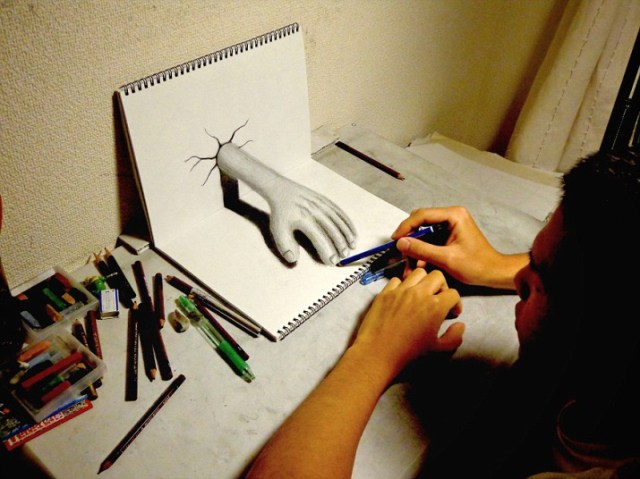
Nagai Hideyuki – Japanese artist that makes his paintings leap off the page – “anamorphosis”

Nagai Hideyuki 3D Art

These eye-popping two-dimensional sketches look as though they are about to leap off the page thanks to Japanese artist Nagai Hideyuki’s clever pencil work.

Hideyuki, 21, creates tricks of perspective by playing with where light and shadows would fall if the object really were coming out to meet you.

Once propped against a wall these vivid optical illusions work perfectly to create a 3D effect.

Hideyuki, 21, from Japan, uses just his pencil to conjure up amazing sketches that fool the brain.

His ability to draw so well in three-dimensions came from the restrictions on street artists in Japan. He wanted to work to resemble street art that pops out from walls.

He was inspired by a technique known professionally as anamorphosis as used by British artist Julian Beever who creates similarly elaborate ‘three-dimensional’ work when viewed from the right angle on pavements using chalk.

Because of stricter laws in Japan, Hideyuki has been restricted to the confines of his sketchbook but it has not stopped him making equally impressive artwork, letting his imagination run riot with everything from gremlins to trains to gaping mouths.

Read more: http://www.dailymail.co.uk/news/article-2318339/Nagai-Hideyuki-Artist-makes-drawings-leap-page.html#ixzz2TBDZikzA

Researchers explore connecting the brain to machines

brain

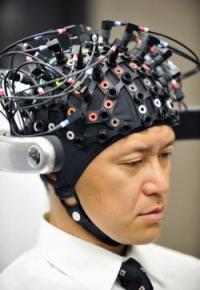
Behind a locked door in a white-walled basement in a research building in Tempe, Ariz., a monkey sits stone-still in a chair, eyes locked on a computer screen. From his head protrudes a bundle of wires; from his mouth, a plastic tube. As he stares, a picture of a green cursor on the black screen floats toward the corner of a cube. The monkey is moving it with his mind.

The monkey, a rhesus macaque named Oscar, has electrodes implanted in his motor cortex, detecting electrical impulses that indicate mental activity and translating them to the movement of the ball on the screen. The computer isn’t reading his mind, exactly — Oscar’s own brain is doing a lot of the lifting, adapting itself by trial and error to the delicate task of accurately communicating its intentions to the machine. (When Oscar succeeds in controlling the ball as instructed, the tube in his mouth rewards him with a sip of his favorite beverage, Crystal Light.) It’s not technically telekinesis, either, since that would imply that there’s something paranormal about the process. It’s called a “brain-computer interface” (BCI). And it just might represent the future of the relationship between human and machine.

Stephen Helms Tillery’s laboratory at Arizona State University is one of a growing number where researchers are racing to explore the breathtaking potential of BCIs and a related technology, neuroprosthetics. The promise is irresistible: from restoring sight to the blind, to helping the paralyzed walk again, to allowing people suffering from locked-in syndrome to communicate with the outside world. In the past few years, the pace of progress has been accelerating, delivering dazzling headlines seemingly by the week.

At Duke University in 2008, a monkey named Idoya walked on a treadmill, causing a robot in Japan to do the same. Then Miguel Nicolelis stopped the monkey’s treadmill — and the robotic legs kept walking, controlled by Idoya’s brain. At Andrew Schwartz’s lab at the University of Pittsburgh in December 2012, a quadriplegic woman named Jan Scheuermann learned to feed herself chocolate by mentally manipulating a robotic arm. Just last month, Nicolelis’ lab set up what it billed as the first brain-to-brain interface, allowing a rat in North Carolina to make a decision based on sensory data beamed via Internet from the brain of a rat in Brazil.

So far the focus has been on medical applications — restoring standard-issue human functions to people with disabilities. But it’s not hard to imagine the same technologies someday augmenting capacities. If you can make robotic legs walk with your mind, there’s no reason you can’t also make them run faster than any sprinter. If you can control a robotic arm, you can control a robotic crane. If you can play a computer game with your mind, you can, theoretically at least, fly a drone with your mind.

It’s tempting and a bit frightening to imagine that all of this is right around the corner, given how far the field has already come in a short time. Indeed, Nicolelis — the media-savvy scientist behind the “rat telepathy” experiment — is aiming to build a robotic bodysuit that would allow a paralyzed teen to take the first kick of the 2014 World Cup. Yet the same factor that has made the explosion of progress in neuroprosthetics possible could also make future advances harder to come by: the almost unfathomable complexity of the human brain.

From I, Robot to Skynet, we’ve tended to assume that the machines of the future would be guided by artificial intelligence — that our robots would have minds of their own. Over the decades, researchers have made enormous leaps in artificial intelligence (AI), and we may be entering an age of “smart objects” that can learn, adapt to, and even shape our habits and preferences. We have planes that fly themselves, and we’ll soon have cars that do the same. Google has some of the world’s top AI minds working on making our smartphones even smarter, to the point that they can anticipate our needs. But “smart” is not the same as “sentient.” We can train devices to learn specific behaviors, and even out-think humans in certain constrained settings, like a game of Jeopardy. But we’re still nowhere close to building a machine that can pass the Turing test, the benchmark for human-like intelligence. Some experts doubt we ever will.

Philosophy aside, for the time being the smartest machines of all are those that humans can control. The challenge lies in how best to control them. From vacuum tubes to the DOS command line to the Mac to the iPhone, the history of computing has been a progression from lower to higher levels of abstraction. In other words, we’ve been moving from machines that require us to understand and directly manipulate their inner workings to machines that understand how we work and respond readily to our commands. The next step after smartphones may be voice-controlled smart glasses, which can intuit our intentions all the more readily because they see what we see and hear what we hear.

The logical endpoint of this progression would be computers that read our minds, computers we can control without any physical action on our part at all. That sounds impossible. After all, if the human brain is so hard to compute, how can a computer understand what’s going on inside it?

It can’t. But as it turns out, it doesn’t have to — not fully, anyway. What makes brain-computer interfaces possible is an amazing property of the brain called neuroplasticity: the ability of neurons to form new connections in response to fresh stimuli. Our brains are constantly rewiring themselves to allow us to adapt to our environment. So when researchers implant electrodes in a part of the brain that they expect to be active in moving, say, the right arm, it’s not essential that they know in advance exactly which neurons will fire at what rate. When the subject attempts to move the robotic arm and sees that it isn’t quite working as expected, the person — or rat or monkey — will try different configurations of brain activity. Eventually, with time and feedback and training, the brain will hit on a solution that makes use of the electrodes to move the arm.

That’s the principle behind such rapid progress in brain-computer interface and neuroprosthetics. Researchers began looking into the possibility of reading signals directly from the brain in the 1970s, and testing on rats began in the early 1990s. The first big breakthrough for humans came in Georgia in 1997, when a scientist named Philip Kennedy used brain implants to allow a “locked in” stroke victim named Johnny Ray to spell out words by moving a cursor with his thoughts. (It took him six exhausting months of training to master the process.) In 2008, when Nicolelis got his monkey at Duke to make robotic legs run a treadmill in Japan, it might have seemed like mind-controlled exoskeletons for humans were just another step or two away. If he succeeds in his plan to have a paralyzed youngster kick a soccer ball at next year’s World Cup, some will pronounce the cyborg revolution in full swing.

Schwartz, the Pittsburgh researcher who helped Jan Scheuermann feed herself chocolate in December, is optimistic that neuroprosthetics will eventually allow paralyzed people to regain some mobility. But he says that full control over an exoskeleton would require a more sophisticated way to extract nuanced information from the brain. Getting a pair of robotic legs to walk is one thing. Getting robotic limbs to do everything human limbs can do may be exponentially more complicated. “The challenge of maintaining balance and staying upright on two feet is a difficult problem, but it can be handled by robotics without a brain. But if you need to move gracefully and with skill, turn and step over obstacles, decide if it’s slippery outside — that does require a brain. If you see someone go up and kick a soccer ball, the essential thing to ask is, ‘OK, what would happen if I moved the soccer ball two inches to the right?'” The idea that simple electrodes could detect things as complex as memory or cognition, which involve the firing of billions of neurons in patterns that scientists can’t yet comprehend, is far-fetched, Schwartz adds.

That’s not the only reason that companies like Apple and Google aren’t yet working on devices that read our minds (as far as we know). Another one is that the devices aren’t portable. And then there’s the little fact that they require brain surgery.

A different class of brain-scanning technology is being touted on the consumer market and in the media as a way for computers to read people’s minds without drilling into their skulls. It’s called electroencephalography, or EEG, and it involves headsets that press electrodes against the scalp. In an impressive 2010 TED Talk, Tan Le of the consumer EEG-headset company Emotiv Lifescience showed how someone can use her company’s EPOC headset to move objects on a computer screen.

Skeptics point out that these devices can detect only the crudest electrical signals from the brain itself, which is well-insulated by the skull and scalp. In many cases, consumer devices that claim to read people’s thoughts are in fact relying largely on physical signals like skin conductivity and tension of the scalp or eyebrow muscles.

Robert Oschler, a robotics enthusiast who develops apps for EEG headsets, believes the more sophisticated consumer headsets like the Emotiv EPOC may be the real deal in terms of filtering out the noise to detect brain waves. Still, he says, there are limits to what even the most advanced, medical-grade EEG devices can divine about our cognition. He’s fond of an analogy that he attributes to Gerwin Schalk, a pioneer in the field of invasive brain implants. The best EEG devices, he says, are “like going to a stadium with a bunch of microphones: You can’t hear what any individual is saying, but maybe you can tell if they’re doing the wave.” With some of the more basic consumer headsets, at this point, “it’s like being in a party in the parking lot outside the same game.”

It’s fairly safe to say that EEG headsets won’t be turning us into cyborgs anytime soon. But it would be a mistake to assume that we can predict today how brain-computer interface technology will evolve. Just last month, a team at Brown University unveiled a prototype of a low-power, wireless neural implant that can transmit signals to a computer over broadband. That could be a major step forward in someday making BCIs practical for everyday use. Meanwhile, researchers at Cornell last week revealed that they were able to use fMRI, a measure of brain activity, to detect which of four people a research subject was thinking about at a given time. Machines today can read our minds in only the most rudimentary ways. But such advances hint that they may be able to detect and respond to more abstract types of mental activity in the always-changing future.

http://www.ydr.com/living/ci_22800493/researchers-explore-connecting-brain-machines

Putting the Clock in ‘Cock-A-Doodle-Doo’

130318132625-large
Of course, roosters crow with the dawn. But are they simply reacting to the environment, or do they really know what time of day it is? Researchers reporting on March 18 in Current Biology, a Cell Press publication, have evidence that puts the clock in “cock-a-doodle-doo”

“‘Cock-a-doodle-doo’ symbolizes the break of dawn in many countries,” says Takashi Yoshimura of Nagoya University. “But it wasn’t clear whether crowing is under the control of a biological clock or is simply a response to external stimuli.”

That’s because other things — a car’s headlights, for instance — will set a rooster off, too, at any time of day. To find out whether the roosters’ crowing is driven by an internal biological clock, Yoshimura and his colleague Tsuyoshi Shimmura placed birds under constant light conditions and turned on recorders to listen and watch.

Under round-the-clock dim lighting, the roosters kept right on crowing each morning just before dawn, proof that the behavior is entrained to a circadian rhythm. The roosters’ reactions to external events also varied over the course of the day.

In other words, predawn crowing and the crowing that roosters do in response to other cues both depend on a circadian clock.

The findings are just the start of the team’s efforts to unravel the roosters’ innate vocalizations, which aren’t learned like songbird songs or human speech, the researchers say.

“We still do not know why a dog says ‘bow-wow’ and a cat says ‘meow,’ Yoshimura says. “We are interested in the mechanism of this genetically controlled behavior and believe that chickens provide an excellent model.”

Tsuyoshi Shimmura, Takashi Yoshimura. Circadian clock determines the timing of rooster crowing. Current Biology, 2013; 23 (6): R231 DOI: 10.1016/j.cub.2013.02.015

http://www.sciencedaily.com/releases/2013/03/130318132625.htm

Women’s legs used as advertising space in Japan

Japanese-Womens-Legs-Bought-For-Advertising-Space-In-Japan

We’re all familiar with Japan’s creative and often strange advertising methods, but this may be a first. Absolute Territory PR, a Japanese advertising agency, has begun paying young Japanese women to apply stick-on tattoos to their legs.

The guerrilla advertising technique has proven very successful in Japan.

Japanese women employed by the advertising agency are instructed to stamp their legs with an ad and go on with their normal daily activities; they are, however, also required to wear a short skirt or shorts and show off their “pins” as much as possible.

As long as the stick-on tattoo is visible on their legs for eight hours a day, their job is done, and they are paid a portion of the advertising fee.

According to the Daily Mail, it’s also mandatory for the girls to post pictures of themselves “wearing” the ad on their own Facebook, Twitter, and other social media networks.

Not only are regular companies using the advertising service, but the rock band Green Day recently used the service while promoting the Japan release of their newest CD.

Eichi Atsumi, a spokesperson for Absolute Territory PR, Japanese women must be at least 18 years old and be connected to a minimum of 20 people on any social network.

Based on a report from the International Business Times, women are paid between $13 and as much as $128 for wearing mini-skirts and advertising for the agency.

“We hope registered members will have fun taking part in this,” Atsumi said.

As of November 2012, almost 1,300 Japanese women have already registered their legs as advertising space, and that number just keeps growing.

Read more at http://www.inquisitr.com/536604/japanese-womens-legs-used-as-advertising-space-in-japan/#UfAEqiOovz4R8dwO.99

115-year-old Iowan woman dies, was world’s oldest person

hshvo_Xl_55
This file April 2010 photo shows Dina Manfredini of Johnston, Iowa. Manfredini, who inherited the title of world’s oldest person less than two weeks ago, died Monday, Dec. 17, 2012, at age 115, her granddaughter Lori Logli said. She did not elaborate on the cause of her grandmother’s death. Manfredini was born on April 4, 1897, in Italy, according to Guinness officials. She moved to the United States in 1920 and settled in Des Moines with her husband.

A 115-year-old Iowa woman’s granddaughter says the woman has died less than two weeks after inheriting the title of world’s oldest person.

Dina Manfredini’s granddaughter Lori Logli says Manfredini died Monday morning. Logli wouldn’t elaborate on her grandmother’s cause of death.

Manfredini lived at the Bishop Drumm Retirement Center in Johnston. Guinness World Records confirmed she inherited the title of world’s oldest living person less than two weeks ago. Bessie Cooper of Georgia previously held the title at age 116.

Guinness spokesman Robert Young says a Japanese man is believed to now hold the title. Jiroemon Kimura was born on April 19, 1897, which makes him just 15 days younger than Manfredini. Young says Kimura, of Kyotango in Kyoto, also is believed to be the second-oldest man in documented history.

Read more here: http://www.sacbee.com/2012/12/17/5059978/115-year-old-woman-dies-was-worlds.html#storylink=cpy

London bar raided after selling whale skin cocktail

101212-whale

Cops swooped on the Nightjar bar in Hoxton, East London, where barmen were  serving the Moby Dick drink.

It contained Laphroaig whisky, Drambuie, ale, bitters and a “whale skin  infusion”.

The raid last week comes amid a Europe-wide ban on whale meat and products,  except under strict restrictions in Greenland and Denmark.

The Metropolitan Police were tipped-off in October that the bar was serving  whale skin illegally. The Met’s Wildlife Crime Unit and a UK Border Force  officer raided the premises on December 3.

A police spokesman said: “One item from the premises was seized. This has  been  sent for analysis.”

No arrests have been made at the Nightjar, which describes itself on its  website as “a hidden slice of old-school glamour”. Its drinks range from £9  to £17 a glass.

Bar bosses said it had been unaware the drink contained an illegal ingredient  until the raid and has removed the drink from sale.

Nightjar director Edmund Weil said: “We did have a drink on this year’s menu  which included a small amount of scotch whisky infused with a single 2 x 5cm  strip of dried whale skin.

“The strip was purchased in a shop by an employee while on a trip to Japan in  autumn 2011.

“Until the police visit, neither ourselves nor our employees were aware of  the  legislation under which the bottle was seized.

“In hindsight we realise that regardless of the legal framework around such  products, it was an error of judgement on our part to include this on our  menu, and we would like to offer our apologies to anyone who may have been  offended by it.

“We have removed the drink entirely from our menu, which will be reprinted  before Monday to reflect this.”

Native Greenlanders who use whales as subsistence food are the only Europeans  allowed to kill or to eat them in strictly limited amounts.

Read more: http://www.thesun.co.uk/sol/homepage/news/4689220/Bar-raided-for-whale-meat-cocktail.html#ixzz2EhWDnief

Study of the Decade: Looking at Photos of Cute Animals Linked to Increased Work Performance

Stuck at work? Having trouble finishing out your Friday? Take a good, long look at this bunny. It’s adorable. And, according to newly published research, it could actually improve your performance at work*.

Researchers from Hiroshima University in Japan describe the results of their study in the latest issue of PLoS ONE. We’ve preserved the researchers’ description verbatim where possible, including explanations only when necessary, because there’s something unequivocally excellent about reading things like “cuteness-triggered positive emotion” in peer-reviewed scientific research:

In this study, three experiments were conducted to examine the effects of viewing cute images on subsequent task performance. In the first experiment, university students performed a fine motor dexterity task [participants played Bilibili Dr. Game, basically the Japanese version of Operation] before and after viewing images of baby [“cute images”] or adult [“less cute”] animals. Performance… increased after viewing cute images more than after viewing images that were less cute.

In the second experiment, this finding was replicated by using a non-motor visual search task. [This involved counting the number of times a specified number appeared in successive 40-digit groupings. For example, a subject presented with the numbers on the left would be asked to identify, as quickly as possible, how many times the number 8 appeared in the group. Test participants completed as many of these number groups as possible in a three minute period.] Performance improved more after viewing cute images than after viewing less cute images. Viewing images of pleasant foods was ineffective in improving performance. 

In the third experiment, participants performed a global–local letter task after viewing images of baby animals, adult animals, and neutral objects.

A quick explanation here: in a global-local letter task, participants are asked to indicate, as quickly as possible, whether a stimulus contains the letter “H” or letter “T” by pressing left or right on a response pad. Sounds easy, but the task actually requires a fair bit of concentration, as sometimes the letter the participant is looking for is actually composed of a series of other letters (an example is the big “H,” pictured at left, built out of smaller, closely spaced “F”s. This is an example of a global target stimulus); while other times, the letter they’re looking for is spelling out a larger letter (the big “L” on the left is built out of smaller, closely spaced “T”s. This is an example of a localtarget stimulus). Alright, back to the findings:

In general, global features were processed faster than local features. However, this global precedence effect was reduced after viewing cute images.

Results show that participants performed tasks requiring focused attention more carefully after viewing cute images. This is interpreted as the result of a narrowed attentional focus induced by the cuteness-triggered positive emotion… For future applications, cute objects may be used as an emotion elicitor to induce careful behavioral tendencies in specific situations, such as driving and office work.

http://io9.com/5947360/study-of-the-decade-looking-at-photos-of-cute-animals-linked-to-increased-work-performance

Parents-to-be in Japan can buy a 3D printed model of their fetus

EXPECTANT parents in Japan who can’t wait to show the world what their baby will look like can now buy a 3D model of the fetus to share with their friends.

Based on an MRI scan, a 3D printer can create a 9-centimetre resin model of the white fetus, encased in a transparent block in the shape of the mother’s body.

“As it is only once in a lifetime that you are pregnant with that child, we received requests for these kind of models from pregnant women who… do not want to forget the feelings and experience of that time,” said Tomohiro Kinoshita of FASOTEC, the company offering the service.

The 3D model is called Shape of an Angel and costs 100,000 yen ($A1171).

It also comes with a miniature version that could be a nice adornment to a mobile phone, he added. Many young women in Japan add decorations to their phone strap.

The company said the ideal time for a scan is about eight or nine months into the pregnancy.

For those who would like a less pricey version, the company will offer a 3D model of the face of the fetus for 50,000 yen in December.

It will use ultrasound images taken at a medical clinic in Tokyo that is working with the company.

FASOTEC, originally a supplier of devices including 3D printers, uses a layering technique to build up three-dimensional structures.

The technique has been touted as a solution to localised manufacture on a small scale.

http://www.theaustralian.com.au/australian-it/parents-to-be-in-japan-can-buy-3d-printed-model-of-fetus/story-e6frgakx-1226525367570

Thanks to Kebmodee for bringing this to the attention of the It’s Interesting community.

Research from Asia is overturning long-held notions about the factors that drive people to commit suicide


SHANGHAI, CHINA—Mrs. Y’s death would have stumped many experts. A young mother and loyal wife, the rural Chinese woman showed none of the standard risk factors for suicide. She was not apparently depressed or mentally ill. Villagers said she exuded happiness and voiced few complaints. But when a neighbor publicly accused Mrs. Y of stealing eggs from her henhouse, the shame was unbearable. Mrs. Y rushed home and downed a bottle of pesticide. “A person cannot live without face,” she cried before she died. “I will die to prove that I did not steal her eggs.”

Decades of research in Western countries have positioned mental illness as an overwhelming predictor of suicide, figuring in more than 90% of such deaths. Another big risk factor is gender: Men commit suicide at much higher rates than women, by a ratio of nearly 4 to 1 in the United States, according to the U.S. Centers for Disease Control and Prevention. Other common correlates include city life and divorce. But in China, says Jie Zhang, a sociologist at the State University of New York, Buffalo State, the case of Mrs. Y is “a very typical scenario.”

Zhang oversaw interviews with Mrs. Y’s family and acquaintances while researching the prevalence of mental illness among suicide victims aged 15 to 34 in rural China. Through psychological autopsies—detailed assessments after death—Zhang and coauthors found that only 48% of 392 victims had a mental illness, they reported in the July 2010 issue of the American Journal of Psychiatry. An earlier study of Chinese suicide victims put the prevalence of mental disorders at 63%—still nowhere near as high as accepted models of suicide prevention would predict. Meanwhile, other standard risk factors simply don’t hold true, or are even reversed, in China. Chinese women commit suicide at unusually high rates; rural residents kill themselves more frequently than city dwellers do; and marriage may make a person more, rather than less, volatile.

Such differences matter because China accounts for an estimated 22% of global suicides, or roughly 200,000 deaths every year. In India, meanwhile, some 187,000 people took their own lives in 2010—twice as many as died from HIV/AIDS. By comparison, the World Health Organization (WHO) estimates that suicides in high-income countries total only 140,000 a year. Suicide rates in Japan and South Korea, however, are similar to China’s (see p. 1026), suggesting that this is a regional public health issue. And yet suicide in Asia is poorly understood. “Suicide has not gotten the attention it deserves vis-à-vis its disease burden,” says Prabhat Jha, director of the Centre for Global Health Research in Toronto, Canada.

Emerging research from developing countries like China and India is now filling that gap—and overturning prevailing notions. “The focus of the study of suicide in the West is psychiatry,” Zhang says. While mental illness remains an important correlate in Asia, he says, researchers may learn more from a victim’s family, religion, education, and personality. New findings, Zhang says, suggest that some researchers may have misread correlation as causation: In both the East and the West, “mental illness might not be the real cause of suicide.”

Distressing data

Reliable data on suicide across Asia were once maddeningly scarce. In Thailand until 2003, there was no requirement that the reported cause of death be medically validated—a flaw that rendered the country’s suicide data inaccurate. In India, suicide is a crime, which means it often goes unreported. But the Thai government now has a more accurate reporting system for mortality figures, while Indian researchers are benefiting from the Million Death Study, an effort to catalog causes of death for 1 million Indians in a 16-year survey relying on interviews with family members (Science, 15 June, p. 1372). The study has already produced a disturbing revelation about reported suicide rates. “When we compare our data with police reports, you find undercounts of at least 25% in men and 36% in women,” says Jha, the study’s lead investigator.

New insights from China are particularly instructive. Because suicide carries a stigma, the Chinese government withheld data on the topic until the late 1980s. When information finally came out, it quickly became clear that the country had a serious problem. In 1990, for example, the World Bank’s Global Burden of Disease Study estimated there were 343,000 suicides in China—or 30 per 100,000 people. The U.S. rate for the same year was 12 per 100,000.

But other reports gave different figures, prompting a debate on sources. WHO’s extrapolated total was based on data that China had reported from stations covering only 10% of the population, skewed toward urban residents. As researchers focused on the problem, they arrived at more reliable figures—but also unearthed more mysteries. In an analysis in The Lancet in 2002, a group led by Michael Phillips of Shanghai Mental Health Center and Emory University School of Medicine in Atlanta estimated that from 1995 to 1999, Chinese women killed themselves more frequently than men—by a ratio of 5 to 4. “There was originally disbelief about the very different gender ratio in China,” Phillips says, although later it was accepted.

Today, the suicide sex ratio in China is roughly 1 to 1, still a significant departure from the overall U.S. male-to-female ratio of 4 to 1. In India, the male-to-female suicide ratio is 1.5 to 1, although in the 15 to 29 age group it is close to equal. And yet, WHO estimates the global sex ratio at three men to one woman. (With colleague Cheng Hui, Phillips recently used Chinese and Indian figures to lower that estimate to 1.67 to 1.) Among young adults in India, suicide is second only to maternal mortality as a cause of death for women, according to the Million Death Survey.

In both China and India, cases like Mrs. Y’s involving no apparent mental illness are common. In India, suicide is most prevalent among teenagers and young adults—the cohort that is entering the workforce, marrying, and facing new life stresses. This contrasts with the Western pattern of high suicide rates among the middle-aged, suggesting that although “there might well be some underlying psychiatric conditions, the main drivers of [suicide in India] are probably chiefly social conditions,” Jha says. While cautioning that detailed psychological autopsies are still needed in India, he says, “it’s a reasonable assumption that many of these young folks are not mentally ill.”

Convincing researchers outside Asia may prove an uphill battle. Matthew Miller, a suicide researcher at the Harvard Injury Control Research Center in Boston, says that mental illness may be underdiagnosed in Asia for reasons that aren’t fully understood. That could throw off correlation studies. Phillips, who has worked in China for over 20 years, agrees that underdiagnosis is a problem, and that “many Western researchers still believe that we are just missing cases.” But he rejects that explanation. Even accounting for underdiagnosis, he says, the finding of a lower rate of mental illness among suicide victims has held up in multiple studies. Many Chinese suicide victims, he adds, are “most certainly severely distressed, but they don’t meet the criteria of a formal mental illness.”

Lethal weapons

Assuming that suicide risk is shaped by different factors in Asia, researchers are striving to uncover the roots. One clue may lie in the high proportion of unplanned Chinese suicides. In a 2002 survey of 306 Chinese patients who had been hospitalized for at least 6 hours following a suicide attempt, Phillips and colleagues found that 35% had contemplated suicide for less than 10 minutes—and 54% for less than 2 hours. Impulsiveness among suicide victims in Asia “tends to be higher than in the West,” says Paul Yip, director of the Hong Kong Jockey Club Centre for Suicide Research and Prevention at the University of Hong Kong and one of the authors of a recent WHO report on suicide in Asia. Although impulsive personality traits are sometimes linked to illnesses like bipolar disorder, studies in China have not uncovered full-fledged personality disorders in impulsive suicide victims.

In a tragic twist, impulsive victims in Asia tend to favor highly fatal methods. After interviewing family members and friends of 505 Chinese suicide victims, Kenneth Conner, a psychiatric researcher at the University of Rochester Medical Center in New York, and colleagues reported in 2005 that those who had ingested pesticides were more likely to have acted rashly than were those who used other methods such as hanging or drowning. Pesticides are a leading cause of suicide death in China and India, and the cause of roughly half of suicides worldwide. Pesticides may also explain Asia’s unusual suicide sex ratio, Jha says. In the West, women attempt suicide just as frequently as men do, but they tend to down sleeping pills—and often survive.

The trends in Asia point to a need for innovative prevention strategies. Zhang believes efforts should focus less on mental illness and more on “educating people to have realistic goals in life and teaching them to cope with crisis.” Front and center should be universities and rural women’s organizations, both of which already have active suicide prevention programs in China, he says. Such community-based approaches appear to have been effective in Hong Kong, Yip says. Over the past decade, the territory has rolled out programs for schoolchildren on dealing with stress and outreach groups for older adults. Its suicide rate has fallen 27% since 2003.

But resources in many Asian countries are limited. The vast majority of cities in China and India still do not have 24-hour suicide prevention hotlines. That may make what scholars call means restriction—reducing access to tools commonly used in suicide—a better goal. In Sri Lanka, pesticides once accounted for two-thirds of suicide deaths. Then in 1995, the government took steps to ban the most toxic pesticides. The suicide rate plummeted by 50% in the following decade.

The varying degrees to which mental illness and suicide correlate in East and West may ultimately be beside the point, argues Zhang, who believes a third factor may be the trigger in both regions. Strain theory, which posits that societal pressures, rather than inborn traits, contribute to crime, can help explain suicide, he believes. “Psychological strains usually precede a suicidal behavior, and they also happen before an individual becomes mentally ill.”

When a person is pulled by two or more conflicting pressures, Zhang says, as with “a girl who receives Confucian values at home and then goes to school and learns about modern values and gender equality,” she may be more prone to suicide. Other situational stresses may include a sudden crisis faced by a rural woman lacking coping mechanisms—such as the case of Mrs. Y—or an incident that forces a young man to confront a gap between his aspirations and reality. Zhang found that strain theory held up for his study subjects in rural China. He plans to probe whether it also applies to older Chinese.

Ultimately, Zhang hopes to test strain theory on Americans. The U.S. National Institutes of Health “spends millions and millions of dollars every year on treating mental illness to prevent suicide,” he says. “But no matter how much money we spend, how many psychiatrists we train, or how much work we do in psychiatric clinics, the U.S. suicide rate doesn’t decrease.” It has hovered around 10 to 12 suicides per 100,000 people since 1960.

Such research may be the tip of the iceberg when it comes to debunking long-held ideas about behavior disorders. Alcoholism is another area ripe for exploration, Cheng says: The profile of alcoholics in China contrasts sharply with that in the West. Because of social pressure to drink, Chinese alcoholics are far more likely to be working and married than American counterparts, who are often unemployed and divorced, she says. Suicide, Cheng muses, “is just another example of how environment can change behavior.”

http://www.sciencemag.org/content/338/6110/1025.full