Humans Share Microbiomes With Their Dogs

three-puppies

You know you share genes with your biological parents and kids, but what about microbes? A new study finds that families share skin, tongue and gut microbes with each other… and their dogs.

The study shows how the people and pets you live with affect the microscopic bacteria, fungi and other creatures living all over your body.

Researchers from universities across the U.S. studied 17 families with heterosexual parents and children ranging from infants to 18-year-olds; 17 families with one or more dogs, but no children; 18 families with kids and dogs; and 18 couples with no children or dogs. Volunteers sent in Q-tip-like swabs that they had rubbed on their foreheads, the palms of their hands, the tops of their tongues and a smudge of their feces (really). Study volunteers also sent in swabs of their dogs’ paws, fur and tongues.

The researchers ran genetic analyses on the samples, looking for the genetic material of microbes. They found that family members had more similar microbes on all parts of their bodies than people from different families. Family members’ skin microbes were the most alike, demonstrating that people share microbes on the surfaces they touch, and from touching each other. The adults in the family shared the most microbes.

Parents also shared many microbes with their children, but only if the kids were older than three. Younger kids may have vastly different microbes than their older family members because they’re still developing, the researchers wrote in a paper they published April 16 in the journal eLIFE.

As for Rover, he seems to have a some interesting effects on his humans’ microbes. As with other family members, adults share more microbes with their own dogs than they do with other people’s dogs.

But the researchers also found that simply owning a dog seems to have an effect on overall microbe-sharing. Cohabiting couples shared more microbes with one another if they had a dog, compared with couples that didn’t have dogs. Dog owners also had more species in common with other dog owners than they did with puppy-less people.

Want to know about the little critters that live on Fido? Dogs have more diverse microbes living on their bodies than humans do, including groups of microbes normally associated with humans, plus microbes that live in soil and water. One of the major groups of bacteria that dog owners and their pets share is Betaproteobacteria, which appear on human skin and on dog tongues.

http://www.popsci.com/science/article/2013-04/humans-share-microbiomes-their-dogs-study-finds

Life quite possibly existed before Earth, claim scientists

origins+of+life

Life existed long before Earth came into being, and may have originated outside our solar system, scientists claim.

Researchers say life first appeared about 10 billion years ago – long before Earth, which is believed to be 4.5 billion years old. Geneticists have applied Moore’s Law – observation that computers increase exponentially in complexity, at a rate of about double the transistors per integrated circuit every two years – to the rate at which life on Earth grows in complexity.

Alexei Sharov of the National Institute on Ageing in Baltimore, and Richard Gordon of the Gulf Specimen Marine Laboratory in Florida, replaced the transistors with nucleotides – the building blocks of DNA and RNA – and the circuits with genetic material. Their findings suggest life first appeared about 10 billion years ago, far older than the Earth’s projected age of 4.5 billion years. Like in the 2012 sci-fi movie Prometheus, as our solar system was forming, pre-existing bacteria-like organisms, or even simple nucleotides from an older part of the galaxy, could have reached Earth by hitching an interstellar ride on comets, asteroids or other inorganic space debris.

However, the calculations are not a scientific proof that life predates Earth – there’s no way of knowing for sure that organic complexity increased at a steady rate at any point in the universe’s history.

“There are lots of hypothetical elements to (our argument) … But to make a wider view, you need some hypothetical elements,” Sharov said.

Sharov said that if he had to bet on it, he’d say “it’s 99 per cent true that life started before Earth – but we should leave one per cent for some wild chance that we haven’t accounted for.”

The theory of “life before Earth,” if found true, challenges the long-held science-fiction trope of the scientifically advanced alien species. If genetic complexity progresses at a steady rate, then the social and scientific development of any other alien life form in the Milky Way galaxy would be roughly equivalent to those of humans, the report said.

“Contamination with bacterial spores from space appears the most plausible hypothesis that explains the early appearance of life on Earth,” researchers said.

http://www.phenomenica.com/2013/04/life-did-exist-before-earth-claim-scientists.html

Shark behaviour affected by full moon

grey-reef-shark-moon

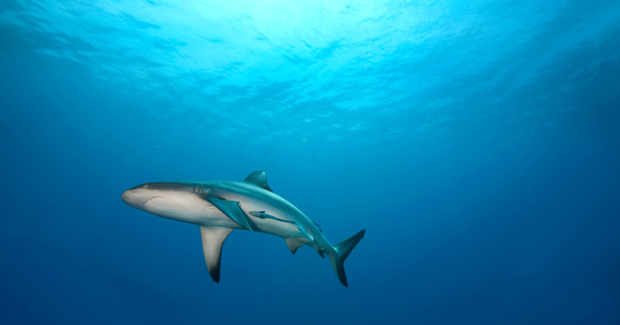
Grey reef sharks behave differently depending on the point in the lunar cycle, new research suggests.

THE DIVING BEHAVIOUR OF sharks appears to be influenced by the moon, water temperature and time of day, researchers have revealed.

A study of about 40 grey reef sharks, commonly found on coral reefs in northern Australia and the Indo-Pacific, found they stayed in deep water during a full moon and moved to shallow water with the new moon.

“To our knowledge, this is the first time such patterns have been observed in detail for reef sharks,” says lead researcher Gabriel Vianna, from the University of Western Australia (UWA) in Perth.

The sharks were tagged near Palau, east of the Philippines, and followed for two years. During this time, scientists from UWA and the Australian Institute of Marine Science recorded their movement and diving patterns.

The findings, published this week in the journal PLOS ONE, reveal that sharks descended to greater depths, and used a wider range of depths, around the time of the full moon.

Diving was also affected by seasonal changes, as the group, which mostly consisted of adult females, was recorded diving to an average depth of 35m in winter and 60m in spring.

In winter, the sharks remained closer to the surface, where the water was warmer. During summer, however, the sharks moved to a range of depths.

The researchers suggest that because sharks are cold blooded, they may prefer warmer water to conserve their energy. Warm water may also provide optimal conditions for foraging for food, the study says.

The findings also suggest that the time of day could affect how deeply sharks dive.

“We were surprised to see sharks going progressively deeper during the morning and the exact inverse pattern in the afternoon, gradually rising towards the surface,” says Gabriel, adding that the behaviour may relate to how much light is reflected on the reef at different times during the day.

Better knowledge of shark behaviour could help reduce the risk of sharks coming into contact with locals and tourists fishing, particularly if their diving behaviour can be predicted at certain times of the day.

“In places such as Palau, which relies heavily on marine tourism and where sharks are a major tourist attraction, the fishing of a few dozen sharks from popular dive sites could have a very negative impact on the national economy,” Gabriel says.

http://www.australiangeographic.com.au/journal/sharks-affected-by-full-moon.htm

Life jacket helps disabled goldfish swim

Einstein developed swim bladder disease, which caused him to turn upside down and sink to the bottom of his tank.

His owner, warehouse worker Leighton Naylor, was so distressed by the sight of his struggling pet, he knew he had to take matters into his own hands.

“He’s always been a fighter so when he sunk to the bottom one day and couldn’t get back up again it was a very sorry sight. It broke my heart to see him so helpless. He looked so depressed,” said the 32-year-old from Blackpool.

He made Einstein a “floating frame” from recycled tubing, which fits perfectly over the fish’s two-inch long body.

“I wanted to build something that would allow Einstein to move his fins a little bit and be comfortable at the same time,” he said.

“He wriggled a bit a first and he wasn’t too keen on the idea. He kept catching on to plants and getting stuck but since I’ve rearranged the tank to make it disability friendly he’s been absolutely fine.”

http://www.telegraph.co.uk/news/newsvideo/weirdnewsvideo/10013956/Life-jacket-helps-disabled-goldfish-swim-again.html

Supernova left its mark in ancient bacteria

1_12797_Cass-A-NASA
Radioactive iron may be first fossil imprint of a nearby cosmic explosion.

by Alexandra Witze

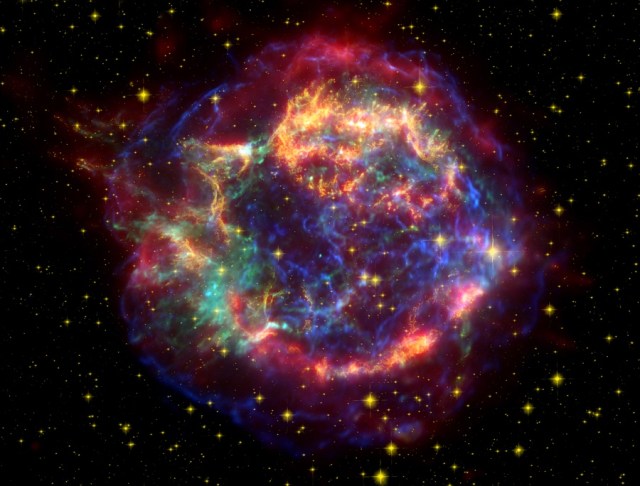
Sediment in a deep-sea core may hold radioactive iron spewed by a distant supernova 2.2 million years ago and preserved in the fossilized remains of iron-loving bacteria. If confirmed, the iron traces would be the first biological signature of a specific exploding star.

Shawn Bishop, a physicist at the Technical University of Munich in Germany, reported preliminary findings on 14 April at a meeting of the American Physical Society in Denver, Colorado.

In 2004, scientists reported finding the isotope iron-60, which does not form on Earth, in a piece of sea floor from the Pacific Ocean. They calculated how long ago this radioactive isotope had arrived by using the rate at which it decays over time. The culprit, they concluded, was a supernova in the cosmic neighbourhood.

Bishop wondered if he could find signs of that explosion in the fossil record on Earth. Some natural candidates are certain species of bacteria that gather iron from their environment to create 100-nanometre-wide magnetic crystals, which the microbes use to orient themselves within Earth’s magnetic field so that they can navigate to their preferred conditions. These ‘magnetotactic’ bacteria live in sea-floor sediments.

So Bishop and his colleagues acquired parts of a sediment core from the eastern equatorial Pacific Ocean, dating to between about 1.7 million and 3.3 million years ago. They took sediment samples from strata corresponding to periods roughly 100,000 years apart, and treated them with a chemical technique that extracts iron-60 but not iron from nonbiological sources, such as soil washing off the continents. The scientists then ran the samples through a mass spectrometer to see if any iron-60 was present.

And it was. “It looks like there’s something there,” Bishop told reporters at the Denver meeting. The levels of iron-60 are minuscule, but the only place they seem to appear is in layers dated to around 2.2 million years ago. This apparent signal of iron-60, Bishop said, could be the remains of magnetite (Fe3O4) chains formed by bacteria on the sea floor as radioactive supernova debris showered on them from the atmosphere, after crossing inter-stellar space at nearly the speed of light.

No one is sure what particular star might have exploded at this time, although one paper points to suspects in the Scorpius–Centaurus stellar association, at a distance of about 130 parsecs (424 light years) from the Sun3.

“I’m really excited about this,” says Brian Thomas, an astrophysicist at Washburn University in Topeka, Kansas, who was not involved in the work. “The nice thing is that it’s directly tied to a specific event.”

“For me, philosophically, the charm is that this is sitting in the fossil record of our planet,” Bishop says. He and his team are now working on a second core, also from the Pacific, to see if it too holds the iron-60 signal.

http://www.nature.com/news/supernova-left-its-mark-in-ancient-bacteria-1.12797

Naked man risks croc death for booze

naked-man-braves-crocodile-infested-waters-for-bet_582_389
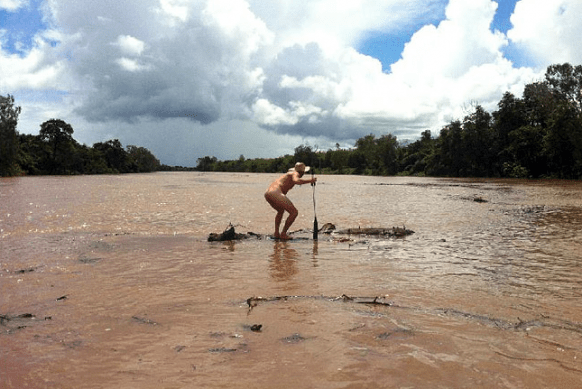
The croc-infested Daly River was up to 9m deep when this man was tackling the flow on a log.

A fisherman risked his life for what he considered a good cause – a bet. He won two cases of bourbon for jumping on to a log racing down a flooded, crocodile-infested river in the nude, riding the makeshift raft for about three minutes before clambering back into a boat.

“I’d enjoyed a few beers and it seemed a good idea at the time,” he said. “We weren’t catching any fish – because the river was flowing too fast – so I thought, ‘Why not?’ “But when I woke up the next morning, it didn’t seem so clever.”

Witness Billy Innes said his friend thought nothing of the dangers of drowning or being eaten by a crocodile. “It was hilarious,” he said.

The daredevil, who asked not to be named, was camping at the Daly River on Sunday when he accepted the bet.

“Huge trees were hammering down the river,” Mr Innes said. “It was quite a sight. Someone dared him to get on to one of the logs and row across the river. We went out in a boat and he jumped overboard on to a tree. He managed to stay on for quite a while before getting back into the boat. He got two cases of Jack Daniels for it – and thought that made it all worthwhile.”

The Daly is one of the Territory big “croc rivers”.

Keith Parry, 20, was killed while swimming across the Daly River in April 2009. He was crossing the river because he wanted more beer.

http://www.ntnews.com.au/article/2013/04/04/319219_ntnews.html

Alexander Mandon buried alive in Columbia as cure after being struck by lightning 4 times

The saying lightning never strikes the same place twice apparently does not apply in Alexander Mandón’s case. The 20-year-old Colombian has been struck by lightning four times since September. So to “cure” his electrical attraction, a local indigenous doctor recommended that Mandón be buried alive in an upright position, Spanish-language publication “Noticias Uno” reports.

Burying Mandón allows the surrounding dirt to absorb any inappropriate electrical charges in his body, according to the indigenous healer. The first attempt was unsuccessful, since Mandón was not positioned the correct way. So, residents of Mandón’s native town Sampués, a community more than 300 miles north of Bogotá, tried again. In a video of the burial, several people work to cover Mandón in dirt. Ultimately, the group entombs Mandón’s entire body, except for his head.

Mandón’s faulty “electrical charge” has been a heavy burden on the 20-year-old. He was struck by lightning for the third time while serving in the Colombian military. His commander became concerned about the risk and discharged Mandón, “Colombia Reports” notes. However, the lightning strikes did not stop there. Following his return home to Sampués in northern Colombia, Mandón was struck by a bolt, yet again, outside a cantina where he once worked. Mandón’s fourth lightning strike left him trembling and struggling to walk, leading Mandón to seek out the traditional medicine doctor.

While it would be difficult to determine whether the treatment worked, Mandón plans to stay inside for the foreseeable future.

Lightning strikes, which can contain as many as 100 million electrical volts, can cause cardiac arrest or serious injury, including severe burns and brain damage, National Geographic reports. Though the electrical discharges do kill (in 10 percent of cases), surviving a strike remains more likely.

In 2011, South Carolina resident Melvin Roberts survived his sixth lightning strike.

http://www.huffingtonpost.com/2013/03/27/alexander-mandon-buried-lightning-strikes_n_2965574.html?ref=topbar

Researchers explore connecting the brain to machines

brain

Behind a locked door in a white-walled basement in a research building in Tempe, Ariz., a monkey sits stone-still in a chair, eyes locked on a computer screen. From his head protrudes a bundle of wires; from his mouth, a plastic tube. As he stares, a picture of a green cursor on the black screen floats toward the corner of a cube. The monkey is moving it with his mind.

The monkey, a rhesus macaque named Oscar, has electrodes implanted in his motor cortex, detecting electrical impulses that indicate mental activity and translating them to the movement of the ball on the screen. The computer isn’t reading his mind, exactly — Oscar’s own brain is doing a lot of the lifting, adapting itself by trial and error to the delicate task of accurately communicating its intentions to the machine. (When Oscar succeeds in controlling the ball as instructed, the tube in his mouth rewards him with a sip of his favorite beverage, Crystal Light.) It’s not technically telekinesis, either, since that would imply that there’s something paranormal about the process. It’s called a “brain-computer interface” (BCI). And it just might represent the future of the relationship between human and machine.

Stephen Helms Tillery’s laboratory at Arizona State University is one of a growing number where researchers are racing to explore the breathtaking potential of BCIs and a related technology, neuroprosthetics. The promise is irresistible: from restoring sight to the blind, to helping the paralyzed walk again, to allowing people suffering from locked-in syndrome to communicate with the outside world. In the past few years, the pace of progress has been accelerating, delivering dazzling headlines seemingly by the week.

At Duke University in 2008, a monkey named Idoya walked on a treadmill, causing a robot in Japan to do the same. Then Miguel Nicolelis stopped the monkey’s treadmill — and the robotic legs kept walking, controlled by Idoya’s brain. At Andrew Schwartz’s lab at the University of Pittsburgh in December 2012, a quadriplegic woman named Jan Scheuermann learned to feed herself chocolate by mentally manipulating a robotic arm. Just last month, Nicolelis’ lab set up what it billed as the first brain-to-brain interface, allowing a rat in North Carolina to make a decision based on sensory data beamed via Internet from the brain of a rat in Brazil.

So far the focus has been on medical applications — restoring standard-issue human functions to people with disabilities. But it’s not hard to imagine the same technologies someday augmenting capacities. If you can make robotic legs walk with your mind, there’s no reason you can’t also make them run faster than any sprinter. If you can control a robotic arm, you can control a robotic crane. If you can play a computer game with your mind, you can, theoretically at least, fly a drone with your mind.

It’s tempting and a bit frightening to imagine that all of this is right around the corner, given how far the field has already come in a short time. Indeed, Nicolelis — the media-savvy scientist behind the “rat telepathy” experiment — is aiming to build a robotic bodysuit that would allow a paralyzed teen to take the first kick of the 2014 World Cup. Yet the same factor that has made the explosion of progress in neuroprosthetics possible could also make future advances harder to come by: the almost unfathomable complexity of the human brain.

From I, Robot to Skynet, we’ve tended to assume that the machines of the future would be guided by artificial intelligence — that our robots would have minds of their own. Over the decades, researchers have made enormous leaps in artificial intelligence (AI), and we may be entering an age of “smart objects” that can learn, adapt to, and even shape our habits and preferences. We have planes that fly themselves, and we’ll soon have cars that do the same. Google has some of the world’s top AI minds working on making our smartphones even smarter, to the point that they can anticipate our needs. But “smart” is not the same as “sentient.” We can train devices to learn specific behaviors, and even out-think humans in certain constrained settings, like a game of Jeopardy. But we’re still nowhere close to building a machine that can pass the Turing test, the benchmark for human-like intelligence. Some experts doubt we ever will.

Philosophy aside, for the time being the smartest machines of all are those that humans can control. The challenge lies in how best to control them. From vacuum tubes to the DOS command line to the Mac to the iPhone, the history of computing has been a progression from lower to higher levels of abstraction. In other words, we’ve been moving from machines that require us to understand and directly manipulate their inner workings to machines that understand how we work and respond readily to our commands. The next step after smartphones may be voice-controlled smart glasses, which can intuit our intentions all the more readily because they see what we see and hear what we hear.

The logical endpoint of this progression would be computers that read our minds, computers we can control without any physical action on our part at all. That sounds impossible. After all, if the human brain is so hard to compute, how can a computer understand what’s going on inside it?

It can’t. But as it turns out, it doesn’t have to — not fully, anyway. What makes brain-computer interfaces possible is an amazing property of the brain called neuroplasticity: the ability of neurons to form new connections in response to fresh stimuli. Our brains are constantly rewiring themselves to allow us to adapt to our environment. So when researchers implant electrodes in a part of the brain that they expect to be active in moving, say, the right arm, it’s not essential that they know in advance exactly which neurons will fire at what rate. When the subject attempts to move the robotic arm and sees that it isn’t quite working as expected, the person — or rat or monkey — will try different configurations of brain activity. Eventually, with time and feedback and training, the brain will hit on a solution that makes use of the electrodes to move the arm.

That’s the principle behind such rapid progress in brain-computer interface and neuroprosthetics. Researchers began looking into the possibility of reading signals directly from the brain in the 1970s, and testing on rats began in the early 1990s. The first big breakthrough for humans came in Georgia in 1997, when a scientist named Philip Kennedy used brain implants to allow a “locked in” stroke victim named Johnny Ray to spell out words by moving a cursor with his thoughts. (It took him six exhausting months of training to master the process.) In 2008, when Nicolelis got his monkey at Duke to make robotic legs run a treadmill in Japan, it might have seemed like mind-controlled exoskeletons for humans were just another step or two away. If he succeeds in his plan to have a paralyzed youngster kick a soccer ball at next year’s World Cup, some will pronounce the cyborg revolution in full swing.

Schwartz, the Pittsburgh researcher who helped Jan Scheuermann feed herself chocolate in December, is optimistic that neuroprosthetics will eventually allow paralyzed people to regain some mobility. But he says that full control over an exoskeleton would require a more sophisticated way to extract nuanced information from the brain. Getting a pair of robotic legs to walk is one thing. Getting robotic limbs to do everything human limbs can do may be exponentially more complicated. “The challenge of maintaining balance and staying upright on two feet is a difficult problem, but it can be handled by robotics without a brain. But if you need to move gracefully and with skill, turn and step over obstacles, decide if it’s slippery outside — that does require a brain. If you see someone go up and kick a soccer ball, the essential thing to ask is, ‘OK, what would happen if I moved the soccer ball two inches to the right?'” The idea that simple electrodes could detect things as complex as memory or cognition, which involve the firing of billions of neurons in patterns that scientists can’t yet comprehend, is far-fetched, Schwartz adds.

That’s not the only reason that companies like Apple and Google aren’t yet working on devices that read our minds (as far as we know). Another one is that the devices aren’t portable. And then there’s the little fact that they require brain surgery.

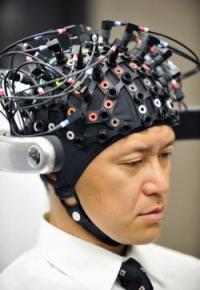
A different class of brain-scanning technology is being touted on the consumer market and in the media as a way for computers to read people’s minds without drilling into their skulls. It’s called electroencephalography, or EEG, and it involves headsets that press electrodes against the scalp. In an impressive 2010 TED Talk, Tan Le of the consumer EEG-headset company Emotiv Lifescience showed how someone can use her company’s EPOC headset to move objects on a computer screen.

Skeptics point out that these devices can detect only the crudest electrical signals from the brain itself, which is well-insulated by the skull and scalp. In many cases, consumer devices that claim to read people’s thoughts are in fact relying largely on physical signals like skin conductivity and tension of the scalp or eyebrow muscles.

Robert Oschler, a robotics enthusiast who develops apps for EEG headsets, believes the more sophisticated consumer headsets like the Emotiv EPOC may be the real deal in terms of filtering out the noise to detect brain waves. Still, he says, there are limits to what even the most advanced, medical-grade EEG devices can divine about our cognition. He’s fond of an analogy that he attributes to Gerwin Schalk, a pioneer in the field of invasive brain implants. The best EEG devices, he says, are “like going to a stadium with a bunch of microphones: You can’t hear what any individual is saying, but maybe you can tell if they’re doing the wave.” With some of the more basic consumer headsets, at this point, “it’s like being in a party in the parking lot outside the same game.”

It’s fairly safe to say that EEG headsets won’t be turning us into cyborgs anytime soon. But it would be a mistake to assume that we can predict today how brain-computer interface technology will evolve. Just last month, a team at Brown University unveiled a prototype of a low-power, wireless neural implant that can transmit signals to a computer over broadband. That could be a major step forward in someday making BCIs practical for everyday use. Meanwhile, researchers at Cornell last week revealed that they were able to use fMRI, a measure of brain activity, to detect which of four people a research subject was thinking about at a given time. Machines today can read our minds in only the most rudimentary ways. But such advances hint that they may be able to detect and respond to more abstract types of mental activity in the always-changing future.

http://www.ydr.com/living/ci_22800493/researchers-explore-connecting-brain-machines

Mike the Headless Chicken

No, it’s not the latest eye-popping item from the always entertaining Weekly World News. Instead, it’s an actual headline from the October 22, 1945, issue of LIFE magazine, above an article about … well, a headless chicken: “Beheaded Chicken Lives Normally After Freak Decapitation by Ax.”

“Ever since Sept. 10,” LIFE informed its readers, “a rangy Wyandotte rooster named Mike has been living a normal chicken’s life though he has no head.” Mike, it seems, “lost his head in the usual rooster way. Mrs. L.A. Olson, wife of a farmer in Fruita, Colo., 200 miles west of Denver, decided to have chicken for dinner. Mrs. Olson took Mike to the chopping block and axed off his head. Thereupon Mike got up and soon began to strut around…. What Mrs. Olson’s ax had done was to clip off most of the skull but leave intact one ear, the jugular vein and the base of the brain, which controls motor function.”

The rest is poultry history. Mike lived for 18 months after losing his head, finally succumbing at a motel in the Arizona desert in 1946 during one of his many appearances as a sideshow attraction in the American southwest.

Here, LIFE.com presents Mike’s unlikely story, as well as the utterly unsettling pictures that ran (and some that never ran) in LIFE.

chicken2<
Mike the headless chicken “dances” in 1945.

chicken3
Mike the headless chicken in his Colorado barnyard, with fellow chickens, 1945.

chicken4
A picture of the suitcase containing the tools for feeding Mike the headless chicken, including an eye dropper that was used to provide sustenance through the hole atop his torso where his head used to be.

chicken5
Mike the headless chicken is fed through an eye dropper, directly into his esophagus, in 1945.

chicken6
Promoter Hope Wade holds Mike the headless chicken’s formerly useful noggin, as if attempting to reintroduce the bird to its lost self, in 1945. (Some reports, however, claim that the Olsons’ cat ate Mike’s head, and that another rooster’s head stood in for Mike’s during his brief brush with fame.)

Thanks to Ray Gaudette for bringing this to the attention of the It’s Interesting community.

Read more: http://life.time.com/curiosities/photos-mike-the-headless-chicken-beyond-belief/#ixzz2OZ1jpmWC

Thriving bacteria discovered at the deepest point in the ocean

dn23277-1_300

Hollywood director James Cameron found little evidence of life when he descended nearly 11,000 metres to the deepest point in the world’s oceans last year. If only he had taken a microscope and looked just a few centimetres deeper.

Ronnie Glud at the University of Southern Denmark in Odense, and his colleagues, have discovered unusually high levels of microbial activity in the sediments at the site of Cameron’s dive – Challenger Deep at the bottom of the western Pacific’s Mariana Trench.

Glud’s team dispatched autonomous sensors and sample collectors into the trench to measure microbial activity in the top 20 centimetres of sediment on the sea bed. The pressure there is almost 1100 times greater than at the surface. Finding food, however, is an even greater challenge than surviving high pressures for anything calling the trench home.

Any nourishment must come in the form of detritus falling from the surface ocean, most of which is consumed by other organisms on the way down. Only 1 per cent of the organic matter generated at the surface reaches the sea floor’s abyssal plains, 3000 to 6000 metres below sea level. So what are the chances of organic matter making it even deeper, into the trenches that form when one tectonic plate ploughs beneath another?

Surprisingly, the odds seem high. Glud’s team compared sediment samples taken from Challenger Deep and a reference site on the nearby abyssal plain. The bacteria at Challenger Deep were around 10 times as abundant as those on the abyssal plain, with every cubic centimetre of sediment containing 10 million microbes. The deep microbes were also twice as active as their shallower kin.

These figures make sense, says Glud, because ocean trenches are particularly good at capturing sediment. They are broad as well as deep, with a steep slope down to the deepest point, so any sediment falling on their flanks quickly cascades down to the bottom in muddy avalanches. Although the sediment may contain no more than 1 per cent organic matter, so much of it ends up at Challenger Deep that the level of microbial activity shoots up.

“There is much more than meets the eye at the bottom of the sea,” says Hans Røy, at Aarhus University in Denmark. Last year, he studied seafloor sediments below the north Pacific gyre – an area that, unlike Challenger Deep, is almost devoid of nutrients. Remarkably, though, even here Røy found living microbes.

“With the exception of temperatures much above boiling, bacteria seem to cope with everything this planet can throw at them,” he says.

Journal reference: Nature Geoscience, DOI: 10.1038/ngeo1773

http://www.newscientist.com/article/dn23277-deepest-point-in-the-ocean-is-teeming-with-life.html?cmpid=RSS|NSNS|2012-GLOBAL|online-news