Life jacket helps disabled goldfish swim

Einstein developed swim bladder disease, which caused him to turn upside down and sink to the bottom of his tank.

His owner, warehouse worker Leighton Naylor, was so distressed by the sight of his struggling pet, he knew he had to take matters into his own hands.

“He’s always been a fighter so when he sunk to the bottom one day and couldn’t get back up again it was a very sorry sight. It broke my heart to see him so helpless. He looked so depressed,” said the 32-year-old from Blackpool.

He made Einstein a “floating frame” from recycled tubing, which fits perfectly over the fish’s two-inch long body.

“I wanted to build something that would allow Einstein to move his fins a little bit and be comfortable at the same time,” he said.

“He wriggled a bit a first and he wasn’t too keen on the idea. He kept catching on to plants and getting stuck but since I’ve rearranged the tank to make it disability friendly he’s been absolutely fine.”

http://www.telegraph.co.uk/news/newsvideo/weirdnewsvideo/10013956/Life-jacket-helps-disabled-goldfish-swim-again.html

New Study Ties Autism Risk to Creases in Placenta

placenta

After most pregnancies, the placenta is thrown out, having done its job of nourishing and supporting the developing baby.

But a new study raises the possibility that analyzing the placenta after birth may provide clues to a child’s risk for developing autism. The study, which analyzed placentas from 217 births, found that in families at high genetic risk for having an autistic child, placentas were significantly more likely to have abnormal folds and creases.

“It’s quite stark,” said Dr. Cheryl K. Walker, an obstetrician-gynecologist at the Mind Institute at the University of California, Davis, and a co-author of the study, published in the journal Biological Psychiatry. “Placentas from babies at risk for autism, clearly there’s something quite different about them.”

Researchers will not know until at least next year how many of the children, who are between 2 and 5, whose placentas were studied will be found to have autism. Experts said, however, that if researchers find that children with autism had more placental folds, called trophoblast inclusions, visible after birth, the condition could become an early indicator or biomarker for babies at high risk for the disorder.

“It would be really exciting to have a real biomarker and especially one that you can get at birth,” said Dr. Tara Wenger, a researcher at the Center for Autism Research at Children’s Hospital of Philadelphia, who was not involved in the study.

The research potentially marks a new frontier, not only for autism, but also for the significance of the placenta, long considered an after-birth afterthought. Now, only 10 percent to 15 percent of placentas are analyzed, usually after pregnancy complications or a newborn’s death.

Dr. Harvey J. Kliman, a research scientist at the Yale School of Medicine and lead author of the study, said the placenta had typically been given such little respect in the medical community that wanting to study it was considered equivalent to someone in the Navy wanting to scrub ships’ toilets with a toothbrush. But he became fascinated with placentas and noticed that inclusions often occurred with births involving problematic outcomes, usually genetic disorders.

He also noticed that “the more trophoblast inclusions you have, the more severe the abnormality.” In 2006, Dr. Kliman and colleagues published research involving 13 children with autism, finding that their placentas were three times as likely to have inclusions. The new study began when Dr. Kliman, looking for more placentas, contacted the Mind Institute, which is conducting an extensive study, called Marbles, examining potential causes of autism.

“This person came out of the woodwork and said, ‘I want to study trophoblastic inclusions,’ ” Dr. Walker recalled. “Now I’m fairly intelligent and have been an obstetrician for years and I had never heard of them.”

Dr. Walker said she concluded that while “this sounds like a very smart person with a very intriguing hypothesis, I don’t know him and I don’t know how much I trust him.” So she sent him Milky Way bar-size sections of 217 placentas and let him think they all came from babies considered at high risk for autism because an older sibling had the disorder. Only after Dr. Kliman had counted each placenta’s inclusions did she tell him that only 117 placentas came from at-risk babies; the other 100 came from babies with low autism risk.

She reasoned that if Dr. Kliman found that “they all show a lot of inclusions, then maybe he’s a bit overzealous” in trying to link inclusions to autism. But the results, she said, were “astonishing.” More than two-thirds of the low-risk placentas had no inclusions, and none had more than two. But 77 high-risk placentas had inclusions, 48 of them had two or more, including 16 with between 5 and 15 inclusions.

Dr. Walker said that typically between 2 percent and 7 percent of at-risk babies develop autism, and 20 percent to 25 percent have either autism or another developmental delay. She said she is seeing some autism and non-autism diagnoses among the 117 at-risk children in the study, but does not yet know how those cases match with placental inclusions.

Dr. Jonathan L. Hecht, associate professor of pathology at Harvard Medical School, said the study was intriguing and “probably true if it finds an association between these trophoblast inclusions and autism.” But he said that inclusions were the placenta’s way of responding to many kinds of stress, so they might turn out not to be specific enough to predict autism.

Dr. Kliman calls inclusions a “check-engine light, a marker of: something’s wrong, but I don’t know what it is.”

That’s how Chris Mann Sullivan sees it, too. Dr. Sullivan, a behavioral analyst in Morrisville, N.C., was not in the study, but sent her placenta to Dr. Kliman after her daughter Dania, now 3, was born. He found five inclusions. Dr. Sullivan began intensive one-on-one therapy with Dania, who has not been given a diagnosis of autism, but has some relatively mild difficulties.

“What would have happened if I did absolutely nothing, I’m not sure,” Dr. Sullivan said. “I think it’s a great way for parents to say, ‘O.K., we have some risk factors; we’re not going to ignore it.’ ”

Thanks to Dr. Rajadhyaksha for bringing this to the attention of the It’s Interesting community.

NASA Mars Rover draws enormous penis in the dirt – almost crashes NASA’s website

mars_rover_oo_err

Nasa’s $800m Mars Exploration Rovers have accidentally drawn a penis.

The twin exploration vehicles Spirit and Opportunity were launched nine years ago, in an effort to search the surface of Mars for signs of water erosion and possibly even life.

According to Nasa, since then the rovers have driven over more than 10km of Martian land, directed by teams back on Earth combined with autonomous cameras designed to avoid potential problems with the terrain.

It appears that part of the robots’ programming involves spinning in tight circles to test nearby terrain and find new routes.

Humorously, depending on your age perhaps, that has the unfortunate consequence of drawing a certain shape on the surface, which when discovered by Reddit essentially crashed Nasa’s website.

The image was posted on Nasa’s site and appears to be a genuine picture from the Martian surface – albeit one taken at an unfortunate angle.

It’s not clear which of the rovers drew the shape, or even when it was made.

Nasa lost communication with the Spirit rover in 2009 after it became stuck in some sand. Meanwhile the Opportunity is still traversing the surface on its way to the Endeavour crater.

http://www.huffingtonpost.co.uk/2013/04/24/mars-rover-penis-nasa_n_3144656.html

Wet washcloth in space

Two high school students in Nova Scotia, Kendra Lemke and Meredith Faulkner, asked Canadian astronaut Chris Hadfield (who is orbiting the planet right now) what would it be like to dip a wash cloth in water, (they suggested he clump it into a bottle, then pull it out) and squeeze it.

On Earth, a really wet wash cloth, squeezed tight, will drip, right?

Up on the International Space Station, wet wash cloths don’t drip. What they do is shown here.

Latest teen Internet trend – condom snorting

The “condom challenge” is the newest, most disturbing YouTube trend in which young kids snort condoms and then pull them out of their mouths. Yes, it’s as gross as it sounds.

Though videos surfaced online as early as October, the challenge recently picked up speed with one YouTube user’s post, where a girl completes the challenge while blasting Taylor Swift’s “22” in the background — probably not what the singer had in mind when she wrote the song.

New cell phone app designed to prevent incest in Iceland

dynamic_resize

A new cellphone app touts itself as a way for Iceland’s singles to avoid sleeping with relatives — as the isolated country’s small population of 320,000 means most people are related. The acquaintances just have to bump their phones together and it tells them instantly if they’re family. Three Icelandic engineers designed the app with the help of the Book of Icelanders that contains data from 720,000 people born in Iceland.

News of Iceland says, “Everyone has heard of (or experienced) it when someone goes all in with someone and then later runs into that person at a family gathering some other time. This new app might just prevent such awkward moments.”

Its slogan: “Bump the app before you bump in bed.”

The app is available for Android phones and will be available for iPhone soon.

http://cnews.canoe.ca/CNEWS/WeirdNews/2013/04/18/20753176.html

Mysterious structure found at bottom of the Sea of Galilee in Israel.

130419031135-sea-of-galilee-stone-structure-story-body130419031859-sea-of-galilee-stone-structure-2-story-top

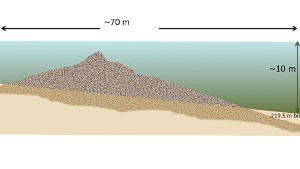
A mysterious, circular structure, with a diameter greater than the length of a Boeing 747 jet, has been discovered submerged about 30 feet (9 meters) underneath the Sea of Galilee in Israel.

Scientists first made the discovery by accident in 2003 using sonar to survey the bottom of the lake but published their findings only recently.

“We just bumped into it,” recalls Shmuel Marco, a geophysicist from Tel Aviv University who worked on the project. “Usually the bottom of the lake is quite smooth. We were surprised to find a large mound. Initially we didn’t realize the importance of this but we consulted with a couple of archaeologists, and they said it looked like an unusually large Bronze Age statue.”

The structure is comprised of basalt rocks, arranged in the shape of a cone. It measures 230 feet (70 meters) at the base of the structure, is 32 feet (10 meters) tall, and weighs an estimated 60,000 tons. It is twice the size of the ancient stone circle at Stonehenge in England.

Its size and location, say Marco, who also took video of the structure during a scuba dive to examine it, indicated it could have been constructed underwater as a type of fish nursery. However archeologists think it more likely it was built on dry land and later submerged by the lake.

“From a geophysical perspective, it is also important to the history of the lake, because it means the water level was lower than it was today,” says Marco.

According to Yitzhak Paz, the archeologist who led the study, the fact that the structure is underwater has made it a particularly difficult study.

“If the site was inland, it would be much easier to investigate. By now we would have excavated, but because it’s submerged we haven’t yet been able to. It is a much harder process, both physically and financially. It is very expensive to raise support for such an enterprise.”

The exact age of the structure has been difficult to pinpoint, but calculations based on the six to ten feet (two to three meters) of sand that have accumulated over the bottom of the base — sand accumulates an average of one to four millimeters per year — as well as comparisons to other structures in the region, put the estimate anywhere between 2,000 and 12,000 years old.

The possible purpose of the structure is even more enigmatic.

Dani Nadel, an archeologist from the University of Haifa, who partnered on the site, and who has lead several prehistoric excavations in the region, notes it shares similarities with communal burial sites, though he’s quick to discourage anyone from drawing a definitive conclusion.

“This is such a huge structure that it truly is something unusual. It could have been a big ceremonial structure, or a ramp. There could have once been statues on top of people in certain rituals. I mean, I’m really going wild here. The truth is we don’t know how it was constructed, what its exact age is, how it was used, or how long ago it was used. We have several speculations, but we don’t know much except that it’s there and it’s huge.”

Despite the limitations of examining underwater ruins, Nadel says that once they do raise the funds to excavate, there is a good likelihood that their findings will be more complete than would be possible with a land-based structure.

“Above land, many organic remains are decomposed by worms, and other creatures needing oxygen. Underwater, you don’t have oxygen, so the process of decomposition is on a much smaller scale,” he says.

Nadel points to Ohalo II, a site he excavated near the Sea of Galilee that had been submerged for 23,000 years before a drop in water level made it easy to excavate. Ohalo II is significant because it was one of the best preserved prehistoric sites in the world.

“In most sites, you’re lucky to find five or ten seeds. At Ohalo, we found 150,000. We learned a lot about the diet (of the inhabitants), what fish they were eating, what animals they were hunting. When a site is underwater it gives us the opportunity to see history in much more detail.”

What archeologists are certain of is that the monument was likely of great importance to the people who built it. Marco notes that the nearest basalt outcrop was a few hundred meters from the site, and that the stones, which were three to six feet (one to two meters) in width, would have weighed over 200 pounds (90 kilograms) at times.

“We see a society that was capable of organizing the construction of such a large structure. It’s unique to transport these stones and unique to arrange them. You need to plan and to mobilize people, because they’re too heavy to be carried by a single person.”

Nadel points out that given the harsh environment such a structure was a particularly impressive accomplishment.

“You have to imagine,” says Nadel, “these people were building something that was more durable than their brush huts.”

http://www.cnn.com/2013/04/19/world/meast/israel-ancient-structure-mystery/index.html?hpt=hp_t5

Supernova left its mark in ancient bacteria

1_12797_Cass-A-NASA
Radioactive iron may be first fossil imprint of a nearby cosmic explosion.

by Alexandra Witze

Sediment in a deep-sea core may hold radioactive iron spewed by a distant supernova 2.2 million years ago and preserved in the fossilized remains of iron-loving bacteria. If confirmed, the iron traces would be the first biological signature of a specific exploding star.

Shawn Bishop, a physicist at the Technical University of Munich in Germany, reported preliminary findings on 14 April at a meeting of the American Physical Society in Denver, Colorado.

In 2004, scientists reported finding the isotope iron-60, which does not form on Earth, in a piece of sea floor from the Pacific Ocean. They calculated how long ago this radioactive isotope had arrived by using the rate at which it decays over time. The culprit, they concluded, was a supernova in the cosmic neighbourhood.

Bishop wondered if he could find signs of that explosion in the fossil record on Earth. Some natural candidates are certain species of bacteria that gather iron from their environment to create 100-nanometre-wide magnetic crystals, which the microbes use to orient themselves within Earth’s magnetic field so that they can navigate to their preferred conditions. These ‘magnetotactic’ bacteria live in sea-floor sediments.

So Bishop and his colleagues acquired parts of a sediment core from the eastern equatorial Pacific Ocean, dating to between about 1.7 million and 3.3 million years ago. They took sediment samples from strata corresponding to periods roughly 100,000 years apart, and treated them with a chemical technique that extracts iron-60 but not iron from nonbiological sources, such as soil washing off the continents. The scientists then ran the samples through a mass spectrometer to see if any iron-60 was present.

And it was. “It looks like there’s something there,” Bishop told reporters at the Denver meeting. The levels of iron-60 are minuscule, but the only place they seem to appear is in layers dated to around 2.2 million years ago. This apparent signal of iron-60, Bishop said, could be the remains of magnetite (Fe3O4) chains formed by bacteria on the sea floor as radioactive supernova debris showered on them from the atmosphere, after crossing inter-stellar space at nearly the speed of light.

No one is sure what particular star might have exploded at this time, although one paper points to suspects in the Scorpius–Centaurus stellar association, at a distance of about 130 parsecs (424 light years) from the Sun3.

“I’m really excited about this,” says Brian Thomas, an astrophysicist at Washburn University in Topeka, Kansas, who was not involved in the work. “The nice thing is that it’s directly tied to a specific event.”

“For me, philosophically, the charm is that this is sitting in the fossil record of our planet,” Bishop says. He and his team are now working on a second core, also from the Pacific, to see if it too holds the iron-60 signal.

http://www.nature.com/news/supernova-left-its-mark-in-ancient-bacteria-1.12797

Children with older fathers and grandfathers live longer

_60819372_fatherandbabyspl

Delaying fatherhood may offer survival advantages, say US scientists who have found children with older fathers and grandfathers appear to be “genetically programmed” to live longer.

The genetic make-up of sperm changes as a man ages and develops DNA code that favours a longer life – a trait he then passes to his children. The team found the link after analysing the DNA of 1,779 young adults. Their work appears in Proceedings of the National Academy of Sciences.

Experts have known for some time that lifespan is linked to the length of structures known as telomeres that sit at the end of the chromosomes that house our genetic code, DNA. Generally, a shorter telomere length means a shorter life expectancy. Like the plastic tips on shoelaces, telomeres protect chromosomal ends from damage. But in most cells, they shorten with age until the cells are no longer able to replicate.

However, scientists have discovered that in sperm, telomeres lengthen with age. And since men pass on their DNA to their children via sperm, these long telomeres can be inherited by the next generation. Dr Dan Eisenberg and colleagues from the Department of Anthropology at Northwestern University studied telomere inheritance in a group of young people living in the Philippines.

Telomeres, measured in blood samples, were longer in individuals whose fathers were older when they were born. The telomere lengthening seen with each year that the men delayed fatherhood was equal to the yearly shortening of telomere length that occurs in middle-aged adults. Telomere lengthening was even greater if the child’s paternal grandfather had also been older when he became a father. Although delaying fatherhood increases the risk of miscarriage, the researchers believe there may be long-term health benefits.

Inheriting longer telomeres will be particularly beneficial for tissues and biological functions that involve rapid cell growth and turnover – such as the immune system, gut and skin – the scientists believe. And it could have significant implications for general population health. “As paternal ancestors delay reproduction, longer telomere length will be passed to offspring, which could allow lifespan to be extended as populations survive to reproduce at older ages.”

Prof Thomas von Zglinicki, an expert in cellular ageing at Newcastle University, said more research was needed.

“Very few of the studies that linked telomere length to health in late life have studied the impact, if any, of paternal age. It is still completely unclear whether telomere length at conception (or birth) or rate of telomere loss with age is more important for age-related morbidity and mortality risk in humans. “The authors did not examine health status in the first generation offspring. It might be possible that the advantage of receiving long telomeres from an old father is more than offset by the disadvantage of higher levels of general DNA damage and mutations in sperm,” he said.

http://www.bbc.co.uk/news/health-18392873

Thanks to Kebmodee for bringing this to the attention of the It’s Interesting community.