Mind over matter helps paralysed woman control robotic arm

Graphic-robotic-arm-001

A woman who is paralysed from the neck down has stunned doctors with her extraordinary skill at using a robotic arm that is controlled by her thoughts alone.

The 52-year-old patient, called Jan, lost the use of her limbs more than 10 years ago to a degenerative disease that damaged her spinal cord. The disruption to her nervous system was the equivalent to having a broken neck.

But in training sessions at the University of Pittsburgh, doctors found she quickly learned to make fluid movements with the brain-controlled robotic arm, reaching levels of performance never seen before.

Doctors recruited the woman to test a robotic arm that is controlled by a new kind of computer program that translates the natural brain activity used to move our limbs into commands to move the robotic arm.

The design is intended to make the robotic arm more intuitive for patients to use. Instead of having to think where to move the arm, a patient can simply focus on the goal, such as “pick up the ball”.

Several groups around the world are developing so-called brain-machine interfaces to control robotic arms and other devices, such as computers, but none has achieved such impressive results.

Writing in the Lancet, researchers said Jan was able to move the robotic arm back, forward, right, left, and up and down only two days into her training. Within weeks she could reach out, and change the position of the hand to pick up objects on a table, including cones, blocks and small balls, and put them down at another location.

“We were blown away by how fast she was able to acquire her skill, that was completely unexpected,” said Andrew Schwartz, professor of neurobiology at the University of Pittsburgh. “At the end of a good day, when she was making these beautiful movements, she was ecstatic.”

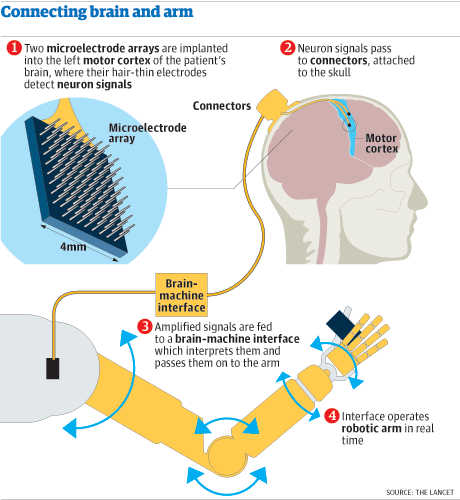
To wire the woman up to the arm, doctors performed a four-hour operation to implant two tiny grids of electrodes, measuring 4mm on each side, into Jan’s brain. Each grid has 96 little electrodes that stick out 1.5mm. The electrodes were pushed just beneath the surface of the brain, near neurons that control hand and arm movement in the motor cortex.

Once the surgeons had implanted the electrodes, they replaced the part of the skull they had removed to expose the brain. Wires from the electrodes ran to connectors on the patient’s head, which doctors could then use to plug the patient into the computer system and robotic arm.

Before Jan could use the arm, doctors had to record her brain activity imagining various arm movements. To do this, they asked her to watch the robotic arm as it performed various moves, and got her to imagine moving her own arm in the same way.

While she was thinking, the computer recorded the electrical activity from individual neurons in her brain.

Neurons that control movement tend to have a preferred direction, and fire their electrical pulses more frequently to perform a movement in that direction. “Once we understand which direction each neuron likes to fire in, we can look at a larger group of neurons and figure out what direction the patient is trying to move the arm in,” Schwartz said.

To begin with, the robotic arm was programmed to help Jan’s movements, by ignoring small mistakes in movements. But she quickly progressed to controlling the arm without help. After three months of training, she completed tasks with the robotic arm 91.6% of the time, and 30 seconds faster than when the trial began.

In an accompanying article, Grégoire Courtine, at the Swiss Federal Institute of Technology in Lausanne, said: “This bioinspired brain-machine interface is a remarkable technological and biomedical achievement.”

There are hurdles ahead for mind-controlled robot limbs. Though Jan’s performance continued to improve after the Lancet study was written, she has plateaued recently, because scar tissue that forms around the tips of the electrodes degrades the brain signals the computer receives.

Schwartz said that using thinner electrodes, around five thousandths of a millimetre thick, should solve this problem, as they will be too small to trigger the scarring process in the body.

The researchers now hope to build senses into the robotic arm, so the patient can feel the texture and temperature of the objects they are handling. To do this, sensors on the fingers of the robotic hand could send information back to the sensory regions of the brain.

Another major focus of future work is to develop a wireless system, so the patient does not have to be physically plugged into the computer that controls the robotic arm.

Thanks to Kebmodee AND Dr. Rajadhyaksha for bringing this to the attention of the It’s Interesting community.

http://www.guardian.co.uk/science/2012/dec/17/paralysed-woman-robotic-arm-pittsburgh

115-year-old Iowan woman dies, was world’s oldest person

hshvo_Xl_55
This file April 2010 photo shows Dina Manfredini of Johnston, Iowa. Manfredini, who inherited the title of world’s oldest person less than two weeks ago, died Monday, Dec. 17, 2012, at age 115, her granddaughter Lori Logli said. She did not elaborate on the cause of her grandmother’s death. Manfredini was born on April 4, 1897, in Italy, according to Guinness officials. She moved to the United States in 1920 and settled in Des Moines with her husband.

A 115-year-old Iowa woman’s granddaughter says the woman has died less than two weeks after inheriting the title of world’s oldest person.

Dina Manfredini’s granddaughter Lori Logli says Manfredini died Monday morning. Logli wouldn’t elaborate on her grandmother’s cause of death.

Manfredini lived at the Bishop Drumm Retirement Center in Johnston. Guinness World Records confirmed she inherited the title of world’s oldest living person less than two weeks ago. Bessie Cooper of Georgia previously held the title at age 116.

Guinness spokesman Robert Young says a Japanese man is believed to now hold the title. Jiroemon Kimura was born on April 19, 1897, which makes him just 15 days younger than Manfredini. Young says Kimura, of Kyotango in Kyoto, also is believed to be the second-oldest man in documented history.

Read more here: http://www.sacbee.com/2012/12/17/5059978/115-year-old-woman-dies-was-worlds.html#storylink=cpy

NYU Student tweeting every reported US drone strike has revealed the ‘double tap’ tactic of killing first responders

drone

NYU student Josh Begley is tweeting every reported U.S. drone strike since 2002, and the feed highlights a disturbing tactic employed by the U.S. that is widely considered a war crime.

Known as the “double tap,” the tactic involves bombing a target multiple times in relatively quick succession, meaning that the second strike often hits first responders.

A 2007 report by the Homeland Security Institute called double taps a “favorite tactic of Hamas” and the FBI considers it a tactic employed by terrorists.

UN special rapporteur on extrajudicial killings Christof Heyns said that if there are “secondary drone strikes on rescuers who are helping (the injured) after an initial drone attack, those further attacks are a war crime.”

The U.S. refuses to discuss the merits of its overtly covert drone program, but the reports featured on @dronestream clearly document that U.S. hellfire missiles have intentionally targeted funerals and civilian rescuers.

And that’s only a 10-month window in Pakistan. It has happened in Afghanistan as well, and the first instance of “explicit intelligence posthumously proving” that an innocent civilian had been killed happened in Yemen.

In September the NYU and Stanford law schools released a report detailing how double taps by U.S. drones affect the Pakistani population, and noted that “high-level” militants killed only accounted for 2 percent of U.S. drone strike casualties.

Read more: http://www.businessinsider.com/us-drone-tweets-reveal-double-tap-plan-2012-12#ixzz2EyCYyb3N

Thanks to Kebmodee for bringing this to the attention of the It’s Interesting community.

Earth at night

Glints of light from cities, fires, gas flares, even unregistered fishing boats speckle the dark like fireflies in a new series of satellite images released at the American Geophysical Union’s fall meeting. The Suomi National Polar-orbiting Partnership satellite, a joint project between NASA and the National Oceanic and Atmospheric Administration, launched about a year ago and has circled Earth 5000 times. Among its instruments is the Visible Infrared Imaging Radiometer Suite (VIIRS), which has dramatically improved spatial resolution compared with its predecessor (the Defense Meteorological Satellite Program, which earlier produced images of Earth at night). VIIRS includes a sensor (called a day/night band, or DNB) that can see in low-light conditions, allowing meteorologists to study moonlit clouds. But the images suggest that scientists will want to take advantage of the DNB’s images in multiple ways: not just to study clouds, but also to assess disasters such as power outages (such as before and after Superstorm Sandy last month), to study gas flares and estimate volumes of CO2 emissions, or to keep an eye on illegal unreported fishing (the boats emit light to draw in their stocks). On moonless nights—or during the dark winter months at the poles—the instrument can study Earth’s features in the dim light of the aurora, which is particularly useful when the temperature difference between atmospheric, land, and water features is not strong enough for infrared imaging. Most surprising, though, was that the DNB can even see in the dim light of Earth’s “airglow,” chemical reactions in the upper atmosphere that produce a faint radiance an order of magnitude brighter than starlight, said atmospheric scientist Steve Miller, deputy director of the Cooperative Institute for Research in the Atmosphere in Fort Collins, Colorado, at a press conference accompanying the unveiling. The DNB “is truly a paradigm shift,” he said. “This is not your father’s low-light sensor.”

Ray Kurzweil joins Google

Ray-Kurzweil-singularity

The most well known advocate of the Singularity is Ray Kurzweil, who Bill Gates has called one of the best thinkers of the future of technology.

Ray Kurzweil confirmed today that he will be joining Google to work on new projects involving machine learning and language processing.

“I’m excited to share that I’ll be joining Google as Director of Engineering this Monday, December 17,” said Kurzweil.

“I’ve been interested in technology, and machine learning in particular, for a long time: when I was 14, I designed software that wrote original music, and later went on to invent the first print-to-speech reading machine for the blind, among other inventions. I’ve always worked to create practical systems that will make a difference in people’s lives, which is what excites me as an inventor.

“In 1999, I said that in about a decade we would see technologies such as self-driving cars and mobile phones that could answer your questions, and people criticized these predictions as unrealistic. Fast forward a decade — Google has demonstrated self-driving cars, and people are indeed asking questions of their Android phones. It’s easy to shrug our collective shoulders as if these technologies have always been around, but we’re really on a remarkable trajectory of quickening innovation, and Google is at the forefront of much of this development.

“I’m thrilled to be teaming up with Google to work on some of the hardest problems in computer science so we can turn the next decade’s ‘unrealistic’ visions into reality.”

http://www.kurzweilai.net/kurzweil-joins-google-to-work-on-new-projects-involving-machine-learning-and-language-processing

Thanks to Kebmodee for bringing this to the attention of the It’s Interesting community.

Proposed Montreal law would require all dogs to be bilingual

Dogs-Banner

Earlier this week, Montreal city councilor Benoit LaDouce proposed a bylaw that would require all dogs in public parks to be bi-lingual. According to Mr. LaDouce, “Dogs parks in our city are chaotic and communication is at the heart of the conflict.” In his mind, K9/citizen relations would be more harmonious if dogs in public spaces understood commands in both English and French.

http://www.cbc.ca/thisisthat/blog/2012/12/12/montreal-bylaw-requires-dogs-to-understand-commands-in-both-official-languages/?_tmc=OP6250GfCpJe83-b1qy_jB7Gke4VtETpPTwqQnZRVXY

How gender stereotypes warp our view of depression

74583142depressioncrop

Stereotypes about male and female roles may influence the way we perceive depressed people.

It’s a well-known fact that men and women who behave the same way in the exact same situation—whether it’s a job interview, a cocktail party, or a traffic stop—are sometimes perceived and treated differently based on their gender.

Something similar, it seems, may happen when men and women start to show signs of depression. A new study, published this week in the journal PLoS ONE, suggests that people of both sexes are less likely to view men as being depressed and in need of professional help—even if a man’s symptoms are identical to a woman’s.

“A lot of attention has been paid to depression in women, and with good reason: Depression is twice as common in women,” says Dr. James B. Potash, the editor of the study and a professor of psychiatry at the University of Iowa, in Iowa City. “There has been relatively little focus on education about depression in men. This [study] emphasizes the importance of figuring out how to get through to men that depression can be disabling and treatment is important.”

Health.com: 12 Signs of Depression in Men

In the study, researchers in the U.K. asked a group of about 600 adults to read a short description of a hypothetical depressed person. This vignette, which was designed to illustrate the diagnostic criteria for clinical depression (also known as major depression), read in part:

For the past two weeks, Kate has been feeling really down. She wakes up in the morning with a flat, heavy feeling that sticks with her all day. She isn’t enjoying things the way she normally would. In fact, nothing gives her pleasure. Even when good things happen, they don’t seem to make Kate happy.

Fifty-seven percent of the study participants recognized Kate’s symptoms—which also included difficulty concentrating, fatigue, and insomnia—as indications of a mental health disorder, and more than three-quarters of those people correctly identified the disorder as depression. Only 10% of the respondents said Kate did not have a problem.

The researchers presented the same vignette to another group of 600 people. This time, however, every mention of “Kate” was replaced by “Jack,” and all the pronouns were switched from female to male. Those minor changes had a noticeable effect: Though nearly as many people recognized Jack as having a mental health problem (52%), more than twice as many as in the Kate scenario said he did not (21%).

In addition, men themselves were less likely than women to label Jack depressed—a pattern that was not seen with Kate.

Health.com: How to Help Someone Who’s Depressed

Why the difference? Male stereotypes that emphasize traits such as toughness and strength may dissuade both women and men, and especially the latter, from identifying or acknowledging the signs of depression in men, says study author Viren Swami.

“Men are expected to be strong, deny pain and vulnerability, and conceal any emotional fragility,” says Swami, a psychologist at the University of Westminster, in London. “Because of these societal expectations, men appear to have poorer understanding of mental health and aren’t as good at detecting symptoms of depression compared with women.”

Potash says the findings also may reflect the fact that women are generally more attuned to emotions and better at articulating them. Some men might have all the outward signs of depression, and yet when asked about their mood they “may not be able to say much more than ‘I don’t know,’” he says. “A substantial minority of men just don’t describe depression.”

Health.com: 10 Careers With High Rates of Depression

On a deeper level, men’s failure to recognize the symptoms of depression in a fellow male may represent a kind of defense mechanism prompted by an “unconscious identification” with that man, says Dr. Radu Saveanu, a professor of psychiatry at the University of Miami Miller School of Medicine.

“They may think, ‘If this guy is having trouble and may need treatment, I may be in the same position someday,’” says Saveanu, who was not involved in the study. “That anxiety distorts the ability to be more objective.”

All of these dynamics may affect the likelihood of seeking or recommending treatment. In the study, men were more likely than women to recommend that Kate seek professional help, but this gap disappeared in the Jack scenario. Men also expressed less sympathy for Jack than women did.

The reluctance to seek treatment isn’t unique to men, but it does reflect an independent-minded streak that is more common among males, Potash says. Men tend to think that pulling themselves out of depression is “something they ought to be able to do,” he says. “It’s the stereotype of men who never ask for directions. They won’t admit that they can’t take care of it themselves.”

Health.com: Depressed? 12 Mental Tricks to Turn It Around

Gender, of course, isn’t the only factor that shapes how we view depression symptoms. Swami also found that respondents of either sex who held negative attitudes towards psychiatry and science felt that both Kate and Jack’s symptoms were less distressing, more difficult to treat, and less worthy of sympathy or professional help.

Swami took these trends into account, but he can’t rule out that other factors might have influenced the gender differences seen in the study. The participants’ own mental health history was unknown, for instance, though Swami says previous diagnoses do not tend to impact “mental health literacy,” or how well people understand mental health issues.

Future research will need to address these limitations, he says.

Read more: http://healthland.time.com/2012/11/15/how-gender-stereotypes-warp-our-view-of-depression/#ixzz2Es26tBvB


Doctor’s remove nine inch long sex toy from Chinese man’s colon

colon

A Chinese man was forced to seek medical help when a nine-inch long dildo got stuck in his intestines for five days. Doctors at Zhongshan Hospital in the Xuhui District said that they removed the dildo from the 30-year-old man on Saturday.

According to The Huffington Post, the dildo (“butt plug”) measured roughly nine inches and three inches wide. Shanghai Daily reports that doctors say it got stuck in his anus and slipped into his intestine after he inserted it to “enhance sexual pleasure with his wife.”

According to Shanghai Daily, the man reported at the hospital on Friday after he began experiencing pain. Doctors failed to remove the object at the first attempt, The Inquisitr reports. He returned the next day after visiting another hospital. The doctors made a second attempt and removed the dildo on Saturday.

Shanghai Daily reports Dr. Yao Liqing said: “If we did not remove the dildo in time, the man could have gone into critical condition.” He added: “Doctors were astonished to see such a big item taken out of the patient’s body.”

Liqing said the dildo blocked the man’s large intestine and caused tissue damage. AFP reports that a hospital spokesman said surgeons removed the dildo from the man’s intestines using an endoscope. The Inquistr reports Liqing said: “We had decided to operate if we failed to take it out with the help of an endoscope. In the end we removed it and avoided having to do surgery.”

According to AFP, the Chinese state media reported that accidents involving sex toys are on the rise “amid loosening attitudes towards sex.”

The sex toy industry in China is booming. China is the world’s top producer of sex toys with 70% of the world’s sex toys produced in the country. The industry is estimated at $2 billion. The Huffington Post reports that as the younger generation of Chinese with increasing standards of living adopt more sexually permissive lifestyles, shops selling sex toys and contraceptives have become commonplace in Chinese cities.

According to the Shanghai Daily, medical professionals observing the increasing incidence of accidents involving sex toys have warned people to carefully follow manufacturer’s instructions and not to use the toys in “unintended” ways.
Shanghaiist comments: “Doctors reminded the public that it’s not the size but what you do with it that counts.”

Dr. Yao Liqing said: “People must use sex toys properly and avoid ones that are too big as they can hurt people. There have been three similar cases so far this year. In the previous two or three years, we only had one such case. These patients were in deep pain when they arrived at the hospital.”

Read more: http://www.digitaljournal.com/article/335143#ixzz2F2reaUuP

Thanks To Mrs. Lindley for bringing this to the attention of the It’s Interesting community.

Valeria Lukyanova – Human Barbie

barbie1

barbie2

barbie3

barbie4

barbie5

barbie6

barbie7

Valeria Lukyanova is best known to the world as the “Human Barbie.” The model who dressed up looks incredibly similar to the Barbie dolls that most girls grew up with is now fight charges that she is digitally changing her look in photographs. That’s right some are suggesting that the human Barbie is a fake and on Monday the blogger world has demanded the model come forward to explain how she looks like a Barbie doll.

As the sudden interest in the model has picked up thanks to her black and white photographs in V Magazine, everyone seems to be focused on tearing her down. Readers have been questioning if the model really looks like a Barbie doll in life or if it is fake. While many have accused the model of getting surgery or changing her looks online, Lukyanova claims her face and body is 100% hers and all of it looks like a Barbie doll.

“Many people say bad things about people who want to perfect themselves,” said Valeria Lukyanova in V Magazine. “It’s hard work, but they dismiss it as something done by surgeons or computer artists.”

http://www.examiner.com/article/7-photos-human-barbie-fake-valeria-lukyanova-claims-natural-beauty