Mars Rover Finds “All the Prerequisites For Life — a Habitable Environment”

mars

Curiosity has found discovered that Mars possesses conditions that could have supported ancient — and future — life, announced NASA scientists during a press conference today.

“A fundamental question for this mission is whether Mars could have supported a habitable environment,” said Michael Meyer, lead scientist for NASA’s Mars Exploration Program. “From what we know now, the answer is yes.”

Reportedly, the sample taken from the sedimentary rock targeted by Curiosity contains sulfur, nitrogen, hydrogen, oxygen, phosphorus, and carbon, all key ingredients for life. One NASA scientist referred to the findings as “really something special,” as well as containing up to 20% clay — which is formed by the reaction of relatively fresh water with igneous materials.

Additonally, scientists discovered a mixture of oxidized, less-oxidized, and even non-oxidized chemicals capable of supporting an energy gradient of the sort many microbes on Earth require for survival.

“The range of chemical ingredients we have identified in the sample is impressive, and it suggests pairings such as sulfates and sulfides that indicate a possible chemical energy source for micro-organisms,” said Paul Mahaffy, a NASA official.

http://www.policymic.com/mobile/articles/29536/mars-rover-finds-all-the-prerequisites-for-life-a-habitable-environment

Guide dog for blind dog

blind_dog

A caring terrier has taken on the role as guide-dog for his blind labrador brother. Little crossbreed terrier Milo, six, acts as seven-year-old Eddie’s eyes to play and bring him back to proud owner Angie Baker-Stedham when they’re out and about. He can even be seen pulling Eddie along by a lead. Angie, 45, says the heartwarming pair from Cardiff are joined at the hip. She said: “Before Eddie went blind they both used to chase after dog toys, but now Eddie relies on Milo to help him play and they love going into the woods.

“Milo has always got his eye on Eddie and even sits on Eddie’s back when he lies down. I first noticed that Eddie was going blind last year when he started to walk into wheelie bins and walls. It happened so quickly which is sad because before they used to play together so easily. Now Milo helps me to fetch Eddy when I call for him. He leads Eddie all the way back to me.”

Milo took on the role of his assistance dog with no training. Angie said: “Milo really cares for Eddie, he always licks his face, they sleep in the same room and spend all their time together. Without Milo, Eddie would be lost. It’s a wonderful relationship and improves Eddie’s quality of life, as his blindness is incurable.”

http://www.mirror.co.uk/news/uk-news/guide-dog-blind-dog-caring-1748005

Astrobiologists Find Ancient Fossils in Fireball Fragments

Polonnaruwa%20meteorite

On 29 December 2012, a fireball lit up the early evening skies over the Sri Lankan province of Polonnaruwa. Hot, sparkling fragments of the fireball rained down across the countryside and witnesses reported the strong odour of tar or asphalt.

Over the next few days, the local police gathered numerous examples of these stones and sent them to the Sri Lankan Medical Research Institute of the Ministry of Health in Colombo. After noticing curious features inside these stones, officials forwarded the samples to a team of astrobiologists at Cardiff University in the UK for further analysis.

The results of these tests, which the Cardiff team reveal today, are extraordinary. They say the stones contain fossilised biological structures fused into the rock matrix and that their tests clearly rule out the possibility of terrestrial contamination.

In total, Jamie Wallis at Cardiff University and a few buddies received 628 stone fragments collected from rice fields in the region. However, they were able to clearly identify only three as possible meteorites.

The general properties of these three stones immediately mark them out as unusual. One stone, for example, had a density of less than 1 gram per cubic centimetre, less than all known carbonaceous meteorites. It had a partially fused crust, good evidence of atmospheric heating, a carbon content of up to 4 per cent and contained an abundance of organic compounds with a high molecular weight, which is not unknown in meteorites. On this evidence, Wallis and co think the fireball was probably a small comet.

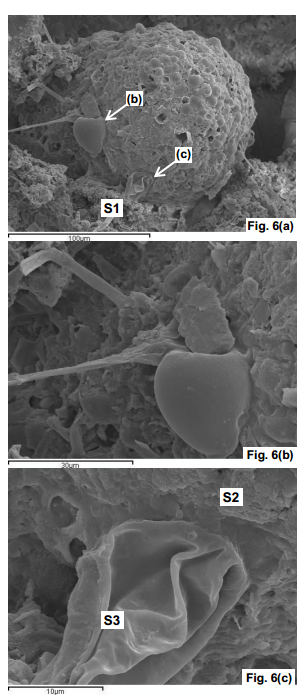
The most startling claims, however, are based on electron microscope images of structures within the stones (see above). Wallis and co say that one image shows a complex, thick-walled, carbon-rich microfossil about 100 micrometres across that bares similarities with a group of largely extinct marine dinoflagellate algae.

They say another image shows well-preserved flagella that are 2 micrometres in diameter and 100 micrometres long. By terrestrial standards, that’s extremely long and thin, which Wallis and co interpret as evidence of formation in a low-gravity, low-pressure environment.

Wallis and co also measured the abundance of various elements in the samples to determine their origin. They say that low levels of nitrogen in particular rule out the possibility of contamination by modern organisms which would have a much higher nitrogen content. The fact that these samples are also buried within the rock matrix is further evidence, they say.

Wallis and co are convinced that the lines of evidence they have gathered are powerful and persuasive. “This provides clear and convincing evidence that these obviously ancient remains of extinct marine algae found embedded in the Polonnaruwa meteorite are indigenous to the stones and not the result of post-arrival microbial contaminants,” they conclude.

There’s no question that a claim of this kind is likely to generate controversy. Critics have already pointed out that the stones could have been formed by lightning strikes on Earth although Wallis and co counter by saying there was no evidence of lightning at the time of the fireball and that in any case, the stones do not bear the usual characteristics of this kind of strike. What’s more, the temperatures generated by lightning would have destroyed any biological content.

Nevertheless, extraordinary claims require extraordinary evidence and Wallis and co will need to make their samples and evidence available to the scientific community for further study before the claims will be taken seriously.

If the paper is taken at face value, one obvious question that arises is where these samples came from. Wallis and co have their own ideas: “The presence of fossilized biological structures provides compelling evidence in support of the theory of cometary panspermia first proposed over thirty years ago,” they say.

This is an idea put forward by Fred Hoyle and Chandra Wickramasinghe, the latter being a member of the team who has carried out this analysis.

There are other explanations, of course. One is that the fireball was of terrestrial origin, a remnant of one of the many asteroid impacts in Earth’s history that that have ejected billions of tonnes of rock and water into space, presumably with biological material inside. Another is that the structures are not biological and have a different explanation.

Either way, considerably more work will have to be done before the claims from this team can be broadly accepted. Exciting times ahead!

http://www.technologyreview.com/view/512381/astrobiologists-find-ancient-fossils-in-fireball-fragments/

Thanks to Kebmodee for bringing this to the attention of the It’s Interesting community.

Stealth Wear fashion to shield people from drones and face-recognition software

drone-proof-burqa
As debate over the use of unmanned aerial vehicles in the U.S. rages on, a fashion designer introduces clothing that blocks drone-mounted infrared cameras.

As the U.S. government draws up plans to use surveillance drones in domestic airspace, opposition to what many consider an unwarranted and significant invasion of privacy is mounting across the country, from rural Virginia to techopolis Seattle. Although officials debate anti-drone legislation at federal, state and local levels, one man is fighting back with high-tech apparel.

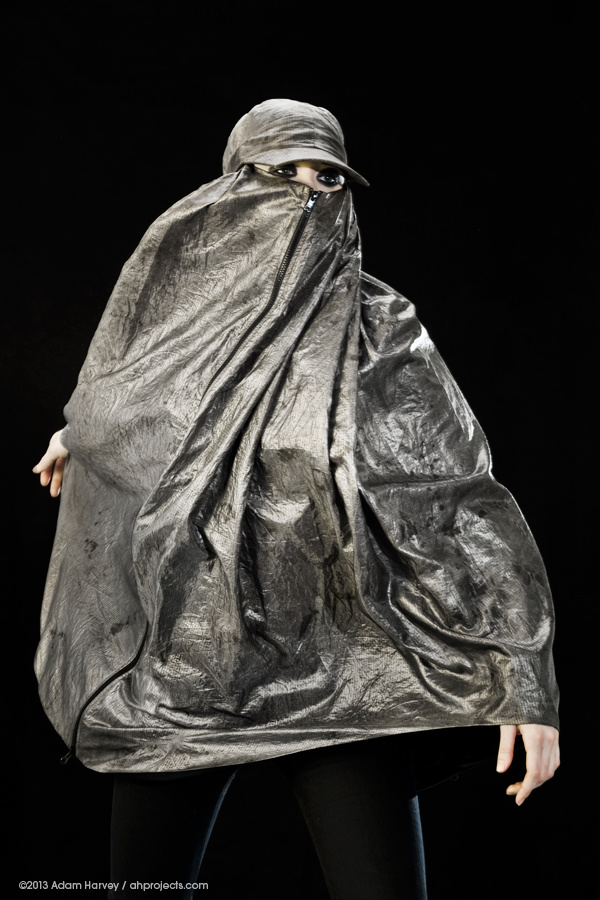
A New York City privacy advocate-turned-urban-guerilla fashion designer is selling garments designed to make their wearers invisible to infrared surveillance cameras, particularly those on drones. And although Adam Harvey admits that his three-item Stealth Wear line of scarves and capes is more of a political statement than a money-making venture, the science behind the fashion is quite sound.

“Fighting drones is not my full-time job, but it could be,” says Harvey, an instructor of physical computing at Manhattan’s School of Visual Arts and the creator of the CV Dazzle project, which seeks to develop makeup and hairstyles that camouflage people from face-recognition cameras and software.

Harvey’s newest medium, metalized fabric, has been around for more than 20 years. It holds in body heat that would burn bright for infrared cameras—a characteristic that could prove attractive to those who do not want unmanned aerial vehicles spying on them.

Metalized fabric
Metal is very good at absorbing and scattering infrared light, says Cheng Sun, a Northwestern University assistant professor of mechanical engineering. In that sense there is nothing exotic in how metalized fabric works—it “would strongly attenuate the [infrared] light,” he says. The metal would dissipate heat to surroundings as well, making the wearer harder to pinpoint.

To date, the fabric has primarily been used in tape and gaskets to protect electronics and communications equipment from static electricity and electromagnetic interference, according to Larry Creasy, director of technology for metalized fabric-maker Laird Technologies, based in Saint Louis.

Here’s how metalizing works, at least at Laird: Woven fabric, commonly nylon or polyester, is coated with a special catalyst—a precious metal Creasy declined to specify—that helps copper bind to the fiber. Once dry, the fabric is submerged in a copper sulfate–plating bath and dried. A nickel sulfamate bath follows to help the finished fabric withstand the elements and abrasions. The result is a flexible, breathable fabric that can be cut with ordinary tools but that protects against electromagnetic interference and masks infrared radiation, Creasy says. The process adds weight to the original fabric. An untreated square yard of nylon weighs about 42.5 grams. Treated, the same patch weighs more than 70 grams.

The fashion
Harvey’s fabric is coated with copper, nickel and silver, a combination that gives his scarves, head-and-shoulders cloak and thigh-length “burqa” a silvery and “luxurious” feel. The material blocks cell signals, as well, adding an element of risk to tweeting, texting and other mobile activities, as the wearer must break cover to communicate.

Stealth Wear is sold only via a U.K. Web site. The burqa goes for about $2,300, the “hoodie” is $481 and the scarf is $565—luxury items, but so, too, is privacy today, Harvey says.

The impetus
The high cost and limited availability are significant drawbacks—Harvey says he’s only sold one Stealth Wear item online, a scarf. But the Federal Aviation Administration (FAA) predicts 10,000 commercial drones will ply domestic airspace by 2017—almost twice the that of the U.S. Air Force’s current fleet of unmanned aircraft. The number of drones flying in the U.S. today is hard to pin down because not every company and agency that gets FAA approval to fly a drone actually puts one in the air. In fact, 1,428 private-sector and government requests have been approved since 2007, according to the FAA. A Los Angeles Times report states that 327 of those permits are still active. Meanwhile, President Obama signed a law in February 2012 that gives the FAA until September 2015 to draw up rules that dictate how law enforcement, the military and other entities may use drones in U.S. airspace.

As of October 2012, 81 law agencies, universities, an Indian tribal agency and other entities had applied to the FAA to fly drones, according to documents released by the FAA to the Electronic Freedom Frontier following a Freedom of Information Act lawsuit. Government entities as diverse as the U.S. Department of State and Otter Tail County, Minn., are among them.

Discomfort rising
Although Harvey’s anti-drone fashions are not currently flying off the shelves, he could soon find himself leading a seller’s market if recent events are any metric:

•The Charlottesville, Va., city council has passed a watered-down ordinance that asks the federal and commonwealth governments not to use drone-derived information in court. Proponents had sought to make the city drone-free (pdf).

•Virginia, Minnesota, Oregon, Montana, Arizona (pdf) and Idaho legislators are trying to at least regulate or even prohibit, drones in their skies.

•Seattle Mayor Mike McGinn returned the city’s two surveillance drones after a hostile public reception.

•A bipartisan pair of U.S. Representatives has introduced legislation to limit information-gathering by government-operated drones as well as prohibit weapons on law-enforcement and privately owned unmanned aerial vehicles.

Drone advocates defend the use of the technology as a surveillance tool. “We clearly need to do a better job of educating people about the domestic use of drones,” says Ben Gielow, government relations manager for the Association for Unmanned Vehicle Systems International. Gielow says U.S. voters must decide the acceptability of data collection from all sources, adding, “Ultimately, an unmanned aircraft is no different than gathering data from the GPS on your phone or from satellites.”

GPS does not use infrared cameras, however, and satellites are not at the center the current privacy debate brewing in Washington—factors that could make Harvey’s designs all the more fashionable.

http://www.scientificamerican.com/article.cfm?id=drone-proof-anti-infrared-apparel&page=2

Flip of a single molecular switch makes an old brain young

green-image

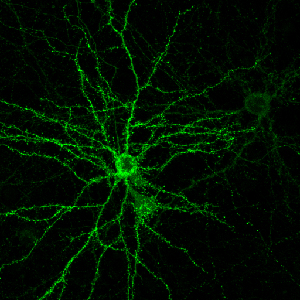
The flip of a single molecular switch helps create the mature neuronal connections that allow the brain to bridge the gap between adolescent impressionability and adult stability. Now Yale School of Medicine researchers have reversed the process, recreating a youthful brain that facilitated both learning and healing in the adult mouse.

Scientists have long known that the young and old brains are very different. Adolescent brains are more malleable or plastic, which allows them to learn languages more quickly than adults and speeds recovery from brain injuries. The comparative rigidity of the adult brain results in part from the function of a single gene that slows the rapid change in synaptic connections between neurons.

By monitoring the synapses in living mice over weeks and months, Yale researchers have identified the key genetic switch for brain maturation a study released March 6 in the journal Neuron. The Nogo Receptor 1 gene is required to suppress high levels of plasticity in the adolescent brain and create the relatively quiescent levels of plasticity in adulthood. In mice without this gene, juvenile levels of brain plasticity persist throughout adulthood. When researchers blocked the function of this gene in old mice, they reset the old brain to adolescent levels of plasticity.

“These are the molecules the brain needs for the transition from adolescence to adulthood,” said Dr. Stephen Strittmatter. Vincent Coates Professor of Neurology, Professor of Neurobiology and senior author of the paper. “It suggests we can turn back the clock in the adult brain and recover from trauma the way kids recover.”

Rehabilitation after brain injuries like strokes requires that patients re-learn tasks such as moving a hand. Researchers found that adult mice lacking Nogo Receptor recovered from injury as quickly as adolescent mice and mastered new, complex motor tasks more quickly than adults with the receptor.

“This raises the potential that manipulating Nogo Receptor in humans might accelerate and magnify rehabilitation after brain injuries like strokes,” said Feras Akbik, Yale doctoral student who is first author of the study.

Researchers also showed that Nogo Receptor slows loss of memories. Mice without Nogo receptor lost stressful memories more quickly, suggesting that manipulating the receptor could help treat post-traumatic stress disorder.

“We know a lot about the early development of the brain,” Strittmatter said, “But we know amazingly little about what happens in the brain during late adolescence.”

Other Yale authors are: Sarah M. Bhagat, Pujan R. Patel and William B.J. Cafferty

The study was funded by the National Institutes of Health. Strittmatter is scientific founder of Axerion Therapeutics, which is investigating applications of Nogo research to repair spinal cord damage.

http://news.yale.edu/2013/03/06/flip-single-molecular-switch-makes-old-brain-young

Palindrome Championship

palindrome2

For most of us, palindromes are just something we learn about one day in school. The teacher writes “race car” on the board, explaining that the phrase is the same backwards as forwards; minds are temporarily blown; and then everyone goes about their lives. But for true palindromists, crafting these linguistic mirror images is an obsession. And they’re about to test their best creations in a competition judged by the likes of crossword guru Will Shortz and “Weird Al” Yankovic.

The first annual SymmyS awards for “outstanding palindrome achievement” were organized by stand-up comedian Mark Saltveit, who runs the online Palindromist magazine out of Portland, Ore. The prizes for this painstaking battle of the wits are bragging rights and pencils decorated with author Jon Agee’s palindrome “Todd erases a red dot.” Unlike another palindrome showdown held last year, there was no time limit on entries. Hundreds of submissions were narrowed down to 40 finalists, ten in each of four categories: long, short, poetry and word-unit (i.e. palindromes that reverse words rather than letters, like “All for one, and one for all!”).

The criteria for judging were left up to the judges, whom we surveyed via email. Their ranks will determine a winner in each category and an overall champ. “Weird Al,” who names “Oozy rat in a sanitary zoo” as a personal favorite, says a winner should show a sense of humor or a spark of wit, as he did in his palindromic song “Bob,” which contains another renowned Agee line: “Go hang a salami, I’m a lasagna hog.”
Many of the entries, anonymous until the winners are announced, certainly have a cheeky side. Take this submission:

A slightly violent to-do list
Tape Roger.
Go “Bang!”
Get Cello.
Collect egg.
Nab Ogre.
Gore Pat.

Will Shortz, famed editor of the New York Times crossword, says that beyond humor, “The most important criteria for a palindrome are sense and naturalness of syntax.” Classics like “A man, a plan, a canal: Panama” belie how difficult it is to make even a moderate amount of sense in a palindrome. Shortz says this is his favorite palindrome, and the longest one he’s ever seen that is generally coherent:

“T. Eliot, top bard, notes putrid tang emanating, is sad. I’d assign it a name — gnat-dirt upset on drab pot toilet.”
Cohering can be easier in word-unit palindromes. Take this sportsman-friendly finalist: “Fishing for excuses? No need. You need no excuses for fishing.” Many of the entries take more brain power to read, such as this poem entitled “Internal Terrorism”:

Doom? Reward?
A maniac ire made target.
Ah, a mix — a mania, terror on Ohio.
I honor or retain a maxim:
“A hate grated America in a mad, rawer mood.”

Palindromist and judge Jeff Grant says he’s also looking for a “natural” quality in palindromes, as in one of his favorites: “Sex at noon taxes.” Comedian Jackie Kashian, who hosts the podcast “The Dork Forest,” says she’ll be looking for depth, though she also loves the simplicity of creations like “evil olive.” Other judges include comedian Demetri Martin and musician John Flansburgh of They Might Be Giants.

To some, the amount of time and effort it takes to craft a palindrome may seem like a waste. But they are the perfect circles of wordplay, nerdy gems that illustrate the potential of our language. “The writing of a brilliant palindrome is a small miracle,” Yankovic says, “and that, I think, deserves to be honored more than a lot of the stupid and inconsequential things we often celebrate in our culture.” The winners will be announced this weekend in Portland and on the Palindromist’s website. A press release from organizer Saltveit notes that the awards ceremony will be modeled after the Oscars, though any offensive musical numbers will be limited to singular “boob” references.

Read more: http://newsfeed.time.com/2013/03/06/madam-im-adam-palindrome-masters-go-head-to-head-in-championship/#ixzz2N9GpKhI8

Supermassive black hole spins at nearly the speed of light

blackhole
This artist’s concept illustrates a supermassive black hole with millions to billions times the mass of our sun. It’s surrounded by matter flowing onto the black hole in what is termed an accretion disk. Also shown is an outflowing jet of energetic particles, believed to be powered by the black hole’s spin. High energy X-radiation lights up the disk, which reflects it, making the disk a source of X-rays. The reflected light enables astronomers to see how fast matter is swirling in the inner region of the disk, and ultimately to measure the black hole’s spin rate.

Nothing can escape a black hole, even light, because to wrench away from its titanic gravitational pull, you’d have to move faster than light is capable of traveling. And nothing can do that, as far as anyone knows. As matter falls into a black hole’s gaping maw, it superheats to millions of degrees, screaming a final cry of X-rays as it is torn apart. At a specific point called an event horizon, the matter disappears and is never heard from again.

A pair of X-ray telescopes recently watched some of these X-ray death gasps and were able to figure out how fast a black hole is spinning. This is “hugely important” for black hole science, according to researchers working with NASA’s Nuclear Spectroscopic Telescope Array, or NuSTAR space telescope. One particularly cool finding: The black hole is spinning almost as fast as Einstein’s theory of gravity says it possibly could. It’s spinning at almost the speed of light.

The galaxy in question is called NGC 1365, which is about twice the size of the Milky Way and located about 60 million light years away. The black hole is about 2 million times more massive than the sun. Scientists using NuSTAR and the European Space Agency’s XMM-Newton satellite wanted to measure how fast it is spinning. This is a key feature of black holes that is related to their size and the way they gobble up stars, gas and even other black holes.

The problem is that black holes are hard to study, because, you know, not even light can escape them. To measure them, you have to measure their effect on their surroundings–like the X-rays emitted by dying matter. This is hard to do because objects between us and them can get in the way, however, making the X-rays look distorted. There have been two competing models explaining why the X-rays look warped: Either gravitational distortion caused by black hole gravity, or distortion caused by intervening clouds of gas and dust.

In this new study, NuSTAR and XMM-Newton set out to determine which one is right. The telescopes carefully traced the X-rays emitted at the very, very edge of the black hole, right near the event horizon, or the point of no return. By combining their distinct viewing abilities, the two telescopes were able to see a wide range of X-ray energies, and figure out that the X-rays are not actually distorted by intervening gas clouds. They look distorted because the black hole is spinning, and its immense gravity warps spacetime as it swirls around. This information was used to tell just how fast the black hole is spinning: Just below the universal speed limit.

Along with new information about this particular black hole, this study suggests that black hole observations can remove a little bit of ambiguity. This will help astronomers continue to unravel the mysteries of these galactic monsters. A paper describing the findings is published last week in Nature.

http://www.popsci.com/science/article/2013-02/new-telescope-discovery-distant-gargantuan-black-hole-spins-near-light-speed

Patient has 75% of his skull replaced by a 3D-printed implant

073188-skull

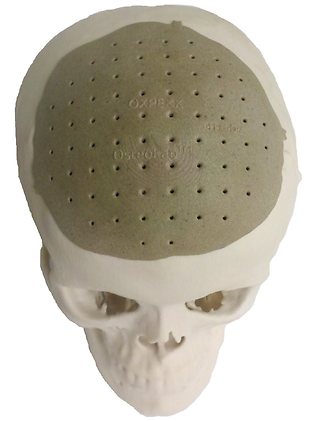
A man has had 75 per cent of his skull replaced with a custom-made 3D-printed implant.
The un-named patient in the United States had his head imaged by a 3D scanner before the plastic prosthetic was crafted to suit his features.

Oxford Performance Materials in Connecticut then gained approval from US regulators before the printed bone replacement was inserted in his skull during a surgical procedure earlier this week.

The ground-breaking operation has only now been revealed.

The company says it can now provide the 3D printouts to replace bone damaged by disease or trauma after the US Food and Drug Administration granted approval on February 18.

The implant is more than a simple moulded plastic plate: Tiny surface details are etched into the polyetherketoneketone to encourage the growth of cells and bone.

The company says about 500 people in the US could make use of the technology each month, with recipients ranging from injured construction workers through to wounded soldiers.

It says it can produce an implant within two weeks of obtaining 3D scans of the affected area.

Read more: http://www.news.com.au/technology/patient-has-75-per-cent-of-his-skull-replaced-by-3dd-printed-implant/story-e6frfro0-1226593075470#ixzz2MzSoM5gy

Thanks to Kebmodee for bringing this to the attention of the It’s Interesting community.

Pessimism About the Future May Lead to Longer, Healthier Life

Pessimism-vs_-optimism-350x262
Older people who have low expectations for a satisfying future may be more likely to live longer, healthier lives than those who see brighter days ahead, according to new research published by the American Psychological Association.

“Our findings revealed that being overly optimistic in predicting a better future was associated with a greater risk of disability and death within the following decade,” said lead author Frieder R. Lang, PhD, of the University of Erlangen-Nuremberg in Germany. “Pessimism about the future may encourage people to live more carefully, taking health and safety precautions.” The study was published online in the journal Psychology and Aging.

Lang and colleagues examined data collected from 1993 to 2003 for the national German Socio-Economic Panel, an annual survey of private households consisting of approximately 40,000 people 18 to 96 years old. The researchers divided the data according to age groups: 18 to 39 years old, 40 to 64 years old and 65 years old and above. Through mostly in-person interviews, respondents were asked to rate how satisfied they were with their lives and how satisfied they thought they would be in five years.

Five years after the first interview, 43 percent of the oldest group had underestimated their future life satisfaction, 25 percent had predicted accurately and 32 percent had overestimated, according to the study. Based on the average level of change in life satisfaction over time for this group, each increase in overestimating future life satisfaction was related to a 9.5 percent increase in reporting disabilities and a 10 percent increased risk of death, the analysis revealed.

Because a darker outlook on the future is often more realistic, older adults’ predictions of their future satisfaction may be more accurate, according to the study. In contrast, the youngest group had the sunniest outlook while the middle-aged adults made the most accurate predictions, but became more pessimistic over time.

“Unexpectedly, we also found that stable and good health and income were associated with expecting a greater decline compared with those in poor health or with low incomes,” Lang said. “Moreover, we found that higher income was related to a greater risk of disability.”

The researchers measured the respondents’ current and future life satisfaction on a scale of 0 to 10 and determined accuracy in predicting life satisfaction by measuring the difference between anticipated life satisfaction reported in 1993 and actual life satisfaction reported in 1998. They analyzed the data to determine age differences in estimated life satisfaction; accuracy in predicting life satisfaction; age, gender and income differences in the accuracy of predicting life satisfaction; and rates of disability and death reported between 1999 and 2010. Other factors, such as illness, medical treatment or personal losses, may have driven health outcomes, the study said.

The findings do not contradict theories that unrealistic optimism about the future can sometimes help people feel better when they are facing inevitable negative outcomes, such as terminal disease, according to the authors. “We argue, though, that the outcomes of optimistic, accurate or pessimistic forecasts may depend on age and available resources,” Lang said. “These findings shed new light on how our perspectives can either help or hinder us in taking actions that can help improve our chances of a long healthy life.”

http://www.sciencedaily.com/releases/2013/02/130227101929.htm