Online Video Game Plugs Players Into Real Biochemistry Lab

sn-crowdsourcing

Crowdsourcing is the latest research rage—Kickstarter to raise funding, screen savers that number-crunch, and games to find patterns in data—but most efforts have been confined to the virtual lab of the Internet. In a new twist, researchers have now crowdsourced their experiments by connecting players of a video game to an actual biochemistry lab. The game, called EteRNA, allows players to remotely carry out real experiments to verify their predictions of how RNA molecules fold. The first big result: a study published this week in the Proceedings of the National Academy of Sciences, bearing the names of more than 37,000 authors—only 10 of them professional scientists. “It’s pretty amazing stuff,” says Erik Winfree, a biophysicist at the California Institute of Technology in Pasadena.

Some see EteRNA as a sign of the future for science, not only for crowdsourcing citizen scientists but also for giving them remote access to a real lab. “Cloud biochemistry,” as some call it, isn’t just inevitable, Winfree says: It’s already here. DNA sequencing, gene expression testing, and many biochemical assays are already outsourced to remote companies, and any “wet lab” experiment that can be automated will be automated, he says. “Then the scientists can focus on the non-boring part of their work.”

EteRNA grew out of an online video game called Foldit. Created in 2008 by a team led by David Baker and Zoran Popović, a molecular biologist and computer scientist, respectively, at the University of Washington, Seattle, Foldit focuses on predicting the shape into which a string of amino acids will fold. By tweaking virtual strings, Foldit players can surpass the accuracy of the fastest computers in the world at predicting the structure of certain proteins. Two members of the Foldit team, Adrien Treuille and Rhiju Das, conceived of EteRNA back in 2009. “The idea was to make a version of Foldit for RNA,” says Treuille, who is now based at Carnegie Mellon University in Pittsburgh, Pennsylvania. Treuille’s doctoral student Jeehyung Lee developed the needed software, but then Das persuaded them to take it a giant step further: hooking players up directly to a real-world, robot-controlled biochemistry lab. After all, RNA can be synthesized and its folded-up structure determined far more cheaply and rapidly than protein can.

Lee went back to the drawing board, redesigning the game so that it had not only a molecular design interface like Foldit, but also a laboratory interface for designing RNA sequences for synthesis, keeping track of hypotheses for RNA folding rules, and analyzing data to revise those hypotheses. By 2010, Lee had a prototype game ready for testing. Das had the RNA wet lab ready to go at Stanford University in Palo Alto, California, where he is now a professor. All they lacked were players.

A message to the Foldit community attracted a few hundred players. Then in early 2011, The New York Times wrote about EteRNA and tens of thousands of players flooded in.

The game comes with a detailed tutorial and a series of puzzles involving known RNA structures. Only after winning 10,000 points do you unlock the ability to join EteRNA’s research team. There the goal is to design RNA sequences that will fold into a target structure. Each week, eight sequences are chosen by vote and sent to Stanford for synthesis and structure determination. The data that come back reveal how well the sequences’ true structures matched their targets. That way, Treuille says, “reality keeps score.” The players use that feedback to tweak a set of hypotheses: design rules for determining how an RNA sequence will fold.

Two years and hundreds of RNA structures later, the players of EteRNA have proven themselves to be a potent research team. Of the 37,000 who played, about 1000 graduated to participating in the lab for the study published today. (EteRNA now has 133,000 players, 4000 of them doing research.) They generated 40 new rules for RNA folding. For example, at the junctions between different parts of the RNA structure—such as between a loop and an arm—the players discovered that it is far more stable if enriched with guanines and cytosines, the strongest bonding of the RNA base pairs. To see how well those rules describe reality, the humans then competed toe to toe against computers in a new series of RNA structure challenges. The researchers distilled the humans’ 40 rules into an algorithm called EteRNA Bot.

The human players still came out on top, solving structures more accurately than the standard software 99% of the time. The algorithmic version of their rules also outperformed the standard software, but only 95% of the time, showing that the crowdsourced human RNA-folding know-how has not been completely captured yet. The next step, Lee says, is to make the wet lab completely robotic. It still requires humans to operate some of the steps between the input of player RNA sequences and the data output.

EteRNA won’t work for every kind of science, says Shawn Douglas, a biomolecular engineer at the University of California, San Francisco, because a problem has to be “amenable to game-ification.” But he’s optimistic that there will be many more to come. “Many areas of biological research have reached a level of complexity that the mental bandwidth of the individual researcher has become a bottleneck,” Douglas says. EteRNA proves that “there are tens of thousands of people around the world with surplus mental bandwidth and the desire to participate in scientific problem solving.” The trick is to design a good game.

http://news.sciencemag.org/biology/2014/01/online-video-game-plugs-players-real-biochemistry-lab

Thanks to Dr. Rajadhyaksha for bringing this to the It’s Interesting community.

U.S. WWII Minnesota Starvation Experiment

Towards the end of World War II, word got through that certain people in occupied territories were eating a near-starvation diet. American researchers wanted to study the effects of starvation, so they recruited volunteers – and starved them some more.

The Minnesota Starvation Experiment pretty much lived up to its name. It was an early experiment in nutrition prompted by news about the conditions in Europe during World War II. The full horror of concentration camps was still to come, but word came in that people in war-torn territories were living on severely restricted diets. Everyone knew that things were going to get worse before they got better, and concerned researched wanted to find out the effects of starvation and how to rehabilitate a severely starved person. In November of 1944, at The University of Minnesota, a study began on the effects of starvation.

When contacted years later, many of the men said the experiment was the toughest thing they had ever done, but were happy to have participated and said they would do it again.

http://io9.com/the-us-wartime-experiment-that-starved-men-more-than-1507200589

Thanks to Kebmodee for bringing this to the attention of the It’s Interesting community.
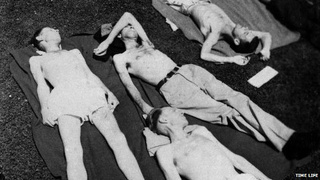
From a pool of 400 volunteers, 36 men were chosen. All were between 22 and 33, and all were in good health. They were told that the experiment would go through four phases. For three months, they would eat a specific number of calories, so that researchers could get them to a healthy weight and get a baseline for their diet. (They were kept active, and the diet they were given was 3,200 calories.) Once they’d gotten up to their “fighting weight,” their caloric intake was to be halved. They’d take in 1,560 calories a day, every day, and no more. They’d have a diet comparable to the food people in Europe would have available – root vegetables and starches with the occasional meat or jell-o. The goal of the diet was to make the men lose a little over two pounds a week, and twenty-five percent of their body weight in six months.

After six months, they’d go through a three-month rehabilitative phase, where they would be allowed more food. They’d be divided into many groups, with different groups given different amounts of calories, and different amounts of protein, fat, and vitamins. Finally, they’d be allowed eight weeks of eating whatever they wanted.

this time, they were kept in dormitories on campus, given regular blood tests, endurance tests, mental tests, and many other kind of tests. They were given administrative work in the lab, and allowed to attend classes at the university. Most of all, they were watched. For the tests to be successful, the researchers had to be sure that the participants weren’t cheating.

The rehabilitative diet did not remain of general interest to subsequent generations – although it did help scientists understand that people who had been starved needed to be overfed, rather than just fed, to help them rebuild their bodies. It is the effects that retain lasting fascination for scientists and for the public. At first, the participants merely complained of hunger, of an inability to concentrate, and of poor judgment. If the men didn’t lose enough weight, their rations were reduced – meaning some got more food than others. They all ate together, watching who got what. Unsurprisingly, resentment sprang up and there were a lot of fights in the dorms. Then came extreme depression. Several members were hospitalized for psychiatric problems. Some mutilated themselves. One man amputated three fingers with a hatchet, although he said later he didn’t know whether he’d done it on purpose or was just not thinking clearly. Considering he had injured his fingers once before, letting a car fall on them, the researchers thought the new injury was at least semi-deliberate, released him from the experiment and put him in psychiatric care.

Then came weakness. When one man cheated on the diet, the researchers demanded the rest of the men go everywhere with a buddy. Years later one of the participants said he was grateful for the buddy system, since he could no longer open heavy doors by himself. The men lost their hair, became dizzy, felt cold all the time, and their muscles ached. Many dropped out of classes. Scientists noted that their resting heart rate and breath rate also fell. The starving body was trying to use up as few calories as possible. For a while, they were allowed gum. They chewed up to forty packs every day until the researchers disallowed gum chewing.

They became obsessed with what food they did have, holding it in their mouths and trying to stretch out mealtimes. On man said that what bothered him more than anything was the fact that food became the central point in his life. He no longer cared about anything but food. He watched movies for the eating scenes, and read magazines for the food ads. Another man said he had begun hating people who were able to go home and have a good dinner. Food became their curse and obsession. This was unsurprising, as a good portion of the men overshot the projected goal of a twenty-five percent loss of body weight. Many men were down to 99 or 100 pounds.

During the three-month rehabilitation period, different groups of men were supposed to receive different amounts of food. Researchers quickly scrapped that idea after the lower-calorie-diet men didn’t show signs of recovery. Some even lost weight after their calorie intake was increased. The lack of calories had caused some of the men’s legs to swell with water, and a calorie infusion allowed them to shed the excess liquid. Despite the sincere efforts of the researchers, almost no men felt recovered after just three months. On the day they were allowed to eat again, quite a few overate and got sick. One had his stomach pumped. Even getting back to their earlier weight didn’t help. They packed on the pounds well beyond that. Some said they couldn’t stop obsessively eating for a year. There was never “enough” food for them.

Today, the results of the Minnesota Starvation Study are mostly of note to people who study eating disorders. Many of the behaviors the starving men displayed, such as diluting food with water to make it look more filling, or overchewing their food to stretch out mealtimes, are also displayed by people suffering from anorexia. The men’s subsequent relentless feeding is similar to binge-eating. Although they made themselves sick physically, they couldn’t get enough food to make them feel satisfied.

Stephen Hawking: ‘There are no black holes’

Stephen Hawking's black hole theory
Notion of an ‘event horizon’, from which nothing can escape, is incompatible with quantum theory, physicist claims.

by Zeeya Merali

Most physicists foolhardy enough to write a paper claiming that “there are no black holes” — at least not in the sense we usually imagine — would probably be dismissed as cranks. But when the call to redefine these cosmic crunchers comes from Stephen Hawking, it’s worth taking notice. In a paper posted online, the physicist, based at the University of Cambridge, UK, and one of the creators of modern black-hole theory, does away with the notion of an event horizon, the invisible boundary thought to shroud every black hole, beyond which nothing, not even light, can escape.

In its stead, Hawking’s radical proposal is a much more benign “apparent horizon”, which only temporarily holds matter and energy prisoner before eventually releasing them, albeit in a more garbled form.

“There is no escape from a black hole in classical theory,” Hawking told Nature. Quantum theory, however, “enables energy and information to escape from a black hole”. A full explanation of the process, the physicist admits, would require a theory that successfully merges gravity with the other fundamental forces of nature. But that is a goal that has eluded physicists for nearly a century. “The correct treatment,” Hawking says, “remains a mystery.”

Hawking posted his paper on the arXiv preprint server on 22 January1. He titled it, whimsically, ‘Information preservation and weather forecasting for black holes’, and it has yet to pass peer review. The paper was based on a talk he gave via Skype at a meeting at the Kavli Institute for Theoretical Physics in Santa Barbara, California, in August 2013.

Hawking’s new work is an attempt to solve what is known as the black-hole firewall paradox, which has been vexing physicists for almost two years, after it was discovered by theoretical physicist Joseph Polchinski of the Kavli Institute and his colleagues.

In a thought experiment, the researchers asked what would happen to an astronaut unlucky enough to fall into a black hole. Event horizons are mathematically simple consequences of Einstein’s general theory of relativity that were first pointed out by the German astronomer Karl Schwarzschild in a letter he wrote to Einstein in late 1915, less than a month after the publication of the theory. In that picture, physicists had long assumed, the astronaut would happily pass through the event horizon, unaware of his or her impending doom, before gradually being pulled inwards — stretched out along the way, like spaghetti — and eventually crushed at the ‘singularity’, the black hole’s hypothetical infinitely dense core.

But on analysing the situation in detail, Polchinski’s team came to the startling realization that the laws of quantum mechanics, which govern particles on small scales, change the situation completely. Quantum theory, they said, dictates that the event horizon must actually be transformed into a highly energetic region, or ‘firewall’, that would burn the astronaut to a crisp.

This was alarming because, although the firewall obeyed quantum rules, it flouted Einstein’s general theory of relativity. According to that theory, someone in free fall should perceive the laws of physics as being identical everywhere in the Universe — whether they are falling into a black hole or floating in empty intergalactic space. As far as Einstein is concerned, the event horizon should be an unremarkable place.

Now Hawking proposes a third, tantalizingly simple, option. Quantum mechanics and general relativity remain intact, but black holes simply do not have an event horizon to catch fire. The key to his claim is that quantum effects around the black hole cause space-time to fluctuate too wildly for a sharp boundary surface to exist.

In place of the event horizon, Hawking invokes an “apparent horizon”, a surface along which light rays attempting to rush away from the black hole’s core will be suspended. In general relativity, for an unchanging black hole, these two horizons are identical, because light trying to escape from inside a black hole can reach only as far as the event horizon and will be held there, as though stuck on a treadmill. However, the two horizons can, in principle, be distinguished. If more matter gets swallowed by the black hole, its event horizon will swell and grow larger than the apparent horizon.

Conversely, in the 1970s, Hawking also showed that black holes can slowly shrink, spewing out ‘Hawking radiation’. In that case, the event horizon would, in theory, become smaller than the apparent horizon. Hawking’s new suggestion is that the apparent horizon is the real boundary. “The absence of event horizons means that there are no black holes — in the sense of regimes from which light can’t escape to infinity,” Hawking writes.

“The picture Hawking gives sounds reasonable,” says Don Page, a physicist and expert on black holes at the University of Alberta in Edmonton, Canada, who collaborated with Hawking in the 1970s. “You could say that it is radical to propose there’s no event horizon. But these are highly quantum conditions, and there’s ambiguity about what space-time even is, let alone whether there is a definite region that can be marked as an event horizon.”

Although Page accepts Hawking’s proposal that a black hole could exist without an event horizon, he questions whether that alone is enough to get past the firewall paradox. The presence of even an ephemeral apparent horizon, he cautions, could well cause the same problems as does an event horizon.

Unlike the event horizon, the apparent horizon can eventually dissolve. Page notes that Hawking is opening the door to a scenario so extreme “that anything in principle can get out of a black hole”. Although Hawking does not specify in his paper exactly how an apparent horizon would disappear, Page speculates that when it has shrunk to a certain size, at which the effects of both quantum mechanics and gravity combine, it is plausible that it could vanish. At that point, whatever was once trapped within the black hole would be released (although not in good shape).

If Hawking is correct, there could even be no singularity at the core of the black hole. Instead, matter would be only temporarily held behind the apparent horizon, which would gradually move inward owing to the pull of the black hole, but would never quite crunch down to the centre. Information about this matter would not destroyed, but would be highly scrambled so that, as it is released through Hawking radiation, it would be in a vastly different form, making it almost impossible to work out what the swallowed objects once were.

“It would be worse than trying to reconstruct a book that you burned from its ashes,” says Page. In his paper, Hawking compares it to trying to forecast the weather ahead of time: in theory it is possible, but in practice it is too difficult to do with much accuracy.

Polchinski, however, is sceptical that black holes without an event horizon could exist in nature. The kind of violent fluctuations needed to erase it are too rare in the Universe, he says. “In Einstein’s gravity, the black-hole horizon is not so different from any other part of space,” says Polchinski. “We never see space-time fluctuate in our own neighbourhood: it is just too rare on large scales.”

Raphael Bousso, a theoretical physicist at the University of California, Berkeley, and a former student of Hawking’s, says that this latest contribution highlights how “abhorrent” physicists find the potential existence of firewalls. However, he is also cautious about Hawking’s solution. “The idea that there are no points from which you cannot escape a black hole is in some ways an even more radical and problematic suggestion than the existence of firewalls,” he says. “But the fact that we’re still discussing such questions 40 years after Hawking’s first papers on black holes and information is testament to their enormous significance.”

http://www.nature.com/news/stephen-hawking-there-are-no-black-holes-1.14583?WT.mc-id=GPL_NatureNews

Video shows humpback whale almost capsizing kayaker in Norway

Incredible footage has emerged capturing the moment a humpback whale swam underneath a kayak and almost capsized the kayaker.
Berthold Hinrichs was kayaking in waters near Senja Island in northern Norway when he saw a pod of humpback whales breaching in the water nearby.

His camera shows as the whales swim closer and closer to his kayak. Finally a humpback whale surfaces right next to him.

“[It] did not capsize [the kayak] but me and my camera got wet,” Hinrichs told news.com.au. “Some minutes later it happened again and then I was on the back of the humpback,” he said.

The video shows the moment the whale swims beside him and then directly under his kayak, crashing into it and making Hinrichs’ kayak shake.

“I got a lot of water in my kayak which froze to ice, so I had to return to the harbour,” Hinrichs said.

According to Hinrichs, there were about 30 humpback whales and 50 orcas in Senja bay that day.

Hinrichs is an avid adventurer and nature enthusiast, whose Facebook page ( https://www.facebook.com/berthold.hinrichs#!/berthold.hinrichs ) contains magnificent photos and videos of many up-close encounters with sea creatures.

Humpbacks are a highly migratory species, found in oceans all around the world. There are estimated to be 6000-8000 humpback whales in the North Pacific and about 10,000 in the North Atlantic. Humpback whales are classified as endangered.

http://www.news.com.au/travel/world-travel/amazing-footage-shows-humpback-whale-almost-capsize-kayaker-in-norway/story-e6frfqbr-1226812210586

Rarely Seen Whale Courting Ritual Spotted Off SoCal Coast

whale+mating
A pair of gray whales is seen courting off the coast of Dana Point, Calif., on Sunday, Jan. 26, 2014, hundreds of miles north of their typical, protected breeding spots in the warm lagoons of Baja California

Not only are whales spyhopping more than usual off the SoCal coast this year, they’re putting on shows rarely seen in this part of the Pacific.

An amorous pair of gray whales was spotted rolling in the surf about 2 miles off the Dana Point coast Sunday — a ritual suggestive of courtship and possibly mating, and usually seen farther out in the ocean.

“It’s not often that we catch this behavior on film,” said Alisa Schulman-Janiger, director and coordinator for ACS/LA Gray Whale Census and Behavior Project.

Schulman-Janiger was hesitant to describe the behavior as mating since it wasn’t clear exactly what was happening underwater, but she said the whales rolling, breaching and touching certainly looks like courtship.

A camera on board Captain Dave’s Dolphin & Whale Watching Safari captured the moment, embedded below. Among the voyeurs witnessing the couple were a pod of curious bottlenose dolphins, kayakers and a stand-up paddle boarder.

“Apparently everyone was curious, especially the dolphin. We often see pacific white-sided dolphin interacting with these whales but to have bottlenose dolphin was extraordinary,” Captain Dave Anderson said.

Every year, gray whales migrate some 12,000 miles from their feeding grounds near Alaska and British Columbia to the warm, protected lagoons of Baja California — hundreds of miles south of Dana Point — to give birth and nurse their calves.

“We don’t know why these two whales chose to make a stop along the way,” Anderson said.

It’s also a mystery why this season has been particularly plentiful for whale watchers off the Southern California coast. Schulman-Janiger said gray whale sightings are the second-highest they’ve been in 31 years, and several factors could be contributing to the trend.

California’s extremely dry winter has made visibility along the coast consistently better, so watchers may be seeing more whales simply because conditions are clearer, Schulman-Janiger said.

“If you can see them, you can count them,” she said.
Another possibility lies in the whales’ arctic feeding grounds, which froze earlier than usual this year, forcing them to head south sooner than expected.

But that still doesn’t explain why so many whales are appearing to hug the shore, a route typically taken by young whales who aren’t in such a rush to get to the Baja lagoons and mate. Schulman-Janiger said scientists will need to see the whole picture of this year’s season before a conclusion can be reached.

So far, Captain Dave’s safaris have had 168 gray whale encounters this season, which runs from January to May. By comparison, the safaris recorded 78 sightings of gray whales last year, the group said.

About 50 miles north along the Palos Verdes Peninsula, where Schulman-Janiger’s whale census project is stationed, there have been about 738 gray whale sightings since Dec. 1, 2013. That’s up about 200 since last year and more than twice the average, according to data from the ACS/LA Gray Whale Census and Behavior Project, pictured above.

For those hoping to spot whales, the creatures will continue migrating south until about mid-February. At the end of April and beginning of May, mothers and their calves will start moving northward again.

To protect the still-vulnerable juveniles, these pairs tend to hug the shore so there’s a better chance of spotting them on their way back to arctic feeding grounds, Schulman-Janiger said.

Foot-Long, Sex-Crazed Snails That Pierce Tires and Devour Houses

hand
giant snail

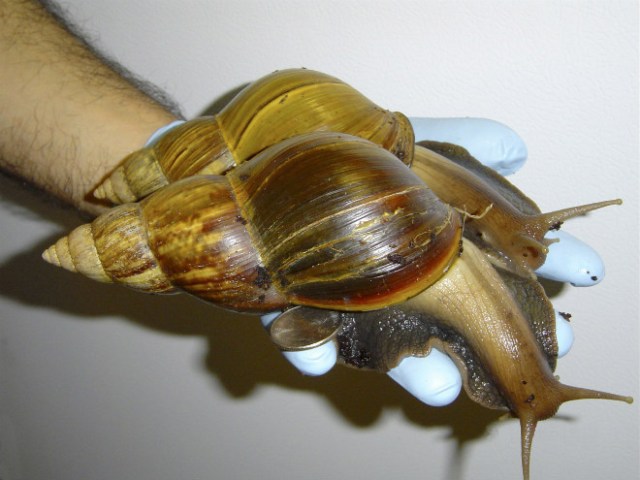
In the 1960s, a boy vacationing with his family in Hawaii pocketed a few giant African land snails (Lissachatina fulica), a mollusk that grows to a foot long and a full pound. Hawaii had been battling the pest, and so too would Florida, where the boy returned with his new friends. Once home, he quickly grew bored of the snails and handed them over to his grandmother, who set them free in her backyard.

What ensued was an invasion by rapidly reproducing critters that have over the last century spread out of their native East Africa into tropical climes all over the world, from Asia to South America, as stowaways on ships or as pets brought home by people with a thing for snails. In Florida, eradication took seven years. Other places, like Brazil, have not been so lucky in their efforts.

You see, the giant African land snail is a hermaphroditic love machine. “Snails have female bits and male bits,” explained biologist Robert Cowie of the University of Hawaii, “a single pore, through which if you’re acting as a male, a penis extrudes, or if you’re acting as a female, through which the other snail puts its penis in. And in some cases they can do it reciprocally.”

Thus the giant snail never meets another snail it can’t get busy with. Once fertilized, the snail will bury several hundred eggs a few inches below ground, and because of the incredible size of the species, the young will emerge far larger than native varieties, making them that much more resistant to predation.

Alas, four decades after evicting this enormous, fecund snail, Florida finds itself overrun once again. The creature was reintroduced here in 2011, and this time, according to Cowie, it may well be “bizarre, voodoo-like religious proceedings” to blame. The snail’s slime, he says, is coveted in certain South American rituals, and practitioners may have released the giant snails into their Miami-area backyards, hoping they’d breed freely.

The USDA and U.S. District Attorney’s Office are investigating this. It probably doesn’t help the ritualists’ case, though, that the year before the current outbreak, authorities questioned a Florida man said to have convinced his followers to drink the fluid from live giant African land snails, which he sliced open before squeezing the slime into their mouths. If you can believe it, the victims fell violently ill — ironic, what with this being a healing ritual.

Anyway, if it was indeed the practitioners who released the snails so they (the snails, not the practitioners) could multiply rapidly, it worked. Big time. Florida agriculture officials have collected 137,000 giant snails in just over two years. Compare that to the relatively few 17,000 collected in the first eradication in the 1960s, and you soon see the magnitude of this problem.

Today, Miami is simply overrun with the things. Not only do the giant snails chow on some 500 economically important plants in the area, they’re devouring houses. It seems they have a taste for stucco, which contains precious calcium. Without a ready supply of the stuff to fuel their amazing growth, they’ll simply turn on each other — at least in captivity.

A long time ago I had some African snails in the lab, in an aquarium-type tank,” said Cowie, “and apparently I wasn’t providing a sufficient source of calcium, and they would just eat each other’s shells. These snails produce big shells, they need a lot of calcium, and a lot of people these days when they keep snails they’ll put a bit of cattle bone in the terrarium for the snails to chew on, just to get the calcium.”

And because I know you were wondering: Yes, you can eat giant African land snails. But cook them well. I mean really well. Just boil them for a month. Grill them with napalm if you have it. Because like many snails and semi-slugs, this species carries the deadly rat lungworm.

As its name suggests, the parasite attacks rats, which pass the larvae in their feces. Snails that eat this waste are infected, as are folks who eat the snails. In humans, the larvae attack the brain, leading to meningitis and often a pretty horrible death. This has been documented as a particular problem in China, where people may not be cooking giant snails sufficiently.

But for all the folks who cook their giant snails properly, still others ingest them accidentally. All manner of critters could very easily end up in your Caesar salad, for instance, since cooks don’t always peel apart the lettuce before chopping it. “And it could just as well be a little baby African snail,” said Cowie. “OK, it’s a bit crunchy, but so is the lettuce a bit crunchy, and you’d never know. So that’s the way people generally get infected in places where they don’t habitually eat raw snails.”

With such health risks combined with the damage to agriculture and the snails just being a public menace — with shells so big and sharp that they can puncture tires that run them over, for instance — Florida is sinking millions of dollars into its eradication measures. The state has 50 full-time staffers assigned to the project, said Denise Feiber of the Florida Department of Agriculture and Consumer Services, which is leading the effort.

By deploying common over-the-counter snail poison and advertising a hotline residents can call to report sightings, authorities have so far been able to contain the critter to Miami. And no, pouring salt on them is in no way an acceptable option for homeowners. It’s a horrible death. Osmosis pulls the water out of the snail, killing it of dehydration. Just don’t do it. Ever.

But it’s possible, according to Cowie, that the giant snail could well spread to other Gulf states, though luckily they probably can’t tolerate the cooler weather in Georgia and other states farther north (contrary to popular belief, Hotlanta is not in fact always hot — most of the time it’s just Atlanta).

Cowie knows all too well the explosive population growth these things are capable of when left unchecked. In Hawaii, where he lives, the giant African land snail was introduced in the 1930s by Japanese immigrants who wanted to keep them as pets. They have since essentially assumed ecological control, tearing through agriculture and muscling out native species.

In 1950s Hawaii, “there were stories of on a rainy day, when the snails all came out and crawled all over the road,” Cowie said, “the cars would squish them and cars would end up skidding on the squished snail. Dead, crushed snail and slime, sort of all mish-mashed together by the cars. So that was when Hawaii got serious about trying to control them. And we’ve not been successful at controlling them.”

http://www.wired.com/wiredscience/2014/01/absurd-creature-of-the-week-foot-giant-african-land-snail/

Astronomers capture the first image of the mysterious web of gas and dark matter that connects all galaxies in the universe

webverse

For the first time, astronomers were able to see a string of hot gas known as a filament that is thought to be part of the mysterious underlying structure that dictates the layout of all the stars and galaxies in our universe.

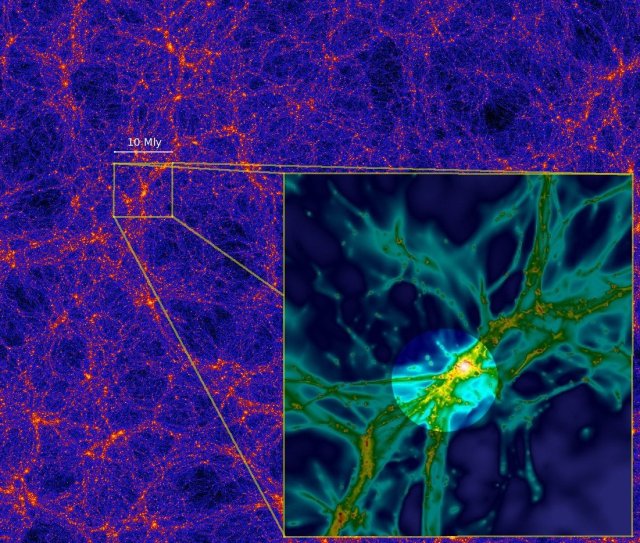
Scientists believe that matter in the universe is arranged into a gigantic web-like structure. This is called the cosmic web.

There are signatures of this structure in the remaining radiation from the Big Bang and in the layout of the universe itself. Without some mysterious force pulling visible matter into this web, galaxies would be randomly scattered across the universe. But they aren’t.

We can see that galaxies are found in groups and those groups come together in larger clusters.

Computer models tell us that those galaxy clusters are linked by long filaments of hot gas and dark matter — a mystery substance that we can’t see because it doesn’t radiate or scatter light but that makes up most of the web.

It’s believed that gas and dark matter flow along the filaments to form clumps of galaxies where the strands intersect. So filaments are important because they represent what the universe looks like on a large scale. The problem is that, even though we should technically be able to see hot gas filaments, they are really hard to detect.

To find this strand of gas, astronomers where able to take advantage of an extremely bright mass of energy and light known as a quasar.

The light from a quasar located 10 billion light-years-away acted like a “flashlight” to make the surrounding gas glow, researchers report Jan. 19 in the journal Nature. This boosted the Lyman alpha radiation that hydrogen gas emits to detectable levels over a huge swath of the region.

The researchers were able to figure out the wavelength of the Lyman alpha radiation emitted by the gas and used the Keck telescope in Hawaii to get an image at that wavelength.

What they were able to see is a cloud of gas extending two million light years across intergalactic space — the largest ever found. And it wasn’t just a diffuse cloud, there are areas where there is more gas and areas of darker, emptier space. The gas-filled areas are filament, while the emptier areas are the gaps between filaments and galaxy clusters.

“This is a very exceptional object,” first author Sebastiano Cantalupo, a postdoctoral fellow at UC Santa Cruz said in a statement. “It’s huge, at least twice as large as any nebula detected before, and it extends well beyond the galactic environment of the quasar.”

Researchers think that the gas filament is even more extended since they only see the part that is illuminated by the radiation from the quasar.

The research still “provides a terrific insight into the overall structure of our universe,” co-author J. Xavier Prochaska, a professor of astronomy and astrophysics at UC Santa Cruz said in statement, since the “quasar is illuminating diffuse gas on scales well beyond any we’ve seen before, giving us the first picture of extended gas between galaxies.”

http://www.sfgate.com/technology/businessinsider/article/Astronomers-Capture-The-First-Image-Of-The-5157713.php

Thanks to Kebmodee for bringing this to the attention of the It’s Interesting community.
Utah is ending homelessness by giving people homes.

UtahReducesHomelessness011814

Earlier this month, Hawaii State representative Tom Bower (D) began walking the streets of his Waikiki district with a sledgehammer, and smashing shopping carts used by homeless people. “Disgusted” by the city’s chronic homelessness problem, Bower decided to take matters into his own hands — literally. He also took to rousing homeless people if he saw them sleeping at bus stops during the day.

Bower’s tactics were over the top, and so unpopular that he quickly declared “Mission accomplished,” and retired his sledgehammer. But Bower’s frustration with his city’s homelessness problem is just an extreme example of the frustration that has led cities to pass measures that effective deal with the homeless by criminalizing homelessness.

•City council members in Columbia, South Carolina, concerned that the city was becoming a “magnet for homeless people,” passed an ordinance giving the homeless the option to either relocate or get arrested. The council later rescinded the ordinance, after backlash from police officers, city workers, and advocates.

•Last year, Tampa, Florida — which had the most homeless people for a mid-sized city — passed an ordinance allowing police officers to arrest anyone they saw sleeping in public, or “storing personal property in public.” The city followed up with a ban on panhandling downtown, and other locations around the city.

•Philadelphia took a somewhat different approach, with a law banning the feeding of homeless people on city parkland. Religious groups objected to the ban, and announced that they would not obey it.

•Raleigh, North Carolina took the step of asking religious groups to stop their longstanding practice of feeding the homeless in a downtown park on weekends. Religious leaders announced that they would risk arrest rather than stop.

This trend makes Utah’s accomplishment even more noteworthy. In eight years, Utah has quietly reduced homelessness by 78 percent, and is on track to end homelessness by 2015.

How did Utah accomplish this? Simple. Utah solved homelessness by giving people homes. In 2005, Utah figured out that the annual cost of E.R. visits and jail stays for homeless people was about $16,670 per person, compared to $11,000 to provide each homeless person with an apartment and a social worker. So, the state began giving away apartments, with no strings attached. Each participant in Utah’s Housing First program also gets a caseworker to help them become self-sufficient, but they keep the apartment even if they fail. The program has been so successful that other states are hoping to achieve similar results with programs modeled on Utah’s.

It sounds like Utah borrowed a page from Homes Not Handcuffs, the 2009 report by The National Law Center on Homelessness & Poverty and The National Coalition for the Homeless. Using a 2004 survey and anecdotal evidence from activists, the report concluded that permanent housing for the homeless is cheaper than criminalization. Housing is not only more human, it’s economical.

http://www.nationofchange.org/utah-ending-homelessness-giving-people-homes-1390056183

Thanks to Kebmodee for bringing this to the attention of the It’s Interesting community.

Mexican Vigilantes Battling A Drug Cartel For Control Of A City

MexDrug1

by Harrison Jacobs

Mexico has long suffered blistering violence and crime at the hands of its homegrown drug cartels.

Though the Mexican government has waged war on the cartels, the effort has struggled to go anywhere. More than 90,000 people have died in the ongoing conflict.

Fed up with a corrupt police force that is often in bed with the cartels and a military that has to this point been ineffective, some Mexicans have taken it upon themselves to fight the cartels and protect their families — with an incredible conflict happening this week in the city of Paracuaro.

Over the last year, vigilante groups, known as fuerzas autodefensas have sprung up all over Mexico, particularly in the southwestern state of Michoacan, an area plagued by the Knights Templar cartel.

MexDrug2

In neighbouring Guerrero, members of the Public Safety System (the name of the vigilante group) marched to commemorate the first anniversary of their founding.

MexDrug3

On Monday, hundreds of vigilantes stormed Paracuaro, Michoacan, where the Knights Templar had set up their headquarters, in order to seize the town back from the cartel. Below is the entrance, where vigilantes erected a checkpoint.

MexDrug4

The gunmen, “community police” from a number of nearby towns, rode in a convoy of pickup trucks and SUVs, before engaging in a gunfight with the Knights Templar.

MexDrug5

The battle was bloody. One vigilante, two members of the Knights Templar, and two federal police were reportedly killed in the shootout.

MexDrug6

Once they had taken control of the town, the vigilantes began disarming municipal police, whom they accuse of being corrupt and in league with the cartel.

MexDrug7

The vigilantes set up patrols and checkpoints on any highways going into and out of Paracuaro.

MexDrug8

Anybody suspected of being associated with the Knights Templar was detained. Currently, 11 police officers are being held on suspicion of colluding with the cartel.

MexDrug9

What happened in Paracuaro is becoming more common. Several months ago, another group in Guerrero detained more than 50 people for over six weeks for alleged crimes.

MexDrug10

While the vigilantes in Paracuaro went after the drug cartel, most other vigilante groups in Mexico are more concerned with punishing criminals who commit robberies, rape, and murder, than stopping the actual drug trade.

MexDrug11

In response to the vigilantes’ takeover of Paracauro, the Michaocan governor told press that the police will begin attempting to “eradicate” the vigilante groups.

MexDrug12

For a government and police force already overwhelmed by the drug cartels, trying to eliminate the vigilante groups likely won’t be easy.

MexDrug13

http://www.businessinsider.com.au/mexican-vigilantes-battle-drug-cartel-photos-2014-1

Thanks to Kebmodee for bringing this to the attention of the It’s Interesting community.

The New York Times had a mistake on its front page every day for over a century

2nyt

The dodgy arithmetic of one employee at the New York Times resulted in inaccurate issues numbers on the front page of every newspaper for over 100 years.

It seems that back in 1898 someone added one to 14,499 and got 15,000, with the huge jump in issues not being noticed until 2000.

How exactly the mistake was made isn’t clear, but how it was spotted was cleared up in the mother of all correction notes published in the Times on the first day of the new millennium, and rediscovered by The Atlantic this week.

It read:

“The error came to light recently when Aaron Donovan, a news assistant, became curious about the numbering, which he updates nightly when working at the news desk. He wondered about the potential for self-perpetuating error. Using a spreadsheet program, he calculated the number of days since The Times’s founding, on Sept. 18, 1851.

Through the newspaper’s archives, he learned that in its first 500 weeks, The Times published no Sunday issue. Then, for 2,296 weeks from April 1861 to April 1905, the Sunday issue was treated as an extension of the Saturday paper, bearing its number. In the early days, the paper skipped publication on a few holidays. No issues were published for 88 days during a strike in 1978. (During five earlier labor disputes, unpublished issues were assigned numbers, sometimes because catch-up editions were later produced for the archives.)

Finally, by scanning books of historic front pages and reels of microfilm, Mr. Donovan zeroed in on the date of the 500-issue gap.”

The issue number was eventually adjusted, but not before the publication congratulated itself on its 50,000th issue, which was actually number 49,500.

http://www.independent.co.uk/news/world/the-new-york-times-had-mistake-on-front-page-every-day-for-over-a-century-9063702.html