Science shows that camels weren’t domesticated as early as The Bible states

subCAME-master1050

By JOHN NOBLE WILFORD

There are too many camels in the Bible, out of time and out of place.

Camels probably had little or no role in the lives of such early Jewish patriarchs as Abraham, Jacob and Joseph, who lived in the first half of the second millennium B.C., and yet stories about them mention these domesticated pack animals more than 20 times. Genesis 24, for example, tells of Abraham’s servant going by camel on a mission to find a wife for Isaac.

These anachronisms are telling evidence that the Bible was written or edited long after the events it narrates and is not always reliable as verifiable history. These camel stories “do not encapsulate memories from the second millennium,” said Noam Mizrahi, an Israeli biblical scholar, “but should be viewed as back-projections from a much later period.”

Dr. Mizrahi likened the practice to a historical account of medieval events that veers off to a description of “how people in the Middle Ages used semitrailers in order to transport goods from one European kingdom to another.”

For two archaeologists at Tel Aviv University, the anachronisms were motivation to dig for camel bones at an ancient copper smelting camp in the Aravah Valley in Israel and in Wadi Finan in Jordan. They sought evidence of when domesticated camels were first introduced into the land of Israel and the surrounding region.

The archaeologists, Erez Ben-Yosef and Lidar Sapir-Hen, used radiocarbon dating to pinpoint the earliest known domesticated camels in Israel to the last third of the 10th century B.C. — centuries after the patriarchs lived and decades after the kingdom of David, according to the Bible. Some bones in deeper sediments, they said, probably belonged to wild camels that people hunted for their meat. Dr. Sapir-Hen could identify a domesticated animal by signs in leg bones that it had carried heavy loads.

The findings were published recently in the journal Tel Aviv and in a news release from Tel Aviv University. The archaeologists said that the origin of the domesticated camel was probably in the Arabian Peninsula, which borders the Aravah Valley. Egyptians exploited the copper resources there and probably had a hand in introducing the camels. Earlier, people in the region relied on mules and donkeys as their beasts of burden.

“The introduction of the camel to our region was a very important economic and social development,” Dr. Ben-Yosef said in a telephone interview. “The camel enabled long-distance trade for the first time, all the way to India, and perfume trade with Arabia. It’s unlikely that mules and donkeys could have traversed the distance from one desert oasis to the next.”

Dr. Mizrahi, a professor of Hebrew culture studies at Tel Aviv University who was not directly involved in the research, said that by the seventh century B.C. camels had become widely employed in trade and travel in Israel and through the Middle East, from Africa as far as India. The camel’s influence on biblical research was profound, if confusing, for that happened to be the time that the patriarchal stories were committed to writing and eventually canonized as part of the Hebrew Bible.

“One should be careful not to rush to the conclusion that the new archaeological findings automatically deny any historical value from the biblical stories,” Dr. Mizrahi said in an email. “Rather, they established that these traditions were indeed reformulated in relatively late periods after camels had been integrated into the Near Eastern economic system. But this does not mean that these very traditions cannot capture other details that have an older historical background.”

25 American Kids Weigh in on What Language the U.S. Speaks

By Stephanie Meade
Founder, Editor-in-Chief of InCultureParent.com

When the multilingual Coke ad came under siege at first I couldn’t be bothered to listen to the noise, because that’s all it was to me — misguided rumbling that didn’t deserve attention. But as the #speakamerican clamor crowded headlines and my twitter stream, I knew our children were the ones who had the most powerful message for us all.

Bilingualism is the proud voice of the U.S. with a growing percentage of children growing up bilingual and multilingual. For these kids, bilingualism is just as American as French fries, apple pies and pizza. And then add in some curry, tagine and tamales too. Currently one in five households, including my own, speak a language other than English at home. And those statistics don’t even count the speakers of English at home that are learning a new language at school. There are over 530 immersion schools in this country and demand for them is outpacing supply in many communities. When I hear polemics about English only, it confounds me why so many see language in zero-sum terms. English can and does peacefully coexist together with hundreds of other languages, as it always has. English-only discourses are a rearview mirror perspective of our nation, one that fails to confront the reality of the present or consider the future of our country in the context of a globalized world.

Speaking another language is not a threat to the fabric of the U.S. — it is the very thread that makes the fabric beautiful. And more than that, it is the thread that when woven together gives us strength. So let’s stop looking in the rearview mirror and start considering the America that will lead us into the future.

What language does America speak? English and over 300 other languages.

I speak English, Spanish, French and Portuguese. I’ve studied Russian, Japanese and German. And I’m learning Arabic.

#ispeakamerican

What languages do you speak?

* Please note: We tried very hard to find a Native American language to represent in our clip, and regret we could not find one in time. There were also many other languages we wanted to include, and it was strictly a matter of timing that we couldn’t represent more.

This video was originally published on InCultureParent, an online magazine for parents raising little global citizens.

Follow Stephanie Meade on Twitter: http://www.twitter.com/incultureparent

Mild electric current to the brain can improve math skills

MATH

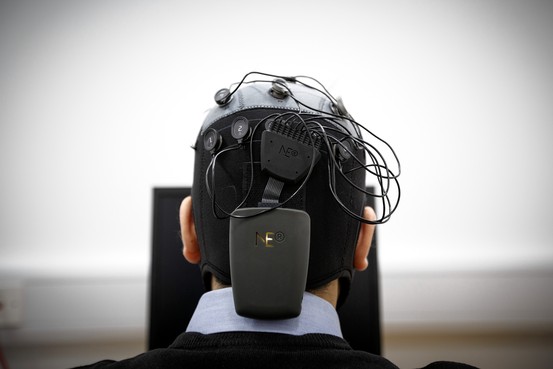
In a lab in Oxford University’s experimental psychology department, researcher Roi Cohen Kadosh is testing an intriguing treatment: He is sending low-dose electric current through the brains of adults and children as young as 8 to make them better at math.

A relatively new brain-stimulation technique called transcranial electrical stimulation may help people learn and improve their understanding of math concepts.

The electrodes are placed in a tightly fitted cap and worn around the head. The device, run off a 9-volt battery commonly used in smoke detectors, induces only a gentle current and can be targeted to specific areas of the brain or applied generally. The mild current reduces the risk of side effects, which has opened up possibilities about using it, even in individuals without a disorder, as a general cognitive enhancer. Scientists also are investigating its use to treat mood disorders and other conditions.

Dr. Cohen Kadosh’s pioneering work on learning enhancement and brain stimulation is one example of the long journey faced by scientists studying brain-stimulation and cognitive-stimulation techniques. Like other researchers in the community, he has dealt with public concerns about safety and side effects, plus skepticism from other scientists about whether these findings would hold in the wider population.

There are also ethical questions about the technique. If it truly works to enhance cognitive performance, should it be accessible to anyone who can afford to buy the device—which already is available for sale in the U.S.? Should parents be able to perform such stimulation on their kids without monitoring?

“It’s early days but that hasn’t stopped some companies from selling the device and marketing it as a learning tool,” Dr. Cohen Kadosh says. “Be very careful.”

The idea of using electric current to treat the brain of various diseases has a long and fraught history, perhaps most notably with what was called electroshock therapy, developed in 1938 to treat severe mental illness and often portrayed as a medieval treatment that rendered people zombielike in movies such as “One Flew over the Cuckoo’s Nest.”

Electroconvulsive therapy has improved dramatically over the years and is considered appropriate for use against types of major depression that don’t respond to other treatments, as well as other related, severe mood states.

A number of new brain-stimulation techniques have been developed, including deep brain stimulation, which acts like a pacemaker for the brain. With DBS, electrodes are implanted into the brain and, though a battery pack in the chest, stimulate neurons continuously. DBS devices have been approved by U.S. regulators to treat tremors in Parkinson’s disease and continue to be studied as possible treatments for chronic pain and obsessive-compulsive disorder.

Transcranial electrical stimulation, or tES, is one of the newest brain stimulation techniques. Unlike DBS, it is noninvasive.

If the technique continues to show promise, “this type of method may have a chance to be the new drug of the 21st century,” says Dr. Cohen Kadosh.

The 37-year-old father of two completed graduate school at Ben-Gurion University in Israel before coming to London to do postdoctoral work with Vincent Walsh at University College London. Now, sitting in a small, tidy office with a model brain on a shelf, the senior research fellow at Oxford speaks with cautious enthusiasm about brain stimulation and its potential to help children with math difficulties.

Up to 6% of the population is estimated to have a math-learning disability called developmental dyscalculia, similar to dyslexia but with numerals instead of letters. Many more people say they find math difficult. People with developmental dyscalculia also may have trouble with daily tasks, such as remembering phone numbers and understanding bills.

Whether transcranial electrical stimulation proves to be a useful cognitive enhancer remains to be seen. Dr. Cohen Kadosh first thought about the possibility as a university student in Israel, where he conducted an experiment using transcranial magnetic stimulation, a tool that employs magnetic coils to induce a more powerful electrical current.

He found that he could temporarily turn off regions of the brain known to be important for cognitive skills. When the parietal lobe of the brain was stimulated using that technique, he found that the basic arithmetic skills of doctoral students who were normally very good with numbers were reduced to a level similar to those with developmental dyscalculia.

That led to his next inquiry: If current could turn off regions of the brain making people temporarily math-challenged, could a different type of stimulation improve math performance? Cognitive training helps to some extent in some individuals with math difficulties. Dr. Cohen Kadosh wondered if such learning could be improved if the brain was stimulated at the same time.

But transcranial magnetic stimulation wasn’t the right tool because the current induced was too strong. Dr. Cohen Kadosh puzzled over what type of stimulation would be appropriate until a colleague who had worked with researchers in Germany returned and told him about tES, at the time a new technique. Dr. Cohen Kadosh decided tES was the way to go.

His group has since conducted a series of studies suggesting that tES appears helpful improving learning speed on various math tasks in adults who don’t have trouble in math. Now they’ve found preliminary evidence for those who struggle in math, too.

Participants typically come for 30-minute stimulation-and-training sessions daily for a week. His team is now starting to study children between 8 and 10 who receive twice-weekly training and stimulation for a month. Studies of tES, including the ones conducted by Dr. Cohen Kadosh, tend to have small sample sizes of up to several dozen participants; replication of the findings by other researchers is important.

In a small, toasty room, participants, often Oxford students, sit in front of a computer screen and complete hundreds of trials in which they learn to associate numerical values with abstract, nonnumerical symbols, figuring out which symbols are “greater” than others, in the way that people learn to know that three is greater than two.

When neurons fire, they transfer information, which could facilitate learning. The tES technique appears to work by lowering the threshold neurons need to reach before they fire, studies have shown. In addition, the stimulation appears to cause changes in neurochemicals involved in learning and memory.

However, the results so far in the field appear to differ significantly by individual. Stimulating the wrong brain region or at too high or long a current has been known to show an inhibiting effect on learning. The young and elderly, for instance, respond exactly the opposite way to the same current in the same location, Dr. Cohen Kadosh says.

He and a colleague published a paper in January in the journal Frontiers in Human Neuroscience, in which they found that one individual with developmental dyscalculia improved her performance significantly while the other study subject didn’t.

What is clear is that anyone trying the treatment would need to train as well as to stimulate the brain. Otherwise “it’s like taking steroids but sitting on a couch,” says Dr. Cohen Kadosh.

Dr. Cohen Kadosh and Beatrix Krause, a graduate student in the lab, have been examining individual differences in response. Whether a room is dark or well-lighted, if a person smokes and even where women are in their menstrual cycle can affect the brain’s response to electrical stimulation, studies have found.

Results from his lab and others have shown that even if stimulation is stopped, those who benefited are going to maintain a higher performance level than those who weren’t stimulated, up to a year afterward. If there isn’t any follow-up training, everyone’s performance declines over time, but the stimulated group still performs better than the non-stimulated group. It remains to be seen whether reintroducing stimulation would then improve learning again, Dr. Cohen Kadosh says.

http://online.wsj.com/news/articles/SB10001424052702303650204579374951187246122?mod=WSJ_article_EditorsPicks&mg=reno64-wsj&url=http%3A%2F%2Fonline.wsj.com%2Farticle%2FSB10001424052702303650204579374951187246122.html%3Fmod%3DWSJ_article_EditorsPicks

New headset beams video directly into your eyeballs

140205160913-avegant-glyph-story-top

A headset due to be released this year promises to beam movies, video games or even video calls directly into your eyeballs.

Yes. The Glyph headset, from Ann Arbor, Michigan-based Avegant, will create visuals that don’t need a screen — just your retinas and your brain.

A Kickstarter campaign was launched last month and set out to raise $250,000 to bankroll the project. It blew past that mark with ease and, with half a month left, was on the verge of breaking the $1 million mark Wednesday.

“We knew we had something really cool and that we’d do well on Kickstarter, but nobody thought we’d hit our goal in less than four hours,” said Edward Tang, Avegant’s CEO. “It’s like ordering flowers for your girlfriend and they show up with a whole truck full of flowers.”

The technology that powers the Glyph centers around a set of 2 million microscopic mirrors — 1 million per eye — that reflect visuals, including 3-D, into the user’s eye.

Unlike some entries into the emerging wearable tech field, the Glyph won’t be limited to a set of specially designed apps. Tang said the headset, which donors can receive for a $499 “donation” to the campaign, is designed to plug into just about anything you own that has a screen — be it a smartphone, laptop, television or gaming console.

Users would play the video content on their mobile or entertainment device but watch it on the Glyph instead of their device’s screen. The Glyph has a battery life of about three hours, Tang said.

“I think Google Glass is really interesting … (but) I think it’s a couple years away,” he said. “If you ask people what they’re doing with their devices today, they’re streaming Netflix, they’re playing video games and they’re listening to music. We created a device that really focused on those aspects.”

The startup also wanted to avoid the “Glasshole” effect. Google promises Glass will be stylish when it’s released to the public, but the look of early test versions has been distracting to some and downright jarring to others.

Glyph, on the other hand, looks like a pair of headphones sitting on the user’s head when not in use. In fact, it doubles as a pair of high-end headphones with noise canceling that compares with some of the leading brands on the market, according to Avegant. To add visuals, the user flips down the band over their head, making it an eyepiece.

The company has opened the headset to outside developers, who they hope will find unexpected uses for its features, which include head-tracking technology.

“By giving developers this brand new tool box, they start to think of amazing applications that we couldn’t in our wildest dreams come up with,” Tang said.

But, wait. Mom always said not to sit too close to the TV set. And we all know that bleary-eyed feeling we get from staring at a smartphone or tablet for too long. Won’t this be worse?

Quite the opposite, Tang said.

He said eye fatigue comes from staring at the artificial, pixelated light from our screens. Remove the screen, remove the problem.

“We agree with the moms of the world,” he said. “What we’re doing is mimicking the actual light around you … . It’s the kind of light that your eyes have been conditioned to see, have evolved to see.”

It’s all so magically futuristic sounding. Which raises an obvious question: Is Glyph all hype?

Folks who have taken an early look don’t think so. At January’s International Consumer Electronics Show in Las Vegas, Glyph was one of 40 products chosen for the Editor’s Choice Award. More than 3,200 exhibitors attended the show.

“What I could tell was that the projected image, just like my last time with Avegant’s virtual retinal display tech, was exceedingly bright and vivid, lacking any sense of pixelation,” CNET’s Scott Stein wrote from CES. “A deep-sea 3-D movie looked like it was projected in a tiny little movie theater in front of my eyes.”

David Pierce wrote for The Verge: ” ‘Life of Pi’ displayed perfectly in 3-D without any tweaking, and I played ‘Call of Duty: Ghosts’ right off a PlayStation 3. All you need to do is to tune the glasses — you focus each eye individually, then set the two eyeholes the right distance apart so they create a single picture. From then on, content just works.”

The Kickstarter campaign runs through February 21. Avegant plans to ship units to donors by the end of the year and says the model that will ship will be smaller and lighter than the test models on display.

Avegant is based in the heart of Michigan’s manufacturing region and hopes to manufacture the Glyph as much as possible in the United States, Tang said.

http://www.cnn.com/2014/02/06/tech/innovation/glyph-avegant-headset/index.html?hpt=hp_bn5

$20 gadget that can hack your car

Screen-Shot-2014-02-05-at-7_35_52-PM2-e1391650802638

Auto makers have long downplayed the threat of hacker attacks on their cars and trucks, arguing that their vehicles’ increasingly-networked systems are protected from rogue wireless intrusion. Now two researchers plan to show that a few minutes alone with a car and a tiny, cheap device can give digital saboteurs all the wireless control they need.

At the Black Hat Asia security conference in Singapore next month, Spanish security researchers Javier Vazquez-Vidal and Alberto Garcia Illera plan to present a small gadget they built for less than $20 that can be physically connected to a car’s internal network to inject malicious commands affecting everything from its windows and headlights to its steering and brakes. Their tool, which is about three-quarters the size of an iPhone, attaches via four wires to the Controller Area Network or CAN bus of a vehicle, drawing power from the car’s electrical system and waiting to relay wireless commands sent remotely from an attacker’s computer. They call their creation the CAN Hacking Tool, or CHT.

“It can take five minutes or less to hook it up and then walk away,” says Vazquez Vidal, who works as a automobile IT security consultant in Germany. “We could wait one minute or one year, and then trigger it to do whatever we have programmed it to do.”

Just what commands the researchers can remotely inject with the CHT, Vazquez Vidal says, depends on the model of car. They tested four different vehicles, whose specific make and model they declined to name, and their tricks ranged from mere mischief like switching off headlights, setting off alarms, and rolling windows up and down to accessing anti-lock brake or emergency brake systems that could potentially cause a sudden stop in traffic. In some cases, the attacks required gaining under-the-hood access or opening the car’s trunk, while in other instances, they say they could simply crawl under the car to plant the device.

For now, the tool communicates via only Bluetooth, limiting the range of any wireless attack to a few feet. But by the time the two researchers present their research in Singapore, they say they’ll upgrade it to use a GSM cellular radio instead that would make it possible to control the device from miles away.

All the ingredients of their tool are off-the-shelf components, adds Vazquez Vidal, so that even if the device is discovered it wouldn’t necessarily provide clues as to who planted it. “It’s totally untraceable,” he says.

The Spanish researchers’ work adds to a growing focus in the security industry on the vulnerability of networked automobiles to hackers’ attacks. Before the Defcon hacker conference last July, researchers Charlie Miller and Chris Valasek put me behind the wheel of a Ford Explorer and a Toyota Prius and then showed that they could plug their laptops into a dashboard port of vehicles to perform nasty tricks like slamming on the Prius’ brakes, jerking its steering wheel and even disabling the brakes of the Explorer at low speeds.

That work helped to spur Senator Edward Markey to send a seven-page letter to 20 automakers asking that they detail their security practices. Though the automakers’ answers were due on January 3rd, Markey’s office hasn’t yet released the results of their responses.

Toyota both brushed off Miller and Valasek’s work by pointing to the fact that their hack required physical access to the vehicle. “Our focus, and that of the entire auto industry, is to prevent hacking from a remote wireless device outside of the vehicle,” Toyota safety manager John Hanson told me at the time.

But Miller and Valasek counter that others had already shown that the initial wireless penetration of a car’s network is indeed possible. In 2011, a team of researchers at the University of Washington and the University of California at San Diego wirelessly penetrated a car’s internals via cellular networks, Bluetooth connections, and even a malicious audio file on a CD in its stereo system.

Vazquez Vidal’s and Garcia Illera’s CHT device adds yet another way to cross that wireless divide, and one that’s likely far cheaper. But like prior researchers, they say their intention is to show that digital car attacks are possible, not to enable them. Though they’ll detail the physical construction of their tool, they say they don’t plan to release the code used to inject commands into their test vehicles’ networks. “The goal isn’t to release our hacking tool to the public and say ‘take this and start hacking cars,’” says Vazquez Vidal. “We want to reach the manufacturers and show them what can be done.”

Like Miller and Valasek, they argue that car makers need to look beyond the initial wireless penetration of a car’s network to consider adding security between a vehicle’s systems, limiting a rogue device’s ability to wreak havoc.

“A car is a mini network,” says Garcia Illera. “And right now there’s no security implemented.”

http://www.forbes.com/sites/andygreenberg/2014/02/05/this-iphone-sized-device-can-hack-a-car-researchers-plan-to-demonstrate/

Thanks to Kebmodee for bringing this to the attention of the It’s Interesting community.

Dried Meat ‘Resurrects’ Lost Species of Beaked Whale

sn-whales

A gift of dried whale meat—and some clever genetic sleuthing across almost 16,000 kilometers of equatorial waters—has helped scientists identify a long-forgotten animal as a new species of beaked whale. The “resurrection” raises new questions about beaked whales, the most elusive and mysterious of cetaceans.

“Literally nothing is known about most species of beaked whales; they are probably the least known family of large mammals,” says Robin Baird, a cetacean biologist at Cascadia Research Collective in Olympia. “So it’s exciting to have this study.”

The species, Mesoplodon hotaula, is a dark blue, Volkswagen-van-sized cetacean with the prominent snout that gives beaked whales their common name. It first came to scientists’ attention in 1963 when a single adult female stranded on the coast of Sri Lanka in the Indian Ocean. The director of the National Museums of Ceylon, P. E. P. Deraniyagala, decided that it was different from the other Mesoplodon species known at that time, and assigned it the name hotaula, meaning “pointed beak” in the local Sinhala language. But only 2 years later, M. hotaula was eliminated as a species when other researchers decided that it was identical to M. ginkgodens (another beaked whale which scientists know only from stranded carcasses and have never seen alive in the sea).

Forty years later, locals on an atoll in the Gilbert Islands, part of the Republic of Kiribati in the west Pacific, gave a visiting marine biologist dried strips of whale meat left over from a recent festival. The sample was turned over to cetacean geneticists at the University of Auckland in New Zealand who had assembled a database of the DNA of all known beaked whales. “It was a surprise, because the genetic sequences from the meat didn’t match any of the known species,” says Scott Baker, a cetacean geneticist now at Oregon State University’s Marine Mammal Institute in Newport, and one of the authors of the study. “We thought we had a new species.”

Then, in 2005, other co-authors collected some whale bone and teeth on Palmyra Atoll, which lies southeast of the Hawaiian Islands and 2600 kilometers northeast of the Gilbert Islands. The genetic sequences extracted from these specimens matched those of the dried meat. “We knew then we were on to something,” Baker says. Finally, in 2009, the body of a beaked whale was found in the Seychelles, in the western part of the Indian Ocean; its DNA also matched that of the dried meat sample, even though this whale lived tens of thousands of kilometers away from the Gilbert Islands.

That was the clue the researchers needed. “We immediately wondered, ‘Could it be Deraniyagala’s beaked whale?’ ” Baker says. It was. The team recently reported its resurrection of the forgotten M. hotaula in Marine Mammal Science. Counting M. hotaula, there are now 15 known species in this genus, making it by far the most species-rich genus of cetaceans.

Overall, the saga of M. hotaula shows “that there are probably even more species of beaked whales that we don’t know about,” says Phil Clapham, a marine mammalogist at the National Marine Mammal Laboratory in Seattle, Washington. “We don’t see them because they’re very deep-diving and live far from land.” They also live in a poorly surveyed part of the ocean, Baker says, where very few people dwell on remote atolls.

Intriguingly, it is the islanders who seem to know the most about M. hotaula and some other beaked whales. The Gilbert Islands residents who provided the original gift of dried meat reported that it came from one of seven whales they had driven onto the beach and killed. “That was something we didn’t know: that these beaked whales live in groups,” Baker says. “We thought they were solitary” because of the single, stranded individuals that are occasionally found. The scientists also believe that males of M. hotaula fight each other, because this behavior is known in other species of beaked whales, and because the teeth of two adult male specimens were broken. “Other than that, and knowing that Deraniyagala was right, M. hotaula is still pretty mysterious,” says Baker, who hopes to launch an expedition to learn more about them.

http://news.sciencemag.org/biology/2014/02/dried-meat-resurrects-lost-species-whale

Thanks to Dr. Rajadhyaksha for bringing this to the attention of the It’s Interesting community.

Dr. David Nutt trying to make drug policies science-based, and to provide a safe alternative to alcohol

drugs

dr nutt
Nutt says politicians often have a “primitive, childish” way of thinking about drugs.

David Nutt is trying to develop a new recreational drug that he hopes will be taken up by millions of people around the world. No, the 62-year-old scientist isn’t “breaking bad.” In fact, he hopes to do good. His drug would be a substitute for alcohol, to create drinks that are just as intoxicating as beer or whiskey but less toxic. And it would come with an antidote to reverse its effects, allowing people to sober up instantly and drive home safely.

Nutt, a neuropsychopharmacologist at Imperial College London and a former top adviser to the British government on drug policy, says he has already identified a couple of candidates, which he is eager to develop further. “We know people like alcohol, they like the relaxation, they like the sense of inebriation,” Nutt says. “Why don’t we just allow them to do it with a drug that isn’t going to rot their liver or their heart?”

But when he presented the idea on a BBC radio program late last year and made an appeal for funding, many were appalled. A charity working on alcohol issues criticized him for “swapping potentially one addictive substance for another”; a commentator called the broadcast “outrageous.” News-papers likened his synthetic drug to soma, the intoxicating compound in Aldous Huxley’s dystopian novel Brave New World. Some of his colleagues dismissed the idea as scientifically unfeasible.

Nutt wasn’t surprised. As a fierce advocate of what he says are more enlightened, rational drug policies, he has been a lightning rod for a long time. Politicians, in Nutt’s view, make irrational decisions about drugs that help them win votes but cost society dearly. Drug policy is often based on the moral judgment that people should not use drugs, he says. Instead, it should reflect what science knows about the harms of different drugs—notably that many are far less harmful than legal substances such as alcohol, he says. The plan for a synthetic alcohol alternative is his own attempt to reduce the damage that drug use can wreak; he believes it could save millions of lives and billions of dollars.

Such views—and the combative way in which he espouses them—frequently land Nutt in fierce disputes. Newspaper commentators have called him “Professor Nutty” or “the dangerous professor.” In 2009, he was sacked from his position as chair of the United Kingdom’s Advisory Council on the Misuse of Drugs, tasked with giving scientific advice to the home secretary, after he criticized a government decision on cannabis.

But in November 2013, he received the John Maddox Prize for standing up for science. “In circumstances that would have humiliated and silenced most people,” wrote neurobiologist Colin Blakemore, one of the judges, “David Nutt continued to affirm the importance of evidence in understanding the harms of drugs and in developing drug policy.”

Controversial comparisons
David Nutt does not look like a dangerous professor. Short and heavyset, he has a jovial, round face and an old-fashioned mustache; one could mistake him for a London taxi driver. He limps slightly, has a down-to-earth way of speaking, and laughs a lot when he talks. “He is a real personality,” says psychopharmacologist Rainer Spanagel of Heidelberg University in Germany. “You can be in a meeting and almost have a result, then he will come in an hour late, stir everything up, and in the end convince everyone of his position.”

Nutt says he realized at an early age that “understanding how the brain works is the most interesting and challenging question in the universe.” When he was a teenager, his father told him a story of how Albert Hofmann, the discoverer of LSD, took a dose of that drug and felt that the bike ride home took hours instead of minutes. “Isn’t that incredible, that a drug can change time?” he asks. On his first night as an undergraduate in Cambridge, he witnessed the powers of drugs again when he went drinking with fellow students. Two of them couldn’t stop. “I just watched them transform themselves. One of them started wailing and crying and the other became incredibly hostile.”

During his clinical training, Nutt says he treated many alcoholics but failed “to get anyone interested in how to reduce their addiction to the drug that was harming them.” He set out to answer that question, first in the United Kingdom, later as the chief of the Section of Clinical Science at the U.S. National Institute on Alcohol Abuse and Alcoholism, a job he held for 2 years. Today, he runs the department of neuropsychopharmacology at Imperial College, using modern imaging techniques to see what happens in the brain when people take drugs or develop an addiction.

But his biggest contribution to science, he says, was a discovery he made quite early in his career: that some molecules don’t just block receptors in the brain, but actually have the opposite effect of the molecules that normally stimulate them—and in doing so shut down a brain pathway. Nutt called these molecules contragonists, and he has made a second career out of being a bit of a contragonist himself, trying to calm society’s overexcited responses to the steady stream of alarming news about drugs.

Fictional affliction
In 2009, Nutt published an article in the Journal of Psychopharmacology comparing the harms from ecstasy with those caused by horse riding. Every 10,000th ecstasy pill is likely to hurt someone, he calculated, while an average horse enthusiast can expect a serious accident every 350 hours of riding. The sport, he concluded, was more dangerous than the notorious party drug. That “raises the critical question of why society tolerates—indeed encourages—certain forms of potentially harmful behaviour but not others such as drug use,” he added.

Politicians were not amused, and Nutt’s whimsical reference to a fictional affliction he called equine addiction syndrome, or “equasy,” did not help. In his book Drugs – Without the Hot Air, Nutt provided his account of a phone conversation he had with U.K. Home Secretary Jacqui Smith after the paper was published. (Smith calls it an “embroidered version” of their talk.)

Smith: “You can’t compare harms from a legal activity with an illegal one.”

Nutt: “Why not?”

“Because one’s illegal.”

“Why is it illegal?”

“Because it’s harmful.”

“Don’t we need to compare harms to determine if it should be illegal?”

“You can’t compare harms from a legal activity with an illegal one.”

Nutt says this kind of circular logic crops up again and again when he discusses recreational drugs with politicians. “It’s what we would call ‘splitting’ in psychiatric terms: this primitive, childish way of thinking things are either good or bad,” he says.

He’s often that outspoken. He likens the way drug laws are hampering legitimate scientific research, for instance into medical applications for psychedelic compounds, to the church’s actions against Galileo and Copernicus. When the United Kingdom recently banned khat, a plant containing a stimulant that’s popular among people from the Horn of Africa and the Arabian Peninsula, he compared the decision with banning cats. And he accuses the Russian government of deliberately using alcohol to weaken the opposition. “However miserable they are, however much they hate their government and their country, they will just drink until they kill themselves, so they won’t protest,” he says.

But it’s his stance on cannabis that got him sacked. In early 2009, ignoring advice from Nutt’s advisory council, Smith upgraded cannabis from class C to class B, increasing the maximum penalty for possession from 2 to 5 years in prison. A few months later, Nutt criticized the decision in a public lecture, arguing that “overall, cannabis use does not lead to major health problems” and that tobacco and alcohol were more harmful. When media reported the remarks, Alan Johnson, who succeeded Smith as home secretary in mid-2009, asked him to resign. “He was asked to go because he cannot be both a government adviser and a campaigner against government policy,” Johnson wrote in a letter in The Guardian.

Nutt did not go quietly. With financial help from a young hedge fund manager, Toby Jackson, he set up a rival body, the Independent Scientific Committee on Drugs, “to ensure that the public can access clear, evidence based information on drugs without interference from political or commercial interest.” Politics have skewed not just drug laws but research itself, he argues. “If you want to get money from the U.S. government to work on a drug, you have to prove it damages the brain,” he says.

One of his favorite examples is a paper that Science published in September 2002. The study, led by George Ricaurte at Johns Hopkins University, seemed to show that monkeys given just two or three doses of ecstasy, chemically known as MDMA, developed severe brain damage. The finding suggested that “even individuals who use MDMA on one occasion may be at risk for substantial brain injury,” the authors wrote. The paper received massive media attention, but it was retracted a year later after the authors discovered that they had accidentally injected the animals not with MDMA but with methamphetamine, also known as crystal meth, which was already known to have the effects seen in the monkeys. Nutt says the mistake should have been obvious from the start because the data were “clearly wrong” and “scientifically implausible.” “If that result was true, then kids would have been dropping dead from Parkinson’s,” he says.

Some resent this combative style. “He is a polarizing figure and the drug policy area is polarized enough,” says Jonathan Caulkins, a professor of public policy at Carnegie Mellon University in Pittsburgh, Pennsylvania. But Jürgen Rehm, an epidemiologist at the Centre for Addiction and Mental Health in Toronto, Canada, says Nutt has helped stimulate debates that were long overdue. “You don’t get to be on the front page of The Lancet and The New York Times unless you sharpen your arguments a little bit,” Rehm says. “I can live with that.”

Ranking the drugs
In 2010, Nutt sparked a new firestorm when he published another comparison: a Lancet paper ranking drugs according to the harm they cause. Nutt and other experts scored a long list of drugs on 16 criteria, nine related to the user, such as death from an overdose or wrecked relationships, and seven related to society, such as drug-fueled violence and economic costs. In the end, every drug was given a score between 0 and 100 to indicate its overall harm. Alcohol came out on top, ahead of heroin; mushrooms and ecstasy were at the low end.

Critics said the study’s methodology was flawed because it didn’t address drug interactions and the social context of drug use. “For instance, the number of fatalities caused by excessive alcohol use is going to depend in part on gun control laws,” says Caulkins, who calls the whole idea of expressing drug harm as a single number “embarrassing.”

Caulkins adds that even if a perfect ranking of drug harms were possible, it wouldn’t mean that politicians should put the tightest control measures on the most harmful drugs. Suppose drug A is more harmful to the individual and society than drug B, he says, but impurities in drug A, when illegally produced, can lead to potentially fatal organ failure while they just taste bad in drug B. If you were going to prohibit only one of the two drugs, it should be drug B, he says, even though it causes less harm per se, because criminalizing drug A would lead to a more dangerous product and more deaths. Nutt’s ranking of drugs, he says, is “a pseudoscientific exercise which is trying to take control of the policy process from a technocratic perspective in a way that isn’t even sound.”

Other scientists defended the paper. Using Nutt’s harm scales, “flawed and limited as they may be, would constitute a quantum leap of progress towards evidence-based and more rational drug policy in Canada and elsewhere,” two Canadian drug scientists wrote in Addiction. Regardless of its quality, the paper has been hugely influential, Rehm says. “Everyone in the E.U. knows that paper, whether they like it or not. There is a time before that paper and a time after it appeared.”

Nutt says his comparisons are an essential first step on the way to more evidence-based drug policies that seek to reduce harm rather than to moralize. The best option would be a regulated market for alcohol and all substances less harmful to the user than alcohol, he argues.

That scenario, under which only heroin, crack cocaine, and methamphetamine would remain illegal, seems unlikely to become a reality. But Nutt says he can already see more rational policies taking hold. Recently, Uruguay and the U.S. states of Colorado and Washington legalized the sale of recreational cannabis, going a step further than the Netherlands, which stopped enforcing laws on the sale and possession of small amounts of soft drugs decades ago. Nutt was also happy to read President Barack Obama’s recent comment that cannabis is less harmful than alcohol. “At last, a politician telling the truth,” he says. “I’ll warn him though—I was sacked for saying that.”

New Zealand, meanwhile, passed a law in 2013 that paves the way for newly invented recreational drugs to be sold legally if they have a “low risk” of harming the user. Nutt, who has advised the New Zealand government, is delighted by what he calls a “rational revolution in dealing with recreational drugs.” The main problem now, he says, is establishing new drugs’ risks—which is difficult because New Zealand does not allow them to be tested on animals—and deciding what “low risk” actually means. “I told them the threshold should be if it is safer than alcohol,” he says. “They said: ‘Oh my god, that is going to be far too dangerous.'”

Safer substitute
Nutt agrees that alcohol is now one of the most dangerous drugs on the market—which is why he’s trying to invent a safer substitute. The World Health Organization estimates that alcohol—whose harms range from liver cirrhosis, cancer, and fetal alcohol syndrome to drunk driving and domestic violence—kills about 2.5 million people annually. “When I scan the brains of people with chronic alcohol dependence, many have brains which are more damaged than those of people with Alzheimer’s,” Nutt says.

In a paper published this month in the Journal of Psychopharmacology, Nutt and Rehm summarize the top six interventions that governments should consider to reduce the harms of alcohol, such as minimum prices and restrictions on the places that can sell hard liquor. They also argue that governments should support the development of alternatives. Nutt points to e-cigarettes—devices that heat and vaporize a nicotine solution—as a model. “In theory, electronic cigarettes could save 5 million lives a year. That is more than [the death toll from] AIDS, malaria, tuberculosis, and meningitis put together,” he says. “I would argue that the e-cigarette is going to be the greatest health invention since vaccination.”

Can an alcohol alternative do the same? “I think that idea is utopian,” says Spanagel, the German psychopharmacologist. One reason is that researchers have recently developed a much more complex picture of what ethanol, as chemists call it, actually does. Twenty years ago, they thought that once it reached the brain, alcohol elicited its many effects by infiltrating the membranes of neurons there and changing their properties. “Now we know that’s nonsense. You would have to drink 5 liters of schnapps for that to happen,” Spanagel says.

In fact, scientists have learned that alcohol, like other drugs, interacts with the receptors for certain neurotransmitters. But unlike other drugs, it acts on a wide range of them, including receptors for GABA, NMDA, serotonin, and acetylcholine. That will make it hard to find a substance to emulate most of alcohol’s wanted effects while avoiding the unwanted ones, Spanagel predicts.

Nutt is concentrating on the GABA system—the most important inhibitory system in mammalian brains. Alcohol activates GABA receptors, effectively quieting the brain and leading to the state of relaxation many people seek. Nutt has sampled some compounds that target GABA receptors and was pleasantly surprised. “After exploring one possible compound I was quite relaxed and sleepily inebriated for an hour or so, then within minutes of taking the antidote I was up giving a lecture with no impairment whatsoever,” he wrote in a recent article.

But he wants to go one step further. “We know that different subtypes of GABA mimic different effects of alcohol,” he says. Nutt combed the scientific literature and patents for compounds targeting specific GABA receptors, and, in an as-yet unpublished report that he shared with Science, he identifies several molecules that he says fit the bill. Compounds targeting subtypes of the GABAA receptor called alpha2 and alpha3 are particularly promising, he says. Some of these molecules were dropped as therapeutic drug candidates precisely because they had side effects similar to alcohol intoxication.

Gregg Homanics, an alcohol researcher at the University of Pittsburgh, is skeptical that another substance could mimic all the positive effects of alcohol. “You could come up with a drug that might make you feel good. But is it going to be the same good feeling as alcohol? I doubt that.” Such a drug might have downsides of its own, warns Andreas Heinz, an addiction researcher at Charité University Medicine Berlin. It could still turn out to be addictive or to harm a small proportion of the population. “There is an advantage when you have known drugs for hundreds of years and you know exactly what they do,” he says.

Still, Nutt’s appearance on the BBC radio program attracted new investors, ranging “from Ukrainian brewers to American hedge funds,” he says, and Imperial Innovations, a company that provides technology transfer services, is working with him “to consider a range of options for taking the research forward,” a spokesperson says. “We think we have enough funding now to take a substance all the way to the market,” Nutt says—in fact, he hopes to be able to offer the first cocktails for sale in as little as a year from now.

Even a very good alcohol substitute would face obstacles. Many people won’t forsake drinks they have long known and loved—such as beer, wine, and whiskey—for a new chemical, Spanagel says. The idea will also trigger all kinds of political and regulatory debates, Rehm says. “How will such a new drug be seen? Will you be able to buy it in the supermarket? In the pharmacy? Will society accept it?”

Whatever the outcome, Nutt’s quest for a safer drink has already made people think about alcohol in a new way, Rehm adds. “It’s provocative in the best sense of the word.” Much the same could be said of the scientist who thought it up.

http://www.sciencemag.org/content/343/6170/478.full

What’s the universe made of? Math

UniverseMath_m_0131

By Tanya Lewis, LiveScience

Scientists have long used mathematics to describe the physical properties of the universe. But what if the universe itself is math? That’s what cosmologist Max Tegmark believes.

In Tegmark’s view, everything in the universe — humans included — is part of a mathematical structure. All matter is made up of particles, which have properties such as charge and spin, but these properties are purely mathematical, he says. And space itself has properties such as dimensions, but is still ultimately a mathematical structure.

“If you accept the idea that both space itself, and all the stuff in space, have no properties at all except mathematical properties,” then the idea that everything is mathematical “starts to sound a little bit less insane,” Tegmark said in a talk given Jan. 15 here at The Bell House. The talk was based on his book “Our Mathematical Universe: My Quest for the Ultimate Nature of Reality” (Knopf, 2014).

“If my idea is wrong, physics is ultimately doomed,” Tegmark said. But if the universe really is mathematics, he added, “There’s nothing we can’t, in principle, understand.”

The idea follows the observation that nature is full of patterns, such as the Fibonacci sequence, a series of numbers in which each number is the sum of the previous two numbers. The flowering of an artichoke follows this sequence, for example, with the distance between each petal and the next matching the ratio of the numbers in the sequence.

The nonliving world also behaves in a mathematical way. If you throw a baseball in the air, it follows a roughly parabolic trajectory. Planets and other astrophysical bodies follow elliptical orbits.

“There’s an elegant simplicity and beauty in nature revealed by mathematical patterns and shapes, which our minds have been able to figure out,” said Tegmark, who loves math so much he has framed pictures of famous equations in his living room.

One consequence of the mathematical nature of the universe is that scientists could in theory predict every observation or measurement in physics. Tegmark pointed out that mathematics predicted the existence of the planet Neptune, radio waves and the Higgs boson particle thought to explain how other particles get their mass.

Some people argue that math is just a tool invented by scientists to explain the natural world. But Tegmark contends the mathematical structure found in the natural world shows that math exists in reality, not just in the human mind.

And speaking of the human mind, could we use math to explain the brain?

Some have described the human brain as the most complex structure in the universe. Indeed, the human mind has made possible all of the great leaps in understanding our world.

Someday, Tegmark said, scientists will probably be able to describe even consciousness using math. (Carl Sagan is quoted as having said, “the brain is a very big place, in a very small space.”)

“Consciousness is probably the way information feels when it’s being processed in certain, very complicated ways,” Tegmark said. He pointed out that many great breakthroughs in physics have involved unifying two things once thought to be separate: energy and matter, space and time, electricity and magnetism. He said he suspects the mind, which is the feeling of a conscious self, will ultimately be unified with the body, which is a collection of moving particles.

But if the brain is just math, does that mean free will doesn’t exist, because the movements of particles could be calculated using equations? Not necessarily, he said.

One way to think of it is, if a computer tried to simulate what a person will do, the computation would take at least the same amount of time as performing the action. So some people have suggested defining free will as an inability to predict what one is going to do before the event occurs.

But that doesn’t mean humans are powerless. Tegmark concluded his talk with a call to action: “Humans have the power not only to understand our world, but to shape and improve it.”

http://www.mnn.com/earth-matters/space/stories/whats-the-universe-made-of-math

Beer Drone Can Buzz The Skies No More, FAA Says

Lakemaid Beer is brewed in Stevens Point, Wis., and distributed to several states in the region. But it was a very local delivery that put the company out of favor with the Federal Aviation Administration.

The Minnesota-based company is receiving a flood of support and condolences after the FAA ruled that its beer delivery drone, which had only recently taken flight, had to be shut down.

Lakemaid calls itself the fishermen’s lager. It had hoped to use drones to deliver its beer to anglers in thousands of ice shacks, from the frozen northern lakes’ combination bait and beer shops. But the government says the brewer’s next test — which Lakemaid managing partner Jack Supple says was tentatively set for Minnesota’s Lake Mille Lacs and the Twin Pines resort — cannot proceed.

“We were a little surprised at the FAA interest in this since we thought we were operating under the 400-foot limit,” Supple says via email. He adds that the beer-makers “figured a vast frozen lake was a lot safer place than [what] Amazon was showing on 60 Minutes.”

The brewery’s test flight created a stir after it was posted on YouTube last week, capturing imaginations and, in some cases, leading people to say they no longer fear a future in which the sky buzzes with drones.

In December, Amazon founder Jeff Bezos gave 60 Minutes a preview of his company’s plan to use drones to move to same-day local delivery in the next several years. In an interview last week, Supple said Lakemaid’s drone plans had advantages over Amazon’s — particularly the flat landscape of a frozen lake and the fairly uniform height of the ice shacks.

But as we discussed after the Amazon report aired, FAA rules don’t currently allow drones to be used for commercial delivery — and it eventually emerged that the test video Bezos showed was actually filmed outside the U.S., for legal reasons. The agency has scheduled reviews of its rules on drones.

Supple says the FAA got in touch to let Lakemaid know its plan broke four — and possibly five — regulations, ranging from the operator’s rating to the use of airspace. And that’s too bad, he says, because he had big plans.

“My intent was to try a larger drone that could fly unmanned, based on just the coordinates” of an ice shack, he says. And the Twin Pines resort “has fish houses out in the bay probably half a mile. So a little longer stretch than we first tested.”

Drones have been used to deliver beer before — notably at a music festival in South Africa. But the federal agency said it’s a no-go in U.S. airspace.
“The FAA controls the safety of our airspace all the way to ground level, according to the calls I got from the local inspector and the regional supervisor this week,” Supple says.

In an email, the agency told Lakemaid that it “recognizes that people and companies other than modelers might be flying UAS with the mistaken understanding” that their actions are legal. But the rules and guidelines used in such cases apply only to people flying model airplanes, the FAA added.

After word of the FAA’s intervention came out, a White House petition was begun to try to get the agency to allow the brewery’s beers to get airborne again.
Supply says Lakemaid is figuring out what its next steps are. But he admits that in hindsight, he can see the FAA’s point.

“I understand their concern,” he says. “Drones whizzing around piloted by any knucklehead is probably not the Jetsons future we all imagined.”

http://www.npr.org/blogs/thetwo-way/2014/01/30/269039542/beer-drone-can-buzz-the-skies-no-more-faa-says

Thanks to Kebmodee for bringing this to the attention of the It’s Interesting community.