Sitting too much may be twice as dangerous for your health as being obese.

There’s been a fast growing body of evidence in the last several years that lack of exercise – or sedentariness – is a major risk factor in health. It’s been linked to heart disease, cancer, and to an early death. And now, a new study finds that lack of exercise may actually be even more of a risk than obesity in early mortality: The researchers calculate that a sedentary lifestyle may actually confer twice the risk of death as being obese. That said, the two are both important and, luckily, closely related: So if you start getting active, you’ll probably lose a little weight along the way, which itself is a very good thing.

The new study looked at data from over 334,000 people who participated in the European Prospective Investigation into Cancer and Nutrition (EPIC) Study. Over a period of 12 years, the participants’ height, weight, and waist circumferences were tracked, along with self-reports of activity levels, both at work and in free time. All-cause mortality (i.e., death from any cause) was the main outcome of interest.

It turned out that lack of physical activity was linked to the greatest risk of death – and the greatest reduction in death risk was in the difference between the lowest two activity groups. In other words, just moving from “inactive” to “moderately inactive” showed the largest reduction in death risk, especially for normal weight people, but true for people of all body weights. And, the authors say, just taking a brisk 20-minute walk per day can move you from one category to the other, and reduce the risk of death anywhere from 16% to 30%.

Using a statistical model, the team also calculated that being sedentary may account for double the death risk of obesity. According to their math, of the 9.2 million deaths in Europe in 2008, about 337,000 were attributable to obesity, whereas 676,000 were attributable to sedentariness.

Another takeaway from the study, however, is that waist circumference is a bigger player in mortality risk than overall body weight, which has certainly been suggested by previous studies. Belly fat seems to be disproportionately linked to chronic health issues like heart disease, stroke, diabetes, cancer, and of course, early mortality. So reducing belly fat is always a significant benefit to one’s health.

“This large study is rather complex in its details, but the take-away messages are actually both clear and simple,” says David L, Katz, Director of the Yale University Prevention Research CenterGriffin Hospital. “At any given body weight, going from inactive to active can reduce the risk of premature mortality substantially. At any given level of activity, going from overweight to a more optimal weight can do the same. We have long known that not all forms of obesity are equally hazardous, and this study reaffirms that. Losing weight if you have an excess around the middle, where it is most dangerous, exerts an influence on mortality comparable to physical activity. Losing excess weight that is not associated with a high waist circumference reduces mortality risk, but less — as we would expect.”

But perhaps the main point in all of this is that being active and being a healthy weight are inextricably linked. Though activity by itself can offer an immediate health benefit if you remain overweight, getting active also leads naturally to loss of body weight. “This study reminds that being both fit and unfat are good for health,” says Katz, “and can add both life to years, and years to life. These are not really disparate challenges, since the physical activity that leads to fitness is on the short list of priorities for avoiding fatness as well. The challenge before us now is for our culture to make it easier to get there from here.”

Earlier this month a study showed that the concept of “healthy obesity” may be very misleading, since health markers in an obese person tend to deteriorate over time. Though the current study suggests that fitness may matter more than fatness, the two are really two sides of a coin: It would be silly to become active and not lose weight — and it would be very hard to do, since the one leads to the other. But perhaps given the great benefits of exercise alone, public health campaigns should focus not just on losing weight, but on encouraging people to add just small amounts physical activity to their lives right off the bat, and to see where it goes from there.

http://www.forbes.com/sites/alicegwalton/2015/01/15/is-lack-of-exercise-worse-for-your-health-than-obesity/

Selfies Linked to Narcissism, Psychopathy

Men who post selfies on social media such as Instagram and Facebook have higher than average traits of narcissism and psychopathy, according to a new study from academics at Ohio State University.

Furthermore, people who use filters to edit shots score even higher for anti-social behaviour such as narcissism, an obsession with one’s own appearance.

Psychologists from the University of Ohio sampled 800 men aged 18 to 40 about their photo-posting habits on social media.

As well as questionnaires to test their levels of vanity, they were also asked if they edited their photos by cropping them or adding a filter.

Assistant Professor Jesse Fox, lead author of the study at The Ohio State University, said: ‘It’s not surprising that men who post a lot of selfies and spend more time editing them are more narcissistic, but this is the first time it has actually been confirmed in a study.

‘The more interesting finding is that they also score higher on this other anti-social personality trait, psychopathy, and are more prone to self-objectification” she said.

http://www.timeslive.co.za/lifestyle/2015/01/08/men-who-post-selfies-have-narcissistic-and-psychopathic-tendencies-study

Bill Gates says a new plant that can turn human feces into electricity and clean drinking water can save a huge number of lives.

The plant, called the Omniprocessor, was designed and built by Janicki Bioenergy and backed by the Bill & Melinda Gates Foundation. The facility would try to prevent diseases caused by contaminated water supplies.

A test plant is up and working at Janicki’s headquarters north of Seattle, according to a blog post by Gates. The first operational plant is planned for Senegal.

“The next-generation processor, more advanced than the one I saw, will handle waste from 100,000 people, producing up to 86,000 liters of potable water a day and a net 250 kw of electricity,” he wrote. “If we get it right, it will be a good example of how philanthropy can provide seed money that draws bright people to work on big problems, eventually creating a self-supporting industry.”

Included is a video of him drinking a glass of the water produced by the plant, which he describes as “delicious” and “as good as any I’ve had out of the bottle.”

“Having studied the engineering behind it, I would happily drink it every day. It’s that safe,” he writes on the post.

The feces is heated to 1000 degrees Celsius, or 1,832 degrees Fahrenheit to draw off the water, which is then further treated to make sure it is safe. But the dried out feces can then be burned, producing enough heat to generate electricity needed to extract the water. Excess electricity can be sold to outside users, as can the water.

Gates says diseases caused by poor sanitation kill some 700,000 children every year. The Bill & Melinda Gates Foundation is making an effort to improve sanitation in the developing world.

“Today, in many places without modern sewage systems, truckers take the waste from latrines and dump it into the nearest river or the ocean—or at a treatment facility that doesn’t actually treat the sewage,” he wrote. “Either way, it often ends up in the water supply.”

http://money.cnn.com/2015/01/07/technology/innovationnation/gates-poop-water/index.html

Protein That Can Edit Other Proteins Without DNA Blueprint Discovered

In our cells, proteins are the tiny machines that do most of the work. And the instructions for making proteins — and for piecing together their building blocks, called amino acids — are laid out by DNA, then relayed through RNA. But now, researchers show for the first time that amino acids can be assembled by another protein — without genetic instructions. These surprising findings were published in Science this week.

If a cell is an automobile-making factory, then ribosomes are the machines on the protein assembly line that links together amino acids in an order specified by DNA and messenger RNA (mRNA), an intermediate template. If something goes awry and a ribosome stalls, the quality control team shows up to disassemble the ribosome, discard that bit of genetic blueprint, and recycle the partially-made protein.

Turns out, that assembly line can keep going even if it loses its genetic instructions, according to a large U.S. team led by University of Utah, University of California, San Francisco, and Stanford researchers. They discovered an unexpected mechanism of protein synthesis where a protein, and not the normal genetic blueprint, specifies which amino acids are added.

“In this case, we have a protein playing a role normally filled by mRNA,” UCSF’s Adam Frost says in a news release. “I love this story because it blurs the lines of what we thought proteins could do.”

Frost and colleagues found a never-before-seen role for one member of the quality control team: a protein named Rqc2, which helps recruit transfer RNA (tRNA) to sites of ribosomal breakdowns (tRNA is responsible for bringing amino acids to the protein assembly line). Before the incomplete protein gets recycled, Rqc2 prompts the stalled ribosomes to add two amino acids — alanine and threonine — over and over. And that’s because the Rqc2–ribosome complex binds tRNAs that carry those two specific amino acids. In the auto analogy, the assembly line keeps going despite having lost its instructions, picking up whatever it can and attaching it in no particular order: horn-wheel-wheel-horn-wheel-wheel-wheel-wheel-horn, for example.

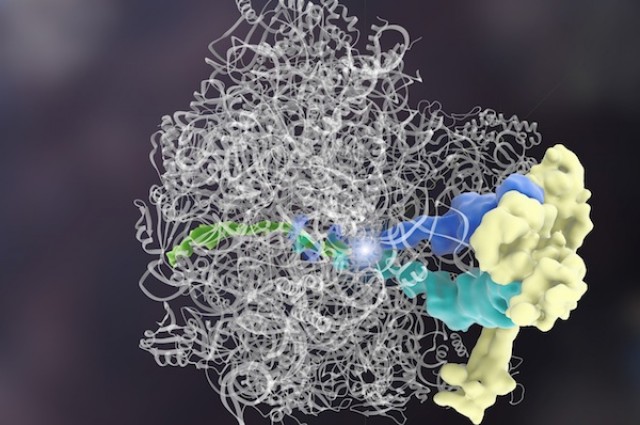
Pictured above, Rqc2 (yellow) binds tRNAs (blue and teal), which add amino acids (bright sot in the middle) to a partially-made protein (green). The complex binds the ribosome (white). A truncated protein with a seemingly random sequence of alanines and threonines probably doesn’t work properly, and that tail could be a code that signals for the malformed protein to be destroyed.

http://www.iflscience.com/health-and-medicine/protein-directs-protein-synthesis-without-dna-blueprint

Thanks to Kebmodee for bringing this to the attention of the It’s Interesting community.

Vast underground complex where Hitler worked on developing nuclear weapons discovered in Austria

A labyrinth of secret underground tunnels believed to have been used by the Nazis to develop a nuclear bomb has been uncovered.

The facility, which covers an area of up to 75 acres, was discovered near the town of St Georgen an der Gusen, Austria last week, it has been reported.

Excavations began on the site after researchers detected heightened levels of radiation in the area – supporting claims that the Nazis were developing nuclear weapons.

Documentary maker Andreas Sulzer, who is leading the excavations, told the Sunday Times that the site is ‘most likely the biggest secret weapons production facility of the Third Reich’.

It is believed to be connected to the B8 Bergkristall underground factory, where the Messerschmitt Me 262 – the first operational jet fighter – was built.

There are also suggestions that the complex is connected to the Mauthausen-Gusen concentration camp.

Slave labour from the camp was used to build both complexes – with as many as 320,000 inmates in the harsh underground conditions.

But while the Bergkristall site was explored by Allied and Russia after the war, the Nazis appeared to have gone through greater lengths to conceal the newly-discovered tunnels.

Its entrance was only uncovered after the excavation team, which includes historians and scientists, pieced together information in declassified intelligence documents and testimonies from witnesses.

The team is now in the process of removing layers of soil and concrete packed into the tunnels and heavy granite plates that were used to cover the entrance.

Helmets belonging to SS troops and other Nazi relics are among the items that have been uncovered so far.

The excavation was halted last week by police, who demanded the group produce a permit for conducting research on historic sites. But Mr Sulzer is confident that work will resume next month.

He told the Sunday Times: ‘Prisoners from concentration camps across Europe were handpicked for their special skills – physicists, chemists or other experts – to work on this monstrous project and we owe it to the victims to finally open the site and reveal the truth.’

The probe was triggered by a research documentary by Mr Sulzer on Hitler’s quest to build an atomic bomb.

In it, he referenced diary entries from a physicist called up to work for the Nazis. There is other evidence of scientists working for a secret project managed by SS General Hans Kammler.

Kammler, who signed off the plans for the gas chambers and crematorium at Auschwitz, was in charge of Hitler’s missile programmes.

Mr Sulzer searched archives in Germany, Moscow and America for evidence of the nuclear weapons-building project led by the SS.

He discovered that on January 2, 1944, some 272 inmates of Mauthausen were taken from the camp to St Georgen to begin the construction of secret galleries.

By November that year, 20,000 out of 40,000 slave labourers drafted in to build the tunnels had been worked to death.

After the war, Austria spent some £10million in pouring concrete into most of the tunnels.

But Sulzer and his backers believe they missed a secret section where the atomic research was conducted.

The Soviets were stationed in St Georgen until 1955 and they took all of the files on the site back with them to Moscow.

Experts are trying to discover if there is a link between St Georgen and sites in Germany proper where scientists were assembled during the Third Reich in a bid to match American efforts to build the ultimate weapon.

In June 2011, atomic waste from Hitler’s secret nuclear programme was believed to have been found in an old mine near Hanover.

More than 126,000 barrels of nuclear material lie rotting over 2,000 feet below ground in an old salt mine.

Rumour has it that the remains of nuclear scientists who worked on the Nazi programme are also there, their irradiated bodies burned in secret by S.S. men sworn to secrecy.

Read more: http://www.dailymail.co.uk/news/article-2888975/Vast-underground-complex-Nazis-developed-WMD-discovered-Austria.html#ixzz3Nt33ax4F
Follow us: @MailOnline on Twitter | DailyMail on Facebook

Thanks to Jody Troupe for bringing this to the attention of the It’s Interesting community.

Man experiencing headaches, seizures, memory flashbacks and strange smells discovered to have had tapeworm living in his brain for 4 years


Parasitic worm normally found in amphibians and crustaceans in China may have scavenged nutrients from patient’s brain

A man who went to see his doctor after suffering headaches and experiencing strange smells was found to have been living for more than four years with a rare parasitic worm in his brain.

In the first case of its kind in Britain, the ribbon-shaped tapeworm was found to have burrowed from one side of the 50-year-old man’s brain to the other.

Doctors were left baffled after spotting strange ring-like patterns moving 5cm through his brain tissue in a series of scans taken over four years.

Surgeons only discovered the 1cm worm while carrying out a biopsy at Addenbrooke’s hospital in Cambridge and took it to parasite experts to be identified.

Geneticists at the Wellcome Trust Sanger Institute in Cambridge found the creature was a rare species of tapeworm known as Spirometra erinaceieuropaei.

Only 300 cases of infection by this parasite in humans have been reported since 1953, with only two previous cases identified in Europe.

The worm is normally found in amphibians and crustaceans in China and as it goes through its life cycle it later infects the guts of cats and dogs, where it can grow into 1.5-metre adult worms. Even in China, where the parasite is normally found, there have only been 1,000 cases reported in humans since 1882.

The unfortunate patient, who was of Chinese descent but lived in East Anglia, is thought to have picked up the parasite while on a visit to China, where he visited regularly. However, exactly how he came to be infected is not known, but he could have picked it up from infected meat or water and the worm then burrowed through his body to his brain.

Now scientists believe they have been able to learn new information about this rare parasite after studying its DNA.

Rather than living on the brain tissue of its unknowing victim, the parasite is thought to have simply absorbed nutrients from the man’s brain through its body as the worm has no mouth.

Dr Hayley Bennett said they hoped to use the result of the study to help diagnose infections in humans more quickly in the future and even find ways of treating it.

She said: “This worm is quite mysterious and we don’t know everything about what species it can infect or how. Humans are a rare and accidental host. for this particular worm. It remains as a larva throughout the infection. We know from the genome that the worm has fatty acid binding proteins that might help it scavenge fatty acids and energy from its environment, which may be one the mechanisms for how it gets its food.

“This genome will act as a reference, so that when new treatments are developed for the more common tapeworms, scientists can cross-check whether they are also likely to be effective against this very rare infection.” The research is published in the journal Genome Biology.

The patient first noticed something was wrong in 2008 when he began suffering headaches, seizures, memory flashbacks and strange smells.

After visiting his doctor, an MRI scan revealed a cluster of rings in the right medial temporal lobe.

He was given tests for a wide range of other diseases including syphilis, HIV and tuberculosis but tested negative for them all. Later scans showed the rings moving through his brain.

After undergoing two biopsies, surgeons found the worm moving around in his brain and removed it in 2012. The man was then given drugs to help treat the infection but he continues to suffer from problems associated with having had the worm living in his brain.

It is not known how he first became infected, but one source of infection is the use of frog poultice, a traditional Chinese remedy where raw frog meat is used to calm sore eyes.

“We did not expect to see an infection of this kind in the UK, but global travel means that unfamiliar parasites do sometimes appear,” said Dr Effrossyni Gkrania-Klotsas, one of the clinicians involved in the man’s treatment at Addenbrooke’s NHS Trust.

“We can now diagnose sparganosis using MRI scans, but this does not give us the information we need to identify the exact tapeworm species and its vulnerabilities.

“Our work shows that, even with only tiny amounts of DNA from clinical samples, we can find out all we need to identify and characterise the parasite.”

http://www.theguardian.com/science/2014/nov/21/tapeworm-parasite-mans-brain-four-years-china

Mathematicians Make a Major Discovery About Prime Numbers

In May 2013, the mathematician Yitang Zhang launched what has proven to be a banner year and a half for the study of prime numbers, those numbers that aren’t divisible by any smaller number except 1. Zhang, of the University of New Hampshire, showed for the first time that even though primes get increasingly rare as you go further out along the number line, you will never stop finding pairs of primes that are a bounded distance apart — within 70 million, he proved. Dozens of mathematicians then put their heads together to improve on Zhang’s 70 million bound, bringing it down to 246 — within striking range of the celebrated twin primes conjecture, which posits that there are infinitely many pairs of primes that differ by only 2.

Now, mathematicians have made the first substantial progress in 76 years on the reverse question: How far apart can consecutive primes be? The average spacing between primes approaches infinity as you travel up the number line, but in any finite list of numbers, the biggest prime gap could be much larger than the average. No one has been able to establish how large these gaps can be.

“It’s a very obvious question, one of the first you might ever ask about primes,” said Andrew Granville, a number theorist at the University of Montreal. “But the answer has been more or less stuck for almost 80 years.”

This past August, two different groups of mathematicians released papers proving a long-standing conjecture by the mathematician Paul Erdős about how large prime gaps can get. The two teams have joined forces to strengthen their result on the spacing of primes still further, and expect to release a new paper later this month.

Erdős, who was one of the most prolific mathematicians of the 20th century, came up with hundreds of mathematics problems over his lifetime, and had a penchant for offering cash prizes for their solutions. Though these prizes were typically just $25, Erdős (“somewhat rashly,” as he later wrote) offered a $10,000 prize for the solution to his prime gaps conjecture — by far the largest prize he ever offered.

Erdős’ conjecture is based on a bizarre-looking bound for large prime gaps devised in 1938 by the Scottish mathematician Robert Alexander Rankin. For big enough numbers X, Rankin showed, the largest prime gap below X is at least

Number theory formulas are notorious for having many “logs” (short for the natural logarithm), said Terence Tao of the University of California, Los Angeles, who wrote one of the two new papers along with Kevin Ford of the University of Illinois, Urbana-Champaign, Ben Green of the University of Oxford and Sergei Konyagin of the Steklov Mathematical Institute in Moscow. In fact, number theorists have a favorite joke, Tao said: What does a drowning number theorist say? “Log log log log … ”

Nevertheless, Rankin’s result is “a ridiculous formula, that you would never expect to show up naturally,” Tao said. “Everyone thought it would be improved on quickly, because it’s just so weird.” But Rankin’s formula resisted all but the most minor improvements for more than seven decades.

Many mathematicians believe that the true size of large prime gaps is probably considerably larger — more on the order of (log X)2, an idea first put forth by the Swedish mathematician Harald Cramér in 1936. Gaps of size (log X)2 are what would occur if the prime numbers behaved like a collection of random numbers, which in many respects they appear to do. But no one can come close to proving Cramér’s conjecture, Tao said. “We just don’t understand prime numbers very well.”

Erdős made a more modest conjecture: It should be possible, he said, to replace the 1/3 in Rankin’s formula by as large a number as you like, provided you go out far enough along the number line. That would mean that prime gaps can get much larger than in Rankin’s formula, though still smaller than in Cramér’s.

The two new proofs of Erdős’ conjecture are both based on a simple way to construct large prime gaps. A large prime gap is the same thing as a long list of non-prime, or “composite,” numbers between two prime numbers. Here’s one easy way to construct a list of, say, 100 composite numbers in a row: Start with the numbers 2, 3, 4, … , 101, and add to each of these the number 101 factorial (the product of the first 101 numbers, written 101!). The list then becomes 101! + 2, 101! + 3, 101! + 4, … , 101! + 101. Since 101! is divisible by all the numbers from 2 to 101, each of the numbers in the new list is composite: 101! + 2 is divisible by 2, 101! + 3 is divisible by 3, and so on. “All the proofs about large prime gaps use only slight variations on this high school construction,” said James Maynard of Oxford, who wrote the second of the two papers.

The composite numbers in the above list are enormous, since 101! has 160 digits. To improve on Rankin’s formula, mathematicians had to show that lists of composite numbers appear much earlier in the number line — that it’s possible to add a much smaller number to a list such as 2, 3, … , 101 and again get only composite numbers. Both teams did this by exploiting recent results — different ones in each case — about patterns in the spacing of prime numbers. In a nice twist, Maynard’s paper used tools that he developed last year to understand small gaps between primes.

The five researchers have now joined together to refine their new bound, and plan to release a preprint within a week or two which, Tao feels, pushes Rankin’s basic method as far as possible using currently available techniques.

The new work has no immediate applications, although understanding large prime gaps could ultimately have implications for cryptography algorithms. If there turn out to be longer prime-free stretches of numbers than even Cramér’s conjecture predicts, that could, in principle, spell trouble for cryptography algorithms that depend on finding large prime numbers, Maynard said. “If they got unlucky and started testing for primes at the beginning of a huge gap, the algorithm would take a very long time to run.”

Tao has a more personal motivation for studying prime gaps. “After a while, these things taunt you,” he said. “You’re supposed to be an expert on prime numbers, but there are these basic questions you can’t answer, even though people have thought about them for centuries.”

Erdős died in 1996, but Ronald Graham, a mathematician at the University of California, San Diego, who collaborated extensively with Erdős, has offered to make good on the $10,000 prize. Tao is toying with the idea of creating a new prize for anyone who makes a big enough improvement on the latest result, he said.

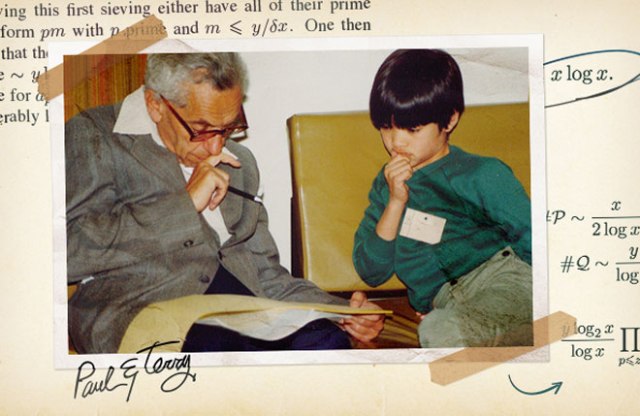
In 1985, Tao, then a 10-year-old prodigy, met Erdős at a math event. “He treated me as an equal,” recalled Tao, who in 2006 won a Fields Medal, widely seen as the highest honor in mathematics. “He talked very serious mathematics to me.” This is the first Erdős prize problem Tao has been able to solve, he said. “So that’s kind of cool.”

The recent progress in understanding both small and large prime gaps has spawned a generation of number theorists who feel that anything is possible, Granville said. “Back when I was growing up mathematically, we thought there were these eternal questions that we wouldn’t see answered until another era,” he said. “But I think attitudes have changed in the last year or two. There are a lot of young people who are much more ambitious than in the past, because they’ve seen that you can make massive breakthroughs.”

http://www.wired.com/2014/12/mathematicians-make-major-discovery-prime-numbers/?mbid=social_fb

New proof shows that it’s possible that the Big Bang created a parallel universe in which time runs backwards

By Gregory Walton

Radical new research led by a British scientist has suggested that there may be a second universe where time runs backwards.

The theoretical claims put forward in the Physical Review Letters journal could revolutionise the field of research into the origin and future of the universe.

In the paper titled ‘Identification of a Gravitational Arrow of Time’, an international team of world renowned scientists led by Oxfordshire-based Dr Julian Barbour challenge assumptions about the so called ‘arrow of time’.

The ‘arrow of time’ is the theory that time is symmetric and therefore time moves forward. They contend that there is no scientific reason that a mirror universe could not have been created where time moved in an distinct way from our own.

But in a quirk of science it is thought that if a parallel universe did exist where time moved backward, any sentient beings there would consider that time in our universe in fact moved backward.

The arrow of time is also known as the ‘one-way’ direction of time and was devised by a British scientist, Dr Arthur Eddington, in the twenties.

All of the laws of physics apply no matter which way time is moving and therefore there is no scientific impediment to such a parallel universe.

Dr. Barbour says: “Time is a mystery. Basically, all the known laws of physics look exactly the same whichever way time runs, and in the world in which we live in everything goes in one direction.”

“If you look at a simple model with a swarm of bees in the middle of the Big Bang but breaking up in either direction, then you would say there are two arrows of time, pointing in opposite direction from the swarm. One arrow would be forwards and one backwards.”

However Dr Barbour acknowledges that locating the ‘other’ universe in practical terms is an altogether different question.

“Our results are a proof of principle,” he said.

http://www.telegraph.co.uk/news/science/science-news/11285605/Did-the-Big-Bang-create-a-parallel-universe-where-time-goes-backwards.html

New research suggests that memories may not be stored by synaptic connections between nerve cells

New research suggests that memories may not be stored by synaptic connections between neurons in the brain, but rather synapses may allow the expression of memories that are stored elsewhere in the neuron.

The revolutionary study by academics at the University of California has suggested for the first time that memories are not stored in synapses as previously thought. It is synapses, the connections between brain cells, that are destroyed by Alzheimer’s.

The breakthrough, reported in the highly regarded online journal eLife, could mean that it becomes possible to restore lost memories.

“Long-term memory is not stored at the synapse,” said David Glanzman, the study’s co-author and professor of integrative biology and physiology and of neurobiology at UCLA. “That’s a radical idea, but that’s where the evidence leads. The nervous system appears to be able to regenerate lost synaptic connections. If you can restore the synaptic connections, the memory will come back. It won’t be easy, but I believe it’s possible.”

Professor Glanzman’s team studied the marine snail Aplysia to understand the animal’s learning and memory functions. Glanzman was particularly interested in the Aplysia’s defensive reactions and the sensory and motor neurons responsible for its withdrawal response.

“If you train an animal on a task, inhibit its ability to produce proteins immediately after training, and then test it 24 hours later, the animal doesn’t remember the training,” said Prof. Glanzman. “However, if you train an animal, wait 24 hours, and then inject a protein synthesis inhibitor in its brain, the animal shows perfectly good memory 24 hours later. In other words, once memories are formed, if you temporarily disrupt protein synthesis, it doesn’t affect long-term memory. That’s true in the Aplysia and in human’s brains.”

As part of the test, the snails were given a number of electric shocks, which in themselves would not usually produce long-term memories. The team found that the memories they thought had been completely erased earlier in the experiment had returned, suggesting that synaptic connections that had previously been lost were apparently restored.

“That suggests that the memory is not in the synapses but somewhere else,” said Glanzman. “We think it’s in the nucleus of the neurons. We haven’t proved that, though.”

He added that the research could be a major breakthrough for Alzheimer’s sufferers as even though the disease destroys synapses in the brain, memories might not necessarily destroyed.

“As long as the neurons are still alive, the memory will still be there, which means you may be able to recover some of the lost memories in the early stages of Alzheimer’s,” said Prof Glanzman.

http://www.telegraph.co.uk/news/science/11307411/Cure-for-memory-loss-could-be-on-the-horizon.html

‘Gecko Gloves’ by Stanford students will let you scale glass walls like Spider-Man

You don’t have to be a superhero like Spider-Man to climb on walls. Researchers have developed “Gecko Gloves” that can help humans climb on glass walls.

The Gecko Gloves have been created by Elliot Hawkes, a mechanical engineering student at the Stanford University. The gloves have very similar scientific principles as found in the sticky toes of geckos.

Hawkes reveals that he is working with a group of engineers who are developing reusable and controllable adhesive materials that can bond with smooth surfaces such as glass, but also release with the use of minimal effort. With the help of the synthetic adhesive, Hawkes and his team created a device that can enable a person to climb on glass walls.

“It’s a lot of fun, but also a little weird, because it doesn’t feel like you should be gripping glass,” says Hawkes. “You keep expecting to slip off, and when you don’t, it surprises you. It’s pretty exhilarating.”

Hawkes explains that each gecko handheld pad is coated with 24 adhesive tiles. Each tile is covered with sawtooth-shape polymer structures, which measures about 100 micrometers long, or about the width of a normal human hair.

The handheld pads are also connected to degressive springs that become less stiff when the pad is stretched, which means that when the springs are pulled they apply similar force to the adhesive tiles and causes the sawtooth-like structure to flatten. When the load tension is released it reduces grip.

Some experts suggest that the Gecko Gloves can be applied in many fields. It can be used to manufacture robots, which carries glass panels. Mark Cutkosky, who is the senior author of the paper, suggests that they are also working on a project with the U.S. National Aeronautics and Space Administration (NASA), which will involve applying the Gecko Gloves to robotic arms of a spacecraft. With the help of the Gecko Gloves, the robotic arm will be able to catch hold of space debris like solar panels and fuel tanks and move it accordingly.

Researchers of the latest study suggest that previous work of gecko or synthetic adhesives showed that adhesive strength is reduced when size increases. However, in the Gecko Gloves, the springs make it possible to sustain the same adhesive power at all sizes ranging from a square millimeter to the size of a human hand.

The latest version of the Gecko Gloves can support around 200 pounds, or about 90 kilograms (kg). However, if the size is increased by 10 times it can support about 2,000 pounds, or 900 kg.

The research has been published in the journal Royal Society Interface.

http://www.techtimes.com/articles/22769/20141224/gecko-gloves-by-stanford-students-will-let-you-scale-glass-walls-want-to-be-spider-man.htm