‘I’ve taken the unusual step of not only seeing a doctor but a vet, and both have confirmed I’m not a reptile.’ New Zealand’s Prime Minister John Key promises that he has no extraterrestrial agenda.
Politicians are often likened to snakes.
But one world leader has been bizarrely forced to deny he is a cold-blooded extraterrestrial hell-bent on controlling the planet.
New Zealand’s Prime Minister John Key went officially on record this week to categorically state he was not a shapeshifting reptilian alien.
He was forced to make the comical statement after an Auckland man filed an Open Information Act request.
It asked Key to prove he wasn’t a “shapeshifting reptilian alien ushering humanity towards enslavement.”
While Key’s office confessed it couldn’t offer up any concrete proof he wasn’t an other world intruder, the man himself did promise he was 100% human.
“I’ve taken the unusual step of not only seeing a doctor but a vet, and both have confirmed I’m not a reptile,” he told reporters.
“I’ve never been in a spaceship, I don’t have a little green suit and never been to outer space,” he added to 3News.
Let’s rewind the clock. Before humans existed, before Earth formed, before the sun ignited, before galaxies arose, before light could even shine, there was the Big Bang. This happened 13.8 billion years ago.
But what about before that? Many physicists say there is no before that. Time began ticking, they insist, at the instant of the Big Bang, and pondering anything earlier isn’t in the realm of science. We’ll never understand what pre-Big Bang reality was like, or what it was formed of, or why it exploded to create our universe. Such notions are beyond human understanding.
But a few unconventional scientists disagree. These physicists theorize that, a moment before the Big Bang, all the mass and energy of the nascent universe was compacted into an incredibly dense—yet finite—speck. Let’s call it the seed of a new universe.
This seed is thought to have been almost unimaginably tiny, possibly trillions of times smaller than any particle humans have been able to observe. And yet it’s a particle that can spark the production of every other particle, not to mention every galaxy, solar system, planet, and person.
If you really want to call something the God particle, this seed seems an ideal fit.
So how is such a seed created? One idea, bandied about for several years—notably by Nikodem Poplawski of the University of New Haven—is that the seed of our universe was forged in the ultimate kiln, likely the most extreme environment in all of nature: inside a black hole.
It’s important to know, before we go further, that over the last couple of decades, many theoretical physicists have come to believe that our universe is not the only one. Instead, we may be part of the multiverse, an immense array of separate universes, each its own shining orb in the true night sky.
How, or even if, one universe is linked to another is a source of much debate, all of it highly speculative and, as of now, completely unprovable. But one compelling idea is that the seed of a universe is similar to the seed of a plant: It’s a chunk of essential material, tightly compressed, hidden inside a protective shell.
This precisely describes what is created inside a black hole. Black holes are the corpses of giant stars. When such a star runs out of fuel, its core collapses inward. Gravity pulls everything into an increasingly fierce grip. Temperatures reach 100 billion degrees. Atoms are smashed. Electrons are shredded. Those pieces are further crumpled.
The star, by this point, has turned into a black hole, which means that its gravitational pull is so severe that not even a beam of light can escape. The boundary between the interior and exterior of a black hole is called the event horizon. Enormous black holes, some of them millions of times more massive than the sun, have been discovered at the center of nearly every galaxy, including our own Milky Way.
If you use Einstein’s theories to determine what occurs at the bottom of a black hole, you’ll calculate a spot that is infinitely dense and infinitely small: a hypothetical concept called a singularity. But infinities aren’t typically found in nature. The disconnect lies with Einstein’s theories, which provide wonderful calculations for most of the cosmos, but tend to break down in the face of enormous forces, such as those inside a black hole—or present at the birth of our universe.
Physicists like Dr. Poplawski say that the matter inside a black hole does reach a point where it can be crushed no further. This “seed” might be incredibly tiny, with the weight of a billion suns, but unlike a singularity, it is real.
The compacting process halts, according to Dr. Poplawski, because black holes spin. They spin extremely rapidly, possibly close to the speed of light. And this spin endows the compacted seed with a huge amount of torsion. It’s not just small and heavy; it’s also twisted and compressed, like one of those jokey spring-loaded snakes in a can.
Which can suddenly unspring, with a bang. Make that a Big Bang—or what Dr. Poplawski prefers to call “the big bounce.”
It’s possible, in other words, that a black hole is a conduit—a “one-way door,” says Dr. Poplawski—between two universes. This means that if you tumble into the black hole at the center of the Milky Way, it’s conceivable that you (or at least the shredded particles that were once you) will end up in another universe. This other universe isn’t inside ours, adds Dr. Poplawski; the hole is merely the link, like a shared root that connects two aspen trees.
And what about all of us, here in our own universe? We might be the product of another, older universe. Call it our mother universe. The seed this mother universe forged inside a black hole may have had its big bounce 13.8 billion years ago, and even though our universe has been rapidly expanding ever since, we could still be hidden behind a black hole’s event horizon.
New high resolution satellite image processing technology allows researchers to identify and count right whales at the ocean surface or to depths of up to 15 metres — described as a boon to tracking the health of whale populations.
The very trait that pushed southern right whales close to extinction — lolling near the surface of warm waters — is helping to revolutionize the way whales are counted.
New satellite technology has allowed the use of high-resolution photographs and image processing software to detect the crustaceans at the surface or to a depth of 15 metres in shallow waters off Argentina.
High-res satellites are a cost-effective improvement over the way whale populations are currently calculated — narrowly limited counts from shore, a ship or a plane.
Scientists used the most powerful commercial observation platforms available can see surface features as small as 50 centimetres in black and white.
A test of the satellite’s image-recognition capacity, reported in the journal Plos One, detected about 90% of southern right whales swimming in the Golfo Nuevo on the coast of Argentina compared to a manual search of the imagery.
The accuracy surpasses previous attempts at space-borne assessment and could revolutionize the way whale populations are estimated.
“Our study is a proof of principle,” Peter Fretwell of the British Antarctic Survey told the BBC.
“But as the resolution of the satellites increases and our image analysis improves, we should be able to monitor many more species and in other types of location.
“It should be possible to do total population counts and in the future track the trajectory of those populations.”
For this study, Fretwell and his colleagues purchased a single, massive image taken in September 2012 by the WorldView2 satellite. The image covers 113 square kilometres including Golfo Nuevo, a circular gulf off the Argentine coast and an area where southern right whales are known to breed and raise their young from July through November.
By looking at the same image in different wavelengths, including one able to penetrate 15 metres beneath the ocean, the researchers were able to spot 55 probable whales and 22 possible whales in the gulf as well as 13 whale-shapes underwater.
“Satellite imagery provides much more accurate and wider coverage,” Fretwell told the Los Angeles Times. “If this works, we can take it out to many other species as well.”
These animals were driven to near-extinction in the early 20th century. Recognized as slow, shallow swimmers, they were the “right” whales to hunt.
For this reason, their numbers dropped from a pre-whaling population of 55,000-70,000 to just 300 by the 1920s.
“The same reason they are the right whales to catch makes them the right whales to look for by satellite,” said Fretwell.
Their numbers have seen something of a recovery, but without the means to carry out an accurate census, it is hard to know their precise status.
Scientists already have used satellite imagery to count populations of penguins in Antarctica, and Fretwell said similar work was being done with seals. The key to using satellites to track animals is not the size of the animal but how much it stands out from its environment, he said.
Scientists have long used mathematics to describe the physical properties of the universe. But what if the universe itself is math? That’s what cosmologist Max Tegmark believes.
In Tegmark’s view, everything in the universe — humans included — is part of a mathematical structure. All matter is made up of particles, which have properties such as charge and spin, but these properties are purely mathematical, he says. And space itself has properties such as dimensions, but is still ultimately a mathematical structure.
“If you accept the idea that both space itself, and all the stuff in space, have no properties at all except mathematical properties,” then the idea that everything is mathematical “starts to sound a little bit less insane,” Tegmark said in a talk given Jan. 15 here at The Bell House. The talk was based on his book “Our Mathematical Universe: My Quest for the Ultimate Nature of Reality” (Knopf, 2014).
“If my idea is wrong, physics is ultimately doomed,” Tegmark said. But if the universe really is mathematics, he added, “There’s nothing we can’t, in principle, understand.”
The idea follows the observation that nature is full of patterns, such as the Fibonacci sequence, a series of numbers in which each number is the sum of the previous two numbers. The flowering of an artichoke follows this sequence, for example, with the distance between each petal and the next matching the ratio of the numbers in the sequence.
The nonliving world also behaves in a mathematical way. If you throw a baseball in the air, it follows a roughly parabolic trajectory. Planets and other astrophysical bodies follow elliptical orbits.
“There’s an elegant simplicity and beauty in nature revealed by mathematical patterns and shapes, which our minds have been able to figure out,” said Tegmark, who loves math so much he has framed pictures of famous equations in his living room.
One consequence of the mathematical nature of the universe is that scientists could in theory predict every observation or measurement in physics. Tegmark pointed out that mathematics predicted the existence of the planet Neptune, radio waves and the Higgs boson particle thought to explain how other particles get their mass.
Some people argue that math is just a tool invented by scientists to explain the natural world. But Tegmark contends the mathematical structure found in the natural world shows that math exists in reality, not just in the human mind.
And speaking of the human mind, could we use math to explain the brain?
Some have described the human brain as the most complex structure in the universe. Indeed, the human mind has made possible all of the great leaps in understanding our world.
Someday, Tegmark said, scientists will probably be able to describe even consciousness using math. (Carl Sagan is quoted as having said, “the brain is a very big place, in a very small space.”)
“Consciousness is probably the way information feels when it’s being processed in certain, very complicated ways,” Tegmark said. He pointed out that many great breakthroughs in physics have involved unifying two things once thought to be separate: energy and matter, space and time, electricity and magnetism. He said he suspects the mind, which is the feeling of a conscious self, will ultimately be unified with the body, which is a collection of moving particles.
But if the brain is just math, does that mean free will doesn’t exist, because the movements of particles could be calculated using equations? Not necessarily, he said.
One way to think of it is, if a computer tried to simulate what a person will do, the computation would take at least the same amount of time as performing the action. So some people have suggested defining free will as an inability to predict what one is going to do before the event occurs.
But that doesn’t mean humans are powerless. Tegmark concluded his talk with a call to action: “Humans have the power not only to understand our world, but to shape and improve it.”
Notion of an ‘event horizon’, from which nothing can escape, is incompatible with quantum theory, physicist claims.
by Zeeya Merali
Most physicists foolhardy enough to write a paper claiming that “there are no black holes” — at least not in the sense we usually imagine — would probably be dismissed as cranks. But when the call to redefine these cosmic crunchers comes from Stephen Hawking, it’s worth taking notice. In a paper posted online, the physicist, based at the University of Cambridge, UK, and one of the creators of modern black-hole theory, does away with the notion of an event horizon, the invisible boundary thought to shroud every black hole, beyond which nothing, not even light, can escape.
In its stead, Hawking’s radical proposal is a much more benign “apparent horizon”, which only temporarily holds matter and energy prisoner before eventually releasing them, albeit in a more garbled form.
“There is no escape from a black hole in classical theory,” Hawking told Nature. Quantum theory, however, “enables energy and information to escape from a black hole”. A full explanation of the process, the physicist admits, would require a theory that successfully merges gravity with the other fundamental forces of nature. But that is a goal that has eluded physicists for nearly a century. “The correct treatment,” Hawking says, “remains a mystery.”
Hawking posted his paper on the arXiv preprint server on 22 January1. He titled it, whimsically, ‘Information preservation and weather forecasting for black holes’, and it has yet to pass peer review. The paper was based on a talk he gave via Skype at a meeting at the Kavli Institute for Theoretical Physics in Santa Barbara, California, in August 2013.
Hawking’s new work is an attempt to solve what is known as the black-hole firewall paradox, which has been vexing physicists for almost two years, after it was discovered by theoretical physicist Joseph Polchinski of the Kavli Institute and his colleagues.
In a thought experiment, the researchers asked what would happen to an astronaut unlucky enough to fall into a black hole. Event horizons are mathematically simple consequences of Einstein’s general theory of relativity that were first pointed out by the German astronomer Karl Schwarzschild in a letter he wrote to Einstein in late 1915, less than a month after the publication of the theory. In that picture, physicists had long assumed, the astronaut would happily pass through the event horizon, unaware of his or her impending doom, before gradually being pulled inwards — stretched out along the way, like spaghetti — and eventually crushed at the ‘singularity’, the black hole’s hypothetical infinitely dense core.
But on analysing the situation in detail, Polchinski’s team came to the startling realization that the laws of quantum mechanics, which govern particles on small scales, change the situation completely. Quantum theory, they said, dictates that the event horizon must actually be transformed into a highly energetic region, or ‘firewall’, that would burn the astronaut to a crisp.
This was alarming because, although the firewall obeyed quantum rules, it flouted Einstein’s general theory of relativity. According to that theory, someone in free fall should perceive the laws of physics as being identical everywhere in the Universe — whether they are falling into a black hole or floating in empty intergalactic space. As far as Einstein is concerned, the event horizon should be an unremarkable place.
Now Hawking proposes a third, tantalizingly simple, option. Quantum mechanics and general relativity remain intact, but black holes simply do not have an event horizon to catch fire. The key to his claim is that quantum effects around the black hole cause space-time to fluctuate too wildly for a sharp boundary surface to exist.
In place of the event horizon, Hawking invokes an “apparent horizon”, a surface along which light rays attempting to rush away from the black hole’s core will be suspended. In general relativity, for an unchanging black hole, these two horizons are identical, because light trying to escape from inside a black hole can reach only as far as the event horizon and will be held there, as though stuck on a treadmill. However, the two horizons can, in principle, be distinguished. If more matter gets swallowed by the black hole, its event horizon will swell and grow larger than the apparent horizon.
Conversely, in the 1970s, Hawking also showed that black holes can slowly shrink, spewing out ‘Hawking radiation’. In that case, the event horizon would, in theory, become smaller than the apparent horizon. Hawking’s new suggestion is that the apparent horizon is the real boundary. “The absence of event horizons means that there are no black holes — in the sense of regimes from which light can’t escape to infinity,” Hawking writes.
“The picture Hawking gives sounds reasonable,” says Don Page, a physicist and expert on black holes at the University of Alberta in Edmonton, Canada, who collaborated with Hawking in the 1970s. “You could say that it is radical to propose there’s no event horizon. But these are highly quantum conditions, and there’s ambiguity about what space-time even is, let alone whether there is a definite region that can be marked as an event horizon.”
Although Page accepts Hawking’s proposal that a black hole could exist without an event horizon, he questions whether that alone is enough to get past the firewall paradox. The presence of even an ephemeral apparent horizon, he cautions, could well cause the same problems as does an event horizon.
Unlike the event horizon, the apparent horizon can eventually dissolve. Page notes that Hawking is opening the door to a scenario so extreme “that anything in principle can get out of a black hole”. Although Hawking does not specify in his paper exactly how an apparent horizon would disappear, Page speculates that when it has shrunk to a certain size, at which the effects of both quantum mechanics and gravity combine, it is plausible that it could vanish. At that point, whatever was once trapped within the black hole would be released (although not in good shape).
If Hawking is correct, there could even be no singularity at the core of the black hole. Instead, matter would be only temporarily held behind the apparent horizon, which would gradually move inward owing to the pull of the black hole, but would never quite crunch down to the centre. Information about this matter would not destroyed, but would be highly scrambled so that, as it is released through Hawking radiation, it would be in a vastly different form, making it almost impossible to work out what the swallowed objects once were.
“It would be worse than trying to reconstruct a book that you burned from its ashes,” says Page. In his paper, Hawking compares it to trying to forecast the weather ahead of time: in theory it is possible, but in practice it is too difficult to do with much accuracy.
Polchinski, however, is sceptical that black holes without an event horizon could exist in nature. The kind of violent fluctuations needed to erase it are too rare in the Universe, he says. “In Einstein’s gravity, the black-hole horizon is not so different from any other part of space,” says Polchinski. “We never see space-time fluctuate in our own neighbourhood: it is just too rare on large scales.”
Raphael Bousso, a theoretical physicist at the University of California, Berkeley, and a former student of Hawking’s, says that this latest contribution highlights how “abhorrent” physicists find the potential existence of firewalls. However, he is also cautious about Hawking’s solution. “The idea that there are no points from which you cannot escape a black hole is in some ways an even more radical and problematic suggestion than the existence of firewalls,” he says. “But the fact that we’re still discussing such questions 40 years after Hawking’s first papers on black holes and information is testament to their enormous significance.”
For the first time, astronomers were able to see a string of hot gas known as a filament that is thought to be part of the mysterious underlying structure that dictates the layout of all the stars and galaxies in our universe.
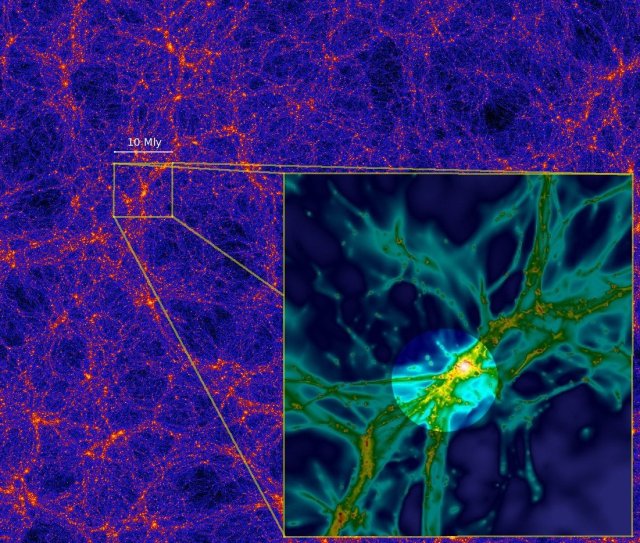
Scientists believe that matter in the universe is arranged into a gigantic web-like structure. This is called the cosmic web.
There are signatures of this structure in the remaining radiation from the Big Bang and in the layout of the universe itself. Without some mysterious force pulling visible matter into this web, galaxies would be randomly scattered across the universe. But they aren’t.
We can see that galaxies are found in groups and those groups come together in larger clusters.
Computer models tell us that those galaxy clusters are linked by long filaments of hot gas and dark matter — a mystery substance that we can’t see because it doesn’t radiate or scatter light but that makes up most of the web.
It’s believed that gas and dark matter flow along the filaments to form clumps of galaxies where the strands intersect. So filaments are important because they represent what the universe looks like on a large scale. The problem is that, even though we should technically be able to see hot gas filaments, they are really hard to detect.
To find this strand of gas, astronomers where able to take advantage of an extremely bright mass of energy and light known as a quasar.
The light from a quasar located 10 billion light-years-away acted like a “flashlight” to make the surrounding gas glow, researchers report Jan. 19 in the journal Nature. This boosted the Lyman alpha radiation that hydrogen gas emits to detectable levels over a huge swath of the region.
The researchers were able to figure out the wavelength of the Lyman alpha radiation emitted by the gas and used the Keck telescope in Hawaii to get an image at that wavelength.
What they were able to see is a cloud of gas extending two million light years across intergalactic space — the largest ever found. And it wasn’t just a diffuse cloud, there are areas where there is more gas and areas of darker, emptier space. The gas-filled areas are filament, while the emptier areas are the gaps between filaments and galaxy clusters.
“This is a very exceptional object,” first author Sebastiano Cantalupo, a postdoctoral fellow at UC Santa Cruz said in a statement. “It’s huge, at least twice as large as any nebula detected before, and it extends well beyond the galactic environment of the quasar.”
Researchers think that the gas filament is even more extended since they only see the part that is illuminated by the radiation from the quasar.
The research still “provides a terrific insight into the overall structure of our universe,” co-author J. Xavier Prochaska, a professor of astronomy and astrophysics at UC Santa Cruz said in statement, since the “quasar is illuminating diffuse gas on scales well beyond any we’ve seen before, giving us the first picture of extended gas between galaxies.”
An airline pilot has reported a near miss in which a “rugby ball”-shaped UFO passed within a few feet of his passenger jet while flying near Heathrow Airport.
The captain told the aviation authorities who have investigated the incident that he was certain the object was going to crash into his aircraft and ducked as it headed towards him.
The investigation has been unable to establish any earthly identity for the mysterious craft, which left the aircrew with no time to take evasive action.
The incident occurred while the A320 Airbus was cruising at 34,000ft, around 20 miles west of the airport, over the Berkshire countryside.
The captain spotted the object travelling towards the jet out of a left hand side, cockpit window, apparently heading directly for it.
A report into the incident states: “He was under the apprehension that they were on collision course with no time to react. His immediate reaction was to duck to the right and reach over to alert the FO (First Officer); there was no time to talk to alert him.”
It adds: “The Captain was fully expecting to experience some kind of impact with a conflicting aircraft.”
He told investigators he believes the object passes “within a few feet” above the jet.
He described it as being “cigar/rugby ball like” in shape, bright silver and apparently “metallic” in construction.
Once he had composed himself, he checked the aircraft’s instruments and contacted air traffic controllers to report the incident. However, there was no sign of the mystery craft.
The incident was investigated by the UK Airprox Board, which studies “near misses” involving aircraft in British airspace.
It checked data recordings to establish what other aircraft were in the area at the time, but eliminated them all from its quest to find out what had been responsible. It also ruled out meteorological balloons, after checking none were released in the vicinity. Toy balloons were also discounted, as they are not large enough to reach such heights. Military radar operators were also contacted but were unable to trace the reported object.
The sighting occurred in daylight, at around. 6.35pm on July 13. It has only emerged now, following publication of the report, which concluded it was “not possible to trace the object or determine the likely cause of the sighting”.
The report does not name the airline or flight involved. Even though it describes the aircraft as being “just to the west of Heathrow”, aviation experts believe that at such an altitude it would be unlikely to have taken off from, or be preparing to land at, the west London airport.
Instead, the A320, which is popular with many carriers, among them British Airways and Virgin, is likely to have been travelling between a regional airport elsewhere in the UK, and another on the Continent. The aircraft typically carry about 150 passengers.
The Ministry of Defence closed its UFO desk in December 2009, along with its hotline for reporting such sightings. Following that change, the Civil Aviation Authority took the decision that it would continue to look into such reports, from aircrew and air traffic controllers, because they could have implications for “flight safety”.
In 2012, the head of the National Air Traffic Control Services admitted staff detected around one unexplained flying object every month.
Dr David Clarke, a Sheffield Hallam academic and the UFO consultant for the National Archives, said: “The aviation authorities obviously think this is something they should continue to look into and if you are a regular air traveller, you are likely to agree.”
Dr Clarke, a sceptic on UFO issues, said: “This latest sighting is interesting, because it is detailed and clear. These pilots don’t file these reports for something and nothing. There was obviously something there.”
Chris Yates, an aviation consultant, said: “Although we assume when these things happen, a UFO is responsible, there is usually an explanation that materialises at some point.”
“Our hypothesis is that the inside of a black hole — it may not be there. Probably that’s the end of space itself. There’s no inside at all.”
– Joe Polchinski, physicist
It could rightly be called the most massive debate of the year: Physicists are locked in an argument over what happens if you fall into a black hole.
On one side are those who support the traditional view from Albert Einstein. On the other, backers of a radical new theory that preserves the very core of modern physics by destroying space itself.
Regardless of who’s right, the new take on black holes could lead to a better understanding of the universe, says Leonard Susskind, a physicist at Stanford University. “This is the kind of thing where progress comes from.”
Black holes are regions of space so dense that nothing, not even light, can escape.
There’s a long-standing view about what would happen if you fell into one of these holes. At first, you’re not going to notice much of anything — but the black hole’s gravity is getting stronger and stronger. And eventually you pass a point of no return.
“It’s kind of like you’re rowing on Niagara Falls, and you pass the point [where] you can’t row fast enough to escape the current,” Susskind says. “Well, you’re doomed at that point. But passing the point of no return — you wouldn’t even notice it.”
Now you can’t get out. And gravity from the black hole is starting to pull on your feet more than your head. “The gravity wants to sort of stretch you in one direction and squeeze you in another,” says Joe Polchinski, a physicist at the University of California, Santa Barbara. He says the technical term for this stretching is spaghettification.
“It’d be kind of medieval,” says Polchinkski. “It’d be like something on Game of Thrones.”
In Einstein’s version of events, that’s the end. But Polchinski has a new version of things: “Our hypothesis is that the inside of a black hole — it may not be there,” he says.
So what’s inside the black hole? Nothing, Polchinski says. Actually even less than that. “Probably that’s the end of space itself; there’s no inside at all.”
This “no inside” idea may sound outrageous, but it’s actually a stab at solving an even bigger problem with black holes.
According to the dominant theory of physics — quantum mechanics — information can never disappear from the universe. Put another way, the atoms in your body are configured in a particular way. They can be rearranged (radically if you happen to slip inside a black hole). But it should always be possible, at least in theory, to look at all those rearranged atoms and work out that they were once part of a human of your dimensions and personality.
This rule is absolutely fundamental. “Everything is built on it,” says Susskind. “If it were violated, everything falls apart.”
For a long time, black holes stretched this rule, but they didn’t break it. People thought that if you fell into a black hole, your spaghettified remains would always be in there, trapped beyond the point of no return.
That is, until the famous physicist Stephen Hawking came along. In the 1970s, Hawking showed that, according to quantum mechanics, a black hole evaporates — very slowly, it vanishes. And that breaks the fundamental rule because all that information that was once in your spaghettified remains vanishes with it.
This didn’t seem to bother Hawking. (“I’m not a psychiatrist, and I can’t psychoanalyze him,” Susskind says.) But it has bothered a lot of other physicists since.
And in the intervening years, work by another theorist — Juan Maldacena, with Princeton’s Institute for Advanced Study — seems to show that Hawking was wrong. Information has to get out of the black hole … somehow. But nobody knows how.
So Polchinski took another look. “We took Hawking’s original argument,” he says, “and very carefully ran it backwards.”
And Polchinski and his colleagues found one way to keep things from vanishing when they fall inside a black hole — they got rid of the inside. By tearing apart the fabric of space beyond the point of no return, the group was able to preserve the information rule of quantum mechanics.
In this version, anything falling into a black hole is instantly vaporized at the point of no return, in a fiery storm of quantum particles. Particles coming from the hole collectively carry away any and all information about the object that’s falling in.
So in Polchinski’s version, when you fall into a black hole, you don’t disappear. Instead, you smack into the end of the universe.
“You just come to the end of space, and there’s nothing beyond it. Terminated,” Susskind says. All the information once contained in your atoms is re-radiated in a quantum mechanical fire.
This new version seems too radical to Susskind. “I don’t think this is true,” he says. “In fact, I think almost nobody thinks this is true — that space falls apart inside a black hole.”
Even Polchinski still feels that black holes should have insides. “My gut believes that the black hole has an interior,” he says. But, he adds, nobody’s been able to disprove his hypothesis that it doesn’t.
“Every counterargument I’ve seen is flawed,” Polchinski says.
Susskind agrees: “Nobody quite knows exactly what’s wrong with their argument — and that’s what makes this so important and interesting.”
And as crazy as it sounds, this is progress. In the year ahead, Susskind hopes someone can find the flaw in Polchinski’s argument, just the way Polchinski found a flaw in Stephen Hawking’s argument. But it will be awhile before we understand black holes inside and out.
At a black hole, Albert Einstein’s theory of gravity apparently clashes with quantum physics, but that conflict could be solved if the Universe were a holographic projection.
A team of physicists have provided what has been described by the journal Nature as the “clearest evidence yet” that our universe is a hologram.
The new research could help reconcile one of modern physics’ most enduring problems : the apparent inconsistencies between the different models of the universe as explained by quantum physics and Einstein’s theory of gravity.
The two new scientific papers are the culmination of years’ work led by Yoshifumi Hyakutake of Ibaraki University in Japan, and deal with hypothetical calculations of the energies of black holes in different universes.
The idea of the universe existing as a ‘hologram’ doesn’t refer to a Matrix-like illusion, but the theory that the three dimensions we perceive are actually just “painted” onto the cosmological horizon – the boundary of the known universe.
If this sounds paradoxical, try to imagine a holographic picture that changes as you move it. Although the picture is two dimensional, observing it from different locations creates the illusion that it is 3D.
This model of the universe helps explain some inconsistencies between general relativity (Einstein’s theory) and quantum physics. Although Einstein’s work underpins much of modern physics, at certain extremes (such as in the middle of a black hole) the principles he outlined break down and the laws of quantum physics take over.
The traditional method of reconciling these two models has come from the 1997 work of theoretical physicist Juan Maldacena, whose ideas built upon string theory. This is one of the most well respected ‘theories of everything’ (Stephen Hawking is a fan) and it posits that one-dimensional vibrating objects known as ‘strings’ are the elementary particles of the universe.
Maldacena has welcomed the new research by Hyakutake and his team, telling the journal Nature that the findings are “an interesting way to test many ideas in quantum gravity and string theory.”
Leonard Susskind, a theoretical physicist regarded as one of the fathers of string theory, added that the work by the Japanese team “numerically confirmed, perhaps for the first time, something we were fairly sure had to be true, but was still a conjecture.”
Here is the original press release from Nature:
A team of physicists has provided some of the clearest evidence yet that our Universe could be just one big projection.
In 1997, theoretical physicist Juan Maldacena proposed1 that an audacious model of the Universe in which gravity arises from infinitesimally thin, vibrating strings could be reinterpreted in terms of well-established physics. The mathematically intricate world of strings, which exist in nine dimensions of space plus one of time, would be merely a hologram: the real action would play out in a simpler, flatter cosmos where there is no gravity.
Maldacena’s idea thrilled physicists because it offered a way to put the popular but still unproven theory of strings on solid footing — and because it solved apparent inconsistencies between quantum physics and Einstein’s theory of gravity. It provided physicists with a mathematical Rosetta stone, a ‘duality’, that allowed them to translate back and forth between the two languages, and solve problems in one model that seemed intractable in the other and vice versa. But although the validity of Maldacena’s ideas has pretty much been taken for granted ever since, a rigorous proof has been elusive.
In two papers posted on the arXiv repository, Yoshifumi Hyakutake of Ibaraki University in Japan and his colleagues now provide, if not an actual proof, at least compelling evidence that Maldacena’s conjecture is true.
In one paper2, Hyakutake computes the internal energy of a black hole, the position of its event horizon (the boundary between the black hole and the rest of the Universe), its entropy and other properties based on the predictions of string theory as well as the effects of so-called virtual particles that continuously pop into and out of existence. In the other3, he and his collaborators calculate the internal energy of the corresponding lower-dimensional cosmos with no gravity. The two computer calculations match.
“It seems to be a correct computation,” says Maldacena, who is now at the Institute for Advanced Study in Princeton, New Jersey and who did not contribute to the team’s work.
The findings “are an interesting way to test many ideas in quantum gravity and string theory”, Maldacena adds. The two papers, he notes, are the culmination of a series of articles contributed by the Japanese team over the past few years. “The whole sequence of papers is very nice because it tests the dual [nature of the universes] in regimes where there are no analytic tests.”
“They have numerically confirmed, perhaps for the first time, something we were fairly sure had to be true, but was still a conjecture — namely that the thermodynamics of certain black holes can be reproduced from a lower-dimensional universe,” says Leonard Susskind, a theoretical physicist at Stanford University in California who was among the first theoreticians to explore the idea of holographic universes.
Neither of the model universes explored by the Japanese team resembles our own, Maldacena notes. The cosmos with a black hole has ten dimensions, with eight of them forming an eight-dimensional sphere. The lower-dimensional, gravity-free one has but a single dimension, and its menagerie of quantum particles resembles a group of idealized springs, or harmonic oscillators, attached to one another.
Nevertheless, says Maldacena, the numerical proof that these two seemingly disparate worlds are actually identical gives hope that the gravitational properties of our Universe can one day be explained by a simpler cosmos purely in terms of quantum theory.







 It's Interesting