New research identifies similarity between how pigeons and human children learn equivalent of words

The more scientists study pigeons, the more they learn how their brains—no bigger than the tip of an index finger—operate in ways not so different from our own.

In a new study from the University of Iowa, researchers found that pigeons can categorize and name both natural and manmade objects—and not just a few objects. These birds categorized 128 photographs into 16 categories, and they did so simultaneously.

Ed Wasserman, UI professor of psychology and corresponding author of the study, says the finding suggests a similarity between how pigeons learn the equivalent of words and the way children do.

“Unlike prior attempts to teach words to primates, dogs, and parrots, we used neither elaborate shaping methods nor social cues,” Wasserman says of the study, published online in the journal Cognition. “And our pigeons were trained on all 16 categories simultaneously, a much closer analog of how children learn words and categories.”

For researchers like Wasserman, who has been studying animal intelligence for decades, this latest experiment is further proof that animals—whether primates, birds, or dogs—are smarter than once presumed and have more to teach scientists.

“It is certainly no simple task to investigate animal cognition; But, as our methods have improved, so too have our understanding and appreciation of animal intelligence,” he says. “Differences between humans and animals must indeed exist: many are already known. But, they may be outnumbered by similarities. Our research on categorization in pigeons suggests that those similarities may even extend to how children learn words.”

Wasserman says the pigeon experiment comes from a project published in 1988 and featured in The New York Times in which UI researchers discovered pigeons could distinguish among four categories of objects.

This time, the UI researchers used a computerized version of the “name game” in which three pigeons were shown 128 black-and-white photos of objects from 16 basic categories: baby, bottle, cake, car, cracker, dog, duck, fish, flower, hat, key, pen, phone, plan, shoe, tree. They then had to peck on one of two different symbols: the correct one for that photo and an incorrect one that was randomly chosen from one of the remaining 15 categories. The pigeons not only succeeded in learning the task, but they reliably transferred the learning to four new photos from each of the 16 categories.

Pigeons have long been known to be smarter than your average bird—or many other animals, for that matter. Among their many talents, pigeons have a “homing instinct” that helps them find their way home from hundreds of miles away, even when blindfolded. They have better eyesight than humans and have been trained by the U. S. Coast Guard to spot orange life jackets of people lost at sea. They carried messages for the U.S. Army during World Wars I and II, saving lives and providing vital strategic information.

UI researchers say their expanded experiment represents the first purely associative animal model that captures an essential ingredient of word learning—the many-to-many mapping between stimuli and responses.

“Ours is a computerized task that can be provided to any animal, it doesn’t have to be pigeons,” says UI psychologist Bob McMurray, another author of the study. “These methods can be used with any type of animal that can interact with a computer screen.”

McMurray says the research shows the mechanisms by which children learn words might not be unique to humans.

“Children are confronted with an immense task of learning thousands of words without a lot of background knowledge to go on,” he says. “For a long time, people thought that such learning is special to humans. What this research shows is that the mechanisms by which children solve this huge problem may be mechanisms that are shared with many species.”

Wasserman acknowledges the recent pigeon study is not a direct analogue of word learning in children and more work needs to be done. Nonetheless, the model used in the study could lead to a better understanding of the associative principles involved in children’s word learning.

“That’s the parallel that we’re pursuing,” he says, “but a single project—however innovative it may be—will not suffice to answer such a provocative question.”

http://now.uiowa.edu/2015/02/pigeon-power

Adoptees’ ‘lost language’ from infancy triggers brain response


Chinese children are lined up in Tiananmen Square in 2003 for photos with the overseas families adopting them. The children in the new study were adopted from China at an average age of 12.8 months and raised in French-speaking families.

You may not recall any memories from the first year of life, but if you were exposed to a different language at the time, your brain will still respond to it at some level, a new study suggests.

Brain scans show that children adopted from China as babies into families that don’t speak Chinese still unconsciously recognize Chinese sounds as language more than a decade later.

“It was amazing to see evidence that such an early experience continued to have a lasting effect,” said Lara Pierce, lead author of the study just published in the journal Proceedings of the National Academy of Sciences, in an email to CBC News.

The adopted children, who were raised in French-speaking Quebec families, had no conscious memory of hearing Chinese.

“If you actually test these people in Chinese, they don’t actually know it,” said Denise Klein, a researcher at McGill University’s Montreal Neurological Institute who co-authored the paper.

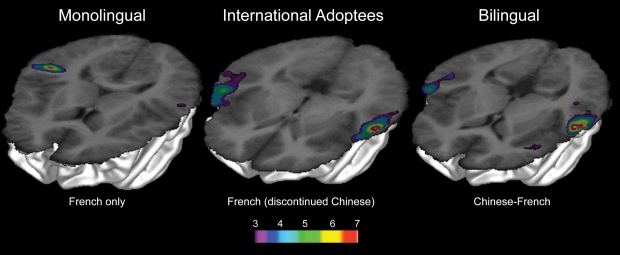
But their brains responded to Chinese language sounds the same way as those of bilingual children raised in Chinese-speaking families.


Children exposed to Chinese as babies display similar brain activation patterns as children with continued exposure to Chinese when hearing Chinese words, fMRI scans show.

“In essence, their pattern still looks like people who’ve been exposed to Chinese all their lives.”

Pierce, a PhD candidate in psychology at McGill University, working with Klein and other collaborators, scanned the brains of 48 girls aged nine to 17. Each participant lay inside a functional magnetic resonance imaging machine while she listened to pairs of three-syllable phrases. The phrases contained either:

■Sounds and tones from Mandarin, the official Chinese dialect.
■Hummed versions of the same tones but no actual words.

Participants were asked to tell if the last syllables of each pair were the same or different. The imaging machine measured what parts of the brain were active as the participants were thinking.

“Everybody can do the task — it’s not a difficult task to do,” Klein said. But the sounds are processed differently by people who recognize Chinese words — in that case, they activate the part of the brain that processes language.

Klein said the 21 children adopted from China who participated in the study might have been expected to show patterns similar to those of the 11 monolingual French-speaking children. After all, the adoptees left China at an average age of 12.8 months, an age when most children can only say a few words. On average, those children had not heard Chinese in more than 12 years.

The fact that their brains still recognized Chinese provides some insight into the importance of language learning during the first year of life, Klein suggested.

Effect on ‘relearning’ language not known

But Klein noted that the study is a preliminary one and the researchers don’t yet know what the results mean.

For example, would adopted children exposed to Chinese in infancy have an easier time relearning Chinese later, compared with monolingual French-speaking children who were learning it for the first time?

Pierce said studies trying to figure that out have had mixed results, but she hopes the findings in this study could generate better ways to tackle that question.

She is also interested in whether the traces of the lost language affect how the brain responds to other languages or other kinds of learning. Being able to speak multiple languages has already been shown to have different effects on the way the brain processes languages and other kinds of information.

http://www.cbc.ca/news/technology/adoptees-lost-language-from-infancy-triggers-brain-response-1.2838001

Brain decoder can eavesdrop on your inner voice

brainy_2758840b

Talking to yourself used to be a strictly private pastime. That’s no longer the case – researchers have eavesdropped on our internal monologue for the first time. The achievement is a step towards helping people who cannot physically speak communicate with the outside world.

“If you’re reading text in a newspaper or a book, you hear a voice in your own head,” says Brian Pasley at the University of California, Berkeley. “We’re trying to decode the brain activity related to that voice to create a medical prosthesis that can allow someone who is paralysed or locked in to speak.”

When you hear someone speak, sound waves activate sensory neurons in your inner ear. These neurons pass information to areas of the brain where different aspects of the sound are extracted and interpreted as words.

In a previous study, Pasley and his colleagues recorded brain activity in people who already had electrodes implanted in their brain to treat epilepsy, while they listened to speech. The team found that certain neurons in the brain’s temporal lobe were only active in response to certain aspects of sound, such as a specific frequency. One set of neurons might only react to sound waves that had a frequency of 1000 hertz, for example, while another set only cares about those at 2000 hertz. Armed with this knowledge, the team built an algorithm that could decode the words heard based on neural activity alone (PLoS Biology, doi.org/fzv269).

The team hypothesised that hearing speech and thinking to oneself might spark some of the same neural signatures in the brain. They supposed that an algorithm trained to identify speech heard out loud might also be able to identify words that are thought.

Mind-reading

To test the idea, they recorded brain activity in another seven people undergoing epilepsy surgery, while they looked at a screen that displayed text from either the Gettysburg Address, John F. Kennedy’s inaugural address or the nursery rhyme Humpty Dumpty.

Each participant was asked to read the text aloud, read it silently in their head and then do nothing. While they read the text out loud, the team worked out which neurons were reacting to what aspects of speech and generated a personalised decoder to interpret this information. The decoder was used to create a spectrogram – a visual representation of the different frequencies of sound waves heard over time. As each frequency correlates to specific sounds in each word spoken, the spectrogram can be used to recreate what had been said. They then applied the decoder to the brain activity that occurred while the participants read the passages silently to themselves.

Despite the neural activity from imagined or actual speech differing slightly, the decoder was able to reconstruct which words several of the volunteers were thinking, using neural activity alone (Frontiers in Neuroengineering, doi.org/whb).

The algorithm isn’t perfect, says Stephanie Martin, who worked on the study with Pasley. “We got significant results but it’s not good enough yet to build a device.”

In practice, if the decoder is to be used by people who are unable to speak it would have to be trained on what they hear rather than their own speech. “We don’t think it would be an issue to train the decoder on heard speech because they share overlapping brain areas,” says Martin.

The team is now fine-tuning their algorithms, by looking at the neural activity associated with speaking rate and different pronunciations of the same word, for example. “The bar is very high,” says Pasley. “Its preliminary data, and we’re still working on making it better.”

The team have also turned their hand to predicting what songs a person is listening to by playing lots of Pink Floyd to volunteers, and then working out which neurons respond to what aspects of the music. “Sound is sound,” says Pasley. “It all helps us understand different aspects of how the brain processes it.”

“Ultimately, if we understand covert speech well enough, we’ll be able to create a medical prosthesis that could help someone who is paralysed, or locked in and can’t speak,” he says.

Several other researchers are also investigating ways to read the human mind. Some can tell what pictures a person is looking at, others have worked out what neural activity represents certain concepts in the brain, and one team has even produced crude reproductions of movie clips that someone is watching just by analysing their brain activity. So is it possible to put it all together to create one multisensory mind-reading device?

In theory, yes, says Martin, but it would be extraordinarily complicated. She says you would need a huge amount of data for each thing you are trying to predict. “It would be really interesting to look into. It would allow us to predict what people are doing or thinking,” she says. “But we need individual decoders that work really well before combining different senses.”

http://www.newscientist.com/article/mg22429934.000-brain-decoder-can-eavesdrop-on-your-inner-voice.html

New research may help explain why curiosity promotes better memory

Everyone knows it’s easier to learn about a topic you’re curious about. Now, a new study reveals what’s going on in the brain during that process, revealing that such curiosity may give a person a memory boost.

When participants in the study were feeling curious, they were better at remembering information even about unrelated topics, and brain scans showed activity in areas linked to reward and memory.

The results, detailed October 2 in the journal Neuron, hint at ways to improve learning and memory in both healthy people and those with neurological disorders, the researchers said.

“Curiosity may put the brain in a state that allows it to learn and retain any kind of information, like a vortex that sucks in what you are motivated to learn, and also everything around it,” Matthias Gruber, a memory researcher at the University of California, Davis, said in a statement. “These findings suggest ways to enhance learning in the classroom and other settings.”

Gruber and his colleagues put people in a magnetic resonance imaging (MRI) scanner and showed them a series of trivia questions, asking them to rate their curiosity about the answers to those questions. Later, the participants were shown selected trivia questions, then a picture of a neutral face during a 14-second delay, followed by the answer. Afterward, the participants were given a surprise memory test of the faces, and then a memory test of the trivia answers.

Not surprisingly, the study researchers found that people remembered more information about the trivia when they were curious about the trivia answers. But unexpectedly, when the participants were curious, they were also better at remembering the faces, an entirely unrelated task. Participants who were curious were also more likley than others to remember both the trivia information and unrelated faces a day later, the researchers found.

The brain scans showed that, compared with when their curiosity wasn’t piqued, when people were curious, they showed more activation of brain circuits in the nucleus accumbens, an area involved in reward. These same circuits, mediated by the neurochemical messenger dopamine, are involved in forms of external motivation, such as food, sex or drug addiction.

Finally, being curious while learning seemed to produce a spike of activity in the hippocampus, an area involved in forming new memories, and strengthened the link between memory and reward brain circuits.

The study’s findings not only highlight the importance of curiosity for learning in healthy people, but could also give insight into neurological conditions. For example, as people age, their dopamine circuits tend to deteriorate, so understanding how curiosity affects these circuits could help scientists develop treatments for patients with memory disorders, the researchers said.

http://www.livescience.com/48121-curiosity-boosts-memory-learning.html

Our Brains Immediately Judge the Trustworthiness of People

Brain, artwork

Even if we cannot consciously see a person’s face, our brain is able to make a snap decision about how trustworthy they are.

According to a new study published in the Journal of Neuroscience, the brain immediately determines how trustworthy a face is before it’s fully perceived, which supports the fact that we make very fast judgments about people.

Researchers at Dartmouth College and New York University showed a group of participants photos of real people’s faces, as well as computer-generated faces that were meant to look either trustworthy or untrustworthy. It’s been shown in the past that people generally think that faces with high inner eyebrows and prominent cheekbones are more trustworthy, and the opposite features are untrustworthy, which the researchers were able to confirm.

In a second part of their experiment, the researchers showed a separate group of participants the same images but for only about 30 milliseconds while they were in a brain scanner. They then did something called “backward masking,” which consists of showing a participant an irrelevant image or “mask” immediately after quickly showing them a face. The procedure makes the brain incapable of processing the face.

Even though the patients were not able to process the faces, their brains did. The researchers focused on activity in the amygdala, a part of the brain responsible for social and emotional behavior, and found that specific areas of the amygdala were activated based on judgments of trustworthiness or non-trustworthiness. This, the researchers conclude, is evidence that our brains make judgments of people before we even process who they are or what they look like.

Thanks to Pete Cuomo for bringing this to the attention of the It’s Interesting community.

http://time.com/?xid=newsletter-brief#3083667/brain-trustworthiness/

On/Off switch for consciousness in the human brain may have been discovered

ONE moment you’re conscious, the next you’re not. For the first time, researchers have switched off consciousness by electrically stimulating a single brain area.

Scientists have been probing individual regions of the brain for over a century, exploring their function by zapping them with electricity and temporarily putting them out of action. Despite this, they have never been able to turn off consciousness – until now.

Although only tested in one person, the discovery suggests that a single area – the claustrum – might be integral to combining disparate brain activity into a seamless package of thoughts, sensations and emotions. It takes us a step closer to answering a problem that has confounded scientists and philosophers for millennia – namely how our conscious awareness arises.

Many theories abound but most agree that consciousness has to involve the integration of activity from several brain networks, allowing us to perceive our surroundings as one single unifying experience rather than isolated sensory perceptions.

One proponent of this idea was Francis Crick, a pioneering neuroscientist who earlier in his career had identified the structure of DNA. Just days before he died in July 2004, Crick was working on a paper that suggested our consciousness needs something akin to an orchestra conductor to bind all of our different external and internal perceptions together.

With his colleague Christof Koch, at the Allen Institute for Brain Science in Seattle, he hypothesised that this conductor would need to rapidly integrate information across distinct regions of the brain and bind together information arriving at different times. For example, information about the smell and colour of a rose, its name, and a memory of its relevance, can be bound into one conscious experience of being handed a rose on Valentine’s day.

The pair suggested that the claustrum – a thin, sheet-like structure that lies hidden deep inside the brain – is perfectly suited to this job (Philosophical Transactions of The Royal Society B, doi.org/djjw5m).

It now looks as if Crick and Koch were on to something. In a study published last week, Mohamad Koubeissi at the George Washington University in Washington DC and his colleagues describe how they managed to switch a woman’s consciousness off and on by stimulating her claustrum. The woman has epilepsy so the team were using deep brain electrodes to record signals from different brain regions to work out where her seizures originate. One electrode was positioned next to the claustrum, an area that had never been stimulated before.

When the team zapped the area with high frequency electrical impulses, the woman lost consciousness. She stopped reading and stared blankly into space, she didn’t respond to auditory or visual commands and her breathing slowed. As soon as the stimulation stopped, she immediately regained consciousness with no memory of the event. The same thing happened every time the area was stimulated during two days of experiments (Epilepsy and Behavior, doi.org/tgn).
To confirm that they were affecting the woman’s consciousness rather than just her ability to speak or move, the team asked her to repeat the word “house” or snap her fingers before the stimulation began. If the stimulation was disrupting a brain region responsible for movement or language she would have stopped moving or talking almost immediately. Instead, she gradually spoke more quietly or moved less and less until she drifted into unconsciousness. Since there was no sign of epileptic brain activity during or after the stimulation, the team is sure that it wasn’t a side effect of a seizure.

Koubeissi thinks that the results do indeed suggest that the claustrum plays a vital role in triggering conscious experience. “I would liken it to a car,” he says. “A car on the road has many parts that facilitate its movement – the gas, the transmission, the engine – but there’s only one spot where you turn the key and it all switches on and works together. So while consciousness is a complicated process created via many structures and networks – we may have found the key.”

Counter-intuitively, Koubeissi’s team found that the woman’s loss of consciousness was associated with increased synchrony of electrical activity, or brainwaves, in the frontal and parietal regions of the brain that participate in conscious awareness. Although different areas of the brain are thought to synchronise activity to bind different aspects of an experience together, too much synchronisation seems to be bad. The brain can’t distinguish one aspect from another, stopping a cohesive experience emerging.

Since similar brainwaves occur during an epileptic seizure, Koubeissi’s team now plans to investigate whether lower frequency stimulation of the claustrum could jolt them back to normal. It may even be worth trying for people in a minimally conscious state, he says. “Perhaps we could try to stimulate this region in an attempt to push them out of this state.”

Anil Seth, who studies consciousness at the University of Sussex, UK, warns that we have to be cautious when interpreting behaviour from a single case study. The woman was missing part of her hippocampus, which was removed to treat her epilepsy, so she doesn’t represent a “normal” brain, he says.

However, he points out that the interesting thing about this study is that the person was still awake. “Normally when we look at conscious states we are looking at awake versus sleep, or coma versus vegetative state, or anaesthesia.” Most of these involve changes of wakefulness as well as consciousness but not this time, says Seth. “So even though it’s a single case study, it’s potentially quite informative about what’s happening when you selectively modulate consciousness alone.”

“Francis would have been pleased as punch,” says Koch, who was told by Crick’s wife that on his deathbed, Crick was hallucinating an argument with Koch about the claustrum and its connection to consciousness.

“Ultimately, if we know how consciousness is created and which parts of the brain are involved then we can understand who has it and who doesn’t,” says Koch. “Do robots have it? Do fetuses? Does a cat or dog or worm? This study is incredibly intriguing but it is one brick in a large edifice of consciousness that we’re trying to build.”

http://www.newscientist.com/article/mg22329762.700-consciousness-onoff-switch-discovered-deep-in-brain.html?full=true#.U7n7sI1dVC8

Thanks to Kebmodee for bringing this to the attention of the It’s Interesting community.

7 Very Bizarre (and Very Rare) Psychotic Hallucinations

brain

The many documented cases of strange delusions and neurological syndromes can offer a window into how bizarre the brain can be.

It may seem that hallucinations are random images that appear to some individuals, or that delusions are thoughts that arise without purpose. However, in some cases, a specific brain pathway may create a particular image or delusion, and different people may experience the same hallucination.

In recent decades, with advances in brain science, researchers have started to unravel the causes of some of these conditions, while others have remained a mystery.

Here is a look at seven odd hallucinations, which show that anything is possible when the brain takes a break from reality.

1. Alice-in-Wonderland syndrome
This neurological syndrome is characterized by bizarre, distorted perceptions of time and space, similar to what Alice experienced in Lewis Carroll’s “Alice’s Adventures in Wonderland.”

Patients with Alice-in-Wonderland syndrome describe seeing objects or parts of their bodies as smaller or bigger than their actual sizes, or in an altered shape. These individuals may also perceive time differently.

The rare syndrome seems to be caused by some viral infections, epilepsy, migraine headaches and brain tumors. Studies have also suggested that abnormal activity in parts of the visual cortex that handle information about the shape and size of objects might cause the hallucinations.

It’s also been suggested that Carroll himself experienced the condition during migraine headaches and used them as inspiration for writing the tale of Alice’s strange dream.

English psychiatrist John Todd first described the condition in an article published in the Canadian Medical Association Journal in 1955, and that’s why the condition is also called Todd’s syndrome. However, an earlier reference to the condition appears in a 1952 article by American neurologist Caro Lippman. The doctor describes a patient who reported feeling short and wide as she walked, and referenced “Alice’s Adventures in Wonderland” to explain her body image illusions.

2. Walking Corpse Syndrome
This delusion, also called Cotard’s Syndrome, is a rare mental illness in which patients believe they are dead, are dying or have lost their internal organs.

French neurologist Jules Cotard first described the condition in 1880, finding it in a woman who had depression and also symptoms of psychosis. The patient believed she didn’t have a brain or intestines, and didn’t need to eat. She died of starvation.

Other cases of Cotard’s syndrome have been reported in people with a range of psychiatric and neurological problems, including schizophrenia, traumatic brain injury and multiple sclerosis.

In a recent case report of Cotard’s syndrome, researchers described a previously healthy 73-year-old woman who went to the emergency room insisting that she was “going to die and going to hell.” Eventually, doctors found the patient had bleeding in her brain due to a stroke. After she received treatment in the hospital, her delusion resolved within a week, according to the report published in January 2014 in the journal of Neuropsychiatry.

3. Charles Bonnet syndrome
People who have lost their sight may develop Charles Bonnet syndrome, which involves having vivid, complex visual hallucinations of things that aren’t really there.

People with this syndrome usually hallucinate people’s faces, cartoons, colored patterns and objects. It is thought the condition occurs because the brain’s visual system is no longer receiving visual information from the eye or part of the retina, and begins making up its own images.

Charles Bonnet syndrome occurs in between 10 and 40% of older adults who have significant vision loss, according to studies.

4. Clinical lycanthropy
In this extremely rare psychiatric condition, patients believe they are turning into wolves or other animals. They may perceive their own bodies differently, and insist they are growing the fur, sharp teeth and claws of a wolf.

Cases have also been reported of people with delusional beliefs about turning into dogs, pigs, frogs and snakes.

The condition usually occurs in combination with another disorder, such as schizophrenia, bipolar disorder or severe depression, according to a review study published in the March issue of the journal History of Psychiatry in 2014.

5. Capgras delusion
Patients with Capgras delusion believe that an imposter has replaced a person they feel close to, such as a friend or spouse. The delusion has been reported in patients with schizophrenia, Alzheimer’s disease, advanced Parkinson’s disease, dementia and brain lesions.

One brain imaging study suggested the condition may involve reduced neural activity in the brain system that processes information about faces and emotional responses.

6. Othello syndrome
Named after Shakespeare’s character, Othello syndrome involves a paranoid belief that the sufferer’s partner is cheating. People with this condition experience strong obsessive thoughts and may show aggression and violence.

In one recent case report, doctors described a 46-year-old married man in the African country Burkina Faso who had a stroke, which left him unable to communicate and paralyzed in half of his body. The patient gradually recovered from his paralysis and speaking problems, but developed a persistent delusional jealousy and aggression toward his wife, accusing her of cheating with an unidentified man.

7. Ekbom’s syndrome
Patients with Ekbom’s syndrome, also known as delusional parasitosis or delusional infestations, strongly believe they are infested with parasites that are crawling under their skin. Patients report sensations of itching and being bitten, and sometimes, in an effort to get rid of the pathogens, they may hurt themselves, which can result in wounds and actual infections.

It’s unknown what causes these delusions, but studies have linked the condition with structural changes in the brain, and some patients have improved when treated with antipsychotic medications.

http://www.livescience.com/46477-oddest-hallucinations.html

Neuroscientist Says NIH Funding Squeeze Causing ‘Crisis’ in Biomedical Enterprise

By Jeannie Baumann

Many scientists now spend more time scrambling to raise money for their work than actually doing the research because of the erosion of NIH funding over the last decade, the president of a biomedical research university said during a June 18 congressional briefing.

Mark Tessier-Lavigne said the 25 percent decline in the National Institutes of Health’s purchasing power has led to grants being funded at historically low rates, causing promising young scientists to leave the field altogether and threatening the future of the biomedical research workforce.

“The financial squeeze has triggered a crisis in the biomedical research enterprise,” according to Tessier-Lavigne, who is president of the Rockefeller University in New York and investigates how neural circuits in the brain form during embryonic development. “Renewing NIH funding is an essential investment, not just for our health, but also for our economy.”

Tessier-Lavigne was the main speaker at the Capitol Hill briefing, “Paying Dividends: How Federally Funded Biomedical Research Fuels the Pharmaceutical Industry in the U.S.,” which was organized by the Coalition for the Life Sciences and theCongressional Biomedical Research Caucus as part of the 2014 caucus briefing series.

The key point of Tessier-Lavigne’s presentation—that scientific opportunity has never been greater while federal funding for basic research is at a low—has been echoed, especially by NIH Director Francis S. Collins when testifying before lawmakers in both the House and the Senate.

“We live in a golden age of biological research, of disease research, and of drug discovery that’s been enabled by a revolution in the biosciences that’s occurred over the past 40 years, thanks to the development of very powerful technologies,” said Tessier-Lavigne, citing as examples recombinant DNA, gene sequencing, human genetics and imaging. “We can now tackle disease systematically and that is enabling systematic drug discovery.”

The research ecosystem requires early investment through NIH funding to academia to yield the treatments and cures from the pharmaceutical industry, Tessier-Lavigne said.

“There’s a division of labor,” he said. “Most of the scientific discovery that leads to the insights that are built upon are made in academia, in research labs, in research institutes, in universities supported by the NIH. At the other end of the spectrum, industry—mostly large pharmaceutical companies and large biotech companies—are responsible for making the drugs and taking them through human clinical trials.”

Tessier-Lavigne has worked at both ends of the spectrum, serving as chief scientific officer at biotechnology company Genentech before taking over at Rockefeller. He rejected the idea that drug companies could take on funding the basic research. The cost and time lines of drug discovery and development are already too great, he said.

“To make a drug, to get a drug approved there’s huge attritions,” he said. The process starts with targeting 24 projects, and scientists try to make drugs to fight them that yields on average about nine drug candidates that make it into clinical trials.

“But of those nine, only a single one will make it over the finish line as an approved drug,” he said.

That drug-making process takes an average of 13 years, including five years to make the drug candidates and eight years to get to clinical approval. Including failures, he estimated those costs at anywhere between $2 billion to $4 billion per drug.

“So companies that do this are already struggling to succeed just at this. There are no more resources to fund the ferment back here that leads to the identification of new knowledge. The companies can’t do it and they won’t do it,” he said.

“Couldn’t we just rely on other nations to generate the basic knowledge and then industry here could continue to do the translational work?” Tessier-Lavigne asked rhetorically.

“Well, that’s not how it works. Industry wants its R&D [research and development] sites to be located next to the sites of innovation. It’s as simple as that,” he said.

Over the past 30 years, Tessier-Lavigne said, there has been a “massive” transfer of industry from Europe to the U.S. because of the prominence of the U.S. biomedical enterprise.

“If we don’t maintain, sustain our investment in our basic biomedical enterprise, industry will pick up and move to the other sites,” he said, adding that countries like China are where these companies will move, taking jobs with them.
Rep. Jackie Speier (D-Calif.), co-chairman of the Congressional Biomedical Research Caucus, also mentioned that the U.S. may lose its position as the leader in R&D.

“We still lead in terms of patents and overall research, but China is about to eat our lunch,” said Speier, whose district includes the Bay Area and Genentech’s headquarters. “In fact, China has just about eclipsed Japan now in terms of research and within the next 10 years, it is anticipated that they will indeed overcome us in terms of research and development. And that would indeed be a tragic set of circumstances.”
Action Plan

Tessier-Lavigne proposed an action plan that primarily involves gradually restoring NIH funding in absolute dollars to its 2003 level—the final year of a five-year doubling. Since the 2003 doubling, the NIH’s budget has remained flat at about $30 billion. Collins has said that his agency would have about a $40 billion annual budget if the NIH had continued to receive the steady, 3 percent increases it received from the 1970s onward.

Restoring funding to the 2003 levels would relieve the squeeze on existing programs so scientists can focus on their work as well as stimulate new initiatives to accelerate progress and open new areas of discovery, Tessier-Lavigne said.

At the same time, the academic sector has a responsibility to make sure it spends these dollars effectively while developing a pipeline of new talent. And all stakeholders—academia, the NIH, disease foundations and the private sector—must ensure research discoveries are effectively translated into new therapies and cures.

The next congressional briefing is scheduled for July 16 on the advances and potential of embryonic stem cell research, withLawrence Goldstein, director of the University of California, San Diego, Stem Cell Program.

Thanks to Pete Cuomo for bringing this to the attention of the It’s Interesting community.

Brain tumor causes uncontrollable laughter

They say laughter is the best medicine. But what if laughter is the disease?

For a 6-year-old girl in Bolivia who suffered from uncontrollable and inappropriate bouts of giggles, laughter was a symptom of a serious brain problem. But doctors initially diagnosed the child with “misbehavior.”

“She was considered spoiled, crazy — even devil-possessed,” Dr. José Liders Burgos Zuleta, ofAdvanced Medical Image Centre, in Bolivia, said in a statement.

But Burgos Zuleta discovered that the true cause of the girl’s laughing seizures, medically called gelastic seizures, was a brain tumor.

After the girl underwent a brain scan, the doctors discovered a hamartoma, a small, benign tumor that was pressing against her brain’s temporal lobe.The doctors surgically removed the tumor, and the girl is now healthy, the doctors said.

The girl stopped having the uncontrollable attacks of laughter and now only laughs normally, the doctors said.

Gelastic seizures are a form of epilepsy that is relatively rare, said Dr. Solomon Moshé, a pediatric neurologist at Albert Einstein College of Medicine in New York. The word comes from the Greek word for laughter, “gelos.”

“It’s not necessarily ‘hahaha’ laughing,” Moshé told Live Science. “There’s no happiness in this. Some of the kids may be very scared,” he added.

The seizures are most often caused by tumors in the hypothalamus, especially in kids, although they can also come from tumors in other parts of brain, Moshé said. Although laughter is the main symptom, patients may also have outbursts of crying.

These tumors can cause growth abnormalities if they affect the pituitary gland, he said.

The surgery to remove such brain tumors used to be difficult and dangerous, but a new surgical technique developed within the last 10 years allows doctors to remove them effectively without great risk, Moshé said.

The doctors who treated the girl said their report of her case could raise awareness of the strange condition, so doctors in Latin America can diagnose the true cause of some children’s “behavioral” problems, and refer them to a neurologist.

The case report was published June 16 in the journal ecancermedicalscience.

Thanks to Michael Moore for sharing this with the It’s Interesting community.

http://www.cbsnews.com/news/girls-uncontrollable-laughter-caused-by-brain-tumor/

New research confirms that looking angry gets people to do what you want.

by Amanda L. Chan

If you’ve ever gotten the death glare from your parent, child or S.O., you already know the results of this new study to be true.

New research in the journal Psychological Science shows that people are more likely to give in to an unfair demand when they are presented with a threatening facial expression.

For one of the experiments in the study, 870 people played a negotiation game, which involved deciding how to split $1 between two people. In each scenario, there was a “proposer,” who decided how the dollar would be split and a “responder.” However, before making the decision, the proposer was shown a video clip of the responder making either a neutral facial expression or an angry one. (Little did the study participants know, the responder was actually an actress who was instructed to portray a certain facial expression in each scenario).

In addition to viewing the facial expressions of the responder, the proposer received a written demand from the responder for either half of the amount (considered a “fair” request), or 70 percent of the amount (an “unfair” request). If the responder didn’t accept the proposer’s deal, neither party would get the money.

Researchers found an association between the offer made by the proposer and the facial expression of the responder. If the responder made an angry face and requested the 70 percent, the proposer was more likely to give the 70 percent.

Meanwhile, if the responder made an angry face and only requested the 50-50 split, this didn’t seem to affect how much the proposer offered, likely because the request was already deemed fair. (Something to consider: Because a woman actor was used for the experiment and female and male anger can be perceived differently, the results of the study apply only in the context of a woman’s angry facial expressions being able to influence giving into an unfair demand.)

http://www.huffingtonpost.com/2014/06/09/look-angry-facial-expression-demand_n_5473238.html