‘Extinct’ whale found: Odd-looking pygmy whale traced back 2 million years

12-19-12-pgymy-right-whale_full_380

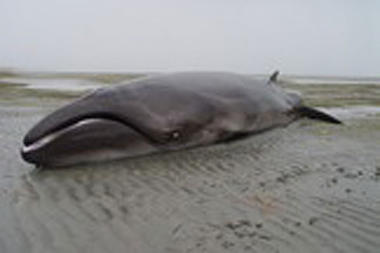
The pygmy right whale, a mysterious and elusive creature that rarely comes to shore, is the last living relative of an ancient group of whales long believed to be extinct, a new study suggests.

The findings, published Tuesday, Dec. 18, in the Proceedings of the Royal Society B, may help to explain why the enigmatic marine mammals look so different from any other living whale.

“The living pygmy right whale is, if you like, a remnant, almost like a living fossil,” said Felix Marx, a paleontologist at the University of Otago in New Zealand. “It’s the last survivor of quite an ancient lineage that until now no one thought was around.”

The relatively diminutive pygmy right whale, which grows to just 21 feet (6.5 meters) long, lives out in the open ocean. The elusive marine mammals inhabit the Southern Hemisphere and have only been spotted at sea a few dozen times. As a result, scientists know almost nothing about the species’ habits or social structure.

The strange creature’s arched, frownlike snout makes it look oddly different from other living whales. DNA analysis suggested pygmy right whales diverged from modern baleen whales such as the blue whale and the humpback whale between 17 million and 25 million years ago. However, the pygmy whales’ snouts suggested they were more closely related to the family of whales that includes the bowhead whale. Yet there were no studies of fossils showing how the pygmy whale had evolved, Marx said.

To understand how the pygmy whale fit into the lineage of whales, Marx and his colleagues carefully analyzed the skull bones and other fossil fragments from pygmy right whales and several other ancient cetaceans.

The pygmy whale’s skull most closely resembled that of an ancient family of whales called cetotheres that were thought to have gone extinct around 2 million years ago, the researchers found. Cetotheres emerged about 15 million years ago and once occupied oceans across the globe.

The findings help explain how pygmy whales evolved and may also help shed light on how these ancient “lost” whales lived. The new information is also a first step in reconstructing the ancient lineage all the way back to the point when all members of this group first diverged, he said.

http://www.csmonitor.com/Science/2012/1219/Extinct-whale-found-Odd-looking-pygmy-whale-traced-back-2-million-years

Thanks to Dr. Lutter for bringing this to the attention of the It’s Interesting community.

Venezuelan Pitcher Plant Uses Wettable Hairs to Make Insects Slip Into Its Deadly Traps

pitcher

An insect-trapping pitcher plant in Venezuela uses its downward pointing hairs to create a ‘water slide’ on which insects slip to their death, new research reveals. The research was published December 19, in the journal Proceedings of the Royal Society B.

Hairs on plants, called trichomes, are typically used to repel water. However, the Cambridge researchers observed that the hairs on the inside of Heliamphora nutans pitcher plants were highly wettable, prompting them to test whether this phenomenon is related to the trapping of insects.

They found that wetting strongly enhanced the slipperiness of the trap and increased the capture rate for ants almost three-fold — from 29 per cent when dry to 88 per cent when wet. Upon further examination, they found that the wetting affected the insects’ adhesive pads while the directional arrangement of the hairs was effective against the claws.

Dr Ulrike Bauer, lead author of the paper from the University of Cambridge, said: “When the hairs of the plant are wet, the ants’ adhesive pads essentially aquaplane on the surface, making the insects lose grip and slip into the bowl of the pitcher. This is the first time that we have observed hairs being used by plants in this way, as they are typically used to make leaves water repellent.”

They also found that the plant used a wicking method during dryer times to pull moisture from the bowl of the pitcher up to the hairy trapping surface, enabling them to capitalise on this aquaplaning effect even when there is no rain.

Dr Bauer added: “This very neat adaptation might help the plants to maximise their nutrient acquisition.”

The Heliamphora nutans pitcher plant lives on the spectacular table mountains of the Guyana Highlands in Southern Venezuela, between altitudes of 2000-2700m. The pitchers can grow up to 18 cm tall and 7 cm wide and trap mainly ants.

http://www.sciencedaily.com/releases/2012/12/121218203513.htm

Hatching Order Influences Birds’ Behavior

121207094343-large

The hatching order of birds influences how they behave in adult life according to research from the Lancaster Environment Centre. Dr Ian Hartley and Dr Mark Mainwaring (LEC) are the authors of the study in Animal Behaviour, which looked at how the birds’ behaviour was affected by the way their parents cared for them as hatchlings.

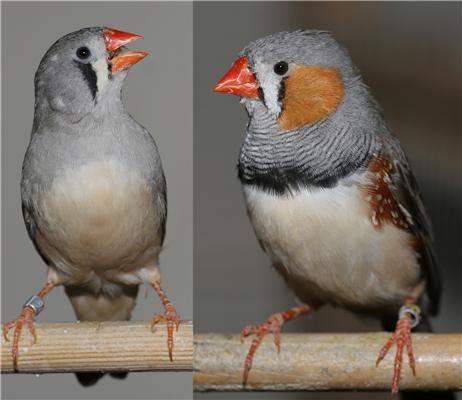
They found that the youngest members of zebra finch broods are more adventurous than their older siblings in adult life.

Dr Hartley said that the study showed for the first time that hatching order influences birds’ “behavioural repertoires” in adulthood.

Hatching eggs over a period of time, rather than all at once, is known as “hatching asynchrony” and occurs when eggs are incubated as soon as they are laid. For a zebra finch, this means that birds born up to four days apart can share the same nest and must compete for food.

The researchers experimentally controlled hatching synchrony within clutches, so that some clutches hatched simultaneously, while others hatched over a period of days. They then tested the behaviour of over one hundred offspring as adults. They found the youngest birds from asynchronously hatched clutches explored their environment more widely.

They measured how explorative the zebra finches were by recording how many times they visited bird feeders within an unfamiliar test aviary. They found that the youngest offspring in a brood approached the feeders significantly more often than their peers within a 30 minute period.

Researchers wanted to know how the method of rearing affected the behaviour of offspring beyond the nest, once they were living as independent adult birds. The results have implications for understanding how environmental stability might influence behaviours, and how flexible animals might be at coping with environmental change.

Journal Reference:

1.Mark C. Mainwaring, Ian R. Hartley. Hatching asynchrony and offspring sex influence the subsequent exploratory behaviour of zebra finches. Animal Behaviour, 2012; DOI: 10.1016/j.anbehav.2012.10.009

http://www.sciencedaily.com/releases/2012/12/121207094343.htm

Potato the Dog claimed to be math genius

Proud dog owner Lu Zesheng says he has been able to train his two-year-old canine companion Potato to do arithmetic. Lu poses the questions, and Potato barks the answers.

For example, when asked: “How much is 3.44 plus 3.56?” Potato barks seven times which, according to Lu, means he knows the answer is seven.

As well as being able to solve mathematical puzzles, Lu also says Potato has an excellent memory and, when asked for the number on the side of China’s first aircraft carrier, the dog barks the correct answer of “sixteen”.

According to Chinese state television, Potato can also memorise mobile phone numbers and even people’s ages.

http://www.telegraph.co.uk/news/newsvideo/weirdnewsvideo/9731570/Chinese-dog-is-maths-genius-according-to-owner.html

Post-Sandy beach erosion reveals skeleton of rare beaked whale

Whalebones-jpg

When Hurricane Sandy blew by Florida last month it blew sand away that led to erosion.

That erosion exposed the remains of a beaked whale on Sunday.

An Orlando-area couple was looking for sand dollars when they noticed something far more interesting in the sand at the oceanfront dog park in New Smyrna Beach.

When they started digging, they found the remains of an 8- to 9-foot whale that may have been there for decades.

“It speaks to the amazing amount of post-Sandy erosion that’s happened on this beach,” said Ed Dettman, who walks the beach every day.

There is only one record of a beaked whale washed up on the beach, and this isn’t it.

The skull, vertebrae and ribs were recovered and laid out as if the whale were in a museum.

The couple turned their find over to the county.

The remains were a foot below the surface but were likely much deeper before the storm blew through.

Read more: http://www.wesh.com/news/central-florida/volusia-county/Beach-erosion-reveals-remains-of-whale/-/12983450/17799578/-/7lkvaqz/-/index.html#ixzz2FSYDmWfx

Proposed Montreal law would require all dogs to be bilingual

Dogs-Banner

Earlier this week, Montreal city councilor Benoit LaDouce proposed a bylaw that would require all dogs in public parks to be bi-lingual. According to Mr. LaDouce, “Dogs parks in our city are chaotic and communication is at the heart of the conflict.” In his mind, K9/citizen relations would be more harmonious if dogs in public spaces understood commands in both English and French.

http://www.cbc.ca/thisisthat/blog/2012/12/12/montreal-bylaw-requires-dogs-to-understand-commands-in-both-official-languages/?_tmc=OP6250GfCpJe83-b1qy_jB7Gke4VtETpPTwqQnZRVXY

Pee marks the spot

sn-mice

Human beings tend to avoid places that smell of urine. But to mice, there is something positively addictive about the scent; they like to go back to a spot where they found the excretions again and again. Now, researchers have discovered that this behavior is triggered by a single protein in the urine of male mice.

Mice use scent to mark their territory, advertise their social dominance, and convey information about their health and reproductive status. But these are usually volatile pheromones that disperse quickly, and it has remained unclear what exactly stimulates a female to be attracted to a specific male.

Previous research had shown that female laboratory mice often return to a place where they have come across cage bedding soiled by males. Now, researchers at the University of Liverpool in the United Kingdom have confirmed this. Female mice spent five times as much time in a place where they had encountered a dish with male urine than at a place where they encountered water. Just 10 minutes of exposure to the urine was enough for the mice to show this place preference even after 14 days.

However, if the mice were prevented from by a mesh screen touching the urine with their nose, the place seemed to lose its attractiveness. “That suggested that the story was not as simple as everybody assumed and volatile pheromones were not responsible,” says behavioral ecologist Jane Hurst, one of the authors of the study. By separating the urine into different fractions, the scientists showed that a protein called darcin that they had identified in 2005—and which mice can only detect if their noses touch the urine—is responsible for the frequent visits. Pure darcin, produced in cell culture in the lab, elicited the same reaction, the authors report online today in Science.

“This is a really compelling story,” says Lisa Stowers, a neuroscientist at the Scripps Research Institute in San Diego, California. “Mammals were thought to be much more complex, but this study shows that a single chemical can lead [them to act] in a certain way.” The study is “very simple and elegant,” she adds. But it also raises new questions. For instance: There are many other ways a mouse could learn to return to a certain place. “So what is the benefit of evolving this [special] mechanism?”

Hurst says that what fascinates her is that the pheromones induce learning in the mice. And the animals do not only learn to be attracted to the place where they encountered the darcin. “They learn the odor cues of that specific male and are then attracted to it,” Hurst says. “Being familiar with a scent really seems to be important for whether a female is interested in a male.” The reason, Hurst suggests, is that dominant males, who make attractive mates, tend to leave the most marks in a certain territory.

The researchers showed that male mice, too, are attracted to a place if they have encountered darcin there, probably to foster a behavior called countermarking. “If males come across another male’s scent mark, they put their own, fresher urine there,” Hurst explains. This could also be the reason why some laboratory strains seem to have lost the ability to produce darcin: Because laboratory mice are usually group-housed, they have been selected to be less aggressive, and not producing darcin could help reduce tensions.

http://news.sciencemag.org/sciencenow/2012/12/pee-marks-the-spot.html?ref=em

Thanks to Dr. Rajadhyaksha for bringing this to the attention of the It’s Interesting community.

Controversial surgical treatment for addiction burns away the brain’s pleasure center


How far should doctors go in attempting to cure addiction? In China, some physicians are taking the most extreme measures. By destroying parts of the brain’s “pleasure centers” in heroin addicts and alcoholics, these neurosurgeons hope to stop drug cravings. But damaging the brain region involved in addictive desires risks permanently ending the entire spectrum of natural longings and emotions, including the ability to feel joy.

In 2004, the Ministry of Health in China banned this procedure due to lack of data on long term outcomes and growing outrage in Western media over ethical issues about whether the patients were fully aware of the risks.

However, some doctors were allowed to continue to perform it for research purposes—and recently, a Western medical journal even published a new study of the results. In 2007, The Wall Street Journal detailed the practice of a physician who claimed he performed 1000 such procedures to treat mental illnesses such as depression, schizophrenia and epilepsy, after the ban in 2004; the surgery for addiction has also since been done on at least that many people.

The November publication has generated a passionate debate in the scientific community over whether such research should be published or kept outside the pages of reputable scientific journals, where it may find undeserved legitimacy and only encourage further questionable science to flourish.

The latest study is the third published since 2003 in Stereotactic and Functional Neurosurgery, which isn’t the only journal chronicling results from the procedure, which is known as ablation of the nucleus accumbens. In October, the journal World Neurosurgery also published results from the same researchers, who are based at Tangdu Hospital in Xi’an.

The authors, led by Guodong Gao, claim that the surgery is “a feasible method for alleviating psychological dependence on opiate drugs.” At the same time, they report that more than half of the 60 patients had lasting side effects, including memory problems and loss of motivation. Within five years, 53% had relapsed and were addicted again to opiates, leaving 47% drug free.

(MORE: Addicted: Why We Get Hooked)

Conventional treatment only results in significant recovery in about 30-40% of cases, so the procedure apparently improves on that, but experts do not believe that such a small increase in benefit is worth the tremendous risk the surgery poses.  Even the most successful brain surgeries carry risk of infection, disability and death since opening the skull and cutting brain tissue for any reason is both dangerous and unpredictable. And the Chinese researchers report that 21% of the patients they studied experienced memory deficits after the surgery and 18% had “weakened motivation,” including at least one report of lack of sexual desire. The authors claim, however, that “all of these patients reported that their [adverse results] were tolerable.” In addition, 53% of patients had a change in personality, but the authors describe the majority of these changes as “mildness oriented,” presumably meaning that they became more compliant. Around 7%, however, became more impulsive.

The surgery is actually performed while patients are awake in order to minimize the chances of destroying regions necessary for sensation, consciousness or movement.  Surgeons use heat to kill cells in small sections of both sides of the brain’s nucleus accumbens.  That region is saturated with neurons containing dopamine and endogenous opioids, which are involved in pleasure and desire related both to drugs and to ordinary experiences like eating, love and sex.

(MORE: A Drug to End Drug Addiction)

In the U.S. and the U.K., reports the Wall Street Journal, around two dozen stereotactic ablations are performed each year, but only in the most intractable cases of depression and obsessive-compulsive disorder and after extensive review by institutional review boards and intensive discussions with the patient, who must acknowledge the risks. Often, a different brain region is targeted, not the nucleus accumbens. Given the unpredictable and potentially harmful consequences of the procedure, experts are united in their condemnation of using the technique to treat addictions. “To lesion this region that is thought to be involved in all types of motivation and pleasure risks crippling a human being,” says Dr. Charles O’Brien, head of the Center for Studies of Addiction at the University of Pennsylvania.

David Linden, professor of neuroscience at Johns Hopkins and author of a recent book about the brain’s pleasure systems calls the surgery “horribly misguided.”  He says “This treatment will almost certainly render the subjects unable to feel pleasure from a wide range of experiences, not just drugs of abuse.”

But some neurosurgeons see it differently. Dr. John Adler, professor emeritus of neurosurgery at Stanford University, collaborated with the Chinese researchers on the publication and is listed as a co-author.  While he does not advocate the surgery and did not perform it, he believes it can provide valuable information about how the nucleus accumbens works, and how best to attempt to manipulate it. “I do think it’s worth learning from,” he says. ” As far as I’m concerned, ablation of the nucleus accumbens makes no sense for anyone.  There’s a very high complication rate. [But] reporting it doesn’t mean endorsing it. While we should have legitimate ethical concerns about anything like this, it is a bigger travesty to put our heads in the sand and not be willing to publish it,” he says.

(MORE: Anesthesia Study Opens Window Into Consciousness)

Dr. Casey Halpern, a neurosurgery resident at the University of Pennsylvania makes a similar case. He notes that German surgeons have performed experimental surgery involving placing electrodes in the same region to treat the extreme lack of pleasure and motivation associated with otherwise intractable depression.  “That had a 60% success rate, much better than [drugs like Prozac],” he says. Along with colleagues from the University of Magdeburg in Germany, Halpern has just published a paper in the Proceedings of the New York Academy of Sciences calling for careful experimental use of DBS in the nucleus accumbens to treat addictions, which have failed repeatedly to respond to other approaches. The paper cites the Chinese surgery data and notes that addiction itself carries a high mortality risk.

DBS, however, is quite different from ablation.  Although it involves the risk of any brain surgery, the stimulation itself can be turned off if there are negative side effects, while surgical destruction of brain tissue is irreversible. That permanence—along with several other major concerns — has ethicists and addiction researchers calling for a stop to the ablation surgeries, and for journals to refuse to publish related studies.

Harriet Washington, author of Medical Apartheid:  The Dark History of Medical Experimentation on Black Americans from Colonial Times to the Present, argues that by publishing the results of unethical studies, scientists are condoning the questionable conditions under which the trials are conducted. “When medical journals publish research that violates the profession’sethical guidelines, this serves not only to sanction such abuses, but to encourage them,” she says. “In doing so, this practice encourages a relaxing of moral standards that threatens all patients and subjects, but especially  the medically vulnerable.”

(MORE: Real-Time Video: First Look at a Brain Losing Consciousness Under Anesthesia)

Shi-Min Fang, a Chinese biochemist who became a freelance journalist and recently won the journal Nature‘s Maddox prize for his exposes of widespread fraud in Chinese research, has revealed some of the subpar scientific practices behind research conducted in China, facing death threats and, as the New York Times reported, a beating with a hammer. He agrees that publishing such research only perpetuates the unethical practices. Asked by TIME to comment on the addiction surgery studies, Fang writes that publishing the research, particularly in western journals, “would encourage further unethical research, particularly in China where rewards for publication in international journals are high.”

While he doesn’t have the expertise to comment specifically on the ablation data, he says “the results of clinical research in China are very often fabricated. I suspect that the approvals by Ethics Committee mentioned in these papers were made up to meet publication requirement. I also doubt if the patients were really informed in detail about the nature of the study.” Fang also notes that two of the co-authors of the paper are advertising on the internet in Chinese, offering the surgery at a cost of 35,000 renminbi, about $5,600.  That’s more than the average annual income in China, which is about $5,000.

Given the available evidence, in fact, it’s hard to find a scientific justification for even studying the technique in people at all. Carl Hart, associate professor of psychology at Columbia University and author of the leading college textbook on psychoactive drugs, says animal studies suggest the approach may ultimately fail as an effective treatment for addiction; a 1984 experiment, for example, showed that destroying the nucleus accumbens in rats does not permanently stop them from taking opioids like heroin and later research found that it similarly doesn’t work for curbing cocaine cravings. Those results alone should discourage further work in humans. “These data are clear,” he says, “If you are going to take this drastic step, you damn well better know all of the animal literature.” [Disclosure:  Hart and I have worked on a book project together].

(MORE: Top 10 Medical Breakthroughs of 2012)

Moreover, in China, where addiction is so demonized that execution has been seen as an appropriate punishment and where the most effective known treatment for heroin addiction— methadone or buprenorphine maintenance— is illegal, it’s highly unlikely that addicted people could give genuinely informed consent for any brain surgery, let alone one that risks losing the ability to feel pleasure. And even if all of the relevant research suggested that ablating the nucleus accumbens prevented animals from seeking drugs, it would be hard to tell from rats or even primates whether the change was due to an overall reduction in motivation and pleasure or to a beneficial reduction in desiring just the drug itself.

There is no question that addiction can be difficult to treat, and in the most severe cases, where patients have suffered decades of relapses and failed all available treatments multiple times, it may make sense to consider treatments that carry significant risks, just as such dangers are accepted in fighting suicidal depression or cancer.  But in the ablation surgery studies, some of the participants were reportedly as young as 19 years old and had only been addicted for three years.  Addiction research strongly suggests that such patients are likely to recover even without treatment, making the risk-benefit ratio clearly unacceptable.

The controversy highlights the tension between the push for innovation and the reality of risk. Rules on informed consent didn’t arise from fears about theoretical abuses:  they were a response to the real scientific horrors of the Holocaust. And ethical considerations become especially important when treating a condition like addiction, which is still seen by many not as an illness but as a moral problem to be solved by punishment.  Scientific innovation is the goal, but at what price?
Read more: http://healthland.time.com/2012/12/13/controversial-surgery-for-addiction-burns-away-brains-pleasure-center/#ixzz2ExzobWQq

Thanks to Dr. Lutter for bringing this to the attention of the It’s Interesting community.

 

New SARS-like virus can infect both humans and animals

sn-coronavirus


A SARS-like virus discovered this summer in the Middle East may infect more than just humans. The pathogen, a close cousin to the one that caused the 2002 to 2003 SARS outbreak, may also be able to infect cells from pigs and a wide range of bat species, researchers report today. The findings may help public health officials track the source of the outbreak and identify the role of wild animals and livestock in spreading the virus, researchers say.

Scientists first detected the virus in a 60-year-old man from Jeddah, Saudi Arabia, who developed severe pneumonia this past spring. Unable to identify the microbe causing the illness, doctors sent samples to Erasmus MC in Rotterdam, the Netherlands. There, scientists identified the infectious agent as a coronavirus, a group known to cause many ailments, such as the common cold and a variety of gastrointestinal infections. Cases have popped up in Qatar and Jordan as well; in total, researchers have so far confirmed nine infections, including five deaths. Several other cases are suspected but haven’t been confirmed.

Researchers have fully sequenced the virus, which they dubbed hCoV-EMC (short for human coronavirus-Erasmus Medical Center). The genome revealed that it is closely related to the SARS coronavirus.

The new study, published online in mBio, is an attempt to answer other basic questions, such as where the virus originated, how it enters cells, and what other animals it might infect, says Christian Drosten, a virologist at the University of Bonn Medical Center in Germany and one of the lead authors.

Scientists knew that the SARS virus uses a receptor called ACE2 to pry open cells. Because these receptors are mainly found deep inside the human lung, patients developed very severe illness that frequently left them too sick to spread SARS to many others; the people most at risk were health care workers who take care of patients. If hCoV-EMC used the same receptor, researchers would have a head start in understanding how it spreads and how to stop it—primarily by protecting health care workers. It might also help them in the development of drugs and vaccines.

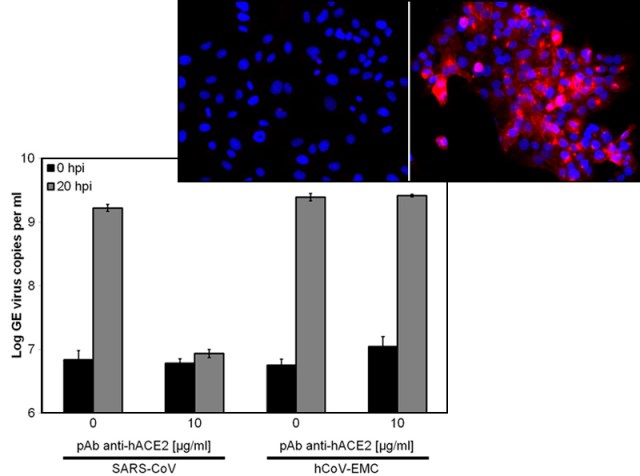
To find out, the team engineered baby hamster kidney cells to express the human ACE2 receptor. These cells could be infected with the SARS coronavirus, as expected, but not hCoV-EMC. That finding, supported by additional experiments, led them to conclude that the new coronavirus does not use ACE2 to get in. Which receptor it uses instead is still unclear, which is a “downside” of the new study, says Larry Anderson, an infectious disease specialist at Emory University in Atlanta.

Epidemiologists also want to know which species of animals it is capable of infecting to keep the new coronavirus from spreading further. To determine what types of animals hCoV-EMC can infect, Drosten and colleagues infected cells from humans, pigs, and a wide variety of bats, the key natural reservoirs of coronaviruses. The new virus could infect all of these types of cells. “It’s unusual for a coronavirus to easily go back to bats,” Drosten says. “Most coronaviruses come from bats, but once they jump to other species, you could never get them to reinfect bat cells.” The SARS virus, for instance, originated in Chinese horseshoe bats, but once it ended up in humans, it had changed so much that scientists were unable to infect bat cells with it.

“The fact that [hCoV-EMC] can infect bat cells is consistent with the hypothesis that bats might be the origin of this virus, but this finding doesn’t prove it,” Anderson says. “This virus had to come from an animal source—there’s no other explanation for what’s going on. But we still don’t know what that source is.”

Based on the findings, however, it seems likely that the new coronavirus can infect a wide range of species, Drosten says. That means public health officials may have to start looking for infections and deaths in local wild animal and livestock populations to keep the virus in check, he says.

http://news.sciencemag.org/sciencenow/2012/12/new-sars-like-virus-infects-both.html?ref=hp

Homosexuality may start in the womb

sn-homosexuality


From a strictly Darwinian viewpoint, homosexuality shouldn’t still be around. It isn’t the best way to pass along one’s genes, and to complicate the picture further, no “gay genes” have even been identified. According to a newly released hypothesis, the explanation may not lie in DNA itself. Instead, as an embryo develops, sex-related genes are turned on and off in response to fluctuating levels of hormones in the womb, produced by both mother and child. This tug of war benefits the unborn child, keeping male or female development on a steady course even amid spikes in hormones. But if these so-called epigenetic changes persist once the child is born and has children of its own, some of those offspring may be homosexual, the study proposes.

Evolutionary geneticist William Rice of the University of California, Santa Barbara, felt there had to be a reason why homosexuality didn’t just fade away down the generations. Research estimates that about 8% of the population is gay, and homosexuality is known to run in families. If one of a set of identical twins is gay, there’s a 20% probability that the other will be, too.

Furthermore, Rice notes, “homosexuality isn’t just a human thing.” Among California gulls, which he watches from his office window, about 14% of pairs are female-female. In Australian black swans, some 6% of pairs are male-male, and 8% of male sheep are attracted exclusively to male partners.

But many genetic screens have failed to turn up genes that are responsible for sexual orientation. So to find out what makes homosexuality persist, Rice and colleagues began a comprehensive survey of the literature.

According to conventional wisdom, an embryo becomes a boy when a gene on the Y chromosome triggers the development of testes, which then begin to produce male sex hormones, including testosterone, at about the 8th week of gestation. With no Y chromosome and hence no testosterone, the embryo becomes a girl.

But testosterone doesn’t explain everything, the researchers found. For one thing, female fetuses are exposed to small amounts of the hormone from their adrenal glands, the placenta, and the mother’s endocrine system. At many key points of gestation, male and female fetuses are often exposed to similar amounts of testosterone. Levels of the hormone can even be higher than normal in females and lower than normal in males without any effect on genital or brain structure.

Rice and his co-workers were more intrigued by studies showing that male and female fetuses respond differently to the hormones that surround them, even when one hormone is temporarily higher. In their study, published online today in The Quarterly Review of Biology, the authors propose that differences in sensitivity to sex hormones result from “epigenetic” changes. These are changes that affect not the structure of a gene but when, if, and how much of it is activated—by chemically altering a gene’s promoter region or “on” switch, for example. Epigenetic changes at key points in the pathway through which testosterone exerts its effects on the fetus could blunt or enhance the hormone’s activity as needed, the authors suggest.

Although epigenetic changes are usually temporary, they involve alterations in the proteins that bind together the long strands of DNA. Thus, they can sometimes be handed down to offspring. According to the hypothesis, homosexuality may be a carry-over from one’s parents’ own prenatal resistance to the hormones of the opposite sex. The “epi-marks” that adjusted parental genes to resist excess testosterone, for example, may alter gene activation in areas of the child’s brain involved in sexual attraction and preference. “These epigenetic changes protect mom and dad during their own early development,” Rice says. The initial benefit to the parents may explain why the trait of homosexuality persists throughout evolution, he says.

“The authors have done a terrific job providing a mechanism for genetic variation, especially a variation that might not be expected to persist because it’s so tightly bound to reproduction,” says evolutionary biologist Marlene Zuk of the University of Minnesota, Twin Cities. But she adds that to go from changes in gene expression to why someone is attracted to a person of the same sex is a question for which science may never fill in all the blanks.

http://news.sciencemag.org/sciencenow/2012/12/homosexuality-may-start-in-the-w.html?ref=hp