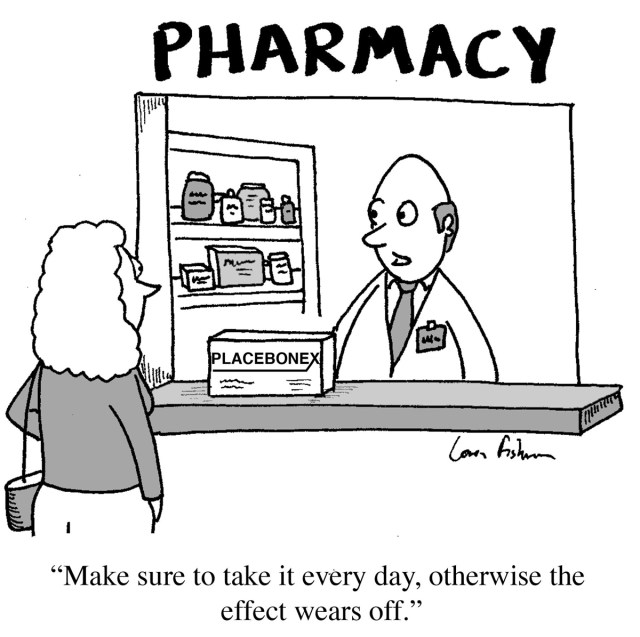
Placebo Effect May Account for Half of Drug’s Efficacy

placebo-effect-one-a-day

Even when a medication works, half of its impact on a patient may be due to one aspect of the placebo effect: the positive message that a doctor provides when prescribing the treatment, according to a new study.

Researchers designed an elaborate study, in which 66 people suffering from migraine headaches were given either a placebo, or a common migraine drug called Maxalt. However, for each migraine attack the participants had during the study period, they were told something different. For example, they were told they were taking a placebo when they were actually taking Maxalt, or vice versa, and sometimes they were told the pill could be either Maxalt or a placebo.

The pain-relieving benefits of the migraine drug increased when patients were told they were taking an effective drug for the treatment of acute migraine. And when the identities of Maxalt tablets and placebo pills were switched, patients reported similar pain relief from placebo pills labeled as Maxalt as from Maxalt tablets labeled as a placebo, according to the study published January 8 in the journal Science Translational Medicine.

The results suggest that the information people have is as important as the effects of the drug in reducing pain, the researchers said.

“In many conditions, placebo effect is a big part of the effect of the drug,” said study researcher, Ted Kaptchuk, a professor of medicine at Harvard Medical School. In the new study, 50 percent of the drug’s effect could be attributed to the placebo effect, he said.

“Themore you give a positive message, the more a drug works. In this case, our message was just as important as the pharmacology of the drug,” Kaptchuk said.

In other words, patients may benefit from optimistic messages from their doctors, which may enhance the effectiveness of a good pharmaceutical, the researchers said.

“When doctors set patients’ expectations high, Maxalt [or, potentially, other migraine drugs] becomes more effective,” said study researcher Rami Burstein, a professor of anesthesia at Harvard Medical School. “Increased effectiveness means shorter migraine attacks and shorter migraine attacks mean that less medication is needed,” Burstein said.

However, physicians should be realistic when prescribing a treatment, Kaptchuk said.

“The medical community should consider what’s the positive message that is still accurate, and not an exaggeration that verges on deception,” he told LiveScience.

Migraine attacks are throbbing headaches, usually accompanied by nausea, vomiting and sensitivity to light and sound. The researchers decided to look at migraine, because it is a recurring condition, and responds well to medication, Kaptchuk said.

During the study, the participants had a total of 450 migraine attacks. Each time they were provided with one of the six available treatments: two were made with positive expectations (envelopes labeled “Maxalt”), two were made with negative expectations (envelopes labeled “placebo”), and two were made with neutral expectations (envelopes labeled “Maxalt or placebo”).

But within each of these conditions, the envelopes contained either the placebo or Maxalt. The patients then reported their pain experiences.

“When patients received Maxalt labeled as placebo, they were being treated by the medication — but without any positive expectation,” Burstein said.

For both placebo and Maxalt, patients reported great pain-relieving effects when the envelope was labeled “Maxalt.” This suggests that a positive message and a powerful medication are both important for effective clinical care, the researchers said.
The placebo effect is centered on the idea that a person’s expectations and beliefs drive changes in symptoms, even though they have received a sugar pill or a sham treatment with no effect. Knowing that they have received a placebo changes their expectations, which is expected to alter the placebo effect.

However, people in the study also reported pain relief even when they knew the pill they were receiving was a placebo, compared with no treatment at all.

This finding “contradicts the medical beliefs,” Kaptchuk said. “Because in medicine, we think you have to think it’s a real drug for placebo to work. But apparently, the body has memories, or an embodied awareness, which operates below the level of consciousness.”

One possible mechanism for this effect could be that the body is conditioned to react positively in medical situations, Kaptchuk said.

“We know from other studies that the symbols, the rituals and the words of medicine activate the brain to release neurotransmitters that change the experience of illness. It activates centers in the brain that modulate many symptoms like pain and nausea and fatigue,” he said.

http://www.livescience.com/42430-placebo-effect-half-of-drug-efficacy.html

New nerve stimulation treatment for sleep apnea

Machines that you strap on at night, appliances you wear in your mouth, even surgeries to remove throat tissue — all measures people have resorted to because of sleep apnea.

Kathy Gaberson has sleep apnea, which left her sleepy and forgetful during the day. The snoring and other symptoms even kept her husband awake.

“I would wake up, and he would be leaning over me, with eyes wide open, and I would say, ‘What?’ And he said, ‘You’re not breathing.’ Well, you are now, but you weren’t,” said Gaberson.

She used the strapped-on pressure machine, or CPAP, for years. But it hurt her nose, made turning in bed more complicated, and was hard to travel with.

She saw an ad for a study at UPMC, an alternative for people who have had trouble putting up with CPAP.

Researchers were studying an implanted device to keep the airway open. It stimulates the nerve to the tongue.

More than 100 people participated, mostly men, average age 57.

The device is put in surgically in the upper chest with sensors for breathing and a stimulator wire to the tongue. This is activated by the person at night with a remote.

After a multi-step evaluation, Kathy qualified for the study. In fact, based on a test that looked at her throat during sleep, she was ideal.

“My tongue moved back and blocked my airway,” she says.

The device keeps the tongue out of the throat. This is timed with breathing.

“If you close your mouth, and try to stick out your tongue, that’s what it feels like. These muscles here contract,” she says.

With the device, episodes of apnea, or breathing stoppages, go down 70 percent. It is not yet FDA approved and widely available to patients.

It was a one-day procedure. She had very little pain, and was back to her usual activity days later with only a lifting restriction.

She is disappointed she had to have the device removed because of an unrelated bloodstream infection, and she’s back to using CPAP.

“I was not falling asleep during the day. My memory improved. I felt much more energetic,” she says. “It gave me a better sleep quality than the CPAP ever did.”

The study, funded by the device-maker, is in this week’s New England Journal of Medicine.

http://pittsburgh.cbslocal.com/2014/01/09/new-implantable-device-helping-sleep-apnea-patients/

Thanks to Kebmodee for bringing this to the attention of the It’s Interesting community.

When doctors prescribe books to heal the mind

bibliotherapy_WEB

By Leah Price

More than 350 million people worldwide suffer from depression. Fewer than half receive any treatment; even fewer have access to psychotherapy. Around the turn of the millennium, antidepressants became the most prescribed kind of drug in the United States. In the United Kingdom, 1 in 6 adults has taken one.

But what if a scientist were to discover a treatment that required minimal time and training to administer, and didn’t have the side effects of drugs? In 2003, a psychiatrist in Wales became convinced that he had. Dr. Neil Frude noticed that some patients, frustrated by year-long waits for treatment, were reading up on depression in the meantime. And of the more than 100,000 self-help books in print, a handful often seemed to work.

This June, a program was launched that’s allowing National Health Service doctors across England to act upon Frude’s insight. The twist is that the books are not just being recommended, they’re being “prescribed.” If your primary care physician diagnoses you with “mild to moderate” depression, one of her options is now to scribble a title on a prescription pad. You take the torn-off sheet not to the pharmacy but to your local library, where it can be exchanged for a copy of “Overcoming Depression,” “Mind Over Mood,” or “The Feeling Good Handbook.” And depression is only one of over a dozen conditions treated. Other titles endorsed by the program include “Break Free from OCD,” “Feel the Fear and Do it Anyway,” “Getting Better Bit(e) by Bit(e),” and “How to Stop Worrying.”

The NHS’s Books on Prescription program is only the highest-profile example of a broader boom in “bibliotherapy.” The word is everywhere in Britain this year, although—or because—it means different things to different people. In London, a painter, a poet, and a former bookstore manager have teamed up to offer over-the-counter “bibliotherapy consultations”: after being quizzed about their literary tastes and personal problems, the worried well-heeled pay 80 pounds for a customized reading list. At the Reading Agency, a charity that developed and administers Books on Prescription, a second program called Mood-Boosting Books recommends fiction and poetry. The NHS’s public health and mental health budgets also fund nonprofits such as The Reader Organization, which gathers people who are unemployed, imprisoned, old, or just lonely to read poems and fiction aloud to one another.

At best, Books on Prescription looks like a win-win for both patients and book lovers. It boosts mental health while also bringing new library users in the door. Libraries loaned out NHS-approved self-help books 100,000 times in the first three months of the program; no doubt some of their borrowers must have picked up a novel or a memoir en route to the circulation desk. At worst, it’s hard to see what harm the program can do. Unlike drugs, books carry no risk of side effects like weight gain, dampened libido, or nausea (unless you read in the car).

For book lovers, an organization with as much clout as the NHS would seem to be a welcome ally. Yet its initiatives raise troubling questions about why exactly a society should value reading. What’s lost when a bookshelf is repurposed as a medicine cabinet—and when a therapist’s job gets outsourced to the page?

In 1916, the clergyman Samuel Crothers coined the term “bibliotherapy,” positing tongue-in-cheek that “a book may be a stimulant or a sedative or an irritant or a soporific.” In the intervening century, doctors, nurses, librarians, and social workers have more seriously championed “bibliopathy,” “bibliocounseling,” “biblioguidance,” and “literatherapy”—all variations on the notion that reading can heal.

Only recently, however, have the mental health effects of one genre—self-help books—been rigorously studied. As early as 1997, a randomized trial found bibliotherapy supervised by therapists no less effective in treating unipolar depression than individual or group therapy. More surprisingly, a 2007 literature review by the same researcher found that books treated anxiety just as effectively without a therapist’s guidance as with it. A 2004 meta-analysis comparing bibliotherapy for anxiety and depression to short-term talk therapy found books “as effective as professional treatment of relatively short duration.”

None of this means a book can outperform a therapist, even if it can underbid him. A 2012 meta-analysis of anxiety disorders concluding that “comparing self-help with waiting list gave a significant effect size of 0.84 in favour of self-help” nevertheless cautioned that “comparison of self-help with therapist-administered treatments revealed a significant difference in favour of the latter.” Translation: A book does worse than a therapist, but it’s better than nothing. And in the short term, at least, nothing is what many patients get.

Books on Prescription can be understood as an extension of larger changes in psychiatry over the past few decades. For most of the 20th century, psychodynamic therapy placed more emphasis on the therapist-patient relationship than on the content of the therapist’s words. More recently, insurers’ interest in cutting costs and researchers’ interest in protocols that can be measured and replicated have combined to nudge treatment toward short-term, standardized methods such as cognitive-behavioral therapy. Books take this trajectory to its logical conclusion. If your aim is less to help patients explore the underlying causes of their condition than to offer step-by-step instructions for managing it, then who cares whether the exercises emanate from a mouth, a manual, or even a smartphone app?

But even therapies like cognitive-behavioral therapy require the patient to feel recognized and understood by another human being. Asked how a printed page can mimic that face-to-face encounter, Frude comes up with an unexpected word: “magic.” The best books give the illusion of listening and caring, he explains, because authors who are also clinicians can draw on years of experience interacting with patients to leave each reader saying “that book was about me.” He does acknowledge that not every case fits books “off the peg” (or off the rack, as we say in the United States). But it’s a striking metaphor to choose—one that makes psychodynamic therapy sound like a luxury good as unattainable as Savile Row tailoring.

Where Frude sees magic, a cynic might smell pragmatism. Even short-term cognitive-behavioral therapy costs more than a $24.95 hardcover. But in any case, many patients read whether or not they have the NHS’s blessing. If recommended titles crowd out the misinformation that patients might otherwise stumble upon, whether in print or online, Books on Prescription will already have helped.

It’s hard not to notice that Books on Prescription was developed in the same years when American universities began to offer MOOCs, or massive open online courses. Even if an online course lacks the give-and-take of a seminar, it’s better than nothing. Like Books on Prescription, MOOCs scale up an activity whose face-to-face version was traditionally out of reach of the masses. Also like Books on Prescription, MOOCs create a cost-effective alternative that may eventually squeeze out personal contact even at the high end of the market.

That concern aside, it’s no surprise that self-help books can help the self. That literature might help, however, is a more controversial proposition. The other half of the Reading Agency’s two-pronged Reading Well initiative, Mood-Boosting Books, promotes fiction, poetry, and memoirs. Its annual list of “good reads for people who are anxious or depressed” mixes titles that represent characters experiencing anxiety or depression (Mark Haddon’s “A Spot of Bother”) with others calculated to combat those conditions. Some go for laughs (Sue Townsend’s “The Secret Diary of Adrian Mole Aged 13¾”); others, such as “A Street Cat Named Bob” and “The Bad Dog’s Diary,” read like printouts of PetTube.com. Others are darker and more demanding: Reading Well anointed Alice Munro’s short stories as a selection before the Nobel Prize Committee did.

The Reading Agency’s endorsement of imaginative reading stops short of recommending specific titles. Its website bristles with disclaimers that the works of literature are nominated by reading groups rather than tested by scientists. Yet the charity has given Mood-Boosting Books prestige—and the NHS has put hard cash behind them as well, providing some libraries with grants to purchase the recommended works of literature along with the “prescribed” self-help titles.

I ask Judith Shipman, who runs the Mood-Boosting Books program, whether recommending books “for people who are anxious or depressed” implies that poems or novels can treat those conditions. “I don’t think we could claim that they are therapy or a substitute for therapy,” she hazards after a long pause. “But for those who don’t quite need therapy, Mood-Boosting Books could be a nice little lift.”

Today it might seem commonplace to suggest that books are good for you. In the longer view, though, the hope that both literature and practical nonfiction can cure reverses an older belief by doctors that reading could cause physical and mental illness. In 1867, one expert cautioned that taking a book to bed could “injure your eyes, your brain, your nervous system.” Some social reformers proposed regulating books as if they were drugs. In 1883, the New York State Legislature debated whether to fine “any person who shall sell, loan, or give to any minor under sixteen years of age any dime novel or book of fiction, without first obtaining the written consent of the parent or guardian of such a minor.” As late as 1889, one politician called fiction “moral poison.”

As radio, TV, gaming, and eventually the Internet began to compete with books, though, fiction-reading came to look wholesome by comparison. Today, with only half of Americans reading any book for pleasure in a given year, reading is finding new champions from an unlikely quarter: science. This year, Science published a study concluding that reading about fictional characters increases empathy; in his 2011 book “The Better Angels of Our Nature,” the psychologist Steven Pinker correlated the rise of imaginative literature with a centuries-long decline in violence. And while correlation doesn’t imply causation, randomized trials have also attempted to link fiction-reading to physical health. In a 2008 study of 81 preteens, girls assigned fiction in which characters eat balanced breakfasts ended up with a lower body mass index than the control group. The Reading Well website itself cites a 2009 study that compared heart rates and muscle tension before and after various activities and found that reading is “68% better at reducing stress levels than listening to music; 100% more effective than drinking a cup of tea.” The numbers may be less telling than the fact that someone would think to compare books to tea in the first place.

It’s too early to predict the long-term effects of bibliotherapy programs. There’s little precedent for a government to make neuroscientists and psychiatrists the arbiters of what books should be read and why. And literary critics like me recoil from reducing the value of reading to a set of health metrics. But as library budgets shrink and any text longer than 140 characters gets crowded out by audio and video, white-coated experts may be the only ones prospective readers can hear. Racing to find out what happens next, seeing the world through a character’s eyes, wallowing in the play of language—all are becoming means to medical ends. Today, for an increasing number of people, the pleasures of reading require a doctor’s note.

http://www.bostonglobe.com/ideas/2013/12/22/when-doctors-prescribe-books-heal-mind/H2mbhLnTJ3Gy96BS8TUgiL/story.html

More evidence that mindfullness meditation can help with anxiety, depression and pain

mindfulness-meditation

By Andrew M. Seaman

Mindfulness meditation may be useful in battles against anxiety, depression and pain, according to a fresh look at past research.

Using data from 47 earlier studies, researchers found moderate evidence to support the use of mindfulness meditation to treat those conditions. Meditation didn’t seem to affect mood, sleep or substance use.

“Many people have the idea that meditation means just sitting quietly and doing nothing,” wrote Dr. Madhav Goyal in an email to Reuters Health. “That is not true. It is an active training of the mind to increase awareness, and different meditation programs approach this in different ways.”

Goyal led the study at The Johns Hopkins University in Baltimore.

He and his colleagues write in JAMA Internal Medicine that meditation techniques emphasize mindfulness and concentration.

So-called mindfulness meditation is aimed at allowing the mind to pay attention to whatever thoughts enter it, such as sounds in the environment, without becoming too focused. Mantra meditation, on the other hand, involves focusing concentration on a particular word or sound.

Approximately 9 percent of people in the U.S. reported meditating in 2007, according to the National Institutes of Health. About 1 percent said they use meditation as some sort of treatment or medicine.

For the new report, the researchers searched several electronic databases that catalog medical research for trials that randomly assigned people with a certain condition – such as anxiety, pain or depression – to do meditation or another activity. These randomized controlled trials are considered the gold standard of medical research.

The researchers found 47 studies with over 3,500 participants that met their criteria.

After combining the data, Goyal said his team found between a 5 and 10 percent improvement in anxiety symptoms among people who took part in mindfulness meditation, compared to those who did another activity.

There was also about a 10 to 20 percent improvement in symptoms of depression among those who practiced mindfulness meditation, compared to the other group.

“This is similar to the effects that other studies have found for the use of antidepressants in similar populations,” Goyal said.

Mindfulness meditation was also tied to reduced pain. But Goyal said it’s hard to know what kind of pain may be most affected by meditation.

The benefits of meditation didn’t surpass what is typically associated with other treatments, such as drugs and exercise, for those conditions.

“As with many therapies, we try to get a moderate level of confidence that the therapy works before we prescribe it,” Goyal said. “If we have a high level of confidence, it is much better.”

But he noted that the researchers didn’t find anything more than moderate evidence of benefit from meditation for anxiety, depression and pain.

There was some suggestion that meditation may help improve stress and overall mental health, but the evidence supporting those findings was of low quality.

There was no clear evidence that meditation could influence positive mood, attention, substance use, eating habits, sleep or weight.

“Clinicians should be prepared to talk with their patients about the role that meditation programs could have in addressing psychological stress, particularly when symptoms are mild,” Goyal said.

Dr. Allan Goroll, who wrote an editorial accompanying the new study, told Reuters Health the analysis is an example of an area of much-needed scientific study, because many people make treatment decisions based on beliefs – not data.

“That is particularly the case with alternative and complimentary approaches to treating medical problems,” he said. “It ranges from taking vitamins to undergoing particular procedures for which the scientific evidence is very slim but people’s beliefs are very great.”

Goroll is professor at Harvard Medical School and Massachusetts General Hospital in Boston.

Goyal said people should remember that meditation was not conceived to treat any particular health problem.

“Rather, it is a path we travel on to increase our awareness and gain insight into our lives,” he wrote. “The best reason to meditate is to gain this insight. Improvements in health conditions are really a side benefit, and it’s best to think of them that way.”

SOURCE: bit.ly/WiwDtv JAMA Internal Medicine, online January 6, 2014.

Japanese turnip may stop the flu

Suguki-640x426

Scientists have discovered that bacteria found in a traditional Japanese pickle can prevent flu. Could this be the next superfood?

The research, which assesses the immune-boosting powers of Lactobacillus brevis from Suguki – a pickled turnip, popular in Japan – in mice that have been exposed to a flu virus, is published today (06 November) in the SfAM journal, Letters in Applied Microbiology.

Lead researcher, Ms Naoko Waki of KAGOME CO., LTD. in Japan said: “Our results show that when a particular strain of Lactobacillus brevis is eaten by mice, it has protective effects against influenza virus infection.”

Suguki enthusiasts have often cited its protective powers but it is not known yet whether the same effects will be seen in humans. Human clinical trials using a probiotic drink containing Lactobacillus brevis KB290 bacteria are underway and scientists are hopeful that, given a suitable quantity of bacteria, foods containing them may turn out to be the next superfood.

What it is about the bacteria that gives them this amazing property is not known, but it is remarkably tolerant to stomach juices, which are too acidic for many bacteria. This is largely due to a protective layer of sugars called exopolysaccharides.

“We know that exopolysaccharides have immune boosting effects in other similar bacteria, so we wonder if the exopolysaccharides of KB290 are responsible for the effects we see,” said Ms Waki. Further studies will be undertaken to investigate this.

The effect of the bacteria is to increase the production of immune system molecules in the body – IFN-α and flu-specific antibodies – and to enhance activity to eradicate virus infected cells. In this study these effects were sufficient to prevent infection by the H1N1 flu and the scientists think that there could also be protection against other viral infections, including the deadly H7N9 flu, which has recently emerged in China.

http://www.eurekalert.org/pub_releases/2013-11/w-jsp110413.php

Durham man with ALS achieves Krispy Kreme dream

Vhris

krispy-kreme-cruiser

In a speech a few weeks ago at Durham Academy, his high-school alma mater, Chris Rosati told students about a sweet dream of his.

He wanted to hijack a Krispy Kreme doughnut delivery truck and, with the cops chasing him, drive around tossing out free confections and cheer. Robin Hood, with baked goods.

The normally jaded teens embraced the idea with such enthusiasm that Rosati – already inclined to mischief – became determined to make it happen.

But every successful dreamer is also a realist, and Rosati knew his chances of getting away with a loaded doughnut truck were pretty slim, especially since he was diagnosed three years ago with amyotrophic lateral sclerosis. He can still walk, with assistance, but the degenerative neuromuscular disorder, which is ultimately fatal, has slowed him down.

He would need some help.

Rosati, a self-employed marketing consultant, knew what to do. He set up a Facebook page called A Krispy Kreme Heist, where he described his plan. He solicited “likes,” in the hopes that eventually, Winston-Salem-based Krispy Kreme would hear about it, lend him a truck and driver, and give him some doughnuts to give away.

Since he got sick, he explained, “I’m more open than ever to chasing my dreams … even odd ones like this.”

His story traveled like the scent of Original Glazed hot off the line. Within eight hours, Krispy Kreme corporate officials heard about Rosati’s idea.

“We got in touch with Chris and told him, ‘Don’t steal one of our trucks,’” said Megan Brock, directer of marketing. “We’ll give you the Krispy Kreme Cruiser and a thousand doughnuts.”

The Cruiser is a 1960 Flexible Starliner bus restored and christened last year for the company’s 75th anniversary. Krispy Kreme likes to say it’s one sweet ride that travels the country for promotional events.

Tuesday, its route was chosen by Rosati, who had the driver go to Duke University Medical Center, where he visited a cancer treatment center, a bone marrow transplant facility and the clinic where he gets treatment for his ALS.

After that, it was on to Durham Academy, where 400 high-schoolers had been assembled on the sidewalk without knowing why.

They figured it out when the Cruiser rolled into the parking lot, with its trademark green polka dots and Krispy Kreme bow-tie logo. They screamed and hooted.

“I told y’all to live out your dreams, as dumb as they may be sometimes,” he told the students as he got off the bus.

They would each get a doughnut, he promised, but then he asked a favor. Would some of them take a box, go out into the community and give them away just to see people smile?

“You get 12 chances in that box to make somebody happy,” he said.

Rosati’s wife, Anna, said the couple would use video of the day’s events to inspire others toward random acts of kindness through Rosati’s nonprofit, called Inspire MEdia. Eventually, Anna Rosati said, the couple hope the foundation will be able to help people fund their own uplifting projects.

http://www.journalnow.com/news/state_region/article_8a8f4da8-5fb0-11e3-ad14-001a4bcf6878.html

Thanks to Dr. Goldman for bringing this to the It’s Interesting community.

Man Flu

manflu_2774361b

New study suggests that men may actually suffer more when they have influenza because high levels of testosterone can weaken immune response.

For years women have cried “man flu” when men make a fuss over a few sniffles.

But a new study suggests that men may actually suffer more when they are struck down with flu – because high levels of testosterone can weaken their immune response.

The study by Stanford University School of Medicine, examined the reactions of men and women to vaccination against flu.

It found women generally had a stronger antibody response to the jab than men, giving them better protection against the virus.

Men with lower testosterone levels also had a better immune response, more or less equivalent to that of women.

It has long been suggested that men might be more susceptible to bacterial, viral, fungal and parasitic infection than women are.

The study published in the Proceedings of the National Academy of Sciences, found women had higher blood levels of signaling proteins that immune cells pass back and forth, when the body is under threat.

Previous research has found that testosterone has anti-inflammatory properties, suggesting a possible interaction between the male sex hormone and immune response.

Professor of microbiology and immunology Mark Davis said: “This is the first study to show an explicit correlation between testosterone levels, gene expression and immune responsiveness in humans.

“It could be food for thought to all the testosterone-supplement takers out there.”

Scientists said they were left perplexed as why evolution would designed a hormone that enhances classic male sexual characteristics – such as muscle strength, beard growth and risk-taking propensity – yet left them with a weaker immune system.

Previous studies have found that while women may accuse men of exaggerating when they have flu, females who are more likely to admit to having sniffles and sneezes.

The research, carried out by London School of Hygiene and Tropical Medicine last winter, shows that women are are 16 per cent more likely to say they are ill.

http://www.telegraph.co.uk/health/healthnews/10536083/Man-flu-the-truth-that-women-dont-want-to-hear.html

‘Jumping Genes’ Linked to Schizophrenia

sn-schizophrenia

Roaming bits of DNA that can relocate and proliferate throughout the genome, called “jumping genes,” may contribute to schizophrenia, a new study suggests. These rogue genetic elements pepper the brain tissue of deceased people with the disorder and multiply in response to stressful events, such as infection during pregnancy, which increase the risk of the disease. The study could help explain how genes and environment work together to produce the complex disorder and may even point to ways of lowering the risk of the disease, researchers say.

Schizophrenia causes hallucinations, delusions, and a host of other cognitive problems, and afflicts roughly 1% of all people. It runs in families—a person whose twin sibling has the disorder, for example, has a roughly 50-50 chance of developing it. Scientists have struggled to define which genes are most important to developing the disease, however; each individual gene associated with the disorder confers only modest risk. Environmental factors such as viral infections before birth have also been shown to increase risk of developing schizophrenia, but how and whether these exposures work together with genes to skew brain development and produce the disease is still unclear, says Tadafumi Kato, a neuroscientist at the RIKEN Brain Science Institute in Wako City, Japan and co-author of the new study.

Over the past several years, a new mechanism for genetic mutation has attracted considerable interest from researchers studying neurological disorders, Kato says. Informally called jumping genes, these bits of DNA can replicate and insert themselves into other regions of the genome, where they either lie silent, doing nothing; start churning out their own genetic products; or alter the activity of their neighboring genes. If that sounds potentially dangerous, it is: Such genes are often the culprits behind tumor-causing mutations and have been implicated in several neurological diseases. However, jumping genes also make up nearly half the current human genome, suggesting that humans owe much of our identity to their audacious leaps.

Recent research by neuroscientist Fred Gage and colleagues at the University of California (UC), San Diego, has shown that one of the most common types of jumping gene in people, called L1, is particularly abundant in human stem cells in the brain that ultimately differentiate into neurons and plays an important role in regulating neuronal development and proliferation. Although Gage and colleagues have found that increased L1 is associated with mental disorders such as Rett syndrome, a form of autism, and a neurological motor disease called Louis-Bar syndrome, “no one had looked very carefully” to see if the gene might also contribute to schizophrenia, he says.

To investigate that question, principal investigator Kazuya Iwamoto, a neuroscientist; Kato; and their team at RIKEN extracted brain tissue of deceased people who had been diagnosed with schizophrenia as well as several other mental disorders, extracted DNA from their neurons, and compared it with that of healthy people. Compared with controls, there was a 1.1-fold increase in L1 in the tissue of people with schizophrenia, as well as slightly less elevated levels in people with other mental disorders such as major depression, the team reports today in Neuron.

Next, the scientists tested whether environmental factors associated with schizophrenia could trigger a comparable increase in L1. They injected pregnant mice with a chemical that simulates viral infection and found that their offspring did, indeed, show higher levels of the gene in their brain tissue. An additional study in infant macaques, which mimicked exposure to a hormone also associated with increased schizophrenia risk, produced similar results. Finally, the group examined human neural stem cells extracted from people with schizophrenia and found that these, too, showed higher levels of L1.

The fact that it is possible to increase the number of copies of L1 in the mouse and macaque brains using established environmental triggers for schizophrenia shows that such genetic mutations in the brain may be preventable if such exposures can be avoided, Kato says. He says he hopes that the “new view” that environmental factors can trigger or deter genetic changes involved in the disease will help remove some of the disorder’s stigma.

Combined with previous studies on other disorders, the new study suggests that L1 genes are indeed more active in the brain of patients with neuropsychiatric diseases, Gage says. He cautions, however, that no one yet knows whether they are actually causing the disease. “Now that we have multiple confirmations of this occurring in humans with different diseases, the next step is to determine if possible what role, if any, they play.”

One tantalizing possibility is that as these restless bits of DNA drift throughout the genomes of human brain cells, they help create the vibrant cognitive diversity that helps humans as a species respond to changing environmental conditions, and produces extraordinary “outliers,” including innovators and geniuses such as Picasso, says UC San Diego neuroscientist Alysson Muotri. The price of such rich diversity may be that mutations contributing to mental disorders such as schizophrenia sometimes emerge. Figuring out what these jumping genes truly do in the human brain is the “next frontier” for understanding complex mental disorders, he says. “This is only the tip of the iceberg.”

Thanks to Dr. Rajadhyaksha for bringing this to the attention of the It’s Interesting community.

http://news.sciencemag.org/biology/2014/01/jumping-genes-linked-schizophrenia

Alexandra Wolff: 1 of 55 people in the U.S. with highly superior autobiographical memory.

alexandra_custom-dd75c71966d9515cea210d91d68ce7aff737e3a5-s6-c85

On Feb. 21, Alexandra Wolff ate steak, mashed potatoes and broccoli for dinner. Later that night, sitting in her room, she spent 20 minutes scanning pictures in InStyle magazine.

She remembers those things, just as she remembers that on Aug. 2 she stopped at Target and bought Raisin Bran; and on April 17 she wore a white button-down shirt; and on Oct. 2 she went to TGI Fridays and spoke to the hostess, who was wearing black leather flats with small bows on them.

Alexandra Wolff has what’s known as highly superior autobiographical memory. She is one of only 55 people in the U.S. who have been identified with this ability. All of these people can remember details about their lives that the rest of us couldn’t hope to remember: the strangers they pass on the street, the first thing they saw when they woke up seven months ago.

And though it’s not clear why the brains of people with HSAM can do what they do, what is clear is that this ability gives them an access to the past that’s profoundly different from you and me.

If you think of 2013, probably only a handful of memories stand out. The day-by-day is a blur.

We forget most of our lives.

But Alexandra says that remembering even an inconsequential trip to Target is an almost physical experience for her. She says she sees what she saw that day, hears what she heard, and emotionally feels what she felt at the time.

“Right down to getting sick to my stomach or getting a headache,” she says. “It’s almost like time travel.”

But being unable to forget can affect your relationship to the present, people with this form of memory say.

Alexandra is 22 and lives with her mother in a long brick ranch house in southern Maryland. She has dark hair and beautifully balanced features, but hasn’t really dated and seems to have few of the preoccupations of most 22-year-olds. She blames her memory for this, saying it separates her from other people her age because they can’t understand why she’s so focused on things that have already happened.

Alexandra often feels frustrated with her preoccupation with the past. “It seems like you hold onto everything, and it seems like you’re just stuck in the past all the time,” she says.

It really bothers her. For one, Alexandra says, in her life there are no fresh days, no clean slates without association. Every morning when she wakes up, details of that date from years before are scrolling through her mind, details that can profoundly affect the new day she’s in.

For example, the day before we spoke was a day when years ago in middle school a boy bullied her in one of her classes.

“I didn’t mention it to anyone,” she says, “but I mean, still in the back of my mind I kept thinking and thinking about it. It knocked some of my confidence down.”

Because the past is so viscerally right there, so available, she finds that when the present gets overwhelming, it’s hard not to retreat to the past.

Even though she’s only 22, she says she spends huge amounts of time in her room with her eyes closed, reliving the past in her mind, particularly this one day a decade ago.

It was July 8, 2004. She spent that day in a bathing suit by a pool laughing and playing with her 10-year-old cousin. They ate macaroni and cheese, and swam. It was an easy, innocent time.

She says she probably takes herself through that day in her mind four times a week. Over the past couple of years, she estimates, she’s probably spent close to 2,000 hours reliving that one day.

“I mean, I definitely say it’s a huge temptation. I could, if I didn’t have stuff to do all day, I could probably live in the past 24/7.”
Scientists think there’s a reason why we forget.

“It has long been believed by research scientists that forgetting is adaptive,” says James McGaugh, the University of California, Irvine neurobiologist who first documented highly superior autobiographical memory.

McGaugh discovered HSAM by accident. He got an email out of the blue from a woman named Jill Price who said she had a serious memory problem: She couldn’t seem to forget anything, and like Alexandra, this bothered her.

“The emotions evoked by remembering bad things troubled her,” McGaugh says.

And so McGaugh started studying first Price and then other people with this kind of memory. He found ultimately that there are differences in the brains of people with HSAM, though it’s not clear whether the differences are the cause or the consequence of this ability.

But it is clear that it’s specifically this issue of forgetting that’s different. If you were asked to recall what happened to you earlier this morning, you’d remember roughly the same amount as someone like Alexandra. But if asked about this morning three months from now, for you it would probably be gone, while for her it’s as fresh as it is for you today.

“So it’s not that they’re superior learners,” McGaugh says, “it’s that they are very poor at forgetting.”
The emotional effects of not being able to forget aren’t clear, says McGaugh. No one, including McGaugh, has studied it. His sense is that there is variation in the group of 55.

“The effects of having this ability depends on the kind of experiences people have had in the past as well as their present circumstances,” he says.

But Bill Brown, another person with HSAM, says that he’s been in touch with most of the people in the group, and that everyone he has spoken to has struggled with depression. He says that very few of them have been able to maintain a long-term marriage — the rumor is only 2 out of the 55.
Brown himself, though a pretty jolly guy, recently separated from his wife.

And talking to him, you do get the sense that the difference in his memory has led to misunderstandings in his relationships.

“Just because I remember something that you did wrong doesn’t mean that I still hold it against you,” he says. “But it’s taken me a long while to realize that folks without my ability probably don’t understand that distinction. Because after all, if you’re bringing it up, the logic from the other side would be: You must still hold it against me.”

This is not, in fact, the case, he says. “It has more to do with wanting you to be honest in your dealings.”

What he eventually realized was that most of the people he talks to are being as honest as they know how to be. “They just don’t necessarily remember.”
Brown says it’s easier for him now, because over time he’s learned how to manage the memories, not to focus on the bad stuff, and instead use his memory to entertain himself.

“But you know,” he says, “life’s rough, and there’s so much bad that’s kinda there.”

Sometimes, he says, he thinks it might be nice to forget.

http://www.npr.org/blogs/health/2013/12/18/255285479/when-memories-never-fade-the-past-can-poison-the-present

New research shows that moderate alcohol consumption boosts the immune system

Artisanal Beer Brewers Find Growing Niche In Berlin

According to a new study, alcohol can boost your immune system. Researchers vaccinated animals and then gave them access to alcohol. Researchers found that the animals that had consumed alcohol also had faster responses to the vaccines. The researchers hope this study leads to a better understanding of how the immune system works, and how to improve its ability to respond to vaccines and infections. Moderate alcohol consumption has long been associated with a lower mortality rate.

Moderate alcohol consumption boosts your immune system while chronic alcohol consumption leads to a suppressed vaccine response. The difference between moderate and chronic is defined by the National Institute on Alcohol Abuse and Alcoholism. They define moderate as no more than four drinks on a single day and no more than 14 in a week for men. For women, it is defined as no more than three drinks on a single day and no more than seven in a week.

The study was published in the journal Vaccine.

http://www.sciencedirect.com/science/article/pii/S0264410X13014734