Astronomers discover largest known structure in the universe

universe_largest_structure

Astronomers have discovered the largest known structure in the universe – a group of quasars so large it would take 4 billion years to cross it while traveling at speed of light.

The immense scale also challenges Albert Einstein’s Cosmological Principle, the assumption that the universe looks the same from every point of view, researchers said.

The findings by academics from Britain’s University of Central Lancashire were published in the journal Monthly Notices of the Royal Astronomical Society and reported on the society’s website on Friday.

Quasars are believed to be the brightest objects in the universe, with light emanating from the nuclei of galaxies from the early days of the universe and visible billions of light-years away.

“Since 1982 it has been known that quasars tend to group together in clumps or ‘structures’ of surprisingly large sizes, forming large quasar groups or LQGs,” the society said.

This newly discovered large quasar group has a dimension of 500 megaparsecs, each megaparsec measuring 3.3 million light-years.

Because the LQG is elongated, its longest dimension is 1,200 megaparsecs, or 4 billion light-years, the society said.

That size is 1,600 times larger than the distance from Earth’s Milky Way to the nearest galaxy, the Andromeda.

“While it is difficult to fathom the scale of this LQG, we can say quite definitely it is the largest structure ever seen in the entire universe,” Roger Clowes, leader of the research team, said in a statement. “This is hugely exciting – not least because it runs counter to our current understanding of the scale of the universe.”

Clowes said the team would continue to investigate the phenomenon with particular interest in the challenge to the Cosmological Principle, which has been widely accepted since Einstein, whose work still forms the basis for much of modern cosmology.

Thanks to Kebmodee for bringing this to the attention of the It’s Interesting community.

http://www.reuters.com/article/2013/01/12/space-quasars-idUSL1E9CC08B20130112

Researchers unlock formula that brilliant mathematician Srinivasa Ramanujan wrote on his deathbed 100 years ago

srinivasa_ramanujan_-_opc_-_1

theta-function

While on his death bed, the brilliant Indian mathematician Srinivasa Ramanujan cryptically wrote down functions he said came to him in dreams, with a hunch about how they behaved. Now 100 years later, researchers say they’ve proved he was right.

“We’ve solved the problems from his last mysterious letters. For people who work in this area of math, the problem has been open for 90 years,” Emory University mathematician Ken Ono said.

Ramanujan, a self-taught mathematician born in a rural village in South India, spent so much time thinking about math that he flunked out of college in India twice, Ono said.

But he sent mathematicians letters describing his work, and one of the most preeminent ones, English mathematician G. H. Hardy, recognized the Indian boy’s genius and invited him to Cambridge University in England to study. While there, Ramanujan published more than 30 papers and was inducted into the Royal Society. [Creative Genius: The World’s Greatest Minds]

“For a brief window of time, five years, he lit the world of math on fire,” Ono told LiveScience.

But the cold weather eventually weakened Ramanujan’s health, and when he was dying, he went home to India.

It was on his deathbed in 1920 that he described mysterious functions that mimicked theta functions, or modular forms, in a letter to Hardy. Like trigonometric functions such as sine and cosine, theta functions have a repeating pattern, but the pattern is much more complex and subtle than a simple sine curve. Theta functions are also “super-symmetric,” meaning that if a specific type of mathematical function called a Moebius transformation is applied to the functions, they turn into themselves. Because they are so symmetric these theta functions are useful in many types of mathematics and physics, including string theory.

Ramanujan believed that 17 new functions he discovered were “mock modular forms” that looked like theta functions when written out as an infinte sum (their coefficients get large in the same way), but weren’t super-symmetric. Ramanujan, a devout Hindu, thought these patterns were revealed to him by the goddess Namagiri.

Ramanujan died before he could prove his hunch. But more than 90 years later, Ono and his team proved that these functions indeed mimicked modular forms, but don’t share their defining characteristics, such as super-symmetry.

The expansion of mock modular forms helps physicists compute the entropy, or level of disorder, of black holes.

In developing mock modular forms, Ramanujan was decades ahead of his time, Ono said; mathematicians only figured out which branch of math these equations belonged to in 2002.

“Ramanujan’s legacy, it turns out, is much more important than anything anyone would have guessed when Ramanujan died,” Ono said.

The findings were presented last month at the Ramanujan 125 conference at the University of Florida, ahead of the 125th anniversary of the mathematician’s birth on Dec. 22.

Read more: http://www.businessinsider.com/researchers-unlock-formula-mathematician-srinivasa-ramanujan-2012-12#ixzz2GTAEauqP

Thanks to Kebmodee for bringing this to the attention of the It’s Interesting community.

Norway Begins Four Year Test Of Thorium Nuclear Reactor

image2A

image1A2

A Norwegian company is breaking with convention and switching to an alternative energy it hopes will be safer, cleaner and more efficient. But this isn’t about ditching fossil fuels, but rather about making the switch from uranium to thorium. Oslo based Thor Energy is pairing up with the Norwegian government and US-based (but Japanese/Toshiba owned) Westinghouse to begin a four year test that they hope will dispel doubts and make thorium the rule rather than the exception. The thorium will run at a government reactor in Halden.

Thorium was discovered in 1828 by the Swedish chemist Jons Jakob Berzelius who named it after the Norse god of thunder, Thor. Found in trace amounts in rocks and soil, thorium is actually about three times more abundant than uranium.

The attractiveness of thorium has led others in the past to build their own thorium reactors. A reactor operated in Germany between 1983 and 1989, and three operated in the US between the late sixties and early eighties. These plants were abandoned, some think, because the plutonium produced at uranium reactors was deemed indispensable to many in a Cold War world.

Thorium is ‘fertile,’ unlike ‘fissile’ uranium, which means it can’t be used as is but must first be converted to uranium-233. A good deal of research has been conducted to determine if fuel production, processing and waste management for thorium is safe and cost effective. For decades many have argued that thorium is superior to the uranium in nearly all of the world’s nuclear reactors, providing 14 percent of the world’s electricity. Proponents argue that thorium reacts more efficiently than uranium does, that the waste thorium produces is shorter lived than waste from uranium, and that, because of its much higher melting point, is meltdown proof. An added plus is the fact that thorium reactors do not produce plutonium and thus reduce the risk of nuclear weapons proliferation.

Some experts maintain that the benefits of thorium would be maximized in molten salt reactors or pebble bed reactors. The reactor at Halden is not ideal for thorium as it is a ‘heavy water’ reactor, built for running uranium. But it is also a reactor that has already received regulatory approval. Many thorium supporters argue that, rather than wait for ideal molten salt or pebble bed reactors tests should be performed in approved reactors so that their benefits can be more quickly demonstrated to the world.

But is thorium really cheaper, cleaner and more efficient than uranium? And if so, do the added benefits really warrant the cost and effort to make the switch? Data is still pretty scarce, but at least one report is urging us to not believe the hype.

Through their National Nuclear Laboratory the UK’s Department of Energy & Climate Change released a report in September that stated: “thorium has theoretical advantages regarding sustainability, reducing radiotoxicity and reducing proliferation risk. While there is some justification for these benefits, they are often overstated.” The report goes on to acknowledge that worldwide interest in thorium is likely to remain high and they recommend that the UK maintain a “low level” of research and development into thorium fuel.

The place where thorium is proven either way could be China. The country is serious about weaning itself off of fossil fuels and making nuclear power their primary energy source. Fourteen nuclear power reactors are in operation in China today, another 25 under construction, and there are plans to build more. And in 2011 they announced plans to build a thorium, molten salt reactor. So whether it be Norway, the UK, China, or some other forward-thinking countries, we’ll soon find out if thorium reactors are better than uranium ones, at which point more countries may want to join the thorium chain reaction.

Norway Begins Four Year Test Of Thorium Nuclear Reactor

Thanks to Kebmodee for bringing this to the attention of the It’s Interesting community.

College Student’s Turtle Project

ap_clemson_turtle_ll_121227_wg

Clemson University student Nathan Weaver set out to determine how to help turtles cross the road. He ended up getting a glimpse into the dark souls of some humans.

Weaver put a realistic rubber turtle in the middle of a lane on a busy road near campus. Then he got out of the way and watched over the next hour as seven drivers swerved and deliberately ran over the animal. Several more apparently tried to hit it but missed.

“I’ve heard of people and from friends who knew people that ran over turtles. But to see it out here like this was a bit shocking,” said Weaver, a 22-year-old senior in Clemson’s School of Agricultural, Forest and Environmental Sciences.

To seasoned researchers, the practice wasn’t surprising.

The number of box turtles is in slow decline, and one big reason is that many wind up as roadkill while crossing the asphalt, a slow-and-steady trip that can take several minutes.

Sometimes humans feel a need to prove they are the dominant species on this planet by taking a two-ton metal vehicle and squishing a defenseless creature under the tires, said Hal Herzog, a Western Carolina University psychology professor.

“They aren’t thinking, really. It is not something people think about. It just seems fun at the time,” Herzog said. “It is the dark side of human nature.”

Jeffrey Collins/AP PhotoClemson University student Nathan Weaver… View Full Size Jeffrey Collins/AP PhotoClemson University student Nathan Weaver holds a fake turtle he is using in his research to try and save the animals, Dec. 12, 2012, in Clemson, S.C.
Herzog asked a class of about 110 students getting ready to take a final whether they had intentionally run over a turtle, or been in a car with someone who did. Thirty-four students raised their hands, about two-thirds of them male, said Herzog, author of a book about humans’ relationships with animals, called “Some We Love, Some We Hate, Some We Eat.”

Weaver, who became interested in animals and conservation through the Boy Scouts and TV’s “Crocodile Hunter” Steve Irwin, wants to figure out the best way to get turtles safely across the road and keep the population from dwindling further.

Among the possible solutions: turtle underpasses or an education campaign aimed at teenagers on why drivers shouldn’t mow turtles down.

The first time Weaver went out to collect data on turtles, he chose a spot down the road from a big apartment complex that caters to students. He counted 267 vehicles that passed by, seven of them intentionally hitting his rubber reptile.

He went back out about a week later, choosing a road in a more residential area. He followed the same procedure, putting the fake turtle in the middle of the lane, facing the far side of the road, as if it was early in its journey across. The second of the 50 cars to pass by that day swerved over the center line, its right tires pulverizing the plastic shell.

“Wow! That didn’t take long,” Weaver said.

Other cars during the hour missed the turtle. But right after his observation period was up, before Weaver could retrieve the model, another car moved to the right to hit the animal as he stood less than 20 feet away.

“One hit in 50 cars is pretty significant when you consider it might take a turtle 10 minutes to cross the road,” Weaver said.

Running over turtles even has a place in Southern lore.

In South Carolina author Pat Conroy’s semi-autobiographical novel “The Great Santini,” a fighter-pilot father squishes turtles during a late-night drive when he thinks his wife and kids are asleep. His wife confronts him, saying: “It takes a mighty brave man to run over turtles.”

The father denies it at first, then claims he hits them because they are a road hazard. “It’s my only sport when I’m traveling,” he says. “My only hobby.”

That hobby has been costly to turtles.

It takes a turtle seven or eight years to become mature enough to reproduce, and in that time, it might make several trips across the road to get from one pond to another, looking for food or a place to lay eggs. A female turtle that lives 50 years might lay over 100 eggs, but just two or three are likely to survive to reproduce, said Weaver’s professor, Rob Baldwin.

Snakes also get run over deliberately. Baldwin wishes that weren’t the case, but he understands, considering the widespread fear and loathing of snakes. But why anyone would want to run over turtles is a mystery to the professor.

“They seem so helpless and cute,” he said. “I want to stop and help them. My kids want to stop and help them. My wife will stop and help turtles no matter how much traffic there is on the road. I can’t understand the idea why you would swerve to hit something so helpless as a turtle.”

http://abcnews.go.com/US/wireStory/college-students-turtle-project-takes-dark-twist-18076298?page=2

Thanks to Kebmodee for bringing this to the attention of the It’s Interesting community.

Former Dallas Cowboys NFL quarterback Jon Kitna finds ‘gold mine’ at his troubled old high school

Kitna-desk2-jpg_055221

Before he left the Dallas Cowboys to come home again, Jon Kitna had one request of the two principals who run Lincoln High School:

Give me your worst students.

The other teachers told him to stop. This was last February and it was going to be hard enough to teach three algebra classes in the middle of a semester. He was two months gone from an NFL career that went for 16 years, after all. Yes, this was his old high school, the one where he was a star quarterback in the early 1990s, but didn’t the new football coach understand what he was getting into?

Didn’t he see the numbers? Didn’t he know that four of every five of the students were on free or reduced lunches? That finding a meal was more important than understanding negative integers? Inspiring the best students was going to be difficult enough. Save himself, they advised. Start slow. Make it easy.

Kitna shook his head. Easy wasn’t the point. At 6-foot-4 with a buzz cut and a body built for football, he fills the classroom doorways. He would not be intimidated. And how could they understand this was the only job he ever wanted – that his time in the NFL was a daily preparation for this moment? No, coming home was supposed to be as hard.

And so again he told the principals to have the other math teachers select the students they didn’t want – the ones who didn’t listen, who didn’t try, who didn’t care. He would take them all. The principals nodded. Lists were made, class rolls prepared. The new football coach was handed three dream teams of troublemakers. They wished him luck.

Only something happened in those three algebra classes, something no one could have imagined. The students who didn’t listen suddenly did. Those who never did work turned in assignments. And when the results of the math assessments came in, Kitna’s students were second best in the school. It wasn’t because their teacher was an NFL quarterback. Many of them didn’t have televisions at home. They had little idea who Jon Kitna was. No, this was something else. Something bigger. Something one of those two principals, Pat Erwin, considers in his office one recent day and finally calls: “The Kitna effect.”

He doesn’t have to be here, of course. Sixteen years as an NFL quarterback brought him more than $20 million. It gave him big homes and nice cars. It allowed his wife Jennifer and three children to never need again. When he walked away from the Cowboys after the 2011 season, he could have gone to the golf course or the broadcast booth or even one of those sprawling high schools with a giant stadium in a suburb of Dallas if he only wanted to coach.

“I don’t think that’s what my purpose was,” Kitna says. “This is my challenge. This is what I was meant to do.”

He is sitting at a teacher’s desk in the front of a classroom not long before his Algebra I class. Everything has changed in 20 years. Things seem worse now. There are so many more drugs. The poverty shocks him.

Yet people he knows from the old days say the school was more violent when he was a student. Gangs roamed the halls. He remembers the gangs but many of those kids were also his friends and they shielded him from what they were doing. Perhaps his memories are sanitized. Maybe because he was surrounded by wealth for so long the hardship here is all the more unsettling.

He sat with his team in a pregame study hall one fall day and told the players to close their books. Something was missing. What was it? He could sense they wanted to learn. He could see them working in school. They tried hard at football practice. And yet simple homework assignments went unfinished. Grades that had improved then mysteriously dropped. For every step forward there was a stumble.

“What is the disconnect?” he asked.

For several moments no one said anything. Then slowly the stories spilled out. Terrible stories. Heartbreaking stories. The players told of homes without parents. They said nobody in the house asked to see their homework. They talked of barely existing at all. They said the only place anyone seemed to care was at school. And they told him that even then he was the only one to whom they could relate.

“It was eye-opening,” Kitna says. “It was tearful to hear kids say: ‘My parents when I am doing my homework tell me to stop doing my homework and go sell drugs.’ Or to hear a kid say: ‘I don’t ever eat because I want my mom to eat and only one of us can eat.’ ”

For a moment Kitna is silent.

Then he stops and looks up wistfully.

“All that being said, I’m on a gold mine,” he continues. “This place is a freaking gold mine because these kids are super, uber-talented. Not just athletically. You’ve got kids who can sing and blow the pipes off of things. You see kids who can do acting and drama-type stuff and arts that are just amazing.

“People [in the NFL] said I got credited for being a great leader, they [said] ‘even as a backup people are drawn to you.’ And they’d say ‘why?’ Because I went here. It’s because I went here. I’m thoroughly convinced of that because if you go here you don’t just get to be one kind of person, you have to be able to adapt and intermix yourself into all different kinds of cultures and situations.”

A buzzer sounds. Time for class. The room begins to fill. The kids are laughing. A few say “hello.” One asks what they are going to work on that day. Kitna watches them and smiles. “I’m on a gold mine here,” he says again.

It takes a village to change a culture, and Kitna has filled his coaching staff with friends and associates he has known over the years. This includes former Oregon State player Casey Kjos, a cousin who he raised as a son, and Eric Boles, his teammate at Central Washington University who played briefly in the NFL. Jennifer and his brother’s wife take care of details like making meals for the team during training camp because they figure the players will otherwise not eat. Since the school had little money for things like uniforms and equipment they took over the booster club and website, and set up a 501(c)(3) and began soliciting donations.

To show his seriousness, Kitna spent $150,000 to fill the weight room with equipment as nice as that in any NFL practice facility. He had the walls painted and named it after his old Lincoln teammate and longtime NFL safety Lawyer Milloy. Soon others followed. Carson Palmer, a teammate in Cincinnati, bought two industrial washers for uniforms. Current Cowboys quarterback Tony Romo provided the money for new jerseys. Calvin Johnson, his old receiver in Detroit paid for new equipment as did Cowboys linebacker DeMarcus Ware. Since the kids didn’t have their own spikes for practice, the Cowboys boxed up dozens of cleats. When Nike took over the NFL uniform contract in the spring, the Seahawks sold their now useless game pants to Lincoln at $1 a pair so the team could have practice uniforms.

Several times, Erwin, the co-principal, has walked into the school on Saturday mornings and found Kitna washing uniforms.

“I think what he is trying to do is see what can happen to kids in a high-poverty area when you put them in a world-class setting,” Erwin says.

But inspiring kids who come from nothing is not as easy as wearing Marshawn Lynch’s pants and Dez Bryant’s old cleats. For every moment of joy comes a day that makes no sense.

Not long after he arrived, Kitna took the football team to Seattle for a series of 7-on-7 drills at the University of Washington. When he sent notes to the parents, only three called to ask about the trip.

Then when the bus returned to Lincoln at 11:30 p.m., Kitna was stunned to discover not one parent or relative had come to meet them. He and the coaches split the players up and drove them home. It was 12:15 a.m. when Kitna dropped off the last of the players in his car. And as the door shut and the player waved good bye, Kitna wept.

“I could never fathom that my son would leave for school at 6:30 a.m. with no money for food and some coach I never met or know is going to take him to the University of Washington for 7-on-7 drills and I don’t even know what that means and then not have any transportation when he gets back,” he says. “That’s when it hit me how hard this was going to be.”

And yet he keeps pushing because this is all he knows to do, walking through the halls with a computer bag over his shoulder, nodding to kids, calling them: “Dude.”

“Jon does everything he has with his whole heart,” says Boles, who is one of his assistants. “I told him: ‘You are responsible to the kids but you are not responsible for them. You can’t control it, Jon.’ But his belief is: If they can make one decision a week or one decision a day that is better than the day before then you are making an impact.”

Or as the other co-principal, Greg Eisnaugle, says as he stands in the hall one day: “He just exudes positivism. He makes the kids feel they are worthy.

Then Eisnaugle pauses.

“Have you met Rayshaun Miller?” he asks.

On the dream team of troublemakers, Rayshaun Miller was a lottery pick. He rolled through his first year and a half at Lincoln tormenting teachers so much that many threw their hands up in frustration. The tales of his arrogance and disrespect filled the main office. Once Erwin found him in the hallway boasting of his 4.4 time in the 40-yard dash and how he would tear through opponents on the football field.

“How will we know, Rayshaun?” Erwin said. “You can’t stay eligible.”

But there is also something compelling about Miller. He is bright. While most teenagers find it difficult to connect with adults, he makes eye contact. His handshake is firm. He likes to talk. This is the student Kitna met when he arrived last February, not the one who drove the teachers mad. At the time Miller was failing pretty much everything. Kitna said he would pick him up at his house at 6:30 every morning and drive him to school where they would work on algebra before the students arrived. Later in the day, he was in Kitna’s class, which gave him more than two hours of math daily with the new coach.

His grades soared. The kid who was failing got A’s and B’s. The kid who mocked his teachers waved good morning. When other students fought, he broke them apart. Soon word came to the office of a new, different Rayshaun Miller. And everyone wondered just what had happened.

Miller stands in the weight room after school one day and says: “I got my act together.”

He was born in Sacramento, Calif., and was sent to live with his father in Tacoma when he was 6 to escape the violence of his old neighborhood. He hasn’t seen his mother or brother since. He says he carried the anger over this for a long time. It was Kitna, he says, who told him he couldn’t use his background as a reason for giving up.

“He taught me there is no excuse for not trying,” Miller says.

Then Miller starts to talk about his old self, the one who tried to fail. He tells a story of a time he mocked a student for getting an A in a class. He remembers calling the student “stupid.”

Now, in the weight room, Miller laughs.

“Can you believe that?” he says. “I called someone ‘stupid’ for getting an A.”

Football was a miracle for Kitna. Even he never imagined he’d be in the NFL. It took years to become the starting quarterback at Lincoln. Nobody was waiting with a scholarship when he graduated. His parents helped him pull the money together to go to Central Washington, an NAIA school halfway across the state, where he found himself at the bottom of a long list of quarterbacks. Eventually he became the starter. His senior year, Central won the NAIA national championship, which got him mild acclaim in Washington but did nothing to further his career.

Assuming he was done with football, Kitna finished his teaching degree and began pursuing the dream he and Jennifer talked so much about: teaching and coaching. Lincoln was actually looking for a head football coach. He applied but was turned down.

Then a few days later Dennis Erickson showed up on Central’s campus.

The Seahawks coach at the time was there to give a tryout to his nephew, Jamie Christian, who was one of Central’s receivers. The tryout was a family favor, yet what amazed Erickson was the quarterback whose throws looked like rockets zooming into Christian’s hands. The Seahawks offered Kitna a contract and a spot in their 1996 training camp. He made the practice squad and after the season was placed on the roster of the Barcelona Dragons of the World League. Barcelona won the league title on home turf. Kitna was MVP of the championship game and left the field to chants of “Keeetna! Keeetna! Keeetna!” He was anonymous no more.

He made Seattle’s roster in 1997 and became the team’s starting quarterback in 1998. In 2001 he went to Cincinnati, then to Detroit in 2006 where he threw for 4,000 yards two consecutive seasons, eventually landing in Dallas in 2009.

Yet while this became his football narrative, it was never the story he wanted to tell. Rather the one he repeats, offering to anyone who will listen, is more complicated. It starts with a young college student from Tacoma who understood little about who he was. He went to parties. He drank until he was drunk. He stole. Boles, who speaks to companies about their image, once told a group from 7-Eleven: “You guys can invoice Jon Kitna because he stole so much from you.”
Boles was going through a religious awakening at this time. And he talked to Kitna a lot about what he learned. One night Jennifer, who was Kitna’s girlfriend at the time, came home to find him in bed with another woman. In the midst of the ensuing argument, Boles’ words suddenly made sense. And what came from that night was a different Kitna. The drinking stopped along with the stealing and the partying. His expressions of faith were overt, manifesting itself in T-shirts with slogans like “God Athletic Department” or caps with crosses. His bookshelf filled with spiritual texts.

His purpose became clear. He would teach. He would go back into the cities, to the worst of neighborhoods and he would make children better. He would tell them about choices and respect and responsibility. He was going to change lives.

With Lincoln being a public school, faith is not a part of the lesson plan. Kitna understands this and seems to respect it. After all, he is teaching in a district where students come from all over the world and from a variety of religions. And don’t the lessons he is trying to teach apply to everyone regardless of belief?

“Character is an every day, all the time thing,” Kitna says. “It’s who you really are. It’s not what you turn on and off when you’re around a coach or at home with your parents.”

He has a philosophy that he took from a team chaplain in Detroit. He calls it “the four pillars of manhood,” with each represented by a letter that forms the acronym: “R.E.A.L.” as in: A R.E.A.L. man…

Rejects passivity
Empathizes with others
Accepts responsibility
Leads courageously

And while R.E.A.L. is gender specific and targeted first toward the Lincoln football players, Kitna believes it to be a message that can be embraced by all the students. Who doesn’t need to be reminded to show empathy or courage or take responsibility for mistakes? Virtues are virtues, whether they are taught by a preacher or a math teacher or a football coach.

“Win with grace, lose with dignity,” Kitna says.

He sighs when he hears the complaints about NFL players celebrating touchdowns and sacks – mocking the failures of the opponent on that particular play. If people want to change this, he says, the time to do so isn’t when the players are in the NFL. It’s too late then. You have to reach them when they are teenagers.

And the lessons are harsh. One day this fall Kitna was told of a football player who watched another student draw a derogatory picture of a classmate. The football player had nothing to do with the drawing but he laughed. Kitna had a meeting with the player, the teacher and the student who was the target of the drawing.

“Well you didn’t do anything to help the situation,” Kitna told the player. “You didn’t reject passivity.”

Then he suspended the player for two series in the upcoming game.

Later that week, a group of football players surrounded a group of girl volleyball players from a different school who had come to Lincoln for a match. Two of the players danced suggestively in front of the girls. When Kitna found out about it the next day, he gathered the team together.

“Who was there?” he asked.

Two players raised their hands.

“Who else was there?” he demanded.

Eventually five more players stood before him with hands raised. “You who did it, you are out a half,” Kitna said. “And you who didn’t do anything about it, you are out for two series.”

Months later, now, Kitna shakes his head. Lincoln lost its starting quarterback, a starting defensive lineman, starting center, a starting receiver and a starting linebacker for parts of that next game. The other team returned a punt for a touchdown, perhaps in part because special teams practice was canceled for the meeting about the volleyball incident. The replacement quarterback had a pass intercepted for a touchdown and Lincoln lost. It was a critical defeat in a 5-5 season.

“They got to feel the impact of losing a football game because of the decisions we make,” he says. “But the greater things was [that] the freshmen got to see it. ‘Coach doesn’t play, he really means this.’ ”

In the classroom a projection device turns on, the lights go dim and Kitna stands before his Algebra 1 class with a problem to solve. Behind him, on a screen, is a drawing of a yellow cab with the following question:

“A taxicab company charges a flat fee of $1.85 plus an additional .40 cents per quarter mile. A: Write a formula to find the total cost for cab fare. B: Use this formula to find the cost for one person to travel eight miles.”

The students unpack their bags, pull pencils from holders and take school-owned calculators from felt caddies that hang on the wall but already something is wrong. Kitna can sense it. Then it hits him: Almost none of them have been inside a taxicab. They are staring at him because they don’t understand the question.

Before the first X or fraction or set of parentheses can be scribbled on paper, Kitna must explain taxicabs. He shrugs. Teaching is making him a very patient man. Carefully, he explains the concept of a taxi meter.

He had to give up two of the algebra classes this fall because the demands of building the football program became too much. He replaced them with weight training which gives him more time with the football players. He thinks it’s important that they see him as much as possible.

But there is also a part of him that loves this class. And there are so many stories, like the one of the girl who barely spoke for the first few weeks who is now one of the best students. He can see the recognition. He can feel learning. This makes him happy. For, yes, he is sitting on a gold mine.

http://sports.yahoo.com/news/nfl–former-nfl-qb-jon-kitna-finds-%E2%80%98gold-mine%E2%80%99-at-a-school-where-other-teachers-only-saw-problems-194739063.html;_ylt=Ar6kvx3k_zQSjPSgERE96qY5nYcB;_ylu=X3oDMTRqMWdwbDRoBG1pdANMSVNUUyBNaXhlZCBMaXN0IEZQIEV4cGVydHMEcGtnAzIxOTE5NTcxLWE1YjgtM2ExMS04OGY2LTIzNWRmY2ZkMWM0YQRwb3MDMwRzZWMDTWVkaWFCTGlzdE1peGVkTFBDQVRlbXAEdmVyAzAwNDljNzIzLTRhYjQtMTFlMi1hZmJkLTNmOTY0NmQ5Y2ZmNw–;_ylg=X3oDMTFpNzk0NjhtBGludGwDdXMEbGFuZwNlbi11cwRwc3RhaWQDBHBzdGNhdANob21lBHB0A3NlY3Rpb25z;_ylv=3

Thanks to Kebmodee for bringing this to the attention of the It’s Interesting community.

Mind over matter helps paralysed woman control robotic arm

Graphic-robotic-arm-001

A woman who is paralysed from the neck down has stunned doctors with her extraordinary skill at using a robotic arm that is controlled by her thoughts alone.

The 52-year-old patient, called Jan, lost the use of her limbs more than 10 years ago to a degenerative disease that damaged her spinal cord. The disruption to her nervous system was the equivalent to having a broken neck.

But in training sessions at the University of Pittsburgh, doctors found she quickly learned to make fluid movements with the brain-controlled robotic arm, reaching levels of performance never seen before.

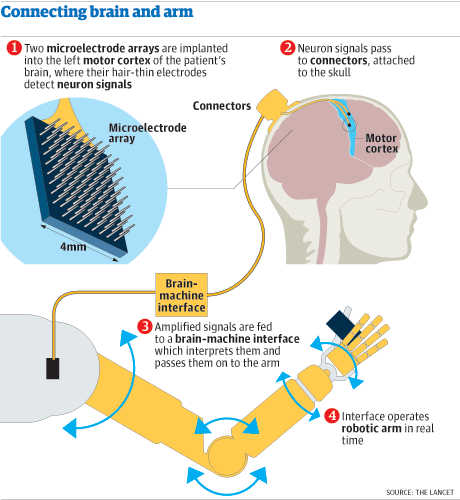
Doctors recruited the woman to test a robotic arm that is controlled by a new kind of computer program that translates the natural brain activity used to move our limbs into commands to move the robotic arm.

The design is intended to make the robotic arm more intuitive for patients to use. Instead of having to think where to move the arm, a patient can simply focus on the goal, such as “pick up the ball”.

Several groups around the world are developing so-called brain-machine interfaces to control robotic arms and other devices, such as computers, but none has achieved such impressive results.

Writing in the Lancet, researchers said Jan was able to move the robotic arm back, forward, right, left, and up and down only two days into her training. Within weeks she could reach out, and change the position of the hand to pick up objects on a table, including cones, blocks and small balls, and put them down at another location.

“We were blown away by how fast she was able to acquire her skill, that was completely unexpected,” said Andrew Schwartz, professor of neurobiology at the University of Pittsburgh. “At the end of a good day, when she was making these beautiful movements, she was ecstatic.”

To wire the woman up to the arm, doctors performed a four-hour operation to implant two tiny grids of electrodes, measuring 4mm on each side, into Jan’s brain. Each grid has 96 little electrodes that stick out 1.5mm. The electrodes were pushed just beneath the surface of the brain, near neurons that control hand and arm movement in the motor cortex.

Once the surgeons had implanted the electrodes, they replaced the part of the skull they had removed to expose the brain. Wires from the electrodes ran to connectors on the patient’s head, which doctors could then use to plug the patient into the computer system and robotic arm.

Before Jan could use the arm, doctors had to record her brain activity imagining various arm movements. To do this, they asked her to watch the robotic arm as it performed various moves, and got her to imagine moving her own arm in the same way.

While she was thinking, the computer recorded the electrical activity from individual neurons in her brain.

Neurons that control movement tend to have a preferred direction, and fire their electrical pulses more frequently to perform a movement in that direction. “Once we understand which direction each neuron likes to fire in, we can look at a larger group of neurons and figure out what direction the patient is trying to move the arm in,” Schwartz said.

To begin with, the robotic arm was programmed to help Jan’s movements, by ignoring small mistakes in movements. But she quickly progressed to controlling the arm without help. After three months of training, she completed tasks with the robotic arm 91.6% of the time, and 30 seconds faster than when the trial began.

In an accompanying article, Grégoire Courtine, at the Swiss Federal Institute of Technology in Lausanne, said: “This bioinspired brain-machine interface is a remarkable technological and biomedical achievement.”

There are hurdles ahead for mind-controlled robot limbs. Though Jan’s performance continued to improve after the Lancet study was written, she has plateaued recently, because scar tissue that forms around the tips of the electrodes degrades the brain signals the computer receives.

Schwartz said that using thinner electrodes, around five thousandths of a millimetre thick, should solve this problem, as they will be too small to trigger the scarring process in the body.

The researchers now hope to build senses into the robotic arm, so the patient can feel the texture and temperature of the objects they are handling. To do this, sensors on the fingers of the robotic hand could send information back to the sensory regions of the brain.

Another major focus of future work is to develop a wireless system, so the patient does not have to be physically plugged into the computer that controls the robotic arm.

Thanks to Kebmodee AND Dr. Rajadhyaksha for bringing this to the attention of the It’s Interesting community.

http://www.guardian.co.uk/science/2012/dec/17/paralysed-woman-robotic-arm-pittsburgh

NYU Student tweeting every reported US drone strike has revealed the ‘double tap’ tactic of killing first responders

drone

NYU student Josh Begley is tweeting every reported U.S. drone strike since 2002, and the feed highlights a disturbing tactic employed by the U.S. that is widely considered a war crime.

Known as the “double tap,” the tactic involves bombing a target multiple times in relatively quick succession, meaning that the second strike often hits first responders.

A 2007 report by the Homeland Security Institute called double taps a “favorite tactic of Hamas” and the FBI considers it a tactic employed by terrorists.

UN special rapporteur on extrajudicial killings Christof Heyns said that if there are “secondary drone strikes on rescuers who are helping (the injured) after an initial drone attack, those further attacks are a war crime.”

The U.S. refuses to discuss the merits of its overtly covert drone program, but the reports featured on @dronestream clearly document that U.S. hellfire missiles have intentionally targeted funerals and civilian rescuers.

And that’s only a 10-month window in Pakistan. It has happened in Afghanistan as well, and the first instance of “explicit intelligence posthumously proving” that an innocent civilian had been killed happened in Yemen.

In September the NYU and Stanford law schools released a report detailing how double taps by U.S. drones affect the Pakistani population, and noted that “high-level” militants killed only accounted for 2 percent of U.S. drone strike casualties.

Read more: http://www.businessinsider.com/us-drone-tweets-reveal-double-tap-plan-2012-12#ixzz2EyCYyb3N

Thanks to Kebmodee for bringing this to the attention of the It’s Interesting community.

Ray Kurzweil joins Google

Ray-Kurzweil-singularity

The most well known advocate of the Singularity is Ray Kurzweil, who Bill Gates has called one of the best thinkers of the future of technology.

Ray Kurzweil confirmed today that he will be joining Google to work on new projects involving machine learning and language processing.

“I’m excited to share that I’ll be joining Google as Director of Engineering this Monday, December 17,” said Kurzweil.

“I’ve been interested in technology, and machine learning in particular, for a long time: when I was 14, I designed software that wrote original music, and later went on to invent the first print-to-speech reading machine for the blind, among other inventions. I’ve always worked to create practical systems that will make a difference in people’s lives, which is what excites me as an inventor.

“In 1999, I said that in about a decade we would see technologies such as self-driving cars and mobile phones that could answer your questions, and people criticized these predictions as unrealistic. Fast forward a decade — Google has demonstrated self-driving cars, and people are indeed asking questions of their Android phones. It’s easy to shrug our collective shoulders as if these technologies have always been around, but we’re really on a remarkable trajectory of quickening innovation, and Google is at the forefront of much of this development.

“I’m thrilled to be teaming up with Google to work on some of the hardest problems in computer science so we can turn the next decade’s ‘unrealistic’ visions into reality.”

http://www.kurzweilai.net/kurzweil-joins-google-to-work-on-new-projects-involving-machine-learning-and-language-processing

Thanks to Kebmodee for bringing this to the attention of the It’s Interesting community.

Maori stones hold magnetic clues

_64421877_64421876

Scientists are studying the Earth’s magnetic field using the stones that line Maori steam ovens.

The cooking process generates so much heat that the magnetic minerals in these stones will realign themselves with the current field direction.

An archaeological search is under way in New Zealand to find sites containing old ovens, or hangi as they are known.

Abandoned stones at these locations could shed light on Earth’s magnetic behaviour going back hundreds of years.

“We have very good palaeomagnetic data from across the world recording field strength and direction – especially in the Northern Hemisphere,” said Gillian Turner from Victoria University, Wellington, New Zealand.

“The southwest Pacific is the gap, and in order to complete global models, we’re rather desperate for good, high-resolved data from our part of the world,” she told BBC News.

Dr Turner was speaking here at the American Geophysical Union (AGU) Fall meeting, the world’s largest annual gathering of Earth scientists.

The NZ researcher is working on a project to retrieve information about changes in the Earth’s magnetic field stretching back over the past 10,000 years.

For data on the last few centuries, she would ordinarily have turned to pottery.

When these objects are fired, the minerals in their clay are heated above the Curie temperature and are demagnetised.

Then, as the pots cool down, those minerals become magnetised again in the direction of the prevalent field. And the strength of the magnetisation is directly related to the strength of that field.

Unfortunately for Dr Turner, the first settlers on New Zealand 700-800 years ago – the Maori – did not use pottery. However, the researcher has hit upon a fascinating alternative.

She is now exploiting the Maori cooking tradition of the steam oven.

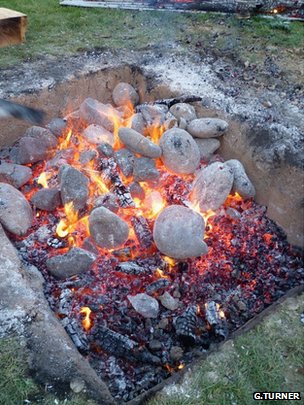
These were pits in the ground into which were placed very hot stones, covered with baskets of food and layers of fern fronds soaked in water.

The whole construction was then topped with soil and left to cook for several hours.

Dr Turner and colleagues experimented with a modern-day hangi to see if the stones at the base of the pit could achieve the necessary Curie temperatures to reset their magnetisation – to prove they could be used as an alternative data source for their study.

“The Maori legend is that the stones achieve white hot heat,” she explained.

“Well, red hot is about 700 degrees and so white hot would be a good deal more than that. But by putting some thermocouples in the stones we were able to show they got as high as 1,100C, which of itself is quite surprising. At that temperature, rock-forming minerals start to become plastic if not melt.”

By placing a compass on top of the cooled hangi stones Dr Turner’s team was able to establish that a re-magnetisation had indeed taken place.

It turns out that hangi stones were carefully chosen, and one of the most popular types was an andesite boulder found in Central North Island.

“The Maori prefer these volcanic boulders because they don’t crack and shatter in the fire, and from our point of view they’re the best because magnetically they behave better – they’re formed with a high concentration of magnetite,” the Wellington scientist said. “But there are some sedimentary rocks which we can use also.”

Dr Turner’s team is now scouring New Zealand for archaeological digs that have uncovered hangi ovens. It is crucial that a date is recovered with the stones. This can be provided by a radiocarbon analysis of the charcoal left from the firewood used to light the oven.

Hangi stones are only likely to take Dr Turner back to the 1200s. For magnetic data deeper in time, she needs to go to other sources.

“We’re also studying volcanic rocks because they’re erupted above the Curie temperature. And the other source of information is lake sediments. Long-core sediments can give us a continuous record at specific places.”

http://www.bbc.co.uk/news/science-environment-20520454

Thanks to Kebmodee for bringing this to the attention of the It’s Interesting community.

British company claims biggest engine advance since the jet: the SABRE engine

A Skylon in flight with a cutaway of the SABRE engine


A small British company with a dream of building a re-usable space plane has won an important endorsement from the European Space Agency (ESA) after completing key tests on its novel engine technology.

Reaction Engines Ltd believes its Sabre engine, which would operate like a jet engine in the atmosphere and a rocket in space, could displace rockets for space access and transform air travel by bringing any destination on Earth to no more than four hours away.

That ambition was given a boost on Wednesday by ESA, which has acted as an independent auditor on the Sabre test programme.

“ESA are satisfied that the tests demonstrate the technology required for the Sabre engine development,” the agency’s head of propulsion engineering Mark Ford told a news conference.

“One of the major obstacles to a re-usable vehicle has been removed,” he said. “The gateway is now open to move beyond the jet age.”

The space plane, dubbed Skylon, only exists on paper. What the company has right now is a remarkable heat exchanger that is able to cool air sucked into the engine at high speed from 1,000 degrees Celsius to minus 150 degrees in one hundredth of a second.

This core piece of technology solves one of the constraints that limit jet engines to a top speed of about 2.5 times the speed of sound, which Reaction Engines believes it could double.

With the Sabre engine in jet mode, the air has to be compressed before being injected into the engine’s combustion chambers. Without pre-cooling, the heat generated by compression would make the air hot enough to melt the engine.

The challenge for the engineers was to find a way to cool the air quickly without frost forming on the heat exchanger, which would clog it up and stop it working.

Using a nest of fine pipes that resemble a large wire coil, the engineers have managed to get round this fatal problem that would normally follow from such rapid cooling of the moisture in atmospheric air.

They are tight-lipped on exactly how they managed to do it.

“We are not going to tell you how this works,” said the company’s chief designer Richard Varvill, who started his career at the military engine division of Rolls-Royce. “It is our most closely guarded secret.”

The company has deliberately avoided filing patents on its heat exchanger technology to avoid details of how it works – particularly the method for preventing the build-up of frost – becoming public.

The Sabre engine could take a plane to five times the speed of sound and an altitude of 25 km, about 20 percent of the speed and altitude needed to reach orbit. For space access, the engines would then switch to rocket mode to do the remaining 80 percent.

Reaction Engines believes Sabre is the only engine of its kind in development and the company now needs to raise about 250 million pounds ($400 million) to fund the next three-year development phase in which it plans to build a small-scale version of the complete engine.

Chief executive Tim Hayter believes the company could have an operational engine ready for sale within 10 years if it can raise the development funding.

The company reckons the engine technology could win a healthy chunk of four key markets together worth $112 billion (69 billion pounds) a year, including space access, hypersonic air travel, and modified jet engines that use the heat exchanger to save fuel.

The fourth market is unrelated to aerospace. Reaction Engines believes the technology could also be used to raise the efficiency of so-called multistage flash desalination plants by 15 percent. These plants, largely in the Middle East, use heat exchangers to distil water by flash heating sea water into steam in multiple stages.

The firm has so far received 90 percent of its funding from private sources, mainly rich individuals including chairman Nigel McNair Scott, the former mining industry executive who also chairs property developer Helical Bar.

Chief executive Tim Hayter told Reuters he would welcome government investment in the company, mainly because of the credibility that would add to the project.

But the focus will be on raising the majority of the 250 million pounds it needs now from a mix of institutional investors, high net worth individuals and possibly potential partners in the aerospace industry.

Sabre produces thrust by burning hydrogen and oxygen, but inside the atmosphere it would take that oxygen from the air, reducing the amount it would have to carry in fuel tanks for rocket mode, cutting weight and allowing Skylon to go into orbit in one stage.

Scramjets on test vehicles like the U.S. Air Force Waverider also use atmospheric air to create thrust but they have to be accelerated to their operating speed by normal jet engines or rockets before they kick in. The Sabre engine can operate from a standing start.

If the developers are successful, Sabre would be the first engine in history to send a vehicle into space without using disposable, multi-stage rockets.

Skylon is years away, but in the meantime the technology is attracting interest from the global aerospace industry and governments because it effectively doubles the technical limits of current jet engines and could cut the cost of space access.

The heat exchanger technology could also be incorporated into a new jet engine design that could cut 5 to 10 percent – or $10 (6.25 pounds)-20 billion – off airline fuel bills.

That would be significant in an industry where incremental efficiency gains of one percent or so, from improvements in wing design for instance, are big news.

Thanks to Kebmodee for bringing this to the attention of the It’s Interesting community.

http://uk.reuters.com/article/2012/11/28/uk-science-spaceplane-idUKBRE8AR0R520121128