Sex cereal

sex_cereal_jpg_size__xxlarge_letterbox

It’s a new product getting lots of attention. Welcome to the somewhat uncomfortable world of selling Sex Cereal. The brainchild of a Toronto businessman, Sex Cereal is quickly rising to fame after making an appearance on CBC’s Dragon’s Den just before Valentine’s Day.

Peter Ehrlich came up with the concept while walking through a vegan food fair. The lightbulb went off and the idea of a cereal with different recipes for men and women was born. “Sexual health is so important,” Ehrlich said from his office in Toronto. “I wanted to create something sexy and fun in the health food industry because nothing is. Everything is very serious.”

Ehrlich used nutritionists to formulate two separate recipes that are supposed to improve the sexual health of men and women in different ways. The person behind the image and packaging of Sex Cereal is St. Catharines designer Maximilian Kaiser – the son of Inniskillin winery co-founder Karl Kaiser – who has been designing labels for wine bottles and packaging for other industries for 20 years. The packaging Kaiser came up with has a blonde pin-up girl on the cereal for women and a fit guy on the cereal for men.

“Initially we had some pin-up girl positions that were a little more racy, but we dialed it back a bit because of the legitimacy of the product,” Kaiser said. “We didn’t want it to look like a gag gift. It’s about trying to get the attention without being like a novelty.”

That continues to be one of the big challenges of selling the cereal – even though it’s available in hundreds of nutrition and grocery stores across Canada. “We’ve put a lot of effort into making people realize it’s a whole food and high-quality stuff,” said Kaiser. Ehrlich said after launching the cereal last June, it wasn’t until the beginning of this year that distributors and stores finally started agreeing to carry it. But interest is picking up – especially since the Dragon’s Den appearance. It’s now available in 700 stores across Canada including a handful in St. Catharines.

Tina Lee, the owner of Well! Well! Well! Nutrition Centre said she didn’t mind carrying it after the popularity of another natural cereal with a unique name. “When a company came out with Holy Crap we thought ‘you’ve gotta be kidding.’ But it sold like crazy,” Lee said about the B.C.-produced cereal. “After that, Sex Cereal came out and it was the same idea.”

As for Sex Cereal, it’s produced and packaged at a factory in St. Catharines. But the people who run that factory said they don’t want to be known as the company that makes the product. They asked that their name and location not be published.

“We have come across that a couple of times,” Kaiser said. “But I think people see the big picture. This is an honest product and people are being honest about sexuality a lot more now, too.”

At about $12 a bag, Sex Cereal isn’t cheap, but Ehrlich said there’s a reason for that. “The ingredients are quite rare,” he said. “I wasn’t creating a cereal for the sake of shock value. I know scientifically it had to be the real thing, but the real thing is expensive.”

HIS Ingredients

Rolled oats, wheat germ, water, chia seeds, black sesame seeds, pumpkin seeds, blueberries (sweetened with apple juice), cacao nibs, goji berries, bee pollen, maca powder, camu camu, coconut sugar

HER Ingredients

Rolled oats, oat bran, sunflower seeds, water, flax seeds, chia seeds, soy protein, cranberries (sweetened with apple juice), goji berries, cacao nibs, almonds, ginger ground, maca powder, coconut sugar

http://www.torontosun.com/2013/03/11/sex-cereal-formulated-for-sexual-health-2

Study aims to determine why some people hate cilantro

On “I Hate Cilantro” websites and Facebook pages they gripe that the herb tastes like soap, mold, or dirt. Cilantro haters not only despise its flavor, they also detest its smell. Stories in publications as serious as the New York Times, the Wall Street Journal and, yes, even msnbc.com have even covered the sharp divide in taste preferences when it comes to this particular herb.  And when a study of identical twins found an aversion to cilantro stems from a genetic glitch, the herb’s bashers finally had a good reason why they found the leaves of the Coriander plant so offensive.

But who are these people in the anti-cilantro community? No one had a clue — until now.

There has been no attempt to quantify which people hate the herb until two nutrition experts from the University of Toronto took a stab at it. They recently published their findings in the journal Flavour. In the study, they surveyed nearly 1,400 young adults ages 20 to 29 in Canada.

Volunteers completed a 63-item preference checklist in which they rated each food on a 9-point scale from 1 (dislike extremely) to 9 (like extremely). They could also select “never tried” or “would not try.”

Researchers found an aversion to cilantro ranged from a low of 3 percent to a high of 21 percent among six different ethnic groups.

Young Canadians with East Asian roots, which included those of Chinese, Japanese, Korean, Thai and Vietnamese descent, had the highest prevalence of people who disliked the herb at 21 percent. Caucasians were second at 17 percent, and people of African descent were third at 14 percent.

Among the herb’s fans, the group with the fewest number of people who disliked cilantro were those of Middle Eastern background at 3 percent, followed by those of Hispanic and South Asian ancestry at 4 percent and 7 percent respectively.

Exposure to the herb at an earlier age and with greater frequency in Mexican, Asian, and Indian cooking likely helps shape a positive flavor preference. Another possibility is that genetic differences among the cultural groups might influence someone’s taste perception of the herb.

Although researchers have yet to evaluate all 63 items on the food-preference checklist, study author Ahmed El-Sohemy, PhD, is sure of one thing: “Cilantro is perhaps the most polarizing with large numbers either loving it or hating it.” The paper calls this the “unusual divisive nature of cilantro.”

“People who dislike cilantro extremely describe it very, very differently from those who love it,” explains El-Sohemy, an associate professor of nutrition at the University of Toronto. The reason? “These individuals live in very different sensory worlds and are not perceiving the same thing,” he says.

As for El-Sohemy’s opinion of cilantro, count him among the lovers. “I remember loving the taste as a child,” he says. “I distinctly remember my mother’s Egyptian cooking, which used cilantro frequently.”

The study is a first step in determining how widespread a dislike for cilantro is, at least in a sample of young Canadians. It’s unclear whether older Canadians feel similarly or how much the herb is despised by people in other countries.

Eventually, the Toronto scientists hope to pinpoint the genetic basis for why cilantro is an herb some people love to hate.

http://bodyodd.nbcnews.com/_news/2012/05/16/11719087-who-hates-cilantro-study-aims-to-find-out

Thanks to Dr. S.G. for bringing this to the attention of the It’s Interesting community.

Food’s Biggest Scam: The Great Kobe Beef Lie

You cannot buy Japanese Kobe beef in this country. Not in stores, not by mail, and certainly not in restaurants. No matter how much you have spent, how fancy a steakhouse you went to, or which of the many celebrity chefs who regularly feature “Kobe beef” on their menus you believed, you were duped. If it wasn’t in Asia you almost certainly have never had Japan’s famous Kobe beef.

You may have had an imitation from the Midwest, Great Plains, South America or Australia, where they produce a lot of “Faux-be” beef. You may have even had a Kobe imposter from Japan before 2010. It is now illegal to import (or even hand carry for personal consumption) any Japanese beef. Before 2010 you could import only boneless fresh Japanese beef, but none was real Kobe. Under Japanese law, Kobe beef can only came from Hyogo prefecture (of which Kobe is the capital city), where no slaughterhouses were approved for export by the USDA. According to its own trade group, the Kobe Beef Marketing & Distribution Promotion Association in Japan, where Kobe Beef is a registered trademark, Macao is the only place it is exported to – and only since last year. If you had real Kobe beef in this country in recent years, someone probably smuggled it in their luggage.

“How is this possible?” you ask, when you see the virtues of Kobe being touted on television food shows, by famous chefs, and on menus all over the country? A dozen burger joints in Las Vegas alone offer Kobe burgers. Google it and you will find dozens of online vendors happy to take your money and ship you very pricey steaks. Restaurant reviews in the New York Times have repeatedly praised the “Kobe beef” served at high-end Manhattan restaurants. Not an issue of any major food magazine goes by without reinforcing the great fat Kobe beef lie.

Despite the fact that Kobe Beef, as well as Kobe Meat and Kobe Cattle, are patented terms and/or trademarks in Japan, these are neither recognized nor protected by U.S. law. As far as regulators here are concerned, Kobe beef, unlike say Florida Orange Juice, means almost nothing (the “beef” part should still come from cows). Like the recent surge in the use of the unregulated label term “natural,” it is an adjective used mainly to confuse consumers and profit from that confusion.

This matters because the reason food lovers and expense account diners want Kobe beef, and are willing to pay a huge premium for it, is because of the real Kobe’s longstanding reputation for excellence. The con the US food industry is running is leading you to believe that what you are paying huge dollars for – like the $40 NYC “Kobe” burger – is somehow linked to this heritage of excellence. It’s not.

Real Kobe beef is produced under some of the world’s strictest legal food standards, whereas “domestic Kobe” beef production, along with that in Australia and South America, is as regulated as the Wild West. In Japan, to be Kobe requires a pure lineage of Tajima-gyu breed cattle (not any old Japanese breed crossbred with American cattle as is the norm here). The animal must also have been born in Hyogo prefecture and thus raised on the local grasses and water and terroir its entire life. It must be a bull or virgin cow, and it takes considerably longer to raise a Tajima-gyu for consumption than most other breeds, adding to the cost. It must be processed in a Hyogo slaughterhouse – none of which export to the US – and then pass a strict government grading exam. There are only 3000 head of certified Kobe Beef cattle in the world, and none are outside Japan. The process is so strict that when the beef is sold, either in stores or restaurants, it must carry the 10-digit identification number so customers know what particular Tajima-gyu cow it came from.

In contrast, when you order “Kobe beef” here, you usually can’t even tell what kind of cow it came from – or where. Or what makes it “Kobe.”

The bottom line is that the only reason there is beef called Kobe beef sold in this country is because our government lets vendors call a lot of things Kobe beef. But the reason consumers buy it is because the cattle industry in Kobe spent lifetimes building a reputation for excellence, a reputation that has essentially been stolen.

There are two different parts to the broad misuse of the Kobe name. Historically in the US, restaurants and distributors have generically termed virtually any beef from anywhere in Japan Kobe, and many high-end restaurants did once get beef from Japan, and put it on the menus as Kobe, though it was not true Kobe beef. But in the past two years there has been no Japanese beef here. So the term Kobe today has even less meaning, and the meat can come from many different countries and have nothing in common with actual Kobe beef except that it comes from cows.  The argument often broached by the food industry that this non-Japanese Kobe is some sort of recreation of the real thing from the same breed of cows is also largely a myth.

Read about it in the USDA’s own words, about how as of early 2010 all beef from Japan including that “normally referred to as Kobe beef,” will “be refused entry,” “including in passenger luggage.” This is still the case, as you can see in the most recent Animal Product Manual, produced by the USDA’s Animal and Plant Health Inspection Service (APHIS), dated March 1, 2012 which specifically states that beef from Japan, fresh or frozen, whole or cut, bone-in or boneless, will be “Refused Entry.”

It is impossible to say exactly what you are getting in your Faux-be slider, or $100 Faux-be strip, but one thing is certain – it is not Japanese Kobe beef.  For the past two years, it has not been any kind of Japanese beef at all.

http://www.forbes.com/sites/larryolmsted/2012/04/12/foods-biggest-scam-the-great-kobe-beef-lie/

New Zealand Hokitika Wildfoods Festival

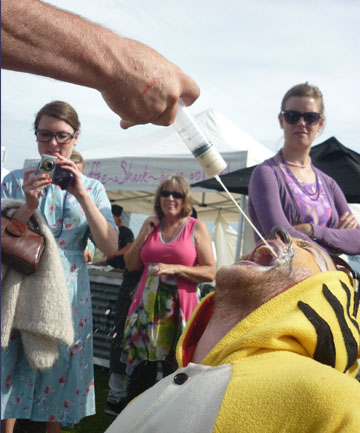
The main attraction at the Hokitika Wildfoods Festival this Saturday was horse semen.

The event has gained notoriety over the last two years after it started offering shots of horse semen to festival-goers and surprisingly the stall has become one of the most popular.

Even the mayor of Hokitika, Maureen Pugh, didn’t shy away from the stallion juice.

Mr Walsh, a vineyard worker in Blenheim, was attending his third Hokitika Wildfoods Festival on Saturday.

The protein shot was definitely the craziest thing yet, the 24-year-old said.

“I don’t like calling it horse semen. I just call it milkshake because that’s what it tastes like.”

Mr Walsh, originally from Palmerston North, hadn’t planned on trying the equestrian smoothie, he said.

“It was a blend of people urging me to do it and the girls I was with paying for it. Then the guy [stall holder] said `take a knee’ so I did.”

The taste wasn’t that bad, he said. “I thought it would be creamy and curdled. The grossest part was it hitting me in the face.”

The stall had a microscope so punters could see the live semen, he said.

“I didn’t look in,” he said. “That would have freaked me out.”

The 23rd Wildfoods Festival had other delicacies on offer, including mountain oysters (sheep’s testicles), live huhu grubs and grasshoppers.

http://www.stuff.co.nz/marlborough-express/news/6564102/Don-t-ask-what-hes-drinking

http://www.wildfoods.co.nz/index.cfm/1,51,0,0,html

Autism may be linked to obesity during pregnancy


Obesity during pregnancy may increase chances for having a child with autism, provocative new research suggests.

It’s among the first studies linking the two, and though it doesn’t prove obesity causes autism, the authors say their results raise public health concerns because of the high level of obesity in this country.

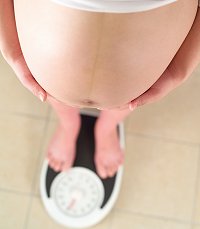
Study women who were obese during pregnancy were about 67 percent more likely than normal-weight women to have autistic children. They also faced double the risk of having children with other developmental delays.

On average, women face a 1 in 88 chance of having a child with autism; the results suggest that obesity during pregnancy would increase that to a 1 in 53 chance, the authors said.

The study was released online Monday in Pediatrics.

Since more than one-third of U.S. women of child-bearing age are obese, the results are potentially worrisome and add yet another incentive for maintaining a normal weight, said researcher Paula Krakowiak, a study co-author and scientist at the University of California, Davis.

Previous research has linked obesity during pregnancy with stillbirths, preterm births and some birth defects.

Dr. Daniel Coury, chief of developmental and behavioral pediatrics at Nationwide Children’s Hospital in Columbus, Ohio, said the results “raise quite a concern.”

He noted that U.S. autism rates have increased along with obesity rates and said the research suggests that may be more than a coincidence.

More research is needed to confirm the results. But if mothers’ obesity is truly related to autism, it would be only one of many contributing factors, said Coury, who was not involved in the study.

Genetics has been linked to autism, and scientists are examining whether mothers’ illnesses and use of certain medicines during pregnancy might also play a role.

The study involved about 1,000 California children, ages 2 to 5. Nearly 700 had autism or other developmental delays, and 315 did not have those problems.

Mothers were asked about their health. Medical records were available for more than half the women and confirmed their conditions. It’s not clear how mothers’ obesity might affect fetal development, but the authors offer some theories.

Obesity, generally about 35 pounds overweight, is linked with inflammation and sometimes elevated levels of blood sugar. Excess blood sugar and inflammation-related substances in a mother’s blood may reach the fetus and damage the developing brain, Krakowiak said.

The study lacks information on blood tests during pregnancy. There’s also no information on women’s diets and other habits during pregnancy that might have influenced fetal development.

There were no racial, ethnic, education or health insurance differences among mothers of autistic kids and those with unaffected children that might have influenced the results, the researchers said.

http://www.usatoday.com/news/health/story/2012-04-09/Autism-obesity-pregnancy/54126558/1

Unicorn Cookbook Found at British Library


A long-lost medieval cookbook, containing recipes for hedgehogs, blackbirds and even unicorns, has been discovered at the British Library. Professor Brian Trump of the British Medieval Cookbook Project described the find as near-miraculous. “We’ve been hunting for this book for years. The moment I first set my eyes on it was spine-tingling.”

Experts believe that the cookbook was compiled by Geoffrey Fule, who worked in the kitchens of Philippa of Hainault, Queen of England (1328-1369). Geoffrey had a reputation for blending unusual flavours – one scholar has called him “the Heston Blumenthal of his day” – and everything points to his hand being behind the compilation.

After recipes for herring, tripe and codswallop (fish stew, a popular dish in the Middle Ages) comes that beginning “Taketh one unicorne”. The recipe calls for the beast to be marinaded in cloves and garlic, and then roasted on a griddle. The cookbook’s compiler, doubtless Geoffrey Fule himself, added pictures in its margins, depicting the unicorn being prepared and then served. Sarah J Biggs, a British Library expert on medieval decoration, commented that “the images are extraordinary, almost exactly as we’d expect them to be, if not better”.

The recipe for cooking blackbirds is believed to be the origin of the traditional English nursery rhyme “Sing a song of sixpence / A pocket full of rye / Four-and-twenty blackbirds / Baked in a pie.” Professor Trump added that he was tempted to try some of the recipes, but suspected that sourcing ingredients would be challenging. “Unfortunately, they don’t stock unicorn in my local branch of Tesco.”

http://britishlibrary.typepad.co.uk/digitisedmanuscripts/2012/04/unicorn-cookbook-found-at-the-british-library.html

Pope Receives Gigantic Chocolate Easter Egg

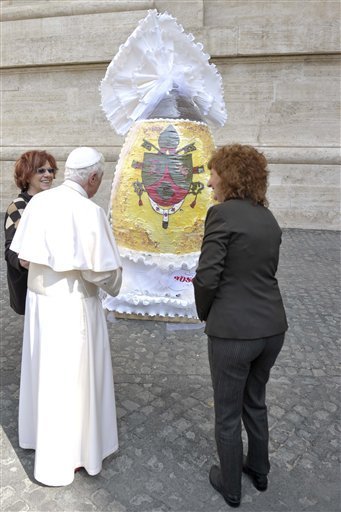
A pleased-looking Pope Benedict XVI has been presented with a colourful, two-metre high Easter egg weighing 250 kilograms as Catholics and other Christians prepare to celebrate Easter.

The egg, made by Italian chocolate maker Tosca, was unveiled in a Vatican courtyard. The brilliant yellow and blue wrapper was decorated with the Pope’s coat of arms, wreathes of flowers and doves – the symbol of peace.

The head of the Roman Catholic Church, who will be 85 later this month, will not be cracking open the egg himself, but will give it to young offenders in Rome’s Casal del Marmo institute, which he visited in 2007, according to the Vatican’s official newspaper, L’Osservatore Romano.

Tosca, based in the northern town of Cremona, is known for its oversized delicacies.

http://bigpondnews.com/articles/OddSpot/2012/04/05/Pope_given_whopper_Easter_egg_736440.html


Japanese Scientist Invents Safe Edible Burger From Human Feces

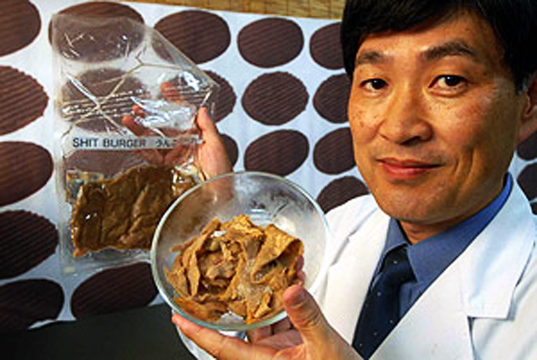
Mitsuyuki Ikeda, a researcher from the Environmental Assessment Center in Okayama has developed a new artificial meat burger made of human feces.

Ikeda has gathered sewage mud (which contains human feces) and has developed the artificial meat by adding fecal extracts, soy protein and steak sauce essence. Artificial food coloring to added to it to give it the same look as red meat. It is composed of 63 percent protein, 25 percent carbohydrates, 3 percent lipids and 9 percent minerals.

Protein is extracted from the sewage mud first. After the protein is extracted, “reaction enhancer” is added to it and it is then put in a machine called the “exploder” which produces the artificial meat. During the entire process, the bacteria in the sewage mud is rendered harmless as it is killed by heating.

The scientist is hoping that the new type of meat will one day replace real meat, which is more expensive to produce. He claims that the new feces burger is actually healthier than real meat (fecal meat has less fat and hence less calories) and is more environment-friendly (cows supposedly contribute around 18 percent of our greenhouse gas emissions).

Currently, fecal meat costs 10-20 times more than normal meat because of the cost of research, but ultimately Ikeda plans to bring the price down so that people can switch to feacl meat one day.

Ikeda did not say whether his “poop meat” is as tasty as real meat and he has acknowledged that few people would be keen to eat it.

http://www.ibtimes.com/articles/164958/20110617/japanese-scientist-makes-poop-burger-mitsuyuki-ikeda.htm


PICA: Woman Eats 4,000 Sponges


A DENTAL nurse told yesterday how she has EATEN 4,000 washing-up sponges due to a rare disorder.

Kerry Trebilcock, 21, has also munched more than 100 bars of SOAP.

She suffers from pica, which causes victims to crave objects that are not food.

Kerry, of Mylor, Cornwall, said: “One day I will beat this and be able to have a shower or do the washing-up without feeling hungry.”

Sponge eater Kerry said she likes to spice up her bizarre snacks with hot sauce or mustard.

Sometimes, she dips them in tea or hot chocolate like biscuits.

She also chomps on chunks of soap — but only organic fruit-flavoured varieties, with lemon and lime her favourite.

Kerry said: “I have been very particular about the type of sponges and soaps I’d eat and how I’d prepare them.

“If I went out for the day I’d carry a small plastic bag of cut-up pieces of sponge with some tomato and BBQ sauce in Tupperware. I was never without a ‘snack’.”

Other pica sufferers eat metal, coal, sand, chalk — or even lightbulbs and furniture.

Petite Kerry, who weighs just 8st, has endured shocking stomach cramps, constipation and diarrhoea.

And although she has cut down on her sponge munching, she has been unable to totally shake the condition.

At one point Kerry was eating five a day topped with hot relish, BBQ sauce, ketchup, mustard, jam or honey.

She said: “The sauces and dipping the sponges in drinks softened them — and I’d chew them until the flavour was gone. Then I would swallow the sponge.”

Sponges are commonly made from cellulose wood fibres or foamed plastic polymers.

Organic soap contains olive or palm oil, glycerin and plant scents, plus oatmeal to lift off dead skin.

Kerry’s eating habits changed after a holiday to Morocco in 2008, during which she picked up an infection of hookworm, a parasite that lives in the small intestine.

At first, she began craving junk food. But then something strange happened.

She said: “After one dinner where I ate a double helping of lasagne and a tub of ice cream, I still felt hungry.

“To distract myself, I decided to wash the dishes. I took out a new sponge from a packet and had an overwhelming desire to eat it.

“I sat down with a glass of water and chewed the sponge until it was gone.

“It tasted of nothing but I found eating it enjoyable.

“Finally my hunger was gone and my stomach felt satisfied.”

Afterwards, though, she felt embarrassed and scared — and cried herself to sleep.

But the next morning, as she washed herself with lemon and lime soap, she had an urge to eat some and swallowed a chunk.

She said: “I knew something was very wrong with me but I didn’t want to tell anyone as I felt like a freak. But after a week I’d eaten nine sponges and over a pound of organic soap.”

Her hookworm infection was diagnosed by her GP but she kept quiet about her cravings in case he thought she was mad.

She said: “I would go to the supermarket and buy over 40 sponges and different types of organic soap.

“It made me hungry just smelling all the different soap products in the cleaning aisle. The cashiers joked that I must love cleaning!”

Kerry, who also eats normal food, finally confided to a friend in 2009.

And after seeing the doctor again, she was told she had pica and could seriously damage her digestive system.

A programme of counselling and vitamins has set her on the road to recovery. And she is determined to succeed. But it is a slow and arduous process.

Kerry said: “I still have a one-inch square of sponge and three teaspoons of organic soap with each meal.

“But I am making progress and speak to other sufferers of pica on internet forums, which helps.

“There are some out there far worse than me who eat car tyres, spoons and even sofas.”

Kerry is trying to curb her pangs with Floral Gum sweets.

She said: “They taste like soap so they help me get the flavour I desire without doing any damage. I know one day I will beat this.”

Kerry’s student sister Jody, 20, told how the family initially found her sponge munching hard to understand.

She said: “Watching her eat a sponge or soap was extremely weird. But Kerry has educated us all about pica.

“I’m so proud she has worked hard to fight this condition and is recovering through counselling.

“She is really brave to talk about it so openly.”

http://www.thesun.co.uk/sol/homepage/news/4161108/Girl-eats-4000-brwashing-up-sponges.html