Snow sculpture car gets parking ticket

snow_sculpture__europics

Traffic wardens slipped up in Germany when they left a parking ticket – on a full-sized snow sculpture of a Volkswagen Beetle. Pranksters had built the car overnight in a no-parking zone in Aachen, complete with outlines for its headlights, windscreens and even the distinctive VW badge on the bonnet.

“It was incredibly realistic looking. It looked like you could get into it and drive away once you’d swept the snow off,” said one local.

“The wardens eventually realised they’d been had when they tried to scrape the snow off the number plate and found there was no plate, just snow,” they added.

But the prank has received a frosty reception from local police. A spokesman said: “We can take a joke as well as the next person and it was a very convincing prank. But whether it was made of metal or snow it was still obstructing a road that should have been clear.”

http://web.orange.co.uk/article/quirkies/Snow_sculpture_car_gets_parking_ticket

Pessimism About the Future May Lead to Longer, Healthier Life

Pessimism-vs_-optimism-350x262
Older people who have low expectations for a satisfying future may be more likely to live longer, healthier lives than those who see brighter days ahead, according to new research published by the American Psychological Association.

“Our findings revealed that being overly optimistic in predicting a better future was associated with a greater risk of disability and death within the following decade,” said lead author Frieder R. Lang, PhD, of the University of Erlangen-Nuremberg in Germany. “Pessimism about the future may encourage people to live more carefully, taking health and safety precautions.” The study was published online in the journal Psychology and Aging.

Lang and colleagues examined data collected from 1993 to 2003 for the national German Socio-Economic Panel, an annual survey of private households consisting of approximately 40,000 people 18 to 96 years old. The researchers divided the data according to age groups: 18 to 39 years old, 40 to 64 years old and 65 years old and above. Through mostly in-person interviews, respondents were asked to rate how satisfied they were with their lives and how satisfied they thought they would be in five years.

Five years after the first interview, 43 percent of the oldest group had underestimated their future life satisfaction, 25 percent had predicted accurately and 32 percent had overestimated, according to the study. Based on the average level of change in life satisfaction over time for this group, each increase in overestimating future life satisfaction was related to a 9.5 percent increase in reporting disabilities and a 10 percent increased risk of death, the analysis revealed.

Because a darker outlook on the future is often more realistic, older adults’ predictions of their future satisfaction may be more accurate, according to the study. In contrast, the youngest group had the sunniest outlook while the middle-aged adults made the most accurate predictions, but became more pessimistic over time.

“Unexpectedly, we also found that stable and good health and income were associated with expecting a greater decline compared with those in poor health or with low incomes,” Lang said. “Moreover, we found that higher income was related to a greater risk of disability.”

The researchers measured the respondents’ current and future life satisfaction on a scale of 0 to 10 and determined accuracy in predicting life satisfaction by measuring the difference between anticipated life satisfaction reported in 1993 and actual life satisfaction reported in 1998. They analyzed the data to determine age differences in estimated life satisfaction; accuracy in predicting life satisfaction; age, gender and income differences in the accuracy of predicting life satisfaction; and rates of disability and death reported between 1999 and 2010. Other factors, such as illness, medical treatment or personal losses, may have driven health outcomes, the study said.

The findings do not contradict theories that unrealistic optimism about the future can sometimes help people feel better when they are facing inevitable negative outcomes, such as terminal disease, according to the authors. “We argue, though, that the outcomes of optimistic, accurate or pessimistic forecasts may depend on age and available resources,” Lang said. “These findings shed new light on how our perspectives can either help or hinder us in taking actions that can help improve our chances of a long healthy life.”

http://www.sciencedaily.com/releases/2013/02/130227101929.htm

New map predicts timing of cities to avoid as sea levels rise

mg21729034_900-2_300

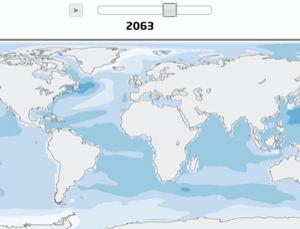
As the world warms, ice melts and water expands, sea level will rise – but faster in some places than others. These simulations, which assume warming in the middle of the range indicated by climate models, provide the best view yet of probable regional variation in sea level rise over the coming decades. Use the play button or slider to control the animations.

Click the link below to view projections for high or low emissions scenarios.

http://sealevel.newscientistapps.com/

SYDNEY, Tokyo and Buenos Aires watch out. These cities will experience some of the greatest sea level rises by 2100, according to one of the most comprehensive predictions to date.

Sea levels have been rising for over 100 years – not evenly, though. Several processes are at work, says Mahé Perrette of the Potsdam Institute for Climate Impact Research in Germany. Some land is sinking, some is rising. Stronger currents create slopes in sea surface, and since all things with mass exert a gravitation pull, disappearing ice sheets lead to a fall in sea levels in their surrounding areas.

Perrette has modelled all of these effects and calculated local sea level rises in 2100 for the entire planet. While the global average rise is predicted to be between 30 and 106 centimetres, he says tropical seas will rise 10 or 20 per cent more, while polar seas will see a below-average rise. Coasts around the Indian Ocean will be hard hit, as will Japan, south-east Australia and Argentina (Earth System Dynamics, doi.org/kbf).

New York’s position may be less perilous than previously thought. A weakening of the Atlantic Gulf Stream will cause water to slop westwards, triggering a rapid rise on the eastern seaboard, but this will be counteracted by Greenland’s weaker gravitational pull. The city is not out of the woods, though, warns Aimée Slangen of Utrecht University in the Netherlands, whose own model suggests that Antarctica could lose a lot of ice, which would produce an above-average rise throughout the northern hemisphere.

For now, Perrette offers a warning to tropical countries. “You may have 120 centimetres of sea level rise on your coastline,” he says. “Build defences.”

This article appeared in print under the headline “Where not to be when seas rise up to meet us”

http://www.newscientist.com/article/mg21729034.900-new-map-pinpoints-cities-to-avoid-as-sea-levels-rise.html

Facebook making 1 in 3 people feel worse about themselves

Social Networking Sites May Be Monitored By Security Services

No surprise — those Facebook photos of your friends on vacation or celebrating a birthday party can make you feel lousy.

Facebook is supposed to envelope us in the warm embrace of our social network, and scanning friends’ pages is supposed to make us feel loved, supported and important (at least in the lives of those we like). But skimming through photos of friends’ life successes can trigger feelings of envy, misery and loneliness as well, according to researchers from two German universities. The scientists studied 600 people who logged time on the social network and discovered that one in three felt worse after visiting the site—especially if they viewed vacation photos. Facebook frequenters who spent time on the site without posting their own content were also more likely to feel dissatisfied.

“We were surprised by how many people have a negative experience from Facebook with envy leaving them feeling lonely, frustrated or angry,” study author Hanna Krasnova from the Institute of Information Systems at Berlin’s Humboldt University told Reuters. ”From our observations some of these people will then leave Facebook or at least reduce their use of the site.”

The most common cause of Facebook frustration came from users comparing themselves socially to their peers, while the second most common source of dissatisfaction was “lack of attention” from having fewer comments, likes and general feedback compared to friends.

The study authors note that both men and women feel pressure to portray themselves in the best light to their Facebook friends, but men are more likely to post more self-promotional content in their ”About Me” and “Notes” sections than women, although women are more likely to stress their physical attractiveness and sociability.

The authors write [PDF]

Overall, however, shared content does not have to be “explicitly boastful” for envy feelings to emerge. In fact, a lonely user might envy numerous birthday wishes his more sociable peer receives on his FB Wall. Equally, a friend’s change in the relationship status from “single” to “in a relationship” might cause emotional havoc for someone undergoing a painful breakup.

So far, it seems that the positive effects of being socially connected supersede the negative consequences of feeling inferior or left out by your circle of friends. But the authors suggest that if the hurtful feelings grow, Facebook and other social media may no longer be a fun way to stay connected with friends, but could become just another source of stress for people.

The research will be presented at an information system conference in Germany in February, called the 11th International Conference on Wirtschaftsinformatik.

Read more: http://healthland.time.com/2013/01/24/why-facebook-makes-you-feel-bad-about-yourself/#ixzz2J7kynw00

Adoption at sea: sperm whales take in outcast bottlenose dolphin

dolphin-with-spinal-trouble-sperm-whales_63541_600x450

A group of sperm whales appear to have taken in a deformed bottlenose dolphin, marine researchers have discovered.

Behavioral ecologists Alexander Wilson and Jens Krause of Berlin’s Leibniz-Institute of Freshwater Ecology and Inland Fisheries came across the heartwarming scene some 15 to 20 kilometers off the Azores in the North Atlantic, as they observed the dolphin six times while it nuzzled and rubbed members of the group, reports the journal Science.

“It really looked like they had accepted the dolphin for whatever reason. They were being very sociable,” Wilson told the journal.

The dolphin’s unfortunate deformity — a spinal disfigurement, likely a birth defect, which gives its back half an “S” shape — could help explain how it’s come to be taken in by the sperm whale group, explains Science.

“Sometimes some individuals can be picked on. It might be that this individual didn’t fit in, so to speak, with its original group,” Wilson says, speculating that the deformity could have put the animal at a disadvantage among its own kind — perhaps it had a low social status, or just couldn’t keep up with the other dolphins.

Sperm whales swim more slowly than dolphins, notes the journal, and the pod designates one member to “babysit” the calves near the surface while the other adults dive deep.

But what was in it for the sperm whales? There’s no obvious advantage, Wilson tells Science.

In fact, as cetacean ecologist Mónica Almeida e Silva of the University of the Azores in Portugal tells the journal, sperm whales have good reasons not to like bottlenose dolphins. “Why would sperm whales accept this animal in their group?” she said. “It’s really puzzling to me.”

But maybe we shouldn’t draw too much from this apparent display of affection: as behavioral biologist Luke Rendell of the University of St. Andrews in the U.K. explained to Science, the briefness of the observation, and its rarity, as well as how little is known about these particular whales, makes it hard to interpret. They might simply enjoy the dolphin’s attentions, says Rendell, or “they could just be thinking, ‘Wow, this is a kind of weird calf’.”

Read more: http://newsfeed.time.com/2013/01/26/adoption-at-sea-sperm-whales-take-in-outcast-bottlenose-dolphin/#ixzz2J7iTuEgQ

Baby Wasps Disinfect Cockroaches Before Eating Them

wasp-and-roach

If cockroaches had nightmares, the emerald cockroach wasp surely would deserve a prominent place therein.

These colorful, tiny parasitic wasps sting American cockroaches twice, once in the midsection to prevent them from running away, and a second time directly in the brain, to make the insects sluggish and zombielike. The wasps then drag the roaches by their antenna, akin to a human pulling a dog on a leash, into a protected nook and lay an egg on the roach. The egg ultimately hatches into larvae that devour the roach from the inside out.

About six weeks later, a young adult wasp emerges after spinning a cocoon inside the shell of the roach. But there’s a catch: What’s to prevent the cockroach “meat” from spoiling? Cockroaches are notoriously dirty animals, covered in bacteria that begin to spoil their flesh — and threaten to harm larval wasps — during this long incubation period.

A study published January 7 in the journal the Proceedings of the National Academy of Sciences found that these larval wasps secrete a surprising amount of potent antimicrobial compounds to prevent their cockroach bounty from spoiling.

“They virtually soak their cockroach host with the secretion to inhibit the growth of competitive microbes that would degrade their food and of pathogenic microbes that threaten their lives,” said study co-author Gudrun Herzner, a researcher at Germany’s University of Regensburg.

The study found that Ampulex compressa larvae secrete several types of antibiotics, specifically the chemicals mellein and micromolide, which inhibit the growth of bacteria, fungi and viruses, Herzner told LiveScience.

“On the one hand, the finding is surprising, because such a simple, little insect larva uses such a sophisticated strategy to ward off detrimental bacteria,” Herzner said. “The larvae are like little chemical plants that produce large amounts of different antimicrobial substances.”

However, she continued, it was not really a surprise to find that these parasitic wasps would have evolved to secrete some antimicrobial substances, given that the cockroach is the young wasp’s only food source, which would by itself spoil if not somehow preserved. The wasps live throughout the tropical regions of Africa, Asia and the Pacific.

Micromolide is considered a promising compound to treat Mycobacterium tuberculosis, the microbe that causes tuberculosis, Herzner said.

This is not the only example of insects producing antimicrobial compounds. The European beewolf wasp hunts honeybees, and coats their bodies in an oily substance that inhibits microbes from growing. Certain types of burying beetles also disinfect the carrion they use as larval food. But in both of these cases, the adult animal secretes the antimicrobial chemicals; the emerald cockroach wasp is a rare example of a larval insect making antibiotics, Herzner said.

http://www.livescience.com/26035-wasps-disinfect-cockroaches.html

Christmas tree throwing world championships, ‘Knut-Fest,’ held in Germany

Now that the festive period is over and the decorations have come down, most households have opted to recycle their old Christmas trees.

But people in the town of Weidenthal in southern Germany have come up with a much more imaginative way of getting rid of them – by holding the world Christmas tree throwing championships.

The idea behind “Knut-Fest,'” as it is known to locals, is to dispense with the Christmas festivities whilst welcoming in the New Year.

Competitors are asked to bring along their old trees, stripped of lights and other decorations, and see how far they can throw them.

There are three disciplines in the competition; Weitwurf (javelin-style), Hammerwurf (hammer-style) and Hochwurf (high jump-style) throwing.

The overall winner is decided by the total distance achieved over the course of the day.

Frank Schwender, 48, from the nearby town of Frankeneck won the tournament for an unprecedented third consecutive year.

He retained his title with a total distance of 22.45 metres over the three throwing disciplines.

http://www.telegraph.co.uk/news/newsvideo/weirdnewsvideo/9788401/Christmas-tree-throwing-world-championships-held-in-Germany.html

Strengthened link between climate change and volcanic eruptions established

volcano1

It has long been known that volcanic activity can cause short-term variations in climate. Now, researchers at the GEOMAR Helmholtz Centre for Ocean Research Kiel (Germany), together with colleagues from Harvard University have found evidence that the reverse process also occurs: Climate affects volcanic activity. “In times of global warming, the glaciers are melting on the continents relatively quickly. At the same time the sea level rises. The weight on the continents decreases, while the weight on the oceanic tectonic plates increases. The stress changes within in the earth to open more routes for ascending magma” says geophysicist Dr Marion Jegen from GEOMAR, who participated in the study. The rate of global cooling at the end of the warm phases is much slower, so there are less dramatic stress changes during these times.

“If you follow the natural climate cycles, we are currently at the end of a really warm phase. Therefore, things are volcanically quieter now. The impact from man-made warming is still unclear based on our current understanding” says GEOMAR volcanologist Dr Steffen Kutterolf, who has been with SFB 574 since its founding.
In 1991, it was a disaster for the villages nearby the erupting Philippine volcano Pinatubo. But the effects were felt even as far away as Europe. The volcano threw up many tons of ash and other particles into the atmosphere causing less sunlight than usual to reach the Earth’s surface. For the first few years after the eruption, global temperatures dropped by half a degree. In general, volcanic eruptions can have a strong short-term impact on climate. Conversely, the idea that climate may also affect volcanic eruptions on a global scale and over long periods of time is completely new.

Researchers at GEOMAR Helmholtz Centre for Ocean Research Kiel (Germany) and Harvard University in Massachusetts (USA) have now found strong evidence for this relationship from major volcanic eruptions around the Pacific Ocean over the past 1 million years. They have presented their results in the latest issue of the international journal Geology.

For more than ten years the project has been extensively exploring volcanoes of Central America. “Among others pieces of evidence, we have observations of ash layers in the seabed and have reconstructed the history of volcanic eruptions for the past 460,000 years,” says Kutterolf. Particular patterns started to appear. “There were periods when we found significantly more large eruptions than in others” says Kutterolf.

After comparing these patterns with the climate history, there was an amazing match. The periods of high volcanic activity followed fast, global temperature increases and associated rapid ice melting. To expand the scope of the discoveries, Dr Kutterolf and his colleagues studied other cores from the entire Pacific region. These cores had been collected as part of the International Integrated Ocean Drilling Program (IODP) and its predecessor programmes. They record more than a million years of the Earth’s history.

“In fact, we found the same pattern from these cores as in Central America” says Jegen. Together with colleagues at Harvard University, the geologists and geophysicists searched for a possible explanation. They found it with the help of geological computer models.

The next step is to investigate shorter-term historical variations to better understand implications for the present day.

For more information: Kutterolf, S., M. Jegen, J. X. Mitrovica, T. Kwasnitschka, A. Freundt, P. J. Huybers (2012): A detection of Milankovitch frequencies in global volcanic activity. Geology, G33419.1, dx.doi.org/10.1130/G33419.1 Journal reference: Geology

http://www.dailygalaxy.com/my_weblog/2012/12/ecoalert-strong-link-between-climate-change-and-volcanic-eruptions-discovered.html

Smoking Smothers Your Genes

sn-epigenetic

Cigarettes leave you with more than a smoky scent on your clothes and fingernails. A new study has found strong evidence that tobacco use can chemically modify and affect the activity of genes known to increase the risk of developing cancer. The finding may give researchers a new tool to assess cancer risk among people who smoke.

DNA isn’t destiny. Chemical compounds that affect the functioning of genes can bind to our genetic material, turning certain genes on or off. These so-called epigenetic modifications can influence a variety of traits, such as obesity and sexual preference. Scientists have even identified specific epigenetic patterns on the genes of people who smoke. None of the modified genes has a direct link to cancer, however, making it unclear whether these chemical alterations increase the risk of developing the disease.

In the new study, published in Human Molecular Genetics, researchers analyzed epigenetic signatures in blood cells from 374 individuals enrolled in the European Prospective Investigation into Cancer and Nutrition. EPIC, as it’s known, is a massive study aimed at linking diet, lifestyle, and environmental factors to the incidence of cancer and other chronic diseases. Half of the group consisted of people who went on to develop colon or breast cancer 5 to 7 years after first joining the study, whereas the other half remained healthy.

The team, led by James Flanagan, a human geneticist at Imperial College London, discovered a distinct “epigenetic footprint” in study subjects who were smokers. Compared with people who had never smoked, these individuals had fewer chemical tags known as methyl groups—a common type of epigenetic change—on 20 different regions of their DNA. When the researchers extended the analysis to a separate group of patients and mice that had been exposed to tobacco smoke, they narrowed down the epigenetic modifications to several sites located in four genes that have been weakly linked to cancer before. All of these changes should increase the activity of these genes, Flanagan says. It’s unclear why increasing the activity of the genes would cause cancer, he says, but individuals who don’t have cancer tend not to have these modifications.

The study is the first to establish a close link between epigenetic modifications on a cancer gene and the risk of developing the disease, says Robert Philibert, a behavioral geneticist at the University of Iowa in Iowa City. “To the best of my knowledge, no previous genome-wide epigenetics study has taken such efforts from initial discovery to replication to experimental validation,” adds Lutz Breitling, an epidemiologist at the German Cancer Research Center in Heidelberg, Germany.

The work may lead to new ways to asses cancer risks from smoking. “Previous research into smoking has often asked people to fill out questionnaires, … which have their obvious drawbacks and inaccuracies,” Flanagan says. The new study, he says, may make it possible for doctors to quantify a person’s cancer risk simply through an epigenetic analysis of their DNA.

http://news.sciencemag.org/sciencenow/2012/12/smoking-smothers-your-genes.html

Thanks to Dr. Rajadhyaksha for bringing this to the attention of the It’s Interesting community.

Controversial surgical treatment for addiction burns away the brain’s pleasure center


How far should doctors go in attempting to cure addiction? In China, some physicians are taking the most extreme measures. By destroying parts of the brain’s “pleasure centers” in heroin addicts and alcoholics, these neurosurgeons hope to stop drug cravings. But damaging the brain region involved in addictive desires risks permanently ending the entire spectrum of natural longings and emotions, including the ability to feel joy.

In 2004, the Ministry of Health in China banned this procedure due to lack of data on long term outcomes and growing outrage in Western media over ethical issues about whether the patients were fully aware of the risks.

However, some doctors were allowed to continue to perform it for research purposes—and recently, a Western medical journal even published a new study of the results. In 2007, The Wall Street Journal detailed the practice of a physician who claimed he performed 1000 such procedures to treat mental illnesses such as depression, schizophrenia and epilepsy, after the ban in 2004; the surgery for addiction has also since been done on at least that many people.

The November publication has generated a passionate debate in the scientific community over whether such research should be published or kept outside the pages of reputable scientific journals, where it may find undeserved legitimacy and only encourage further questionable science to flourish.

The latest study is the third published since 2003 in Stereotactic and Functional Neurosurgery, which isn’t the only journal chronicling results from the procedure, which is known as ablation of the nucleus accumbens. In October, the journal World Neurosurgery also published results from the same researchers, who are based at Tangdu Hospital in Xi’an.

The authors, led by Guodong Gao, claim that the surgery is “a feasible method for alleviating psychological dependence on opiate drugs.” At the same time, they report that more than half of the 60 patients had lasting side effects, including memory problems and loss of motivation. Within five years, 53% had relapsed and were addicted again to opiates, leaving 47% drug free.

(MORE: Addicted: Why We Get Hooked)

Conventional treatment only results in significant recovery in about 30-40% of cases, so the procedure apparently improves on that, but experts do not believe that such a small increase in benefit is worth the tremendous risk the surgery poses.  Even the most successful brain surgeries carry risk of infection, disability and death since opening the skull and cutting brain tissue for any reason is both dangerous and unpredictable. And the Chinese researchers report that 21% of the patients they studied experienced memory deficits after the surgery and 18% had “weakened motivation,” including at least one report of lack of sexual desire. The authors claim, however, that “all of these patients reported that their [adverse results] were tolerable.” In addition, 53% of patients had a change in personality, but the authors describe the majority of these changes as “mildness oriented,” presumably meaning that they became more compliant. Around 7%, however, became more impulsive.

The surgery is actually performed while patients are awake in order to minimize the chances of destroying regions necessary for sensation, consciousness or movement.  Surgeons use heat to kill cells in small sections of both sides of the brain’s nucleus accumbens.  That region is saturated with neurons containing dopamine and endogenous opioids, which are involved in pleasure and desire related both to drugs and to ordinary experiences like eating, love and sex.

(MORE: A Drug to End Drug Addiction)

In the U.S. and the U.K., reports the Wall Street Journal, around two dozen stereotactic ablations are performed each year, but only in the most intractable cases of depression and obsessive-compulsive disorder and after extensive review by institutional review boards and intensive discussions with the patient, who must acknowledge the risks. Often, a different brain region is targeted, not the nucleus accumbens. Given the unpredictable and potentially harmful consequences of the procedure, experts are united in their condemnation of using the technique to treat addictions. “To lesion this region that is thought to be involved in all types of motivation and pleasure risks crippling a human being,” says Dr. Charles O’Brien, head of the Center for Studies of Addiction at the University of Pennsylvania.

David Linden, professor of neuroscience at Johns Hopkins and author of a recent book about the brain’s pleasure systems calls the surgery “horribly misguided.”  He says “This treatment will almost certainly render the subjects unable to feel pleasure from a wide range of experiences, not just drugs of abuse.”

But some neurosurgeons see it differently. Dr. John Adler, professor emeritus of neurosurgery at Stanford University, collaborated with the Chinese researchers on the publication and is listed as a co-author.  While he does not advocate the surgery and did not perform it, he believes it can provide valuable information about how the nucleus accumbens works, and how best to attempt to manipulate it. “I do think it’s worth learning from,” he says. ” As far as I’m concerned, ablation of the nucleus accumbens makes no sense for anyone.  There’s a very high complication rate. [But] reporting it doesn’t mean endorsing it. While we should have legitimate ethical concerns about anything like this, it is a bigger travesty to put our heads in the sand and not be willing to publish it,” he says.

(MORE: Anesthesia Study Opens Window Into Consciousness)

Dr. Casey Halpern, a neurosurgery resident at the University of Pennsylvania makes a similar case. He notes that German surgeons have performed experimental surgery involving placing electrodes in the same region to treat the extreme lack of pleasure and motivation associated with otherwise intractable depression.  “That had a 60% success rate, much better than [drugs like Prozac],” he says. Along with colleagues from the University of Magdeburg in Germany, Halpern has just published a paper in the Proceedings of the New York Academy of Sciences calling for careful experimental use of DBS in the nucleus accumbens to treat addictions, which have failed repeatedly to respond to other approaches. The paper cites the Chinese surgery data and notes that addiction itself carries a high mortality risk.

DBS, however, is quite different from ablation.  Although it involves the risk of any brain surgery, the stimulation itself can be turned off if there are negative side effects, while surgical destruction of brain tissue is irreversible. That permanence—along with several other major concerns — has ethicists and addiction researchers calling for a stop to the ablation surgeries, and for journals to refuse to publish related studies.

Harriet Washington, author of Medical Apartheid:  The Dark History of Medical Experimentation on Black Americans from Colonial Times to the Present, argues that by publishing the results of unethical studies, scientists are condoning the questionable conditions under which the trials are conducted. “When medical journals publish research that violates the profession’sethical guidelines, this serves not only to sanction such abuses, but to encourage them,” she says. “In doing so, this practice encourages a relaxing of moral standards that threatens all patients and subjects, but especially  the medically vulnerable.”

(MORE: Real-Time Video: First Look at a Brain Losing Consciousness Under Anesthesia)

Shi-Min Fang, a Chinese biochemist who became a freelance journalist and recently won the journal Nature‘s Maddox prize for his exposes of widespread fraud in Chinese research, has revealed some of the subpar scientific practices behind research conducted in China, facing death threats and, as the New York Times reported, a beating with a hammer. He agrees that publishing such research only perpetuates the unethical practices. Asked by TIME to comment on the addiction surgery studies, Fang writes that publishing the research, particularly in western journals, “would encourage further unethical research, particularly in China where rewards for publication in international journals are high.”

While he doesn’t have the expertise to comment specifically on the ablation data, he says “the results of clinical research in China are very often fabricated. I suspect that the approvals by Ethics Committee mentioned in these papers were made up to meet publication requirement. I also doubt if the patients were really informed in detail about the nature of the study.” Fang also notes that two of the co-authors of the paper are advertising on the internet in Chinese, offering the surgery at a cost of 35,000 renminbi, about $5,600.  That’s more than the average annual income in China, which is about $5,000.

Given the available evidence, in fact, it’s hard to find a scientific justification for even studying the technique in people at all. Carl Hart, associate professor of psychology at Columbia University and author of the leading college textbook on psychoactive drugs, says animal studies suggest the approach may ultimately fail as an effective treatment for addiction; a 1984 experiment, for example, showed that destroying the nucleus accumbens in rats does not permanently stop them from taking opioids like heroin and later research found that it similarly doesn’t work for curbing cocaine cravings. Those results alone should discourage further work in humans. “These data are clear,” he says, “If you are going to take this drastic step, you damn well better know all of the animal literature.” [Disclosure:  Hart and I have worked on a book project together].

(MORE: Top 10 Medical Breakthroughs of 2012)

Moreover, in China, where addiction is so demonized that execution has been seen as an appropriate punishment and where the most effective known treatment for heroin addiction— methadone or buprenorphine maintenance— is illegal, it’s highly unlikely that addicted people could give genuinely informed consent for any brain surgery, let alone one that risks losing the ability to feel pleasure. And even if all of the relevant research suggested that ablating the nucleus accumbens prevented animals from seeking drugs, it would be hard to tell from rats or even primates whether the change was due to an overall reduction in motivation and pleasure or to a beneficial reduction in desiring just the drug itself.

There is no question that addiction can be difficult to treat, and in the most severe cases, where patients have suffered decades of relapses and failed all available treatments multiple times, it may make sense to consider treatments that carry significant risks, just as such dangers are accepted in fighting suicidal depression or cancer.  But in the ablation surgery studies, some of the participants were reportedly as young as 19 years old and had only been addicted for three years.  Addiction research strongly suggests that such patients are likely to recover even without treatment, making the risk-benefit ratio clearly unacceptable.

The controversy highlights the tension between the push for innovation and the reality of risk. Rules on informed consent didn’t arise from fears about theoretical abuses:  they were a response to the real scientific horrors of the Holocaust. And ethical considerations become especially important when treating a condition like addiction, which is still seen by many not as an illness but as a moral problem to be solved by punishment.  Scientific innovation is the goal, but at what price?
Read more: http://healthland.time.com/2012/12/13/controversial-surgery-for-addiction-burns-away-brains-pleasure-center/#ixzz2ExzobWQq

Thanks to Dr. Lutter for bringing this to the attention of the It’s Interesting community.