Billionaire plans to build real life Jurassic Park


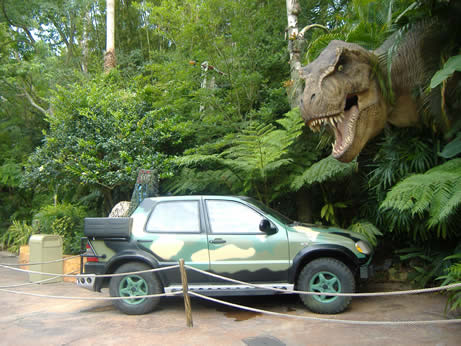
An Australian billionaire reportedly plans to clone a real dinosaur from ancient DNA samples for a “Jurassic Park-style” area at his new theme resort, prompting many around the web to ask, “Has Clive Palmer seen how Jurassic Park ended?”

Palmer, one of Australia’s richest men, has been in “deep discussion” with the same scientists who cloned Dolly the sheep in 1996 to bring his vision to life, reports the Sunshine Coast Daily.

Insiders say that if successful, Palmer will set his dinosaur free to roam around a resort he’s building Coolum, Australia. Other plans for the resort are said to include a 20-storey Sky Needle, a casino, and a giant London Eye-style Ferris wheel.

It may sound like an elaborate ruse, but Palmer is the mind (and pocketbook) behind a number of outlandish projects announced in the past.

In April the mining tycoon announced plans to build a fully functional replica of the RMS Titanic, which he says will be ready to set sail by 2016.

Rumours persist that he is also planning to build sky rail to Mount Coolum.

Palmer hasn’t publicly addressed the Jurassic Park rumours, but has scheduled a press conference in Brisbane on Friday.

Excitement and skepticism about the project could be found in equal measure online Thursday afternoon.

“Because some insanely rich people are still decent human beings, Australian 5x billionaire Clive Palmer (the same guy building a replica of the Titanic) wants to clone a dinosaur and let it loose on his property as a sort of ultra-casual Jurassic Park,” writes Geekolgie. “I know where I want to go for my next birthday.”

Extreme Tech’s Ryan Whitwan warns dinosaur lovers not to get their hopes up.

“Assuming that a benevolent billionaire had magical, perfect dinosaur DNA, we don’t even have the living cells we’d need to birth a dinosaur,” he explains. “It’s not a question of technology, or of funding… We’re never going to return dinosaurs or any other ancient creature to Earth because their genes are long gone.”

http://www.cbc.ca/news/yourcommunity/2012/08/billionaire-plans-to-build-real-life-jurassic-park.html


Texas man texts about danger of texting while driving just before he plunges off cliff

A college student from Texas believes he is lucky to be alive after a terrible crash. He was texting and driving when his truck flew off of a cliff.

Chance Bothe’s truck plunged off of a bridge and into a ravine. One of the last things he typed indicated what almost happened to him.

He wrote, “I need to quit texting, because I could die in a car accident.”

After the crash, Chance had a broken neck, a crushed face, a fractured skull, and traumatic brain injuries. Doctors had to bring him back to life three times . Now, 6 months later, he’s finally able to talk about what happened.

“They just need to understand, don’t do it. Don’t do it. It’s not worth losing your life,” he said. “I went to my grandmother’s funeral not long ago, and I kept thinking, it kept jumping into my head, I’m surprised that’s not me up in that casket. I came very close to that, to being gone forever.”

Chance’s father said, if he had a child just learning to drive, he would disable texting and Internet on their phone.

As of August 1st, drivers in Alabama will face a $25 fine the first time they are caught texting behind the wheel.

NASA scientist links recent extreme hot weather to climate change

What do the 2010 heat wave in Russia, last year’s Texas drought, and the 2003 heat wave in Europe have in common?

All are examples of extreme weather caused by climate change, according to a new study from NASA scientist James Hansen.

“This is not a climate model or a prediction but actual observations of weather events and temperatures that have happened,” he wrote in a Washington Post opinion piece meant to accompany the study.

“Our analysis shows that it is no longer enough to say that global warming will increase the likelihood of extreme weather and to repeat the caveat that no individual weather event can be directly linked to climate change. To the contrary, our analysis shows that, for the extreme hot weather of the recent past, there is virtually no explanation other than climate change.”

The study, which was published by the Proceedings of the National Academy of Sciences, looks at the past six decades of global temperatures and finds what Hansen described as a “stunning” rise in the frequency of extremely hot summers.

It compared what is happening now to what was happening between 1951-1980. In those years, extremely hot temperatures covered less than 0.2% of the planet. Now, those temperatures cover about 10% of the land area, the study said.

It dismissed the idea that specific weather patterns are by themselves sufficient to explain today’s extreme anomalies. Phenomena like La Nina have always been around, but large areas of extreme warming have only come about with climate change, the study said.

“The odds that natural variability created these extremes are minuscule, vanishingly small. To count on those odds would be like quitting your job and playing the lottery every morning to pay the bills,” wrote Hansen.

Hansen directs research at the NASA Goddard Institute for Space Studies in New York and is a longtime environmental activist.

http://www.cnn.com/2012/08/05/us/climate-change/index.html?hpt=hp_t2

Berkeley Laser Fires Pulses Hundreds of Times More Powerful Than All the World’s Electric Plants Combined

Blink and you’ll miss it. Don’t blink, and you’ll still miss it.

Imagine a device capable of delivering more power than all of the world’s electric plants. But this is not a prop for the next James Bond movie. A new laser at Lawrence Berkeley National Laboratory was put through its paces July 20, delivering pulses with a petawatt of power once per second. A petawatt is 1015 watts, or 1,000,000,000,000,000 watts—about 400 times as much as the combined instantaneous output of all the world’s electric plants.

How is that even possible? Well, the pulses at the Berkeley Lab Laser Accelerator (BELLA) are both exceedingly powerful and exceedingly short. Each petawatt burst lasts just 40 femtoseconds, or 0.00000000000004 second. Since it fires just one brief pulse per second, the laser’s average power is only about 40 watts—the same as an incandescent bulb in a reading lamp.

BELLA’s laser is not the first to pack so much power—a laser at Lawrence Livermore National Laboratory, just an hour’s drive inland from Berkeley, reached 1.25 petawatts in the 1990s. And the University of Texas at Austin has its own high-power laser, which hit the 1.1-petawatt mark in 2008. But the Berkeley laser is the first to deliver petawatt pulses with such frequency, the lab says. At full power, for comparison, the Texas Petawatt Laser can fire one shot per hour.

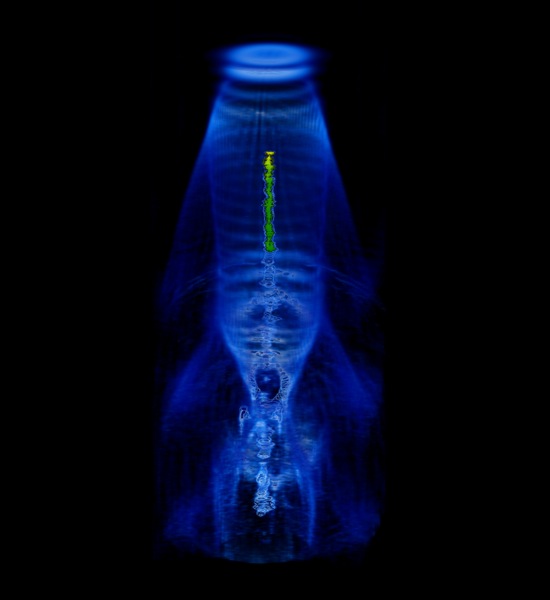
The Department of Energy plans to use the powerful laser to drive a very compact particle accelerator via a process called laser wakefield acceleration, boosting electrons to high energies for use in colliders or for imaging or medical applications. Electron beams are already in use to produce bright pulses of x-rays for high-speed imaging. An intense laser pulse can ionize the atoms in a gas, separating electrons from protons to produce a plasma. And laser-carved waves in the plasma [blue in image above] sweep up electrons [green], accelerating them outward at nearly the speed of light.

BELLA director Wim Leemans says that the project’s first experiments will seek to accelerate beams of electrons to energies of 10 billion electron-volts (or 10 GeV) by firing the laser through a plasma-based apparatus about one meter long. The laser apparatus itself is quite a bit larger, filling a good-size room. For comparison, the recently repurposed Stanford Linear Accelerator Center produced electron beams of 50 GeV from an accelerator 3.2 kilometers in length.

http://blogs.scientificamerican.com/observations/2012/08/01/berkeley-laser-fires-pulses-hundreds-of-times-more-powerful-than-all-the-worlds-electric-plants-combined/

Thanks to Ray Gaudette for bringing this to the attention of the It’s Interesting community.

German town designates men-only parking spaces


The mayor of the Black Forest town of Triberg says women would find it difficult to park there because drivers need to back in diagonally without hitting a pillar and a wall.

Gallus Strobel noted that 12 places in the 220-capacity car park are reserved for women. Many German cities designate a small number of parking spaces, usually near exits, for women concerned about their personal safety in poorly-lit garages.

Strobel told The Associated Press that he had received overwhelmingly positive reactions from men who feel discriminated against by “women only” parking.

But the Triberg mayor says some “humorless people” had criticized the move.


Ontario woman discovers 80,000 bees in her ceiling

A homeowner in southern Ontario says she knew she had a “sweet mess” on her  hands when a crack in the ceiling started oozing honey.

Loretta Yates soon discovered the 1 1/2-storey house she shares with her  husband and 22-month-old son was also home to about 80,000 bees nesting in the  first-floor ceiling.

She says her insurance company wouldn’t cover the damage to her house in  Varney, just outside Mount Forest, and a pest control company couldn’t promise  to get the bugs out for good.

That’s when she called beekeeper David Schuit, who took down the ceiling and  scraped the honeycomb loose, catching at least one queen bee and recovering more  than 100 kilograms of honey.

Schuit says there was so much dripping down in the kitchen, a lightbulb blew  because it was half-full of honey.

Bees and wasps have been nesting in the house for about four years, says  Yates, but she never realized there were so many.

“I guess with the cracked ceiling in the kitchen and the honey dripping on me — that was (the) time to get help,” she said Monday.

It’s expected some of the honey will be made into candles.

Read more: http://www.theprovince.com/technology/Honey+oozing+from+ceiling+leads+discovery+bees+inside+Ontario+home/7013333/story.html#ixzz22Olc7qQV

Digital pills enter the marketplace


Digestible microchips embedded in drugs may soon tell doctors whether a patient is taking their medications as prescribed. These sensors are the first ingestible devices approved by the US Food and Drug Administration (FDA). To some, they signify the beginning of an era in digital medicine.

“About half of all people don’t take medications like they’re supposed to,” says Eric Topol, director of the Scripps Translational Science Institute in La Jolla,California. “This device could be a solution to that problem, so that doctors can know when to rev up a patient’s medication adherence.” Topol is not affiliated with the company that manufactures the device, Proteus Digital Health in Redwood City,California, but he embraces the sensor’s futuristic appeal, saying, “It’s like big brother watching you take your medicine.”

The sand-particle sized sensor consists of a minute silicon chip containing trace amounts of magnesium and copper. When swallowed, it generates a slight voltage in response to digestive juices, which conveys a signal to the surface of a person’s skin where a patch then relays the information to a mobile phone belonging to a healthcare-provider.

Currently, the FDA, and the analogous regulatory agency in Europe have only approved the device based on studies showing its safety and efficacy when implanted in placebo pills. But Proteus hopes to have the device approved within other drugs in the near future. Medicines that must be taken for years, such as those for drug resistant tuberculosis, diabetes, and for the elderly with chronic diseases, are top candidates, says George Savage, co-founder and chief medical officer at the company.

“The point is not for doctors to castigate people, but to understand how people are responding to their treatments,” Savage says. “This way doctors can prescribe a different dose or a different medicine if they learn that it’s not being taken appropriately.”

Proponents of digital medical devices predict that they will provide alternatives to doctor visits, blood tests, MRIs and CAT scans. Other gadgets in the pipeline include implantable devices that wirelessly inject drugs at pre-specified times, and sensors that deliver a person’s electrocardiogram to their smartphone.

In his book published in January, The Creative Destruction of Medicine, Topol says that the 2010s will be known as the era of digital medical devices. “There are so many of these new technologies coming along,” Topol says, “it’s going to be a new frontier for rendering care.”

Thanks to Kedmobee for bringing this to the attention of the It’s Interesting community.

http://blogs.nature.com/news/2012/07/digital-pills-make-their-way-to-market.html

NASA says that Enceladus, Saturn’s largest moon, is a good bet for alien life in our solar system


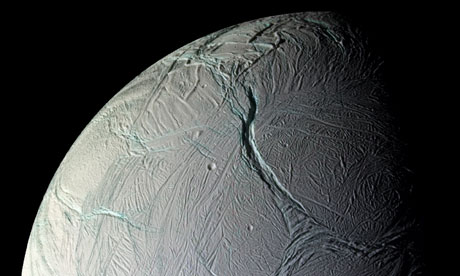
Enceladus is little bigger than a lump of rock and has appeared, until recently, as a mere pinprick of light in astronomers’ telescopes. Yet Saturn‘s tiny moon has suddenly become a major attraction for scientists. Many now believe it offers the best hope we have of discovering life on another world inside our solar system.

The idea that a moon a mere 310 miles in diameter, orbiting in deep, cold space,   1bn miles from the sun, could provide a home for alien lifeforms may seem extraordinary. Nevertheless, a growing number of researchers consider this is a real prospect and argue that Enceladus should be rated a top priority for future space missions.

This point is endorsed by astrobiologist Professor Charles Cockell of Edinburgh University. “If someone gave me several billion dollars to build whatever space probe I wanted, I would have no hesitation,” he says. “I would construct one that could fly to Saturn and collect samples from Enceladus. I would go there rather than Mars or the icy moons of Jupiter, such as Europa, despite encouraging signs that they could support life. Primitive, bacteria-like lifeforms may indeed exist on these worlds but they are probably buried deep below their surfaces and will be difficult to access. On Enceladus, if there are lifeforms, they will be easy to pick up. They will be pouring into space.”

The cause of this unexpected interest in Enceladus – first observed by William Herschel in 1789 and named after one of the children of the Earth goddess Gaia – stems from a discovery made by the robot spacecraft Cassini, which has been in orbit of Saturn for the past eight years. The $3bn probe has shown that the little moon not only has an atmosphere, but that geysers of water are erupting from its surface into space. Even more astonishing has been its most recent discovery, which has shown that these geysers contain complex organic compounds, including propane, ethane, and acetylene.

“It just about ticks every box you have when it comes to looking for life on another world,” says Nasa astrobiologist Chris McKay. “It has got liquid water, organic material and a source of heat. It is hard to think of anything more enticing short of receiving a radio signal from aliens on Enceladus telling us to come and get them.”

Cassini’s observations suggest Enceladus possesses a subterranean ocean that is kept liquid by the moon’s internal heat. “We are not sure where that energy is coming from,” McKay admits. “The source is producing around 16 gigawatts of power and looks very like the geothermal energy sources we have on Earth – like the deep vents we  see in our ocean beds and which bubble up hot gases.”

At the moon’s south pole, Enceladus’s underground ocean appears to rise close to the surface. At a few sites, cracks have developed and water is bubbling to the surface before being vented into space, along with complex organic chemicals that also appear to have built up in its sea.

Equally remarkable is the impact of this water on Saturn. The planet is famed for its complex system of rings, made of bands of small particles in orbit round the planet. There are seven main rings: A, B, C, D, E, F and G, and the giant E-ring is linked directly with Enceladus. The water the moon vents into space turns into ice crystals and these feed the planet’s E-ring. “If you turned off the geysers of Enceladus, the great E-ring of Saturn would disappear within a few years,” says McKay. “For a little moon, Enceladus has quite an impact.”

Yet the discovery of Enceladus’s strange geology was a fairly tentative affair, says Professor Michele Dougherty of Imperial College London. She was the principal investigator for Cassini’s magnetometer instrument. “Cassini had been in orbit round Saturn for more than six months when it passed relatively close to Enceladus. Our results indicated that Saturn’s magnetic field was being dragged round Enceladus in a way that suggested it had an atmosphere.”

So Dougherty and her colleagues asked the Cassini management to direct the probe to take a much closer look. This was agreed and in July 2005 Cassini moved in for a close-up study. “I didn’t sleep for two nights before that,” says Dougherty. “If Cassini found nothing we would have looked stupid and the management team might not have listened to us again.”

Her fears were groundless. Cassini swept over Enceladus at a height of 173km and showed that it did indeed possess an atmosphere, albeit a thin one consisting of water vapour, carbon dioxide, methane and nitrogen. “It was wonderful,” says Dougherty. “I just thought: wow!”

Subsequent sweeps over the moon then revealed those plumes of water. The only other body in the solar system, apart from Earth, possessing liquid water on its surface had  been revealed. Finally came the discovery of organics, and the little moon went from being merely an interesting world to one that was utterly fascinating.

“Those plumes do not represent a torrent,” cautions McKay. “This is not the Mississippi pouring into space. The output is roughly equivalent to that of the Old Faithful geyser in Yellowstone national park. On the other hand, it would be enough to create a river that you could kayak down.

“The fact that this water is being vented into space and is mixed with organic material is truly remarkable, however. It is an open invitation to go there. The place may as well have a big sign hanging over it saying: ‘Free sample: take one now’.”

Collecting that sample will not be easy, however. At a distance of 1bn miles, Saturn and its moons are a difficult target. Cassini took almost seven years to get there after its launch from Cape Canaveral in  1997.

“A mission to Enceladus would take a similar time,” says McKay. Once there, several years would be needed to make several sweeps over Enceladus to collect samples of water and organics. “Then we would need a further seven years to get those samples back to Earth.”

Such a mission would therefore involve almost 20 years of space flight – on top of the decade needed to plan it and to construct and launch the probe. “That’s 30 years in all, a large chunk of any scientist’s professional life,” says McKay.

McKay and a group of other Nasa scientists based at the Jet Propulsion Laboratory in Pasadena are undaunted, however. They are now finalising plans for an Enceladus Sample Return mission, which would involve putting a probe in orbit round Saturn. It would then use the gravity of the planet’s biggest moon, Titan, to make sweeps over Enceladus. Plume samples would then be stored in a canister that would eventually be fired back to Earth on a seven-year return journey.

Crucially, McKay and his colleagues believe such a mission could be carried out at a relatively modest cost – as part of Nasa’s Discovery programme, which funds low-budget missions to explore the solar system. Previous probes have included Lunar Prospector, which studied the moon’s geology; Stardust, which returned a sample of material scooped from a comet’s tail; and Mars Pathfinder, which deployed a tiny motorised robot vehicle on the Red Planet in 1997.

“The criteria for inclusion in the Discovery programme demand that any mission must cost less than $500m, though that does not include the price of launch,” says McKay. “We think we can adapt the technology that was developed on the Stardust mission to build an Enceladus Sample Return. If so, we can keep the cost below $500m. We are finalising plans and will announce our proposals in autumn.”

Such a mission is backed by Dougherty. “I think Enceladus is one of the best bets we now have for finding life on another world in our solar system. It is certainly worth visiting but it is not the only hope we have. The icy moons of Jupiter – such as Ganymede, Callisto and Europa – still look a very good prospect as well.”

And there is one problematic issue concerning Enceladus: time. “Conditions for life there are good at present but we do not know how long they have been in existence,” says McKay. “They might be recent or ancient. For life to have evolved, we need the latter to have been the case. At present, we have no idea about their duration, though geologists I have spoken to suggest that water and organics may have been there for a good while. The only way we will find out is to go there.”

The late entry of Enceladus in the race to find extraterrestrial life adds an intriguing new destination for astrobiologists in their hunt for aliens. Before its geysers were discovered, two main targets dominated their research: Mars and the icy moons of Jupiter. The former is the easiest to get to and has already received visits from dozens of probes. On 6 August, the $2.5bn robot rover Curiosity is set to land there and continue the hunt for life on the Red Planet. “For life to evolve you need liquid water, and although it is clear it once flowed on Mars, its continued existence there is debatable,” says Cockell. “By contrast, you can see water pouring off Enceladus along with those organics.”

Many scientists argue that water could exist deep below the Martian surface, supporting bacteria-like lifeforms. However, these reservoirs could be many metres, if not kilometres, below Mars’s surface and it could take decades to find them. Similarly, the oceans under the thick ice that covers Europa – and two other moons of Jupiter, Ganymede and Callisto – could also support life. But again, it will be extremely difficult for a robot probe to drill through the kilometres of ice that cover the oceans of these worlds.

Enceladus, by these standards, is an easy destination – but a distant one that will take a long time to reach. “No matter where we look, it appears it will take two or three decades to get answers to our questions about the existence of life on other worlds in the solar system,” says Cockell. “By that time, telescopes may have spotted signs of life on planets elsewhere in the galaxy. Our studies of extra-solar planets are getting more sophisticated, after all, and one day we may spot the presence of oxygen and water in our spectrographic studies of these distant worlds – an unambiguous indication that living entities exist there.

However, telescopic studies of extra-solar planets won’t reveal the nature of those lifeforms. Only by taking samples from planets in our solar system and returning them to laboratories on Earth, where we can study them, will we be able to reveal their exact nature and mode of replication – if they exist, of course. The little world of Enceladus could then have a lot to teach us.

http://www.guardian.co.uk/science/2012/jul/29/alien-life-enceladus-saturn-moon

Fei Lin’s penis stolen by thieves


The 41-year old Fei Lin told police that he was sleeping when thieves burst into his room and put a bag over his head: “They put something over my head and pulled down my trousers and then they ran off,” Lin said. “I was so shocked I didn’t feel a thing—then I saw I was bleeding and my penis was gone.”

While nobody has been apprehended yet, a report in the Austrian Times stated that police believe the assailants were jealous or slighted lovers of several local women whom Lin was involved with romantically or sexually. Lin, for his part, denied taking part in any infidelity.

TNT Magazine claims that emergency workers and police conducted a search for Lin’s anatomy but were unable to find the missing penis. The thieves have not yet been located, but police said they were beginning a search for the men and their female lovers.

http://www.ibtimes.com/articles/367155/20120726/fei-lin-s-penis-stolen-man-china.htm

Thanks to Dr. Nakamura for bringing this to the attention of the It’s Interesting community.