
Multi-Tasking Humpback Whales Sing While Feeding, Not Just Breeding

Humpback whales are famed for their songs, most often heard in breeding season when males are competing to mate with females. In recent years, however, reports of whale songs occurring outside traditional breeding grounds have become more common. A new study may help explain why.
Humpbacks sing for their supper — or at least, they sing while they hunt for it.
The research, published December 19 in PLoS ONE, uncovers the whales’ little-understood acoustic behavior while foraging.
It also reveals a previously unknown behavioral flexibility on their part that allows the endangered marine mammals to balance their need to feed continuously with the competing need to exhibit mating behaviors such as song displays.
“They need to feed. They need to breed. So essentially, they multi-task,” said study co-author Ari S. Friedlaender, research scientist at Duke University’s Nicholas School of the Environment. “This suggests the widely held behavioral dichotomy of breeding-versus-feeding for this species is too simplistic.”
Researchers from the U.S. Naval Postgraduate School, the University of California-Santa Barbara and Duke tracked 10 humpback whales in coastal waters along the Western Antarctic Peninsula in May and June 2010. The peninsula’s bays and fjords are important late-season feeding grounds where humpbacks feast on krill each austral autumn before migrating to warm-water calving grounds thousands of miles away.
Using non-invasive multi-sensor tags that attach to the whales with suction cups, the researchers recorded the whales’ underwater movements and vocalizations as they foraged.
All 10 of the tags picked up the sounds of background songs, and in two cases, they recorded intense and continuous whale singing with a level of organization and structure approaching that of a typical breeding-ground mating display. The song bouts sometimes lasted close to an hour and in one case occurred even while sensors indicated the whale, or a close companion, was diving and lunging for food.
Humpbacks sing most frequently during breeding season, but are known to sing on other occasions too, such as while escorting mother-calf pairs along migratory routes. Though the reasons they sing are still not thoroughly understood, one distinction is clear: Songs sung in breeding grounds are quite different in duration, phrase type and theme structure from those heard at other locations and times.
“The fact that we heard mating displays being sung in late-season foraging grounds off the coast of Antarctica suggests humpback whale behavior may be more closely tied to the time of year than to physical locations. This may signify an ability to engage in breeding activities outside their traditional warm-water breeding grounds,” said Douglas P. Nowacek, Repass-Rogers University Associate Professor of Conservation Technology at Duke’s Nicholas School.
As the region’s climate warms, sea ice cover around the Western Antarctic Peninsula has thinned in recent years and the water stays open later in the foraging season, he explained. Whales are remaining there longer into austral autumn to feast on krill instead of heading off to warm-water breeding grounds, as many scientists previously believed.
“Mating may now be taking place at higher latitudes,” Nowacek said. “This merits further study.”
Alison K. Stimpert, research associate in oceanography at the Naval Postgraduate School, was lead author of the new study. Lindsey E. Peavey, a PhD Student at the University of California at Santa Barbara’s Bren School of Environmental Science and Management, co-authored it with Stimpert, Friedlaender and Nowacek.
Journal Reference:
1.Stimpert AK, Peavey LE, Friedlaender AS, Nowacek DP. Humpback Whale Song and Foraging Behavior on an Antarctic Feeding Ground. PLoS One, 2012 DOI: 10.1371/journal.pone.0051214
http://www.sciencedaily.com/releases/2012/12/121219174156.htm
Scientists Construct First Detailed Map of How the Brain Organizes Everything We See

Our eyes may be our window to the world, but how do we make sense of the thousands of images that flood our retinas each day? Scientists at the University of California, Berkeley, have found that the brain is wired to put in order all the categories of objects and actions that we see. They have created the first interactive map of how the brain organizes these groupings.
The result — achieved through computational models of brain imaging data collected while the subjects watched hours of movie clips — is what researchers call “a continuous semantic space.”
“Our methods open a door that will quickly lead to a more complete and detailed understanding of how the brain is organized. Already, our online brain viewer appears to provide the most detailed look ever at the visual function and organization of a single human brain,” said Alexander Huth, a doctoral student in neuroscience at UC Berkeley and lead author of the study published Dec. 19 in the journal Neuron.
A clearer understanding of how the brain organizes visual input can help with the medical diagnosis and treatment of brain disorders. These findings may also be used to create brain-machine interfaces, particularly for facial and other image recognition systems. Among other things, they could improve a grocery store self-checkout system’s ability to recognize different kinds of merchandise.
“Our discovery suggests that brain scans could soon be used to label an image that someone is seeing, and may also help teach computers how to better recognize images,” said Huth.
It has long been thought that each category of object or action humans see — people, animals, vehicles, household appliances and movements — is represented in a separate region of the visual cortex. In this latest study, UC Berkeley researchers found that these categories are actually represented in highly organized, overlapping maps that cover as much as 20 percent of the brain, including the somatosensory and frontal cortices.
To conduct the experiment, the brain activity of five researchers was recorded via functional Magnetic Resonance Imaging (fMRI) as they each watched two hours of movie clips. The brain scans simultaneously measured blood flow in thousands of locations across the brain.
Researchers then used regularized linear regression analysis, which finds correlations in data, to build a model showing how each of the roughly 30,000 locations in the cortex responded to each of the 1,700 categories of objects and actions seen in the movie clips. Next, they used principal components analysis, a statistical method that can summarize large data sets, to find the “semantic space” that was common to all the study subjects.
The results are presented in multicolored, multidimensional maps showing the more than 1,700 visual categories and their relationships to one another. Categories that activate the same brain areas have similar colors. For example, humans are green, animals are yellow, vehicles are pink and violet and buildings are blue.
“Using the semantic space as a visualization tool, we immediately saw that categories are represented in these incredibly intricate maps that cover much more of the brain than we expected,” Huth said.
Other co-authors of the study are UC Berkeley neuroscientists Shinji Nishimoto, An T. Vu and Jack Gallant.
Journal Reference:
1.Alexander G. Huth, Shinji Nishimoto, An T. Vu, Jack L. Gallant. A Continuous Semantic Space Describes the Representation of Thousands of Object and Action Categories across the Human Brain. Neuron, 2012; 76 (6): 1210 DOI: 10.1016/j.neuron.2012.10.014
http://www.sciencedaily.com/releases/2012/12/121219142257.htm
Mike Hayes will harvest his grapes in the nude


ECCENTRIC Queensland winemaker Mike Hayes will harvest some of his grapes in the nude during a full moon to revive an ancient winemaking ritual.
Mr Hayes, 48, from Symphony Hill Wines on the Granite Belt, said he was studying 4000-year-old winemaking techniques as part of a Churchill Fellowship.
He said the first records of naked harvesting and naked crushing of the fruit with bare feet came from Georgia, an independent state of the former Soviet Union and the birthplace of winemaking.
“I don’t know if it will work, but I’m certainly going to give it a shot,” he said. “The ancients believed the moon drew energy from the grapes and goodness from the soil – just as the moon pulls the tides.”
“I know some people will think I am mad with a double D.”
“However, many cultures study the lunar cycles and engage in all kinds of mystical rites before harvest.”
Hayes says there is a certain logic to bare-cheek winemaking.
“Clothing made from animal hides would no doubt contain bacteria that would taint the winemaking process.”
He said the bible also records Noah running naked through a vineyard.
Hayes will begin by harvesting gewurztraminer, an aromatic white variety in March, and follow up in April with a nude harvest of his nebbiolo, the Italian red blockbuster.
For added authenticity Hayes will allow the juice to ferment slowly in clay amphopra pots he will bury underground.
“There will be no preservatives or additives whatsoever.”
Mr Hayes has bagged a haul of gold medals and Symphony Hill was this year upgraded to a five-star winery by Australian wine guru James Halliday.
Hayes recently completed his masters of winemaking in alternative grape varieties.
He trialled 60 different rare grape varieties.
As part of his Churchill Fellowship he will travel to Italy, Spain, Portugal and France to study so-called autochthonous grape varieties, those “sprung from the earth” or indigenous to a region.
Bullying by Childhood Peers Leaves a Trace That Can Change the Expression of a Gene Linked to Mood

A recent study by a researcher at the Centre for Studies on Human Stress (CSHS) at the Hôpital Louis-H. Lafontaine and professor at the Université de Montréal suggests that bullying by peers changes the structure surrounding a gene involved in regulating mood, making victims more vulnerable to mental health problems as they age.
The study published in the journal Psychological Medicine seeks to better understand the mechanisms that explain how difficult experiences disrupt our response to stressful situations. “Many people think that our genes are immutable; however this study suggests that environment, even the social environment, can affect their functioning. This is particularly the case for victimization experiences in childhood, which change not only our stress response but also the functioning of genes involved in mood regulation,” says Isabelle Ouellet-Morin, lead author of the study.
A previous study by Ouellet-Morin, conducted at the Institute of Psychiatry in London (UK), showed that bullied children secrete less cortisol — the stress hormone — but had more problems with social interaction and aggressive behaviour. The present study indicates that the reduction of cortisol, which occurs around the age of 12, is preceded two years earlier by a change in the structure surrounding a gene (SERT) that regulates serotonin, a neurotransmitter involved in mood regulation and depression.
To achieve these results, 28 pairs of identical twins with a mean age of 10 years were analyzed separately according to their experiences of bullying by peers: one twin had been bullied at school while the other had not. “Since they were identical twins living in the same conditions, changes in the chemical structure surrounding the gene cannot be explained by genetics or family environment. Our results suggest that victimization experiences are the source of these changes,” says Ouellet-Morin. According to the author, it would now be worthwhile to evaluate the possibility of reversing these psychological effects, in particular, through interventions at school and support for victims.
Journal Reference:
1.I. Ouellet-Morin, C. C. Y. Wong, A. Danese, C. M. Pariante, A. S. Papadopoulos, J. Mill, L. Arseneault. Increased serotonin transporter gene (SERT) DNA methylation is associated with bullying victimization and blunted cortisol response to stress in childhood: a longitudinal study of discordant monozygotic twins. Psychological Medicine, 2012; DOI: 10.1017/S0033291712002784
http://www.sciencedaily.com/releases/2012/12/121218081615.htm
Shot Away from Its Companion, Giant Star Makes Waves: Spitzer Captures Infrared Portrait

Like a ship plowing through still waters, the giant star Zeta Ophiuchi is speeding through space, making waves in the dust ahead. NASA’s Spitzer Space Telescope has captured a dramatic, infrared portrait of these glowing waves, also known as a bow shock.
Astronomers theorize that this star was once sitting pretty next to a companion star even heftier than itself. But when that star died in a fiery explosion, Zeta Ophiuchi was kicked away and sent flying. Zeta Ophiuchi, which is 20 times more massive and 80,000 times brighter than our sun, is racing along at about 54,000 mph (24 kilometers per second).
In this view, infrared light that we can’t see with our eyes has been assigned visible colors. Zeta Ophiuchi appears as the bright blue star at center. As it charges through the dust, which appears green, fierce stellar winds push the material into waves. Where the waves are the most compressed, and the warmest, they appear red. This bow shock is analogous to the ripples that precede the bow of a ship as it moves through the water, or the pileup of air ahead of a supersonic airplane that results in a sonic boom.
NASA’s Wide-field Infrared Survey Explorer, or WISE, released a similar picture of the same object in 2011. WISE sees infrared light as does Spitzer, but WISE was an all-sky survey designed to take snapshots of the entire sky. Spitzer, by contrast, observes less of the sky, but in more detail. The WISE image can be seen at: http://www.jpl.nasa.gov/news/news.php?release=2011-026 .
NASA’s Jet Propulsion Laboratory, Pasadena, Calif., manages the Spitzer Space Telescope mission for NASA’s Science Mission Directorate, Washington. Science operations are conducted at the Spitzer Science Center at the California Institute of Technology in Pasadena. Data are archived at the Infrared Science Archive housed at the Infrared Processing and Analysis Center at Caltech. Caltech manages JPL for NASA. For more information about Spitzer, visit: http://spitzer.caltech.edu and http://www.nasa.gov/spitzer .
http://www.sciencedaily.com/releases/2012/12/121218153330.htm
Indian man has been perched in tree for nine months, waiting for his wife to apologize for her infidelity

A man in India has been hiding up a tree for the past nine months waiting for his unfaithful wife to apologise. It all started when the man, known simply as Sanjay, caught his wife in an overly familiar position with the next door neighbour in their flat in Mumbai.
Sanjay promptly returned back with his wife to their home village so they could reconcile their differences, but in March when she insisted on returning to Mumbai, Sanjay threw an almighty hissy fit, climbing up a guava tree and not coming down.
Sanjay eats, sleeps and even relieves himself from the top of the tree. He says he will climb down only when his wife apologises to him for her infidelity.
Sanjay’s family members have made several attempts to bring his wife Tara back but she is unrelenting.
“He climbed on to this tree on March 9 and has remained there ever since. Whenever we try to bring him down, he threatens to commit suicide. He eats and sleeps on the tree and even relives himself from there. We keep going to him and asking him if he needs anything,” says Kushma Devi, Sanjay’s mother.
The local villagers claim that Sanjay, sometimes, climbs down from the tree and takes a stroll but climbs back again when he sees someone coming towards him.
Seeing his determination, the villagers have not yet informed the police. “We apprehend that he may harm himself if we seek outside help. As long as he is safe there, we are happy for him,” says his sister Nisha.
http://www.asianage.com/india/man-remains-perched-tree-march-967
‘Extinct’ whale found: Odd-looking pygmy whale traced back 2 million years
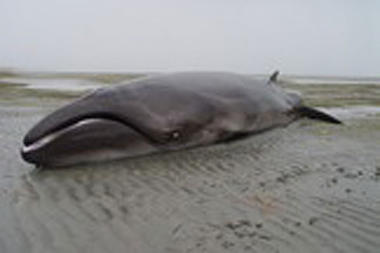
The pygmy right whale, a mysterious and elusive creature that rarely comes to shore, is the last living relative of an ancient group of whales long believed to be extinct, a new study suggests.
The findings, published Tuesday, Dec. 18, in the Proceedings of the Royal Society B, may help to explain why the enigmatic marine mammals look so different from any other living whale.
“The living pygmy right whale is, if you like, a remnant, almost like a living fossil,” said Felix Marx, a paleontologist at the University of Otago in New Zealand. “It’s the last survivor of quite an ancient lineage that until now no one thought was around.”
The relatively diminutive pygmy right whale, which grows to just 21 feet (6.5 meters) long, lives out in the open ocean. The elusive marine mammals inhabit the Southern Hemisphere and have only been spotted at sea a few dozen times. As a result, scientists know almost nothing about the species’ habits or social structure.
The strange creature’s arched, frownlike snout makes it look oddly different from other living whales. DNA analysis suggested pygmy right whales diverged from modern baleen whales such as the blue whale and the humpback whale between 17 million and 25 million years ago. However, the pygmy whales’ snouts suggested they were more closely related to the family of whales that includes the bowhead whale. Yet there were no studies of fossils showing how the pygmy whale had evolved, Marx said.
To understand how the pygmy whale fit into the lineage of whales, Marx and his colleagues carefully analyzed the skull bones and other fossil fragments from pygmy right whales and several other ancient cetaceans.
The pygmy whale’s skull most closely resembled that of an ancient family of whales called cetotheres that were thought to have gone extinct around 2 million years ago, the researchers found. Cetotheres emerged about 15 million years ago and once occupied oceans across the globe.
The findings help explain how pygmy whales evolved and may also help shed light on how these ancient “lost” whales lived. The new information is also a first step in reconstructing the ancient lineage all the way back to the point when all members of this group first diverged, he said.
Thanks to Dr. Lutter for bringing this to the attention of the It’s Interesting community.
Venezuelan Pitcher Plant Uses Wettable Hairs to Make Insects Slip Into Its Deadly Traps

An insect-trapping pitcher plant in Venezuela uses its downward pointing hairs to create a ‘water slide’ on which insects slip to their death, new research reveals. The research was published December 19, in the journal Proceedings of the Royal Society B.
Hairs on plants, called trichomes, are typically used to repel water. However, the Cambridge researchers observed that the hairs on the inside of Heliamphora nutans pitcher plants were highly wettable, prompting them to test whether this phenomenon is related to the trapping of insects.
They found that wetting strongly enhanced the slipperiness of the trap and increased the capture rate for ants almost three-fold — from 29 per cent when dry to 88 per cent when wet. Upon further examination, they found that the wetting affected the insects’ adhesive pads while the directional arrangement of the hairs was effective against the claws.
Dr Ulrike Bauer, lead author of the paper from the University of Cambridge, said: “When the hairs of the plant are wet, the ants’ adhesive pads essentially aquaplane on the surface, making the insects lose grip and slip into the bowl of the pitcher. This is the first time that we have observed hairs being used by plants in this way, as they are typically used to make leaves water repellent.”
They also found that the plant used a wicking method during dryer times to pull moisture from the bowl of the pitcher up to the hairy trapping surface, enabling them to capitalise on this aquaplaning effect even when there is no rain.
Dr Bauer added: “This very neat adaptation might help the plants to maximise their nutrient acquisition.”
The Heliamphora nutans pitcher plant lives on the spectacular table mountains of the Guyana Highlands in Southern Venezuela, between altitudes of 2000-2700m. The pitchers can grow up to 18 cm tall and 7 cm wide and trap mainly ants.
http://www.sciencedaily.com/releases/2012/12/121218203513.htm
 It's Interesting