DNA mugshot: Computer sketch program can reconstruct faces from DNA


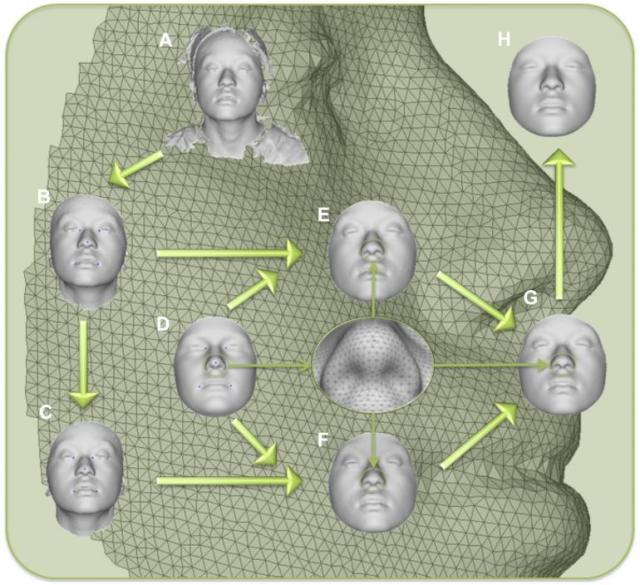
Workflow for 3D face scan processing, including the A) original surface, B) trimmed to exclude non-face parts, C) reflected to make mirror image, D) anthropometric mask of quasi-landmarks, E) remapped, F) reflected remapped, G) symmetrized and H) reconstructed.

By Philip Ross

Could a single hair be used to make an accurate 3D model of a criminal suspect’s face? Researchers from the U.S. and Belgium have developed a computer program that renders a crude genetic “mugshot” from a small sample of DNA.

Forensics can already predict eye and hair color relatively easily. Io9 notes that criminal investigators can even use maggots to extract a victim’s DNA from their unidentifiable body or find hidden faces by zooming into hi-res photos of eyes. But the face is a complex structure that’s more difficult to map from just one DNA sample.

According to New Scientist, researchers used a stereoscopic camera to make 3D images of roughly 600 volunteers with mixed European and West African ancestry. They identified more than 7,000 distinct points on the face to see how sex and racial ancestry affect the position of these points. The variations were used to develop a statistical model that reconstructs the overall shape of a person’s face.

The team also isolated 24 genetic variants, called single nucleotide polymorphisms, which play a role in shaping a face, such as those that shape the head during embryonic development. Lastly, researchers had volunteers rate the 600 faces on perceived ethnicity as well as on a scale of masculinity and femininity.

The new study, published in the journal PLOS Genetics, says this process could allow investigators to make computer-generated mugshots from genetic material left at a crime scene.

“We show that facial variation with regard to sex, ancestry, and genes can be systematically studied with our methods, allowing us to lay the foundation for predictive modeling of faces,” the authors note. “Such predictive modeling could be forensically useful; for example, DNA left at crime scenes could be tested and faces predicted in order to help to narrow the pool of potential suspects. Further, our methods could be used to predict the facial features of descendants, deceased ancestors, and even extinct human species. In addition, these methods could prove to be useful diagnostic tools.”

Any 3D renderings created using the new technology wouldn’t be used in a court of law – any person identified via the DNA mugshots would still have his DNA compared to the crime scene sample – but it could at least narrow the search for a suspected criminal. And there are still a few kinks to work out in the process before the technology is ever used in the field.

“I believe that in five to 10 years’ time, we will be able to computationally predict a face,” Peter Claes of the Catholic University of Leuven in Belgium told New Scientist.

http://www.ibtimes.com/dna-mugshot-how-crime-fighting-computer-sketch-program-can-predict-face-your-genes-1563049

Thanks to Da Brayn for bringing this to the attention of the It’s Interesting community.

Artificial Intelligence Poses Extinction Risk To Humanity Says Oxford University’s Stuart Armstrong

Artificial intelligence poses an “extinction risk” to human civilisation, an Oxford University professor has said.

Almost everything about the development of genuine AI is uncertain, Stuart Armstrong at the Future of Humanity Institute said in an interview with The Next Web.

That includes when we might develop it, how such a thing could come about and what it means for human society.

But without more research and careful study, it’s possible that we could be opening a Pandora’s box. Which is exactly the sort of thing that the Future of Humanity Institute, a multidisciplinary research hub tasked with asking the “big questions” about the future, is concerned with.

“One of the things that makes AI risk scary is that it’s one of the few that is genuinely an extinction risk if it were to go bad. With a lot of other risks, it’s actually surprisingly hard to get to an extinction risk,” Armstrong told The Next Web.

“If AI went bad, and 95% of humans were killed then the remaining 5% would be extinguished soon after. So despite its uncertainty, it has certain features of very bad risks.”

The thing for humanity to fear is not quite the robots of Terminator (“basically just armoured bears”) but a more incorporeal intelligence capable of dominating humanity from within.

The threat of such a powerful computer brain would include near-term (and near total) unemployment, as replacements for virtually all human workers are quickly developed and replicated, but extends beyond that to genuine threats of widespread anti-human violence.

“Take an anti-virus program that’s dedicated to filtering out viruses from incoming emails and wants to achieve the highest success, and is cunning and you make that super-intelligent,” Armstong said.

“Well it will realise that, say, killing everybody is a solution to its problems, because if it kills everyone and shuts down every computer, no more emails will be sent and and as a side effect no viruses will be sent.”

The caveat to all this is that creating AI is difficult, and we’re nowhere near it. The caveat to that is that it could happen far more quickly than anyone would expect, if just one developer came up with a “neat algorithm” that no one else had thought to construct.

Armstrong’s conclusion is simple: let’s think about this now, particularly in relation to employment, and try to adjust society ourselves before the AI adjusts it for us.

http://www.huffingtonpost.co.uk/2014/03/12/extinction-artificial-intelligence-oxford-stuart-armstrong_n_4947082.html

Mathematician Safa Moteshari determines collapse of civilization in NASA-funded study

end

Civilisation is almost inevitably doomed, a Nasa-funded study has found.

Human society is founded on a level of economic and environmental stability which almost certainly cannot be sustained, it said.

The study used simplified models of civilisation designed to experiment with the balance of resources and climate that creates stability – or not – in our world.

These theoretical models – designed to extrapolate from simple principles the future of our industrialised world – ran into almost intractable problems.

Almost any model “closely reflecting the reality of the world today… we find that collapse is difficult to avoid”, the report said.

Mathematician Safa Motesharri begins his report by stating that “the process of rise-and-collapse is actually a recurrent cycle found throughout history” and that this is borne out by maths, as well as historiography.

“The fall of the Roman Empire, and the equally (if not more) advanced Han, Mauryan, and Gupta Empires, as well as so many advanced Mesopotamian Empires, are all testimony to the fact that advanced, sophisticated, complex, and creative civilizations can be both fragile and impermanent.”
His research – funded by Nasa’s Goddard Space Flight Center and published int he Ecological Economics journal – explored the pressures that can lead to a collapse in civilisation.

These criteria include changes in population, climate change and natural disasters. Access to water, agriculture, and energy are also factors.

Motesharri found that problems with each of these is far more damaging when experienced in combination with another. When this occurs the result is often an “economic stratification” and “stretching of resources” which drags at society’s foundations.

Under this highly simplified model, our society appears to be doomed.

In one of his simulations:

“[Ours] appears to be on a sustainable path for quite a long time, but even using an optimal depletion rate and starting with a very small number of Elites, the Elites eventually consume too much, resulting in a famine among Commoners that eventually causes the collapse of society. It is important to note that this Type-L collapse is due to an inequality-induced famine that causes a loss of workers, rather than a collapse of Nature”

He added that elites tend to have a vested interest in sustaining the current model – however doomed – for as long as possible, regardless of the eventual negative outcome:

“While some members of society might raise the alarm that the system is moving towards an impending collapse and therefore advocate structural changes to society in order to avoid it, Elites and their supporters, who opposed making these changes, could point to the long sustainable trajectory ‘so far’ in support of doing nothing.”

There are caveats, of course. The study is a simplified model of society, not a perfect simulation, and it isn’t able to make solid predictions of the future. It’s also worth noting that Motesharri does allow for the possibility that “collapse can be avoided” – though he thinks it will be exceptionally difficult.

Indeed, as the Guardian reports, other studies by the UK Government and KPMG have also warned of a “perfect storm” of energy scarcity and economy fragility coming within a few decades, which lends weight to his conclusion.

http://www.huffingtonpost.co.uk/2014/03/17/civilisation-doomed_n_4977387.html

Mild electric current to the brain can improve math skills

MATH

In a lab in Oxford University’s experimental psychology department, researcher Roi Cohen Kadosh is testing an intriguing treatment: He is sending low-dose electric current through the brains of adults and children as young as 8 to make them better at math.

A relatively new brain-stimulation technique called transcranial electrical stimulation may help people learn and improve their understanding of math concepts.

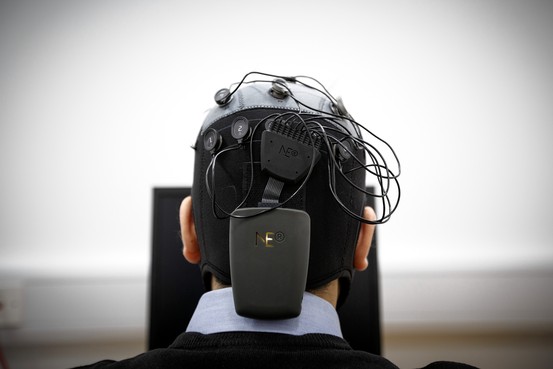
The electrodes are placed in a tightly fitted cap and worn around the head. The device, run off a 9-volt battery commonly used in smoke detectors, induces only a gentle current and can be targeted to specific areas of the brain or applied generally. The mild current reduces the risk of side effects, which has opened up possibilities about using it, even in individuals without a disorder, as a general cognitive enhancer. Scientists also are investigating its use to treat mood disorders and other conditions.

Dr. Cohen Kadosh’s pioneering work on learning enhancement and brain stimulation is one example of the long journey faced by scientists studying brain-stimulation and cognitive-stimulation techniques. Like other researchers in the community, he has dealt with public concerns about safety and side effects, plus skepticism from other scientists about whether these findings would hold in the wider population.

There are also ethical questions about the technique. If it truly works to enhance cognitive performance, should it be accessible to anyone who can afford to buy the device—which already is available for sale in the U.S.? Should parents be able to perform such stimulation on their kids without monitoring?

“It’s early days but that hasn’t stopped some companies from selling the device and marketing it as a learning tool,” Dr. Cohen Kadosh says. “Be very careful.”

The idea of using electric current to treat the brain of various diseases has a long and fraught history, perhaps most notably with what was called electroshock therapy, developed in 1938 to treat severe mental illness and often portrayed as a medieval treatment that rendered people zombielike in movies such as “One Flew over the Cuckoo’s Nest.”

Electroconvulsive therapy has improved dramatically over the years and is considered appropriate for use against types of major depression that don’t respond to other treatments, as well as other related, severe mood states.

A number of new brain-stimulation techniques have been developed, including deep brain stimulation, which acts like a pacemaker for the brain. With DBS, electrodes are implanted into the brain and, though a battery pack in the chest, stimulate neurons continuously. DBS devices have been approved by U.S. regulators to treat tremors in Parkinson’s disease and continue to be studied as possible treatments for chronic pain and obsessive-compulsive disorder.

Transcranial electrical stimulation, or tES, is one of the newest brain stimulation techniques. Unlike DBS, it is noninvasive.

If the technique continues to show promise, “this type of method may have a chance to be the new drug of the 21st century,” says Dr. Cohen Kadosh.

The 37-year-old father of two completed graduate school at Ben-Gurion University in Israel before coming to London to do postdoctoral work with Vincent Walsh at University College London. Now, sitting in a small, tidy office with a model brain on a shelf, the senior research fellow at Oxford speaks with cautious enthusiasm about brain stimulation and its potential to help children with math difficulties.

Up to 6% of the population is estimated to have a math-learning disability called developmental dyscalculia, similar to dyslexia but with numerals instead of letters. Many more people say they find math difficult. People with developmental dyscalculia also may have trouble with daily tasks, such as remembering phone numbers and understanding bills.

Whether transcranial electrical stimulation proves to be a useful cognitive enhancer remains to be seen. Dr. Cohen Kadosh first thought about the possibility as a university student in Israel, where he conducted an experiment using transcranial magnetic stimulation, a tool that employs magnetic coils to induce a more powerful electrical current.

He found that he could temporarily turn off regions of the brain known to be important for cognitive skills. When the parietal lobe of the brain was stimulated using that technique, he found that the basic arithmetic skills of doctoral students who were normally very good with numbers were reduced to a level similar to those with developmental dyscalculia.

That led to his next inquiry: If current could turn off regions of the brain making people temporarily math-challenged, could a different type of stimulation improve math performance? Cognitive training helps to some extent in some individuals with math difficulties. Dr. Cohen Kadosh wondered if such learning could be improved if the brain was stimulated at the same time.

But transcranial magnetic stimulation wasn’t the right tool because the current induced was too strong. Dr. Cohen Kadosh puzzled over what type of stimulation would be appropriate until a colleague who had worked with researchers in Germany returned and told him about tES, at the time a new technique. Dr. Cohen Kadosh decided tES was the way to go.

His group has since conducted a series of studies suggesting that tES appears helpful improving learning speed on various math tasks in adults who don’t have trouble in math. Now they’ve found preliminary evidence for those who struggle in math, too.

Participants typically come for 30-minute stimulation-and-training sessions daily for a week. His team is now starting to study children between 8 and 10 who receive twice-weekly training and stimulation for a month. Studies of tES, including the ones conducted by Dr. Cohen Kadosh, tend to have small sample sizes of up to several dozen participants; replication of the findings by other researchers is important.

In a small, toasty room, participants, often Oxford students, sit in front of a computer screen and complete hundreds of trials in which they learn to associate numerical values with abstract, nonnumerical symbols, figuring out which symbols are “greater” than others, in the way that people learn to know that three is greater than two.

When neurons fire, they transfer information, which could facilitate learning. The tES technique appears to work by lowering the threshold neurons need to reach before they fire, studies have shown. In addition, the stimulation appears to cause changes in neurochemicals involved in learning and memory.

However, the results so far in the field appear to differ significantly by individual. Stimulating the wrong brain region or at too high or long a current has been known to show an inhibiting effect on learning. The young and elderly, for instance, respond exactly the opposite way to the same current in the same location, Dr. Cohen Kadosh says.

He and a colleague published a paper in January in the journal Frontiers in Human Neuroscience, in which they found that one individual with developmental dyscalculia improved her performance significantly while the other study subject didn’t.

What is clear is that anyone trying the treatment would need to train as well as to stimulate the brain. Otherwise “it’s like taking steroids but sitting on a couch,” says Dr. Cohen Kadosh.

Dr. Cohen Kadosh and Beatrix Krause, a graduate student in the lab, have been examining individual differences in response. Whether a room is dark or well-lighted, if a person smokes and even where women are in their menstrual cycle can affect the brain’s response to electrical stimulation, studies have found.

Results from his lab and others have shown that even if stimulation is stopped, those who benefited are going to maintain a higher performance level than those who weren’t stimulated, up to a year afterward. If there isn’t any follow-up training, everyone’s performance declines over time, but the stimulated group still performs better than the non-stimulated group. It remains to be seen whether reintroducing stimulation would then improve learning again, Dr. Cohen Kadosh says.

http://online.wsj.com/news/articles/SB10001424052702303650204579374951187246122?mod=WSJ_article_EditorsPicks&mg=reno64-wsj&url=http%3A%2F%2Fonline.wsj.com%2Farticle%2FSB10001424052702303650204579374951187246122.html%3Fmod%3DWSJ_article_EditorsPicks

New headset beams video directly into your eyeballs

140205160913-avegant-glyph-story-top

A headset due to be released this year promises to beam movies, video games or even video calls directly into your eyeballs.

Yes. The Glyph headset, from Ann Arbor, Michigan-based Avegant, will create visuals that don’t need a screen — just your retinas and your brain.

A Kickstarter campaign was launched last month and set out to raise $250,000 to bankroll the project. It blew past that mark with ease and, with half a month left, was on the verge of breaking the $1 million mark Wednesday.

“We knew we had something really cool and that we’d do well on Kickstarter, but nobody thought we’d hit our goal in less than four hours,” said Edward Tang, Avegant’s CEO. “It’s like ordering flowers for your girlfriend and they show up with a whole truck full of flowers.”

The technology that powers the Glyph centers around a set of 2 million microscopic mirrors — 1 million per eye — that reflect visuals, including 3-D, into the user’s eye.

Unlike some entries into the emerging wearable tech field, the Glyph won’t be limited to a set of specially designed apps. Tang said the headset, which donors can receive for a $499 “donation” to the campaign, is designed to plug into just about anything you own that has a screen — be it a smartphone, laptop, television or gaming console.

Users would play the video content on their mobile or entertainment device but watch it on the Glyph instead of their device’s screen. The Glyph has a battery life of about three hours, Tang said.

“I think Google Glass is really interesting … (but) I think it’s a couple years away,” he said. “If you ask people what they’re doing with their devices today, they’re streaming Netflix, they’re playing video games and they’re listening to music. We created a device that really focused on those aspects.”

The startup also wanted to avoid the “Glasshole” effect. Google promises Glass will be stylish when it’s released to the public, but the look of early test versions has been distracting to some and downright jarring to others.

Glyph, on the other hand, looks like a pair of headphones sitting on the user’s head when not in use. In fact, it doubles as a pair of high-end headphones with noise canceling that compares with some of the leading brands on the market, according to Avegant. To add visuals, the user flips down the band over their head, making it an eyepiece.

The company has opened the headset to outside developers, who they hope will find unexpected uses for its features, which include head-tracking technology.

“By giving developers this brand new tool box, they start to think of amazing applications that we couldn’t in our wildest dreams come up with,” Tang said.

But, wait. Mom always said not to sit too close to the TV set. And we all know that bleary-eyed feeling we get from staring at a smartphone or tablet for too long. Won’t this be worse?

Quite the opposite, Tang said.

He said eye fatigue comes from staring at the artificial, pixelated light from our screens. Remove the screen, remove the problem.

“We agree with the moms of the world,” he said. “What we’re doing is mimicking the actual light around you … . It’s the kind of light that your eyes have been conditioned to see, have evolved to see.”

It’s all so magically futuristic sounding. Which raises an obvious question: Is Glyph all hype?

Folks who have taken an early look don’t think so. At January’s International Consumer Electronics Show in Las Vegas, Glyph was one of 40 products chosen for the Editor’s Choice Award. More than 3,200 exhibitors attended the show.

“What I could tell was that the projected image, just like my last time with Avegant’s virtual retinal display tech, was exceedingly bright and vivid, lacking any sense of pixelation,” CNET’s Scott Stein wrote from CES. “A deep-sea 3-D movie looked like it was projected in a tiny little movie theater in front of my eyes.”

David Pierce wrote for The Verge: ” ‘Life of Pi’ displayed perfectly in 3-D without any tweaking, and I played ‘Call of Duty: Ghosts’ right off a PlayStation 3. All you need to do is to tune the glasses — you focus each eye individually, then set the two eyeholes the right distance apart so they create a single picture. From then on, content just works.”

The Kickstarter campaign runs through February 21. Avegant plans to ship units to donors by the end of the year and says the model that will ship will be smaller and lighter than the test models on display.

Avegant is based in the heart of Michigan’s manufacturing region and hopes to manufacture the Glyph as much as possible in the United States, Tang said.

http://www.cnn.com/2014/02/06/tech/innovation/glyph-avegant-headset/index.html?hpt=hp_bn5

China is cloning on an industrial scale

pig3

pig2

pig1

By David Shukman

You hear the squeals of the pigs long before reaching a set of long buildings set in rolling hills in southern China.

Feeding time produces a frenzy as the animals strain against the railings around their pens. But this is no ordinary farm.

Run by a fast-growing company called BGI, this facility has become the world’s largest centre for the cloning of pigs.

The technology involved is not particularly novel – but what is new is the application of mass production.

The first shed contains 90 animals in two long rows. They look perfectly normal, as one would expect, but each of them is carrying cloned embryos. Many are clones themselves.

This place produces an astonishing 500 cloned pigs a year: China is exploiting science on an industrial scale.

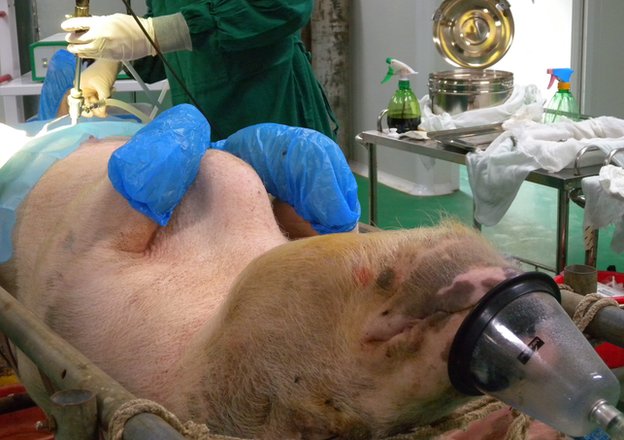
To my surprise, we’re taken to see how the work is done. A room next to the pens serves as a surgery and a sow is under anaesthetic, lying on her back on an operating table. An oxygen mask is fitted over her snout and she’s breathing steadily. Blue plastic bags cover her trotters.

Two technicians have inserted a fibre-optic probe to locate the sow’s uterus. A third retrieves a small test-tube from a fridge: these are the blastocysts, early stage embryos prepared in a lab. In a moment, they will be implanted.

The room is not air-conditioned; nor is it particularly clean. Flies buzz around the pig’s head.

My first thought is that the operation is being conducted with an air of total routine. Even the presence of a foreign television crew seems to make little difference. The animal is comfortable but there’s no sensitivity about how we might react, let alone what animal rights campaigners might make of it all.

I check the figures: the team can do two implantations a day. The success rate is about 70-80%.

Dusk is falling as we’re shown into another shed where new-born piglets are lying close to their mothers to suckle. Heat lamps keep the room warm. Some of the animals are clones of clones. Most have been genetically modified.

The point of the work is to use pigs to test out new medicines. Because they are so similar genetically to humans, pigs can serve as useful “models”. So modifying their genes to give them traits can aid that process.

One batch of particularly small pigs has had a growth gene removed – they stopped growing at the age of one. Others have had their DNA tinkered with to try to make them more susceptible to Alzheimer’s.

Back at the company headquarters, a line of technicians is hunched over microscopes. This is a BGI innovation: replacing expensive machines with people. It’s called “handmade cloning” and is designed to make everything quicker and easier.

The scientist in charge, Dr Yutao Du, explains the technique in a way that leaves me reeling.

“We can do cloning on a very large scale,” she tells me, “30-50 people together doing cloning so that we can make a cloning factory here.”

A cloning factory – an incredible notion borrowed straight from science fiction. But here in Shenzhen, in what was an old shoe factory, this rising power is creating a new industry.

The scale of ambition is staggering. BGI is not only the world’s largest centre for cloning pigs – it’s also the world’s largest centre for gene sequencing.

In neighbouring buildings, there are rows of gene sequencers – machines the size of fridges operating 24 hours a day crunching through the codes for life.

To illustrate the scale of this operation, Europe’s largest gene sequencing centre is the Wellcome Trust Sanger Institute near Cambridge. It has 30 machines. BGI has 156 and has even bought an American company that makes them.

BGI’s chief executive, Wang Jun, tells me how they need the technology to develop ever faster and cheaper ways of reading genes.

Again, a comparison for scale: a recently-launched UK project seeks to sequence 10,000 human genomes. BGI has ambitions to sequence the genomes of a million people, a million animals and a million plants.

Wang Jun is keen to stress that all this work must be relevant to ordinary people through better healthcare or tastier food. The BGI canteen is used as a testbed for some of the products from the labs: everything from grouper twice the normal size, to pigs, to yoghurt.

I ask Wang Jun how he chooses what to sequence. After the shock of hearing the phrase “cloning factory”, out comes another bombshell:

“If it tastes good you should sequence it,” he tells me. “You should know what’s in the genes of that species.”

Species that taste good is one criterion. Another he cites is that of industrial use – raising yields, for example, or benefits for healthcare.

“A third category is if it looks cute – anything that looks cute: panda, polar bear, penguin, you should really sequence it – it’s like digitalising all the wonderful species,” he explains.

I wonder how he feels about acquiring such power to take control of nature but he immediately contradicts me.

“No, we’re following Nature – there are lots of people dying from hunger and protein supply so we have to think about ways of dealing with that, for example exploring the potential of rice as a species,” the BGI chief counters.

China is on a trajectory that will see it emerging as a giant of science: it has a robotic rover on the Moon, it holds the honour of having the world’s fastest supercomputer and BGI offers a glimpse of what industrial scale could bring to the future of biology.

Read more: http://www.bbc.co.uk/news/science-environment-25576718

Thanks to Kebmodee for bringing this to the attenion of the It’s Interesting community.

Tikker: the wristwatch that focuses you on the ultimate deadline

Tikker

Tick Tock. Tick Tock. Tick Tock.

The seconds left in 2013 are slipping away. And you know what else is slipping away? The seconds left in your life.

Luckily for you, there’s a new product called Tikker, a wristwatch that counts down your life, so you can watch on a large, dot-matrix display as the seconds you have left on earth disappear down a black hole.

Your estimated time of death is, of course, just that, an estimate. Tikker uses an algorithm like the one used by the federal government to figure a person’s life expectancy. But the effect is chilling, a sort of incessant grim reaper reminding you that time is running out.

Tikker’s inventor is a 37-year-old Swede named Fredrik Colting. He says he invented the gadget not as a morbid novelty item, but in an earnest attempt to change his own thinking.

He wanted some sort of reminder to not sweat the small stuff and reach for what matters. He figured imminent death was the best motivator there is. That’s why he calls Tikker, “the happiness watch.” It’s his belief that watching your life slip away will remind you to savor life while you have it.

And, it turns out, there is some evidence for his point of view. A 2009 study showed that thinking about death makes you savor life more. And a 2011 study has shown thinking about death makes you more generous, more likely to donate your blood.

But that’s not the whole story. A whole dark underbelly of research suggests that thinking about our own mortality can bring out the worst in us. The work of Jeff Greenberg, Sheldon Solomon and Tom Pyszczynski — grandfathers of an idea in social psychology called terror management theory — has shown that thinking about death makes us, well, pretty xenophobic. When confronted with our mortality, we cling to those like us and disparage those who are different.

Now, why do you get both positive and negative effects? Well, that’s an open question in science right now. Do both always occur? Does it depend on the person? Does it depend on the way in which you are made to think about death, specifically picturing your own death or thinking about death in a more abstract or subliminal way? No one knows yet.

So whether Tikker will make you happy or, as Solomon quipped to me, “a xenophobic serial killer,” is still unknown. What is known is that the watch will be available in April 2014, and thousands of preorders have already rolled in.

http://kosu.org/2013/12/nothing-focuses-the-mind-like-the-ultimate-deadline-death/

Samantha West – robot telemarketer that denies it’s a robot

ways-messing-with-telemarketers-6

The phone call came from a charming woman with a bright, engaging voice to the cell phone of a TIME Washington Bureau Chief Michael Scherer. She wanted to offer a deal on health insurance, but something was fishy.

When Scherer asked point blank if she was a real person, or a computer-operated robot voice, she replied enthusiastically that she was real, with a charming laugh. But then she failed several other tests. When asked “What vegetable is found in tomato soup?” she said she did not understand the question. When asked multiple times what day of the week it was yesterday, she complained repeatedly of a bad connection.

Over the course of the next hour, several TIME reporters called her back, working to uncover the mystery of her bona fides. Her name, she said, was Samantha West, and she was definitely a robot, given the pitch perfect repetition of her answers. Her goal was to ask a series of questions about health coverage—”Are you on Medicare?” etc.—and then transfer the potential customer to a real person, who could close the sale. You can listen for yourself to some of the reporting here: http://newsfeed.time.com/2013/12/10/meet-the-robot-telemarketer-who-denies-shes-a-robot/

If you want, you can call her too. Her number is (484) 589-5611. This number, if you Google it, is the subject of much discussion online as other recipients of Samantha West calls complain on chat boards about the mysteriously persistent lady who keeps calling them. “A friendly sounded woman on the other end claimed I requested health insurance information,” writes one mark. “She doggedly refused to deviate from her script.”

After answering her questions, one TIME reporter was transferred to an actual human who did not promptly end the call, as others had when asked about Samantha. Asked for the company’s website, the real human on the other end of the line said it was premierhealthagency.com, the website of a Ft. Lauderdale company. “We’re here to help. . . because we care,” is the company motto on its homepage. A TIME reporter called the company directly, identified himself and said TIME was doing a story about the robot who calls people on the company’s behalf. “We don’t use robot calls, sir,” said the person who answered the phone, before promptly hanging up the phone.

When the number was called a second time, a real live employee of Premier Health Plans Inc., who gave his name as Bruce Martin, answered the phone. He said he was not sure if Samantha West’s phone number, mentioned above, was one of the company’s numbers. “First of all, we use TV, we use radio, we use Internet,” said Martin. He described the company as selling life insurance, health insurance and dental insurance. He asked that TIME publish the name of his company, the website and phone number in the article. “If you are going to publish this in the magazine, I’d like to get something out of it,” he said. The TIME reporter agreed to do just that.

Martin also said he would inquire internally about whether Samantha West worked for the company, but would not be able to respond to the request Monday night. TIME will update the story with any additional information he provides.

UPDATE: As of Dec. 11, one day after this story published, the phone number listed above was no longer answered by Samantha West. Rather, it diverted callers to a busy signal. Also the website, premierhealthagency.com, had been taken offline.

Read more: Samantha West The Telemarketer Robot Who Swears She’s Not a Robot | TIME.com http://newsfeed.time.com/2013/12/10/meet-the-robot-telemarketer-who-denies-shes-a-robot/#ixzz2nSpfusYd

Electric brain stimulation in a specific area discovered to induce a sense of determination

Doctors in the US have induced feelings of intense determination in two men by stimulating a part of their brains with gentle electric currents.

The men were having a routine procedure to locate regions in their brains that caused epileptic seizures when they felt their heart rates rise, a sense of foreboding, and an overwhelming desire to persevere against a looming hardship.

The remarkable findings could help researchers develop treatments for depression and other disorders where people are debilitated by a lack of motivation.

One patient said the feeling was like driving a car into a raging storm. When his brain was stimulated, he sensed a shaking in his chest and a surge in his pulse. In six trials, he felt the same sensations time and again.

Comparing the feelings to a frantic drive towards a storm, the patient said: “You’re only halfway there and you have no other way to turn around and go back, you have to keep going forward.”

When asked by doctors to elaborate on whether the feeling was good or bad, he said: “It was more of a positive thing, like push harder, push harder, push harder to try and get through this.”

A second patient had similar feelings when his brain was stimulated in the same region, called the anterior midcingulate cortex (aMCC). He felt worried that something terrible was about to happen, but knew he had to fight and not give up, according to a case study in the journal Neuron.

Both men were having an exploratory procedure to find the focal point in their brains that caused them to suffer epileptic fits. In the procedure, doctors sink fine electrodes deep into different parts of the brain and stimulate them with tiny electrical currents until the patient senses the “aura” that precedes a seizure. Often, seizures can be treated by removing tissue from this part of the brain.

“In the very first patient this was something very unexpected, and we didn’t report it,” said Josef Parvizi at Stanford University in California. But then I was doing functional mapping on the second patient and he suddenly experienced a very similar thing.”

“Its extraordinary that two individuals with very different past experiences respond in a similar way to one or two seconds of very low intensity electricity delivered to the same area of their brain. These patients are normal individuals, they have their IQ, they have their jobs. We are not reporting these findings in sick brains,” Parvizi said.

The men were stimulated with between two and eight milliamps of electrical current, but in tests the doctors administered sham stimulation too. In the sham tests, they told the patients they were about to stimulate the brain, but had switched off the electical supply. In these cases, the men reported no changes to their feelings. The sensation was only induced in a small area of the brain, and vanished when doctors implanted electrodes just five millimetres away.

Parvizi said a crucial follow-up experiment will be to test whether stimulation of the brain region really makes people more determined, or simply creates the sensation of perseverance. If future studies replicate the findings, stimulation of the brain region – perhaps without the need for brain-penetrating electrodes – could be used to help people with severe depression.

The anterior midcingulate cortex seems to be important in helping us select responses and make decisions in light of the feedback we get. Brent Vogt, a neurobiologist at Boston University, said patients with chronic pain and obsessive-compulsive disorder have already been treated by destroying part of the aMCC. “Why not stimulate it? If this would enhance relieving depression, for example, let’s go,” he said.

http://www.theguardian.com/science/2013/dec/05/determination-electrical-brain-stimulation

Thanks to Kebmodee for bringing this to the attention of the It’s Interesting community.