Among New York Subway’s Millions of Riders, a Study Finds Many Mystery Microbes

Have you ever been on the subway and seen something that you did not quite recognize, something mysteriously unidentifiable?

Well, there is a good chance scientists do not know what it is either.

Researchers at Weill Cornell Medical College released a study on Thursday that mapped DNA found in New York’s subway system — a crowded, largely subterranean behemoth that carries 5.5 million riders on an average weekday, and is filled with hundreds of species of bacteria (mostly harmless), the occasional spot of bubonic plague, and a universe of enigmas. Almost half of the DNA found on the system’s surfaces did not match any known organism and just 0.2 percent matched the human genome.

“People don’t look at a subway pole and think, ‘It’s teeming with life,’ ” said Dr. Christopher E. Mason, a geneticist at Weill Cornell Medical College and the lead author of the study. “After this study, they may. But I want them to think of it the same way you’d look at a rain forest, and be almost in awe and wonder, effectively, that there are all these species present — and that you’ve been healthy all along.”

Dr. Mason said the inspiration for the study struck about four years ago when he was dropping off his daughter at day care. He watched her explore her new surroundings by happily popping objects into her mouth. As is the custom among tiny children, friendships were made on the floor, by passing back and forth toys that made their way from one mouth to the next.

“I couldn’t help thinking, ‘How much is being transferred, and on which kinds of things?’ ” Dr. Mason said. So he considered a place where adults can get a little too close to each other, the subway.

Thus was the project, called PathoMap, born. Over the past 17 months, a team mainly composed of medical students, graduate students and volunteers fanned out across the city, using nylon swabs to collect DNA, in triplicate, from surfaces that included wooden benches, stairway handrails, seats, doors, poles and turnstiles.

In addition to the wealth of mystery DNA — which was not unexpected given that only a few thousand of the world’s genomes have been fully mapped — the study’s other findings reflected New York’s famed diversity, both human and microbial.

The Bronx was found to be the most diverse borough in terms of microbial species. Brooklyn claimed second place, followed by Manhattan, Queens and Staten Island, where researchers took samples on the Staten Island Railway.

On the human front, Dr. Mason said that, in some cases, the DNA that was found in some subway stations tended to match the neighborhood’s demographic profile. An area with a high concentration of Hispanic residents near Chinatown in Manhattan, for example, yielded a large amount of Hispanic and Asian genes.

In an area of Brooklyn to the south of Prospect Park that roughly encompassed the Kensington and Windsor Terrace neighborhoods, the DNA gathered frequently read as British, Tuscan, and Finnish, three groups not generally associated with the borough. Dr. Mason had an explanation for the finding: Scientists have not yet compiled a reliable database of Irish genes, so the many people of Irish descent who live in the area could be the source of DNA known to be shared with other European groups. The study produced some less appetizing news. Live, antibiotic-resistant bacteria were discovered in 27 percent of the collected samples, though among all the bacteria, only 12 percent could be associated with disease. Researchers also found three samples associated with bubonic plague and two with DNA fragments of anthrax, though they noted that none of those samples showed evidence of being alive, and that neither disease had been diagnosed in New York for some time. The presence of anthrax, Dr. Mason said, “is consistent with the many documented cases of anthrax in livestock in New York State and the East Coast broadly.”

The purpose of the study was not simply to satisfy scientific curiosity, the authors said. By cataloging species now, researchers can compare them against samples taken in the future to determine whether certain diseases, or even substances used as bioterrorism weapons, had spread.

City and transit officials did not sound grateful for the examination.

“As the study clearly indicates, microbes were found at levels that pose absolutely no danger to human life and health,” Kevin Ortiz, a spokesman for the Metropolitan Transportation Authority, said in an email. And the city’s health department called the study “deeply flawed” and misleading.

Dr. Mason responded by saying he and his team had simply presented their complete results.

“For us to not report the fragments of anthrax and plague in the context of a full analysis would have been irresponsible,” he said. “Our findings indicate a normal, healthy microbiome, and we welcome others to review the publicly available data and run the same analysis.”

Thanks to Kebmodee for bringing this to the attention of the It’s Interesting community.

New research identifies similarity between how pigeons and human children learn equivalent of words

The more scientists study pigeons, the more they learn how their brains—no bigger than the tip of an index finger—operate in ways not so different from our own.

In a new study from the University of Iowa, researchers found that pigeons can categorize and name both natural and manmade objects—and not just a few objects. These birds categorized 128 photographs into 16 categories, and they did so simultaneously.

Ed Wasserman, UI professor of psychology and corresponding author of the study, says the finding suggests a similarity between how pigeons learn the equivalent of words and the way children do.

“Unlike prior attempts to teach words to primates, dogs, and parrots, we used neither elaborate shaping methods nor social cues,” Wasserman says of the study, published online in the journal Cognition. “And our pigeons were trained on all 16 categories simultaneously, a much closer analog of how children learn words and categories.”

For researchers like Wasserman, who has been studying animal intelligence for decades, this latest experiment is further proof that animals—whether primates, birds, or dogs—are smarter than once presumed and have more to teach scientists.

“It is certainly no simple task to investigate animal cognition; But, as our methods have improved, so too have our understanding and appreciation of animal intelligence,” he says. “Differences between humans and animals must indeed exist: many are already known. But, they may be outnumbered by similarities. Our research on categorization in pigeons suggests that those similarities may even extend to how children learn words.”

Wasserman says the pigeon experiment comes from a project published in 1988 and featured in The New York Times in which UI researchers discovered pigeons could distinguish among four categories of objects.

This time, the UI researchers used a computerized version of the “name game” in which three pigeons were shown 128 black-and-white photos of objects from 16 basic categories: baby, bottle, cake, car, cracker, dog, duck, fish, flower, hat, key, pen, phone, plan, shoe, tree. They then had to peck on one of two different symbols: the correct one for that photo and an incorrect one that was randomly chosen from one of the remaining 15 categories. The pigeons not only succeeded in learning the task, but they reliably transferred the learning to four new photos from each of the 16 categories.

Pigeons have long been known to be smarter than your average bird—or many other animals, for that matter. Among their many talents, pigeons have a “homing instinct” that helps them find their way home from hundreds of miles away, even when blindfolded. They have better eyesight than humans and have been trained by the U. S. Coast Guard to spot orange life jackets of people lost at sea. They carried messages for the U.S. Army during World Wars I and II, saving lives and providing vital strategic information.

UI researchers say their expanded experiment represents the first purely associative animal model that captures an essential ingredient of word learning—the many-to-many mapping between stimuli and responses.

“Ours is a computerized task that can be provided to any animal, it doesn’t have to be pigeons,” says UI psychologist Bob McMurray, another author of the study. “These methods can be used with any type of animal that can interact with a computer screen.”

McMurray says the research shows the mechanisms by which children learn words might not be unique to humans.

“Children are confronted with an immense task of learning thousands of words without a lot of background knowledge to go on,” he says. “For a long time, people thought that such learning is special to humans. What this research shows is that the mechanisms by which children solve this huge problem may be mechanisms that are shared with many species.”

Wasserman acknowledges the recent pigeon study is not a direct analogue of word learning in children and more work needs to be done. Nonetheless, the model used in the study could lead to a better understanding of the associative principles involved in children’s word learning.

“That’s the parallel that we’re pursuing,” he says, “but a single project—however innovative it may be—will not suffice to answer such a provocative question.”

http://now.uiowa.edu/2015/02/pigeon-power

Sperm whale poonado

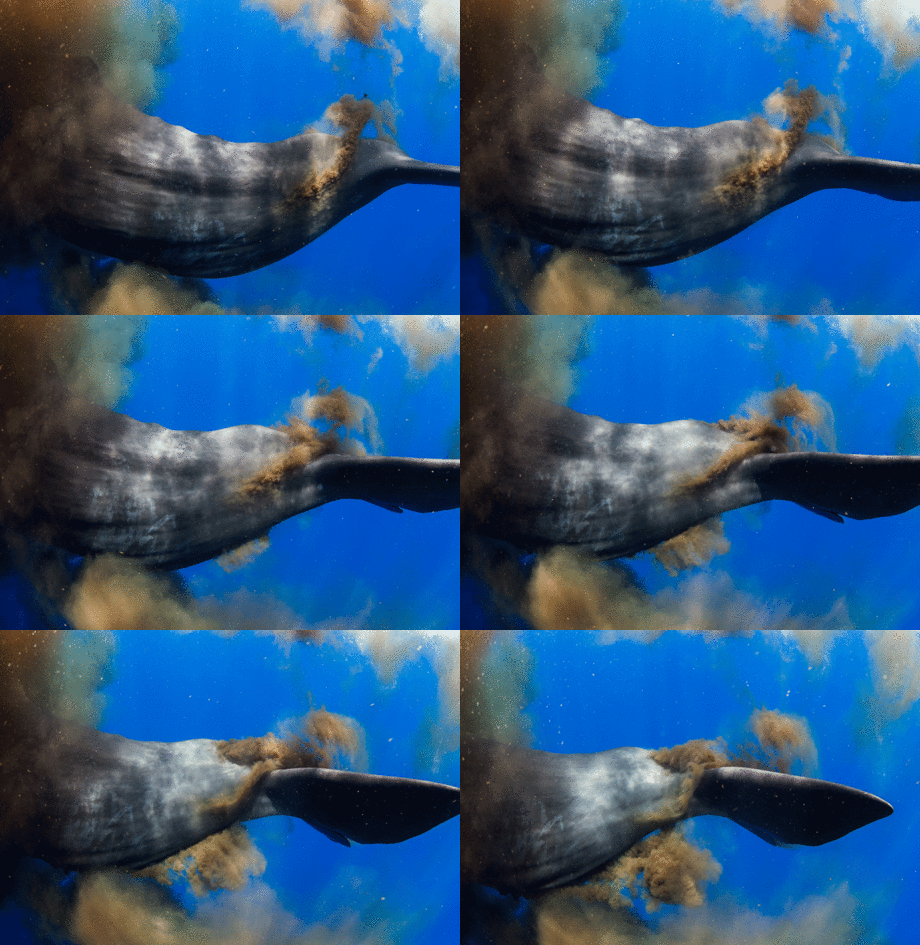
ENCOUNTERING a mighty sperm whale is a magical experience. But in this case, it was tempered somewhat by a rarely seen defence mechanism: emergency defecation.

Sperm whales are the largest toothed predators in the world, so what have they got to be scared of? Here it was pesky divers buzzing around them, taking photos.

Canadian photographer Keri Wilk was sailing off the island of Dominica in the Caribbean, hoping to film these gargantuan creatures, when he spotted one and jumped in for some close-ups. The whale approached Wilk and his three colleagues, pointed downwards, and began to evacuate its bowels. To make matters worse, it then started to churn up the water. “Like a bus-sized blender, it very quickly and effectively dispersed its faecal matter into a cloud,” says Wilk.

Defensive defecation has been recorded in pygmy and dwarf sperm whales, which, as their names suggest, are diminutive compared with their cousins. But this is perhaps less surprising, given that they have natural predators. Wilk is unaware of any other reports of sperm whales’ emergency excretion.

Despite what you might think of being enveloped in what Wilk describes as a “poonado”, he cherishes the moment. “I’ve experienced lots of interesting natural phenomenon underwater, all over the world, but this is near the top of the list,” he says. “As long as you didn’t take your mask off, you couldn’t really smell anything. Taste is another matter…”

http://www.newscientist.com/article/mg22530064.700-sperm-whales-emergency-evacuation-of-its-bowels.html#.VMtpm4dRGng

Study shows lemurs use communal latrines as information exchange centers

Ein Weißfuß-Wieselmaki (Lepilemur leucopus) in seinem Schlafbaum.

Emily loves Justin – Stop global warming – Two more weeks till I graduate!: The exchange of information in public toilets is widespread. It also occurs in the world of white-footed sportive lemurs. Only instead of writing on the walls, they use scent-marks in order to communicate with their own kind.. In a study published online in Springer’s journal Behavioral Ecology and Sociobiology, Iris Dröscher and Peter Kappeler from the German Primate Center (DPZ) have found that the urine left on latrine trees serves as a method to maintain contact with family members. It also serves as a means to inform an intruder that there is a male that will defend his partner. Latrines thus serve as information exchange centers and promote social bonding in territorial nocturnal animals that do not live in closely-knit groups.

In the animal kingdom, the use of latrines, which serve as specific locations for urination and defecation, is a common occurrence. Because little is known about why primates, in particular, use the same latrines over and over, the researchers set out to investigate this phenomenon among white-footed sportive lemurs (Lepilemur leucopus) in southern Madagascar. Do they hint to others that they want to defend their mate or territory? Or, do they indicate the fertility of the female? Or do they promote exchange of information within a group and support social bonding? To answer these questions, the researchers wanted to establish where such latrines were found, and if they were used differently between seasons and between individuals of different ages and sexes. In the process, Dröscher and Kappeler spent over 1,000 hours watching the toilet habits of 14 radio-collared adult sportive lemurs.

White-footed sportive lemurs are nocturnal tree-dwellers that are found exclusively in southern Madagascar. They live together in families consisting of parents and their offspring. Even though the family members share a common territory, the individuals do not interact much. Neither do pair-partners sleep in the same tree nor do they associate while foraging. But what they have in common are latrines that are located in the core of their territory. All members of the family visit the same latrines for defecation and urination. Dröscher and Kappeler believe the latrines are a way in which to maintain familiarity and social bonding among members of a social unit, who otherwise have very little contact with each other. Such scent signals are picked up from urine that stains the tree trunks rather than feces that accumulate on the ground under the trees.

Males visited the latrines more often during nights when an intruder invaded the territory. In addition, the males placed scent marks from their specialized anogenital glands preferentially in latrines. “This indicates that latrine use in this primate species should also be connected to mate defense,” says Iris Dröscher, a PhD student at the German Primate Center.

“Scent marks transmit a variety of information such as sexual and individual identity and may function to signal an individual’s presence and identity to others,” continues Dröscher. “Latrines therefore serve as information exchange centers of individual-specific information.”

“Especially nocturnal species with limited habitat visibility and low inter-individual cohesion profit from predictable areas for information exchange to facilitate communication,” says Peter Kappeler, head of the Department for Behavioral Ecology and Sociobiology at the DPZ. “The white-footed sportive lemur has found these information centers by means of latrine use.”

More information: Dröscher I, Kappeler PM (2014): “Maintenance of familiarity and social bonding via communal latrine use in a solitary primate (Lepilemur leucopus).” Behavioral Ecology and Sociobiology, DOI: 10.1007/s00265-014-1810-z

http://phys.org/news/2014-10-lemurs-latrines-exchange-centers.html

Live cricket extracted from a man’s ear

Above is video of what happened when an Indian man went to a doctor complaining of an ear ache.

The doctor told the man, believed to be from Southern India, that he had a two-inch cricket lodged in his ear canal, which was then removed with tweezers as shown.

An expert told the Daily Star that the insect is likely a house cricket.

“These critters are known to be an invasive species, appearing all over the globe,” Michael Sweet, lecturer at the University of Derby and invertebrate biology expert, told the paper.

“It is likely this cricket crawled into the man’s ear while he was sleeping and was just hiding there until night came around.”

It is not believed the pest caused the man any harm.

http://www.aol.com/article/2014/10/09/the-amazing-moment-a-live-cricket-is-extracted-from-a-mans-ear/20975693/

Thanks to Mrs. Lindley for bringing this to the attention of the It’s Interesting community.
Cowbells make cows miserable

A field of cowbell-equipped-cows may create a soothing soundscape of wind and chimes, but what’s soothing to us doesn’t translate to the cows. Though Christopher Walken and internet humor from over 14 years ago require more cowbell, it turns out the actual bovine after which the bells are named really hate the things.

A study was performed as part of a doctoral dissertation for the Swiss Federal Institute of Technology in Zurich where agricultural scientist Julia Johns and a colleague measured the decibel levels of cowbells. The team attached 12-pound cowbells to over 100 cows across 25 locations around the country, and it turns out the cowbells can reach decibel levels of 113 — far above the legal limit of 85. The cowbells aren’t just over the legal limit, but reach a level of noise equivalent to a jackhammer or a chainsaw.

The team studied the cows reactions, and found that the cows exposed to the cowbells chew their food for significantly less time than the cows without the bells, and some cows have even proven to have their hearing severely impaired.

The team does admit that the weight of the bells could also negatively affect the cows, but a slightly heavy cowbell necklace likely wouldn’t cause hearing impairment.

Farmers use the bells to locate cows grazing in pasture, but researchers have suggested replacing them with GPS trackers. However, the farmers claim that poor reception in the mountainous areas would make that solution difficult.

http://www.geek.com/geek-cetera/it-turns-out-that-cowbells-make-cows-miserable-1605552/

Spitting fish adjust for distance when shooting

archer fish
Footage captured by two high-speed cameras shows the fish’s ability in detail

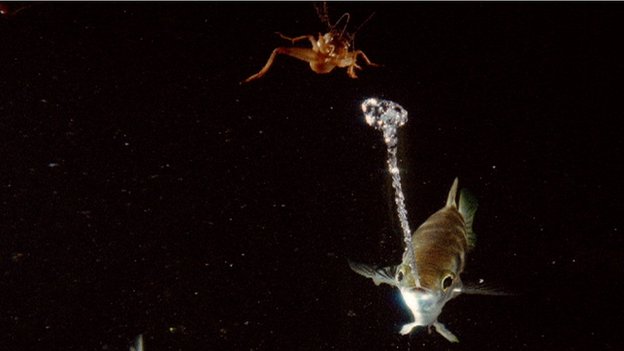
The jets of water that archer fish use to shoot down prey are “tuned” to arrive with maximum impact over a range of distances, according to a study.

By Jonathan Webb
Science reporter, BBC News

High-speed cameras were used to analyse fishes’ spitting performance in detail.

As they create each jet, the fish tweak the flow of water over time, causing a focussed blob of water to gather just in front of the target, wherever it is.

The ability comes from precise changes to the animal’s mouth opening, which may prove useful in designing nozzles.

Senior author Prof Stefan Schuster, from the University of Bayreuth in Germany, explained that jets of water and other fluids are used to cut or shape materials in industries ranging from mining to medicine.

He believes his new fish-based findings could improve the technology.

Patience and precision
“I’ve never seen anything in which they use a nozzle that changes its diameter,” he told the BBC. “The most standard approach is adjusting the pressure.”

But pressure, which the archer fish apply by squeezing their gill covers together, is not the secret to their ballistic precision.

Prof Schuster and his PhD student Peggy Gerullis found no evidence for pressure adjustments, nor for chemical additives or flicking movements in the water, which might account for the fishes’ ability to control the stability of the water jet, and focus the accelerating blob at its tip.

“The fish add nothing – they only shoot water, and they keep absolutely still during release of the jet,” Prof Schuster said.

“They just do it with the mouth opening diameter. It is not a simple manoeuvre… The diameter is continuously changing.”

That makes the new study, published in Current Biology, the first evidence of an animal actively manipulating the dynamics of a water jet.

Prof Schuster and Ms Gerullis trained two archer fish to hit targets at distances from 20cm to 60cm, under bright lights to help with filming.

The targets were small spheres, which allowed the team to calculate the forces involved.

Accuracy, of course, was rewarded – usually with a small fly. “You can easily train a fish to shoot at anything you want,” said Prof Schuster. “They are perfectly happy as long as something edible falls down.”

The tricky part was organising the angles.

“To be ready to monitor to the right spots with reasonable spatial resolution, you have to convince the fish somehow to fire from a defined position. That was the hardest part of the study, actually.”

With patience, the researchers collected enough measurements to reveal that the all-important blob of water at the jet’s tip, which allows archer fish to dislodge their prey, forms just before impact – no matter the target distance.

To accomplish this, the animals fine-tune not just the speed, but the stability of the water jet.

“It means that the physics the fish is using is much more complicated than previously thought,” Prof Schuster explained.

Cognitive evolution?

Dynamic jet control must now be added to an already impressive list of this fish’s abilities.

Other research has explored questions ranging from how archer fish compensate for the distortion of their vision by the water surface, to how they learn to hit moving targets by copying their companions, to exactly how they produce a water jet that catches up on itself to form their distinctive, watery missile.

Prof Schuster believes that their spitting accuracy may have evolved in a similar way to human throwing, which some theorists argue sparked an accompanying expansion of our cognitive abilities.

His team has also done fieldwork in Thailand, where they observed that the fish hunt in daylight, when their insect targets are few and far between. So having a good range, and not missing, are a big advantage for survival.

That power and precision requires brain power.

“People have calculated that to double [throwing] range requires roughly an 8-fold increase in the number of neurons involved in throwing,” Prof Schuster said.

So are these fish evolving into the cleverest animals under water?

“I don’t think they will develop into humans. [But] they have many strange abilities that you wouldn’t expect from fish.

“Maybe we can show by looking more closely at the brain, that shooting might have played a similar, prominent role in driving these abilities, as it’s thought that throwing played in human evolution.

“That’s just a crazy idea of mine.”

http://www.bbc.com/news/science-environment-29046018

Thank to Kebmodee for bringing this to the attention of the It’s Interesting community.

Japanese jeans designed by caged lions and tigers

A Japanese jeans maker has found a new way of capitalising on zoo animals. Zoo Jeans are producing jeans “designed by dangerous animals”. Denim is wrapped around tyres, which are then thrown to the lions who enjoy ripping and biting at the material. This produces that all-important designer, distressed look.

Rather than simply being a marketing gimic, there is actually value in this from an animal welfare perspective. Involving lions and the zoo’s other large carnivores in the activity is part of what’s called environmental enrichment. This is the provision of stimuli to help improve well-being. It’s a win-win activity for many zoos, who can make alternative profits from their animals, which tend to be used to provide extra facilities for them.

Wrapping denim around a tyre to make enrichment devices for toothy carnivores is just one way that zoos have profited from their animals’ hobbies over the years. Since their inception, zoos have looked for different ways to fund their activities. London Zoo when it first opened would let in penniless visitors for a cat or dog to be fed to the carnivores. Visitors with money were offered other things to keep themselves amused as they looked at the animals.

read more: http://theconversation.com/jeans-designed-by-lions-and-tigers-are-a-win-win-for-zoos-28988

Bachelor party stumbles upon 3 million year old stegomastodon skull

Some guys have trouble remembering just what happened during their bachelor party, but a group of men on a recent stag send-off in New Mexico aren’t likely to forget their celebration very soon — since they stumbled upon a perfectly preserved three-million-year-old mastodon skull.

The party was on a hike in Elephant Butte Lake State Park near Albuquerque when they saw a bone jutting one to two inches from the sand. They started digging and uncovered the enormous skull. Their first thought was it could be the remains of a woolly mammoth so they snapped photos and sent them to the New Mexico Museum of Natural History and Science.

Scientists there made the identification — it wasn’t a woolly mammoth, but, in fact, a much more exciting find. The skull belonged to a stegomastodon — a prehistoric ancestor of the woolly mammoth — as well as today’s elephants. The massive animal stood about 9 feet tall, weighed six tons and walked the Earth during the Ice Age, according to Gary Morgan, a paleontologist at the museum who analyzed the fossil. He estimates the animal was about 50 years old when it died on a sandbar of the ancient Rio Grande River.

The family of mastodons migrated to North America around 15 million years ago and died out around 10,000 years ago.

“This is far and away the best one we’ve ever found,” said Morgan about the bachelor party’s discovery.

Scientists, following up on the party’s tip, went to the site and sealed the skull, which weighed more than 1,000 pounds, in a cast. It was transported to the museum, where it will eventually will be placed on display.

Antonia Gradillas, 33, was among the men who made the original discovery. He said, “This is the coolest thing ever. Some people with PhDs in this field might not even have this kind of opportunity. We were so lucky.”

Thanks to Dr. Rajadhyaksha for bringing this to the attention of the It’s Interesting community.

http://news.discovery.com/animals/paleontology/bachelor-party-finds-mastedon-skull-140616.htm

How male spiders keep females to themselves

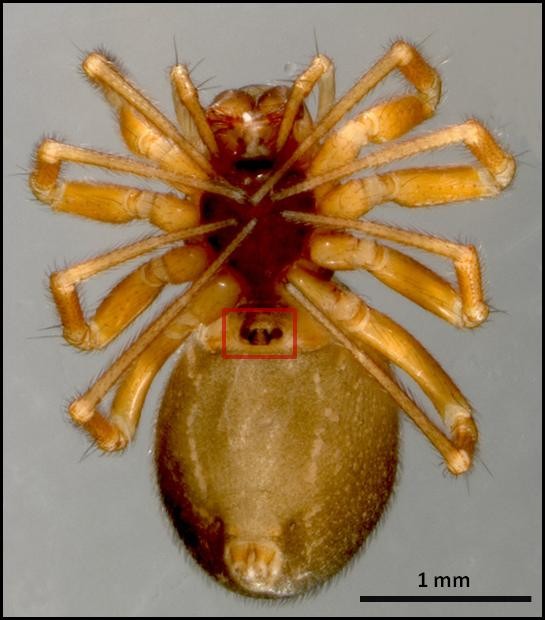
Dwarf spiders don’t need to take paternity tests to know who the father is—for the most part. Right after copulation, males plug up the genital tract of females (red box in picture) to ensure that competitors can’t deposit sperm. Researchers studying the technique found that the larger the plug, the more difficult it is for subsequent males to remove. Described this month in Behavioral Ecology and Sociobiology, the “stoppers” effectively prevent 67.5% of males who show up later from breeding.

Thanks to Dr. Rajadhyaksha for bringing this to the attention of the It’s Interesting community.

http://news.sciencemag.org/sifter/2014/06/how-male-spiders-keep-females-to-themselves