How Exercise Beefs Up the Brain

exercise

New research explains how abstract benefits of exercise—from reversing depression to fighting cognitive decline—might arise from a group of key molecules.

While our muscles pump iron, our cells pump out something else: molecules that help maintain a healthy brain. But scientists have struggled to account for the well-known mental benefits of exercise, from counteracting depression and aging to fighting Alzheimer’s and Parkinson’s disease. Now, a research team may have finally found a molecular link between a workout and a healthy brain.

Much exercise research focuses on the parts of our body that do the heavy lifting. Muscle cells ramp up production of a protein called FNDC5 during a workout. A fragment of this protein, known as irisin, gets lopped off and released into the bloodstream, where it drives the formation of brown fat cells, thought to protect against diseases such as diabetes and obesity. (White fat cells are traditionally the villains.)

While studying the effects of FNDC5 in muscles, cellular biologist Bruce Spiegelman of Harvard Medical School in Boston happened upon some startling results: Mice that did not produce a so-called co-activator of FNDC5 production, known as PGC-1α, were hyperactive and had tiny holes in certain parts of their brains. Other studies showed that FNDC5 and PGC-1α are present in the brain, not just the muscles, and that both might play a role in the development of neurons.

Spiegelman and his colleagues suspected that FNDC5 (and the irisin created from it) was responsible for exercise-induced benefits to the brain—in particular, increased levels of a crucial protein called brain-derived neurotrophic factor (BDNF), which is essential for maintaining healthy neurons and creating new ones. These functions are crucial to staving off neurological diseases, including Alzheimer’s and Parkinson’s. And the link between exercise and BDNF is widely accepted. “The phenomenon has been established over the course of, easily, the last decade,” says neuroscientist Barbara Hempstead of Weill Cornell Medical College in New York City, who was not involved in the new work. “It’s just, we didn’t understand the mechanism.”

To sort out that mechanism, Spiegelman and his colleagues performed a series of experiments in living mice and cultured mouse brain cells. First, they put mice on a 30-day endurance training regimen. They didn’t have to coerce their subjects, because running is part of a mouse’s natural foraging behavior. “It’s harder to get them to lift weights,” Spiegelman notes. The mice with access to a running wheel ran the equivalent of a 5K every night.

Aside from physical differences between wheel-trained mice and sedentary ones—“they just look a little bit more like a couch potato,” says co-author Christiane Wrann, also of Harvard Medical School, of the latter’s plumper figures—the groups also showed neurological differences. The runners had more FNDC5 in their hippocampus, an area of the brain responsible for learning and memory.

Using mouse brain cells developing in a dish, the group next showed that increasing the levels of the co-activator PGC-1α boosts FNDC5 production, which in turn drives BDNF genes to produce more of the vital neuron-forming BDNF protein. They report these results online today in Cell Metabolism. Spiegelman says it was surprising to find that the molecular process in neurons mirrors what happens in muscles as we exercise. “What was weird is the same pathway is induced in the brain,” he says, “and as you know, with exercise, the brain does not move.”

So how is the brain getting the signal to make BDNF? Some have theorized that neural activity during exercise (as we coordinate our body movements, for example) accounts for changes in the brain. But it’s also possible that factors outside the brain, like those proteins secreted from muscle cells, are the driving force. To test whether irisin created elsewhere in the body can still drive BDNF production in the brain, the group injected a virus into the mouse’s bloodstream that causes the liver to produce and secrete elevated levels of irisin. They saw the same effect as in exercise: increased BDNF levels in the hippocampus. This suggests that irisin could be capable of passing the blood-brain barrier, or that it regulates some other (unknown) molecule that crosses into the brain, Spiegelman says.

Hempstead calls the findings “very exciting,” and believes this research finally begins to explain how exercise relates to BDNF and other so-called neurotrophins that keep the brain healthy. “I think it answers the question that most of us have posed in our own heads for many years.”

The effect of liver-produced irisin on the brain is a “pretty cool and somewhat surprising finding,” says Pontus Boström, a diabetes researcher at the Karolinska Institute in Sweden. But Boström, who was among the first scientists to identify irisin in muscle tissue, says the work doesn’t answer a fundamental question: How much of exercise’s BDNF-promoting effects come from irisin reaching the brain from muscle cells via the bloodstream, and how much are from irisin created in the brain?

Though the authors point out that other important regulator proteins likely play a role in driving BDNF and other brain-nourishing factors, they are focusing on the benefits of irisin and hope to develop an injectable form of FNDC5 as a potential treatment for neurological diseases and to improve brain health with aging.

http://news.sciencemag.org/biology/2013/10/how-exercise-beefs-brain

Thanks to Dr. Rajadhyaksha for bringing this to the attention of the It’s Interesting community.
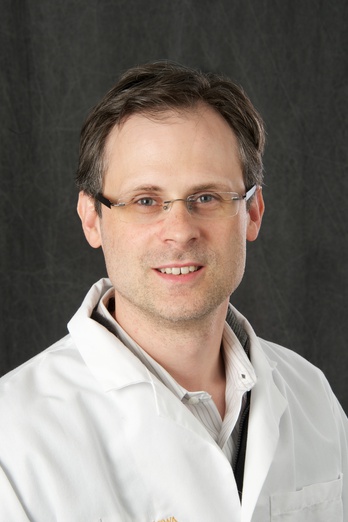
University of Iowa psychiatrist Dr. Michael Lutter reports discovery of 2 genes linked to eating disorders

Lutter,Michael

Eating-1

Eating disorders like anorexia nervosa and bulimia often run in families, but identifying specific genes that increase a person’s risk for these complex disorders has proved difficult.

Now scientists from the University of Iowa and University of Texas Southwestern Medical Center have discovered — by studying the genetics of two families severely affected by eating disorders — two gene mutations, one in each family, that are associated with increased risk of developing eating disorders.

Moreover, the new study shows that the two genes interact in the same signaling pathway in the brain, and that the two mutations produce the same biological effect. The findings suggest that this pathway might represent a new target for understanding and potentially treating eating disorders.

“If you’re considering two randomly discovered genes, the chance that they will interact is small. But, what really sealed the deal for us that the association was real was that the mutations have the same effect,” says Michael Lutter, M.D., Ph.D., UI assistant professor of psychiatry and senior author of the study.

Overall, the study, published Oct. 8 in the Journal of Clinical Investigation, suggests that mutations that decrease the activity of a transcription factor — a protein that turns on the expression of other genes — called estrogen-related receptor alpha (ESRRA) increase the risk of eating disorders.

Anorexia nervosa and bulimia nervosa are fairly common, especially among women. They affect between 1 and 3 percent of women. They also are among the most lethal of all psychiatric diseases; about 1 in 1,000 women will die from anorexia.

Finding genes associated with complex diseases like eating disorders is challenging. Scientists can analyze the genetics of thousands of people and use statistics to find common, low-risk gene variations, the accumulation of which causes complex disorders from psychiatric conditions like eating disorders to conditions like heart disease or obesity.

On the other end of the spectrum are very rare gene variants, which confer an almost 100 percent risk of getting the disease. To track down these variants, researchers turn to large families that are severely affected by an illness.

Lutter and his colleagues were able to work with two such families to identify the two new genes associated with eating disorders.

“It’s basically a matter of finding out what the people with the disorder share in common that people without the disease don’t have,” Lutter explains. “From a theoretical perspective, it’s straightforward. But the difficulty comes in having a large enough group to find these rare genes. You have to have large families to get the statistical power.”

In the new study, 20 members from three generations of one family (10 affected individuals and 10 unaffected), and eight members of a second family (six affected and two unaffected) were analyzed.

The gene discovered in the larger family was ESRRA, a transcription factor that turns on the expression of other genes. The mutation associated with eating disorders decreases ESSRA activity.

The gene found in the second family is a transcriptional repressor called histone deacetylase 4 (HDAC4), which turns off transcription factors, including ESRRA. This mutation is unusual in the sense that it increases the gene’s activity — most mutations decrease or destroy a gene’s activity.

Importantly, the team also found that the two affected proteins interacted with one another; HDAC4 binds to ESRRA and inhibits it.

“The fact that the HDAC4 mutation happens to increase the gene activity and happens to increase its ability to repress the ESSRA protein we found in the other family was just beyond coincidence,” Lutter says.

The two genes are already known to be involved in metabolic pathways in muscle and fat tissue. They also are both regulated by exercise.

In the brain, HDAC4 is very important for regulating genes that form connections between neurons. However, there’s almost nothing known about ESRRA in the brain, although it is expressed in many brain regions that are disrupted in anorexia.

Lutter and his colleagues plan to study the role of these genes in mice and in cultured neurons to find out exactly what they are doing in the brain. They will also look for ways to modify the genes’ activity, with the long-term goal of finding small molecules that might be developed into therapies for eating disorders.

They also plan to study patients with eating disorders and see if other genes associated with the ESSRA/HDAC4 brain pathway are affected in humans.

http://www.sciencedaily.com/releases/2013/10/131008122443.htm

FBI Captures Alleged Silk Road Boss Using His Own Methods

silk road

From an Internet café in San Francisco, a 29-year-old free-market evangelist who called himself “Dread Pirate Roberts” used untraceable web services, an international network of servers and anonymous digital currency to run a global online exchange of cocaine and heroin beyond the reach of the law.

For two years, cybercrime experts from the FBI pored over the secretive online drug bazaar known as Silk Road — an underground operation that had become, by the time the FBI shut it down this week, the venue for $1 billion worth of illegal transactions, according to prosecutors. Seeking the mastermind behind it, investigators began picking up clues: an anonymous posting to a website devoted to hallucinogenic mushrooms, recurring references to an Austrian school of economics, and early clues left on public sites including Google and LinkedIn.

A big break came in July, when a routine inspection of inbound mail from Canada turned up a parcel containing nine counterfeit IDs — each with a different name, but all featuring the photograph of the same man.

According to a 33-page criminal complaint unsealed yesterday in Manhattan federal court, the man in the ID photos was Ross Ulbricht, Silk Road’s alleged overseer. FBI agents arrested Ulbricht in San Francisco the same day at the Glen Park library in San Francisco, where he had gone to log onto a computer, according to a person briefed on the matter.

The criminal complaint against Ulbricht depicts the dark side of Internet commerce. In it, special agent Christopher Tarbell of the FBI’s New York office described Silk Road as “the most sophisticated and extensive criminal marketplace on the Internet today” — a virtual bazaar where buyers could find everything from heroin and hacking software to contact information for hit men in more than 10 different countries.

Meanwhile, on July 10 of this year, customs officials intercepted the package from Canada as part of what the complaint characterized as a routine inspection. The package, addressed to an apartment on 15th Street in San Francisco, contained nine counterfeit IDs, each in a different name, but all featuring a photo of the same person.

Agents from Homeland Security Investigations arrived on July 26 at the 15th Street address. There, according to the complaint, they encountered Ross Ulbricht, whose photo matched those on all nine fake IDs.

Confronted with a fake California driver’s license bearing his photo and birthdate but a different name, Ulbricht avoided answering questions about the purchase of false IDs, according to the complaint. Instead, he volunteered that “hypothetically” anyone could go onto a website named Silk Road and purchase any drugs or counterfeit IDs they wanted. Ulbricht then produced his real ID, a Texas driver’s license, according to the complaint, and explained that he was subletting a room in the apartment for $1,000 a month. According to the complaint, he also said the roommates knew him as “Josh.”

Ulbricht stands accused of narcotics trafficking, money laundering, computer-hacking conspiracy and, in an indictment unsealed yesterday in Maryland, of attempted murder.

Bitcoin Bets Feed Twitter Dreams as Regulators CircleCyber Drug Bazaar’s Alleged Boss Paired EBay Style, Crime
The genius of Silk Road’s design and the reason it eluded the FBI’s grasp for so long, according to the complaint, was its impenetrability. The site was accessible only on a so-called tor network, which is designed to conceal the true Internet addresses of computers using it. Its exclusive reliance on Bitcoin, an anonymous digital currency, added another layer of protection for its buyers and sellers.

Since November 2011, Tarbell’s team made more than 100 purchases of drugs from Silk Road vendors, accepting shipments of ecstasy, cocaine, heroin, LSD and other drugs posted from 10 different countries, including the U.S., according to the complaint.

In the FBI’s bid to identify the individual behind Silk Road, an agent on Tarbell’s team combed through Internet postings and discovered the earliest mention of the site on shroomery.org, an informational website for consumers of “magic mushrooms,” in January 2011.

The posting, from someone with the username altoid, alerted the site’s visitors to Silk Road and asked if anyone had tried it. Two days later, someone using the same username posted a similar message on “bitcointalk.org,” a discussion forum for the virtual currency.

“The two postings created by ’altoid’ on Shroomery and Bitcoin Talk appear to be attempts to generate interest in the site,” Tarbell wrote. “The fact that ’altoid’ posted similar messages about the site on two very different discussion forums, two days apart, indicates that ’altoid’ was visiting various discussion forums…and seeking to publicize the site among the forum users — which, based on my training and experience, is a common online marketing tactic for new websites.”

In October 2011, altoid surfaced again on the Bitcoin forum, seeking an “IT pro” to help build a Bitcoin startup company and directing potential job candidates to the Gmail account of someone named Ross Ulbricht. From a Google profile associated with the account, the FBI learned that Ulbricht had an interest in the Austrian school of economics and the Auburn, Alabama-based Ludwig von Mises Institute. According to the group’s website, it functions as a center of Libertarian political and social theory.

Similar sentiments are voiced on a page of professional networking site LinkedIn that is also attributed to Ulbricht, according to the complaint. In a LinkedIn profile accessed yesterday, a user identified as Ross Ulbricht describes himself as an “investment adviser and entrepreneur” and lists his interests as “trading, economics, physics, virtual worlds, liberty.”

Agents made a connection between Ulbricht and Silk Road: The site’s webmaster, who identified himself as Dread Pirate Roberts, made regular references to Austrian economic theory and the teachings of Mises to justify Silk Road’s existence.

The New York FBI agents weren’t the only lawmen gunning for Silk Road. In April 2012, a federal agent in Maryland began communicating with Dread Pirate Roberts in an undercover capacity, posing as a drug dealer.

In January, the undercover agent completed the sale of a small quantity of cocaine to a Silk Road employee and was paid the equivalent of $27,000 in Bitcoin currency. According to the Maryland indictment, Dread Pirate Roberts subsequently asked the undercover agent to murder an employee the site overseer believed to have stolen money from Silk Road.

During this time, Tarbell’s team in New York tracked the Silk Road webmaster’s online logins to an Internet café on Laguna Street in San Francisco, near an apartment where Ulbricht had moved.

Following the confrontation, Tarbell and his team learned that in the weeks leading up to the discovery of the counterfeit identity papers, Dread Pirate Roberts had sent a series of private e-mails suggesting that he “needed a fake ID,” according to the complaint.

All the while, word of Silk Road and its bazaar of illicit goods and services spread around the Internet. In August, Forbes.com posted an interview with Dread Pirate Roberts that it said was conducted via messages sent through the site. “The highest levels of government are hunting me,” the cyber entrepreneur said, adding: “I can’t take any chances.”

Yesterday afternoon, Ulbricht surfaced at San Francisco’s Glen Park library, a small branch facility where public computers are located in front of the check-out desk. There, according to the person familiar with the matter, he was arrested by the FBI.

The criminal case is U.S. v. Ulbricht, 13-mg-023287; the civil forfeiture case is U.S. v. Ulbricht, 13-cv-06919, U.S. District Court, Southern District of New York (Manhattan).

To contact the reporters on this story: Greg Farrell in New York at gregfarrell@bloomberg.net

To contact the editor responsible for this story: Michael Hytha at mhytha@bloomberg.net

http://www.businessweek.com/news/2013-10-03/fbi-captures-alleged-silk-road-pirate-boss-using-his-own-methods#p2

Thanks to Kebmodee for bringing this to the attention of the It’s Interesting community.

First cases of flesh-eating drug Krokodil surface in US

krokodil640

A man prepares heroin in Zhukovsky, Russia, near Moscow. To produce krokodil, which has a comparable effect to heroin but is much cheaper to make, users mix codeine with gasoline, paint thinner, iodine, hydrochloric acid and red phosphorous.

Krokodil, a flesh-eating drug which first surfaced in Russia more than a decade ago, has reportedly been found in the United States.

Similar to morphine or heroin, krokodil is made by mixing codeine with substances like gasoline, paint thinner, oil or alcohol. That mixture is then injected into a vein, potentially causing an addict’s skin to turn greenish, scaly and eventually rot away.

Dr. Frank LoVecchio, co-medical director at Banner Good Samaritan Poison and Drug Information Center in Arizona, told CBS5 that the first two cases of people using the drug have been reported in the state. He declined to comment on the patients’ conditions.

“As far as I know, these are the first cases in the United States that are reported,” LoVecchio said, adding that the cases are believed to be linked. “So we’re extremely frightened.”

Users of krokodil — or desomorphine — had previously only been found in large numbers in Russia, where 65 million doses of the opiate were seized during the first three months of 2011, Russia’s Federal Drug Control Service told Time.

“This is really frightening,” Dr. Aaron Skolnik, a toxicologist at Banner Good Samaritan Poison and Drug Information Center told MyFoxPhoenix.com. “This is something we hoped would never make it to the U.S. because it’s so detrimental to the people who use it.”

To produce the potentially deadly drug, which has a comparable effect to heroin but is much cheaper to make, users mix codeine with gasoline, paint thinner, iodine, hydrochloric acid and red phosphorous. Codeine, a controlled substance in the United States used to treat mild to moderate pain, is widely available over the counter in Russia.

In 2010, up to a million people, according to various estimates, were injecting the resulting substance into their veins in Russia, thus far the only country worldwide to see it grow into an epidemic, Time reports.

The drug’s sinister moniker — also known as crocodile — refers to the greenish and scaly appearance of a user’s skin at the site of injection as blood vessels rupture and cause surrounding tissues to die. According to reports, the drug first appeared in Siberia and parts of Russia around 2002, but has spread throughout the country in recent years.

Officials at the Washington-based National Institute on Drug Abuse told FoxNews.com in 2011 that they had not heard of the drug prior to an inquiry by FoxNews.com.

Dr. Ellen Marmur, chief of dermatological and cosmetic surgery at the Mount Sinai Medical Center in New York City, told FoxNews.com in 2011 she had never seen any cases involving krokodil, but said it reminded her of “skin popping,” or when intravenous drug users inject a substance directly into their skin due to damaged veins.

“This looks to me a lot like skin popping, what drug users used to do back in the day with heroin and other drugs,” Marmur said. “It just kills the skin, that’s what you’re seeing, big dead pieces of skin.”

Those large pieces of dead skin are referred to as eschars, Marmur said, leaving the user prone to infection, amputation and other complications.

Marmur said at the time that she was concerned the drug could eventually make its way into the United States.

“It’s horrible,” she continued. “These people are the ultimate in self-destructive drug addiction. Once you’re an addict at this level, any rational thinking doesn’t apply.”

Dr. Lewis Nelson, a medical toxicologist at Bellevue Hospital Center in New York, also said in 2011 that he doubted krokodil would reach the United States due to the availability of other cheap, powerful drugs such as black tar heroin and Oxycontin.

“It’s not going to become a club drug, I can guarantee you that,” he said.

http://www.foxnews.com/health/2013/09/26/first-cases-flesh-eating-drug-krokodil-surface-in-us/

Chinese doctor builds new nose on forehead

nose

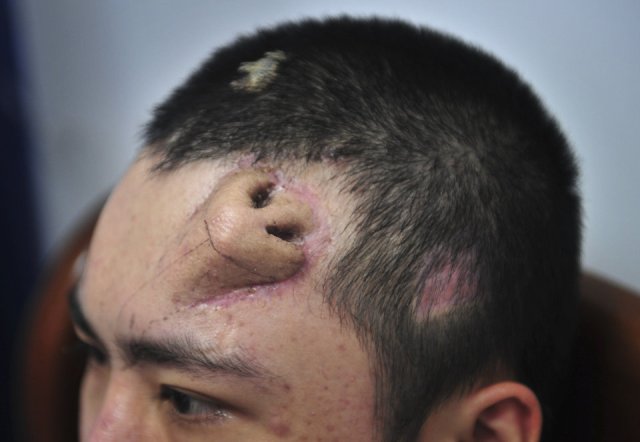
A surgeon in China says he has constructed an extra nose out of a man’s rib cartilage and implanted it under the skin of his forehead to prepare for a transplant in probably the first operation of its kind.

Surgeon Guo Zhihui at Fujian Medical University Union Hospital in China’s southeastern province of Fujian spent nine months cultivating the graft for a 22-year-old man whose nose was damaged.

The striking images of the implant — with the nostril section facing diagonally upward on the left side of the man’s forehead — drew widespread publicity after they began to circulate in Chinese media this week. Guo plans to cut the nose from the forehead while leaving a section of skin still connected, and then rotate and graft it into position in a later operation.

“We were just interested in helping the man and did not expect it would stir up this much attention,” Guo said in an interview Friday with The Associated Press.

Surgeons previously have used cartilage to help rebuild noses in their proper position and are experimenting with growing new ones from stem cells on other parts of the body, such as a forearm. But this was the first known case of building a nose on a forehead.

Alexander Seifalian, a professor of nanotechnology and regenerative medicine at University College London who has worked on transplants using stem cells, said implanting the nose graft in the forehead makes sense because the skin there has the same “structure and texture” as that of a nose.

However, he said it was unclear why the Chinese team built the nose on the forehead rather than in its proper position. A nose graft grown from stem cells would be prepared on another body part first, but this operation is using existing cartilage, Seifalian said.

“They could have made the nose and just put it on the nose, not in the forehead,” Seifalian said. “I don’t know why they put it there.”

However, Seifalian noted that he had not seen any scientific information on the Chinese operation and was just going by media reports.

The patient lost part of his nose in an accident in August 2012 and did not immediately have any reconstruction surgery because he couldn’t afford it, Guo said. An infection later ate away much of his nose cartilage, he said.

Guo said his team examined what remained of the nose and concluded there would be little chance of viably grafting cartilage there, instead building the nose on the forehead. When the new nose is rotated into position and grafted, it will at first have its own blood supply from links to the forehead, before developing new blood vessels. Later surgery will smooth out all of the skin.

The team first expanded skin on the man’s forehead for more than three months before using rib cartilage to build the nose bridge. Lastly, Guo’s team built the nostrils.

“We sculpted the nose three-dimensionally, like carpenters,” he said.

http://news.yahoo.com/chinese-doctor-builds-nose-mans-forehead-023520476.html

Thanks to Mr. Cuomo and Kebmodee for bringing this to the attention of the It’s Interesting community.

Man becomes drunk when stomach turns into brewery

beer_1016300_fullwidth_620x350

When a 61-year-old Texas man came into an emergency room claiming he was dizzy and was found to have a blood alcohol concentration of 0.37 percent, doctors assumed he was drunk. Despite the fact the man claimed he hadn’t consumed alcohol that day, most doctors still thought he was a “closet drinker,” NPR reported.

It turned out that those medical professionals were wrong: the man had “auto-brewery syndrome.” His stomach contained so much yeast that he was making his own in-house brew, literally. Before he was diagnosed with the syndrome, the patient’s wife — who was a nurse — was so concerned with her husband’s constantly drunk condition that she had him regularly tested with a Breathalyzer. He would record numbers as high as 0.33 to 0.4 percent, considerably higher than the U.S. legal driving limit of 0.08 percent.

Barbara Cordell, the dean of nursing at Panola College in Carthage, Texas, and Dr. Justin McCarthy, a gastroenterologist in Lubbock, Texas, decided to figure out what was really going on.

“He would get drunk out of the blue — on a Sunday morning after being at church, or really, just anytime,” Cordell told NPR.

After isolating the patient for 24 hours and making sure there was no alcohol or sugar available, the team continued to check his blood alcohol level. The levels were as high as 0.12 percent without any alcohol consumption. The doctors then realized that he must have been infected with high levels Saccharomyces cerevisiae, a kind of yeast that is used in alcohol fermentation and baking. They suspected that because the patient had been put on antibiotics following surgery for a broken foot in 2004, the medications might have killed all his gut bacteria. This allowed the yeast to thrive in his body.

The Environmental Protection Agency said the organism is not considered to be a pathogen, and some people take large quantities of the yeast daily as part of a “health food” diet.”No one takes potential danger from Saccharomyces cerevesiae seriously,” Dr. Michael D. Gershon, a professor in the department of pathology and cell biology at Columbia University in New York, told CBSNews.com.

Gershon added that the yeast is so non-threatening that it is often used by researchers in studies without any additional precautions.

Interviews revealed the man ate a lot of carbohydrates. That meant each time the patient ate something with starch, the high amounts of yeast in his body turned the sugars into ethanol or ethyl alcohol, which made him drunk from the inside. To cure his illness, the patient was placed on a low-carbohydrate diet and prescribed antifungal medication to get rid of the excess yeast.

His case study was published in the International Journal of Clinical Medicine earlier this summer.

The researchers acknowledge that this condition is extremely rare. Only a handful of cases have been reported in the last three decades, including a 13-year-old girl with short gut syndrome who would get drunk if she ate carbohydrates. Another 3-year-old with the same condition became drunk when she had a fruit drink high in carbohydrates.

“This is a rare syndrome but should be recognized because of the social implications such as loss of job, relationship difficulties, stigma, and even possible arrest and incarceration,” the authors noted. “It would behoove health care providers to listen more carefully to the intoxicated patient who denies ingesting alcohol.”

Thanks to Mike Moore for bringing this to the attention of the It’s Interesting community.

University of Iowa researchers uncover mechanism of infective endocarditis

heart infection

University of Iowa researchers have discovered what causes the lethal effects of staphylococcal infective endocarditis – a serious bacterial infection of heart valves that kills approximately 20,000 Americans each year. According to the UI study, the culprits are superantigens — toxins produced in large quantities by Staphylococcus aureus bacteria — which disrupt the immune system, turning it from friend to foe.

“The function of a superantigen is to ‘mess’ with the immune system,” says Patrick Schlievert, PhD, UI professor and chair of microbiology at the UI Carver College of Medicine. “Our study shows that in endocarditis, a superantigen is over-activating the immune system, and the excessive immune response is actually contributing very significantly to the destructive aspects of the disease, including capillary leakage, low blood pressure, shock, fever, destruction of the heart valves, and strokes that may occur in half of patients.”

Other superantigens include toxic shock syndrome toxin-1, which Schlievert identified in 1981 as the cause of toxic shock syndrome.

Staph bacteria is the most significant cause of serious infectious diseases in the United States, according to the Centers for Disease Control and Prevention (CDC), and infective endocarditis is the most serious complication of staph bloodstream infection. This dangerous condition affects approximately 40,000 people annually and has a death rate of about 50 percent. Among patients who survive the infection, approximately half will have a stroke due to the damage from the aggressive infection of the heart valves.

Despite the serious nature of this disease, little progress has been made over the past several decades in treating the deadly condition.

The new study, led Schlievert, and published Aug. 20 in the online open-access journal mBio, suggests that blocking the action of superantigens might provide a new approach for treating infective endocarditis.

“We have high affinity molecules that neutralize superantigens and we have previously shown in experimental animals that we can actually prevent strokes associated with endocarditis in animal models. Likewise, we have shown that we can vaccinate against the superantigens and prevent serious disease in animals,” Schlievert says.

“The idea is that either therapeutics or vaccination might be a strategy to block the harmful effects of the superantigens, which gives us the chance to do something about the most serious complications of staph infections.”

The UI scientists used a strain of methicillin resistant staph aureus (MRSA), which is a common cause of endocarditis in humans, in the study. They also tested versions of the bacteria that are unable to produce superantigens. By comparing the outcomes in the animal model of infection with these various bacteria, the team proved that the lethal effects of endocarditis and sepsis are caused by the large quantities of the superantigen staphylococcal enterotoxin C (SEC) produced by the staph bacteria.

The study found that SEC contributes to disease both through disruption of the immune system, causing excessive immune response to the infection and low blood pressure, and direct toxicity to the cells lining the heart.

Low blood flow at the infection site appears to be one of the consequences of the superantigen’s action. Increasing blood pressure by replacing fluids reduced the formation of so-called vegetations – plaque-like meshwork made up of cellular factors from the body and bacterial cells — on the heart valves and significantly protected the infected animals from endocarditis. The researchers speculate that increased blood flow may act to wash away the superantigen molecules or to prevent the bacteria from settling and accumulating on the heart valves.

In addition to Schlievert, the research team included Wilmara Salgado-Pabon, PhD, the first author on the study, Laura Breshears, Adam Spaulding, Joseph Merriman, Christopher Stach, Alexander Horswill, and Marnie Peterson.

The research was funded in part by grants from the National Institutes of Health (AI74283, AI57153, AI83211, and AI73366).

http://www.infectioncontroltoday.com/news/2013/08/bacterial-toxins-cause-deadly-heart-disease.aspx

Ohio man orders gun safe on Internet and discovers almost 300 pounds of marijuana inside

HT_pot_in_gun_safe_ml_130816_16x9_608

Authorities in Ohio say a man who ordered a gun safe online opened it up only to discover 280 pounds of marijuana inside.

Shelby County Sheriff John Lenhart in western Ohio says the safe was made in Nogales, Mexico and that it was sent by truck to Ohio.

He says the marijuana has a street value of $420,000.

Federal authorities who are investigating say the truck driver who brought the shipment into the United States is now missing.

The Ohio sheriff says that truck was carrying a full shipment of safes, but none of the others contained any drugs.

He says the safe with the marijuana was delivered to Ohio in June, but authorities have kept quiet about it while they looked into how the safe got into the U.S.

http://abcnews.go.com/US/wireStory/gun-safe-ohio-man-filled-marijuana-19995543

Pea plant grows inside man’s lung

ccccc

Ron Sveden had been battling emphysema for months when his condition deteriorated.

He was steeling himself for a cancer diagnosis when X-rays revealed the growth in his lung.

Doctors believe that Mr Sveden ate the pea at some point, but it “went down the wrong way” and sprouted.

“One of the first meals I had in the hospital after the surgery had peas for the vegetable. I laughed to myself and ate them,” Mr Sveden told a local Boston TV reporter.

Mr Sveden said the plant was about half an inch (1.25cm) in size.

“Whether this would have gone full-term and I’d be working for the Jolly Green Giant, I don’t know. I think the thing that finally dawned on me is that it wasn’t the cancer,” Mr Sveden said.

http://www.bbc.co.uk/news/world-us-canada-10945050

Florida man wakes up with no memory of his past and speaking only Swedish

swede

Doctors are looking into the mystery of a Florida man who awoke speaking only Swedish, with no memory of his past, after he was found unconscious four months ago at a Southern California motel.

Michael Boatwright, 61, woke up with amnesia, calling himself Johan Ek.

Boatwright was found unconscious in a Motel 6 room in Palm Springs, Calif., in February. After police arrived, he was transported to the Desert Regional Medical Center in Palm Springs where he woke up.

Hospital officials said Boatwright may have been in town for a tennis tournament in the Coachella Valley. He was found with a duffel bag of exercise clothes, a backpack and tennis rackets. He also carried four forms of identification — a passport, a California identification card, a veteran’s medical card and a Social Security card — all of which identified him as Michael Thomas Boatwright.

Palm Springs police have documented his information in case anyone lists Boatwright as missing or wanted, authorities said.

In March, doctors diagnosed Boatwright with Transient Global Amnesia, a condition triggered by physical or emotional trauma that can last for several months.
The rare mental disorder is characterized by memory loss, “sudden and unplanned travel,” and possible adoption of a new identity, according to the Sun.

After an extensive search, medical personnel and social workers have been unable to locate Boatwright’s next of kin. Authorities are still unsure of his birthplace, listed on his ID as Florida — photos show him in Sweden at a young age.

Boatwright doesn’t recall how to exchange money, take public transportation, or seek temporary housing like homeless shelters or hotels, the social worker assigned to his case, Lisa Hunt-Vasquez said.

He doesn’t remember his son and two ex-wives, either.

He has no income or insurance, further complicating his treatment at Desert Regional. And he has little money he can access — only $180. He also has a few Chinese bank accounts, but can only access one account, which holds $7, according to the newspaper.

Doctors don’t know how much longer he will be able to stay at the centre — aside from his amnesia, Boatwright is in good health. The hospital is currently looking for alternatives that would keep him off the streets. For now, Boatwright is unsure of both his past and his future.

“Sometimes it makes me really sad and sometimes it just makes me furious about the whole situation and the fact that I don’t know anybody, I don’t recognize anybody,” Boatwright told the newspaper.

Last year, a North Dakota college student who went missing for nearly a week before turning up in Arizona said she had a bout of amnesia and didn’t know who she was.

Amber Glatt, a 22-year-old Valley City State University student, vanished on the Fourth of July, prompting aerial searches. She contacted her mother five days later from the Grand Canyon. Her mother said Glatt has had recurring amnesia since suffering a head injury years ago.

Glatt told WDAY-TV that after she lost her memory she met a man in a bar who let her tag along on his trip to the Grand Canyon. She said the man eventually saw online that she’d been reported missing and alerted her.

Glatt regained most of her memory.

http://www.theprovince.com/news/Florida+wakes+with+memory+past+speaking+only+Swedish/8666679/story.html