Autism may be linked to obesity during pregnancy


Obesity during pregnancy may increase chances for having a child with autism, provocative new research suggests.

It’s among the first studies linking the two, and though it doesn’t prove obesity causes autism, the authors say their results raise public health concerns because of the high level of obesity in this country.

Study women who were obese during pregnancy were about 67 percent more likely than normal-weight women to have autistic children. They also faced double the risk of having children with other developmental delays.

On average, women face a 1 in 88 chance of having a child with autism; the results suggest that obesity during pregnancy would increase that to a 1 in 53 chance, the authors said.

The study was released online Monday in Pediatrics.

Since more than one-third of U.S. women of child-bearing age are obese, the results are potentially worrisome and add yet another incentive for maintaining a normal weight, said researcher Paula Krakowiak, a study co-author and scientist at the University of California, Davis.

Previous research has linked obesity during pregnancy with stillbirths, preterm births and some birth defects.

Dr. Daniel Coury, chief of developmental and behavioral pediatrics at Nationwide Children’s Hospital in Columbus, Ohio, said the results “raise quite a concern.”

He noted that U.S. autism rates have increased along with obesity rates and said the research suggests that may be more than a coincidence.

More research is needed to confirm the results. But if mothers’ obesity is truly related to autism, it would be only one of many contributing factors, said Coury, who was not involved in the study.

Genetics has been linked to autism, and scientists are examining whether mothers’ illnesses and use of certain medicines during pregnancy might also play a role.

The study involved about 1,000 California children, ages 2 to 5. Nearly 700 had autism or other developmental delays, and 315 did not have those problems.

Mothers were asked about their health. Medical records were available for more than half the women and confirmed their conditions. It’s not clear how mothers’ obesity might affect fetal development, but the authors offer some theories.

Obesity, generally about 35 pounds overweight, is linked with inflammation and sometimes elevated levels of blood sugar. Excess blood sugar and inflammation-related substances in a mother’s blood may reach the fetus and damage the developing brain, Krakowiak said.

The study lacks information on blood tests during pregnancy. There’s also no information on women’s diets and other habits during pregnancy that might have influenced fetal development.

There were no racial, ethnic, education or health insurance differences among mothers of autistic kids and those with unaffected children that might have influenced the results, the researchers said.

http://www.usatoday.com/news/health/story/2012-04-09/Autism-obesity-pregnancy/54126558/1

‘Kony 2012’ Director Suffers Psychotic Break


The director of a wildly popular video about brutal African warlord Joseph Kony has been diagnosed with brief psychosis and is expected to stay in the hospital for weeks, his wife said Wednesday.

Jason Russell, 33, was hospitalized last week in San Diego after witnesses saw him pacing naked on a sidewalk, screaming incoherently and banging his fists on the pavement. He was in his underwear when police arrived.

His outburst came after the video’s sudden success on the Internet brought heightened scrutiny to Invisible Children, the group he co-founded in 2005 to fight African war atrocities.

Russell’s family said that the filmmaker’s behavior was not due to drugs or alcohol. He was given a preliminary diagnosis of brief reactive psychosis, in which a person displays sudden psychotic behavior.

“Doctors say this is a common experience given the great mental, emotional and physical shock his body has gone through in these last two weeks. Even for us, it’s hard to understand the sudden transition from relative anonymity to worldwide attention — both raves and ridicules, in a matter of days,” Danica Russell said in a statement.

Researchers don’t know how many people suffer from the condition, mainly because symptoms are fleeting, but those with personality disorders are at greater risk for having an episode. Brief reactive psychosis is triggered by trauma or major stress such as an accident or death of a loved one. Other stressors can include sleep deprivation or dehydration.

Symptoms include hallucinations, delusions and strange speech and behavior. People typically recover within a few weeks without medication. Others have to take antipsychotic drugs to alleviate symptoms or undergo talk therapy to cope.

The condition causes “temporary debilitation, but in general people have good recoveries,” said Dr. Stephen Marder, professor of psychiatry at the University of California, Los Angeles.

In some cases, doctors say brief reactive psychosis can signal the beginning of a more serious mental illness such as schizophrenia.

Danica Russell said it may be months before her husband returns to San Diego-based Invisible Children.

“Jason will get better. He has a long way to go, but we are confident that he will make a full recovery,” she said.

Russell narrates the 30-minute video “Kony 2012,” which has been viewed more than 84 million times on YouTube since it was released this month. In the video, Russell talks to his young son, Gavin, about Kony and the Lord’s Resistance Army.

The Invisible Children group has been criticized for not spending enough directly on the people it intends to help and for oversimplifying the 26-year-old conflict involving the LRA and its leader, Kony, a bush fighter wanted by the International Criminal Court for crimes against humanity.

Invisible Children has acknowledged the video overlooked many nuances but said it was a “first entry point” that puts the conflict “in an easily understandable format.” It said money that directly benefits the cause accounted for more than 80 percent of its spending from 2007 to 2011.

Read more: http://www.sfgate.com/cgi-bin/article.cgi?f=/n/a/2012/03/21/national/a083749D70.DTL#ixzz1prY2sYn4


Maryland Couple has 5,000 Cabbage Patch Dolls and has built a $200,000 amusement park for them

Kevin, a cheery, curled-top boy, extends an invitation to his friend by cell phone, “I’d love to have you come over and play.”

For most children that play date at Magic Crystal Valley in Maryland would be a dream come true: riding a miniature train, a motorized swing and even a hot-air balloon that sweeps them 30 feet in the air.

But Kevin, and his hundreds of friends from around the country, are Cabbage Patch Kids, and their “parents” are humans who are obsessed with the ugly, but cuddly dolls that hit the market by storm in 1983.

Pat and Joe Prosey own 5,000 and they consider them their own children, even though the 64-year-olds have a real-life grown daughter.

“They are kids. We don’t use the word D-O-L-L — they might hear,” said Joe, a former shipyard worker who built this special playground for other enthusiasts.

They are collectors, but say it really isn’t about the money, but an obsession with their “babies.”

The obsession all began with Pat Prosey, a former paint store technician, who had loved baby dolls as a girl. “Mother said one day I would probably collect some type of doll when I was older,” she said.

The soft dolls with the wrinkled faces were created by Xavier Roberts, a 21-year-old art student from Georgia, who adopted a German technique for sculpture with his mother’s quilting skills, according to his the Cabbage Patch Kids website.

His concept — adoptable “Little People” — was developed in 1976. Each doll was different and came with a double-barreled name and a birth certificate.

By the end of 1981, the Cabbage Patch doll had made the cover of Newsweek magazine, and he had sold nearly 3 million kids. By 1990, 65 million had been “adopted,” according to his web site.

Pat Prosey got her first Cabbage Patch Meg in 1985 for $50. “She was kind of cute and when I got her got her home, Joe thought I had lost my mind,” she said.

But soon, she found a boy, named Kevin, and today he is the spokesman for what has become their personal Cabbage Patch empire.

After Meg and Kevin, came the “preemies” and the ones with freckles. “They went from freckles to teeth to glasses and toothbrushes, and before you know it, our whole house in Baltimore was filled with Cabbage Patch Kids,” said Pat Prosey.

But when her father offered the couple a farm two hours south in Leonardstown, Md., they jumped at the chance to find room for their growing collection.

She said she thought, “Now, I could actually build a place for my kids,” and the amusement park was born.

As for Joe Prosey, he got hooked in the 1980s one day when he was at a waterskiing event and saw a miniature sample of a wet suit hanging on a shop wall. “I thought, that’ll fit a Cabbage Patch Kid.”

The following weekend, he dressed Kevin the wetsuit and took him waterskiing — even though has he got strange looks from others.

Soon, Joe Prosey was writing a column in a collectors’ newsletter using Kevin’s voice. “He was a real kid doing real stuff,” he said. “There was such response, a woman phoned us and asked, could I do it again?”

Then, as they met more Cabbage Patch parents, the Proseys sent gifts back and forth — eventually arranging play dates at their dream playground.

Now the couple displays and sells Cabbage Patch originals. Those from the 70s and 80s can sell for as much as $25,000 to $35,000 a piece.

“Xavier Robert told us, “If you want to prosper at this thing, you have to live the fantasy day in and day out,” said Joe Prosey. “The collectors will love you.”

Experts say there is a fine line between collecting and hoarding, which a serious psychological disorder.

“With hoarding, we look at three main behaviors: one, acquiring too many possessions; second, having great difficulty discarding something; and three difficulty organizing,” said Julie Pike, a clinical psychologist from the Anxiety Disorder Treatment Center in Durham, N.C. “But there is a lot of overlap.”

Pike has been featured on TLC’s reality show, “Hoarding: Buried Alive,” and spoke with ABCNews.com last year.

Collectors are usually well-organized and know exactly where each item is and what they have. They are also proud, not ashamed, of their possessions, she said.

“But if collectors get in a place where they are spending so much money that they can’t pay their mortgage, that’s a problem,” Pike said. “Or if they are spending so much time at it that they can’t go to their job or leave their house.”

Pat Prosey insists she loves her “fantasy world” and the couple has always had “a roof over our heads, food in our mouths and clothes on our back.”

“You can walk out of every day life and there is no harm done, no foul play and have a good time,” she said. “People pay $2 million for a painting — is that crazy? I love my Cabbage Patches like another person loves a Rembrandt or a shiny new car.”

http://abcnews.go.com/Health/crazy-obsession-couple-owns-5000-cabbage-patch-kids/story?id=15828541#.T1cbryM2GRC

Nomophobia


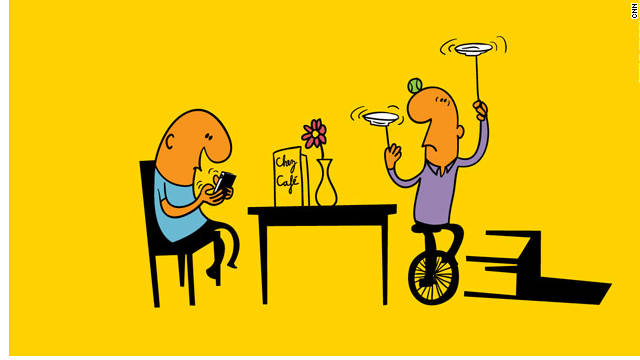
According to recent research sponsored by SecurEnvoy, an internet security firm, more people feel anxious and tense when they are out of reach of their phone — and the younger they are, the more likely the stress.

Known as “nomophobia,” or “no mobile-phone phobia,” a recent online survey of 1,000 people in the UK found that almost two thirds (66%) of respondents were afflicted, a rise of 11% when compared to a similar study four years ago.

“Some people get panic attacks when they are not with their phones,” said Michael Carr-Gregg, an adolescent psychologist working in Melbourne.

“Others become very anxious and make all endeavors to locate the mobile phone. I have clients who abstain from school or their part-time jobs to look for their phones when they cannot find them in the morning.”

CNN Photos: De-Vice: Our mobile addiction

According to the survey, the younger you are, the more prone you are to nomophobia. The youngest age group (18 -24) tops the nomophobic list at 77%, which is 11% more than that of the next group — those aged 25-34.

“This is the most tribal generation of young people,” said Carr-Gregg. “Adolescents want to be with their friends on a 24-hour basis.”

Women are also more likely to be unnerved by cell phone separation, with 70% of respondents reporting the malady compared to 61% of men. Andy Kemshall, the CTO and co founder of secure Envoy, believes that may be because men are more likely to have two phones and are less likely to misplace both — 47% of men carry two phones, compared to only 33% of women.

Major drivers of nomophobia include boredom, loneliness, and insecurity, said Carr-Gregg, while some young nomophobes cannot bear solitude. “Many of my clients go to bed with their mobile phones while sleeping just like how one will have the teddy bear in the old days,” he said.

“While teddy doesn’t communicate, the phone does,” said Carr-Gregg, adding insomnia to the list of potential problems.

“This reduced the amount of time to reflect,” he said. “Some kids cannot entertain themselves. The phone has become our digital security blanket.”

As smartphone penetration spreads across the globe, so does nomophobia. On a visit to Singapore in February this year, Carr-Gregg spoke to students from a peer support group at the United World College and identified similar problems.

“There is no doubt that nomophobia is international,” he said. “[But] without phones, there will not be nomophobia.”

Meanwhile, Indian researchers have also evaluated mobile phone dependence among students at M.G.M. Medical College and the associated hospital of central India. India, after China, is the second largest mobile phone market in the world. The Telecom Regulatory Authority of India (TRAI) reported that there were 884.37 million mobile connections in India as of November, while China had 963.68 million.

The cross-sectional study, published by the Indian Journal of Community Medicine three years ago, recruited 200 medical students and scholars. About one in five students were nomophobic, results showed. The study claimed that the mobile phone has become “a necessity because of the countless perks that a mobile phone provides like personal diary, email dispatcher, calculator, video game player, camera and music player.”

“There is an increase in the nomophobic population in India because the number of mobile phone users has increased,” said Dr. Sanjay Dixit, one the researchers and the head of the Indian Journal of Community Medicine. “We are currently doing another research on mobile phone dependency, it’s not published yet, but analysis shows that about 45% of the Indian population, not just medical students, is nomophobic.”

With the augmented ownership and usage of smartphones among adolescents, Dixit says the young population is more at risk, partly because they can access the Internet through phones more easily, increasing the time spent on phones.

“We found out that people who use mobile phones for more than three hours a day have a higher chance of getting nomophobia,” he said, warning this can pose potential dangers.

Accidents lurk while nomophobes fix their attention on phones. According to Dixit, up to 25% nomophobes reported accidents while messaging or talking on the phone, which includes minor road accidents, falling while going upstairs or downstairs and stumbling while walking. More than 20% also reported pain in the thumbs due to excessive texting.

“One could look at this as a form of addiction to the phone,” said Eric Yu Hai Chen, a psychiatrist and professor at The University of Hong Kong. “The fear is part of the addiction. The use of hand phone has some features that predispose this activity to addiction, similar to video games, naming, easy access.”

To tackle anxiety and accidents induced by phones, Dixit suggests switching off the phone, especially while driving. “People can also carry a charger all the time,” he said. “Our study shows that the no-battery-situation upsets nomophobes the most.

“People can also prepay phone cards for emergency calls and credit balance in phones to ensure a constant and functioning network,” he said. Other solutions include supplying friends with an alternate contact number and storing important phone numbers somewhere else as backups.

“Enforcing a period when handset is turned off can help loosen its hold over everyday life,” said Dixit. Sometimes, the problem can even be the cure.

“One of my clients actually makes use mobile phone apps to deal with anxiety,” said Carr-Gregg. “It’s called iCounselor Anxiety.”

The launch of the app presents users with a scale to rate their anxiety levels from 1 to 10, where 10 is “panicked.” After choosing the level, ten recommendations of calming activities will be suggested, followed by instructions to change the user’s thoughts, so to change subsequent feelings.

“It is almost like having a psychologist in your phone,” said Carr-Gregg.

Prevalent it may be, nomophobia, however, is not yet a qualified phobia.

“Nomophobia is not included in the DSM [Diagnostic and Statistical Manual of Mental Disorders] yet,” said Dixit. “But it is an up coming problem. For the first time on this continent [India], we are trying to make it more scientific,” he added, referring to his undergoing research on nomophobic India.

http://www.cnn.com/2012/03/06/tech/mobile/nomophobia-mobile-addiction/index.html?hpt=hp_c4

PICA: Woman Eats 4,000 Sponges


A DENTAL nurse told yesterday how she has EATEN 4,000 washing-up sponges due to a rare disorder.

Kerry Trebilcock, 21, has also munched more than 100 bars of SOAP.

She suffers from pica, which causes victims to crave objects that are not food.

Kerry, of Mylor, Cornwall, said: “One day I will beat this and be able to have a shower or do the washing-up without feeling hungry.”

Sponge eater Kerry said she likes to spice up her bizarre snacks with hot sauce or mustard.

Sometimes, she dips them in tea or hot chocolate like biscuits.

She also chomps on chunks of soap — but only organic fruit-flavoured varieties, with lemon and lime her favourite.

Kerry said: “I have been very particular about the type of sponges and soaps I’d eat and how I’d prepare them.

“If I went out for the day I’d carry a small plastic bag of cut-up pieces of sponge with some tomato and BBQ sauce in Tupperware. I was never without a ‘snack’.”

Other pica sufferers eat metal, coal, sand, chalk — or even lightbulbs and furniture.

Petite Kerry, who weighs just 8st, has endured shocking stomach cramps, constipation and diarrhoea.

And although she has cut down on her sponge munching, she has been unable to totally shake the condition.

At one point Kerry was eating five a day topped with hot relish, BBQ sauce, ketchup, mustard, jam or honey.

She said: “The sauces and dipping the sponges in drinks softened them — and I’d chew them until the flavour was gone. Then I would swallow the sponge.”

Sponges are commonly made from cellulose wood fibres or foamed plastic polymers.

Organic soap contains olive or palm oil, glycerin and plant scents, plus oatmeal to lift off dead skin.

Kerry’s eating habits changed after a holiday to Morocco in 2008, during which she picked up an infection of hookworm, a parasite that lives in the small intestine.

At first, she began craving junk food. But then something strange happened.

She said: “After one dinner where I ate a double helping of lasagne and a tub of ice cream, I still felt hungry.

“To distract myself, I decided to wash the dishes. I took out a new sponge from a packet and had an overwhelming desire to eat it.

“I sat down with a glass of water and chewed the sponge until it was gone.

“It tasted of nothing but I found eating it enjoyable.

“Finally my hunger was gone and my stomach felt satisfied.”

Afterwards, though, she felt embarrassed and scared — and cried herself to sleep.

But the next morning, as she washed herself with lemon and lime soap, she had an urge to eat some and swallowed a chunk.

She said: “I knew something was very wrong with me but I didn’t want to tell anyone as I felt like a freak. But after a week I’d eaten nine sponges and over a pound of organic soap.”

Her hookworm infection was diagnosed by her GP but she kept quiet about her cravings in case he thought she was mad.

She said: “I would go to the supermarket and buy over 40 sponges and different types of organic soap.

“It made me hungry just smelling all the different soap products in the cleaning aisle. The cashiers joked that I must love cleaning!”

Kerry, who also eats normal food, finally confided to a friend in 2009.

And after seeing the doctor again, she was told she had pica and could seriously damage her digestive system.

A programme of counselling and vitamins has set her on the road to recovery. And she is determined to succeed. But it is a slow and arduous process.

Kerry said: “I still have a one-inch square of sponge and three teaspoons of organic soap with each meal.

“But I am making progress and speak to other sufferers of pica on internet forums, which helps.

“There are some out there far worse than me who eat car tyres, spoons and even sofas.”

Kerry is trying to curb her pangs with Floral Gum sweets.

She said: “They taste like soap so they help me get the flavour I desire without doing any damage. I know one day I will beat this.”

Kerry’s student sister Jody, 20, told how the family initially found her sponge munching hard to understand.

She said: “Watching her eat a sponge or soap was extremely weird. But Kerry has educated us all about pica.

“I’m so proud she has worked hard to fight this condition and is recovering through counselling.

“She is really brave to talk about it so openly.”

http://www.thesun.co.uk/sol/homepage/news/4161108/Girl-eats-4000-brwashing-up-sponges.html

The Forgetting Pill Now Under Development

Even though Post Traumatic Stress Disorder is triggered by a stressful incident, it is really a disease of memory. The problem isn’t the trauma—it’s that the trauma can’t be forgotten. Most memories, and their associated emotions, fade with time. But PTSD memories remain horribly intense, bleeding into the present and ruining the future.

Neuroscientists have a molecular explanation of how and why memories change. In fact, their definition of memory has broadened to encompass not only the cliché cinematic scenes from childhood but also the persisting mental loops of illnesses like PTSD and addiction—and even pain disorders like neuropathy. Unlike most brain research, the field of memory has actually developed simpler explanations. Whenever the brain wants to retain something, it relies on just a handful of chemicals. Even more startling, an equally small family of compounds could turn out to be a universal eraser of history, a pill that we could take whenever we wanted to forget anything.

And researchers have found one of these compounds.

In the very near future, the act of remembering will become a choice.

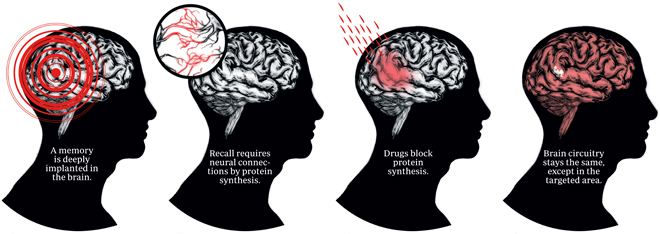
1. Pick a memory.

It has to be something deeply implanted in the brain, a long-term memory that has undergone a process called consolidation—a restructuring of neural connections.


2.  Recall requires neural connections by protein synthesis.

To remember something, your brain synthesizes new proteins to stabilize circuits of neural connections.  To date, researchers have identified one such protein, called PKMzeta.  Before trying to erase the targeted memory, researchers would ensure that it was ensconsed by having the patient write down an account of the event or retell it aloud several times.

3.  Nuke the memory.

To delete the memory, researchers would administer a drug that blocks PKMzeta and then ask the patient to recall the event again. Because the protein required to reconsolidate the memory will be absent, the memory will cease to exist. Neuroscientists think they’ll be able to target the specific memory by using drugs that bind selectively to receptors found only in the correct area of the brain.

4.  Everything else is fine.

If the drug is selective enough and the memory precise enough, everything else in the brain should be unaffected and remain as correct—or incorrect—as ever.

http://www.wired.com/magazine/2012/02/ff_forgettingpill/

Skin Cancer Drug Serendipitously Discovered to Treat Alzheimer’s Disease in Mice


Scientists say they “serendipitously” discovered that a drug used to treat a type of cancer quickly reversed Alzheimer’s disease in mice.

“It’s really exciting,” said Maria Carrillo, senior director for medical and scientific relations for the Alzheimer’s Association. “They saw very positive and robust behavior effects in the mice.”

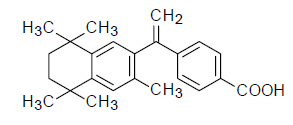
In the study, researchers at Case Western Reserve University School of Medicine gave mice mega-doses of bexarotene, a drug used to treat a type of skin cancer called cutaneous T-cell lymphoma. Within 72 hours, the mice showed dramatic improvements in memory and more than 50% of amyloid plaque — a hallmark of Alzheimer’s disease — had been removed from the brain.

The study was published Thursday in the journal Science.

Gary Landreth, the lead researcher at Case Western, cautioned that even though his results were impressive in mice, it may turn out not to work in people.

“I want to say as loudly and clearly as possible that this was a study in mice, not in humans,” he said. “We’ve fixed Alzheimer’s in mice lots of times, so we need to move forward expeditiously but cautiously.”

Mice — and humans — with Alzheimer’s have high levels of a substance called amyloid beta in their brain. Pathology tests on the mice showed bexarotene lowered the levels of amyloid beta and raised the levels of apolipoprotein E, which helps keep amyloid beta levels low.

Landreth said he hopes to try the drug out in healthy humans within two months, to see if it has the same effect.

Those participating in the trial would be given the standard dose that cancer patients are usually given.

Researchers tested the memories of mice with Alzheimer’s both before and after giving them bexarotene. For example, the Alzheimer’s mice walked right into a cage where they’d previously been given a painful electrical shock, but after treatment with bexarotene, the mice remembered the shock and refused to enter the cage.

In another test, the scientists put tissue paper in a cage. Normal mice instinctively use tissues in their cage to make a nest, but mice with Alzheimer’s can’t figure out what to do with the tissues. After treatment with the drug, the Alzheimer’s mice made a nest with the paper.

Carrillo said one of the major advantages of bexarotene is that it’s already been approved by the Food and Drug Administration for use in humans, which means the researchers can move into human trials sooner than if it were a completely new drug.

The Alzheimer’s Foundation is funding Case Western’s next phase of research, which will involve using bexarotene at the levels used on cancer patients, Landreth said. Since the drug does have some side effects — it can increase cholesterol, for example — he hopes to use it in even lower levels as the study goes on.

Landreth said his lab had been working on other drugs for Alzheimer’s for 10 years when a graduate student, Paige Cramer, decided to try bexarotene, which works on a receptor involved in amyloid beta clearance. Some other drugs that worked in mice were too toxic to use in humans.

“We’re really lucky that bexarotene is a great drug with an acceptable safety profile,” he said. “This doesn’t happen very many times in life.”

http://www.cnn.com/2012/02/09/health/us-cancer-drug-alzheimers/index.html?hpt=hp_bn10

‘Magic Mushrooms’ May Treat Depression


Rave-goers and visitors to Amsterdam before December 2008 may be intimately familiar with magic mushrooms, but there’s little scientific knowledge on what happens to the brain while tripping.

Now it appears that more research is warranted. A growing number of studies suggested that perhaps the mushrooms’ key ingredient could work magic for certain mental disorders.

New research in Proceedings of the National Academy of Sciences sheds light on why one of the mushrooms’ hallucinogenic chemical compounds, psilocybin, may hold promise for the treatment of depression. Scientists explored the effect of psilocybin on the brain, documenting the neural basis behind the altered state of consciousness that people have reported after using magic mushrooms.

“We have found that these drugs turn off the parts of the brain that integrate sensations – seeing, hearing, feeling – with thinking,” said David Nutt, co-author of the study and researcher at Imperial College London in the United Kingdom.

Nutt is also Britain’s former chief drug adviser, who has published controversial papers about the relative harms of various drugs. He was asked to leave his government position in 2009 because “he cannot be both a government adviser and a campaigner against government policy,” according to a letter in the Guardian from a member of the British Parliament.

Psilocybin is illegal in the United States and considered a Schedule 1 drug, along with heroin and LSD. Schedule 1 drugs “have a high potential for abuse and serve no legitimate medical purpose in the United States,” according to the Department of Justice.

But in the early stages of research on psilocybin, there’s been a bunch of good news for its medicinal potential: psilocybin has shown to be helpful for terminally ill cancer patients dealing with anxiety, and preliminary studies on depression are also promising.

Nutt’s study is also preliminary and small, with only 30 participants. His group used magnetic resonance imaging (MRI) to look at how the brain responds to psilocybin, from normal waking consciousness to a psychedelic state.

The study found that the more psilocybin shuts off the brain, the greater the feeling of being in an altered state of consciousness, he said. It’s not the same as dreaming, because you’re fully conscious and aware, he said.

The medial prefrontal cortex, the front part of the brain in the middle, appears to be crucial – it determines how you think, feel and behave. Damage to it produces profound changes in personality, and so if you switch it off, your sense of self becomes fragmented, Nutt said. That’s what happens when psilocybin decreases activity in it.

“Some people say they become one with the universe,” he said. “It’s that sort of transcendental experience.”

Another brain region that psilocybin affects is the anterior cingulate cortex, which is over-active in depression, Nutt said. Some patients with severe depression that cannot be treated with pharmaceuticals receive deep brain stimulation, a technique of surgically implanting a device that delivers electrical impulses directed at decreasing activity in that brain region. Psilocybin could be a cheaper option, Nutt said.

It’s counterintuitive that a hallucinogenic drug would de-activate rather than stimulate key brain regions, although other studies have shown a mix of results regarding psilocybin turning brain areas on and off, said Roland Griffiths, a professor of psychiatry and neuroscience at the Johns Hopkins University School of Medicine. Griffiths was not involved in Nutt’s study, but has also researched the effects of psilocybin.

Even if this drug gets approved some day, don’t expect to be able to pick up a prescription for psilocybin at your local pharmacy, Griffiths cautioned. There’s too much potential for abuse, he said.

Although scientists have found many positive effects of psilocybin in experimental trials, there are of course potential dangers. Some people have frightening experiences while on psilocybin. The fear and anxiety responses of magic mushrooms can be so great that, when taken casually in a non-medical setting, people can cause harm to themselves or others. They may jump out a window or run into traffic because of a panic reaction.

The drug would have to be administered in a controlled setting in a hospital, if found in further research to be an effective and safe therapy for certain mental illnesses, Griffiths said. It would not be appropriate for people who already have psychotic disorders such as schizophrenia, since psilocybin can exacerbate those symptoms.

But among healthy volunteers, Griffiths and others have found that people may have long-lasting positive effects from the vivid memories of being on psilocybin (in a controlled, experimental setting). People report mystical experiences of feeling the “interconnectedness of all things,” which can be life-changing.

“People claim to have an enhanced sense of self, more emotional balance, they’re more compassionate, they’re more sensitive to the needs of others,” he said. “They have more well-being and less depression, but they’re not ‘high’ in any conventional sense. They feel like their perceptual set has shifted.”

The memories of the psilocybin experience, and positive outcomes that users attribute toward them, can last as much as 25 years, research has shown.

Still, there’s just not enough known yet about the long-term safety of psilocybin to say whether it could also do damage to the brain, Griffiths said.

“There’d have to be changes in the brain for these long-lasting memories and attributions to occur,” Griffiths said. “We don’t know how those changes occur, and why.”


Wiring the Brain to Treat Depression


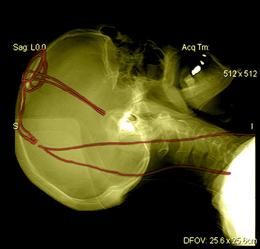
The procedure starts with a surgeon drilling two holes in the patient’s skull. “Every bone and tooth in my head was rattling,” says Lisa Battiloro, who was awake, but not in pain, during the eight-hour operation.

Neurologists asked her questions and issued commands as they pinpointed the exact spot in her brain for electrical stimulation. At one point, “I suddenly felt hopeful and optimistic about the future,” recalls Ms. Battiloro, who had battled severe depression for more than a decade. That’s when the doctors knew they had found Brodmann 25, an area deep in the cerebral cortex associated with negative mood. They secured the electrodes in place, then sedated Ms. Battiloro while they ran an extension wire under the skin, down the side of her head and into her chest, where they implanted a battery pack to supply her brain with a mild electrical current.

Within two months, Ms. Battiloro says, her depression had lifted considerably. Now, nearly four years later, it hasn’t returned. “My friends and family are amazed,” say Ms. Battiloro, 41, of Boynton Beach, Fla. “I’m a new and improved Lisa.”

Deep brain stimulation, sometimes called a pacemaker for the brain, has helped halt tremors in more than 100,000 patients with Parkinson’s disease and other movement disorders since 1997. Now, researchers are reporting encouraging results using the procedure for psychiatric conditions as well. Ms. Battiloro was one of 17 patients in a study published this month in the Archives of General Psychiatry. After two years of DBS, 92% reported significant relief from their major depression or bipolar disorder and more than half were in remission, with no manic side effects.

“We are seeing dramatic effects in the small numbers of subjects, and they are not just getting well, they are getting well without side effects and without relapsing,” says neurologist Helen Mayberg, who led the study at Emory University in Atlanta.

read more here:  http://online.wsj.com/article/SB10001424052970204555904577164813955136748.html#articleTabs=article


Firefighters Cut Through Wall To Rescue Hoarder

Firefighters had to cut through an exterior wall to rescue a man who became stuck in the bathroom of his cluttered, second-story apartment on Long Island, NY, officials told local media.

The man was very “overweight,” officials told MYFOXNY.com.

According to authorities quoted by Newsday, a rescue team used a series of ladders and a rope system Thursday to lower the man, identified as a 55-year-old former postal worker, to safety on a stretcher around 12:30 p.m. — about three hours after someone called 911. His weight is unknown.

The man, who was not identified by police or firefighters, was taken to a local hospital for treatment, the paper said. Officials said the man fell in his bathroom and could not get back on his feet. He was listed in stable condition.

Stacks of boxes blocked firefighters from bringing rescue equipment up to the man’s apartment, prompting them to cut a way out through the wall, Brookhaven Town spokesman Jack Krieger said in an email to Newsday. The narrowness of the space in some places added to their difficulty, authorities said.

“From what I’m told stuff was stacked to the ceiling in most of the rooms” on the second floor, Krieger told the paper.

The second floor of the wood-frame home was condemned by the town after the rescue, Krieger said. Officials deemed it unfit for human occupancy because of what he called hoarding. The home’s owner declined to comment.

After the rescue, a massive pile of junk and collectibles — including stacks of newspapers and figurines of dragons and “Star Wars” characters — lay in the yard, Newsday said.