Video that causes natural visual hallucinations

This video has been carefully designed to create a strong natural hallucination. Use full screen for best results.

If you follow the video’s instructions, when you look away you will continue to see wavy lines in your wall or on the floor. When the video ends and you look away, your brain still expects to see the waves, and therefore it creates them for you. Saying the letters out loud doesn’t really play a role, it just ensures that you are focusing on the center of the screen, where you can best receive the stimulus.

The resultant hallucination is temporary and should wear off within a couple of minutes.

Thanks to Kebmodee for bringing this to the attention of the It’s Interesting community.

50-Cent Origami Microscope Could Help Fight Malaria

When Manu Prakash, PhD, wants to impress lab visitors with the durability of his Origami-based paper microscope, he throws it off a three-story balcony, stomps on it with his foot and dunks it into a water-filled beaker. Miraculously, it still works.

Even more amazing is that this microscope — a bookmark-sized piece of layered cardstock with a micro-lens — only costs about 50 cents in materials to make.

Prakash’s dream is that this ultra-low-cost microscope will someday be distributed widely to detect dangerous blood-borne diseases like malaria, African sleeping sickness, schistosomiasis and Chagas.

“I wanted to make the best possible disease-detection instrument that we could almost distribute for free,” said Prakash. “What came out of this project is what we call use-and-throw microscopy.”

The Foldscope can be assembled in minutes, includes no mechanical moving parts, packs in a flat configuration, is extremely rugged and can be incinerated after use to safely dispose of infectious biological samples. With minor design modifications, it can be used for bright-field, multi-fluorescence or projection microscopy.

One of the unique design features of the microscope is the use of inexpensive spherical lenses rather than the precision-ground curved glass lenses used in traditional microscopes. These poppy-seed-sized lenses were originally mass produced in various sizes as an abrasive grit that was thrown into industrial tumblers to knock the rough edges off metal parts. In the simplest configuration of the Foldscope, one 17-cent lens is press-fit into a small hole in the center of the slide-mounting platform. Some of his more sophisticated versions use multiple lenses and filters.

To use a Foldscope, a sample is mounted on a microscope slide and wedged between the paper layers of the microscope. With a thumb and forefinger grasping each end of the layered paper strip, a user holds the micro-lens close enough to one eye that eyebrows touch the paper. Focusing and locating a target object are achieved by flexing and sliding the paper platform with the thumb and fingers.

Because of the unique optical physics of a spherical lens held close to the eye, samples can be magnified up to 2,000 times. (To the right are two disease-causing microbes, Giardia lamblia and Leishmania donovani, photographed through a Foldscope.)

The Foldscope can be customized for the detection of specific organisms by adding various combinations of colored LED lights powered by a watch battery, sample stains and fluorescent filters. It can also be configured to project images on the wall of a dark room.

In addition, Prakash is passionate about mass-producing the Foldscope for educational purposes, to inspire children — our future scientists — to explore and learn from the microscopic world.

In a recent Stanford bioengineering course, Prakash used the Foldscope to teach students about the physics of microscopy. He had the entire class build their own Foldscope. Then teams wrote reports on microscopic observations or designed Foldscope accessories, such a smartphone camera attachment.

http://scopeblog.stanford.edu/2014/03/10/stanford-bioengineer-develops-a-50-cent-paper-microscope/
Thanks to Kebmodee for bringing this to the attention of the It’s Interesting community.

Vertical forest in Milan

The completion of the world’s first vertical forest is nearing. Located in Milan, Bosco Verticale is Boeri Studio’s effort to make cities greener along with supporting an overly dense urban population. The project kicked off in 2011, and is widely looked at by the rest of the world.

New photographs that have emerged show the appearance of the finished residential tower blocks with 100 different species of trees and shrubs covering the whole place in a vertical forest.

The sunlight filtering through the forest leaves, breathing the fresh air, and everything can just be nothing else than poor bliss. The project will mostly be complete by early 2014.

The project can accommodate in one building about forest that equals 10.000 sq m of forest. Also include 480 large and medium size trees, 250 small size trees, 11,000 groundcover plants and 5,000 shrubs. Greywater recycling is also being pursued, which will eventually water the vegetation and the photovoltaic panels will provide power.

Each tower supports the equivalent population of an area of single family dwellings of nearly 50,000. The smallest apartment of the lot is 65 sqm and has a small woodland terrace. The largest apartment, on the other hand, is 450 sqm with a terrace of around 80 sqm.

The architects say that they are kicked about the next phase when engineers, builders, masons, lawyers and electricians actually finish work and residents begin to live.

They say that every plant has been chosen by botanists to thrive in the present condition. A specialized maintenance company will keep in check of the vertical forest in the coming years.

Dolce Vita Homes worked in collaboration with Coima Image for the interior designing, Residenze Porta Nuova is marketing the project.

http://www.greenpacks.org/2014/01/20/bosco-verticale-vertical-forest-nearing-completion-in-milan/

Thanks to Kebmodee for bringing this to the attention of the It’s Interesting community.

$20 gadget that can hack your car

Screen-Shot-2014-02-05-at-7_35_52-PM2-e1391650802638

Auto makers have long downplayed the threat of hacker attacks on their cars and trucks, arguing that their vehicles’ increasingly-networked systems are protected from rogue wireless intrusion. Now two researchers plan to show that a few minutes alone with a car and a tiny, cheap device can give digital saboteurs all the wireless control they need.

At the Black Hat Asia security conference in Singapore next month, Spanish security researchers Javier Vazquez-Vidal and Alberto Garcia Illera plan to present a small gadget they built for less than $20 that can be physically connected to a car’s internal network to inject malicious commands affecting everything from its windows and headlights to its steering and brakes. Their tool, which is about three-quarters the size of an iPhone, attaches via four wires to the Controller Area Network or CAN bus of a vehicle, drawing power from the car’s electrical system and waiting to relay wireless commands sent remotely from an attacker’s computer. They call their creation the CAN Hacking Tool, or CHT.

“It can take five minutes or less to hook it up and then walk away,” says Vazquez Vidal, who works as a automobile IT security consultant in Germany. “We could wait one minute or one year, and then trigger it to do whatever we have programmed it to do.”

Just what commands the researchers can remotely inject with the CHT, Vazquez Vidal says, depends on the model of car. They tested four different vehicles, whose specific make and model they declined to name, and their tricks ranged from mere mischief like switching off headlights, setting off alarms, and rolling windows up and down to accessing anti-lock brake or emergency brake systems that could potentially cause a sudden stop in traffic. In some cases, the attacks required gaining under-the-hood access or opening the car’s trunk, while in other instances, they say they could simply crawl under the car to plant the device.

For now, the tool communicates via only Bluetooth, limiting the range of any wireless attack to a few feet. But by the time the two researchers present their research in Singapore, they say they’ll upgrade it to use a GSM cellular radio instead that would make it possible to control the device from miles away.

All the ingredients of their tool are off-the-shelf components, adds Vazquez Vidal, so that even if the device is discovered it wouldn’t necessarily provide clues as to who planted it. “It’s totally untraceable,” he says.

The Spanish researchers’ work adds to a growing focus in the security industry on the vulnerability of networked automobiles to hackers’ attacks. Before the Defcon hacker conference last July, researchers Charlie Miller and Chris Valasek put me behind the wheel of a Ford Explorer and a Toyota Prius and then showed that they could plug their laptops into a dashboard port of vehicles to perform nasty tricks like slamming on the Prius’ brakes, jerking its steering wheel and even disabling the brakes of the Explorer at low speeds.

That work helped to spur Senator Edward Markey to send a seven-page letter to 20 automakers asking that they detail their security practices. Though the automakers’ answers were due on January 3rd, Markey’s office hasn’t yet released the results of their responses.

Toyota both brushed off Miller and Valasek’s work by pointing to the fact that their hack required physical access to the vehicle. “Our focus, and that of the entire auto industry, is to prevent hacking from a remote wireless device outside of the vehicle,” Toyota safety manager John Hanson told me at the time.

But Miller and Valasek counter that others had already shown that the initial wireless penetration of a car’s network is indeed possible. In 2011, a team of researchers at the University of Washington and the University of California at San Diego wirelessly penetrated a car’s internals via cellular networks, Bluetooth connections, and even a malicious audio file on a CD in its stereo system.

Vazquez Vidal’s and Garcia Illera’s CHT device adds yet another way to cross that wireless divide, and one that’s likely far cheaper. But like prior researchers, they say their intention is to show that digital car attacks are possible, not to enable them. Though they’ll detail the physical construction of their tool, they say they don’t plan to release the code used to inject commands into their test vehicles’ networks. “The goal isn’t to release our hacking tool to the public and say ‘take this and start hacking cars,’” says Vazquez Vidal. “We want to reach the manufacturers and show them what can be done.”

Like Miller and Valasek, they argue that car makers need to look beyond the initial wireless penetration of a car’s network to consider adding security between a vehicle’s systems, limiting a rogue device’s ability to wreak havoc.

“A car is a mini network,” says Garcia Illera. “And right now there’s no security implemented.”

http://www.forbes.com/sites/andygreenberg/2014/02/05/this-iphone-sized-device-can-hack-a-car-researchers-plan-to-demonstrate/

Thanks to Kebmodee for bringing this to the attention of the It’s Interesting community.
Beer Drone Can Buzz The Skies No More, FAA Says

Lakemaid Beer is brewed in Stevens Point, Wis., and distributed to several states in the region. But it was a very local delivery that put the company out of favor with the Federal Aviation Administration.

The Minnesota-based company is receiving a flood of support and condolences after the FAA ruled that its beer delivery drone, which had only recently taken flight, had to be shut down.

Lakemaid calls itself the fishermen’s lager. It had hoped to use drones to deliver its beer to anglers in thousands of ice shacks, from the frozen northern lakes’ combination bait and beer shops. But the government says the brewer’s next test — which Lakemaid managing partner Jack Supple says was tentatively set for Minnesota’s Lake Mille Lacs and the Twin Pines resort — cannot proceed.

“We were a little surprised at the FAA interest in this since we thought we were operating under the 400-foot limit,” Supple says via email. He adds that the beer-makers “figured a vast frozen lake was a lot safer place than [what] Amazon was showing on 60 Minutes.”

The brewery’s test flight created a stir after it was posted on YouTube last week, capturing imaginations and, in some cases, leading people to say they no longer fear a future in which the sky buzzes with drones.

In December, Amazon founder Jeff Bezos gave 60 Minutes a preview of his company’s plan to use drones to move to same-day local delivery in the next several years. In an interview last week, Supple said Lakemaid’s drone plans had advantages over Amazon’s — particularly the flat landscape of a frozen lake and the fairly uniform height of the ice shacks.

But as we discussed after the Amazon report aired, FAA rules don’t currently allow drones to be used for commercial delivery — and it eventually emerged that the test video Bezos showed was actually filmed outside the U.S., for legal reasons. The agency has scheduled reviews of its rules on drones.

Supple says the FAA got in touch to let Lakemaid know its plan broke four — and possibly five — regulations, ranging from the operator’s rating to the use of airspace. And that’s too bad, he says, because he had big plans.

“My intent was to try a larger drone that could fly unmanned, based on just the coordinates” of an ice shack, he says. And the Twin Pines resort “has fish houses out in the bay probably half a mile. So a little longer stretch than we first tested.”

Drones have been used to deliver beer before — notably at a music festival in South Africa. But the federal agency said it’s a no-go in U.S. airspace.
“The FAA controls the safety of our airspace all the way to ground level, according to the calls I got from the local inspector and the regional supervisor this week,” Supple says.

In an email, the agency told Lakemaid that it “recognizes that people and companies other than modelers might be flying UAS with the mistaken understanding” that their actions are legal. But the rules and guidelines used in such cases apply only to people flying model airplanes, the FAA added.

After word of the FAA’s intervention came out, a White House petition was begun to try to get the agency to allow the brewery’s beers to get airborne again.
Supply says Lakemaid is figuring out what its next steps are. But he admits that in hindsight, he can see the FAA’s point.

“I understand their concern,” he says. “Drones whizzing around piloted by any knucklehead is probably not the Jetsons future we all imagined.”

http://www.npr.org/blogs/thetwo-way/2014/01/30/269039542/beer-drone-can-buzz-the-skies-no-more-faa-says

Thanks to Kebmodee for bringing this to the attention of the It’s Interesting community.
U.S. WWII Minnesota Starvation Experiment

Towards the end of World War II, word got through that certain people in occupied territories were eating a near-starvation diet. American researchers wanted to study the effects of starvation, so they recruited volunteers – and starved them some more.

The Minnesota Starvation Experiment pretty much lived up to its name. It was an early experiment in nutrition prompted by news about the conditions in Europe during World War II. The full horror of concentration camps was still to come, but word came in that people in war-torn territories were living on severely restricted diets. Everyone knew that things were going to get worse before they got better, and concerned researched wanted to find out the effects of starvation and how to rehabilitate a severely starved person. In November of 1944, at The University of Minnesota, a study began on the effects of starvation.

When contacted years later, many of the men said the experiment was the toughest thing they had ever done, but were happy to have participated and said they would do it again.

http://io9.com/the-us-wartime-experiment-that-starved-men-more-than-1507200589

Thanks to Kebmodee for bringing this to the attention of the It’s Interesting community.

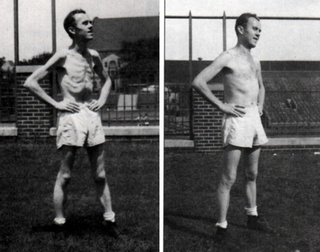
From a pool of 400 volunteers, 36 men were chosen. All were between 22 and 33, and all were in good health. They were told that the experiment would go through four phases. For three months, they would eat a specific number of calories, so that researchers could get them to a healthy weight and get a baseline for their diet. (They were kept active, and the diet they were given was 3,200 calories.) Once they’d gotten up to their “fighting weight,” their caloric intake was to be halved. They’d take in 1,560 calories a day, every day, and no more. They’d have a diet comparable to the food people in Europe would have available – root vegetables and starches with the occasional meat or jell-o. The goal of the diet was to make the men lose a little over two pounds a week, and twenty-five percent of their body weight in six months.

After six months, they’d go through a three-month rehabilitative phase, where they would be allowed more food. They’d be divided into many groups, with different groups given different amounts of calories, and different amounts of protein, fat, and vitamins. Finally, they’d be allowed eight weeks of eating whatever they wanted.

this time, they were kept in dormitories on campus, given regular blood tests, endurance tests, mental tests, and many other kind of tests. They were given administrative work in the lab, and allowed to attend classes at the university. Most of all, they were watched. For the tests to be successful, the researchers had to be sure that the participants weren’t cheating.

The rehabilitative diet did not remain of general interest to subsequent generations – although it did help scientists understand that people who had been starved needed to be overfed, rather than just fed, to help them rebuild their bodies. It is the effects that retain lasting fascination for scientists and for the public. At first, the participants merely complained of hunger, of an inability to concentrate, and of poor judgment. If the men didn’t lose enough weight, their rations were reduced – meaning some got more food than others. They all ate together, watching who got what. Unsurprisingly, resentment sprang up and there were a lot of fights in the dorms. Then came extreme depression. Several members were hospitalized for psychiatric problems. Some mutilated themselves. One man amputated three fingers with a hatchet, although he said later he didn’t know whether he’d done it on purpose or was just not thinking clearly. Considering he had injured his fingers once before, letting a car fall on them, the researchers thought the new injury was at least semi-deliberate, released him from the experiment and put him in psychiatric care.

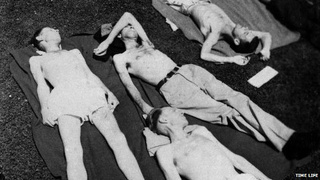
Then came weakness. When one man cheated on the diet, the researchers demanded the rest of the men go everywhere with a buddy. Years later one of the participants said he was grateful for the buddy system, since he could no longer open heavy doors by himself. The men lost their hair, became dizzy, felt cold all the time, and their muscles ached. Many dropped out of classes. Scientists noted that their resting heart rate and breath rate also fell. The starving body was trying to use up as few calories as possible. For a while, they were allowed gum. They chewed up to forty packs every day until the researchers disallowed gum chewing.

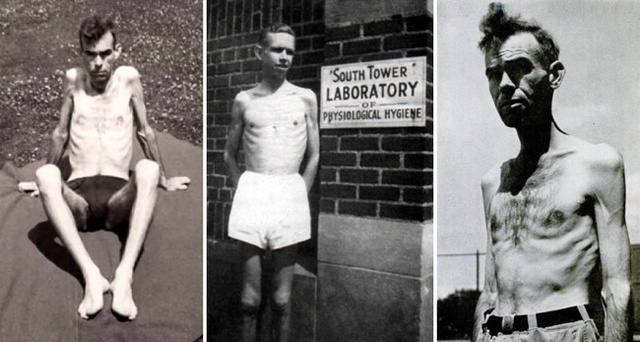
They became obsessed with what food they did have, holding it in their mouths and trying to stretch out mealtimes. On man said that what bothered him more than anything was the fact that food became the central point in his life. He no longer cared about anything but food. He watched movies for the eating scenes, and read magazines for the food ads. Another man said he had begun hating people who were able to go home and have a good dinner. Food became their curse and obsession. This was unsurprising, as a good portion of the men overshot the projected goal of a twenty-five percent loss of body weight. Many men were down to 99 or 100 pounds.

During the three-month rehabilitation period, different groups of men were supposed to receive different amounts of food. Researchers quickly scrapped that idea after the lower-calorie-diet men didn’t show signs of recovery. Some even lost weight after their calorie intake was increased. The lack of calories had caused some of the men’s legs to swell with water, and a calorie infusion allowed them to shed the excess liquid. Despite the sincere efforts of the researchers, almost no men felt recovered after just three months. On the day they were allowed to eat again, quite a few overate and got sick. One had his stomach pumped. Even getting back to their earlier weight didn’t help. They packed on the pounds well beyond that. Some said they couldn’t stop obsessively eating for a year. There was never “enough” food for them.

Today, the results of the Minnesota Starvation Study are mostly of note to people who study eating disorders. Many of the behaviors the starving men displayed, such as diluting food with water to make it look more filling, or overchewing their food to stretch out mealtimes, are also displayed by people suffering from anorexia. The men’s subsequent relentless feeding is similar to binge-eating. Although they made themselves sick physically, they couldn’t get enough food to make them feel satisfied.

Astronomers capture the first image of the mysterious web of gas and dark matter that connects all galaxies in the universe

webverse

For the first time, astronomers were able to see a string of hot gas known as a filament that is thought to be part of the mysterious underlying structure that dictates the layout of all the stars and galaxies in our universe.

Scientists believe that matter in the universe is arranged into a gigantic web-like structure. This is called the cosmic web.

There are signatures of this structure in the remaining radiation from the Big Bang and in the layout of the universe itself. Without some mysterious force pulling visible matter into this web, galaxies would be randomly scattered across the universe. But they aren’t.

We can see that galaxies are found in groups and those groups come together in larger clusters.

Computer models tell us that those galaxy clusters are linked by long filaments of hot gas and dark matter — a mystery substance that we can’t see because it doesn’t radiate or scatter light but that makes up most of the web.

It’s believed that gas and dark matter flow along the filaments to form clumps of galaxies where the strands intersect. So filaments are important because they represent what the universe looks like on a large scale. The problem is that, even though we should technically be able to see hot gas filaments, they are really hard to detect.

To find this strand of gas, astronomers where able to take advantage of an extremely bright mass of energy and light known as a quasar.

The light from a quasar located 10 billion light-years-away acted like a “flashlight” to make the surrounding gas glow, researchers report Jan. 19 in the journal Nature. This boosted the Lyman alpha radiation that hydrogen gas emits to detectable levels over a huge swath of the region.

The researchers were able to figure out the wavelength of the Lyman alpha radiation emitted by the gas and used the Keck telescope in Hawaii to get an image at that wavelength.

What they were able to see is a cloud of gas extending two million light years across intergalactic space — the largest ever found. And it wasn’t just a diffuse cloud, there are areas where there is more gas and areas of darker, emptier space. The gas-filled areas are filament, while the emptier areas are the gaps between filaments and galaxy clusters.

“This is a very exceptional object,” first author Sebastiano Cantalupo, a postdoctoral fellow at UC Santa Cruz said in a statement. “It’s huge, at least twice as large as any nebula detected before, and it extends well beyond the galactic environment of the quasar.”

Researchers think that the gas filament is even more extended since they only see the part that is illuminated by the radiation from the quasar.

The research still “provides a terrific insight into the overall structure of our universe,” co-author J. Xavier Prochaska, a professor of astronomy and astrophysics at UC Santa Cruz said in statement, since the “quasar is illuminating diffuse gas on scales well beyond any we’ve seen before, giving us the first picture of extended gas between galaxies.”

http://www.sfgate.com/technology/businessinsider/article/Astronomers-Capture-The-First-Image-Of-The-5157713.php

Thanks to Kebmodee for bringing this to the attention of the It’s Interesting community.
Utah is ending homelessness by giving people homes.

UtahReducesHomelessness011814

Earlier this month, Hawaii State representative Tom Bower (D) began walking the streets of his Waikiki district with a sledgehammer, and smashing shopping carts used by homeless people. “Disgusted” by the city’s chronic homelessness problem, Bower decided to take matters into his own hands — literally. He also took to rousing homeless people if he saw them sleeping at bus stops during the day.

Bower’s tactics were over the top, and so unpopular that he quickly declared “Mission accomplished,” and retired his sledgehammer. But Bower’s frustration with his city’s homelessness problem is just an extreme example of the frustration that has led cities to pass measures that effective deal with the homeless by criminalizing homelessness.

•City council members in Columbia, South Carolina, concerned that the city was becoming a “magnet for homeless people,” passed an ordinance giving the homeless the option to either relocate or get arrested. The council later rescinded the ordinance, after backlash from police officers, city workers, and advocates.

•Last year, Tampa, Florida — which had the most homeless people for a mid-sized city — passed an ordinance allowing police officers to arrest anyone they saw sleeping in public, or “storing personal property in public.” The city followed up with a ban on panhandling downtown, and other locations around the city.

•Philadelphia took a somewhat different approach, with a law banning the feeding of homeless people on city parkland. Religious groups objected to the ban, and announced that they would not obey it.

•Raleigh, North Carolina took the step of asking religious groups to stop their longstanding practice of feeding the homeless in a downtown park on weekends. Religious leaders announced that they would risk arrest rather than stop.

This trend makes Utah’s accomplishment even more noteworthy. In eight years, Utah has quietly reduced homelessness by 78 percent, and is on track to end homelessness by 2015.

How did Utah accomplish this? Simple. Utah solved homelessness by giving people homes. In 2005, Utah figured out that the annual cost of E.R. visits and jail stays for homeless people was about $16,670 per person, compared to $11,000 to provide each homeless person with an apartment and a social worker. So, the state began giving away apartments, with no strings attached. Each participant in Utah’s Housing First program also gets a caseworker to help them become self-sufficient, but they keep the apartment even if they fail. The program has been so successful that other states are hoping to achieve similar results with programs modeled on Utah’s.

It sounds like Utah borrowed a page from Homes Not Handcuffs, the 2009 report by The National Law Center on Homelessness & Poverty and The National Coalition for the Homeless. Using a 2004 survey and anecdotal evidence from activists, the report concluded that permanent housing for the homeless is cheaper than criminalization. Housing is not only more human, it’s economical.

http://www.nationofchange.org/utah-ending-homelessness-giving-people-homes-1390056183

Thanks to Kebmodee for bringing this to the attention of the It’s Interesting community.

Mexican Vigilantes Battling A Drug Cartel For Control Of A City

MexDrug1

by Harrison Jacobs

Mexico has long suffered blistering violence and crime at the hands of its homegrown drug cartels.

Though the Mexican government has waged war on the cartels, the effort has struggled to go anywhere. More than 90,000 people have died in the ongoing conflict.

Fed up with a corrupt police force that is often in bed with the cartels and a military that has to this point been ineffective, some Mexicans have taken it upon themselves to fight the cartels and protect their families — with an incredible conflict happening this week in the city of Paracuaro.

Over the last year, vigilante groups, known as fuerzas autodefensas have sprung up all over Mexico, particularly in the southwestern state of Michoacan, an area plagued by the Knights Templar cartel.

MexDrug2

In neighbouring Guerrero, members of the Public Safety System (the name of the vigilante group) marched to commemorate the first anniversary of their founding.

MexDrug3

On Monday, hundreds of vigilantes stormed Paracuaro, Michoacan, where the Knights Templar had set up their headquarters, in order to seize the town back from the cartel. Below is the entrance, where vigilantes erected a checkpoint.

MexDrug4

The gunmen, “community police” from a number of nearby towns, rode in a convoy of pickup trucks and SUVs, before engaging in a gunfight with the Knights Templar.

MexDrug5

The battle was bloody. One vigilante, two members of the Knights Templar, and two federal police were reportedly killed in the shootout.

MexDrug6

Once they had taken control of the town, the vigilantes began disarming municipal police, whom they accuse of being corrupt and in league with the cartel.

MexDrug7

The vigilantes set up patrols and checkpoints on any highways going into and out of Paracuaro.

MexDrug8

Anybody suspected of being associated with the Knights Templar was detained. Currently, 11 police officers are being held on suspicion of colluding with the cartel.

MexDrug9

What happened in Paracuaro is becoming more common. Several months ago, another group in Guerrero detained more than 50 people for over six weeks for alleged crimes.

MexDrug10

While the vigilantes in Paracuaro went after the drug cartel, most other vigilante groups in Mexico are more concerned with punishing criminals who commit robberies, rape, and murder, than stopping the actual drug trade.

MexDrug11

In response to the vigilantes’ takeover of Paracauro, the Michaocan governor told press that the police will begin attempting to “eradicate” the vigilante groups.

MexDrug12

For a government and police force already overwhelmed by the drug cartels, trying to eliminate the vigilante groups likely won’t be easy.

MexDrug13

http://www.businessinsider.com.au/mexican-vigilantes-battle-drug-cartel-photos-2014-1

Thanks to Kebmodee for bringing this to the attention of the It’s Interesting community.

China is cloning on an industrial scale

pig3

pig2

pig1

By David Shukman

You hear the squeals of the pigs long before reaching a set of long buildings set in rolling hills in southern China.

Feeding time produces a frenzy as the animals strain against the railings around their pens. But this is no ordinary farm.

Run by a fast-growing company called BGI, this facility has become the world’s largest centre for the cloning of pigs.

The technology involved is not particularly novel – but what is new is the application of mass production.

The first shed contains 90 animals in two long rows. They look perfectly normal, as one would expect, but each of them is carrying cloned embryos. Many are clones themselves.

This place produces an astonishing 500 cloned pigs a year: China is exploiting science on an industrial scale.

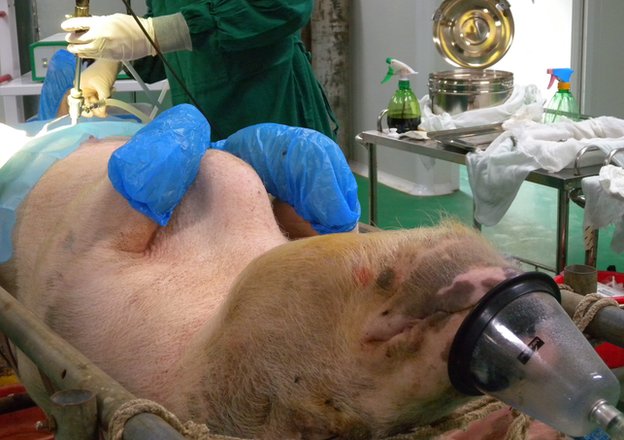
To my surprise, we’re taken to see how the work is done. A room next to the pens serves as a surgery and a sow is under anaesthetic, lying on her back on an operating table. An oxygen mask is fitted over her snout and she’s breathing steadily. Blue plastic bags cover her trotters.

Two technicians have inserted a fibre-optic probe to locate the sow’s uterus. A third retrieves a small test-tube from a fridge: these are the blastocysts, early stage embryos prepared in a lab. In a moment, they will be implanted.

The room is not air-conditioned; nor is it particularly clean. Flies buzz around the pig’s head.

My first thought is that the operation is being conducted with an air of total routine. Even the presence of a foreign television crew seems to make little difference. The animal is comfortable but there’s no sensitivity about how we might react, let alone what animal rights campaigners might make of it all.

I check the figures: the team can do two implantations a day. The success rate is about 70-80%.

Dusk is falling as we’re shown into another shed where new-born piglets are lying close to their mothers to suckle. Heat lamps keep the room warm. Some of the animals are clones of clones. Most have been genetically modified.

The point of the work is to use pigs to test out new medicines. Because they are so similar genetically to humans, pigs can serve as useful “models”. So modifying their genes to give them traits can aid that process.

One batch of particularly small pigs has had a growth gene removed – they stopped growing at the age of one. Others have had their DNA tinkered with to try to make them more susceptible to Alzheimer’s.

Back at the company headquarters, a line of technicians is hunched over microscopes. This is a BGI innovation: replacing expensive machines with people. It’s called “handmade cloning” and is designed to make everything quicker and easier.

The scientist in charge, Dr Yutao Du, explains the technique in a way that leaves me reeling.

“We can do cloning on a very large scale,” she tells me, “30-50 people together doing cloning so that we can make a cloning factory here.”

A cloning factory – an incredible notion borrowed straight from science fiction. But here in Shenzhen, in what was an old shoe factory, this rising power is creating a new industry.

The scale of ambition is staggering. BGI is not only the world’s largest centre for cloning pigs – it’s also the world’s largest centre for gene sequencing.

In neighbouring buildings, there are rows of gene sequencers – machines the size of fridges operating 24 hours a day crunching through the codes for life.

To illustrate the scale of this operation, Europe’s largest gene sequencing centre is the Wellcome Trust Sanger Institute near Cambridge. It has 30 machines. BGI has 156 and has even bought an American company that makes them.

BGI’s chief executive, Wang Jun, tells me how they need the technology to develop ever faster and cheaper ways of reading genes.

Again, a comparison for scale: a recently-launched UK project seeks to sequence 10,000 human genomes. BGI has ambitions to sequence the genomes of a million people, a million animals and a million plants.

Wang Jun is keen to stress that all this work must be relevant to ordinary people through better healthcare or tastier food. The BGI canteen is used as a testbed for some of the products from the labs: everything from grouper twice the normal size, to pigs, to yoghurt.

I ask Wang Jun how he chooses what to sequence. After the shock of hearing the phrase “cloning factory”, out comes another bombshell:

“If it tastes good you should sequence it,” he tells me. “You should know what’s in the genes of that species.”

Species that taste good is one criterion. Another he cites is that of industrial use – raising yields, for example, or benefits for healthcare.

“A third category is if it looks cute – anything that looks cute: panda, polar bear, penguin, you should really sequence it – it’s like digitalising all the wonderful species,” he explains.

I wonder how he feels about acquiring such power to take control of nature but he immediately contradicts me.

“No, we’re following Nature – there are lots of people dying from hunger and protein supply so we have to think about ways of dealing with that, for example exploring the potential of rice as a species,” the BGI chief counters.

China is on a trajectory that will see it emerging as a giant of science: it has a robotic rover on the Moon, it holds the honour of having the world’s fastest supercomputer and BGI offers a glimpse of what industrial scale could bring to the future of biology.

Read more: http://www.bbc.co.uk/news/science-environment-25576718

Thanks to Kebmodee for bringing this to the attenion of the It’s Interesting community.