A Brazilian television station’s cruel sense of humor.


Conservationists in Brazil are poised to try cloning eight animals that are under pressure, including jaguars and maned wolves.
Other conservation groups have welcomed the plan, but say the priority should always be to preserve species in the wild by minimising hunting and maintaining habitats.
“While cloning is a tool of last resort, it may prove valuable for some species,” says Ian Harrison of the Biodiversity Assessment Unit at Conservation International in Arlington, Virginia. “Experimenting with it now, using species that are not at immediate risk of extinction, is important.”
None of the targeted animals are critically endangered, but Brazil’s agricultural research agency, Embrapa, wants a headstart. Working with the Brasilia Zoological Garden, it has collected around 420 tissue samples, mostly from carcasses.
The eight species live in the Cerrado, a tropical savannah. They will be cloned and kept in captivity as a reserve in case wild populations collapse.
Within a month, Embrapa hopes to begin cloning the maned wolf (Chrysocyon brachyurus), which is classed as “Near Threatened” on the IUCN Red List of endangered species. About 13,000 remain across South America.
As well as jaguars and maned wolves, the researchers hope to clone black lion tamarins (Leontopithecus chrysopygus), bush dogs (Speothos venaticus), coatis, collared anteaters (Tamandua tetradactyla), gray brocket deer (Mazama gouazoupira) and bison.
There are no plans to release cloned animals into the wild, says Embrapa’s Carlos Frederico Martins. Being clones, they would lack the genetic variability of wild populations.
Embrapa created Brazil’s first cloned animal in 2001, a cow called Vitória that died last year. It has since cloned over 100 animals, mainly cows and horses.
Rare animals have been cloned before, including the ox-like gaur, a wild sheep called a mouflon, a wild cow called the banteng, and even an extinct mountain goat – the Pyrenean ibex – that died at birth. Since then, more versatile cloning techniques have been developed, increasing the chances of success.
“The key is foresight, to just save a little piece of skin, blood or other living cells before the genes from these individuals are lost from the planet forever. A freezer the size of a standard refrigerator could store the genetics for all the pandas in China, or all the mountain gorillas in Africa,” says Robert Lanza of Advanced Cell Technology in Marlborough, Massachusetts, who headed the group that produced the gaur. “If you have the genetic material you can produce sperm, for instance, and reintroduce genetic diversity whenever you want.”
Rhiannon Lloyd of the University of Portsmouth, UK, runs a facility that stores DNA of threatened and extinct species. She backs Embrapa’s plan: “Collecting from dead specimens prevents the valuable information within their cells being lost forever.”

Nine new species of colorful, arboreal tarantulas have been discovered in central and eastern Brazil, an area where only seven tarantula species had previously been known. All nine of the newly described species are threatened by habitat loss and potentially by overzealous spider collectors.
As described this week in the open-access journal ZooKeys, the newly discovered species have been named Typhochlaena amma, T. costae, T. curumim, T. paschoali, Pachistopelma bromelicola, Iridopelma katiae, I. marcoi, I. oliveirai and I. vanini. The Typhochlaena genus had last been seen in 1850.
The study of the area’s tarantulas was conducted by Rogério Bertani, a researcher at the Instituto Butantan in Sao Paulo. A previous spider first described by Bertani, Pterinopelma sazimai, was named one of the top 10 new species of 2011. That spider, like many of the new ones he described this week, is also threatened by the exotic pet trade.
As Bertani writes in his 94-page paper, tarantulas—arachnids of the family Theraphosidae—have not been heavily studied to date, “despite their potential importance as top predators in ecological webs, the pet trade and a source of important tools for pharmacological research.” He definitely picked up the slack here, studying specimens from the wild and nine different museums and other institutions in order to measure legs, hairs, eyes, claws and other physical attributes to determine the new species. The analysis also allowed him to re-describe dozens of previously identified tarantula species.
Unfortunately, just about all of the new species Bertani describes appear to be at least threatened, if not endangered. Of the five Typhochlaena species, only 40 specimens have been collected to date. The new Pachistopelma species he describes depend on high-elevation flowering plants called bromeliads, which offer both water and shelter from intense mountain sunlight but are themselves threatened by habitat destruction in some regions. Other species live in the Atlantic rainforest, which has been reduced to just 7 percent of its original size. Most of the species he describes are extremely colorful, and Bertani says this could lead to exploitation by the illegal exotic pet trade.
Bertani says the discovery of these new species shows how little is known about wildlife even in areas like the Brazilian rainforests that have been identified as biodiversity hotspots.

A 20-year-old Brazilian woman has sold her virginity for $780,000 in an online auction to a Japanese man known simply as Natsu.
Catarina Migliorini’s virginity auction was organized by Virgins Wanted, the project of Australian filmmaker Justin Sisely.
Both Migliorini and a young male virgin, Alexander Stepanov, hocked their virginity online. Stepanov’s first time went to a buy identified as Nene B. from Brazil for a mere $3,000 US.
The auction had been live since Sept. 17, but until Wednesday – the last day of bidding – the highest bid for Migliorini had been $150,000. Natsu beat out five other high rollers who all bid in excess of $600,000 for the chance to bed the virgin.
Under the rules of the auction, Migliorini will be examined by a gynecologist and will “provide the winning bidder with medical evidence of her virginity.” Stepanov’s virginity cannot be medically proven, so he and two of his family members will give “statutory declarations to support his claim.”
Speaking last month with the Folha de S. Paulo newspaper, Migliorini said she got involved with the project two years ago when she saw a story about an Australian filmmaker who was looking for a virgin. She claims she wants to open an NGO with her winnings and invest in a public-housing project for poor families in Santa Catarina, where she was born. But speaking with the Huffington Post recently, Sisely said he was skeptical of Migliorini’s purported good intentions.
“I was surprised she said that because in all my dealings with her, she made it clear that it was a business decision for her,” he said. “Now, given how big this story is in Brazil, she’s trapped. If she doesn’t give any money to charity, she’s going to look bad.”
The winning bidders must submit to a medical examination and a police check, and cannot be intoxicated during their time with the virgins. No kissing or fellatio is allowed, and although the virgins and the winners are to agree about the length and duration of the sex, “the minimum consummation time is one hour,” the rules state.
Migliorini, who said she doesn’t think of it as prostitution, said the sex will happen in a private airplane.
The Virgins Wanted website said only that “the sexual act will take place where it is not illegal.”
http://cnews.canoe.ca/CNEWS/WeirdNews/2012/10/25/20307921.html

A 41-year-old car washer from northeastern Brazil shocked his family by turning up at his own wake after his family mistakenly identified a murdered local man at the morgue as him, local media reported on Tuesday.
Family and friends in the town of Alagoinhas in Bahia state were gathered around the body of another car washer resembling Gilberto Araujo when he showed up after being told of his “death” by a friend who had spotted him in the street.
“I said, ‘guys, I’m alive, pinch me,”’ Araujo told the O Globo news website. He had not seen his family for about four months until then.
His mother, shopkeeper Maria Menezes, said some of those attending the wake fainted while others fled.
“It was a fright … I’m very happy because what mother has a son that they say is dead then turns up alive?” she said.
On first learning of the confusion, Araujo tried to call an acquaintance at the wake to inform them he was alive, but his call was dismissed as a prank. The corpse has now been returned, O Globo reported.
http://cnews.canoe.ca/CNEWS/WeirdNews/2012/10/23/20303561.html

Doctors in the New England Journal of Medicine reported that they diagnosed a case of a rare disease called cutis verticus gyrata, which causes the folds in the scalp to form – specifically, “ridges and furrows resembling the brain’s surface,” write Dr. Karen Regina Rosso Schons and Andre Avelino Costa Beber of Hospital Universitario de Santa Maria in Brazil.
The 21-year-old patient with this condition didn’t display symptoms of neurological or psychiatric conditions, but he did have intellectual or learning impairment.
Doctors did not attempt an intervention because “the patient had no associated disorders and the condition did not bother him cosmetically.”
After a year, the patient was the same, according to the report.
http://thechart.blogs.cnn.com/2012/10/19/rare-disease-makes-scalp-look-like-brain/?hpt=hp_c2

Carme Cristina Lima, 32, was running for councillor of Itacoatiara, in Brazil’s northern state of Amazonas.
Police became suspicious when they saw a crowd allegedly gathering around Ms Lima’s car on the morning of election day on Sunday.
Officers searched her car and allegedly found hundreds of packets of cocaine attached to the candidate’s leaflets with instructions on how to vote for her.
Speaking to Brazil’s TNOnline website, police chief Daniel Ottoni said: “There was a large gathering of people around Ms Lima, but when they saw the police they all ran away.
“The candidate and another man also fled by car but officers caught up with them.
“According to locals, she had been distributing the drugs since early in the morning, on condition that people vote for her.”
Ms Lima was arrested for electoral corruption and drug dealing.
Kelvin Santos was declared deceased after he stopped breathing due to complications from bronchial pneumonia at Aberlardo Santos Hospital in the northern Brazilian city of Belem. SBT, one of Brazil’s leading TV networks, reported that while awaiting for the body to be released into family custody, the infant was placed in an airtight body bag for three hours.
The family gathered for an open-casket wake later that day, where, according to the two year-old’s aunt, during which the infant repeatedly “appeared to move”, before apparently sitting at up and asking his father for a drink of water.
The entire family thought they had witnessed a miracle and that Kelvin had in fact come back to life. But a few seconds later, the little boy’s body fell back in the casket and the family couldn’t revive him again.
The boy was rushed back to the hospital where he was pronounced dead a second time.
“Dead people don’t just wake up and talk,” said Antonio Santos, the boy’s father according to The Daily Mail. “I’m determined to find out the truth.”
A similar case occurred in Argentina earlier this year. Except this one had a happy ending.
Analia Bouter fell to her knees in shock after finding her baby alive in a coffin in the morgue nearly 12 hours after the girl had been declared dead. Her baby daughter, born three months premature, was pronounced a stillborn on April 3rd in a hospital in the city of Resistencia. The baby was put in a coffin and sent to a morgue.
Twelve hours later her parents were able to open the coffin to say their goodbyes. Instead, they found their baby was trembling.
“I moved the coverings aside and saw the tiny hand, with all five fingers, and I touched her hand and then uncovered her face,” said the mother in to TeleNoticias, an international news channel, according to The Associated Press. “That’s where I heard a tiny little cry. I told myself I was imagining it – it was my imagination. And then I stepped back and saw her waking up. It was as if she was saying `Mama, you came for me!’
A morgue worker picked her up and confirmed the baby was alive.
The family plans on suing the Hospital Perrando in the city of Resistencia for malpractice.
http://www.inflexwetrust.com/2012/06/08/dead-child-sat-up-in-coffin-at-funeral-and-asked-for-water/
Thanks to SRW for bringing this to the attention of the It’s Interesting community.

Experts came across the Atretochoana eiselti, which experts have dubbed the “floppy snake”, as they examined a hydroelectric dam on a river in the Amazon.
Six of the eyeless creatures — actually a family of “blind snake” more closely related to the salamander — were found living at the bottom of the Madeira River in Brazil’s northern state of Rondonia.
The discovery was made in November last year as a stretch of the river was being drained, but was onlyrecently made public after the snake’s genus was finally confirmed.
Julian Tupan, biologist for the Santo Antonio Energy company which is building the dam, told Brazil’s Estadao website that hardly anything is known about the lungless, limbless amphibians.
He said: “Of the six we collected, one died, three were released back into the wild and another two were kept for studies.
“Despite looking like snakes, they aren’t reptiles and are more closely related to salamanders and frogs.
“We think the animal breathes through its skin, and probably feeds on small fish and worms, but there is still nothing proven.
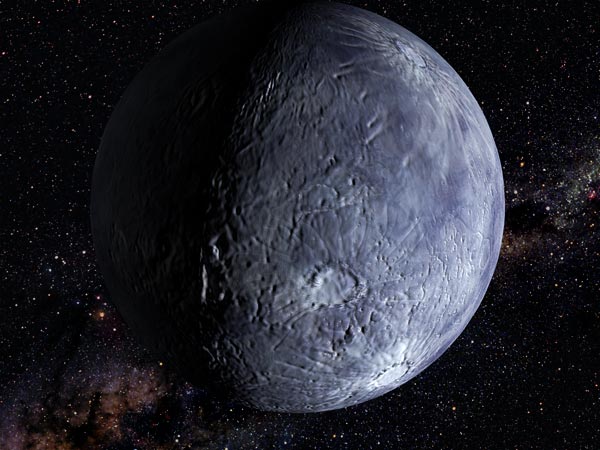
An as yet undiscovered planet might be orbiting at the dark fringes of the solar system, according to new research.
Too far out to be easily spotted by telescopes, the potential unseen planet appears to be making its presence felt by disturbing the orbits of so-called Kuiper belt objects, said Rodney Gomes, an astronomer at the National Observatory of Brazil in Rio de Janeiro.
Kuiper belt objects are small icy bodies—including some dwarf planets—that lie beyond the orbit of Neptune.
Once considered the ninth planet in our system, the dwarf planet Pluto, for example, is one of the largest Kuiper belt objects, at about 1,400 miles (2,300 kilometers) wide. Dozens of the other objects are hundreds of miles across, and more are being discovered every year.
(See “Three New ‘Plutos’? Possible Dwarf Planets Found.”)
What’s intriguing, Gomes said, is that, according to his new calculations, about a half dozen Kuiper belt objects—including the remote body known as Sedna—are in strange orbits compared to where they should be, based on existing solar system models. (Related: “Pluto Neighbor Gets Downsized.”)
The objects’ unexpected orbits have a few possible explanations, said Gomes, who presented his findings Tuesday at a meeting of the American Astronomical Society in Timberline Lodge, Oregon.
“But I think the easiest one is a planetary-mass solar companion”—a planet that orbits very far out from the sun but that’s massive enough to be having gravitational effects on Kuiper belt objects.
Mystery Planet a Captured Rogue?
For the new work, Gomes analyzed the orbits of 92 Kuiper belt objects, then compared his results to computer models of how the bodies should be distributed, with and without an additional planet.
If there’s no distant world, Gomes concludes, the models don’t produce the highly elongated orbits we see for six of the objects.
How big exactly the planetary body might be isn’t clear, but there are a lot of possibilities, Gomes added.
Based on his calculations, Gomes thinks a Neptune-size world, about four times bigger than Earth, orbiting 140 billion miles (225 billion kilometers) away from the sun—about 1,500 times farther than Earth—would do the trick.
But so would a Mars-size object—roughly half Earth’s size—in a highly elongated orbit that would occasionally bring the body sweeping to within 5 billion miles (8 billion kilometers) of the sun.
Gomes speculates that the mystery object could be a rogue planet that was kicked out of its own star system and later captured by the sun’s gravity. (See “‘Nomad’ Planets More Common Than Thought, May Orbit Black Holes.”)
Or the putative planet could have formed closer to our sun, only to be cast outward by gravitational encounters with other planets.
However, actually finding such a world would be a challenge.
To begin with, the planet might be pretty dim. Also, Gomes’s simulations don’t give astronomers any clue as to where to point their telescopes—”it can be anywhere,” he said.
Other astronomers are intrigued but say they’ll want a lot more proof before they’re willing to agree that the solar system—again—has nine planets. (Also see “Record Nine-Planet Star System Discovered?”)
“Obviously, finding another planet in the solar system is a big deal,” said Rory Barnes, an astronomer at the University of Washington. But, he added, “I don’t think he really has any evidence that suggests it is out there.”
Instead, he added, Gomes “has laid out a way to determine how such a planet could sculpt parts of our solar system. So while, yes, the evidence doesn’t exist yet, I thought the bigger point was that he showed us that there are ways to find that evidence.”
Douglas Hamilton, an astronomer from the University of Maryland, agrees that the new findings are far from definitive.
“What he showed in his probability arguments is that it’s slightly more likely. He doesn’t have a smoking gun yet.”
And Hal Levison, an astronomer at the Southwest Research Institute in Boulder, Colorado, says he isn’t sure what to make of Gomes’s finding.
“It seems surprising to me that a [solar] companion as small as Neptune could have the effect he sees,” Levison said.
But “I know Rodney, and I’m sure he did the calculations right.”
 It's Interesting