New research shows that people with ‘O’ blood type have decreased risk of cognitive decline

A pioneering study conducted by leading researchers at the University of Sheffield has revealed blood types play a role in the development of the nervous system and may impact the risk of developing cognitive decline.

The research, carried out in collaboration with the IRCCS San Camillo Hospital Foundation in Venice, shows that people with an ‘O’ blood type have more grey matter in their brain, which helps to protect against diseases such as Alzheimer’s, than those with ‘A’, ‘B’ or ‘AB’ blood types.

Research fellow Matteo De Marco and Professor Annalena Venneri, from the University’s Department of Neuroscience, made the discovery after analysing the results of 189 Magnetic Resonance Imaging (MRI) scans from healthy volunteers.

The researchers calculated the volumes of grey matter within the brain and explored the differences between different blood types.

The results, published in the Brain Research Bulletin, show that individuals with an ‘O’ blood type have more grey matter in the posterior proportion of the cerebellum.

In comparison, those with ‘A’, ‘B’ or ‘AB’ blood types had smaller grey matter volumes in temporal and limbic regions of the brain, including the left hippocampus, which is one of the earliest part of the brain damaged by Alzheimer’s disease.

These findings indicate that smaller volumes of grey matter are associated with non-‘O’ blood types.

As we age a reduction of grey matter volumes is normally seen in the brain, but later in life this grey matter difference between blood types will intensify as a consequence of ageing.

“The findings seem to indicate that people who have an ‘O’ blood type are more protected against the diseases in which volumetric reduction is seen in temporal and mediotemporal regions of the brain like with Alzheimer’s disease for instance,” said Matteo DeMarco.

“However additional tests and further research are required as other biological mechanisms might be involved.”

Professor Annalena Venneri added: “What we know today is that a significant difference in volumes exists, and our findings confirm established clinical observations. In all likelihood the biology of blood types influences the development of the nervous system. We now have to understand how and why this occurs.”

More information: “‘O’ blood type is associated with larger grey-matter volumes in the cerebellum,” Brain Research Bulletin, Volume 116, July 2015, Pages 1-6, ISSN 0361-9230, dx.doi.org/10.1016/j.brainresbull.2015.05.005

Scientists Have Figured Out How to Recover Forgotten Memories Still Lurking in the Brain

memory

All might not be lost. Researchers recently announced a discovery that could have significant implications later down the road for helping people with severe amnesia or Alzheimer’s disease.

The research tackles a highly debated topic of whether memory loss due to damaged brain cells means that memories cannot be stored anymore or if just accessing that memory is inhibited in some way.

Scientists from MIT found in new research that the latter is most likely the case, demonstrating how lost memories could be recovered using technology known as optogenetics, which a news release about the study described as when “proteins are added to neurons to allow them to be activated with light.”

“The majority of researchers have favored the storage theory, but we have shown in this paper that this majority theory is probably wrong,” Susumu Tonegawa, a professor in MIT’s biology department and director of the RIKEN-MIT Center at the Picower Institute for Learning and Memory, said in a statement. “Amnesia is a problem of retrieval impairment.”

First, the scientists demonstrated how “memory engram cells” — brain cells that trigger a memory upon experiencing a related sight or smell, for example — could be strengthened in mice.

The researchers then gave the mice anisomycin, which blocked protein synthesis in neurons, after they had formed a new memory. In doing so, the researchers prevented the engram cells from strengthening.

A day later, the scientists tried to trigger the memory in mice, but couldn’t see any activation that would indicate the mice were remembering it.

“So even though the engram cells are there, without protein synthesis those cell synapses are not strengthened, and the memory is lost,” Tonegawa explained of this part of the research.

The team first developed a clever technique to selectively label the neurons representing what is known as a memory engram – in other words, the brain cells involved in forming a specific memory. They did this by genetically engineering mice so they had extra genes in all their neurons. As a result, when neurons fire as a memory is formed, they produce red proteins visible under a microscope, allowing the researchers to tell which cells were part of the engram. They also inserted a gene that made the neurons fire when illuminated by blue light.

After the researchers induced amnesia, they used optogenetic tools on the mice and witnessed the animals experiencing full recollection.

“If you test memory recall with natural recall triggers in an anisomycin-treated animal, it will be amnesiac, you cannot induce memory recall. But if you go directly to the putative engram-bearing cells and activate them with light, you can restore the memory,” Tonegawa said.

With this discovery, the researchers wrote in the study published this week in the journal Science that they believe a “specific pattern of connectivity of engram cells may be crucial for memory information storage and that strengthened synapses in these cells critically contribute to the memory retrieval process.”

James Bisby, a neuroscientist at University College London, told New Scientist that it’s “not surprising that they could trigger the memories, but it is a cool way to do it.”

http://www.newscientist.com/article/dn27618-lost-memories-recovered-in-mice-with-a-flash-of-light.html

Thanks to Steven Weihing for bringing this to the It’s Interesting community.

Columbia University neuroscientist​ gives new perspective on drug abuse and addiction

“I grew up in the hood in Miami in a poor neighborhood. I came from a community in which drug use was prevalent. I kept a gun in my car. I engaged in petty crime. I used and sold drugs. But I stand before you today also — emphasis on also — a professor at Columbia University who studies drug addiction.”

That’s how Dr. Carl Hart, a neuroscientist and professor of psychology and psychiatry, opened a recent TED talk he gave about his research into addiction. After his difficult youth, Hart said he toed the drug war line for a number of years: “I fully believed that the crime and poverty in my community was a direct result of crack cocaine.” He bought into the notion, pushed by policymakers in the 1980s and 1990s, that you could get hooked on crack and other drugs after just one hit.

But his research has disabused him of these notions. He recruited cocaine and meth users into his lab, and over a period of several days offered them some options: they could either receive hits of their drug of choice, or they could take payments of five dollars instead. Crucially, the payments offered were less than the value of the drugs they could consume.

Contrary to the notion of the craven drug fiend who will do literally anything for one more hit, Hart found that half of cocaine and meth users opted for the money over the drugs. And when he increased the payments to 20 dollars, closer to 80 percent of meth users chose the money. The lesson? “Attractive alternatives dramatically decrease drug use,” he said in his talk.

This speaks to another point Hart made, which is worth quoting at length:

80 to 90 percent of people who use illegal drugs are not addicts. They don’t have a drug problem. Most are responsible members of our society. They are employed. They pay their taxes. They take care of their families. And in some cases they even become president of the United States.

He’s right, of course. Among people who have ever used marijuana, only 9 percent become addicted. That rate is 11 percent for cocaine and 17 percent for stimulants like meth. Even the vast majority of people who use heroin — 77 percent of them — never get addicted to the drug.

When it comes to his own kids, Hart, who is black, is less worried about drugs and more worried about the people who enforce drug laws. He says that the effects of drugs at the individual-level are predictable and easy to understand: you smoke some weed, you will experience X effects after Y amount of time. But interactions with the police are a different story. “I don’t know how to keep my children safe with the police because, particularly when it comes to Black folks, interactions with police are not predictable,” he said in a recent Q&A hosted by the Drug Policy Alliance and reported in Ebony magazine.

Thanks to Kebmodee for bringing this to the It’s Interesting community.

Scientists manage to give mice ‘eating disorders’ by knocking out one gene

By Rachel Feltman

If you give a mouse an eating disorder, you might just figure out how to treat the disease in humans. In a new study published Thursday in Cell Press, researchers created mice who lacked a gene associated with disordered eating in humans. Without it, the mice showed behaviors not unlike those seen in humans with eating disorders: They tended to be obsessive compulsive and have trouble socializing, and they were less interested in eating high-fat food than the control mice. The findings could lead to novel drug treatments for some of the 24 million Americans estimated to suffer from eating disorders.

In a 2013 study, the same researchers went looking for genes that might contribute to the risk of an eating disorder. Anorexia nervosa and bulimia nervosa aren’t straightforwardly inherited — there’s definitely more to an eating disorder than your genes — but it does seem like some families might have higher risks than others. Sure enough, the study of two large families, each with several members who had eating disorders, yielded mutations in two interacting genes. In one family, the estrogen-related receptor α (ESRRA) gene was mutated. The other family had a mutation on another gene that seemed to affect how well ESRRA could do its job.

So in the latest study, they created mice that didn’t have ESRRA in the parts of the brain associated with eating disorders.

“You can’t go testing this kind of gene expression in a human,” lead author and University of Iowa neuroscientist Michael Lutter said. “But in mice, you can manipulate the expression of the gene and then look at how it changes their behavior.”

It’s not a perfect analogy to what the gene mutation might do in a human, but the similarities can allow researchers to figure out the mechanism that causes the connection between your DNA and your eating habits.

The mice without ESRRA were tested for several eating-disorder-like behaviors: The researchers tested how hard they were willing to work for high fat food when they were hungry (less, it seemed, so much so that they weighed 15 percent less than their unaltered littermates), how compulsive they were, and how they behaved socially.

In general, the ESRRA-lacking mice were twitchier: They tended to overgroom, a common sign of anxiety in mice, and they were more wary of novelty, growing anxious when researchers put marbles into their cages. They also showed an inability to adapt: When researchers taught the mice how to exit a maze and then changed where the exit was, the mice without ESRRA spent way more time checking out the area where the exit should have been before looking for where it had gone.

The social changes were even more striking: Mice will usually show more interest in a new mouse than one they’ve met before, but in tests the modified mice showed the opposite preference, socializing with a familiar mouse when a new one was also presented.

They were also universally submissive to other mice, something the researchers detected with a sort of scientific game of chicken. Two mice are placed at either end of a tube, and one always plows past the other to get to the opposite side. It’s just the way mice size each other up — someone has to be on top. But every single one of the modified mice let themselves get pushed around.

“100% of the mice lacking this gene were subordinate,” Lutter said. “I’ve never seen an experiment before that produced a 0% verses 100% result.”

The avoidance of fats has an obvious connection to human disorders. But the social anxiety and rigidity are also close analogies to disordered eating in humans.

Now that Lutter and his colleagues know that the gene does something similar in mice, they can start looking for the actual mechanism that’s tripping these switches in the brain. They know that the gene’s pathway is very important for energy metabolism, especially in the breakdown of glucose. It’s possible that mutations in the gene cause some kind of impairment in neurons’ ability to get and process energy, but they can’t be sure yet.

They’ll see if they can pinpoint affected neurons and fix them. They’re also going to test some drugs that are known to affect this gene and its pathways. It’s possible that they’ll land on a treatment that helps calm these negative behaviors in affected mice, leading to treatments for humans with the mutation.

http://www.washingtonpost.com/news/speaking-of-science/wp/2015/04/09/scientists-manage-to-give-mice-eating-disorders-by-knocking-out-one-gene/

Open Access Article here: http://www.cell.com/cell-reports/abstract/S2211-1247(15)00301-0

New study shows that use of psychedelic drugs does not increase risk of mental illness

An analysis of data provided by 135,000 randomly selected participants – including 19,000 people who had used drugs such as LSD and magic mushrooms – finds that use of psychedelics does not increase risk of developing mental health problems. The results are published in the Journal of Psychopharmacology.

Previously, the researchers behind the study – from the Norwegian University of Science and Technology in Trondheim – had conducted a population study investigating associations between mental health and psychedelic use. However, that study, which looked at data from 2001-04, was unable to find a link between use of these drugs and mental health problems.

“Over 30 million US adults have tried psychedelics and there just is not much evidence of health problems,” says author and clinical psychologist Pål-Ørjan Johansen.

“Drug experts consistently rank LSD and psilocybin mushrooms as much less harmful to the individual user and to society compared to alcohol and other controlled substances,” concurs co-author and neuroscientist Teri Krebs.

For their study, they analyzed a data set from the US National Health Survey (2008-2011) consisting of 135,095 randomly selected adults from the US, including 19,299 users of psychedelic drugs.

Krebs and Johansen report that they found no evidence for a link between use of psychedelic drugs and psychological distress, depression, anxiety or suicidal thoughts, plans and attempts.

In fact, on a number of factors, the study found a correlation between use of psychedelic drugs and decreased risk for mental health problems.

“Many people report deeply meaningful experiences and lasting beneficial effects from using psychedelics,” says Krebs.

However, Johansen acknowledges that – given the design of the study – the researchers cannot “exclude the possibility that use of psychedelics might have a negative effect on mental health for some individuals or groups, perhaps counterbalanced at a population level by a positive effect on mental health in others.”

Despite this, Johansen believes that the findings of the study are robust enough to draw the conclusion that prohibition of psychedelic drugs cannot be justified as a public health measure.

Krebs says:

“Concerns have been raised that the ban on use of psychedelics is a violation of the human rights to belief and spiritual practice, full development of the personality, and free-time and play.”

Commenting on the research in a piece for the journal Nature, Charles Grob, a paediatric psychiatrist at the University of California-Los Angeles, says the study “assures us that there were not widespread ‘acid casualties’ in the 1960s.” However, he urges caution when interpreting the results, as individual cases of adverse effects can and do occur as a consequence of psychedelic use.

For instance, Grob describes hallucinogen persisting perception disorder, sometimes referred to as “a never-ending trip.” Patients with this disorder experience “incessant distortions” in their vision, such as shimmering lights and colored dots. “I’ve seen a number of people with these symptoms following a psychedelic experience, and it can be a very serious condition,” says Grob.

http://www.medicalnewstoday.com/articles/290461.php

Scientists achieve implantation of memory into the brains of mice while they sleep

Sleeping minds: prepare to be hacked. For the first time, conscious memories have been implanted into the minds of mice while they sleep. The same technique could one day be used to alter memories in people who have undergone traumatic events.

When we sleep, our brain replays the day’s activities. The pattern of brain activity exhibited by mice when they explore a new area during the day, for example, will reappear, speeded up, while the animal sleeps. This is thought to be the brain practising an activity – an essential part of learning. People who miss out on sleep do not learn as well as those who get a good night’s rest, and when the replay process is disrupted in mice, so too is their ability to remember what they learned the previous day.

Karim Benchenane and his colleagues at the Industrial Physics and Chemistry Higher Educational Institution in Paris, France, hijacked this process to create new memories in sleeping mice. The team targeted the rodents’ place cells – neurons that fire in response to being in or thinking about a specific place. These cells are thought to help us form internal maps, and their discoverers won a Nobel prize last year.

Benchenane’s team used electrodes to monitor the activity of mice’s place cells as the animals explored an enclosed arena, and in each mouse they identified a cell that fired only in a certain arena location. Later, when the mice were sleeping, the researchers monitored the animals’ brain activity as they replayed the day’s experiences. A computer recognised when the specific place cell fired; each time it did, a separate electrode would stimulate brain areas associated with reward.

When the mice awoke, they made a beeline for the location represented by the place cell that had been linked to a rewarding feeling in their sleep. A brand new memory – linking a place with reward – had been formed.

It is the first time a conscious memory has been created in animals during sleep. In recent years, researchers have been able to form subconscious associations in sleeping minds – smokers keen to quit can learn to associate cigarettes with the smells of rotten eggs and fish in their sleep, for example.

Previous work suggested that if this kind of subconscious learning had occurred in Benchenane’s mice, they would have explored the arena in a random manner, perhaps stopping at the reward-associated location. But these mice headed straight for the location, suggesting a conscious memory. “The mouse develops a goal-directed behaviour to go towards the place,” says Benchenane. “It proves that it’s not an automatic behaviour. What we create is an association between a particular place and a reward that can be consciously accessed by the mouse.”

“The mouse is remembering enough abstract information to think ‘I want to go to a certain place’, and go there when it wakes up,” says neuroscientist Neil Burgess at University College London. “It’s a bigger breakthrough [than previous studies] because it really does show what the man in the street would call a memory – the ability to bring to mind abstract knowledge which can guide behaviour in a directed way.”

Benchenane doesn’t think the technique can be used to implant many other types of memories, such as skills – at least for the time being. Spatial memories are easier to modify because they are among the best understood.

His team’s findings also provide some of the strongest evidence for the way in which place cells work. It is almost impossible to test whether place cells function as an internal map while animals are awake, says Benchenane, because these animals also use external cues, such as landmarks, to navigate. By specifically targeting place cells while the mouse is asleep, the team were able to directly test theories that specific cells represent specific places.

“Even when those place cells fire in sleep, they still convey spatial information,” says Benchenane. “That provides evidence that when you’ve got activation of place cells during the consolidation of memories in sleep, you’ve got consolidation of the spatial information.”

Benchenane hopes that his technique could be developed to help alter people’s memories, perhaps of traumatic events (see “Now it’s our turn”, below).

Loren Frank at the University of California, San Francisco, agrees. “I think this is a really important step towards helping people with memory impairments or depression,” he says. “It is surprising to me how many neurological and psychiatric illnesses have something to do with memory, including schizophrenia and obsessive compulsive disorder.”

“In principle, you could selectively change brain processing during sleep to soften memories or change their emotional content,” he adds.

Journal reference: Nature Neuroscience, doi:10.1038/nn.3970

http://www.newscientist.com/article/dn27115-new-memories-implanted-in-mice-while-they-sleep.html#.VP_L9uOVquD

Thanks to Kebmodee for bringing this to the attention of the It’s Interesting community.

How Much Sleep Should You Get? New Recommendations Released

There are new recommendations for how much time people should spend snoozing.

The new guidelines, released by the National Sleep Foundation, include small changes to the recommended ranges for the amount of sleep that children and teens should get. Most of the new advice recommends wider sleep ranges than before. Now, there are also specific sleep ranges for young and older adults, as well as for middle-age adults. Previously, the National Sleep Foundation had a single sleep recommendation for all adults.

To come up with the recommendations, a panel of experts reviewed more than 300 scientific studies on sleep — including studies of the health effects of getting too little or too much sleep — that were published between 2004 and 2014. Here are the new recommended sleep duration ranges for each age group:

• Newborns (up to 3 months old): 14 to 17 hours a day. (Previously, the recommendation was 12 to 18 hours daily.)
• Infants (4 to 11 months): 12 to 15 hours. (Previously, the recommendation was 14 to 15 hours.)
• Toddlers (ages 1 to 2): 11 to 14 hours. (Previously, the recommendation was 12 to 14 hours.)
• Preschoolers (ages 3 to 5): 10 to 13 hours. (Previously, the recommendation was 11 to 13 hours.)
• School-age children (ages 6 to 13): 9 to 11 hours. (Previously, the recommendation was 10 to 11 hours.)
• Teenagers (ages 14 to 17): 8 to 10 hours. (Previously, the recommendation was 8.5 to 9.5 hours.)
• Younger adults (ages 18 to 25): 7 to 9 hours (new age category)
• Adults (ages 26 to 64): 7 to 9 hours (same recommendation as before)
• Older adults (ages 65 and older): 7 to 8 hours (new age category)

“The National Sleep Foundation Sleep Duration Recommendations will help individuals make sleep schedules that are within a healthy range. They also serve as a useful starting point for individuals to discuss their sleep with their health care providers,” David Cloud, CEO of the National Sleep Foundation, said in a statement.

The panel also acknowledged that some people may naturally sleep for shorter or longer periods than the recommendations call for, without experiencing adverse health consequences. For this reason, the recommendations also include sleep ranges that “may be appropriate for some individuals.”

The panel also acknowledged that some people may naturally sleep for shorter or longer periods than the recommendations call for, without experiencing adverse health consequences. For this reason, the recommendations also include sleep ranges that “may be appropriate for some individuals.”

For example, although the NSF recommends that adults ages 26 to 64 sleep 7 to 9 hours, it may be appropriate for some people to sleep for as little as 6 hours, or as long as 10 hours, the guidelines say.

However, “individuals with sleep durations far outside the normal range may be engaging in volitional sleep restriction, or have serious health problems,” the recommendations say.

Too little sleep has been linked with health problems, including obesity and high blood pressure, as well as decreased productivity and drowsy driving, the NSF says. Too much sleep has been linked with health conditions as well, including heart disease and premature death.

A full chart of the recommendations is available from the National Sleep Foundation. The guidelines were released yesterday Feb. 2, and were published in Sleep Health: The Official Journal of the National Sleep Foundation.

The National Sleep Foundation is a non-profit organization that advocates for sleep-related research and education. It accepts funding from corporations involved in healthcare and consumer products, but the organization says that it accepts such money only on an unrestricted basis, meaning the corporations giving the money do not influence the ideas and content published or promoted by the research.

http://www.livescience.com/49676-new-sleep-recommendations.html

New research suggests that memories may not be stored by synaptic connections between nerve cells

New research suggests that memories may not be stored by synaptic connections between neurons in the brain, but rather synapses may allow the expression of memories that are stored elsewhere in the neuron.

The revolutionary study by academics at the University of California has suggested for the first time that memories are not stored in synapses as previously thought. It is synapses, the connections between brain cells, that are destroyed by Alzheimer’s.

The breakthrough, reported in the highly regarded online journal eLife, could mean that it becomes possible to restore lost memories.

“Long-term memory is not stored at the synapse,” said David Glanzman, the study’s co-author and professor of integrative biology and physiology and of neurobiology at UCLA. “That’s a radical idea, but that’s where the evidence leads. The nervous system appears to be able to regenerate lost synaptic connections. If you can restore the synaptic connections, the memory will come back. It won’t be easy, but I believe it’s possible.”

Professor Glanzman’s team studied the marine snail Aplysia to understand the animal’s learning and memory functions. Glanzman was particularly interested in the Aplysia’s defensive reactions and the sensory and motor neurons responsible for its withdrawal response.

“If you train an animal on a task, inhibit its ability to produce proteins immediately after training, and then test it 24 hours later, the animal doesn’t remember the training,” said Prof. Glanzman. “However, if you train an animal, wait 24 hours, and then inject a protein synthesis inhibitor in its brain, the animal shows perfectly good memory 24 hours later. In other words, once memories are formed, if you temporarily disrupt protein synthesis, it doesn’t affect long-term memory. That’s true in the Aplysia and in human’s brains.”

As part of the test, the snails were given a number of electric shocks, which in themselves would not usually produce long-term memories. The team found that the memories they thought had been completely erased earlier in the experiment had returned, suggesting that synaptic connections that had previously been lost were apparently restored.

“That suggests that the memory is not in the synapses but somewhere else,” said Glanzman. “We think it’s in the nucleus of the neurons. We haven’t proved that, though.”

He added that the research could be a major breakthrough for Alzheimer’s sufferers as even though the disease destroys synapses in the brain, memories might not necessarily destroyed.

“As long as the neurons are still alive, the memory will still be there, which means you may be able to recover some of the lost memories in the early stages of Alzheimer’s,” said Prof Glanzman.

http://www.telegraph.co.uk/news/science/11307411/Cure-for-memory-loss-could-be-on-the-horizon.html

Adoptees’ ‘lost language’ from infancy triggers brain response


Chinese children are lined up in Tiananmen Square in 2003 for photos with the overseas families adopting them. The children in the new study were adopted from China at an average age of 12.8 months and raised in French-speaking families.

You may not recall any memories from the first year of life, but if you were exposed to a different language at the time, your brain will still respond to it at some level, a new study suggests.

Brain scans show that children adopted from China as babies into families that don’t speak Chinese still unconsciously recognize Chinese sounds as language more than a decade later.

“It was amazing to see evidence that such an early experience continued to have a lasting effect,” said Lara Pierce, lead author of the study just published in the journal Proceedings of the National Academy of Sciences, in an email to CBC News.

The adopted children, who were raised in French-speaking Quebec families, had no conscious memory of hearing Chinese.

“If you actually test these people in Chinese, they don’t actually know it,” said Denise Klein, a researcher at McGill University’s Montreal Neurological Institute who co-authored the paper.

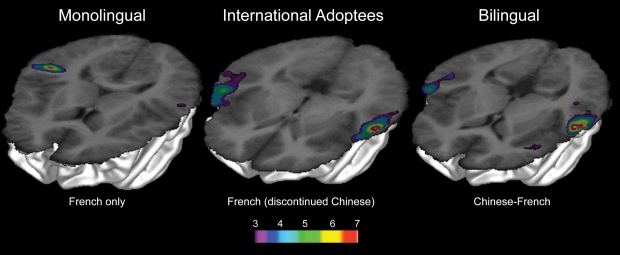
But their brains responded to Chinese language sounds the same way as those of bilingual children raised in Chinese-speaking families.


Children exposed to Chinese as babies display similar brain activation patterns as children with continued exposure to Chinese when hearing Chinese words, fMRI scans show.

“In essence, their pattern still looks like people who’ve been exposed to Chinese all their lives.”

Pierce, a PhD candidate in psychology at McGill University, working with Klein and other collaborators, scanned the brains of 48 girls aged nine to 17. Each participant lay inside a functional magnetic resonance imaging machine while she listened to pairs of three-syllable phrases. The phrases contained either:

■Sounds and tones from Mandarin, the official Chinese dialect.
■Hummed versions of the same tones but no actual words.

Participants were asked to tell if the last syllables of each pair were the same or different. The imaging machine measured what parts of the brain were active as the participants were thinking.

“Everybody can do the task — it’s not a difficult task to do,” Klein said. But the sounds are processed differently by people who recognize Chinese words — in that case, they activate the part of the brain that processes language.

Klein said the 21 children adopted from China who participated in the study might have been expected to show patterns similar to those of the 11 monolingual French-speaking children. After all, the adoptees left China at an average age of 12.8 months, an age when most children can only say a few words. On average, those children had not heard Chinese in more than 12 years.

The fact that their brains still recognized Chinese provides some insight into the importance of language learning during the first year of life, Klein suggested.

Effect on ‘relearning’ language not known

But Klein noted that the study is a preliminary one and the researchers don’t yet know what the results mean.

For example, would adopted children exposed to Chinese in infancy have an easier time relearning Chinese later, compared with monolingual French-speaking children who were learning it for the first time?

Pierce said studies trying to figure that out have had mixed results, but she hopes the findings in this study could generate better ways to tackle that question.

She is also interested in whether the traces of the lost language affect how the brain responds to other languages or other kinds of learning. Being able to speak multiple languages has already been shown to have different effects on the way the brain processes languages and other kinds of information.

http://www.cbc.ca/news/technology/adoptees-lost-language-from-infancy-triggers-brain-response-1.2838001

Brain decoder can eavesdrop on your inner voice

brainy_2758840b

Talking to yourself used to be a strictly private pastime. That’s no longer the case – researchers have eavesdropped on our internal monologue for the first time. The achievement is a step towards helping people who cannot physically speak communicate with the outside world.

“If you’re reading text in a newspaper or a book, you hear a voice in your own head,” says Brian Pasley at the University of California, Berkeley. “We’re trying to decode the brain activity related to that voice to create a medical prosthesis that can allow someone who is paralysed or locked in to speak.”

When you hear someone speak, sound waves activate sensory neurons in your inner ear. These neurons pass information to areas of the brain where different aspects of the sound are extracted and interpreted as words.

In a previous study, Pasley and his colleagues recorded brain activity in people who already had electrodes implanted in their brain to treat epilepsy, while they listened to speech. The team found that certain neurons in the brain’s temporal lobe were only active in response to certain aspects of sound, such as a specific frequency. One set of neurons might only react to sound waves that had a frequency of 1000 hertz, for example, while another set only cares about those at 2000 hertz. Armed with this knowledge, the team built an algorithm that could decode the words heard based on neural activity alone (PLoS Biology, doi.org/fzv269).

The team hypothesised that hearing speech and thinking to oneself might spark some of the same neural signatures in the brain. They supposed that an algorithm trained to identify speech heard out loud might also be able to identify words that are thought.

Mind-reading

To test the idea, they recorded brain activity in another seven people undergoing epilepsy surgery, while they looked at a screen that displayed text from either the Gettysburg Address, John F. Kennedy’s inaugural address or the nursery rhyme Humpty Dumpty.

Each participant was asked to read the text aloud, read it silently in their head and then do nothing. While they read the text out loud, the team worked out which neurons were reacting to what aspects of speech and generated a personalised decoder to interpret this information. The decoder was used to create a spectrogram – a visual representation of the different frequencies of sound waves heard over time. As each frequency correlates to specific sounds in each word spoken, the spectrogram can be used to recreate what had been said. They then applied the decoder to the brain activity that occurred while the participants read the passages silently to themselves.

Despite the neural activity from imagined or actual speech differing slightly, the decoder was able to reconstruct which words several of the volunteers were thinking, using neural activity alone (Frontiers in Neuroengineering, doi.org/whb).

The algorithm isn’t perfect, says Stephanie Martin, who worked on the study with Pasley. “We got significant results but it’s not good enough yet to build a device.”

In practice, if the decoder is to be used by people who are unable to speak it would have to be trained on what they hear rather than their own speech. “We don’t think it would be an issue to train the decoder on heard speech because they share overlapping brain areas,” says Martin.

The team is now fine-tuning their algorithms, by looking at the neural activity associated with speaking rate and different pronunciations of the same word, for example. “The bar is very high,” says Pasley. “Its preliminary data, and we’re still working on making it better.”

The team have also turned their hand to predicting what songs a person is listening to by playing lots of Pink Floyd to volunteers, and then working out which neurons respond to what aspects of the music. “Sound is sound,” says Pasley. “It all helps us understand different aspects of how the brain processes it.”

“Ultimately, if we understand covert speech well enough, we’ll be able to create a medical prosthesis that could help someone who is paralysed, or locked in and can’t speak,” he says.

Several other researchers are also investigating ways to read the human mind. Some can tell what pictures a person is looking at, others have worked out what neural activity represents certain concepts in the brain, and one team has even produced crude reproductions of movie clips that someone is watching just by analysing their brain activity. So is it possible to put it all together to create one multisensory mind-reading device?

In theory, yes, says Martin, but it would be extraordinarily complicated. She says you would need a huge amount of data for each thing you are trying to predict. “It would be really interesting to look into. It would allow us to predict what people are doing or thinking,” she says. “But we need individual decoders that work really well before combining different senses.”

http://www.newscientist.com/article/mg22429934.000-brain-decoder-can-eavesdrop-on-your-inner-voice.html