The Recovering Americans and the ‘Top Secret’ Ebola Treatment

Because Kent Brantly is a physician who has watched people die of Ebola, there was an especially chilling prescience to his assessment last week, between labored breaths: “I am going to die.”

His condition was grave. But then on Saturday, we saw images of Brantly’s heroic return to U.S. soil, walking with minimal assistance from an ambulance into an isolation unit at Emory University Hospital.

“One of the doctors called it ‘miraculous,'” Dr. Sanjay Gupta reported from Emory this morning, of Brantly’s turnaround within hours of receiving a treatment delivered from the U.S. National Institutes of Health. “Not a term we scientists like to throw around.”

“The outbreak is moving faster than our efforts to control it,” Dr. Margaret Chan, director of the World Health Organization, said on Friday in a plea for international help containing the virus. “If the situation continues to deteriorate, the consequences can be catastrophic in terms of lost lives, but also severe socioeconomic disruption and a high risk of spread to other countries.”

In that light, and because Ebola is notoriously incurable (and the strain at large its most lethal), it is overwhelming to hear that “Secret Serum Likely Saved Ebola Patients,” as we do this morning from Gupta’s every-20-minute CNN reports. He writes:

Three top secret, experimental vials stored at subzero temperatures were flown into Liberia last week in a last-ditch effort to save two American missionary workers [Dr. Kent Brantly and Nancy Writebol] who had contracted Ebola, according to a source familiar with details of the treatment.

Brantly had been working for the Christian aid organization Samaritan’s Purse as medical director of the Ebola Consolidation Case Management Center in Monrovia, Liberia. The group yesterday confirmed that he received a dose of an experimental serum before leaving the country.

In Gupta’s optimistic assessment, Brantly’s “near complete recovery” began within hours of receiving the treatment that “likely saved his life.” Writebol is also reportedly improved since receiving the treatment, known as zMapp. But to say that it was a secret implies a frigid American exceptionalism; that the people of West Africa are dying in droves while a classified cure lies in wait.

The “top-secret serum” is a monoclonal antibody. Administration of monoclonal antibodies is an increasingly common but time-tested approach to eradicating interlopers in the human body. In a basic monoclonal antibody paradigm, scientists infect animals (in this case mice) with a disease, the mice mount an immune response (antibodies to fight the disease), and then the scientists harvest those antibodies and give them to infected humans. It’s an especially promising area in cancer treatment.

In this case, the proprietary blend of three monoclonal antibodies known as zMapp had never been tested in humans. It had previously been tested in eight monkeys with Ebola who survived—though all received treatment within 48 hours of being infected. A monkey treated outside of that exposure window did not survive. That means very little is known about the safety and effectiveness of this treatment—so little that outside of extreme circumstances like this, it would not be legal to use. Gupta speculates that the FDA may have allowed it under the compassionate use exemption.

A small 2012 study of monoclonal antibody therapy against Ebola found that it was only effective when administered before or just after exposure to the virus. A 2013 study found that rhesus macaques given an antibody mix called MB-003 within the 48-hour window had a 43 percent chance of surviving—as opposed to their untreated counterparts, whose survival rate was zero.

This Ebola outbreak is the largest in the history of the disease, in terms of both cases and deaths, 729 887 known so far. As Chan warned in her call for urgent international action, the outbreak is geographically the largest, already in four countries with fluid population movement across porous borders and a demonstrated ability to spread by air travel. The outbreak will be stopped by strategic quarantines and preventive education, primarily proper handling of corpses. More than 60 aid workers have become infected, but many more will be needed to stem the tide.

Dr. Anthony Fauci, director of the U.S. National Institute of Allergy and Infectious Disease (NIAID), is encouraged by the antibody treatment.

“Obviously there are plans and enthusiasm to expand this,” Fauci told me. “The limiting factor is the extraordinary paucity of treatment regimens.” Right now the total amount available, to Fauci’s knowledge, is three treatment courses (in addition to what was given to Brantly and Writebol).

NIAID did some of the original research that led to the development, but this is owned by Mapp Biopharmaceuticals. “They are certainly trying to scale up,” Fauci said, “but I’ve heard that their capability is such that it’s going to be months before they have a substantial number of doses, and even then they’re going to be limited.”

“We’re hearing that the administration of this cocktail of antibodies improved both Dr. Brantly and Ms. Writebol, but you know, we don’t know that,” Fauci said, noting the sample size (two) of this small, ad hoc study. Proving effectiveness would require a much larger group of patients being compared to an untreated group. “And we don’t know that they weren’t getting better anyway.”

Thanks to Kebmodee for bringing this to the attention of the It’s Interesting community.

http://www.theatlantic.com/health/archive/2014/08/the-secret-ebola-treatment/375525/
On/Off switch for consciousness in the human brain may have been discovered

ONE moment you’re conscious, the next you’re not. For the first time, researchers have switched off consciousness by electrically stimulating a single brain area.

Scientists have been probing individual regions of the brain for over a century, exploring their function by zapping them with electricity and temporarily putting them out of action. Despite this, they have never been able to turn off consciousness – until now.

Although only tested in one person, the discovery suggests that a single area – the claustrum – might be integral to combining disparate brain activity into a seamless package of thoughts, sensations and emotions. It takes us a step closer to answering a problem that has confounded scientists and philosophers for millennia – namely how our conscious awareness arises.

Many theories abound but most agree that consciousness has to involve the integration of activity from several brain networks, allowing us to perceive our surroundings as one single unifying experience rather than isolated sensory perceptions.

One proponent of this idea was Francis Crick, a pioneering neuroscientist who earlier in his career had identified the structure of DNA. Just days before he died in July 2004, Crick was working on a paper that suggested our consciousness needs something akin to an orchestra conductor to bind all of our different external and internal perceptions together.

With his colleague Christof Koch, at the Allen Institute for Brain Science in Seattle, he hypothesised that this conductor would need to rapidly integrate information across distinct regions of the brain and bind together information arriving at different times. For example, information about the smell and colour of a rose, its name, and a memory of its relevance, can be bound into one conscious experience of being handed a rose on Valentine’s day.

The pair suggested that the claustrum – a thin, sheet-like structure that lies hidden deep inside the brain – is perfectly suited to this job (Philosophical Transactions of The Royal Society B, doi.org/djjw5m).

It now looks as if Crick and Koch were on to something. In a study published last week, Mohamad Koubeissi at the George Washington University in Washington DC and his colleagues describe how they managed to switch a woman’s consciousness off and on by stimulating her claustrum. The woman has epilepsy so the team were using deep brain electrodes to record signals from different brain regions to work out where her seizures originate. One electrode was positioned next to the claustrum, an area that had never been stimulated before.

When the team zapped the area with high frequency electrical impulses, the woman lost consciousness. She stopped reading and stared blankly into space, she didn’t respond to auditory or visual commands and her breathing slowed. As soon as the stimulation stopped, she immediately regained consciousness with no memory of the event. The same thing happened every time the area was stimulated during two days of experiments (Epilepsy and Behavior, doi.org/tgn).
To confirm that they were affecting the woman’s consciousness rather than just her ability to speak or move, the team asked her to repeat the word “house” or snap her fingers before the stimulation began. If the stimulation was disrupting a brain region responsible for movement or language she would have stopped moving or talking almost immediately. Instead, she gradually spoke more quietly or moved less and less until she drifted into unconsciousness. Since there was no sign of epileptic brain activity during or after the stimulation, the team is sure that it wasn’t a side effect of a seizure.

Koubeissi thinks that the results do indeed suggest that the claustrum plays a vital role in triggering conscious experience. “I would liken it to a car,” he says. “A car on the road has many parts that facilitate its movement – the gas, the transmission, the engine – but there’s only one spot where you turn the key and it all switches on and works together. So while consciousness is a complicated process created via many structures and networks – we may have found the key.”

Counter-intuitively, Koubeissi’s team found that the woman’s loss of consciousness was associated with increased synchrony of electrical activity, or brainwaves, in the frontal and parietal regions of the brain that participate in conscious awareness. Although different areas of the brain are thought to synchronise activity to bind different aspects of an experience together, too much synchronisation seems to be bad. The brain can’t distinguish one aspect from another, stopping a cohesive experience emerging.

Since similar brainwaves occur during an epileptic seizure, Koubeissi’s team now plans to investigate whether lower frequency stimulation of the claustrum could jolt them back to normal. It may even be worth trying for people in a minimally conscious state, he says. “Perhaps we could try to stimulate this region in an attempt to push them out of this state.”

Anil Seth, who studies consciousness at the University of Sussex, UK, warns that we have to be cautious when interpreting behaviour from a single case study. The woman was missing part of her hippocampus, which was removed to treat her epilepsy, so she doesn’t represent a “normal” brain, he says.

However, he points out that the interesting thing about this study is that the person was still awake. “Normally when we look at conscious states we are looking at awake versus sleep, or coma versus vegetative state, or anaesthesia.” Most of these involve changes of wakefulness as well as consciousness but not this time, says Seth. “So even though it’s a single case study, it’s potentially quite informative about what’s happening when you selectively modulate consciousness alone.”

“Francis would have been pleased as punch,” says Koch, who was told by Crick’s wife that on his deathbed, Crick was hallucinating an argument with Koch about the claustrum and its connection to consciousness.

“Ultimately, if we know how consciousness is created and which parts of the brain are involved then we can understand who has it and who doesn’t,” says Koch. “Do robots have it? Do fetuses? Does a cat or dog or worm? This study is incredibly intriguing but it is one brick in a large edifice of consciousness that we’re trying to build.”

http://www.newscientist.com/article/mg22329762.700-consciousness-onoff-switch-discovered-deep-in-brain.html?full=true#.U7n7sI1dVC8

Thanks to Kebmodee for bringing this to the attention of the It’s Interesting community.

New Weapon in Fight Against ‘Superbugs’

By Ann Lukits

A soil sample from a national park in eastern Canada has produced a compound that appears to reverse antibiotic resistance in dangerous bacteria.

Scientists at McMaster University in Ontario discovered that the compound almost instantly turned off a gene in several harmful bacteria that makes them highly resistant to treatment with a class of antibiotics used to fight so-called superbug infections. The compound, called aspergillomarasmine A, or AMA, was extracted from a common fungus found in soil and mold.

Antibiotic resistance is a growing public-health threat. Common germs such as Escherichia coli, or E. coli, are becoming harder to treat because they increasingly don’t respond to antibiotics. Some two million people in the U.S. are infected each year by antibiotic-resistant bacteria and 23,000 die as a result, according to the Centers for Disease Control and Prevention. The World Health Organization has called antibiotic resistance a threat to global public health.

The Canadian team was able to disarm a gene—New Delhi Metallo-beta-Lactamase-1, or NDM-1—that has become “public enemy No. 1” since its discovery in 2009, says Gerard Wright, director of McMaster’s Michael G. DeGroote Institute for Infectious Disease Research and lead researcher on the study. The report appears on the cover of this week’s issue of the journal Nature.

“Discovery of a fungus capable of rendering these multidrug-resistant organisms incapable of further infection is huge,” says Irena Kenneley, a microbiologist and infectious disease specialist at Frances Payne Bolton School of Nursing at Cleveland’s Case Western Reserve University. “The availability of more treatment options will ultimately save many more lives,” says Dr. Kenneley, who wasn’t involved in the McMaster research.

The McMaster team plans further experiments to determine the safety and effective dosage of AMA. It could take as long as a decade to complete clinical trials on people with superbug infections, Dr. Wright says.

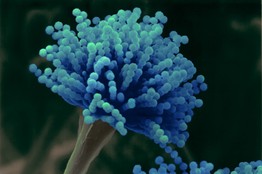
The researchers found that AMA, extracted from a strain of Aspergillus versicolor and combined with a carbapenem antibiotic, inactivated the NDM-1 gene in three drug-resistant superbugs—Enterobacteriaceae, a group of bacteria that includes E. coli; Acenitobacter, which can cause pneumonia and blood infections; and Pseudomonas, which often infect patients in hospitals and nursing homes. The NDM-1 gene encodes an enzyme that helps bacteria become resistant to antibiotics and that requires zinc to survive. AMA works by removing zinc from the enzyme, freeing the antibiotic to do its job, Dr. Wright says. Although AMA was only tested on carbapenem-resistant bacteria, he expects the compound would have a similar effect when combined with other antibiotics.

AMA was first identified in the 1960s in connection with leaf wilt in plants and later investigated as a potential drug for treating high blood pressure. The compound turned up in Dr. Wright’s lab a few years ago during a random screening of organisms derived from 10,000 soil samples stored at McMaster. The sample that produced AMA was collected by one of Dr. Wright’s graduate students during a visit to a Nova Scotia park. It was the only sample of 500 tested that inhibited NDM-1 in cell cultures.

“It was a lucky hit,” says Dr. Wright. “It tells us that going back to those environmental organisms, where we got antibiotics in the first place, is a really good idea.”

The McMaster team developed a purified form of AMA for experiments on mice injected with a lethal form of drug-resistant pneumonia. Treatment with either AMA or a carbapenem antibiotic alone proved ineffective. But combining the substances resulted in more than 95% of the mice still being alive after five days. The combination was also tested on 229 cell cultures from human patients infected with resistant superbugs. The treatment resensitized 88% of the samples to carbapenem.

Still, bacteria could someday find a way to outwit AMA. “I can’t imagine anything we could make where resistance would never be an issue,” he says. “At the end of the day, this is evolution and you can’t fight evolution.”

Thanks to Da Brayn for bringing this to the attention of the It’s Interesting community.

http://m.us.wsj.com/articles/new-weapon-in-fight-against-superbugs-1404175658?mobile=y

Century-old drug reverses signs of autism in mice

By Elizabeth Norton

A single dose of a century-old drug has eliminated autism symptoms in adult mice with an experimental form of the disorder. Originally developed to treat African sleeping sickness, the compound, called suramin, quells a heightened stress response in neurons that researchers believe may underlie some traits of autism. The finding raises the hope that some hallmarks of the disorder may not be permanent, but could be correctable even in adulthood.

That hope is bolstered by reports from parents who describe their autistic children as being caught behind a veil. “Sometimes the veil parts, and the children are able to speak and play more normally and use words that didn’t seem to be there before, if only for a short time during a fever or other stress” says Robert Naviaux, a geneticist at the University of California, San Diego, who specializes in metabolic disorders.

Research also shows that the veil can be parted. In 2007, scientists found that 83% of children with autism disorders showed temporary improvement during a high fever. The timing of a fever is crucial, however: A fever in the mother can confer a higher risk for the disorder in the unborn child.

As a specialist in the cell’s life-sustaining metabolic processes, Naviaux was intrigued. Autism is generally thought to result from scrambled signals at synapses, the points of contact between nerve cells. But given the specific effects of something as general as a fever, Naviaux wondered if the problem lay “higher up” in the cell’s metabolism.

To test the idea, he and colleagues focused on a process called the cell danger response, by which the cell protects itself from threats like infection, temperature changes, and toxins. As part of this strategy, Naviaux explains, “the cells behave like countries at war. They harden their borders. They don’t trust their neighbors.” If the cells in question are neurons, he says, disrupted communication could result—perhaps underlying the social difficulties; heightened sensitivity to sights, sounds, and sensations; and intolerance for anything new that often afflict patients with autism.

The key player may be ATP, the chief carrier of energy within a cell, which can also relay messages to other nearby cells. When too much ATP is released for too long, it can induce a hair-trigger cell danger response in neighboring neurons. In 2013, Naviaux spelled out his hypothesis that autism involves a prolonged, heightened cell danger response, disrupting pathways within and between neurons and contributing to the symptoms of the disorder.

The same year, he and his colleagues homed in on the drug suramin as a way to call off the response. The medication has been in use since the early 20th century to kill the organisms that cause African sleeping sickness. In 1988, it was found to block the so-called purinergic receptors, which bind to compounds called purines and pyrimidines—including ATP. These receptors are found on every cell in the body; on neurons, they help orchestrate many of the processes impaired in autism—such as brain development, the production of new synapses, inflammation, and motor coordination.

To determine if suramin could protect these receptors from overstimulation by ATP, Naviaux’s team worked with mice that developed an autism-like disorder after their mothers had been exposed to a simulated viral infection (and heightened cell danger responses) during pregnancy. Like children with autism, the mice born after these pregnancies were less social and did not seek novelty; they avoided unfamiliar mice and passed up the chance to explore new runs of a maze. In the 2013 paper, the researchers reported that these traits vanished after weekly injections of suramin begun when the mice were 6 weeks old (equivalent to 15-year-old humans). Many consequences of altered metabolism—including the structure of synapses, body temperature, the production of key receptors, and energy transport within neurons—were either corrected or improved.

In the new study, published online today in Translational Psychiatry, the researchers found equally compelling results after a single injection of suramin given to 6-month-old mice (equivalent to 30-year-old humans) with the same autism-like condition. Once again, previously reclusive animals approached unknown mice and investigated unfamiliar parts of a maze, suggesting that the animals had overcome the aversion to novelty that’s a hallmark of autism in children. After the single injection, the team lowered the levels of suramin by half each week. Within 5 weeks most, but not all, of the benefits of treatment had been lost. The drug also corrected 17 of 18 metabolic pathways that are disrupted in mice with autism-like symptoms.

Naviaux cautions that mice aren’t people, and therapies that are promising in rodents have a track record of not panning out in humans. He also says that prolonged treatment with suramin is not an option for children, because it can have side effects such as anemia with long-term use. He notes that there are 19 different kinds of purinergic receptors; if suramin does prove to be helpful in humans, newer drugs could be developed that would target only one or a few key receptors. The researchers are beginning a small clinical trial in humans of a single dose of suramin that they hope will be completed by the end of the year.

The study is exciting, says Bruce Cohen, a pediatric neurologist at Akron Children’s Hospital in Ohio. “The authors have come up with a novel idea, tested it thoroughly, and got a very positive response after one dose.” He notes, however, that the mice with a few characteristics of autism don’t necessarily reflect the entire condition in humans. “Autism isn’t a disease. It’s a set of behaviors contributing to hundreds of conditions and resulting from multiple genes and environmental effects. Great work starts with a single study like this one, but there’s more work to be done.”

http://news.sciencemag.org/biology/2014/06/century-old-drug-reverses-signs-autism-mice

Brain tumor causes uncontrollable laughter

They say laughter is the best medicine. But what if laughter is the disease?

For a 6-year-old girl in Bolivia who suffered from uncontrollable and inappropriate bouts of giggles, laughter was a symptom of a serious brain problem. But doctors initially diagnosed the child with “misbehavior.”

“She was considered spoiled, crazy — even devil-possessed,” Dr. José Liders Burgos Zuleta, ofAdvanced Medical Image Centre, in Bolivia, said in a statement.

But Burgos Zuleta discovered that the true cause of the girl’s laughing seizures, medically called gelastic seizures, was a brain tumor.

After the girl underwent a brain scan, the doctors discovered a hamartoma, a small, benign tumor that was pressing against her brain’s temporal lobe.The doctors surgically removed the tumor, and the girl is now healthy, the doctors said.

The girl stopped having the uncontrollable attacks of laughter and now only laughs normally, the doctors said.

Gelastic seizures are a form of epilepsy that is relatively rare, said Dr. Solomon Moshé, a pediatric neurologist at Albert Einstein College of Medicine in New York. The word comes from the Greek word for laughter, “gelos.”

“It’s not necessarily ‘hahaha’ laughing,” Moshé told Live Science. “There’s no happiness in this. Some of the kids may be very scared,” he added.

The seizures are most often caused by tumors in the hypothalamus, especially in kids, although they can also come from tumors in other parts of brain, Moshé said. Although laughter is the main symptom, patients may also have outbursts of crying.

These tumors can cause growth abnormalities if they affect the pituitary gland, he said.

The surgery to remove such brain tumors used to be difficult and dangerous, but a new surgical technique developed within the last 10 years allows doctors to remove them effectively without great risk, Moshé said.

The doctors who treated the girl said their report of her case could raise awareness of the strange condition, so doctors in Latin America can diagnose the true cause of some children’s “behavioral” problems, and refer them to a neurologist.

The case report was published June 16 in the journal ecancermedicalscience.

Thanks to Michael Moore for sharing this with the It’s Interesting community.

http://www.cbsnews.com/news/girls-uncontrollable-laughter-caused-by-brain-tumor/