Beyonce Fly

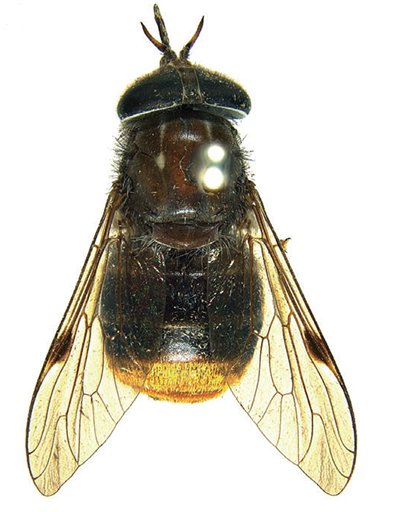
A newly discovered horse fly in Australia was so “bootylicious” with its golden-haired bum, there was only one name worthy of its beauty: Beyonce.

Previously published results from Bryan Lessard, a 24-year-old researcher at Australia’s Commonwealth Scientific and Industrial Research Organization, were recently announced on the species that had been sitting in a fly collection since it was captured in 1981 — the same year pop diva Beyonce was born.

He says he wanted to pay respect to the insect’s beauty by naming it Scaptia (Plinthina) beyonceae.

Lessard said Beyonce would be “in the nature history books forever” and that the fly now bearing her name is “pretty bootylicious” with its golden backside.

“Bootylicious” was the title of a song by Beyonce’s previous group, Destiny’s Child.

It’s unknown if the rare species is a bloodsucker like many female horse flies. Lessard says he was unable to find any live specimens when he went looking in 2010 in northeast Queensland’s Atherton Tablelands, where it was captured three decades ago. However, at least one member of the public has alerted him that he was recently bitten by what’s locally called the “gold bum fly.”

The description of the fly was earlier published in the Australian Journal of Entomology, but the results were announced last week.

Lessard says he hasn’t heard from Beyonce, who recently gave birth to her first child, but he is a fan and hopes she will take his scientific gesture as a compliment. He also said the name was picked to help draw attention to the importance of his field and the need for more researchers to catalog and study insects.

Horse flies are “vital pollinators of native plants, not just in Australia, but all over the world,” Lessard said. “It’s extremely important to name all the undescribed species so we can measure our human impact on the environment and hopefully protect it for future generations to enjoy.”

Read more: http://www.sfgate.com/cgi-bin/article.cgi?f=/n/a/2012/01/16/international/i010548S37.DTL#ixzz1mDfuvlej

Massive Alaskan Volcano May Erupt and Disrupt Air Travel


Officials are monitoring a remote Alaska volcano that could launch an ash cloud, potentially threatening intercontinental flights.

“Eruptive activity” of Cleveland Volcano was detected in satellite data, according to the Alaska Volcano Observatory.

The volcano, also known as Mount Cleveland, is on the Aleutian Islands, southwest of mainland Alaska.

“A new lava dome has been observed in the summit crater,” the observatory said Tuesday. “There have been no observations of ash emissions or explosive activity during this current lava eruption.”

But the volcanic activity could heighten and affect air travel, said Steve McNutt, a scientist at the University of Alaska Fairbanks.

McNutt said 90% of air freight from Asia to Europe and North America flies over Alaska air space, and hundreds of flights — including more than 20,000 passengers — fly through Anchorage’s air space daily.

“If there is an explosion and (ash) reaches high altitudes, it will causes flights to be rerouted and ultimately canceled,” McNutt said.

The volcano’s most recent significant eruption took place in 2001. It produced three explosions that led to ash clouds as high as 7.5 miles (12 kilometers) above sea level, according to the volcano observatory.

“The 2001 eruption also produced a rubbly lava flow and hot avalanche that reached the sea,” the observatory said.

Last year, volcanic ash spewing from Iceland’s Grimsvotn volcano forced the cancellation of hundreds of flights across Europe.

The Grimsvotn eruption came about 13 months after Iceland’s Eyjafjallajokull volcano belched smoke and ash into the skies, forcing the cancellation of thousands of flights per day at the peak of the problem.

http://www.cnn.com/2012/02/01/us/alaska-volcano/index.html

Kandi Gay: Woman Who Texts in her Sleep

BETTENDORF, IOWA (WIVB) – People have been known to moan, talk even walk in their sleep but what about sending text messages?

Kandi Gay is a paramedic whose schedule covers all hours of the day.

But when she goes to sleep day or night like more and more Americans she continues to work, texting as she sleeps or talking on the phone with no memory of doing it.

Kandi Gay said, “I’d be like, ‘No, I slept all day or I slept all night,’ and they’re always like, ‘No, I saw you texting.’ And I’d go back and look at my text messages and have full on conversations.”

Kandi’s father, Wayne Gay said, “I’ll come in and see her texting– she’ll be up in the air with her eyes closed. She’ll be texting and lay it down.”

Doctors say these people are not in a totally deep sleep and other people might eat in their sleep or even have conversations.

http://investmentwatchblog.com/the-woman-who-texts-coherently-in-her-sleep/

$57,000 Boy-Only 5th Grade Dallas School Field Trip to the Movies


DALLAS – An estimated 5,000 DISD fifth-grade boys excitedly exited schools buses, headed out for a field trip. And for fifth-grade boys, it’s a field trip of the best kind. They are being treated to the newly released war movie, “Red Tails.”

It’s a film about the Tuskegee Airmen, a group of African American pilots whose acts of bravery during World War II won them medals of valor. District officials say World War II is part of the fifth grade curriculum.

The district reported late Thursday $32,000 was spent for the movie tickets and $25,000 for the buses.

“What we did is, we provided each school with lesson plans both before and after the movie, so we could take best advantage of the opportunity for these students,” said Jon Dahlander, DISD spokesperson.

By students, he means boys. The fifth-grade girls were not invited. They stayed in school and watched a rented movie about a spelling bee.

read more:  http://www.kvue.com/news/state/Dallas-ISD-questioned-over-57000-field-trip-using-federal-funds-139085874.html

Skin Cancer Drug Serendipitously Discovered to Treat Alzheimer’s Disease in Mice


Scientists say they “serendipitously” discovered that a drug used to treat a type of cancer quickly reversed Alzheimer’s disease in mice.

“It’s really exciting,” said Maria Carrillo, senior director for medical and scientific relations for the Alzheimer’s Association. “They saw very positive and robust behavior effects in the mice.”

In the study, researchers at Case Western Reserve University School of Medicine gave mice mega-doses of bexarotene, a drug used to treat a type of skin cancer called cutaneous T-cell lymphoma. Within 72 hours, the mice showed dramatic improvements in memory and more than 50% of amyloid plaque — a hallmark of Alzheimer’s disease — had been removed from the brain.

The study was published Thursday in the journal Science.

Gary Landreth, the lead researcher at Case Western, cautioned that even though his results were impressive in mice, it may turn out not to work in people.

“I want to say as loudly and clearly as possible that this was a study in mice, not in humans,” he said. “We’ve fixed Alzheimer’s in mice lots of times, so we need to move forward expeditiously but cautiously.”

Mice — and humans — with Alzheimer’s have high levels of a substance called amyloid beta in their brain. Pathology tests on the mice showed bexarotene lowered the levels of amyloid beta and raised the levels of apolipoprotein E, which helps keep amyloid beta levels low.

Landreth said he hopes to try the drug out in healthy humans within two months, to see if it has the same effect.

Those participating in the trial would be given the standard dose that cancer patients are usually given.

Researchers tested the memories of mice with Alzheimer’s both before and after giving them bexarotene. For example, the Alzheimer’s mice walked right into a cage where they’d previously been given a painful electrical shock, but after treatment with bexarotene, the mice remembered the shock and refused to enter the cage.

In another test, the scientists put tissue paper in a cage. Normal mice instinctively use tissues in their cage to make a nest, but mice with Alzheimer’s can’t figure out what to do with the tissues. After treatment with the drug, the Alzheimer’s mice made a nest with the paper.

Carrillo said one of the major advantages of bexarotene is that it’s already been approved by the Food and Drug Administration for use in humans, which means the researchers can move into human trials sooner than if it were a completely new drug.

The Alzheimer’s Foundation is funding Case Western’s next phase of research, which will involve using bexarotene at the levels used on cancer patients, Landreth said. Since the drug does have some side effects — it can increase cholesterol, for example — he hopes to use it in even lower levels as the study goes on.

Landreth said his lab had been working on other drugs for Alzheimer’s for 10 years when a graduate student, Paige Cramer, decided to try bexarotene, which works on a receptor involved in amyloid beta clearance. Some other drugs that worked in mice were too toxic to use in humans.

“We’re really lucky that bexarotene is a great drug with an acceptable safety profile,” he said. “This doesn’t happen very many times in life.”

http://www.cnn.com/2012/02/09/health/us-cancer-drug-alzheimers/index.html?hpt=hp_bn10

Police Taser Woman at North Carolina McDonald’s Drive Through

Cops in Hope Mill, N.C., opened fire with a stun gun on a woman who butted in line at a McDonald’s drive-thru.

Evangeline Lucca, 37, who was with her three-year-old daughter, became confrontational with burger joint employees, who refused to serve her at the pick-up window Friday and asked to go to the end of the line.

Lucca refused to budge by the time police came 20 minutes later and took a shot from a stun gun for her belligerence, the Fay Observer reported.

A second shot was needed before “she just flopped out of the car like a fish,” customer Andy Rich told the Observer.

She’s charged with second-degree trespass and her daughter was taken into protective custody.

http://cnews.canoe.ca/CNEWS/WeirdNews/2012/02/05/19341736.html

Patch of seagrass is world’s oldest living organism


A swathe of seagrass in the Mediterranean could be the oldest known living thing on Earth.

Carlos Duarte of the University of Western Australia in Perth sequenced the DNA of Posidonia oceanica at 40 sites spanning 3500 kilometres of seafloor, from Spain to Cyprus. One patch off the island of Formentera was identical over 15 kilometres of coastline.

Like all seagrasses, Posidonia oceanica reproduces by cloning, so meadows spanning many kilometres are genetically identical and considered one organism.

Given the plant’s annual growth rate the team calculated that the Formentera meadow must be between 80,000 and 200,000 years old, making it the oldest living organism on Earth. It trumps a Tasmanian shrub, Lomatia tasmanica, believed to be 43,600 years old.

Despite its historical robustness, Duarte says the patch of P. oceanica is now threatened by climate change. The Mediterranean is warming three times faster than the world average, and each year P. oceanica meadows decline by around 5 per cent. “They have never experienced the speed of climate that the Mediterranean is currently experiencing,” he says.

Journal reference: PLoS One, DOI: 10.1371/journal.pone.0030454

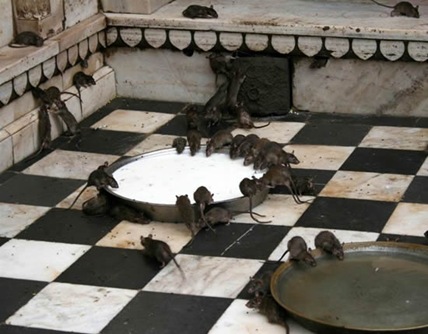
The Rat Temple

India Rat Temple Is Home To 15,000 Revered Rodents Worshipped As Reincarnated Family Members

On the surface, this temple in northern India appears like any other. But there’s a main difference: there are 15,000 deities living inside it and they happen to be rats.

Believed by locals to be the reincarnation of former family members, the rats are allowed to run rampant in and around the temple — a notion that would seem impossible to those living in the West.

But if you want to experience these revered rodents, you must remove your shoes and walk and sit among them.

Read the whole story: http://video.nationalgeographic.com/video/places/culture-places/buildings-landmarks/india-rattemple-pp/

Man Spends $16,000 on Virtual Sword


A man in China recently spent $16,000 for a virtual sword on a game that has not even been released yet.

“Age of Wulin,” by California-based company Snail Games, has not even been released on mainland China but that isn’t stopping some from spending serious cash on the game.

The game is a role-playing one that is set in ancient China and is a massively multiplayer online role-playing game, or better known as MMORPGs.

The man is not alone in his purchases. A study released earlier in the year valued the virtual economy for MMORPGs is $3 billion.