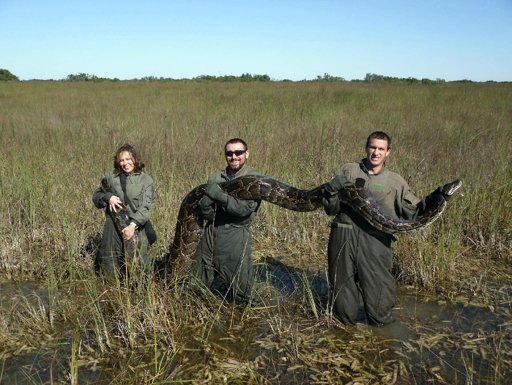
Pythons May Be Wiping Out Animals in the Everglades

A burgeoning population of huge pythons — many of them pets that were turned loose by their owners when they got too big — appears to be wiping out large numbers of raccoons, opossums, bobcats and other mammals in the Everglades, a study says.

The study, published Monday in the Proceedings of the National Academy of Sciences, found that sightings of medium-size mammals are down dramatically — as much as 99 percent, in some cases — in areas where pythons and other large, non-native constrictor snakes are known to be lurking.

Scientists fear the pythons could disrupt the food chain and upset the Everglades’ environmental balance in ways difficult to predict.

“The effects of declining mammal populations on the overall Everglades ecosystem, which extends well beyond the national park boundaries, are likely profound,” said John Willson, a research scientist at Virginia Tech University and co-author of the study.

Tens of thousands of Burmese pythons, which are native to Southeast Asia, are believed to be living in the Everglades, where they thrive in the warm, humid climate. While many were apparently released by their owners, others may have escaped from pet shops during Hurricane Andrew in 1992 and have been reproducing ever since.

Burmese pythons can grow to be 26 feet long and more than 200 pounds, and they have been known to swallow animals as large as alligators. They and other constrictor snakes kill their prey by coiling around it and suffocating it.

The National Park Service has counted 1,825 Burmese pythons that have been caught in and around Everglades National Park since 2000. Among the largest so far was a 156-pound, 16.4-foot one captured earlier this month.

For the study, researchers drove 39,000 miles along Everglades-area roads from 2003 through 2011, counting wildlife spotted along the way and comparing the results with surveys conducted on the same routes in 1996 and 1997.

The researchers found staggering declines in animal sightings: a drop of 99.3 percent among raccoons, 98.9 percent for opossums, 94.1 percent for white-tailed deer and 87.5 percent for bobcats. Along roads where python populations are believed to be smaller, declines were lower but still notable.

Rabbits and foxes, which were commonly spotted in 1996 and 1997, were not seen at all in the later counts. Researchers noted slight increases in coyotes, Florida panthers, rodents and other mammals, but discounted that finding because so few were spotted overall.

“The magnitude of these declines underscores the apparent incredible density of pythons in Everglades National Park,” said Michael Dorcas, a professor at Davidson College in North Carolina and lead author of the study.

Although scientists cannot definitively say the pythons are killing off the mammals, the snakes are the prime suspect. The increase in pythons coincides with the mammals’ decrease, and the decline appears to grow in magnitude with the size of the snakes’ population in an area. A single disease appears unlikely to be the cause since several species were affected.

The report says the effect on the overall ecosystem is hard to predict. Declines among bobcats and foxes, which eat rabbits, could be linked to pythons’ feasting on rabbits. On the flip side, declines among raccoons, which eat eggs, may help some turtles, crocodiles and birds.

Scientists point with concern to what happened in Guam, where the invasive brown tree snake has killed off birds, bats and lizards that pollinated trees and flowers and dispersed seeds. That has led to declines in native trees, fish-eating birds and certain plants.

In 2010, Florida banned private ownership of Burmese pythons. Earlier this month, U.S. Interior Secretary Ken Salazar announced a federal ban on the import of Burmese pythons and three other snakes.

Salazar said Monday that the study shows why such restrictions were needed.

“This study paints a stark picture of the real damage that Burmese pythons are causing to native wildlife and the Florida economy,” he said.

http://news.yahoo.com/pythons-apparently-wiping-everglades-mammals-201541112.html

Thanks to Ray G for bringing this to the attention of the It’s Interesting community.

ACLU Lawsuit Against Obama Administration Over Assassination of American Citizens


The ACLU Wednesday filed a lawsuit against various agencies of the Obama administration — the Justice and Defense Departments and the CIA — over their refusal to disclose any information about the assassination of American citizens. In October, the ACLU filed a FOIA request demanding disclosure of the most basic information about the CIA’s killing of 3 American citizens in Yemen: Anwar Awlaki and Samir Khan, killed by missiles fired by a U.S. drone in September, and Awlaki’s 16-year-old son, Abdulrahman, killed by another drone attack two weeks later.

The ACLU’s FOIA request sought merely to learn the legal and factual basis for these killings — meaning: tell us what legal theories you’ve adopted to secretly target U.S. citizens for execution, and what factual basis did you have to launch these specific strikes? The DOJ and CIA responded not only by refusing to provide any of this information, but refused even to confirm if any of the requested documents exist; in other words, as the ACLU put it yesterday, “these agencies are saying the targeted killing program is so secret that they can’t even acknowledge that it exists.” That refusal is what prompted Wednesday’s lawsuit (in December, the New York Times also sued the Obama administration after it failed to produce DOJ legal memoranda “justifying” the assassination program in response to a FOIA request from reporters Charlie Savage and Scott Shane, but the ACLU’s lawsuit seeks disclosure of both the legal and factual bases for these executions).

Thanks to Kebmodee for bringing this to the attention of the It’s Interesting community:  http://kebmodee.blogspot.com/2012/02/aclu-sues-obama-administration-over.html?utm_source=feedburner&utm_medium=email&utm_campaign=Feed%3A+Kebmodee+%28kebmodee%29

read more here:  http://www.salon.com/2012/02/02/aclu_sues_obama_administration_over_assassination_secrecy/singleton/

Service Dog’s Licks Save Owner’s Life


A lick of the face and a nudge of the hand from Danny, a miniature schnauzer, helped Bethe Bennett regain consciousness after she fell in her Glendale, Ariz., home.

Bennett fell on her tile floor Friday and broke her femur. She lay on the ground in excruciating pain, aware that no visitors were coming until Tuesday.

“I was scared. I really thought I was going to die,” Bennett told ABCNews.com. “I knew I was going into shock because I’m a nurse.”

But Danny,  a trained service dog who used to care for Bennett’s now-deceased mother, lent a helping paw that helped save his devoted owner’s life.

“I started asking Danny to get me the phone,” Bennett said. “He ran back and forth a couple of times barking and finally jumped up and knocked the phone over and pushed it with his nose toward me.”

But then Bennett realized the paramedics may not have been able to get into her locked house.

“Paper!” she asked Danny. He brought over five sheets, one of which had the phone numbers of Bennett’s neighbors.

Bennett called her neighbors, who unlocked her home with a hidden spare key just as paramedics arrived.

She is now recovering at Banner Thunderbird Medical Center in Glendale, with Danny by her side.

Bennett has written a book called the “Forever Home” series about the foster animals she takes in and said she plans to write one about Danny.

“Never in my wildest dreams did I think I’d be the one he’d have to rescue,” she said. “He was my little hero.”

http://abcnews.go.com/blogs/health/2012/02/01/service-dogs-licks-save-owners-life/#.TysGTMU5nvs.email

Thanks to Dr. N for bringing this to the attention of the It’s Interesting community.
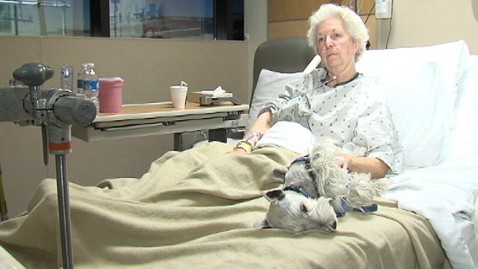
 

And here is a picture of Danny, as ringbearer at Dr. N’s wedding.


Dermatologists Latest Round of Doctors to Receive No Cheating Warning


Doctors studying to become dermatologists have, for years, shared exam questions by memorizing and writing them down after the test to become board certified, CNN has confirmed.

Reports of the use of what are known as “airplane notes” comes after revelations last month that radiology residents around the country for years also have used what are known as “recalls” to prepare for the written exam, which is one step in becoming certified by the American Board of Radiology.

In the wake of the CNN story, the group that oversees 24 medical specialties issued a statement condemning the use of the recalls.

The American Board of Medical Specialties said on its website that, “It should be made abundantly clear that recalling and sharing questions from exams violates exam security, professional ethics and patient trust in the medical profession. When it happens, the practice should be addressed swiftly and decisively. Whether someone is providing or using test questions, ABMS Member Boards enforce sanctions that may include permanent barring from certification, and/or prosecution for copyright violation.”

CNN has confirmed the practice also exists with dermatology, where the recalls are known as “airplane notes,” because residents write down as much as they can remember on the plane after taking the test.

In an anonymous e-mail to the American Board of Dermatology in 2008, a resident wrote: “The board needs to know that there is an organized effort year after year to, by verbatim, reproduce each and every question of the official ABD certifying examination minutes after its completion. So-called “airplane notes”…are well known to dermatology residents and are compiled, typed up and quietly distributed among residency programs across the country.”

The resident, now a practicing dermatologist, wrote, “Each year, minutes after the certifying exam is complete, there is an almost ceremonial meeting of examinees at a local hotel or restaurant there in Chicago. A feverish and collective effort is made by examinees from many programs to reproduce on paper as many questions as they can — verbatim — that they had just encountered. This is then integrated into an updated “airplane notes,” which then has questions from the year before, and the year before that, etc., in an organized fashion. These are even professionally bound at Kinko’s at times.”

In a response to the e-mail, the board’s executive director, Dr. Antoinette Hood, wrote: “The board takes every precaution to discourage this practice amongst graduating residents: maintaining strict security of items, minimizing the number of previously used questions, and requiring an honor code statement (signed two separate times) declaring that information will not be shared. Unfortunately we have no mechanism for enforcing the honor code or controlling interpersonal communications that occur after an examination. The real issue is how do we police professionalism and how do we identify the offenders?”

Hood said she has addressed this issue for several years during the board’s annual meeting by telling dermatology residents the practice is not allowed.

“I’ve never seen airplane notes, but I’ve heard about it,” Hood said.

“We really try to do something to prevent it from happening,” Hood said. “It’s a high stakes examination and people are naturally very anxious about it and that brings out the potential worst in people.”

Asked if she considered this cheating, Hood said, “Yes, but I can’t prove it – period.”

The board has warned residents that using airplane notes is illegal, because test questions are copyrighted.

“There are legal consequences to this practice, as the questions of the American Board of Dermatology are protected by copyright laws, and any reproduction, not approved by the board, illegal. But, of much greater importance, this practice is unethical and violates our professionalism and ethical standards, which are the basis for the trust given us by our patients,” one board newsletter obtained by CNN reads.

Dermatology residents confirm the practice has been widespread, but the value of the actual airplane notes varies depending on the accuracy of the memorization.

The dermatology board scrambles the approximately 300 questions from test to test to make it more difficult to memorize them. About 20% of the questions each year are recycled from old tests, compared with about 50% for the written exam in radiology.

“We scramble the questions so that discourages the rote memorization,” Hood said.

After a phone interview, Hood agreed to an an on-camera interview with CNN to discuss the recalls. But she abruptly canceled the interview two days beforehand, saying she had changed her mind.

While the use of airplane notes and recalls has been discussed for years in dermatology and radiology, they are not widely known outside those professions.

Dr. Gary Becker, executive director of the American Board of Radiology, said using recalls was cheating.

“I am saying it’s cheating. It’s a violation of our policy,” Becker said.

Dr. James Borgstede, the radiology board’s president-elect, said said the test-taking culture has changed since he took the exam in 1978.

“Right now, in radiology, jobs are hard to find. Board certification is very, very important. When I took the exam, you could still practice without being a board-certified radiologist. Now, that’s virtually impossible,” Borgstede said.

“So, a high-stakes examination, and the other thing is it’s a difference in culture. These individuals sort of view us as a system, and them as outside the system, and there’s this issue of sort of stick it to the man. You know, that we’re the system, and they can do this and it’s acceptable. We tell them it’s not acceptable.”

Becker said that despite the use of the recalls, the public is protected because of the overall training and an intensive oral exam that residents must undergo to become certified.

Next year, the board is rolling out a new exam for the first time in more than 10 years. Instead of two written tests and one oral exam, the first exam will be a “core exam” taken after three years of residency training, and the second certifying exam will be taken 15 months after graduation. The oral exam is being eliminated.

Meanwhile, The American College of Radiology, which does not certify radiologists, posted a statement on its website after the CNN story aired.

“The most troubling aspect of this report is the implication that all radiologists who pass these examinations are ‘cheaters.’ The allegation of cheating not only involves an unspecified and unidentified number of individuals, but smears the entire specialty with a broad and unjustified brush,” the statement said.

“Whether one considers the sharing of mentally recalled questions to be unethical, or simply a type of study aid, board certification represents significantly more than passing an exam, and should not be impugned simply on the basis of examination methodology,” it said.

Asked whether the group considered recalls cheating, a spokesman said it had no comment beyond the statement.

Other medical specialties contacted by CNN said they had not experienced that kind of systemic use of recalls.

The American Board of Family Medicine has sent investigators into test review company classes to ensure they aren’t teaching from old test questions.

“When we’ve investigated these groups and (gone) through these classes, we’ve never found old exams,” said board spokesman Robert Cattoi.

The board only re-uses “a very small number of questions” from old exams, he said. The American Board of Orthopedic Surgery re-uses about 20% of old questions each year.

“We know of no similar recall registry of questions such as was in your piece (about) the radiology residents,” said the board’s executive director, Dr. Shepard Hurwitz.

http://www.cnn.com/2012/02/03/health/doctor-cheating-dermatology/index.html?hpt=hp_t2

Spandex Snuggles


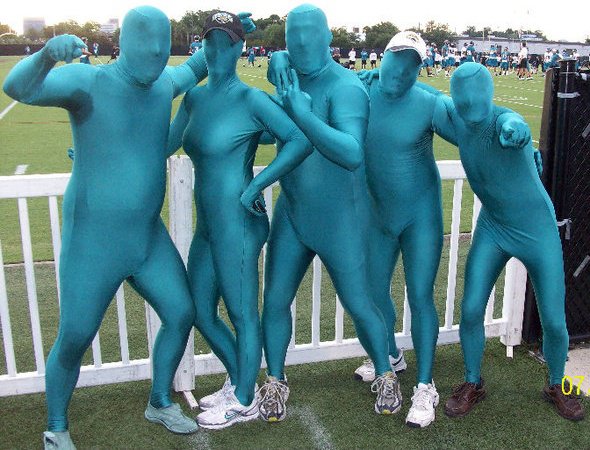
A Rexburg woman was not amused when two men dressed in spandex body suits unlawfully went into her apartment near the Brigham Young University-Idahocampus and gave her a hug before fleeing.

The Post Register reports (http://bit.ly/w1Zvuy ) the woman called police late Tuesday to report two men had entered her apartment dressed in head-to-toe spandex and embraced her against her will. She was not injured.

Rexburg Police Capt. Randy Lewis says the spandex-clad men appear to have entered more than one apartment in the Mountain Pines Apartment complex, but officers only received the one complaint.

Police have dubbed the suspects “snuggles” and say the men face potential charges of battery and unlawful entry.

Rexburg Police Capt. Randy Lewis says the spandex-clad men appear to have entered more than one apartment in the Mountain Pines Apartment complex, but officers only received the one complaint.

___

Information from: Post Register, http://www.postregister.com

Thanks to Nicole Stricker for bringing this to the attention of the It’s Interesting community.

Blood Donor Wins Superbowl Tickets


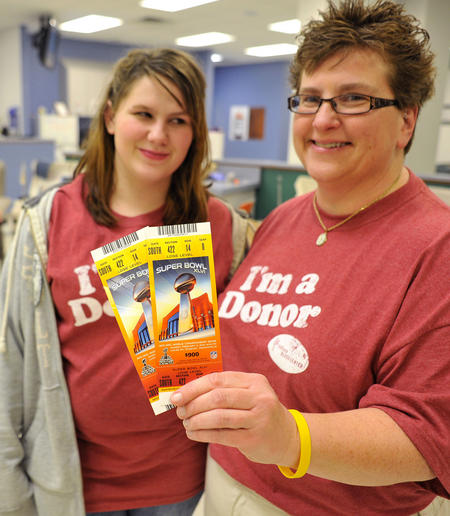
An Indiana woman who has donated 143 units of either whole blood or platelets since 2003 said she was shocked to win Super Bowl tickets.

The Indiana Blood Center said Carol Sikler, 50, of Lafayette gave blood frequently enough to qualify for the contest, which was open to anyone who donated blood or blood products four or more times in the space of three months, and she has now been announced as the winner of two tickets to Sunday’s Super Bowl XLVI in Indianapolis, The Journal & Courier, Lafayette, reported Monday.

Sikler said she has been giving blood in a bid to “break even” for the blood made available to her husband Chuck during a pair of lengthy hospital stays prior to his death in 2003. She said she recently surpassed her goal and decided to keep donating.

“It’s a way for me to do something for someone that can’t ever thank me or pay me back personally. It’s giving without expectation,” she said.

Sikler said she was shocked to win the contest.

“I’m not the kind of person who wins things,” she said.

Read more: http://www.upi.com/Odd_News/2012/01/30/Blood-donor-wins-Super-Bowl-tickets/UPI-33031327965991/#ixzz1lAO2BcnK

Self-Guided Bullet


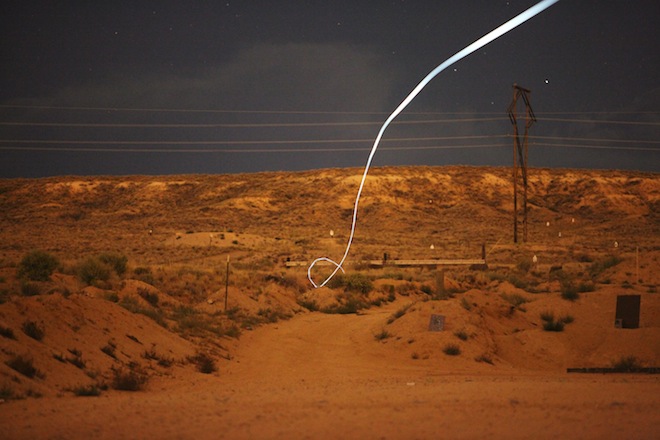
The breakthrough comes courtesy of engineers at the government’s Sandia National Laboratories. They’ve successfully tested a prototype of the bullet at distances up to 2, 000 meters — more than a mile. The photo above is an actual image taken during one of those tests. A light-emitting diode was attached to the bullet, showing the amazing pathway that the munition made through the night sky.


read more from Kebmodee:  http://kebmodee.blogspot.com/2012/01/video-self-guided-bullet-spots-steers.html?utm_source=feedburner&utm_medium=email&utm_campaign=Feed%3A+Kebmodee+%28kebmodee%29


Colbert super PAC rakes in $1 million


Stephen Colbert’s super PAC is working with some serious cash.

Americans For A Better Tomorrow, Tomorrow reported Tuesday that it has raised $1,023,121, according to a document filed with the Federal Election Commission.

An addendum to the disclosure contained language from Colbert that is not usually included in FEC reports.

“Yeah! How you like me now, F.E.C? I’m rolling seven digits deep! I got 99 problems but a non-connected independent-expenditure only committee ain’t one!” Colbert said.

The primary disclosure form, which runs through Dec. 31, lists donations of $825,475, which means Colbert raised almost $200,000 in the month of January alone.

In a statement posted to the super PAC’s website, Colbert said the money had been raised “in full accordance with the law.”

“It’s the way our founding fathers would have wanted it, if they had founded corporations instead of just a country,” Colbert said.

Most donations to the super PAC were under $250, but disclosure forms list some interesting donors who chose to give more. (Campaign finance the Stephen Colbert way.)

A $500 donation from Gavin Newsom, the Lieutenant Governor of California, is listed. His office confirmed the donation to CNNMoney.

And an actor named Bradley Whitford gave $250. It could not be immediately confirmed that the West Wing star did in fact donate.

A Rolling Stones tribute band called the Sticky Fingers Band gave $400. The band bills itself as “the greatest rock and roll tribute band in the world” on its website.

Colbert has spent the better part of a year using his show on Comedy Central to take viewers on a tour of the opaque world of campaign finance law. (Where the money is: A campaign spending primer.)

Armed with the ability to accept unlimited sums of money from corporations, unions, associations and individuals, Colbert’s super PAC has set about doing what other super PACs do: spending unlimited sums to overtly advocate for or against political candidates.

Americans for a Better Tomorrow, Tomorrow ran ads in advance of the Iowa straw poll touting the candidacy of “Rick Parry.”

And while Colbert hit the campaign trail in South Carolina, the super PAC ran ads that referred to Mitt Romney as “Mitt the ripper.”

“If Mitt Romney really believes corporations are people,” the ad said, “then Mitt Romney is a serial killer.”

In one episode, Colbert enlists his lawyer, Trevor Potter, to create a tax-exempt 501(c)(4) so that he can obtain secret donations in a “completely transparent” way.

“Can I take this (c)(4) money and donate it to my super PAC?” Colbert asked after signing paperwork that registered the shell corporation in Delaware. “You can,” Potter said.

The camera then cuts to Colbert, whose face displayed a look of total shock. “Wait,” Colbert said. “What is the difference between that and money laundering?”

http://money.cnn.com/2012/01/31/news/economy/colbert_super_PAC_filing/index.htm?hpt=hp_t2

Army Veteran Declared Dead 4 Times


Despite rumors to the contrary, Army veteran Jerry Miller is still very much alive.

“I’m alive. I’m very alive,” Miller told WESH 2 News.

The U.S. Veterans Administration has declared him dead four times, but Miller, a Brevard County resident, has refuted the claims.

For more, visit WESH.com

“To me, it’s stupid. I can’t die but one time. They have killed me four times,” he said.

Miller, a former drill sergeant, served 10 years in the Army. He said he lives on a government pension and Social Security.

The confusion started in July 2010 when he received a letter addressed to his estate that expressed sympathy for his death and politely explained that, as a dead man, he was not eligible for the veterans benefits he was paid.

Miller said he informed the VA that he was still alive, and his benefits were restarted. But the letters kept coming, each one stopping his benefits.

“I’m alive, you see. This can’t keep going on and on,” Miller said.

He said a letter came this month — addressed to his estate — requesting repayment of more than $94,000 in benefits he shouldn’t have received, because he was dead, and that it included polite instructions how to make the payment.

Miller said he has no idea why he was declared dead.

A VA spokesman told WESH 2 News that the organization was looking into the case.

Miller said he asked his congressman to do the same, but so far, being alive has not been sufficient proof that he is not dead.

http://usnews.msnbc.msn.com/_news/2012/01/31/10279295-im-very-alive-army-veteran-declared-dead-4-times

Researchers develop gene therapy that could correct a common form of blindness


A new gene therapy method developed by University of Florida researchers has the potential to treat a common form of blindness that strikes both youngsters and adults. The technique works by replacing a malfunctioning gene in the eye with a normal working copy that supplies a protein necessary for light-sensitive cells in the eye to function. The findings are published today (Monday, Jan. 23) in the Proceedings of the National Academy of Sciences online.


Several complex and costly steps remain before the gene therapy technique can be used in humans, but once at that stage, it has great potential to change lives.


“Imagine that you can’t see or can just barely see, and that could be changed to function at some levels so that you could read, navigate, maybe even drive — it would change your life considerably,” said study co-author William W. Hauswirth, Ph.D., the Rybaczki-Bullard professor of ophthalmology in the UF College of Medicine and a professor and eminent scholar in department of molecular genetics and microbiology and the UF Genetics Institute. “Providing the gene that’s missing is one of the ultimate ways of treating disease and restoring significant visual function.”


The researchers tackled a condition called X-linked retinitis pigmentosa, a genetic defect that is passed from mothers to sons. Girls carry the trait, but do not have the kind of vision loss seen among boys. About 100,000 people in the U.S. have a form of retinitis pigmentosa, which is characterized by initial loss of peripheral vision and night vision, which eventually progresses to tunnel vision, then blindness. In some cases, loss of sight coincides with the appearance of dark-colored areas on the usually orange-colored retina.


The UF researchers previously had success pioneering the use of gene therapy in clinical trials to reverse a form of blindness known as Leber’s congenital amaurosis. About 5 percent of people who have retinitis pigmentosa have this form, which affects the eye’s inner lining.


“That was a great advance, which showed that gene therapy is safe and lasts for years in humans, but this new study has the potential for a bigger impact, because it is treating a form of the disease that affects many more people,” said John G. Flannery, Ph.D., a professor of neurobiology at the University of California, Berkeley who is an expert in the design of viruses for delivering replacement genes. Flannery was not involved in the current study.


The X-linked form of retinitis pigmentosa addressed in the new study is the most common, and is caused by degeneration of light-sensitive cells in the eyes known as photoreceptor cells. It starts early in life, so though affected children are often born seeing, they gradually lose their vision.


“These children often go blind in the second decade of life, which is a very crucial period,” said co-author Alfred S. Lewin, Ph.D., a professor in the UF College of Medicine department of molecular genetics and microbiology and a member of the UF Genetics Institute. “This is a compelling reason to try to develop a therapy, because this disease hinders people’s ability to fully experience their world.”


Both Lewin and Hauswirth are members of UF’s Powell Gene Therapy Center.


The UF researchers and colleagues at the University of Pennsylvania performed the technically challenging task of cloning a working copy of the affected gene into a virus that served as a delivery vehicle to transport it to the appropriate part of the eye. They also cloned a genetic “switch” that would turn on the gene once it was in place, so it could start producing a protein needed for the damaged eye cells to function.


After laboratory tests proved successful, the researchers expanded their NIH-funded studies and were able to cure animals in which X-linked retinitis pigmentosa occurs naturally. The injected genes made their way only to the spot where they were needed, and not to any other places in the body. The study gave a good approximation of how the gene therapy might work in humans.


“The results are encouraging and the rescue of the damaged photoreceptor cells is quite convincing,” said Flannery, who is on the scientific advisory board of the Foundation Fighting Blindness, which provided some funding for the study. “Since this type of study is often the step before applying a treatment to human patients, showing that it works is critical.”


The researchers plan to repeat their studies on a larger scale over a longer term, and make a version of the virus that proves to be safe in humans. Once that is achieved, a pharmaceutical grade of the virus would have to be produced and tested before moving into clinical trials in humans. The researchers will be able to use much of the technology they have already developed and used successfully to restore vision.

http://news.health.ufl.edu/2012/18394/colleges/college-of-medicine/uf-researchers-develop-gene-therapy-that-could-correct-a-common-form-of-blindness/?elq=9ba814b3680044afb79609c571cffe59