


Luke Holmes, 28, grew huge quantities of marijuana in three-foiled lined tents, with each one containing rows of powerful halogen lights.
The heat they generated sent temperatures soaring to dangerous levels, with police nearly fainting from heat when they entered the house last June, according to a report in The Sun.
Holmes passed away in his sleep in his Halifax, West Yorks, property. He was found by friends three days later when they broke in, concerned that they hadn’t heard from him.
Holmes’ death was declared accidental by an inquest, which ruled that he died from hyperthermia, or excessive heat.
Read more: http://www.metro.co.uk/news/826522-heat-from-cannabis-farm-lamps-kills-drug-user#ixzz1npbGaQB7
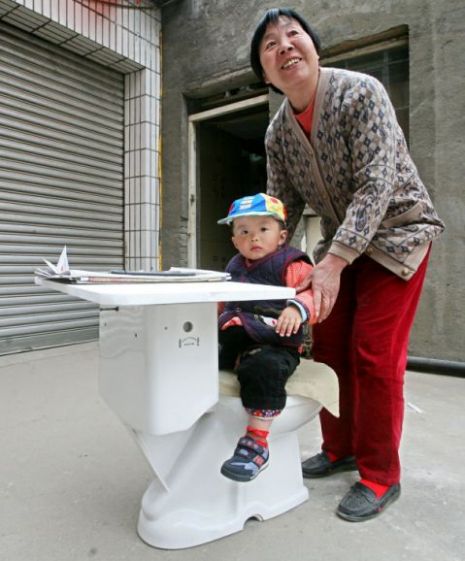
Scientists claim there is a fine margin between genius and madness and this is one invention which surely proves that theory.
Loo manufacturer Gao Jianguo discovered a way to transform these bog standard unused toilets into fully functional desks by turning one lavatory’s cistern lid into portable lap desks.
Alternatively students can sit on top of the toilet seat backwards and work from a fixed position.
Gao, from Shijiazhuang, northern China, has now donated hundreds of the wacky toilet desks to local schools in the area.
While most critics believe his invention stinks, the inventor says his unique idea will stop hundreds of loos being thrown away every year.
‘We have lots of toilets that we would otherwise throw away,’ said Gau, responding to critics who have poo-poohed the idea.
‘It is wasteful and if we can find a use for them we should.
‘They are brand new and have never been used so there is no hygiene issue.’


At a glance the room looks like it would not be out of place in a Japanese company building. A small room, where one might entertain guests, or where the sales team might meet to crunch figures. Several things give the death chamber away: the pulley on the roof, the rings on the wall where the prisoner will be shackled prior to receiving his or her sentence, and the clearly demarcated trapdoor in the center of the room.
Tokyo’s death chamber has been opened to the media for the first time in Japan’s history. As a staunch opponent of the death penalty, the country’s Justice Minister, Keiko Chiba, hopes to draw people’s attention to what goes on there. She faces an uphill struggle as the vast majority of the Japanese public support the death penalty or at least see it as unavoidable.
While prisoners are aware that they have been sentenced to death, the date of the execution is seldom fixed. In theory, it is supposed to be carried out within six months of the sentence, but this rarely happens and the prisoner will only learn of his or her execution date on the day that it will happen. The prisoner will be given a few hours to get their affairs in order, a final meal and then be taken to the death chamber. After meeting with a priest the prisoner will be taken to the death room and shackled to the wall. At the appointed time, the prisoner will be led to the red square in the center of the room where the noose will be drawn around his or her neck.
Behind the curtain, three guards will each press a button. None of them will know whose button activated the trapdoor beneath the prisoner’s feet. If the hanging goes smoothly, the neck will be fractured at either the 2nd and 3rd or 4th and 5th cervical vertebrae. Death may not be instantaneous, in fact it may take as long as fifteen minutes, but unconsciousness usually is. After death, the body’s sphincters relax, causing the release of urine and feces. Approximately one-third of male prisoners will experience a death erection.

Masumi Hayashi, 47, of Wakayama, Japan has been sentenced to death for a mass poisoning that occurred at a summer festival in 1998. The Court found that Hayashi, angry after a dispute with her neighbors, had laced the community curry with arsenic. Four people died and 60 were sickened in the incident.
The Japanese Supreme Court rarely applies the death penalty, reserving it for cases that revolt the public conscience. Once sentenced, inmates are likely to remain on death row for years while all of the avenues for appeal are exhausted.

A BRISBANE woman fleeced Nigerian scam artists by stealing more than $30,000 from their internet car sales racket, a court has been told.
Sarah Jane Cochrane-Ramsey, 23, was employed by the Nigerians as an “agent” in March 2010 but was unaware they were scam artists, the Brisbane District Court heard today.
Her job was to provide an Australian bank account through which they could funnel any payments they received through their dodgy account on a popular car sales website.
Cochrane-Ramsey was to keep eight per cent of all money paid into her account and forward the rest to the Nigerian scammers.
However, the court heard she kept the two payments she received – totalling $33,350 – and spent most of it on herself.
The car buyers who were ripped off reported the matter to police, who traced the account to Cochrane-Ramsey.
Police inquiries found her employers were based in Nigeria but had been using a web server in New York to run their dodgy car sales listings.
Cochrane-Ramsey pleaded guilty to one count of aggravated fraud on Thursday.
Judge Terry Martin described her as having a “dishonest bent” after hearing she had a history of stealing and property offences.
He adjourned the sentence to allow her time to provide further details of money she claimed was in a bank account that would allow her to make some repayments.
Cochrane-Ramsey will be sentenced next month.
She was allowed bail until then.

The Wyoming House of Representatives on Tuesday narrowly voted down legislation to launch a study into what the state should do in the event of a complete economic or political collapse in the United States.
House Bill 85 was rejected 30-27 in a final House vote, as opponents said the task force wasn’t needed and that the bill’s message had already been delivered thanks to significant national media coverage of the legislation in recent days.
The bill would have created a state-run government continuity task force, which would study and prepare Wyoming for potential catastrophes, from disruptions in food and energy supplies to a complete meltdown of the federal government.
The task force also would have looked at the feasibility of Wyoming issuing its own alternative currency, if needed. The original legislation asked for $32,000 to fund the task force; the Joint Appropriations Committee subsequently halved that.
The bill’s sponsor, state Rep. David Miller, R-Riverton, said he didn’t anticipate any major crises hitting America anytime soon. But with the national debt exceeding $15 trillion and protest movements growing around the country, Miller said Wyoming — which has a comparatively good economy and sound state finances — needs to make sure it’s protected should any unexpected emergency hit the U.S.
The bill received prominent media coverage around the state and the nation, especially after lawmakers tacked on a facetious amendment instructing the task force to examine conditions under which Wyoming would need to implement its own military draft, raise a standing army, and acquire strike aircraft and an aircraft carrier.
Many legislative supporters of HB85 said that they were caught off-guard by the amendment, and that several supporters didn’t realize what was going on until the amendment had passed. They stripped the amendment out of the bill on Monday.
Before Tuesday’s vote, Miller said he was optimistic the bill would pass the House. But after the legislation was rejected, Miller said the only things he was surprised about were that the bill made it as far as it did and the overwhelming show of support he’s seen for the proposal, both inside and outside Wyoming.
“I think the political class here in Cheyenne has a little myopic view of the world in relation of what government can do to people,” Miller said, when asked why he believed the bill failed. “I think people should wake up that there’s a lot more people out there concerned about this issue than they realize.”
State Rep. Jeb Steward, R-Encampment, said he voted against the bill Tuesday because he has an aversion to forming more government task forces — especially ones that he thinks aren’t needed.
“To me, they didn’t make a good case for the purpose or need of it,” he said. “It’s just not a priority for me at any price.”
House Speaker Ed Buchanan, R-Torrington, said he voted “no” on the final vote because he believed the proposal had achieved its goal: bringing attention to the serious issue of the mounting national debt.
“We sent the message, and it was received,” Buchanan said. “We had a little fun with it, tongue-in-cheek. But that’s what got the attention. That’s what that made sure the message was received.”
Miller said Tuesday he wasn’t yet sure whether he or another legislator would try again next session to get the task force passed.

Apple’s stock market value topped the $500 billion mark in early trading Wednesday, another record high for what was already the world’s most valuable company.
The half-trillion dollar valuation puts Apple in some extremely exclusive territory, making it one of the five most-valuable companies at any point in history. Only Microsoft, ExxonMobil, Cisco (CSCO, Fortune 500) and General Electric (GE, Fortune 500) have ever surpassed that mark.
Exxon did it most recently in late 2007, when oil prices were soaring. Microsoft, Cisco and GE reached half a trillion dollars in market capitalization in 1999 during the height of the tech bubble.
Microsoft was the only company ever to have a valuation of $600 billion. Its market cap now sits about $267 billion.
Apple’s valuation is now higher than the gross domestic product of Poland, Belgium, Sweden, Saudi Arabia, or Taiwan. (For more comparisons, check out this excellent blog: Things Apple is Worth More Than.)

A new craze is sweeping Japan that involves underwear, a promise to burn calories and a mesmerizing infomercial to back it all up.
Introducing MXP Calorie Shaper Pants, the shiny boxer briefs that hold claim to a revolutionary technology that purportedly enables users to burn extra calories by simply wearing them around.
The makers of these “Calorie Shapers” say their product is built with “honeycomb spring,” a special resin coating, that adds resistance while you walk, thus allegedly increasing the number of calories you burn.
Priced at $32 per pair and holding out the promise to lose weight with no effort, it seems the spandex biker short-like product would sell itself.
The “Calorie Shaper” is being pitched across Japan with an infomercial that looks like a 1980s flashback, complete with choreographed dance routines – in the park, on the street and in the office – and all.
In Japan, where the obesity rate is just 5 percent but alarm-raising headlines have spurred citizens’ concerns, the infomercial has worked and the product is a best-seller.
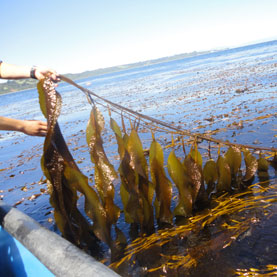
Seaweed may well be an ideal plant to turn into biofuel. It grows in much of the two thirds of the planet that is underwater, so it wouldn’t crowd out food crops the way corn for ethanol does. Because it draws its own nutrients and water from the sea, it requires no fertilizer or irrigation. Most importantly for would-be biofuel-makers, it contains no lignin—a strong strand of complex sugars that stiffens plant stalks and poses a big obstacle to turning land-based plants such as switchgrass into biofuel.
Researchers at Bio Architecture Lab, Inc., (BAL) and the University of Washington in Seattle have now taken the first step to exploit the natural advantages of seaweed. They have built a microbe capable of digesting it and converting it into ethanol or other fuels or chemicals. Synthetic biologist Yasuo Yoshikuni, a co-founder of BAL, and his colleagues took Escherichia coli, a gut bacterium most famous as a food contaminant, and made some genetic modifications that give it the ability to turn the sugars in an edible kelp called kombu into fuel. They report their findings in the January 20 issue of the journal Science.
To get his E. coli to digest kombu, Yoshikuni turned to nature—specifically, he looked into the genetics of natural microbes that can break down alginate, the predominant sugar molecule in the brown seaweed. “The form of the sugar inside the seaweed is very exotic,” Yoshikuni told Scientific American. “There is no industrial microbe to break down alginate and convert it into fuels and chemical compounds.”
Once he and his colleagues had isolated the genes that would confer the required traits, they used a fosmid—a carrier for a small chunk of genetic code—to place the DNA into the E. coli cells, where it took its place in the microbe’s own genetic instruction set. To test the new genetically engineered bacterium, the researchers ground up some kombu, mixed it with water and added the altered E. coli. Before two days had gone by the solution contained about 5 percent ethanol and water. It also did this at (relatively) low temperatures between 25 and 30 degrees Celsius, both of which mean that the engineered microbe can turn seaweed to fuel without requiring the use of additional energy for the process.
An analysis from the Pacific Northwest National Laboratory (pdf) suggests that the U.S. could supply 1 percent of its annual gasoline needs by growing such seaweed for harvest in slightly less than 1 percent of the nation’s territorial waters. Humans already grow and harvest some 15 million metric tons of kombu and other seaweeds to eat. And there’s no reason to fear the newly engineered E. coli escaping into the wild and consuming the seaweed already out there, Yoshikuni argues. “E. coli loves the human gut, it doesn’t like the ocean environment,” he says. “I can hardly imagine it would do something. It would just be dead.”
The microbe could turn out to be useful for making molecules other than ethanol, such as isobutanol or even the precursors of plastics, Yoshikuni says. “Consider the microbe as the chassis with engineered functional modules,” or pathways to produce a specific molecule, Yoshikuni says. “If we integrate other pathways instead of the ethanol pathway, this microbe can be a platform for converting sugar into a variety of molecules.”
The fact that such a one-stop industrial microbe can turn seaweed into a variety of molecules has attracted the attention of outfits such as the U.S. Department of Energy’s Advanced Research Projects Agency–Energy, or ARPA–e, which has funded BAL work with DuPont to produce other molecules from such engineered microbes. “Because seaweed grows naturally in the ocean, it uses the two thirds of the planet that we don’t use for agriculture,” ARPA–e program director Jonathan Burbaum wrote in an e-mail. “ARPA–e is directing a small portion of the remaining funding toward an aquafarm experiment to measure area productivity and harvest efficiency.”
http://www.scientificamerican.com/article.cfm?id=genetically-engineered-stomach-microbe-turns-seaweed-into-ethanol&WT.mc_id=MND_20120216

