



Italian company Volpecar has designed the world’s smallest car.
It is electric and fits in an elevator.
The tiny two seater takes up only 2 square meters of road space.

Italian company Volpecar has designed the world’s smallest car.
It is electric and fits in an elevator.
The tiny two seater takes up only 2 square meters of road space.

The National Pork Board has issued a popular Internet retailer with a “cease and desist” order over a fairly obviously fake product that was a part of a an April Fool’s Day gag.
Every year Think Geek creates a range of “products” for April Fool’s Day that do not actually exist.
The National Pork Board objected to Think Geek’s use of the marketing slogan “the other white meat.”
Think Geek offered a succinct apology:
We’d like to publicly apologize to the NPB for the confusion over unicorn and pork–and for their awkward extended pause on the phone after we had explained our unicorn meat doesn’t actually exist.
The full version of the apology can be read here [PDF]. [Think Geek via Boing Boing]


A long-lost medieval cookbook, containing recipes for hedgehogs, blackbirds and even unicorns, has been discovered at the British Library. Professor Brian Trump of the British Medieval Cookbook Project described the find as near-miraculous. “We’ve been hunting for this book for years. The moment I first set my eyes on it was spine-tingling.”
Experts believe that the cookbook was compiled by Geoffrey Fule, who worked in the kitchens of Philippa of Hainault, Queen of England (1328-1369). Geoffrey had a reputation for blending unusual flavours – one scholar has called him “the Heston Blumenthal of his day” – and everything points to his hand being behind the compilation.
After recipes for herring, tripe and codswallop (fish stew, a popular dish in the Middle Ages) comes that beginning “Taketh one unicorne”. The recipe calls for the beast to be marinaded in cloves and garlic, and then roasted on a griddle. The cookbook’s compiler, doubtless Geoffrey Fule himself, added pictures in its margins, depicting the unicorn being prepared and then served. Sarah J Biggs, a British Library expert on medieval decoration, commented that “the images are extraordinary, almost exactly as we’d expect them to be, if not better”.
The recipe for cooking blackbirds is believed to be the origin of the traditional English nursery rhyme “Sing a song of sixpence / A pocket full of rye / Four-and-twenty blackbirds / Baked in a pie.” Professor Trump added that he was tempted to try some of the recipes, but suspected that sourcing ingredients would be challenging. “Unfortunately, they don’t stock unicorn in my local branch of Tesco.”

A pleased-looking Pope Benedict XVI has been presented with a colourful, two-metre high Easter egg weighing 250 kilograms as Catholics and other Christians prepare to celebrate Easter.
The egg, made by Italian chocolate maker Tosca, was unveiled in a Vatican courtyard. The brilliant yellow and blue wrapper was decorated with the Pope’s coat of arms, wreathes of flowers and doves – the symbol of peace.
The head of the Roman Catholic Church, who will be 85 later this month, will not be cracking open the egg himself, but will give it to young offenders in Rome’s Casal del Marmo institute, which he visited in 2007, according to the Vatican’s official newspaper, L’Osservatore Romano.
Tosca, based in the northern town of Cremona, is known for its oversized delicacies.
http://bigpondnews.com/articles/OddSpot/2012/04/05/Pope_given_whopper_Easter_egg_736440.html

WA church in Sweden has been displaying a life-size Lego statue of Jesus Christ since 2009.
Churchgoers donated nearly 30,000 Lego bricks to build the 1.78 metre (5.8 foot) high statue, said Per Wilder, the pastor of the Oensta Gryta Church in Vaesteras, about 110 kilometres (70 miles) west of Stockholm.
“It is a fantastic installation and it will be there as long as we think it is in a good spot,” he said.
The model was based on Danish sculptor Bertel Thorvaldsens’s 19th century work Christus, which depicts the resurrection of Jesus Christ.
Wilder said the statue would remain permanently at the church and there were no plans to sell it to raise funds.
http://www.google.com/hostednews/afp/article/ALeqM5jfvsy2G44S1zgbkMgubhgKUEEPuQ


At least 24 Filipinos were nailed to crosses to re-enact Jesus Christ’s suffering in a Good Friday rite rejected by Catholic church leaders but witnessed by throngs of believers and thousands of tourists.
Ruben Enaje, a 50-year-old sign painter, screamed in pain as villagers dressed as Roman centurions hammered four-inch stainless steel nails through his palms and set him aloft on a cross under a brutal sun for a few minutes in San Pedro Cutud village in Pampanga province.
Twenty-three other Filipino men were nailed to crosses in the rice-growing province, officials said.
It was Enaje’s 25th crucifixion. He says surviving nearly unscathed when he fell from a three-story building in 1985 prompted him to undergo the annual ordeal. Aside from thanking God, Enaje now prays for more painting jobs.
“Not a bone in my body was broken when I fell from that building,” Enaje said. “It was a miracle.”
“Now, I’m praying for good health and more clients,” Enaje told The Associated Press.
Ahead of the cross nailings, throngs of penitents walked several miles through village streets and beat their bare backs with sharp bamboo sticks and pieces of wood, sometimes splashing spectators with blood. Some participants opened cuts in the penitents’ backs using broken glass to ensure the ritual was sufficiently bloody.
The gory spectacle reflects the Philippines’ unique brand of Catholicism, which merges church traditions with folk superstitions. Many of the mostly impoverished penitents undergo the ritual to atone for sins, pray for the sick or a better life and give thanks for what they believe were God-given miracles.
The most number of crucifixions were staged beside a rice field in San Pedro Cutud, where 15 men were nailed to crosses three at a time on a dusty mound as more than 30,000 people, including three European ambassadors, watched and snapped pictures. An ambulance stood by and more than 20 tourists fainted or became dizzy in the heat, officials said.
Amid the festive air — villagers peddled bottled water, food and religious items everywhere — police and marshals kept order. Some displayed banners with a reminder: “Silence please and take care of your belongings.”
Foreigners have been banned from taking part after an Australian comic was nailed to a cross under a false name a few years ago near Pampanga. Authorities also believe that a Japanese man sought to be crucified as part of a porn film in 1996, tourism officer Ching Pangilinan said.
“They made a mockery out of a local tradition,” she said.
PhotoBlog: Penitents nailed to crosses in Philippine ritual
Church leaders in the Philippines, Asia’s largest predominantly Roman Catholic nation, have frowned on the Easter week rituals, saying Filipinos can show their deep faith without hurting themselves.
Archbishop Angel Lagdameo, based in Iloilo province, said the crucifixions and self-flagellations are an “imperfect imitation with doubtful theological and social significance,” adding that only Jesus Christ’s death saved mankind.
Pampanga Bishop Pablo Virgilio David said the bloody rites reflect the church’s failure to fully educate many Filipinos on Christian tenets.
Enaje and the other penitents said the church should respect their belief.
“When I’m up there on the cross, I feel very close to God,” Enaje said. “We grew up with this tradition and nothing can stop us.”
Red Cross officials urged devotees to consider other forms of penance, including donating blood, and expressed concern over possible health problems such as infection, heat stroke, blood loss and even death from the beating.
San Pedro Cutud village leader Remigio dela Cruz said no penitent has experienced any major health problem since the cross nailings began there in the 1950s. The nails are soaked in alcohol for as long as a year and then sprinkled with holy water before use, he said.
http://www.msnbc.msn.com/id/42721319/ns/world_news-asiapacific/#.T32gg442GRA

Mirlande Wilson, who this week said she may have hit the record Mega Millions jackpot, told a Washington news station Thursday that she has lost the ticket.
WRC-TV is reporting that Wilson said, “I misplaced it. I cannot tell you where the ticket is for my safety and my kids’ safety, but I wish I could find it and get this thing over [with].”
She could not immediately be reached for comment.
That’s one valuable slip of paper. The record-breaking jackpot in the drawing March 30 reached $656 million, worth $105 million in a cash payout to whomever purchased the winning ticket at a Baltimore County 7-Eleven.
Wilson also told the TV station that a report that she hid the ticket at the McDonald’s in Milford Mills was bogus.
“I don’t know where they get the story from. How am I going to have the ticket and hide it behind the McFlurry machine?” Wilson said.
Thanks to ‘Da Brayn’ for updating this story for the It’s Interesting community.
http://www.baltimoresun.com/news/maryland/bs-md-mega-millions-lottery-20120406,0,7808126.story
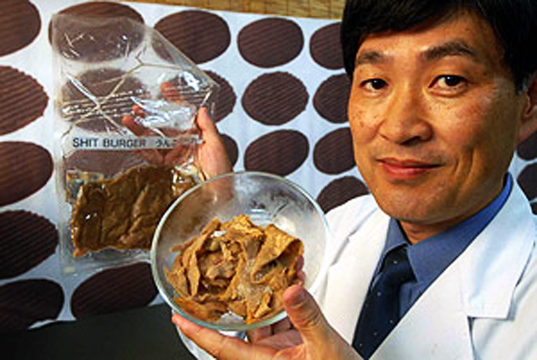
Mitsuyuki Ikeda, a researcher from the Environmental Assessment Center in Okayama has developed a new artificial meat burger made of human feces.
Ikeda has gathered sewage mud (which contains human feces) and has developed the artificial meat by adding fecal extracts, soy protein and steak sauce essence. Artificial food coloring to added to it to give it the same look as red meat. It is composed of 63 percent protein, 25 percent carbohydrates, 3 percent lipids and 9 percent minerals.
Protein is extracted from the sewage mud first. After the protein is extracted, “reaction enhancer” is added to it and it is then put in a machine called the “exploder” which produces the artificial meat. During the entire process, the bacteria in the sewage mud is rendered harmless as it is killed by heating.
The scientist is hoping that the new type of meat will one day replace real meat, which is more expensive to produce. He claims that the new feces burger is actually healthier than real meat (fecal meat has less fat and hence less calories) and is more environment-friendly (cows supposedly contribute around 18 percent of our greenhouse gas emissions).
Currently, fecal meat costs 10-20 times more than normal meat because of the cost of research, but ultimately Ikeda plans to bring the price down so that people can switch to feacl meat one day.
Ikeda did not say whether his “poop meat” is as tasty as real meat and he has acknowledged that few people would be keen to eat it.

A new study from researchers at Jay W. Forrester’s institute at MIT says that the world could suffer from “global economic collapse” and “precipitous population decline” if people continue to consume the world’s resources at the current pace.
Smithsonian Magazine writes that Australian physicist Graham Turner says “the world is on track for disaster” and that current evidence coincides with a famous, and in some quarters, infamous, academic report from 1972 entitled, “The Limits to Growth.”
Produced for a group called The Club of Rome, the study’s researchers created a computing model to forecast different scenarios based on the current models of population growth and global resource consumption. The study also took into account different levels of agricultural productivity, birth control and environmental protection efforts. Twelve million copies of the report were produced and distributed in 37 different languages.
Most of the computer scenarios found population and economic growth continuing at a steady rate until about 2030. But without “drastic measures for environmental protection,” the scenarios predict the likelihood of a population and economic crash.
However, the study said “unlimited economic growth” is still possible if world governments enact policies and invest in green technologies that help limit the expansion of our ecological footprint.
The Smithsonian notes that several experts strongly objected to “The Limit of Growth’s” findings, including the late Yale economist Henry Wallich, who for 12 years served as a governor of the Federal Research Board and was its chief international economics expert. At the time, Wallich said attempting to regulate economic growth would be equal to “consigning billions to permanent poverty.”
Turner says that perhaps the most startling find from the study is that the results of the computer scenarios were nearly identical to those predicted in similar computer scenarios used as the basis for “The Limits to Growth.”
“There is a very clear warning bell being rung here,” Turner said. “We are not on a sustainable trajectory.”
Thanks to Ray Gaudette for bringing this to the attention of the It’s Interesting community.

