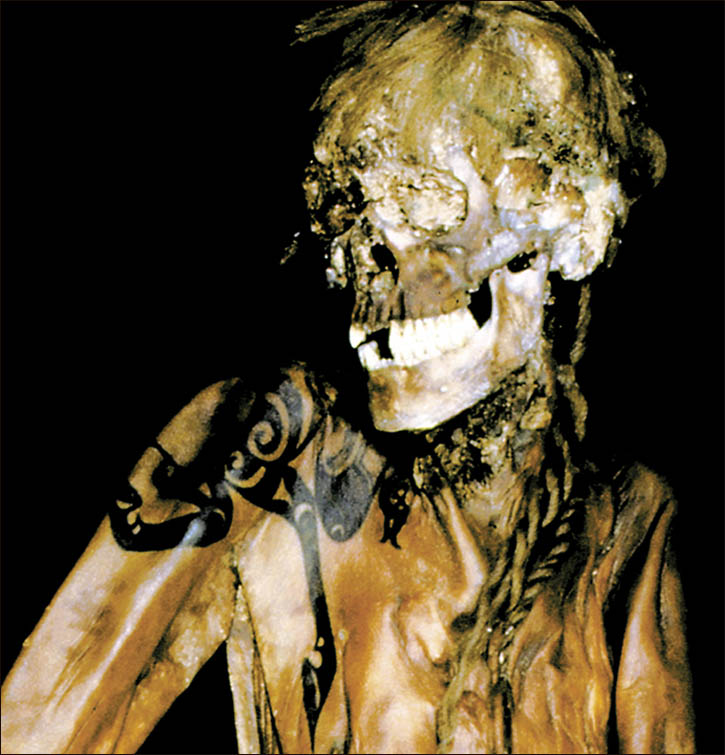
2,500 year old Siberian princess tattoos

The ancient mummy of a mysterious young woman, known as the Ukok Princess, is finally returning home to the Altai Republic this month.

She is to be kept in a special mausoleum at the Republican National Museum in capital Gorno-Altaisk, where eventually she will be displayed in a glass sarcophagus to tourists.

For the past 19 years, since her discovery, she was kept mainly at a scientific institute in Novosibirsk, apart from a period in Moscow when her remains were treated by the same scientists who preserve the body of Soviet founder Vladimir Lenin.

To mark the move ‘home’, The Siberian Times has obtained intricate drawings of her remarkable tattoos, and those of two men, possibly warriors, buried near her on the remote Ukok Plateau, now a UNESCO world cultural and natural heritage site, some 2,500 metres up in the Altai Mountains in a border region close to frontiers of Russia with Mongolia, China and Kazakhstan.

They are all believed to be Pazyryk people – a nomadic people described in the 5th century BC by the Greek historian Herodotus – and the colourful body artwork is seen as the best preserved and most elaborate ancient tattoos anywhere in the world.

To many observers, it is startling how similar they are to modern-day tattoos.

The remains of the immaculately dressed ‘princess’, aged around 25 and preserved for several millennia in the Siberian permafrost, a natural freezer, were discovered in 1993 by Novosibirsk scientist Natalia Polosmak during an archeological expedition.

Buried around her were six horses, saddled and bridled, her spiritual escorts to the next world, and a symbol of her evident status, perhaps more likely a revered folk tale narrator, a healer or a holy woman than an ice princess.

There, too, was a meal of sheep and horse meat and ornaments made from felt, wood, bronze and gold.  And a small container of cannabis, say some accounts, along with a stone plate on which were the burned seeds of coriander.

‘Compared to all tattoos found by archeologists around the world, those on the mummies of the Pazyryk people are the most complicated, and the most beautiful,’ said Dr Polosmak.

‘More ancient tattoos have been found, like the Ice Man found in the Alps – but he only had lines, not the perfect and highly artistic images one can see on the bodies of the Pazyryks.

‘It is a phenomenal level of tattoo art. Incredible.’

While the tattoos, preserved in the permafrost, have been known about since the remains were dug up, until now few have seen the intricate reconstructions that we reveal here.

‘Tattoos were used as a mean of personal identification – like a passport now, if you like. The Pazyryks also believed the tattoos would be helpful in another life, making it easy for the people of the same family and culture to find each other after death,’ added Dr Polosmak.

‘Pazyryks repeated the same images of animals in other types of art, which is considered to be like a language of animal images, which represented their thoughts.

‘The same can be said about the tattoos – it was a language of animal imagery, used to express some thoughts and to define one’s position both in society, and in the world. The more tattoos were on the body, the longer it meant the person lived, and the higher was his position.

‘For example the body of one man, which was found earlier in the 20th century, had his entire body covered with tattoos. Our young woman – the princess – has only her two  arms tattooed. So they signified both age and status.’

The tattoos on the left shoulder of the ‘princess’  show a fantastical mythological animal: a dear with a griffon’s beak and a Capricorn’s antlers. The antlers are decorated with the heads of griffons. And the same griffon’s head is shown on the back of the animal.

The mouth of a spotted panther with a long tail is seen at the legs of a sheep.

She also has a dear’s head on her wrist, with big antlers. There is a drawing on the animal’s body on a thumb on her left hand.

On the man found close to the ‘princess’, the tattoos include the same fantastical creature, this time covering the right side of his body, across his right shoulder and stretching from his chest to his back.

His chest, arms, part of the back and the lower leg are covered with tattoos. There is an argali – a mountain sheep – along with the same dear with griffon’s vulture-like beak, with horns and the back of its head which has a griffon’s heads and an onager drawn on it.

All animals are shown with the lower parts of their bodies turned inside out. There is also a winged snow leopard, a fish and fast-running argali.

Thanks to Kebmodee for bringing this to the attention of the It’s Interesting community.

Spider removed from woman’s ear canal

A woman who went to China’s Changsha Central Hospital complaining of itching in the left side of her head was told by doctors that the source of irritation was a spider that had been living inside her ear canalfor five days.

Doctors reportedly used a saline solution to flush out the spider in order to avoid having the spider burrow deeper inside the canal or bite her.

The flushing technique was successful and the woman reportedly wept with gratitude after being told the spider was removed. Doctors say they believe the spider entered the woman’s home while the home was undergoing renovations, and crawled into her ear while she was sleeping.

A report by CNN states that spiders and other bugs are appearing in greater numbers this summer due to warm weather and drought conditions across the U.S.

“All insects are cold-blooded, so in extreme heat they develop quicker, which results in more generations popping up now compared to previous summers,” Jim Fredericks, an entomologist and wildlife ecology expert with the National Pest Management Association, told the network.

http://news.yahoo.com/blogs/sideshow/doctors-remove-spider-hiding-woman-ear-canal-195029859.html

Thanks to A.N., R.G., and P.C. for bringing this to the attention of the It’s Interesting community.

Bears break into cabin and drink 100 beers


According to The Local, a mother and her three cubs ripped open a wall and forced their way into a cabin in Finnmark, in northeastern Norway, earlier this week – reportedly consuming more than 100 cans of beer along with a supply of marshmallows, honey and chocolate spread.

Cabin owner Even Borthen Nilsen told NRK. “The cabin has the stench of a right old piss up, trash, and bears.”
The bear, and three cubs, are reported to have forced their way into the cabin by ripping a wall off.
“The entire cabin was destroyed,” Nilsen told the local Finnmarken.no daily.
Nilsen told of how his mother and grandmother were the first to discover the carnage left by the beer-thirsty bears, when they arrived at the cabin in Jarfjord in Finnmarken only to find the place turned over.
“The beds and all kitchen appliances, stove, oven and cupboards and shelves were all smashed to pieces,” he said.
And furthermore the bears had finished off all the food and drink in the house – including all the marshmallows, chocolate spread, honey and over 100 cans of beer.
Nilsen explained that excrement on the outside of the cabin left him in no doubt that it was a family of bears which had taken over his cabin for night of feasting and drunken revelry.
“You can see footprints on the windows,” he said.

“The entire cabin was destroyed,” cabin owner Even Nilsen told the local Finnmarken.no daily. “The beds and all kitchen appliances, stove, oven and cupboards and shelves were all smashed to pieces.”

And yes, says Nilsen, the carousing marauders left calling cards: excrement outside the cabin and footprints on the windows.

In other trespassing bear news, Time reports that surveillance video from the Rocky Mountain Chocolate Factory in Estes Park, Colo., shows a black bear went in and out of the store multiple times late last month to snag such goodies as English toffee, caramel-dipped chocolate-chip cookies and milk chocolate “cookie bears”.

“The bear took the comestibles without breaking a thing in the store, ate the stolen goodies outside, and then returned to the shop for more,” says Time. ” All told, the well-behaved bear made seven trips in roughly 15 minutes,” and the thief “left for good after a passing car scared him away.”

http://travel.usatoday.com/destinations/dispatches/post/2012/08/boozing-bears-drink-100-beers-leave-cabin-in-ruins/822112/1?loc=interstitialskip

Thanks to P.C. for bringing this to the attention of the It’s Interesting community.

Retinal device restores sight to blind mice


Researchers report they have developed in mice what they believe might one day become a breakthrough for humans: a retinal prosthesis that could restore near-normal sight to those who have lost their vision.

That would be a welcome development for the roughly 25 million people worldwide who are blind because of retinal disease, most notably macular degeneration.

The notion of using prosthetics to combat blindness is not new, with prior efforts involving retinal electrode implantation and/or gene therapy restoring a limited ability to pick out spots and rough edges of light.

The current effort takes matters to a new level. The scientists fashioned a prosthetic system packed with computer chips that replicate the “neural impulse codes” the eye uses to transmit light signals to the brain.

“This is a unique approach that hasn’t really been explored before, and we’re really very excited about it,” said study author Sheila Nirenberg, a professor and computational neuroscientist in the department of physiology and biophysics at Weill Medical College of Cornell University in New York City. “I’ve actually been working on this for 10 years. And suddenly, after a lot of work, I knew immediately that I could make a prosthetic that would work, by making one that could take in images and process them into a code that the brain can understand.”

Nirenberg and her co-author Chethan Pandarinath (a former Cornell graduate student now conducting postdoctoral research at Stanford University School of Medicine) report their work in the Aug. 14 issue of Proceedings of the National Academy of Sciences. Their efforts were funded by the U.S. National Institutes of Health and Cornell University’s Institute for Computational Biomedicine.

The study authors explained that retinal diseases destroy the light-catching photoreceptor cells on the retina’s surface. Without those, the eye cannot convert light into neural signals that can be sent to the brain.

However, most of these patients retain the use of their retina’s “output cells” — called ganglion cells — whose job it is to actually send these impulses to the brain. The goal, therefore, would be to jumpstart these ganglion cells by using a light-catching device that could produce critical neural signaling.

But past efforts to implant electrodes directly into the eye have only achieved a small degree of ganglion stimulation, and alternate strategies using gene therapy to insert light-sensitive proteins directly into the retina have also fallen short, the researchers said.

Nirenberg theorized that stimulation alone wasn’t enough if the neural signals weren’t exact replicas of those the brain receives from a healthy retina.

“So, what we did is figure out this code, the right set of mathematical equations,” Nirenberg explained. And by incorporating the code right into their prosthetic device’s chip, she and Pandarinath generated the kind of electrical and light impulses that the brain understood.

The team also used gene therapy to hypersensitize the ganglion output cells and get them to deliver the visual message up the chain of command.

Behavioral tests were then conducted among blind mice given a code-outfitted retinal prosthetic and among those given a prosthetic that lacked the code in question.

The result: The code group fared dramatically better on visual tracking than the non-code group, with the former able to distinguish images nearly as well as mice with healthy retinas.

“Now we hope to move on to human trials as soon as possible,” said Nirenberg. “Of course, we have to conduct standard safety studies before we get there. And I would say that we’re looking at five to seven years before this is something that might be ready to go, in the best possible case. But we do hope to start clinical trials in the next one to two years.”

Results achieved in animal studies don’t necessarily translate to humans.

Dr. Alfred Sommer, a professor of ophthalmology at Johns Hopkins University in Baltimore and dean emeritus of Hopkins’  Bloomberg School of Public Health, urged caution about the findings.

“This could be revolutionary,” he said. “But I doubt it. It’s a very, very complicated business. And people have been working on it intensively and incrementally for the last 30 years.”

“The fact that they have done something that sounds a little bit better than the last set of results is great,” Sommer added.  “It’s terrific. But this approach is really in its infancy. And I guarantee that it will be a long time before they get to the point where they can really restore vision to people using prosthetics.”

Other advances may offer benefits in the meantime, he said. “We now have new therapies that we didn’t have even five years ago,” Sommer said. “So we may be reaching a state where the amount of people losing their sight will decline even as these new techniques for providing artificial vision improve. It may not be as sci-fi. But I think it’s infinitely more important at this stage.”

http://health.usnews.com/health-news/news/articles/2012/08/13/retinal-device-restores-sight-to-blind-mice

Thanks to Kebmodee for bringing this to the attention of the It’s Interesting community.

Couples can soon get married at Denny’s in Las Vegas

A new Denny’s planned for downtown Vegas will include a wedding chapel, photo  booth, and flapjack “wedding cakes.”

Denny’s CEO John Miller told the Associated Press that the restaurant/knot spot will be open 24 hours.

Thanks to the future Dr. Goldman for bringing this to the attention of the It’s Interesting community.


New type of snake discovered in Brazil


Experts came across the Atretochoana eiselti, which experts have dubbed the  “floppy  snake”, as they examined a hydroelectric dam on a river in the Amazon.

Six of the eyeless creatures — actually a family of “blind snake”  more  closely related to the salamander — were found living at the  bottom of the  Madeira River in Brazil’s northern state of Rondonia.

The discovery was made in November last year as a stretch of the river was  being drained, but was onlyrecently made public after the snake’s genus was  finally confirmed.

Julian Tupan, biologist for the Santo Antonio Energy company which is  building  the dam, told Brazil’s Estadao website that hardly anything is known  about  the lungless, limbless amphibians.

He said: “Of the six we collected, one died, three were released back into  the  wild and another two were kept for studies.

“Despite looking like snakes, they aren’t reptiles and are more closely  related to salamanders and frogs.

“We think the animal breathes through its skin, and probably feeds on  small  fish and worms, but there is still nothing proven.

Read more: http://www.thesun.co.uk/sol/homepage/news/4466169/Boffins-in-Brazil-find-snake-that-they-say-looks-like-a-penis.html#ixzz23KvzWFHR

Face of Jesus found in tree stump

The bearded face was discovered on the remains of a tree in Belfast City Cemetery, which was cut last week.

It has attracted local attention, and now the image has been captured on video and posted online by Belfast man Sean Osborne.

Mr Osborne went to the cemetery to investigate after his friend, who had been working in the area, spotted what he believed to be the Son of God’s face.

“Lots of people have been to see it and one woman has been there saying the rosary at the stump.

“It really is mounting in terms of curiosity,” he told UTV.

“You can feel the hair on the back of your neck stand up, you really need to see it for yourself.”

The tree was growing in the grave of a young girl called Rebecca Steven, who was buried in August 1916.

A Belfast City Council spokesperson said the image was uncovered during general tree maintenance.

“People have said there’s a likeness to Jesus Christ on the stump,” she added.

The council did not comment on how the image appeared, and Sean said he was not sure either.

“Being a sceptic I’ve been down and scrubbed at it, but you can’t really tell how it got to be there. But I put it on YouTube to let people make up their own mind.

“If someone has painted it on, they’ve done a really good job and kept quiet.

“I don’t really know what I saw, but it will be interesting to see how it pans out,” he explained.

http://www.u.tv/news/Face-of-Jesus-found-on-tree-stump/06cb08d9-ad58-42ac-86a4-911998fe4558

Snake-Cake

Francesca Pitcher from North Star Cakes in the UK created an amazingly realistic cake for her daughter’s birthday that looks exactly like a Burmese python. She put some photos up on her Facebook page and before she knew it the photos began to spread around online.

It’s truly touching reading her comments as she updates fans as the cakes begin to spread around. She writes:

I am, honoured, flattered and utterly terrified this morning as the wonderful Duff Goldman from Ace of Cakes tweeted a picture of my snake cake out to his 40,000 followers last night with the word ‘AMAZING!!’ and a link to my FB page. Who would of thought that the cake I made for my daughter’s birthday party would cause such a stir and bring me a little closer to my idol.

She also added a Facebook milestone, saying “Snake cake has doubled my likes in less than a week – who would have thought it would be so popular?”

In real life, Francesca is afraid of snakes.

See some of the Snake Cake photos below and head to her Facebook page for more.

http://www.huffingtonpost.com/2012/08/09/snake-cake-north-star-cakes_n_1760359.html?utm_hp_ref=food

Amazon ships assault rifle to D.C. resident instead of TV

Seth Horvitz, a Northeast D.C. resident, thought he had ordered a new high-definition television a few days ago through Amazon.com from a third-party merchant. When the package arrived yesterday, however, Horvitz opened the oddly shaped box to find something completely different.

A very big gun.

Instead of the flat-panel TV he had bought to enjoy with his wife, who is pregnant, Horvitz opened the long packaging to discover a Sig Sauer SIG716, a high-caliber, semi-automatic assault weapon capable of mowing down, well, just about anything. Its manufacturer, Swiss Arms AG, describes it as “the rifle of choice when you require the power of a larger caliber carbine.” Awesome.

Not surprisingly, Horvitz and his wife, Seeta, were shocked to find a gun instead of the television they thought they had ordered. They called the Metropolitan Police Department right away. David Cole, a friend of Horvitz’s said that Seeta’s reaction was “basically ‘get that out of here now.’ ”

The District’s gun laws might have slackened in recent years, but assault weapons are still verboten, as is transporting them into or through the District. That’s why Horvitz had to call the police; it would have been illegal for him to pack it in his car and take it back to UPS for a return shipment. MPD officers confiscated the gun and are investigating why it wound up in a Northeast D.C. apartment building rather than the Pennsylvania gun shop it was intended to reach.

The box was dropped off in the hallway outside yesterday afternoon, with a 7.6 pound, 37-inch-long rifle sitting inside. The SIG716 carries a suggested retail price of $2,132.

“[Police] were a little confused at first, they’ve never seen anything quite like it,” Horvitz told Fox 5 last night.

Also, it’s not a television.

UPDATE, 10:45 a.m.: Ty Rogers, an Amazon spokesman, declined to say what the company is doing to remedy the situation.

RELATED: Our interview with Seth Horvitz.

http://dcist.com/2012/08/dc_resident_orders_tv_amazon_delive.php

Vietnamese Airline Fined for In-Flight Bikini Show

A Vietnamese airline has been fined for hosting a mid-flight dance by bikini-clad beauty pageant contestants without first gaining permission, state media said on Thursday.

Low-cost carrier VietJet Air was fined $1,000 by the nation’s aviation authorities for organising the Hawaiian-themed dance to celebrate its maiden flight between Ho Chi Minh City and the tourist hub of Nha Trang, the Tuoi Tre newspaper said.

Five women, all candidates in a local beauty contest, performed the three-minute dance on the August 3 flight while passengers recorded the show on camera phones and later posted clips online, the paper added.

The airline “violated local aviation regulations” by organising “an unapproved show on a flight,” Nguyen Trong Thang, chief inspector of the Civil Aviation Administration of Vietnam, was quoted as saying in the report.

Thang added the pictures were taken while mobile phones were in flight-safe mode and did not pose any risk.

The incident has stirred public debate in conservative Vietnam after photographs and video clips of the sultry performance spread on the Internet.

http://www.ndtv.com/article/world/airline-fined-for-inflight-bikini-show-253191?ndtv_rhs

Thanks to Kebmodee for bringing this to the attention of the It’s Interesting community.