New bricks made from cattle blood

A recent graduate from the University of Westminster in London, architect Jack Munro has developed a process that uses cattle blood as a binding ingredient in making bricks for use in building construction.

A single cow produces up to eight gallons of blood at slaughter (which is typically thrown away), and blood naturally coagulates. Given these facts, Munro, while still a student, conceived the idea of using this blood to facilitate the formation and solidification of bricks. He began testing various mixtures, and eventually landed on the current formula—blood, an antibacterial agent, an anticoagulant, sand, and water. The result is a crimson brick that is strong enough to be used as a . It’s waterproof, too, which means it could be used in resource-scarce places such as parts of the Middle East that currently rely on mud bricks for constructing homes and other buildings.

For his thesis, Munro described how a brick-making operation might work in the community of Siwa, Egypt. He selected that community because it is typical of those that have been adversely impacted by changes in the Saharan desert—where the arid desert conditions are encroaching on previously arable lands. His idea entails creating a manufacturing building by laying a blood-glue mixture over a sand dune. The dune is then allowed to blow away, leaving a hollow shelter behind. In that shelter, the bricks would be made by mixing the anticoagulant EDTA with a quantity of blood to slow thickening. That would be followed by a dose of sodium azide to stop fungal and bacterial growth, and then the addition of sand and water. The final mixture is stirred and then poured into a form, and baked at 70° C for an hour. The result is a brick suitable for use in erecting simple buildings.

Munro concedes that the bricks are not nearly as strong as traditional bricks made using clay, but suggests they are at least as strong as the mud bricks currently in use. The advantage that bricks made from cattle blood have over mud-based is they require far less water—a definite plus in water-deprived parts of the world.

http://phys.org/news/2012-10-architect-bricks-cattle-blood.html

Watching TV makes Americans more passive and accepting of authority


Historically, television viewing has been used by various authorities to quiet potentially disruptive people—from kids, to psychiatric inpatients, to prison inmates. In 1992, Newsweek (“Hooking Up at the Big House”) reported, “Faced with severe overcrowding and limited budgets for rehabilitation and counseling, more and more prison officials are using TV to keep inmates quiet.” Joe Corpier, a convicted murderer, was quoted, “If there’s a good movie, it’s usually pretty quiet through the whole institution.” Both public and private-enterprise prisons have recognized that providing inmates with cable television can be a more economical method to keep them quiet and subdued than it would be to hire more guards.

Just as I have not emptied my refrigerator of beer, I have not gotten rid of my television, but I recognize the effects of beer and TV. During some dismal periods of my life, TV has been my “drug of choice,” and I’ve watched thousands of hours of TV sports and escapist crap. When I don’t need to take the edge off, I have watched Bill Moyers, Frontline, and other “good television.” But I don’t kid myself—the research show that the more TV of any kind we watch, the more passive most of us become.

American TV Viewing

Sociologist Robert Putnam in Bowling Alone (2000) reported that in 1950, about 10 percent of American homes had television sets, but this had grown to more than 99 percent. Putnam also reported that the number of TVs in the average U.S. household had grown to 2.24 sets, with 66 percent of households having three or more sets; the TV set is turned on in the average U.S. home for seven hours a day; two-thirds of Americans regularly watch TV during dinner; and about 40 percent of Americans’ leisure time is spent on television. And Putnam also reported that spouses spend three to four times more time watching television together than they do talking to each other.

In 2009, the Nielsen Company reported that U.S. TV viewing is at an all-time high, the average American viewing television 151 hours per month if one includes the following “three screens”: a television set, a laptop/personal computer, and a cell phone. This increase, according to Nielson, is part of a long-term trend attributable to not only greater availability of screens, increased variety of different viewing methods, more digital recorders, DVR, and TiVo devices but also a tanking economy creating the need for low-cost diversions. And in 2011, the New York Times reported, “Americans watched more television than ever in 2010, according to the Nielsen Company. Total viewing of broadcast networks and basic cable channels rose about 1 percent for the year, to an average of 34 hours per person per week.”

In February 2012, the New York Times reported that young people were watching slightly less television in 2011 than the record highs in 2010. In 2011, as compared to 2010, those 25-34 and 12-17 years of age were watching 9 minutes less a day, and 18-24 year olds were watching television 6 fewer minutes a day. Those 35 and older are spending slightly more time watching TV. However, there is some controversy about trends here, as the New York Times also reported: “According to data for the first nine months of 2011, children spent as much time in front of the television set as they did in 2010, and in some cases spent more. But the proportion of live viewing is shrinking while time-shifted viewing is expanding.”

Online television viewing is increasingly significant, especially so for young people. In one marketing survey of 1,000 Americans reported in 2010, 64% of said they watched at least some TV online. Among those younger than 25 in this survey, 83% watched at least some of their TV online, with 23% of this younger group watching “most” of their TV online, and 6% watching “all” of their TV online.
How does the United States compare to the rest of the world in TV viewing? There aren’t many cross-national studies, and precise comparisons are difficult because of different measurements and different time periods. NOP World, a market research organization, interviewed more than thirty thousand people in thirty countries in a study released in 2005, and reported that the United States was one of the highest TV-viewing nations. NationMaster.com, more than a decade ago, reporting on only the United States, Australia, and eleven European countries, found the following: the United States and the United Kingdom were the highest-viewing nations at 28 hours per week, with the lowest-viewing nations being Finland, Norway, and Sweden at 18 hours per week.

The majority of what Americans view on television—whether on the TV, lap top, or smart phone screen—is through channels owned by six corporations: General Electric (NBC, MSNBC, CNBC, Bravo, and SciFi); Walt Disney (ABC, the Disney Channel, A&E, and Lifetime); Rupert Murdoch’s News Corporation (Fox, Fox Business Channel, National Geographic, and FX); Time Warner (CNN, CW, HBO, Cinemax, Cartoon Network, TBS, TNT); Viacom (MTV, Nickelodeon/Nick-at-Nite, VH1, BET, Comedy Central); and CBS (CBS Television Network, CBS Television Distribution Group, Showtime, and CW, a joint venture with Time Warner). In addition to their television holdings, these media giants have vast holdings in radio, movie studios, and publishing.
However, while progressives lament the concentrated corporate control of the media, there is evidence that the mere act of watching TV—regardless of the content—may well have a primary pacifying effect.

Who among us hasn’t spent time watching a show that we didn’t actually like, or found ourselves flipping through the channels long after we’ve concluded that there isn’t anything worth watching?

Jerry Mander is a “reformed sinner” of sorts who left his job in advertising to publish Four Arguments for the Elimination of Television in 1978. He explains how viewers are mesmerized by what TV insiders call “technical events”—quick cuts, zoom-ins, zoom-outs, rolls, pans, animation, music, graphics, and voice-overs, all of which lure viewers to continue watching even though they have no interest in the content. TV insiders know that it’s these technical events—in which viewers see and hear things that real life does not present—that spellbind people to continue watching.

The “hold on us” of TV technical events, according to Robert Kubey and Mihaly Csikszentmihalyi’s 2002 Scientific American article “Television Addiction Is No Mere Metaphor,” is due to our “orienting response” —our instinctive reaction to any sudden or novel stimulus. They report that:In 1986 Byron Reeves of Stanford University, Esther Thorson of the University of Missouri and their colleagues began to study whether the simple formal features of television—cuts, edits, zooms, pans, sudden noises—activate the orienting response, thereby keeping attention on the screen. By watching how brain waves were affected by formal features, the researchers concluded that these stylistic tricks can indeed trigger involuntary responses and “derive their attentional value through the evolutionary significance of detecting movement. . . . It is the form, not the content, of television that is unique.”

Kubey and Csikszentmihalyi claim that TV addiction is “no mere metaphor” but is, at least psychologically, similar to drug addiction. Utilizing their Experience Sampling Method (in which participants carried a beeper and were signaled six to eight times a day at random to report their activity), Kubey and Csikszentmihalyi found that almost immediately after turning on the TV, subjects reported feeling more relaxed, and because this occurs so quickly and the tension returns so rapidly after the TV is turned off, people are conditioned to associate TV viewing with a lack of tension. They concluded: Habit-forming drugs work in similar ways. A tranquilizer that leaves the body rapidly is much more likely to cause dependence than one that leaves the body slowly, precisely because the user is more aware that the drug’s effects are wearing off.

Similarly, viewers’ vague learned sense that they will feel less relaxed if they stop viewing may be a significant factor in not turning the set off. Mander documents research showing that regardless of the programming, viewers’ brainwaves slow down, transforming them to a more passive, nonresistant state. In one study that Mander reports comparing brainwave activity in reading versus television watching, it was found the brain’s response to reading is more active, unlike the passive response to television—this no matter what the TV content. Comparing  the brain effects of TV viewing to reading, Kubey and Csikszentmihalyi report similar EEG results as measured by alpha brain-wave production. Maybe that’s why when I view a fantastic Bill Moyers interview on TV, I can recall almost nothing except that I enjoyed it; this in contrast to how many content specifics I can remember when I read a transcript of a Moyers interview.

Kubey and Csikszentmihalyi’s survey also revealed that: The sense of relaxation ends when the set is turned off, but the feelings of passivity and lowered alertness continue. Survey participants commonly reflect that television has somehow absorbed or sucked out their energy, leaving them depleted. They say they have more difficulty concentrating after viewing than before. In contrast, they rarely indicate such difficulty after reading. Mander strongly disagrees with the idea that TV is merely a window throughwhich any perception, any argument, or reality may pass. Instead, he claims TV is inherently biased by its technology. For a variety of technical reasons, including TV’s need for sharp contrast to maintain interest, Mander explains that authoritarian-based programming is more technically interesting to viewers than democracy-based programming. War and violence may be unpleasant in real life; however, peace and cooperation make for “boring television.” And charismatic authority figures are more “interesting” on TV than are ordinary citizens debating issues.

In a truly democratic society, one is gaining knowledge directly through one’s own experience with the world, not through the filter of an authority or what Mander calls a mediated experience. TV-dominated people ultimately accept others’ mediated version of the world rather than discovering their own version based on their own experiences. Robert Keeshan, who played Captain Kangaroo in the long-running children’s program, was critical of television—including so-called “good television”— in a manner rarely heard from those who work in it:When you are spending time in front of the television, you are not doing other things.

The young child of three or four years is in the stage of the greatest emotional development that human beings undergo. And we only develop when we experience things, real-life things: a conversation with Mother, touching Father, going places, doing things, relating to others. This kind of experience is critical to a young child, and when the child spends thirty-five hours per week in front of the TV set, it is impossible to have the full range of real-life experience that a young child must have. Even if we had an overabundance of good television programs, it wouldn’t solve the problem. Whatever the content of the program, television watching is an isolating experience. Most people are watching alone, but even when watching it with others, they are routinely glued to the TV rather than interacting with one another.

TV keeps us indoors, and it keeps us from mixing it up in real life. People who are watching TV are isolated from other people, from the natural world—even from their own thoughts and senses. TV creates isolation, and because it also reduces our awareness of our own feelings, when we start to feel lonely we are tempted to watch more so as to dull the ache of isolation. Television is a “dream come true” for an authoritarian society. Those with the most money own most of what people see. Fear-based TV programming makes people more afraid and distrustful of one another, which is good for an authoritarian society depending on a “divide and conquer” strategy. Television isolates people so they are not joining together to govern themselves. Viewing television puts one in a brain state that makes it difficult to think critically, and it quiets and subdues a population. And spending one’s free time isolated and watching TV interferes with the connection to one’s own humanity, and thus makes it easier to accept an authority’s version of society and life.

Whether it is in American penitentiaries or homes, TV is a staple of American pacification. When there’s no beer in our refrigerators, when our pot hookup has been busted, and when we can’t score a psychotropic drug prescription, there is always TV to take off the edge and chill us.

http://www.salon.com/2012/10/30/does_tv_actually_brainwash_americans/

Thanks to SRW for bringing this to the attention of the It’s Interesting community.

Brazilian woman sells virginity for $780,000

A 20-year-old Brazilian woman has sold her virginity for $780,000 in an online auction to a Japanese man known simply as Natsu.

Catarina Migliorini’s virginity auction was organized by Virgins Wanted, the project of Australian filmmaker Justin Sisely.

Both Migliorini and a young male virgin, Alexander Stepanov, hocked their virginity online. Stepanov’s first time went to a buy identified as Nene B. from Brazil for a mere $3,000 US.

The auction had been live since Sept. 17, but until Wednesday – the last day of bidding – the highest bid for Migliorini had been $150,000. Natsu beat out five other high rollers who all bid in excess of $600,000 for the chance to bed the virgin.

Under the rules of the auction, Migliorini will be examined by a gynecologist and will “provide the winning bidder with medical evidence of her virginity.” Stepanov’s virginity cannot be medically proven, so he and two of his family members will give “statutory declarations to support his claim.”

Speaking last month with the Folha de S. Paulo newspaper, Migliorini said she got involved with the project two years ago when she saw a story about an Australian filmmaker who was looking for a virgin. She claims she wants to open an NGO with her winnings and invest in a public-housing project for poor families in Santa Catarina, where she was born. But speaking with the Huffington Post recently, Sisely said he was skeptical of Migliorini’s purported good intentions.

“I was surprised she said that because in all my dealings with her, she made it clear that it was a business decision for her,” he said. “Now, given how big this story is in Brazil, she’s trapped. If she doesn’t give any money to charity, she’s going to look bad.”

The winning bidders must submit to a medical examination and a police check, and cannot be intoxicated during their time with the virgins. No kissing or fellatio is allowed, and although the virgins and the winners are to agree about the length and duration of the sex, “the minimum consummation time is one hour,” the rules state.

Migliorini, who said she doesn’t think of it as prostitution, said the sex will happen in a private airplane.

The Virgins Wanted website said only that “the sexual act will take place where it is not illegal.”

http://cnews.canoe.ca/CNEWS/WeirdNews/2012/10/25/20307921.html


WWII Carrier Pigeon Delivers Message

Secrets from World War II may have been found in a coded message attached to the skeleton of a carrier pigeon found in an English chimney.

The bird was found when David Martin in Bletchingly, Surrey, was renovating his fireplace.

Martin told the BBC that he began “pulling it down, pulling it down…then the pigeon bones began appearing one by one by one. Down came the leg with the red capsule on with a message inside.”

Martin called the discovery unbelievable and his wife was so delighted with the 70-year-old surprise she said it was like “Christmas.”

Theories suggest the bird was making its way from behind enemy lines, perhaps from Nazi occupied France during the D Day invasions heading toward Bletchley Park which was Britain’s main decryption establishment during World War II.

Others say the bird likely got lost, disorientated in bad weather or was simply exhausted after its trip across the English Channel and landed in the Martin’s chimney.

More than 250,000 carrier pigeons were used in World War II. They were called the National Pigeon Service and were relied on heavily to transport secret messages.

During the war the Dickin Medal, which is the highest possible animal’s decoration for valor, was awarded to 32 pigeons, including the United States Army Pigeon Service’s G.I. Joe and the Irish pigeon Paddy.

Government code breakers are working to read the message found in Martin’s chimney.

Colin Hill from the Bletchley Park pigeon exhibition told BBC, “I thought no way on earth can I work this one out.”

They have determined so far that the message is from a Sgt. W. Stott and that it was written 70 years ago.

http://news.yahoo.com/blogs/abc-blogs/wwii-carrier-pigeon-finally-delivers-secret-message-161220880–abc-news-topstories.html

Thanks to Kebmodee for bringing this to the attention of the It’s Interesting community.

Sandy Unearths Bones and Caskets

Residents of New Haven, Conn., got an eerie Halloween surprise when a famed tree uprooted during Hurricane Sandy, unearthing the bones of a woman who died nearly 200 years ago – and maybe from others who died during the same period.

Around 6 p.m. on Monday the famous tree at New Haven’s Upper Green, named the “Lincoln Oak” after President Abraham Lincoln, was uprooted as Sandy swept through. New Haven resident Katie Carbo was passing by when she saw the back of a skull in the 60- to 70-foot-tall tree’s roots, police said.

Carbo quickly contacted the New Haven police, and soon after detectives were on the scene as a crowd of onlookers formed. Officer David Hartman with the New Haven Police Department told ABCNews.com that the timing of the discovery was particularly striking.

“I found myself standing there, among onlookers saying, ‘Wow this is really cool, the day before Halloween,’” he said.

Detectives from the NHPD’s Bureau of Identification and the state Medical Examiner’s office came to collect the bones, which Hartman said included a spine and rib cage.

New Haven police also contacted staff from Yale University’s anthropology department, Hartman said, and the New Haven Independent shot some images.

The NHPD said that it had not launched a criminal investigation into the discovery, and that the remains were being taken to the medical examiner’s office.

“What we haven’t yet determined is what will happen with the remains,” Hartman said. “This archaeological event that is going on will last for probably about a week, they’re estimating.”

New Haven police said that the bones belonged to a probable victim of yellow fever or smallpox, who likely was buried between 1799 and 1821, when the headstones were removed to New Haven’s Grove Street Cemetery, but the bodies were never relocated.

Later, the New Haven Independent, citing an initial investigation by an anthropologist and a state investigator, reported bones at the scene actually may be from two or more centuries-old skeletons – not just one.

The Lincoln Oak was planted at the town green by Admiral Andrew Hall Foote’s Grand Army of the Republic post, in honor of the 100th anniversary of Lincoln’s birthday in 1909, according to the New Haven police.

Robert S. Greenberg, a local historian, said that the town green is the burial ground for as many as 5,000 to 10,000 bodies.

Hartman said that he learned today that this is actually not the first time this has happened on the historic Upper Green. According to a local historian, the same situation occurred in 1931, when an uprooted tree brought up skeletal remains, he said.

New Haven is not the only place where the dead were unearthed in Sandy’s wake. The Associated Press reported that at a cemetery in Crisfield, Md., two caskets were forced out of their graves, making their sides visible from the grass, after the cement slabs covering the graves became dislodged.

http://abcnews.go.com/blogs/headlines/2012/10/superstorm-sandy-unearths-bones-caskets/

Thanks to Mr. C for bringing this to the attention of the It’s Interesting community.

Early therapy can change brains of kids with autism


As the number of children with autism has risen dramatically over the past couple of decades, experts have learned that the earlier a child gets diagnosed, the earlier specialized therapy can be initiated, which can significantly improve outcomes.

Now researchers have been able to show that a particular type of behavioral therapy called the Early Start Denver Model (ESDM) not only improves autism symptoms, but actually normalizes brain activity and improves social behavior.

Autism is a neurodevelopmental disorder that starts to become very apparent around age 3. The main signs and symptoms of autism involve communication, social interactions and repetitive behaviors. According to the latest statistics from the U.S. Centers for Disease Control and Prevention, one in 88 children currently is diagnosed with autism, including one in 54 boys.

“Early intervention alters the trajectory of the brain and social development in children with autism,” says Geraldine Dawson, the lead study author who developed the ESDM therapy along with study co-author Sally Rogers.

Dawson was a researcher at the University of Washington when she helped devise ESDM; she’s now the chief science officer for the advocacy and research group Autism Speaks and a professor at the University of North Carolina. Rogers is a professor and researcher at the University of California Davis MIND Institute.

ESDM therapy uses teaching methods from ABA ,or applied behavioral analysis, the traditional one-on-one interaction between a child and the therapist.

But rather than sitting at a desk next to the child — where a teacher or therapist breaks down complex tasks into small components and gives tangible reinforcements — children receiving ESDM are sitting on the floor, playing with their therapist or parents.

It can be done just about anywhere, and Dawson says the play-based method of engaging a child helps him or her develop a social relationship.

The study began with 48 children in Seattle and Sacramento, California, who were between who were between 1 1/2 and 2 1/2 years old. Half of the children received a total of 20 hours of ESDM therapy over five days a week.

But since parents can be taught the methods in just a few hours, they could engage their children using the ESDM method as well. The other half of the toddlers received community-based interventions, which included in some individual therapist sessions and some day care-based sessions. The number of hours spent with therapists was the same in both groups.

Three years ago, Rogers and Dawson published their first findings from this study and found that children receiving ESDM therapy increased their IQ and language skills three times more than children in the community-intervention group.

That in itself was “very significant,” says Dr. Thomas Insel, director of the National Institute of Mental Health, because it proved that early detection and intervention leads to improved outcomes.

In their latest study, published Friday in the Journal of the American Academy of Child & Adolescent Psychiatry, Rogers and Dawson show what parts of a child’s brain are active after two years of therapy, compared to typically developing children, using an EEG (electroencephalogram). In an EEG, electrical activity in different parts of the brain is measured using electrodes that attached to the child’s head.

“If the child wiggles too much, the data is not interpretable,” says Dawson.

In the end, researchers could only get 60% of the children to sit still enough to get usable EEG results, she says, but that was true in both the group of children with autism and those without.

Fifteen children in the EDSM group, 14 in the community intervention group and 17 typically developing children underwent EEGs while looking at pictures of faces (social stimuli) vs. pictures of toys (nonsocial stimuli).

Technicians measuring the brain activity had no idea which children had autism and which did not.

“Children who received ESDM now showed a normal (brain) response, identical to typical 4-year-olds,” Dawson tells CNN. That wasn’t the case with most children who didn’t have ESDM therapy.

Babies are naturally drawn to people and faces, and their brains show greater responses when they look at a face, compared to an object or a toy, Dawson says.

But in young and even older children with autism, the opposite happens. The part of the brain that should be responding to a face or social activity doesn’t light up, but the part of the brain that responds to objects is more active.

Insel says this study shows that the ESDM form of therapy “not only changes behavior, it changes the brain.”

The exact cause, or more precisely causes, of autism are unknown and there is no cure.

Parents and pediatricians are urged to look for early signs of autism including: little or no eye contact, lack of or delay of spoken language, repetitive use of language and behaviors and persistent fixation on parts of objects.

Since 2007, the American Academy of Pediatrics recommends that pediatricians screen 18- and 24-month-old toddlers for signs of autism.

When something is wrong in the brain — not just in autism, but also in diseases like Alzheimer’s and Parkinson’s — what’s causing the disease is occurring much earlier than when symptoms appear, Insel explains.

Based on the new findings, perhaps using EEGs to measure this type of brain activity could be a biomarker for autism, he says. A biomarker is a distinct characteristic that indicates a particular condition.

Measuring a baby’s brain activity as early as 3 and 6 months could identify changes in the brain before changes in behavior are noticed, he says, and therapy could begin even earlier.

The ESDM model could be applied as early as 12 months, say Dawson and Rogers.

More research will probably have to be done to confirm the biomarker. So until there is a definitive test for diagnosing autism, Dawson says this it’s even more important that pediatricians screen children for autism as early as possible.

“The average age of diagnosis is still 4 and 5 and even older in minority groups,” she says. “We really need to close the gap.”

Autism Speaks has many tools on its website to help parents see what a child with autism looks like compared to a typically developing child. There are also many tool kits to help families of children with autism.

http://www.cnn.com/2012/10/31/health/autism-therapy-brain/index.html?hpt=hp_t3

South Africans offered free phone for every 60 rats caught


Alexandra’s discarded piles of rotting food and leaking sewage have become a perfect breeding ground for rats.
 
As it was in medieval Hamelin, so it is today in the South African township of Alexandra: wherever you go, you are never far from a rat.

But residents of the Johannesburg suburb have been offered a deal unavailable in the era of the Pied Piper – a free mobile phone for every resident who catches 60 of the rodents.

Alexandra has just turned 100 years old and was the young Nelson Mandela’s first home when he moved to Johannesburg. Its cramped shacks and illegal rubbish dumps sit in brutal contrast with neighbouring Sandton, dubbed the wealthiest square mile in Africa.

The crumbling structures, leaking sewage and discarded piles of rotting food are a perfect breeding ground for rats, much to the torment of residents. There have reportedly been cases of children’s fingers being bitten while they sleep.

In an attempt to fight back, city officials have distributed cages and the mobile phone company 8ta has sponsored the volunteer ratcatchers.

Resident Joseph Mothapo says he has won two phones and plans to get one for each member of his family. “It’s easy,” he told South Africa’s Mail & Guardian newspaper, wielding a large cage containing rats. “You put your leftover food inside and the rats climb in, getting caught as the trap door closes.”

But there were signs that the PR stunt could backfire, as animals rights activists criticised the initiative on social networks.

On Monday 8ta denied responsibility for the initiative. It said it was a long-time sponsor of a charity called Lifeline, which had taken the decision to hand out phones.

“You will have to ask Lifeline why they decided to use these promotional products,” said Pynee Chetty, an 8ta spokesman. “They do a lot of good community work, including in Alexandra. They used the promotional material to incentivise members of the community. I wasn’t aware this is how they were going to resolve the problem [of rats].”

He added: “We won’t distance ourselves from Lifeline. It is a charity that does a lot of good work and our support for them is steadfast. I don’t want to deny the story. What I’m saying is that it’s not our initiative.”

The Mail and Guardian reported that thousands of rats have been gassed to death by a specialist, Ashford Sidzumo, at the local sports centre. “We record all the people’s details so we can see where the rats are causing the biggest problem,” he was quoted as saying. “We use this to send fumigation teams there.”

Local councillor Julie Moloi told the Mail & Guardian there had been no choice but to carry out the drastic experiment. “We are afraid these rats will take over Alex and it will become a city of rats,” she said.

In another measure, owls have been given to three local schools because of their rat-catching prowess. But wider deployment of the birds may be difficult: Moloi said people kill them because of traditional beliefs that they are to be feared.

Chinese Man Sues Wife for Giving Birth to ‘Incredibly Ugly’ Child, Wins $120,000


A Chinese wife has been sued by her husband for giving birth to what he calls an ‘incredibly ugly’ child.

Jian Feng from northern China filed a suit against his wife and was awarded $120,000  in a court settlement.

Jian argued that his wife tricked him into the marriage by undergoing plastic surgery to make her beautiful. He said he realised this only when she gave birth to their daughter.

“I married my wife out of love, but as soon as we had our first daughter, we began having marital issues. Our daughter was incredibly ugly, to the point where it horrified me,” Jian said.

The truth of the matter surfaced only when Jian went on to accuse his wife of cheating, as the child looked like neither of its parents.

At that point, the wife admitted to having undergone cosmetic surgery worth $100,000 which had modified her appearance considerably. Jian was not aware of the surgery before their marriage, his wife conceded.

Jian was also granted a divorce, saying the woman married him under false pretences.

http://www.ibtimes.co.uk/articles/398913/20121027/chinese-man-divorce-sues-wife-ugly-child.htm

Watching a horror film can burn over 100 calories


Viewers who put themselves through 90 minutes of adrenaline-pumping terror can use up as much as 113 calories, close to the amount burned during a half-hour walk and the equivalent to a chocolate bar.

The movie top of the list of calorie-burners was found to be the 1980 psychological thriller The Shining, with the average viewer using up a whopping 184 calories.

Jaws took the runner-up spot, with viewers burning on average 161 calories, and The Exorcist came third, with 158 calories.

The University of Westminster study measured the total energy expenditure of ten different people as they watched a selection of frightening movies.

Scientists recorded their heart rate, oxygen intake and carbon dioxide output – and discovered the number of calories used increased by on average a third during the films.

The research also revealed films featuring moments designed to make viewers jump in terror are the best calorie-burners, as they cause heart rates to soar.

Dr Richard Mackenzie, senior lecturer and specialist in cell metabolism and physiology at the University of Westminster, said: “Each of the ten films tested set pulses racing, sparking an increase in the heart rate of the case studies.

“As the pulse quickens and blood pumps around the body faster, the body experiences a surge in adrenaline.

“It is this release of fast acting adrenaline, produced during short bursts of intense stress (or in this case, brought on by fear), which is known to lower the appetite, increase the Basal Metabolic Rate and ultimately burn a higher level of calories.”

Helen Cowley, editor of the movie rental company LOVEFiLM – which commissioned the University of Westminster study – said: “We all know the feeling of wanting to hide behind the sofa or grab a pillow when watching scary or hair raising scenes, but this research suggests that maybe those seeking to burn some calories should keep their eyes on the screen.”

The top calorie-burning frightening films were:

1. The Shining: 184 calories

2. Jaws: 161 calories

3. The Exorcist: 158 calories

4. Alien: 152 calories

5. Saw: 133 calories

6. A Nightmare on Elm Street: 118 calories

7. Paranormal Activity: 111 calories

8. The Blair Witch Project: 105 calories

9. The Texas Chain Saw Massacre: 107 calories

http://www.telegraph.co.uk/news/uknews/9638876/Watching-horror-films-burns-nearly-200-calories-a-time.html

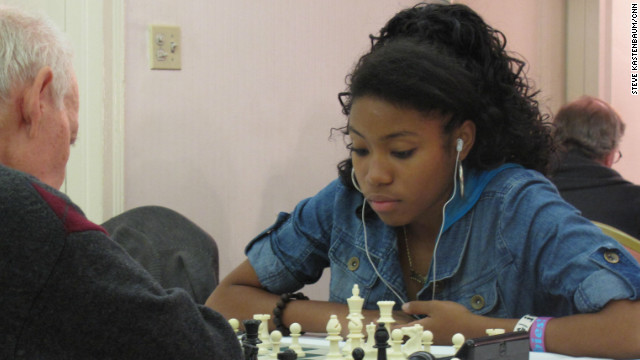
17 year old Rochelle Ballantyne poised to become the first African-American chess master

 Rochelle Ballantyne plays chess the same way she walks through the streets of New York, determined to reach her goal without letting any obstacles slow her down.

The 17 year old from Brooklyn is just a few wins away from becoming the first female African-American to attain the ranking of chess master.

[:47] “I’ve never been the first anything so having that title next to my name is going to… it’s going to feel amazing.”

She crushes her opponents in a sport dominated by men.

Ballantyne grew up in a single parent home in the working class neighborhood of East Flatbush. She first learned to play chess from her grandmother, who didn’t want that background to limit or prevent her from reaching her fullest potential. Ballantyne did not disappoint.

[2:47] “When I push myself, then nothing can stop me.”

When it came time for middle school she wound up at I.S. 318, an inner-city public school that is home to the best chess team in the entire United States. Assistant Principal John Galvin oversees the chess program.

[4:53] “Rochelle was one of our best players that we’ve ever had in our school. She won several individual national championships.”

Her time at the middle school is featured in Brooklyn Castle, a documentary about the chess team released earlier this week.

It’s made her a rising star in the world of chess.

http://cnnradio.cnn.com/2012/10/26/african-american-blazing-a-trail-through-chess/?hpt=hp_c3