
Pee marks the spot

sn-mice

Human beings tend to avoid places that smell of urine. But to mice, there is something positively addictive about the scent; they like to go back to a spot where they found the excretions again and again. Now, researchers have discovered that this behavior is triggered by a single protein in the urine of male mice.

Mice use scent to mark their territory, advertise their social dominance, and convey information about their health and reproductive status. But these are usually volatile pheromones that disperse quickly, and it has remained unclear what exactly stimulates a female to be attracted to a specific male.

Previous research had shown that female laboratory mice often return to a place where they have come across cage bedding soiled by males. Now, researchers at the University of Liverpool in the United Kingdom have confirmed this. Female mice spent five times as much time in a place where they had encountered a dish with male urine than at a place where they encountered water. Just 10 minutes of exposure to the urine was enough for the mice to show this place preference even after 14 days.

However, if the mice were prevented from by a mesh screen touching the urine with their nose, the place seemed to lose its attractiveness. “That suggested that the story was not as simple as everybody assumed and volatile pheromones were not responsible,” says behavioral ecologist Jane Hurst, one of the authors of the study. By separating the urine into different fractions, the scientists showed that a protein called darcin that they had identified in 2005—and which mice can only detect if their noses touch the urine—is responsible for the frequent visits. Pure darcin, produced in cell culture in the lab, elicited the same reaction, the authors report online today in Science.

“This is a really compelling story,” says Lisa Stowers, a neuroscientist at the Scripps Research Institute in San Diego, California. “Mammals were thought to be much more complex, but this study shows that a single chemical can lead [them to act] in a certain way.” The study is “very simple and elegant,” she adds. But it also raises new questions. For instance: There are many other ways a mouse could learn to return to a certain place. “So what is the benefit of evolving this [special] mechanism?”

Hurst says that what fascinates her is that the pheromones induce learning in the mice. And the animals do not only learn to be attracted to the place where they encountered the darcin. “They learn the odor cues of that specific male and are then attracted to it,” Hurst says. “Being familiar with a scent really seems to be important for whether a female is interested in a male.” The reason, Hurst suggests, is that dominant males, who make attractive mates, tend to leave the most marks in a certain territory.

The researchers showed that male mice, too, are attracted to a place if they have encountered darcin there, probably to foster a behavior called countermarking. “If males come across another male’s scent mark, they put their own, fresher urine there,” Hurst explains. This could also be the reason why some laboratory strains seem to have lost the ability to produce darcin: Because laboratory mice are usually group-housed, they have been selected to be less aggressive, and not producing darcin could help reduce tensions.

http://news.sciencemag.org/sciencenow/2012/12/pee-marks-the-spot.html?ref=em

Thanks to Dr. Rajadhyaksha for bringing this to the attention of the It’s Interesting community.

Controversial surgical treatment for addiction burns away the brain’s pleasure center


How far should doctors go in attempting to cure addiction? In China, some physicians are taking the most extreme measures. By destroying parts of the brain’s “pleasure centers” in heroin addicts and alcoholics, these neurosurgeons hope to stop drug cravings. But damaging the brain region involved in addictive desires risks permanently ending the entire spectrum of natural longings and emotions, including the ability to feel joy.

In 2004, the Ministry of Health in China banned this procedure due to lack of data on long term outcomes and growing outrage in Western media over ethical issues about whether the patients were fully aware of the risks.

However, some doctors were allowed to continue to perform it for research purposes—and recently, a Western medical journal even published a new study of the results. In 2007, The Wall Street Journal detailed the practice of a physician who claimed he performed 1000 such procedures to treat mental illnesses such as depression, schizophrenia and epilepsy, after the ban in 2004; the surgery for addiction has also since been done on at least that many people.

The November publication has generated a passionate debate in the scientific community over whether such research should be published or kept outside the pages of reputable scientific journals, where it may find undeserved legitimacy and only encourage further questionable science to flourish.

The latest study is the third published since 2003 in Stereotactic and Functional Neurosurgery, which isn’t the only journal chronicling results from the procedure, which is known as ablation of the nucleus accumbens. In October, the journal World Neurosurgery also published results from the same researchers, who are based at Tangdu Hospital in Xi’an.

The authors, led by Guodong Gao, claim that the surgery is “a feasible method for alleviating psychological dependence on opiate drugs.” At the same time, they report that more than half of the 60 patients had lasting side effects, including memory problems and loss of motivation. Within five years, 53% had relapsed and were addicted again to opiates, leaving 47% drug free.

(MORE: Addicted: Why We Get Hooked)

Conventional treatment only results in significant recovery in about 30-40% of cases, so the procedure apparently improves on that, but experts do not believe that such a small increase in benefit is worth the tremendous risk the surgery poses.  Even the most successful brain surgeries carry risk of infection, disability and death since opening the skull and cutting brain tissue for any reason is both dangerous and unpredictable. And the Chinese researchers report that 21% of the patients they studied experienced memory deficits after the surgery and 18% had “weakened motivation,” including at least one report of lack of sexual desire. The authors claim, however, that “all of these patients reported that their [adverse results] were tolerable.” In addition, 53% of patients had a change in personality, but the authors describe the majority of these changes as “mildness oriented,” presumably meaning that they became more compliant. Around 7%, however, became more impulsive.

The surgery is actually performed while patients are awake in order to minimize the chances of destroying regions necessary for sensation, consciousness or movement.  Surgeons use heat to kill cells in small sections of both sides of the brain’s nucleus accumbens.  That region is saturated with neurons containing dopamine and endogenous opioids, which are involved in pleasure and desire related both to drugs and to ordinary experiences like eating, love and sex.

(MORE: A Drug to End Drug Addiction)

In the U.S. and the U.K., reports the Wall Street Journal, around two dozen stereotactic ablations are performed each year, but only in the most intractable cases of depression and obsessive-compulsive disorder and after extensive review by institutional review boards and intensive discussions with the patient, who must acknowledge the risks. Often, a different brain region is targeted, not the nucleus accumbens. Given the unpredictable and potentially harmful consequences of the procedure, experts are united in their condemnation of using the technique to treat addictions. “To lesion this region that is thought to be involved in all types of motivation and pleasure risks crippling a human being,” says Dr. Charles O’Brien, head of the Center for Studies of Addiction at the University of Pennsylvania.

David Linden, professor of neuroscience at Johns Hopkins and author of a recent book about the brain’s pleasure systems calls the surgery “horribly misguided.”  He says “This treatment will almost certainly render the subjects unable to feel pleasure from a wide range of experiences, not just drugs of abuse.”

But some neurosurgeons see it differently. Dr. John Adler, professor emeritus of neurosurgery at Stanford University, collaborated with the Chinese researchers on the publication and is listed as a co-author.  While he does not advocate the surgery and did not perform it, he believes it can provide valuable information about how the nucleus accumbens works, and how best to attempt to manipulate it. “I do think it’s worth learning from,” he says. ” As far as I’m concerned, ablation of the nucleus accumbens makes no sense for anyone.  There’s a very high complication rate. [But] reporting it doesn’t mean endorsing it. While we should have legitimate ethical concerns about anything like this, it is a bigger travesty to put our heads in the sand and not be willing to publish it,” he says.

(MORE: Anesthesia Study Opens Window Into Consciousness)

Dr. Casey Halpern, a neurosurgery resident at the University of Pennsylvania makes a similar case. He notes that German surgeons have performed experimental surgery involving placing electrodes in the same region to treat the extreme lack of pleasure and motivation associated with otherwise intractable depression.  “That had a 60% success rate, much better than [drugs like Prozac],” he says. Along with colleagues from the University of Magdeburg in Germany, Halpern has just published a paper in the Proceedings of the New York Academy of Sciences calling for careful experimental use of DBS in the nucleus accumbens to treat addictions, which have failed repeatedly to respond to other approaches. The paper cites the Chinese surgery data and notes that addiction itself carries a high mortality risk.

DBS, however, is quite different from ablation.  Although it involves the risk of any brain surgery, the stimulation itself can be turned off if there are negative side effects, while surgical destruction of brain tissue is irreversible. That permanence—along with several other major concerns — has ethicists and addiction researchers calling for a stop to the ablation surgeries, and for journals to refuse to publish related studies.

Harriet Washington, author of Medical Apartheid:  The Dark History of Medical Experimentation on Black Americans from Colonial Times to the Present, argues that by publishing the results of unethical studies, scientists are condoning the questionable conditions under which the trials are conducted. “When medical journals publish research that violates the profession’sethical guidelines, this serves not only to sanction such abuses, but to encourage them,” she says. “In doing so, this practice encourages a relaxing of moral standards that threatens all patients and subjects, but especially  the medically vulnerable.”

(MORE: Real-Time Video: First Look at a Brain Losing Consciousness Under Anesthesia)

Shi-Min Fang, a Chinese biochemist who became a freelance journalist and recently won the journal Nature‘s Maddox prize for his exposes of widespread fraud in Chinese research, has revealed some of the subpar scientific practices behind research conducted in China, facing death threats and, as the New York Times reported, a beating with a hammer. He agrees that publishing such research only perpetuates the unethical practices. Asked by TIME to comment on the addiction surgery studies, Fang writes that publishing the research, particularly in western journals, “would encourage further unethical research, particularly in China where rewards for publication in international journals are high.”

While he doesn’t have the expertise to comment specifically on the ablation data, he says “the results of clinical research in China are very often fabricated. I suspect that the approvals by Ethics Committee mentioned in these papers were made up to meet publication requirement. I also doubt if the patients were really informed in detail about the nature of the study.” Fang also notes that two of the co-authors of the paper are advertising on the internet in Chinese, offering the surgery at a cost of 35,000 renminbi, about $5,600.  That’s more than the average annual income in China, which is about $5,000.

Given the available evidence, in fact, it’s hard to find a scientific justification for even studying the technique in people at all. Carl Hart, associate professor of psychology at Columbia University and author of the leading college textbook on psychoactive drugs, says animal studies suggest the approach may ultimately fail as an effective treatment for addiction; a 1984 experiment, for example, showed that destroying the nucleus accumbens in rats does not permanently stop them from taking opioids like heroin and later research found that it similarly doesn’t work for curbing cocaine cravings. Those results alone should discourage further work in humans. “These data are clear,” he says, “If you are going to take this drastic step, you damn well better know all of the animal literature.” [Disclosure:  Hart and I have worked on a book project together].

(MORE: Top 10 Medical Breakthroughs of 2012)

Moreover, in China, where addiction is so demonized that execution has been seen as an appropriate punishment and where the most effective known treatment for heroin addiction— methadone or buprenorphine maintenance— is illegal, it’s highly unlikely that addicted people could give genuinely informed consent for any brain surgery, let alone one that risks losing the ability to feel pleasure. And even if all of the relevant research suggested that ablating the nucleus accumbens prevented animals from seeking drugs, it would be hard to tell from rats or even primates whether the change was due to an overall reduction in motivation and pleasure or to a beneficial reduction in desiring just the drug itself.

There is no question that addiction can be difficult to treat, and in the most severe cases, where patients have suffered decades of relapses and failed all available treatments multiple times, it may make sense to consider treatments that carry significant risks, just as such dangers are accepted in fighting suicidal depression or cancer.  But in the ablation surgery studies, some of the participants were reportedly as young as 19 years old and had only been addicted for three years.  Addiction research strongly suggests that such patients are likely to recover even without treatment, making the risk-benefit ratio clearly unacceptable.

The controversy highlights the tension between the push for innovation and the reality of risk. Rules on informed consent didn’t arise from fears about theoretical abuses:  they were a response to the real scientific horrors of the Holocaust. And ethical considerations become especially important when treating a condition like addiction, which is still seen by many not as an illness but as a moral problem to be solved by punishment.  Scientific innovation is the goal, but at what price?
Read more: http://healthland.time.com/2012/12/13/controversial-surgery-for-addiction-burns-away-brains-pleasure-center/#ixzz2ExzobWQq

Thanks to Dr. Lutter for bringing this to the attention of the It’s Interesting community.


The Sexxxtons, Mother-Daughter Porn Duo, Provoke Controversy

r-THE-SEXXXTON-large570

The erotic activities of a mother and daughter in Tampa, Fla., who have become an on-screen pornography duo, are pushing the boundaries of propriety and sparking a debate among some experts, even in an industry known for its taboos.

For the last year, Jessica, 56, and her 22-year-old daughter, Monica — known as the Sexxxtons — have been filming sex scenes with each other and non-related partners for their self-titled website. The duo, who like many in pornography do not use their last names, say that even though they will have sex with another person at the same time, they are not interacting with each other.

Their definition of sex may be strictly semantics to the average person, but it also may have legal merit, according to Randy Reep, a Florida-based criminal defense attorney who said that Florida law defines incest, in part, as penetration by one family member to another.

In addition, the right to make pornography is, for the most part, covered by the First Amendment, but the Sexxxtons still might face risks.  “Being involved in pornography in the South carries certain risks,” Reep told HuffPost.  “It’s not as liberal as in California.”

But the letter of the law and the spirir of the law can be two different things, and expert psychiatrist Dr. Carole Lieberman believes the Sexxxtons are guilty of “emotional incest.”

 “Even if they’re not having sex with each other, it has to be titillating to one or both of them, so it crosses the line since sexual arousal comes into the mix.”

Monica defends their work and says it was her idea to start the website.  “I enjoy the sex and I enjoy being with my mom,” she told The Huffington Post.  “During the scenes, I think about how we’re going to be filthy rich.”

Donna Mae Depola, a child sex abuse activist, however, believes that the Sexxxtons’ activities are potentially damaging even if they are consensual.

Depola’s book “The Twelve Tins” documents her reaction to discovering films that her dad made while having sex with her between ages 5 and 12.

“This might be even worse than my situation,” she told HuffPost. “I had no choice, but this mother is an adult and she is a mother and a mother is suppose to protect her daughter. Whether it was the daughter’s idea or not, someday this mother will regret this decision and the daughter will have such resentment that her mother agreed to her daughter’s request, that this appears to have long lasting damage.”

Depola insisted she is not judging them.

“I have no right to do that,” she said. “All I am saying is you can’t justify this behavior to anyone with half a brain. The mom has to stand up and face the truth: A mother does not have sex in the same bed that the daughter is in. Just plain and simple.”

Even though the Sexxxtons claim this is just business, New York-based therapist Silvia M. Dutchevici also believes there could be lasting damage.

“Psychologically, there will be scars for both women,” Dutchevici said. “One cannot perform sexual acts in front of one’s parent (or caretaker) without shame or guilt surfacing. Also, if there is a history of sexual abuse, these “scenes” will trigger some of the trauma.”

Porn actress and Huffington Post blogger Amber Peach has done her share of kinky sex scenes, but the Sexxxtons’ work is too much for her.

“I don’t care if they don’t touch each other or not, it’s got to be hurting something mentally. Some things are secret and most [adult] industry people understand that I think. This really has just left me speechless,” she told HuffPost by email. “I have a great relationship with my parents, and am very open with them, but shooting with them has and will never cross my mind.”

Incest has been called the universal taboo, but there are some sex experts who don’t believe the Sexxxtons are guilty of it — or that it is potentially damaging. 

Veronica Monet, a certified sexologist and anger management specialist, believes the Sexxxtons have handled their situation about as well as it can be.

“At first blush, it sounds like an incestuous enterprise but upon closer examination, I have to admit that both Monica and Jessica appear to enjoy a congenial, egalitarian and respectful relationship,” she told HuffPost. “I find their refusal to be shamed for their adult consensual choice, courageous and admirable. To their credit, they have maintained the sexual boundaries which would preclude this as being an overtly incestuous endeavor.”

Cora Emens, a Netherlands-based sex coach, said that their Jessica and Monica’s personal decisions are no one’s business, but that a mother and daughter sex scene is better in some ways than the typical girl-girl interaction.

“I’d rather see a mother and daughter interact in a sex scene than two women who are strangers and fighting for the attention of the camera,” she told HuffPost. “Whatever gets you off. Porn is all fantasy and let us all at least be free in our fantasy world. Whatever that world may be.”

Although the Sexxxtons’ story sparked controversy, research suggests that long-term porn success may not be in the cards, according to Nicole Prause, an assistant researcher at UCLA in the Department of Psychiatry who studies sexual arousal in response to porn.

“Research shows sexual acts between any parent and child leads most people to report feeling high levels of disgust, especially women, so the strong reaction to their films is unlikely to be seen as more acceptable over time,” she said. “Some researchers have suggested that erotic images online are so sexually compelling because of the novelty they provide. Since these type of interactions are so rare, and even rarely portrayed, I would expect many people who use erotic images on the internet to find them sexually arousing.”

For her part, Monica sees porn as an easy, fun way to make money, but she does have some fantasies she’d like to fulfill with her mom.

“We’ve never come across a father-son porn duo in real life,” she told HuffPost. “We tried to film a scene that was like that, but the guy they cast as the ‘Dad’ looked too much like the ‘Cockroach’ guy from that movie, ‘Men In Black’.”

http://www.huffingtonpost.com/2012/12/07/the-sexxxtons-mother-daughter-porn-duo_n_2258245.html?utm_hp_ref=weird-news

New SARS-like virus can infect both humans and animals

sn-coronavirus


A SARS-like virus discovered this summer in the Middle East may infect more than just humans. The pathogen, a close cousin to the one that caused the 2002 to 2003 SARS outbreak, may also be able to infect cells from pigs and a wide range of bat species, researchers report today. The findings may help public health officials track the source of the outbreak and identify the role of wild animals and livestock in spreading the virus, researchers say.

Scientists first detected the virus in a 60-year-old man from Jeddah, Saudi Arabia, who developed severe pneumonia this past spring. Unable to identify the microbe causing the illness, doctors sent samples to Erasmus MC in Rotterdam, the Netherlands. There, scientists identified the infectious agent as a coronavirus, a group known to cause many ailments, such as the common cold and a variety of gastrointestinal infections. Cases have popped up in Qatar and Jordan as well; in total, researchers have so far confirmed nine infections, including five deaths. Several other cases are suspected but haven’t been confirmed.

Researchers have fully sequenced the virus, which they dubbed hCoV-EMC (short for human coronavirus-Erasmus Medical Center). The genome revealed that it is closely related to the SARS coronavirus.

The new study, published online in mBio, is an attempt to answer other basic questions, such as where the virus originated, how it enters cells, and what other animals it might infect, says Christian Drosten, a virologist at the University of Bonn Medical Center in Germany and one of the lead authors.

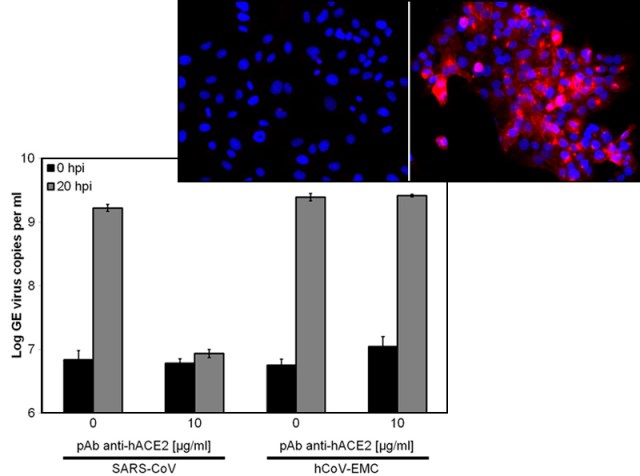
Scientists knew that the SARS virus uses a receptor called ACE2 to pry open cells. Because these receptors are mainly found deep inside the human lung, patients developed very severe illness that frequently left them too sick to spread SARS to many others; the people most at risk were health care workers who take care of patients. If hCoV-EMC used the same receptor, researchers would have a head start in understanding how it spreads and how to stop it—primarily by protecting health care workers. It might also help them in the development of drugs and vaccines.

To find out, the team engineered baby hamster kidney cells to express the human ACE2 receptor. These cells could be infected with the SARS coronavirus, as expected, but not hCoV-EMC. That finding, supported by additional experiments, led them to conclude that the new coronavirus does not use ACE2 to get in. Which receptor it uses instead is still unclear, which is a “downside” of the new study, says Larry Anderson, an infectious disease specialist at Emory University in Atlanta.

Epidemiologists also want to know which species of animals it is capable of infecting to keep the new coronavirus from spreading further. To determine what types of animals hCoV-EMC can infect, Drosten and colleagues infected cells from humans, pigs, and a wide variety of bats, the key natural reservoirs of coronaviruses. The new virus could infect all of these types of cells. “It’s unusual for a coronavirus to easily go back to bats,” Drosten says. “Most coronaviruses come from bats, but once they jump to other species, you could never get them to reinfect bat cells.” The SARS virus, for instance, originated in Chinese horseshoe bats, but once it ended up in humans, it had changed so much that scientists were unable to infect bat cells with it.

“The fact that [hCoV-EMC] can infect bat cells is consistent with the hypothesis that bats might be the origin of this virus, but this finding doesn’t prove it,” Anderson says. “This virus had to come from an animal source—there’s no other explanation for what’s going on. But we still don’t know what that source is.”

Based on the findings, however, it seems likely that the new coronavirus can infect a wide range of species, Drosten says. That means public health officials may have to start looking for infections and deaths in local wild animal and livestock populations to keep the virus in check, he says.

http://news.sciencemag.org/sciencenow/2012/12/new-sars-like-virus-infects-both.html?ref=hp

Homosexuality may start in the womb

sn-homosexuality


From a strictly Darwinian viewpoint, homosexuality shouldn’t still be around. It isn’t the best way to pass along one’s genes, and to complicate the picture further, no “gay genes” have even been identified. According to a newly released hypothesis, the explanation may not lie in DNA itself. Instead, as an embryo develops, sex-related genes are turned on and off in response to fluctuating levels of hormones in the womb, produced by both mother and child. This tug of war benefits the unborn child, keeping male or female development on a steady course even amid spikes in hormones. But if these so-called epigenetic changes persist once the child is born and has children of its own, some of those offspring may be homosexual, the study proposes.

Evolutionary geneticist William Rice of the University of California, Santa Barbara, felt there had to be a reason why homosexuality didn’t just fade away down the generations. Research estimates that about 8% of the population is gay, and homosexuality is known to run in families. If one of a set of identical twins is gay, there’s a 20% probability that the other will be, too.

Furthermore, Rice notes, “homosexuality isn’t just a human thing.” Among California gulls, which he watches from his office window, about 14% of pairs are female-female. In Australian black swans, some 6% of pairs are male-male, and 8% of male sheep are attracted exclusively to male partners.

But many genetic screens have failed to turn up genes that are responsible for sexual orientation. So to find out what makes homosexuality persist, Rice and colleagues began a comprehensive survey of the literature.

According to conventional wisdom, an embryo becomes a boy when a gene on the Y chromosome triggers the development of testes, which then begin to produce male sex hormones, including testosterone, at about the 8th week of gestation. With no Y chromosome and hence no testosterone, the embryo becomes a girl.

But testosterone doesn’t explain everything, the researchers found. For one thing, female fetuses are exposed to small amounts of the hormone from their adrenal glands, the placenta, and the mother’s endocrine system. At many key points of gestation, male and female fetuses are often exposed to similar amounts of testosterone. Levels of the hormone can even be higher than normal in females and lower than normal in males without any effect on genital or brain structure.

Rice and his co-workers were more intrigued by studies showing that male and female fetuses respond differently to the hormones that surround them, even when one hormone is temporarily higher. In their study, published online today in The Quarterly Review of Biology, the authors propose that differences in sensitivity to sex hormones result from “epigenetic” changes. These are changes that affect not the structure of a gene but when, if, and how much of it is activated—by chemically altering a gene’s promoter region or “on” switch, for example. Epigenetic changes at key points in the pathway through which testosterone exerts its effects on the fetus could blunt or enhance the hormone’s activity as needed, the authors suggest.

Although epigenetic changes are usually temporary, they involve alterations in the proteins that bind together the long strands of DNA. Thus, they can sometimes be handed down to offspring. According to the hypothesis, homosexuality may be a carry-over from one’s parents’ own prenatal resistance to the hormones of the opposite sex. The “epi-marks” that adjusted parental genes to resist excess testosterone, for example, may alter gene activation in areas of the child’s brain involved in sexual attraction and preference. “These epigenetic changes protect mom and dad during their own early development,” Rice says. The initial benefit to the parents may explain why the trait of homosexuality persists throughout evolution, he says.

“The authors have done a terrific job providing a mechanism for genetic variation, especially a variation that might not be expected to persist because it’s so tightly bound to reproduction,” says evolutionary biologist Marlene Zuk of the University of Minnesota, Twin Cities. But she adds that to go from changes in gene expression to why someone is attracted to a person of the same sex is a question for which science may never fill in all the blanks.

http://news.sciencemag.org/sciencenow/2012/12/homosexuality-may-start-in-the-w.html?ref=hp

Toothy prehistoric lizard named Obamadon after smiling president

tumblr_md3o18ovd91r1z6a3o1_400

Researchers have named a newly discovered, prehistoric lizard “Obamadon gracilis” in honor of the 44th president’s toothy grin.

The small, insect-eating lizard was first discovered in eastern Montana in 1974, but a recent re-examination showed the fossil had been wrongly classified as a Leptochamops denticulatus and was in fact a new species, researchers told Reuters on Tuesday.

Obamadon gracilis was one of nine newly discovered species reported on Monday in the Proceedings of the National Academy of Sciences.

In naming the new species, scientists from Yale and Harvard universities combined the Latin “Obamadon” for “Obama’s teeth” and “gracilis,” which means slender.

“The lizard has these very tall, straight teeth and Obama has these tall, straight incisors and a great smile,” said Nick Longrich, a paleontologist at the school in New Haven, Connecticut.

It was believed to have lived during the Cretaceous period, which began 145.5 million years ago. Along with many dinosaurs from that era, the lizard died out about 65 million years ago when a giant asteroid struck earth, scientists say.

Longrich said he waited until after the recent U.S. election to name the lizard.

“It would look like we were kicking him when he’s down if he lost and we named this extinct lizard after him,” he said in an interview.

“Romneydon” was never under consideration and “Clintondon” didn’t sound good, said Longrich, who supported Hillary Clinton’s failed run against Obama in the 2008 Democratic primary.

Obama is not the first politician whose name has been used to help classify organisms. Megalonyxx jeffersonii, an extinct species of plant-eating ground sloth, was named in honor of President Thomas Jefferson, an amateur paleontologist who studied the mammal.

Earlier this year, researchers announced they had named five newly identified species of freshwater perch after Obama, Bill Clinton, Al Gore, Jimmy Carter and Theodore Roosevelt.

In 2005, entomologists named three species of North American slime-mold beetles agathidium bushi, agathidium cheneyi and agathidium rumsfeldi in honor of George W. Bush, Dick Cheney, and Donald Rumsfeld – the U.S. president, vice president and secretary of defense at the time.

Other celebrity names also have been used to name new species. A small Caribbean crustacean has been named after reggae icon Bob Marley, an Australian horsefly has been named in honor of hip-hop star Beyonce, and an endangered species of marsh rabbit has been named after Playboy magazine founder Hugh Hefner.

http://news.yahoo.com/yale-names-toothy-dinosaur-obamadon-smiling-president-200415370.html

National Intelligence Council’s Possible World Scenarios for 2030

2030


By 2030, for the first time in human history, a majority of the world’s population will not be impoverished and a politically powerful global middle class could total 3 billion people, up from 1 billion today.

These people, many from what are now developing countries, will be healthier, better educated and connected to the Internet. They will be the critical social and economic sector in most countries.

And they will be urbanites; 60 percent of the world’s population of 8.3 billion in 2030 will live in metropolitan regions, some of which will sprawl across three national borders.

These are among the findings of a quadrennial report, “Global Trends 2030: Alternative Worlds,” by the National Intelligence Council, which reports to the U.S. director of national intelligence. The report advises incoming or returning presidential administrations on multiple — sometimes contradictory — prospective scenarios so policymakers can attempt to shape the future.

“We do not seek to predict,” said Christopher A. Kojm, the chairman of the National Intelligence Council. “Instead we provide a framework to think about possible futures.”

The world the council foresees is one in which the United States is no longer a uniquely dominant global power but remains preeminent because of its legacy strengths, its ability to form coalitions and the reluctance of China to assume a global role.

“No other power would be likely to achieve the same panoply of power in this time frame under any plausible scenario,” the report concluded, despite the fact that China is expected to surpass the United States as the largest economic power in the 2020s.

The report noted that the way in which the United States evolves, and whether it can exploit potential energy independence and solve its fiscal problems, is “a big uncertainty.”

“An economically restored U.S. would be a ‘plus’ in terms of the capability of the international system to deal with major global crises during this long transitional period,” the report said, comparing the current period to seminal moments such as the end of the Napoleonic wars and the fall of the Berlin Wall.

The world envisioned by the report is one in which Islamist terrorism, following the trajectory of earlier waves of violence from 19th-century anarchists to the New Left in the 1970s, will exhaust itself and ebb. But the tactics of terrorism will persist. And new actors, whatever their motivation, could shift their focus from mass casualties to massive economic disruptions through cyberattacks.

Moreover, the overall risk of conflict is rising because the most sophisticated weapons of war — including precision-strike capabilities and biological weaponry — are spreading to more and more governments and even non-state actors.

The world of 2030 will be one in which the greatest strain within and between countries could be the struggle for resources — food, water and energy — and climate change could severely affect the ability to produce sufficient quantities of each.

“Demand for food, water and energy will grow by approximately 35, 40 and 50 percent respectively owing to an increase in the global population and the consumption patterns of an expanding middle class,” the report said.

For these levels of growth to be sustainable, new technologies will have to be married to the careful shepherding of resources. “Water management will become critical to long-term food security,” the report concluded.

Food security has already been affected by climate change, particularly in poorer regions of the world, because droughts and other severe weather events have degraded agricultural productivity. Accelerating global warming could deepen shortages.

“We are not necessarily headed into a world of scarcities but policymakers and their private sector partners will need to be proactive to avoid such a future,” the report said. “Many countries probably won’t have the wherewithal to avoid food and water shortages without massive help from outside.”

Among the countries at high risk of failure by 2030 are some familiar names — Somalia, Burundi, Rwanda, Yemen, Uganda and Afghanistan.

If overall trend lines prove benign, and internal governance improves, countries that have the potential to become significant regional economic powers include Turkey, Vietnam, Egypt, Colombia and Nigeria.

Overall, the report said the rise of Asia, and particularly China, will continue, and there will be “a shift in the technological center of gravity from West to East and South” as “companies, ideas, entrepreneurs and capital” flow from the developed to the developing world.

The ability of the United States and China to manage their relationship will be critical to the stability of the global system.

Under its most optimistic scenario of a strong international partnership, the report finds that “the global economy nearly doubles by 2030 to $132 trillion annually,” benefiting the United States and Europe as well as China and the developing world.

But any number of game-changers could undermine that rosy scenario — economic crises, pandemics, regional conflicts and more rapid climate change. The intelligence analysts, however, said they do not see a “full-scale conflagration” along the lines of world war.

http://www.washingtonpost.com/world/national-security/report-sees-middle-class-growing-islamist-terrorism-subsiding-by-2030/2012/12/10/a4f7137c-42d5-11e2-8061-253bccfc7532_story.html

Thanks to Dr. Lutter for bringing this to the attention of the It’s Interesting community.
Former Beatle Paul McCartney will fill in for Kurt Cobain in Nirvana reunion

1297351201329_ORIGINAL

70 year old Sir Paul McCartney filled in for Kurt Cobain as the surviving members of Nirvana reunited at the Superstorm Sandy benefit in New York on Wednesday.

Grunge stars Dave Grohl and bassist Krist Novoselic have reportedly enlisted the Beatle to play onstage with them at the Madison Square Garden charity gig.

The Fab Four legend reveals Grohl invited him to “jam with some mates”, but admits he had no idea he was filling in for tragic rocker Cobain, who committed suicide in 1994.

Sir Paul tells Britain’s The Sun, “I didn’t really know who they were. They are saying how good it is to be back together. I said, ‘Whoa? You guys haven’t played together for all that time? And somebody whispered to me, ‘That’s Nirvana. You’re Kurt.’ I couldn’t believe it.”

The Rolling Stones, Bruce Springsteen, The Who, and Eric Clapton were also on the bill for the 12-12-12 Concert for Sandy Relief.

http://www.torontosun.com/2012/12/12/paul-mccartney-to-fill-in-for-kurt-cobain-in-nirvana-reunion-gig