Former Dallas Cowboys NFL quarterback Jon Kitna finds ‘gold mine’ at his troubled old high school

Kitna-desk2-jpg_055221

Before he left the Dallas Cowboys to come home again, Jon Kitna had one request of the two principals who run Lincoln High School:

Give me your worst students.

The other teachers told him to stop. This was last February and it was going to be hard enough to teach three algebra classes in the middle of a semester. He was two months gone from an NFL career that went for 16 years, after all. Yes, this was his old high school, the one where he was a star quarterback in the early 1990s, but didn’t the new football coach understand what he was getting into?

Didn’t he see the numbers? Didn’t he know that four of every five of the students were on free or reduced lunches? That finding a meal was more important than understanding negative integers? Inspiring the best students was going to be difficult enough. Save himself, they advised. Start slow. Make it easy.

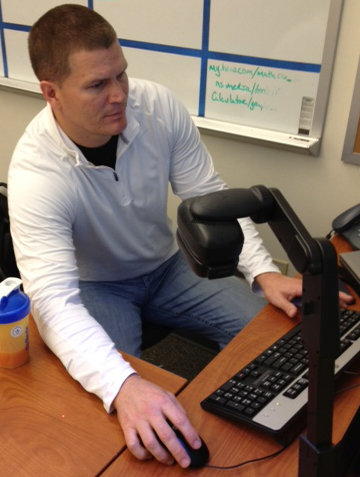
Kitna shook his head. Easy wasn’t the point. At 6-foot-4 with a buzz cut and a body built for football, he fills the classroom doorways. He would not be intimidated. And how could they understand this was the only job he ever wanted – that his time in the NFL was a daily preparation for this moment? No, coming home was supposed to be as hard.

And so again he told the principals to have the other math teachers select the students they didn’t want – the ones who didn’t listen, who didn’t try, who didn’t care. He would take them all. The principals nodded. Lists were made, class rolls prepared. The new football coach was handed three dream teams of troublemakers. They wished him luck.

Only something happened in those three algebra classes, something no one could have imagined. The students who didn’t listen suddenly did. Those who never did work turned in assignments. And when the results of the math assessments came in, Kitna’s students were second best in the school. It wasn’t because their teacher was an NFL quarterback. Many of them didn’t have televisions at home. They had little idea who Jon Kitna was. No, this was something else. Something bigger. Something one of those two principals, Pat Erwin, considers in his office one recent day and finally calls: “The Kitna effect.”

He doesn’t have to be here, of course. Sixteen years as an NFL quarterback brought him more than $20 million. It gave him big homes and nice cars. It allowed his wife Jennifer and three children to never need again. When he walked away from the Cowboys after the 2011 season, he could have gone to the golf course or the broadcast booth or even one of those sprawling high schools with a giant stadium in a suburb of Dallas if he only wanted to coach.

“I don’t think that’s what my purpose was,” Kitna says. “This is my challenge. This is what I was meant to do.”

He is sitting at a teacher’s desk in the front of a classroom not long before his Algebra I class. Everything has changed in 20 years. Things seem worse now. There are so many more drugs. The poverty shocks him.

Yet people he knows from the old days say the school was more violent when he was a student. Gangs roamed the halls. He remembers the gangs but many of those kids were also his friends and they shielded him from what they were doing. Perhaps his memories are sanitized. Maybe because he was surrounded by wealth for so long the hardship here is all the more unsettling.

He sat with his team in a pregame study hall one fall day and told the players to close their books. Something was missing. What was it? He could sense they wanted to learn. He could see them working in school. They tried hard at football practice. And yet simple homework assignments went unfinished. Grades that had improved then mysteriously dropped. For every step forward there was a stumble.

“What is the disconnect?” he asked.

For several moments no one said anything. Then slowly the stories spilled out. Terrible stories. Heartbreaking stories. The players told of homes without parents. They said nobody in the house asked to see their homework. They talked of barely existing at all. They said the only place anyone seemed to care was at school. And they told him that even then he was the only one to whom they could relate.

“It was eye-opening,” Kitna says. “It was tearful to hear kids say: ‘My parents when I am doing my homework tell me to stop doing my homework and go sell drugs.’ Or to hear a kid say: ‘I don’t ever eat because I want my mom to eat and only one of us can eat.’ ”

For a moment Kitna is silent.

Then he stops and looks up wistfully.

“All that being said, I’m on a gold mine,” he continues. “This place is a freaking gold mine because these kids are super, uber-talented. Not just athletically. You’ve got kids who can sing and blow the pipes off of things. You see kids who can do acting and drama-type stuff and arts that are just amazing.

“People [in the NFL] said I got credited for being a great leader, they [said] ‘even as a backup people are drawn to you.’ And they’d say ‘why?’ Because I went here. It’s because I went here. I’m thoroughly convinced of that because if you go here you don’t just get to be one kind of person, you have to be able to adapt and intermix yourself into all different kinds of cultures and situations.”

A buzzer sounds. Time for class. The room begins to fill. The kids are laughing. A few say “hello.” One asks what they are going to work on that day. Kitna watches them and smiles. “I’m on a gold mine here,” he says again.

It takes a village to change a culture, and Kitna has filled his coaching staff with friends and associates he has known over the years. This includes former Oregon State player Casey Kjos, a cousin who he raised as a son, and Eric Boles, his teammate at Central Washington University who played briefly in the NFL. Jennifer and his brother’s wife take care of details like making meals for the team during training camp because they figure the players will otherwise not eat. Since the school had little money for things like uniforms and equipment they took over the booster club and website, and set up a 501(c)(3) and began soliciting donations.

To show his seriousness, Kitna spent $150,000 to fill the weight room with equipment as nice as that in any NFL practice facility. He had the walls painted and named it after his old Lincoln teammate and longtime NFL safety Lawyer Milloy. Soon others followed. Carson Palmer, a teammate in Cincinnati, bought two industrial washers for uniforms. Current Cowboys quarterback Tony Romo provided the money for new jerseys. Calvin Johnson, his old receiver in Detroit paid for new equipment as did Cowboys linebacker DeMarcus Ware. Since the kids didn’t have their own spikes for practice, the Cowboys boxed up dozens of cleats. When Nike took over the NFL uniform contract in the spring, the Seahawks sold their now useless game pants to Lincoln at $1 a pair so the team could have practice uniforms.

Several times, Erwin, the co-principal, has walked into the school on Saturday mornings and found Kitna washing uniforms.

“I think what he is trying to do is see what can happen to kids in a high-poverty area when you put them in a world-class setting,” Erwin says.

But inspiring kids who come from nothing is not as easy as wearing Marshawn Lynch’s pants and Dez Bryant’s old cleats. For every moment of joy comes a day that makes no sense.

Not long after he arrived, Kitna took the football team to Seattle for a series of 7-on-7 drills at the University of Washington. When he sent notes to the parents, only three called to ask about the trip.

Then when the bus returned to Lincoln at 11:30 p.m., Kitna was stunned to discover not one parent or relative had come to meet them. He and the coaches split the players up and drove them home. It was 12:15 a.m. when Kitna dropped off the last of the players in his car. And as the door shut and the player waved good bye, Kitna wept.

“I could never fathom that my son would leave for school at 6:30 a.m. with no money for food and some coach I never met or know is going to take him to the University of Washington for 7-on-7 drills and I don’t even know what that means and then not have any transportation when he gets back,” he says. “That’s when it hit me how hard this was going to be.”

And yet he keeps pushing because this is all he knows to do, walking through the halls with a computer bag over his shoulder, nodding to kids, calling them: “Dude.”

“Jon does everything he has with his whole heart,” says Boles, who is one of his assistants. “I told him: ‘You are responsible to the kids but you are not responsible for them. You can’t control it, Jon.’ But his belief is: If they can make one decision a week or one decision a day that is better than the day before then you are making an impact.”

Or as the other co-principal, Greg Eisnaugle, says as he stands in the hall one day: “He just exudes positivism. He makes the kids feel they are worthy.

Then Eisnaugle pauses.

“Have you met Rayshaun Miller?” he asks.

On the dream team of troublemakers, Rayshaun Miller was a lottery pick. He rolled through his first year and a half at Lincoln tormenting teachers so much that many threw their hands up in frustration. The tales of his arrogance and disrespect filled the main office. Once Erwin found him in the hallway boasting of his 4.4 time in the 40-yard dash and how he would tear through opponents on the football field.

“How will we know, Rayshaun?” Erwin said. “You can’t stay eligible.”

But there is also something compelling about Miller. He is bright. While most teenagers find it difficult to connect with adults, he makes eye contact. His handshake is firm. He likes to talk. This is the student Kitna met when he arrived last February, not the one who drove the teachers mad. At the time Miller was failing pretty much everything. Kitna said he would pick him up at his house at 6:30 every morning and drive him to school where they would work on algebra before the students arrived. Later in the day, he was in Kitna’s class, which gave him more than two hours of math daily with the new coach.

His grades soared. The kid who was failing got A’s and B’s. The kid who mocked his teachers waved good morning. When other students fought, he broke them apart. Soon word came to the office of a new, different Rayshaun Miller. And everyone wondered just what had happened.

Miller stands in the weight room after school one day and says: “I got my act together.”

He was born in Sacramento, Calif., and was sent to live with his father in Tacoma when he was 6 to escape the violence of his old neighborhood. He hasn’t seen his mother or brother since. He says he carried the anger over this for a long time. It was Kitna, he says, who told him he couldn’t use his background as a reason for giving up.

“He taught me there is no excuse for not trying,” Miller says.

Then Miller starts to talk about his old self, the one who tried to fail. He tells a story of a time he mocked a student for getting an A in a class. He remembers calling the student “stupid.”

Now, in the weight room, Miller laughs.

“Can you believe that?” he says. “I called someone ‘stupid’ for getting an A.”

Football was a miracle for Kitna. Even he never imagined he’d be in the NFL. It took years to become the starting quarterback at Lincoln. Nobody was waiting with a scholarship when he graduated. His parents helped him pull the money together to go to Central Washington, an NAIA school halfway across the state, where he found himself at the bottom of a long list of quarterbacks. Eventually he became the starter. His senior year, Central won the NAIA national championship, which got him mild acclaim in Washington but did nothing to further his career.

Assuming he was done with football, Kitna finished his teaching degree and began pursuing the dream he and Jennifer talked so much about: teaching and coaching. Lincoln was actually looking for a head football coach. He applied but was turned down.

Then a few days later Dennis Erickson showed up on Central’s campus.

The Seahawks coach at the time was there to give a tryout to his nephew, Jamie Christian, who was one of Central’s receivers. The tryout was a family favor, yet what amazed Erickson was the quarterback whose throws looked like rockets zooming into Christian’s hands. The Seahawks offered Kitna a contract and a spot in their 1996 training camp. He made the practice squad and after the season was placed on the roster of the Barcelona Dragons of the World League. Barcelona won the league title on home turf. Kitna was MVP of the championship game and left the field to chants of “Keeetna! Keeetna! Keeetna!” He was anonymous no more.

He made Seattle’s roster in 1997 and became the team’s starting quarterback in 1998. In 2001 he went to Cincinnati, then to Detroit in 2006 where he threw for 4,000 yards two consecutive seasons, eventually landing in Dallas in 2009.

Yet while this became his football narrative, it was never the story he wanted to tell. Rather the one he repeats, offering to anyone who will listen, is more complicated. It starts with a young college student from Tacoma who understood little about who he was. He went to parties. He drank until he was drunk. He stole. Boles, who speaks to companies about their image, once told a group from 7-Eleven: “You guys can invoice Jon Kitna because he stole so much from you.”
Boles was going through a religious awakening at this time. And he talked to Kitna a lot about what he learned. One night Jennifer, who was Kitna’s girlfriend at the time, came home to find him in bed with another woman. In the midst of the ensuing argument, Boles’ words suddenly made sense. And what came from that night was a different Kitna. The drinking stopped along with the stealing and the partying. His expressions of faith were overt, manifesting itself in T-shirts with slogans like “God Athletic Department” or caps with crosses. His bookshelf filled with spiritual texts.

His purpose became clear. He would teach. He would go back into the cities, to the worst of neighborhoods and he would make children better. He would tell them about choices and respect and responsibility. He was going to change lives.

With Lincoln being a public school, faith is not a part of the lesson plan. Kitna understands this and seems to respect it. After all, he is teaching in a district where students come from all over the world and from a variety of religions. And don’t the lessons he is trying to teach apply to everyone regardless of belief?

“Character is an every day, all the time thing,” Kitna says. “It’s who you really are. It’s not what you turn on and off when you’re around a coach or at home with your parents.”

He has a philosophy that he took from a team chaplain in Detroit. He calls it “the four pillars of manhood,” with each represented by a letter that forms the acronym: “R.E.A.L.” as in: A R.E.A.L. man…

Rejects passivity
Empathizes with others
Accepts responsibility
Leads courageously

And while R.E.A.L. is gender specific and targeted first toward the Lincoln football players, Kitna believes it to be a message that can be embraced by all the students. Who doesn’t need to be reminded to show empathy or courage or take responsibility for mistakes? Virtues are virtues, whether they are taught by a preacher or a math teacher or a football coach.

“Win with grace, lose with dignity,” Kitna says.

He sighs when he hears the complaints about NFL players celebrating touchdowns and sacks – mocking the failures of the opponent on that particular play. If people want to change this, he says, the time to do so isn’t when the players are in the NFL. It’s too late then. You have to reach them when they are teenagers.

And the lessons are harsh. One day this fall Kitna was told of a football player who watched another student draw a derogatory picture of a classmate. The football player had nothing to do with the drawing but he laughed. Kitna had a meeting with the player, the teacher and the student who was the target of the drawing.

“Well you didn’t do anything to help the situation,” Kitna told the player. “You didn’t reject passivity.”

Then he suspended the player for two series in the upcoming game.

Later that week, a group of football players surrounded a group of girl volleyball players from a different school who had come to Lincoln for a match. Two of the players danced suggestively in front of the girls. When Kitna found out about it the next day, he gathered the team together.

“Who was there?” he asked.

Two players raised their hands.

“Who else was there?” he demanded.

Eventually five more players stood before him with hands raised. “You who did it, you are out a half,” Kitna said. “And you who didn’t do anything about it, you are out for two series.”

Months later, now, Kitna shakes his head. Lincoln lost its starting quarterback, a starting defensive lineman, starting center, a starting receiver and a starting linebacker for parts of that next game. The other team returned a punt for a touchdown, perhaps in part because special teams practice was canceled for the meeting about the volleyball incident. The replacement quarterback had a pass intercepted for a touchdown and Lincoln lost. It was a critical defeat in a 5-5 season.

“They got to feel the impact of losing a football game because of the decisions we make,” he says. “But the greater things was [that] the freshmen got to see it. ‘Coach doesn’t play, he really means this.’ ”

In the classroom a projection device turns on, the lights go dim and Kitna stands before his Algebra 1 class with a problem to solve. Behind him, on a screen, is a drawing of a yellow cab with the following question:

“A taxicab company charges a flat fee of $1.85 plus an additional .40 cents per quarter mile. A: Write a formula to find the total cost for cab fare. B: Use this formula to find the cost for one person to travel eight miles.”

The students unpack their bags, pull pencils from holders and take school-owned calculators from felt caddies that hang on the wall but already something is wrong. Kitna can sense it. Then it hits him: Almost none of them have been inside a taxicab. They are staring at him because they don’t understand the question.

Before the first X or fraction or set of parentheses can be scribbled on paper, Kitna must explain taxicabs. He shrugs. Teaching is making him a very patient man. Carefully, he explains the concept of a taxi meter.

He had to give up two of the algebra classes this fall because the demands of building the football program became too much. He replaced them with weight training which gives him more time with the football players. He thinks it’s important that they see him as much as possible.

But there is also a part of him that loves this class. And there are so many stories, like the one of the girl who barely spoke for the first few weeks who is now one of the best students. He can see the recognition. He can feel learning. This makes him happy. For, yes, he is sitting on a gold mine.

http://sports.yahoo.com/news/nfl–former-nfl-qb-jon-kitna-finds-%E2%80%98gold-mine%E2%80%99-at-a-school-where-other-teachers-only-saw-problems-194739063.html;_ylt=Ar6kvx3k_zQSjPSgERE96qY5nYcB;_ylu=X3oDMTRqMWdwbDRoBG1pdANMSVNUUyBNaXhlZCBMaXN0IEZQIEV4cGVydHMEcGtnAzIxOTE5NTcxLWE1YjgtM2ExMS04OGY2LTIzNWRmY2ZkMWM0YQRwb3MDMwRzZWMDTWVkaWFCTGlzdE1peGVkTFBDQVRlbXAEdmVyAzAwNDljNzIzLTRhYjQtMTFlMi1hZmJkLTNmOTY0NmQ5Y2ZmNw–;_ylg=X3oDMTFpNzk0NjhtBGludGwDdXMEbGFuZwNlbi11cwRwc3RhaWQDBHBzdGNhdANob21lBHB0A3NlY3Rpb25z;_ylv=3

Thanks to Kebmodee for bringing this to the attention of the It’s Interesting community.
Treegonometry uses math to perfectly decorate a Christmas tree

gibberish_math_579-100016366-orig

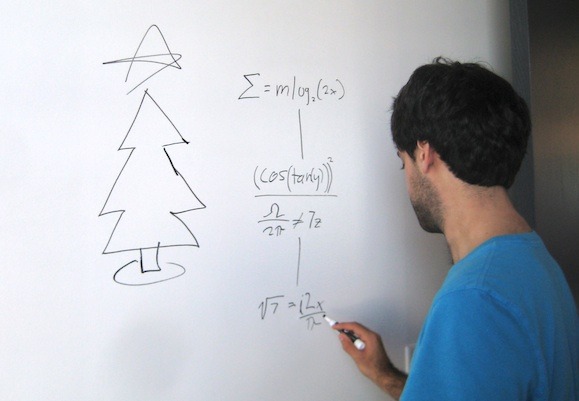
Mathematicians from Great Britain’s University of Sheffield have developed a formula to perfectly decorate any Christmas tree called Treegonometry.

Sheffield students Nicole Wrightham and Alex Craig created the formula to perfectly decorate a tree as part of a challenge put out by the Debenhams department store. The calculations will tell you exactly how many meters of lights and how much tinsel you should use, as well as the height of the angel or star that should go on top of the tree.

The formulas are as follows:

•Number of baubles: Take the square root of 17, divide it by 20 and multiply it by the height of tree (in centimetres).
•Length of tinsel: 13 multiplied by Pi (3.1415) divided by 8, then multiplied by tree height.
•Length of tree lights: Pi multiplied by tree height
•Height (in centimetres) of star or fairy on top of tree: Tree height divided by 10.
If you want to skip the math, the pair of students also put out a calculator that will compute it all for you simply by the tree’s height. For example, a tree that’s 140 centimeters (55 inches) tall would need 29 baubles, 715 centimeters (281.5 inches) of tinsel, 440 centimeters (173.2 inches) of lights, and a 14-centimeter (5.5-inch) decoration on top.

http://www.techhive.com/article/2018984/treegonometry-uses-math-to-perfectly-decorate-a-christmas-tree.html

Strengthened link between climate change and volcanic eruptions established

volcano1

It has long been known that volcanic activity can cause short-term variations in climate. Now, researchers at the GEOMAR Helmholtz Centre for Ocean Research Kiel (Germany), together with colleagues from Harvard University have found evidence that the reverse process also occurs: Climate affects volcanic activity. “In times of global warming, the glaciers are melting on the continents relatively quickly. At the same time the sea level rises. The weight on the continents decreases, while the weight on the oceanic tectonic plates increases. The stress changes within in the earth to open more routes for ascending magma” says geophysicist Dr Marion Jegen from GEOMAR, who participated in the study. The rate of global cooling at the end of the warm phases is much slower, so there are less dramatic stress changes during these times.

“If you follow the natural climate cycles, we are currently at the end of a really warm phase. Therefore, things are volcanically quieter now. The impact from man-made warming is still unclear based on our current understanding” says GEOMAR volcanologist Dr Steffen Kutterolf, who has been with SFB 574 since its founding.
In 1991, it was a disaster for the villages nearby the erupting Philippine volcano Pinatubo. But the effects were felt even as far away as Europe. The volcano threw up many tons of ash and other particles into the atmosphere causing less sunlight than usual to reach the Earth’s surface. For the first few years after the eruption, global temperatures dropped by half a degree. In general, volcanic eruptions can have a strong short-term impact on climate. Conversely, the idea that climate may also affect volcanic eruptions on a global scale and over long periods of time is completely new.

Researchers at GEOMAR Helmholtz Centre for Ocean Research Kiel (Germany) and Harvard University in Massachusetts (USA) have now found strong evidence for this relationship from major volcanic eruptions around the Pacific Ocean over the past 1 million years. They have presented their results in the latest issue of the international journal Geology.

For more than ten years the project has been extensively exploring volcanoes of Central America. “Among others pieces of evidence, we have observations of ash layers in the seabed and have reconstructed the history of volcanic eruptions for the past 460,000 years,” says Kutterolf. Particular patterns started to appear. “There were periods when we found significantly more large eruptions than in others” says Kutterolf.

After comparing these patterns with the climate history, there was an amazing match. The periods of high volcanic activity followed fast, global temperature increases and associated rapid ice melting. To expand the scope of the discoveries, Dr Kutterolf and his colleagues studied other cores from the entire Pacific region. These cores had been collected as part of the International Integrated Ocean Drilling Program (IODP) and its predecessor programmes. They record more than a million years of the Earth’s history.

“In fact, we found the same pattern from these cores as in Central America” says Jegen. Together with colleagues at Harvard University, the geologists and geophysicists searched for a possible explanation. They found it with the help of geological computer models.

The next step is to investigate shorter-term historical variations to better understand implications for the present day.

For more information: Kutterolf, S., M. Jegen, J. X. Mitrovica, T. Kwasnitschka, A. Freundt, P. J. Huybers (2012): A detection of Milankovitch frequencies in global volcanic activity. Geology, G33419.1, dx.doi.org/10.1130/G33419.1 Journal reference: Geology

http://www.dailygalaxy.com/my_weblog/2012/12/ecoalert-strong-link-between-climate-change-and-volcanic-eruptions-discovered.html

Mass squid suicides in California

shutterstock_45976420

Thousands of jumbo squid have recently beached themselves on central California shores, committing mass “suicide.” But despite decades of study into the phenomenon in which the squid essentially fling themselves onto shore, the cause of these mass beachings have been a mystery.

But a few intriguing clues suggest poisonous algae that form so-called red tides may be intoxicating the Humboldt squid and causing the disoriented animals to swim ashore in Monterey Bay, said William Gilly, a marine biologist at Stanford University’s Hopkins Marine Station in Pacific Grove, Calif.

Each of the strandings has corresponded to a red tide, in which algae bloom and release an extremely potent brain toxin, Gilly said. This fall, the red tides have occurred every three weeks, around the same time as the squid beachings, he said. (The squid have been stranding in large numbers for years, with no known cause.)

For decades, beach lovers have reported bizarre mass strandings where throngs of Humboldt squid (Dosidicus gigas), also called jumbo squid, fling themselves ashore, said Hannah Rosen, a marine biology doctoral candidate at the Hopkins Marine Station.

“For some reason they just start swimming for the beach,” Rosen told LiveScience. “They’ll asphyxiate because they’re out of the water too long. People have tried to throw them back in the water, and a lot of times the squid will just head right back for the beach.”

Before this, scientists in 2002 and 2006 noticed mass squid strandings from the Gulf of Mexico all the way to Alaska, Gilly said.

But the cause of the mass squid deaths was an enigma. The strandings seem to happen whenever schools of squid invade new territory, leading some to suggest the creatures simply get lost and don’t realize they are out of the water until it is too late. The squid washing ashore are juvenile size, about 1 foot (0.3 meters) long, and hadn’t been traveled to Monterey Bay before this fall. This season’s stranding, which started Oct. 9, happened around the time Humboldt squid entered the bay.

Other scientists have proposed that red tides that release a lethal toxin called domoic acid may be intoxicating the squid and disorienting them. But when researchers tested the stranded squid for domoic acid, they found only trace amounts of the chemical, Gilly said.

The poisonous chemical mimics a brain chemical called glutamate in mammals, though domoic acid is 10,000 times more potent than glutamate. The similar structure means domoic acid can bind to glutamate receptors on neurons. In turn, the receptor opens channels that let calcium into the cell. At high levels the poison causes brain cells to go haywire and fire like crazy, so much that they fill up with calcium, burst and die, Gilly said. [10 Weird Facts About the Brain]

Humans who eat shellfish contaminated with this red-tide toxin get amnesic shellfish poisoning, because the toxin destroys their brain’s memory center called the hippocampus. Sea lions that eat similarly poisoned anchovies or krill go into seizures or become disoriented and behave bizarrely.

However, no one has tested the effects of lower levels of the chemical on squid.

Potential cause?

But new evidence points to the red tide as at least one cause of the mass strandings. While most sea life follows daily tidal or lunar cycles, the mass deaths seem to be happening every three weeks. That led one of Gilly’s graduate students, R. Russell Williams, to see if something in the environment was leading them astray.

“He was fixated in finding some kind of environmental signal,” Gilly said.

Russell found that red tides occurred every three weeks, around the same time as the squid strandings, suggesting a link, Gilly said.

While past researchers have only found trace levels of the toxic red-tide chemical in stranded squid, low doses of domoic could essentially be making the squid drunk. Combined with navigating unfamiliar waters, that could cause the mass die-offs.

“They could be tipped over the edge by something like domoic acid that might cloud their judgment,” Gilly said.

This isn’t the first time Gilly and his colleagues have been led on a CSI-like hunt for Humboldt squid. In 2011, they figured out why the elusive jumbo squid left their usual feeding grounds off the Baja California coast in the winter of 2009 to 2010. Apparently, the squid had moved north, following their prey, small, bioluminescent fish called lantern fish, which had also moved north due to El Niño weather patterns.

http://www.livescience.com/25550-mass-squid-suicide.html

Spider constructs fake spider to fool enemies

spiderfake

This isn’t a real spider. It’s a decoy spider built from twigs, leaves, debris and dead insects.

Researchers discovered the spider in the Peruvian Amazon, and even though its decoy looks like a medium-sized spider that’s about an inch across, the impressive fake was actually made by a tiny, tricky 5-millimeter spider. That spider behind the curtain is probably, the researchers say, a new species of Cyclosa, a genus known to pull similar stunts. But those creations are relatively un-spider-like–nothing at this level of detail. The smaller builder-spider even moves back and forth, giving the impression that the decoy spider is moving and, in the process, confusing predators into attacking the decoy instead.

http://www.popsci.com/science/article/2012-12/spider-builds-fake-spiders-psych-out-predators

Smoking Smothers Your Genes

sn-epigenetic

Cigarettes leave you with more than a smoky scent on your clothes and fingernails. A new study has found strong evidence that tobacco use can chemically modify and affect the activity of genes known to increase the risk of developing cancer. The finding may give researchers a new tool to assess cancer risk among people who smoke.

DNA isn’t destiny. Chemical compounds that affect the functioning of genes can bind to our genetic material, turning certain genes on or off. These so-called epigenetic modifications can influence a variety of traits, such as obesity and sexual preference. Scientists have even identified specific epigenetic patterns on the genes of people who smoke. None of the modified genes has a direct link to cancer, however, making it unclear whether these chemical alterations increase the risk of developing the disease.

In the new study, published in Human Molecular Genetics, researchers analyzed epigenetic signatures in blood cells from 374 individuals enrolled in the European Prospective Investigation into Cancer and Nutrition. EPIC, as it’s known, is a massive study aimed at linking diet, lifestyle, and environmental factors to the incidence of cancer and other chronic diseases. Half of the group consisted of people who went on to develop colon or breast cancer 5 to 7 years after first joining the study, whereas the other half remained healthy.

The team, led by James Flanagan, a human geneticist at Imperial College London, discovered a distinct “epigenetic footprint” in study subjects who were smokers. Compared with people who had never smoked, these individuals had fewer chemical tags known as methyl groups—a common type of epigenetic change—on 20 different regions of their DNA. When the researchers extended the analysis to a separate group of patients and mice that had been exposed to tobacco smoke, they narrowed down the epigenetic modifications to several sites located in four genes that have been weakly linked to cancer before. All of these changes should increase the activity of these genes, Flanagan says. It’s unclear why increasing the activity of the genes would cause cancer, he says, but individuals who don’t have cancer tend not to have these modifications.

The study is the first to establish a close link between epigenetic modifications on a cancer gene and the risk of developing the disease, says Robert Philibert, a behavioral geneticist at the University of Iowa in Iowa City. “To the best of my knowledge, no previous genome-wide epigenetics study has taken such efforts from initial discovery to replication to experimental validation,” adds Lutz Breitling, an epidemiologist at the German Cancer Research Center in Heidelberg, Germany.

The work may lead to new ways to asses cancer risks from smoking. “Previous research into smoking has often asked people to fill out questionnaires, … which have their obvious drawbacks and inaccuracies,” Flanagan says. The new study, he says, may make it possible for doctors to quantify a person’s cancer risk simply through an epigenetic analysis of their DNA.

http://news.sciencemag.org/sciencenow/2012/12/smoking-smothers-your-genes.html

Thanks to Dr. Rajadhyaksha for bringing this to the attention of the It’s Interesting community.

Scientists Debunk the IQ Myth: Notion of Measuring One’s Intelligence Quotient by Singular, Standardized Test Is Highly Misleading

iq

After conducting the largest online intelligence study on record, a Western University-led research team has concluded that the notion of measuring one’s intelligence quotient or IQ by a singular, standardized test is highly misleading.

The findings from the landmark study, which included more than 100,000 participants, were published Dec. 19 in the journal Neuron. The article, “Fractionating human intelligence,” was written by Adrian M. Owen and Adam Hampshire from Western’s Brain and Mind Institute (London, Canada) and Roger Highfield, Director of External Affairs, Science Museum Group (London, U.K).

Utilizing an online study open to anyone, anywhere in the world, the researchers asked respondents to complete 12 cognitive tests tapping memory, reasoning, attention and planning abilities, as well as a survey about their background and lifestyle habits.

“The uptake was astonishing,” says Owen, the Canada Excellence Research Chair in Cognitive Neuroscience and Imaging and senior investigator on the project. “We expected a few hundred responses, but thousands and thousands of people took part, including people of all ages, cultures and creeds from every corner of the world.”

The results showed that when a wide range of cognitive abilities are explored, the observed variations in performance can only be explained with at least three distinct components: short-term memory, reasoning and a verbal component.

No one component, or IQ, explained everything. Furthermore, the scientists used a brain scanning technique known as functional magnetic resonance imaging (fMRI), to show that these differences in cognitive ability map onto distinct circuits in the brain.

With so many respondents, the results also provided a wealth of new information about how factors such as age, gender and the tendency to play computer games influence our brain function.

“Regular brain training didn’t help people’s cognitive performance at all yet aging had a profound negative effect on both memory and reasoning abilities,” says Owen.

Hampshire adds, “Intriguingly, people who regularly played computer games did perform significantly better in terms of both reasoning and short-term memory. And smokers performed poorly on the short-term memory and the verbal factors, while people who frequently suffer from anxiety performed badly on the short-term memory factor in particular.”

1.Adam Hampshire, Roger R. Highfield, Beth L. Parkin, Adrian M. Owen. Fractionating Human Intelligence. Neuron, 2012; 76 (6): 1225 DOI: 10.1016/j.neuron.2012.06.022

http://www.sciencedaily.com/releases/2012/12/121219133334.htm

Are Bacteria Making You Hungry?

hunry

Over the last half decade, it has become increasingly clear that the normal gastrointestinal (GI) bacteria play a variety of very important roles in the biology of human and animals. Now Vic Norris of the University of Rouen, France, and coauthors propose yet another role for GI bacteria: that they exert some control over their hosts’ appetites. Their review was published online ahead of print in the Journal of Bacteriology.

This hypothesis is based in large part on observations of the number of roles bacteria are already known to play in host biology, as well as their relationship to the host system. “Bacteria both recognize and synthesize neuroendocrine hormones,” Norris et al. write. “This has led to the hypothesis that microbes within the gut comprise a community that forms a microbial organ interfacing with the mammalian nervous system that innervates the gastrointestinal tract.” (That nervous system innervating the GI tract is called the “enteric nervous system.” It contains roughly half a billion neurons, compared with 85 billion neurons in the central nervous system.)

“The gut microbiota respond both to both the nutrients consumed by their hosts and to the state of their hosts as signaled by various hormones,” write Norris et al. That communication presumably goes both ways: they also generate compounds that are used for signaling within the human system, “including neurotransmitters such as GABA, amino acids such as tyrosine and tryptophan — which can be converted into the mood-determining molecules, dopamine and serotonin” — and much else, says Norris.

Furthermore, it is becoming increasingly clear that gut bacteria may play a role in diseases such as cancer, metabolic syndrome, and thyroid disease, through their influence on host signaling pathways. They may even influence mood disorders, according to recent, pioneering studies, via actions on dopamine and peptides involved in appetite. The gut bacterium, Campilobacter jejuni, has been implicated in the induction of anxiety in mice, says Norris.

But do the gut flora in fact use their abilities to influence choice of food? The investigators propose a variety of experiments that could help answer this question, including epidemiological studies, and “experiments correlating the presence of particular bacterial metabolites with images of the activity of regions of the brain associated with appetite and pleasure.”

1.V. Norris, F. Molina, A. T. Gewirtz. Hypothesis: bacteria control host appetites. Journal of Bacteriology, 2012; DOI: 10.1128/JB.01384-12

http://www.sciencedaily.com/releases/2012/12/121219142301.htm