World’s longest-running science experiment finally ends.

The world’s longest-running laboratory experiment has finally delivered a result – eight months after the man who patiently watched over it unrewarded for five decades died.

Set up in the 1920s to demonstrate to students that objects that appear solid can flow like liquids, the pitch drop experiment at the University of Queensland has captivated many who had waited more than 13 years for the latest globule of the tar-like substance to form and fall.

Pitch is a material hard enough to shatter when hit by a hammer. However put a pile of it in a funnel and the pressure generated from being squeezed through the narrow mouth makes it flow like liquid. Albeit slowly.

To put things in perspective: Australia is moving north at six centimetres a year due to continental drift. The pitch in this experiment is moving 10 times slower than that.

On Thursday, the ninth dollop to fall in 83 years touched down. Until last week, no one had ever seen one land.
Similarly, in 1988, he knew a drop was close, but it happened in the five minutes when he left the room to get a cup of tea.

By 2000 there was a webcam pointed at the pitch. Although in England, Professor Mainstone knew he could watch it live or have it recorded. However, a tropical storm caused a 20 minute power outage right when the pitch landed.

Professor Mainstone died after suffering a stroke last August, aged 78, just months before the ninth blob of pitch fell.

Current custodian Andrew White said given the amount of pitch yet to land in the beaker, the experiment could run for at least another 80 years. He said if the pitch continued to drop at the current rate, the next dollop to land could coincide with the centenary of the experiment in 2027.

Physicist John Mainstone missed all three pitch drops that took place during his custodianship. Having retrieved the experiment from the back of a cupboard, he watched over it for 50 years.

Professor Mainstone once devoted an entire weekend to watching the pitch in 1977 – only to go home exhausted and miss the event by a day.

The experiment has been referenced in popular culture, getting a mention in Nick Earls’ book Perfect Skin. It is recognised by Guinness World Records as the longest-running laboratory experiment, and in 2005 it won an Ig Nobel Prize – “for research that makes you people laugh and think”.

Professor White, a quantum physicist who describes himself as just “four pitch drops old”, thinks the experiment’s appeal is in its touchstone qualities.

“It gives you a connection to deep time that you don’t get in your normal lifetime,” he said.

“In that beaker is the pitch drop from before you were born, from before your parents were born and for some younger people, the pitch drop from before their grandparents were born.”

The experiment was set up in 1927 by Thomas Parnell, the founding professor of physics at Queensland University.

Between 1930 and 1988 the pitch drops fell on average every eight years. Professor White said the drops took longer to form and fall after air-conditioning was installed in the university in the 1980s. They now land, slightly larger, in the beaker every 13 years or so.

A common household material a hundred years ago, pitch was used to waterproof containers including boats and coffins.

Pitch is a viscous elastic material, meaning it can behave either as a solid or a liquid depending on the conditions. A more familiar viscous material is toothpaste – it flows when under pressure. But on a toothbrush it can be held upside down and it won’t flow.

The experiment has delivered a published scientific result. After seven drops, scientists calculated the viscosity of pitch in a 1984 paper published in the Euro-pean Journal of Physics. They found it was 230 billion times that of water.

“It’s hardly a high-yield experiment and we could probably have got that data more quickly in other ways,” Professor White admitted. “But the real value of this is that it gets people to think about the world in a different way.”

http://www.smh.com.au/technology/sci-tech/pitch-err-this-worlds-longestrunning-experiment-finally-drops-20140423-zqy9g.html

Protecting new neurons reduces depression caused by stress, and may lead to a new class of molecules to treat depression.

Scientists probing the link between depression and a hormone that controls hunger have found that the hormone’s antidepressant activity is due to its ability to protect newborn neurons in a part of the brain that controls mood, memory, and complex eating behaviors. Moreover, the researchers also showed that a new class of neuroprotective molecules achieves the same effect by working in the same part of the brain, and may thus represent a powerful new approach for treating depression.

“Despite the availability of many antidepressant drugs and other therapeutic approaches, major depression remains very difficult to treat,” says Andrew Pieper, associate professor of psychiatry and neurology at the University of Iowa Carver College of Medicine and Department of Veterans Affairs, and co-senior author of the study.

In the new study, Pieper and colleagues from University of Texas Southwestern Medical Center led by Jeffrey Zigman, associate professor of internal medicine and psychiatry at UT Southwestern, focused on understanding the relationship between depression, the gut hormone ghrelin, and the survival of newborn neurons in the hippocampus, the brain region involved in mood, memory, and eating behaviors.

“Not only did we demonstrate that the P7C3 compounds were able to block the exaggerated stress-induced depression experienced by mice lacking ghrelin receptors, but we also showed that a more active P7C3 analog was able to complement the antidepressant effect of ghrelin in normal mice, increasing the protection against depression caused by chronic stress in these animals,” Zigman explains.

“The P7C3 compounds showed potent antidepressant activity that was based on their neurogenesis-promoting properties,” Pieper adds. “Another exciting finding was that our experiments showed that the highly active P7C3 analog acted more rapidly and was more effective [at enhancing neurogenesis] than a wide range of currently available antidepressant drugs.”

The findings suggest that P7C3-based compounds may represent a new approach for treating depression. Drugs based on P7C3 might be particularly helpful for treating depression associated with chronic stress and depression associated with a reduced response to ghrelin activity, which may occur in conditions such as obesity and anorexia nervosa.

Future studies, including clinical trials, will be needed to investigate whether the findings are applicable to other forms of depression, and determine whether the P7C3 class will have antidepressant effects in people with major depression.

The hippocampus is one of the few regions in the adult brain where new neurons are continually produced – a process known as neurogenesis. Certain neurological diseases, including depression, interfere with neurogenesis by causing death of these new neurons, leading to a net decrease in the number of new neurons produced in the hippocampus.

Ghrelin, which is produced mainly by the stomach and is best known for its ability to stimulate appetite, also acts as a natural antidepressant. During chronic stress, ghrelin levels rise and limit the severity of depression caused by long-term stress. When mice that are unable to respond to ghrelin experience chronic stress they have more severe depression than normal mice.

In the new study, Pieper and Zigman’s team showed that disrupted neurogenesis is a contributing cause of depression induced by chronic stress, and that ghrelin’s antidepressant effect works through the hormone’s ability to enhance neurogenesis in the hippocampus. Specifically, ghrelin helps block the death of these newborn neurons that otherwise occurs with depression-inducing stress. Importantly, the study also shows that the new “P7C3-class” of neuroprotective compounds, which bolster neurogenesis in the hippocampus, are powerful, fast-acting antidepressants in an animal model of stress-induced depression. The results were published online April 22 in the journal Molecular Psychiatry.

Potential for new antidepressant drugs

The neuroprotective compounds tested in the study were discovered about eight years ago by Pieper, then at UT Southwestern Medical Center, and colleagues there, including Steven McKnight and Joseph Ready. The root compound, known as P7C3, and its analogs protect newborn neurons from cell death, leading to an overall increase in neurogenesis. These compounds have already shown promising neuroprotective effects in models of neurodegenerative disease, including Parkinson’s disease, amyotrophic lateral sclerosis (ALS), and traumatic brain injury. In the new study, the team investigated whether the neuroprotective P7C3 compounds would reduce depression in mice exposed to chronic stress, by enhancing neurogenesis in the hippocampus.

http://now.uiowa.edu/2014/04/protecting-new-neurons-reduces-depression-caused-stress

Boosting Excess Neuron Activity Builds Resilience In Mice Vulnerable To Depression

A new study has found that activating natural resilience in the brain could reduce susceptibility for stress in mice, and potentially humans.

Depressive behaviors in mice are often linked to “out-of-balance” neuron activity in the brain’s reward circuit. Suppressing or stopping this hyperactive neuron activity was typically thought to treat this susceptibility to depression or anxiety — but the new study has found quite the opposite.

“To our surprise, neurons in this circuit harbor their own self-tuning, homeostatic mechanism of natural resilience,” Ming-Hu Han of the Icahn School of Medicine at Mount Sinai in New York City, explained in a press release. What this means is that instead of suppressing this excessive neuron activity, boosting it provided a self-stabilizing response, re-establishing balance and producing an antidepressant-like effect.

The mice that were once vulnerable to being anxious, listless, depressed or withdrawn after socially stressful experiences stopped exhibiting these behaviors after their neuron activity received a boost. “As we get to the bottom of a mystery that has perplexed the field for more than a decade, the story takes an unexpected twist that may hold clues to future antidepressants that would at through this counterintuitive resilience mechanism,” Dr. Thomas Insel, NIMH Director, said in the press release.

In susceptible mice, neurons that secrete dopamine — a feel-good hormone — from a reward circuit area called the ventral tegmental area (VTA) become unusually hyperactive. This hyperaction was much higher in mice that were resilient to stress, “even though they were spared the runaway dopamine activity and depression-related behaviors,” the press release reads. Using this logic, the susceptible mice just needed a boost in activation in these neurons to produce resilience.

What is interesting about this study is that it points to the power of the body and brain’s self-correcting prowess. “Homeostatic mechanisms finely regulate other critical components of physiology required for survival — blood glucose and oxygen, body temperature, blood pressure,” Lois Winsky, chief of the NIMH Molecular, Cellular, and Genomic Neuroscience Research Branch, said in the press release. “Similar mechanisms appear to also maintain excitatory balance in brain cells. This study shows how they may regulate circuits underlying behavior.”

http://www.medicaldaily.com/boosting-excess-neuron-activity-builds-resilience-mice-vulnerable-depression-277452

Cocaine Eats Up Brain Twice as Fast as Normal Aging

Chronic cocaine use may speed up brain aging, a new study suggests.

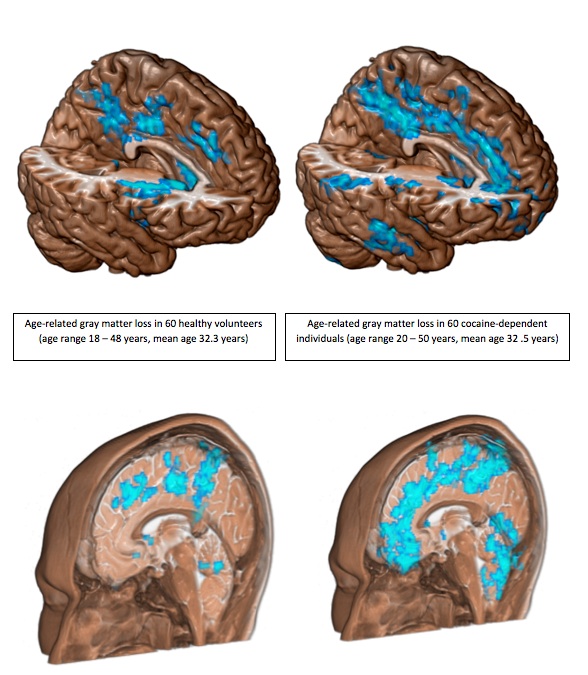
British researchers scanned the brains of 60 people with cocaine dependence and 60 people with no history of substance abuse, and found that those with cocaine dependence had greater levels of age-related loss of brain gray matter.

The cocaine users lost about 3.08 milliliters (ml) of brain volume a year, nearly twice the rate of about 1.69 ml per year seen in the healthy people, the University of Cambridge researchers said.

The increased decline in brain volume in the cocaine users was most noticeable in the prefrontal and temporal cortex, regions associated with attention, decision-making, self-regulation and memory, the investigators noted in a university news release.

“As we age, we all lose gray matter. However, what we have seen is that chronic cocaine users lose gray matter at a significantly faster rate, which could be a sign of premature aging. Our findings therefore provide new insight into why the [mental] deficits typically seen in old age have frequently been observed in middle-aged chronic users of cocaine,” Dr. Karen Ersche, of the Behavioral and Clinical Neuroscience Institute at University of Cambridge, said in the news release.

The study is published in the April 25 issue of the journal Molecular Psychiatry.

Cocaine is used by as many as 21 million people worldwide, and about 1 percent of these people become dependent on the drug, according to the United Nations Office on Drugs and Crime.

While the study doesn’t conclusively prove cocaine causes brain atrophy and other symptoms of aging, the association is cause for concern, the researchers said.

“Our findings clearly highlight the need for preventative strategies to address the risk of premature aging associated with cocaine abuse. Young people taking cocaine today need to be educated about the long-term risk of aging prematurely,” Ersche said.

However, accelerated aging also affects older adults who have abused cocaine and other drugs since early adulthood.

“Our findings shed light on the largely neglected problem of the growing number of older drug users, whose needs are not so well catered for in drug treatment services. It is timely for health care providers to understand and recognize the needs of older drug users in order to design and administer age-appropriate treatments,” Ersche said.

http://health.usnews.com/health-news/news/articles/2012/04/24/cocaine-habit-might-speed-brain-aging

University of Iowa scientists show that ingredient in green tomatoes (tomatidine) may build bigger muscles

A new study has found that a compound in green tomatoes, tomatidine, not only boosts muscle growth and strength, it protects against muscle wasting caused by illness, injury or aging. A research team at the University of Iowa found that healthy mice given supplements containing tomatidine grew bigger muscles, became stronger and could exercise longer. Even better, the mice did not gain any weight due to a corresponding loss of fat, suggesting that the compound may also have potential for treating obesity. Nice bonus.

The research team used a systems biology tool called the Connectivity Map to identify tomatidine and discovered it stimulated growth of cultured human muscle cells. (The same screening method previously identified a compound in apple peel as a muscle-boosting agent – but green tomatoes were found to be even more potent.) In fact, the team discovered that tomatidine generates changes in gene expression that are essentially opposite to the changes that occur in muscle cells when people are affected by muscle atrophy.

“Green tomatoes are safe to eat in moderation. But we don’t know how many green tomatoes a person would need to eat to get a dose of tomatidine similar to what we gave the mice,” study chief Dr. Christopher Adams said in a statement “We also don’t know if such a dose of tomatidine will be safe for people, or if it will have the same effect in people as it does in mice. We are working hard to answer these questions, hoping to find relatively simple ways that people can maintain muscle mass and function, or if necessary, regain it.”

The end goal is “science-based supplements,” or even simply incorporating tomatidine “into everyday foods to make them healthier.”

Muscle atrophy, or muscle-wasting, is a significant health issue. It can be caused by aging, injury, cancer or heart failure and makes people weak and fatigued, prohibits physical activity and predisposes them to falls and fractures. It affects more than 50 million Americans annually, including 30 million elderly.

Exercise can help but it’s not enough and is not an option for those who are ill or injured, Adams said.

The findings were published April 9 in the Journal of Biological Chemistry.

http://www.laweekly.com/squidink/2014/04/15/green-tomatoes-may-build-bigger-muscles

New research suggests that a third of patients diagnosed as vegetative may be conscious with a chance for recovery

Imagine being confined to a bed, diagnosed as “vegetative“—the doctors think you’re completely unresponsive and unaware, but they’re wrong. As many as one-third of vegetative patients are misdiagnosed, according to a new study in The Lancet. Using brain imaging techniques, researchers found signs of minimal consciousness in 13 of 42 patients who were considered vegetative. “The consequences are huge,” lead author Dr. Steven Laureys, of the Coma Science Group at the Université de Liège, tells Maclean’s. “These patients have emotions; they may feel pain; studies have shown they have a better outcome [than vegetative patients]. Distinguishing between unconscious, and a little bit conscious, is very important.”

Detecting human consciousness following brain injury remains exceedingly difficult. Vegetative patients are typically diagnosed by a bedside clinical exam, and remain “neglected” in the health care system, Laureys says. Once diagnosed, “they might not be [re-examined] for years. Nobody questions whether or not there could be something more going on.” That’s about to change.

Laureys has collaborated previously with British neuroscientist Adrian Owen, based at Western University in London, Ont., who holds the Canada Excellence Research Chair in Cognitive Neuroscience and Imaging. (Owen’s work was featured in Maclean’s in October 2013.) Together they co-authored a now-famous paper in the journal Science, in 2006, in which a 23-year-old vegetative patient was instructed to either imagine playing tennis, or moving around her house. Using functional magnetic resonance imaging, or fMRI, they saw that the patient was activating two different parts of her brain, just like healthy volunteers did. Laureys and Owen also worked together on a 2010 follow-up study, in the New England Journal of Medicine, where the same technique was used to ask a patient to answer “yes” or “no” to various questions, presenting the stunning possibility that some vegetative patients might be able to communicate.

In the new Lancet paper, Laureys used two functional brain imaging techniques, fMRI and positron emission tomography (PET), to examine 126 patients with severe brain injury: 41 of them vegetative, four locked-in (a rare condition in which patients are fully conscious and aware, yet completely paralyzed from head-to-toe), and another 81 who were minimally conscious. After finding that 13 of 42 vegetative patients showed brain activity indicating minimal consciousness, they re-examined them a year later. By then, nine of the 13 had improved, and progressed into a minimally conscious state or higher.

The mounting evidence that some vegetative patients are conscious, even minimally so, carries ethical and legal implications. Just last year, Canada’s Supreme Court ruled that doctors couldn’t unilaterally pull the plug on Hassan Rasouli, a man in a vegetative state. This work raises the possibility that one day, some patients may be able to communicate through some kind of brain-machine interface, and maybe even weigh in on their own medical treatment. For now, doctors could make better use of functional brain imaging tests to diagnose these patients, Laureys believes. Kate Bainbridge, who was one of the first vegetative patients examined by Owen, was given a scan that showed her brain lighting up in response to images of her family. Her health later improved. “I can’t say how lucky I was to have the scan,” she said in an email to Maclean’s last year. “[It] really scares me to think what would have happened if I hadn’t had it.”

https://ca.news.yahoo.com/one-third-of-vegetative-patients-may-be-conscious–study-195412300.html

Food Wars Could Rage by 2050

Within a few more decades, dire food shortages may lead to global-scale conflict, warned a top plant scientist in the U.S. Agency for International Development (USAID). There may not be enough land, water and energy to sustain the potential 9 billion people who are projected to share the Earth by 2050.

“Food issues could become as politically destabilizing by 2050 as energy issues are today,” said Fred Davies, senior science adviser for tUSAID’s bureau of food security, in a press release.

Biotechnology, improved breeding and advances in farming techniques may not be capable of keeping up with the growing human population, according to Davies. Even if farm production can be increased through technology, those innovations may not trickle down to small-scale farmers, the very people who most need help to stave off starvation.

Recent history shows that even massive increases in production don’t solve hunger. In the middle of the last century, the “Green Revolution” dramatically increased crop yields. New varieties of wheat and other grains produced bumper crops, but required purchases of expensive seed, fertilizer and other materials.

Hypothetically, food abounded for all after the agricultural advances, and hunger was indeed reduced in many regions. Yet starvation continued because of economic inequalities and lack of access to food supplies. Plus, subsistence farmers couldn’t afford the new technologies or compete with the large farms that could afford fertilizers and high-yielding seeds.

Now, after less than a century, the human population has grown rapidly, fueled by the bountiful harvests of Green Revolution technology. Once again, the global food system approaches its maximum production limit, but this time, technology may not be up to the challenge, as Davies warned.

One way to partially address the challenge could be to shift farm production toward profitable horticultural crops, like chili peppers, as opposed to bulk commodities, such as corn, suggested Davies.

“A greater emphasis is needed in high-value horticultural crops,” Davies said. “Those create jobs and economic opportunities for rural communities and enable more profitable, intense farming.”

In many cultures, sociologists have observed that increasing wealth correlates to decreasing birth rates, a phenomenon known as the demographic-economic paradox. Although a wealthier nation, such as Japan, could support more children, citizens tend to actually have fewer kids.

By lifting people out of poverty, the food wars of the future could be averted, as long as those wealthier future people don’t demand the same amounts of resource-intensive foods, such as beef, that current rich populations enjoy.

http://news.discovery.com/earth/weather-extreme-events/food-wars-could-rage-by-2050-140418.htm

Thanks to Da Brayn for bringing this to the attention of the It’s Interesting community.

NASA Space Assets Detect Ocean inside Saturn Moon

NASA’s Cassini spacecraft and Deep Space Network have uncovered evidence Saturn’s moon Enceladus harbors a large underground ocean of liquid water, furthering scientific interest in the moon as a potential home to extraterrestrial microbes.

Researchers theorized the presence of an interior reservoir of water in 2005 when Cassini discovered water vapor and ice spewing from vents near the moon’s south pole. The new data provide the first geophysical measurements of the internal structure of Enceladus, consistent with the existence of a hidden ocean inside the moon. Findings from the gravity measurements are in the Friday, April 4 edition of the journal Science.

“The way we deduce gravity variations is a concept in physics called the Doppler Effect, the same principle used with a speed-measuring radar gun,” said Sami Asmar of NASA’s Jet Propulsion Laboratory in Pasadena, Calif., a coauthor of the paper. “As the spacecraft flies by Enceladus, its velocity is perturbed by an amount that depends on variations in the gravity field that we’re trying to measure. We see the change in velocity as a change in radio frequency, received at our ground stations here all the way across the solar system.”

The gravity measurements suggest a large, possibly regional, ocean about 6 miles (10 kilometers) deep, beneath an ice shell about 19 to 25 miles (30 to 40 kilometers) thick. The subsurface ocean evidence supports the inclusion of Enceladus among the most likely places in our solar system to host microbial life. Before Cassini reached Saturn in July 2004, no version of that short list included this icy moon, barely 300 miles (500 kilometers) in diameter.

“This then provides one possible story to explain why water is gushing out of these fractures we see at the south pole,” said David Stevenson of the California Institute of Technology, Pasadena, one of the paper’s co-authors.

Cassini has flown near Enceladus 19 times. Three flybys, from 2010 to 2012, yielded precise trajectory measurements. The gravitational tug of a planetary body, such as Enceladus, alters a spacecraft’s flight path. Variations in the gravity field, such as those caused by mountains on the surface or differences in underground composition, can be detected as changes in the spacecraft’s velocity, measured from Earth.

The technique of analyzing a radio signal between Cassini and the Deep Space Network can detect changes in velocity as small as less than one foot per hour (90 microns per second). With this precision, the flyby data yielded evidence of a zone inside the southern end of the moon with higher density than other portions of the interior.

The south pole area has a surface depression that causes a dip in the local tug of gravity. However, the magnitude of the dip is less than expected given the size of the depression, leading researchers to conclude the depression’s effect is partially offset by a high-density feature in the region, beneath the surface.

“The Cassini gravity measurements show a negative gravity anomaly at the south pole that however is not as large as expected from the deep depression detected by the onboard camera,” said the paper’s lead author, Luciano Iess of Sapienza University of Rome. “Hence the conclusion that there must be a denser material at depth that compensates the missing mass: very likely liquid water, which is seven percent denser than ice. The magnitude of the anomaly gave us the size of the water reservoir.”

There is no certainty the subsurface ocean supplies the water plume spraying out of surface fractures near the south pole of Enceladus, however, scientists reason it is a real possibility. The fractures may lead down to a part of the moon that is tidally heated by the moon’s repeated flexing, as it follows an eccentric orbit around Saturn.

Much of the excitement about the Cassini mission’s discovery of the Enceladus water plume stems from the possibility that it originates from a wet environment that could be a favorable environment for microbial life.

“Material from Enceladus’ south polar jets contains salty water and organic molecules, the basic chemical ingredients for life,” said Linda Spilker, Cassini’s project scientist at JPL. “Their discovery expanded our view of the ‘habitable zone’ within our solar system and in planetary systems of other stars. This new validation that an ocean of water underlies the jets furthers understanding about this intriguing environment.”

The Cassini-Huygens mission is a cooperative project of NASA, the European Space Agency and the Italian Space Agency. JPL manages the mission for NASA’s Science Mission Directorate in Washington. For more information about Cassini, visit:

http://www.nasa.gov/cassini

and

http://saturn.jpl.nasa.gov

http://www.jpl.nasa.gov/news/news.php?release=2014-103&utm_source=iContact&utm_medium=email&utm_campaign=NASAJPL&utm_content=cassini20140403

Thanks to Kebmodee for bringing this to the attention of the It’s Interesting community.

Researchers have created a new giant dual-laser that could control the weather

Zeus, God of the Sky, may be out of work, as scientists at the University of Central Florida believe they’ve developed a technique — which involves pointing a high powered laser at the sky — to induce clouds to drop rain and hurl thunderbolts.

Scientists have known that water condensation and lightning activity in storm clouds are associated with large amounts of static charged particles. In theory, stimulating those particles with a laser is the key to harnessing Zeus-like powers.

The hard part, scientists say, is creating a laser beam with the right combination of range, precision and strength.

“When a laser beam becomes intense enough, it behaves differently than usual — it collapses inward on itself,” explained Matthew Mills, a graduate student in the UCF Center for Research and Education in Optics and Lasers. “The collapse becomes so intense that electrons in the air’s oxygen and nitrogen are ripped off creating plasma — basically a soup of electrons.”

But students at UCF’s College of Optics & Photonics have collaborated with researchers at the University of Arizona to create a “dressed laser” that they think might be up for the challenge of controlling the weather.

The dressed laser is a high-power laser beam surrounded by a second beam, which acts as a refueling agent, sustaining the strength and accuracy of the central beam over longer distances.

“Since we have control over the length of a filament with our method, one could seed the conditions needed for a rainstorm from afar,” said Mills. “Ultimately, you could artificially control the rain and lightning over a large expanse with such ideas.”

The students recently published their research findings in the journal Nature Photonics. Their efforts were supported by a $7.5 million grant from the Department of Defense.

Read more: http://www.upi.com/Science_News/2014/04/19/Giant-lasers-could-control-the-weather/1691397928851/#ixzz2zRZl9YTP

Thanks to Da Brayn for bringing this to the attention of the It’s Interesting community.

Easter Bunny drops more than 54,000 eggs and other goodies from helicopter in Owasso, Oklahoma

The Easter Bunny took to the sky on Saturday, dropping tens of thousands of eggs by helicopter on Owasso’s Centennial Park.

The congregation of Lifepoint Baptist Church and area sponsors filled more than 54,000 plastic eggs with candy, toys, stickers and other freebies for the annual Owasso Egg Drop.

“We think it’s a fun event for families,” said Pastor Doug Gregg.

Gregg’s fond memories of Easter egg hunts as a child inspired him to organize the first Owasso Egg Drop six years ago.

He approached Tulsa Helicopter to participate, and the company has since donated its annual egg-dropping services.

Families decked in sunglasses, colorful holiday wear and carrying an array of festive egg-carrying receptacles poured into the park for front-row spots along the yellow caution tape marking six drop zones, five divided by age and one designated for special needs children.

Then the waiting began as the chopper rained down bagfuls of the loot in each zone.

As volunteers signaled the all clear, children made a mad dash for the eggs, picking the fields clean in less than two minutes.

As 8-year-old Wyatt Cargill of Owasso inventoried his spoils moments later, he described the event as “very cool.”

“He has a lot of fun. He enjoys the bouncy places, the egg drop,” his father, David Cargill, said.

Gregg estimated attendance at between 5,000 and 10,000 people and said the draw has “gotten bigger every single year.”

Saturday was the Cargills third year in attendance.

Mother Terrie Cargill said the event is a good way to reach a lot of people and touch lives.

“It probably takes all year to put together,” she speculated.

Gregg said a large majority of Lifepoint’s 100-person congregation helps with the Egg Drop, which also offers paid helicopter rides, inflatable attractions, a Christian illusionist and a live band.

http://www.tulsaworld.com/communities/owasso/easter-bunny-drops-eggs-other-goodies-from-helicopter-in-owasso/article_c70561b5-d48c-51be-a853-3efb9992e437.html

Thanks to Dr. HGP for bringing this to the attention of the It’s Interesting community.