The Moral Bucket List, by David Brooks

by David Brooks

ABOUT once a month I run across a person who radiates an inner light. These people can be in any walk of life. They seem deeply good. They listen well. They make you feel funny and valued. You often catch them looking after other people and as they do so their laugh is musical and their manner is infused with gratitude. They are not thinking about what wonderful work they are doing. They are not thinking about themselves at all.

When I meet such a person it brightens my whole day. But I confess I often have a sadder thought: It occurs to me that I’ve achieved a decent level of career success, but I have not achieved that. I have not achieved that generosity of spirit, or that depth of character.

A few years ago I realized that I wanted to be a bit more like those people. I realized that if I wanted to do that I was going to have to work harder to save my own soul. I was going to have to have the sort of moral adventures that produce that kind of goodness. I was going to have to be better at balancing my life.

It occurred to me that there were two sets of virtues, the résumé virtues and the eulogy virtues. The résumé virtues are the skills you bring to the marketplace. The eulogy virtues are the ones that are talked about at your funeral — whether you were kind, brave, honest or faithful. Were you capable of deep love?

We all know that the eulogy virtues are more important than the résumé ones. But our culture and our educational systems spend more time teaching the skills and strategies you need for career success than the qualities you need to radiate that sort of inner light. Many of us are clearer on how to build an external career than on how to build inner character.

But if you live for external achievement, years pass and the deepest parts of you go unexplored and unstructured. You lack a moral vocabulary. It is easy to slip into a self-satisfied moral mediocrity. You grade yourself on a forgiving curve. You figure as long as you are not obviously hurting anybody and people seem to like you, you must be O.K. But you live with an unconscious boredom, separated from the deepest meaning of life and the highest moral joys. Gradually, a humiliating gap opens between your actual self and your desired self, between you and those incandescent souls you sometimes meet.

So a few years ago I set out to discover how those deeply good people got that way. I didn’t know if I could follow their road to character (I’m a pundit, more or less paid to appear smarter and better than I really am). But I at least wanted to know what the road looked like.

I came to the conclusion that wonderful people are made, not born — that the people I admired had achieved an unfakeable inner virtue, built slowly from specific moral and spiritual accomplishments.

If we wanted to be gimmicky, we could say these accomplishments amounted to a moral bucket list, the experiences one should have on the way toward the richest possible inner life. Here, quickly, are some of them:

THE HUMILITY SHIFT
We live in the culture of the Big Me. The meritocracy wants you to promote yourself. Social media wants you to broadcast a highlight reel of your life. Your parents and teachers were always telling you how wonderful you were.

But all the people I’ve ever deeply admired are profoundly honest about their own weaknesses. They have identified their core sin, whether it is selfishness, the desperate need for approval, cowardice, hardheartedness or whatever. They have traced how that core sin leads to the behavior that makes them feel ashamed. They have achieved a profound humility, which has best been defined as an intense self-awareness from a position of other-centeredness.

SELF-DEFEAT
External success is achieved through competition with others. But character is built during the confrontation with your own weakness. Dwight Eisenhower, for example, realized early on that his core sin was his temper. He developed a moderate, cheerful exterior because he knew he needed to project optimism and confidence to lead. He did silly things to tame his anger. He took the names of the people he hated, wrote them down on slips of paper and tore them up and threw them in the garbage. Over a lifetime of self-confrontation, he developed a mature temperament. He made himself strong in his weakest places.

THE DEPENDENCY LEAP
Many people give away the book “Oh, the Places You’ll Go!” as a graduation gift. This book suggests that life is an autonomous journey. We master certain skills and experience adventures and certain challenges on our way to individual success. This individualist worldview suggests that character is this little iron figure of willpower inside. But people on the road to character understand that no person can achieve self-mastery on his or her own. Individual will, reason and compassion are not strong enough to consistently defeat selfishness, pride and self-deception. We all need redemptive assistance from outside.

People on this road see life as a process of commitment making. Character is defined by how deeply rooted you are. Have you developed deep connections that hold you up in times of challenge and push you toward the good? In the realm of the intellect, a person of character has achieved a settled philosophy about fundamental things. In the realm of emotion, she is embedded in a web of unconditional loves. In the realm of action, she is committed to tasks that can’t be completed in a single lifetime.

ENERGIZING LOVE
Dorothy Day led a disorganized life when she was young: drinking, carousing, a suicide attempt or two, following her desires, unable to find direction. But the birth of her daughter changed her. She wrote of that birth, “If I had written the greatest book, composed the greatest symphony, painted the most beautiful painting or carved the most exquisite figure I could not have felt the more exalted creator than I did when they placed my child in my arms.”

That kind of love decenters the self. It reminds you that your true riches are in another. Most of all, this love electrifies. It puts you in a state of need and makes it delightful to serve what you love. Day’s love for her daughter spilled outward and upward. As she wrote, “No human creature could receive or contain so vast a flood of love and joy as I often felt after the birth of my child. With this came the need to worship, to adore.”

She made unshakable commitments in all directions. She became a Catholic, started a radical newspaper, opened settlement houses for the poor and lived among the poor, embracing shared poverty as a way to build community, to not only do good, but be good. This gift of love overcame, sometimes, the natural self-centeredness all of us feel.

THE CALL WITHIN THE CALL
We all go into professions for many reasons: money, status, security. But some people have experiences that turn a career into a calling. These experiences quiet the self. All that matters is living up to the standard of excellence inherent in their craft.

Frances Perkins was a young woman who was an activist for progressive causes at the start of the 20th century. She was polite and a bit genteel. But one day she stumbled across the Triangle Shirtwaist factory fire, and watched dozens of garment workers hurl themselves to their deaths rather than be burned alive. That experience shamed her moral sense and purified her ambition. It was her call within a call.

After that, she turned herself into an instrument for the cause of workers’ rights. She was willing to work with anybody, compromise with anybody, push through hesitation. She even changed her appearance so she could become a more effective instrument for the movement. She became the first woman in a United States cabinet, under Franklin D. Roosevelt, and emerged as one of the great civic figures of the 20th century.

THE CONSCIENCE LEAP
In most lives there’s a moment when people strip away all the branding and status symbols, all the prestige that goes with having gone to a certain school or been born into a certain family. They leap out beyond the utilitarian logic and crash through the barriers of their fears.

The novelist George Eliot (her real name was Mary Ann Evans) was a mess as a young woman, emotionally needy, falling for every man she met and being rejected. Finally, in her mid-30s she met a guy named George Lewes. Lewes was estranged from his wife, but legally he was married. If Eliot went with Lewes she would be labeled an adulterer by society. She’d lose her friends, be cut off by her family. It took her a week to decide, but she went with Lewes. “Light and easily broken ties are what I neither desire theoretically nor could live for practically. Women who are satisfied with such ties do not act as I have done,” she wrote.

She chose well. Her character stabilized. Her capacity for empathetic understanding expanded. She lived in a state of steady, devoted love with Lewes, the kind of second love that comes after a person is older, scarred a bit and enmeshed in responsibilities. He served her and helped her become one of the greatest novelists of any age. Together they turned neediness into constancy.

Commencement speakers are always telling young people to follow their passions. Be true to yourself. This is a vision of life that begins with self and ends with self. But people on the road to inner light do not find their vocations by asking, what do I want from life? They ask, what is life asking of me? How can I match my intrinsic talent with one of the world’s deep needs?

Their lives often follow a pattern of defeat, recognition, redemption. They have moments of pain and suffering. But they turn those moments into occasions of radical self-understanding — by keeping a journal or making art. As Paul Tillich put it, suffering introduces you to yourself and reminds you that you are not the person you thought you were.

The people on this road see the moments of suffering as pieces of a larger narrative. They are not really living for happiness, as it is conventionally defined. They see life as a moral drama and feel fulfilled only when they are enmeshed in a struggle on behalf of some ideal.

This is a philosophy for stumblers. The stumbler scuffs through life, a little off balance. But the stumbler faces her imperfect nature with unvarnished honesty, with the opposite of squeamishness. Recognizing her limitations, the stumbler at least has a serious foe to overcome and transcend. The stumbler has an outstretched arm, ready to receive and offer assistance. Her friends are there for deep conversation, comfort and advice.

External ambitions are never satisfied because there’s always something more to achieve. But the stumblers occasionally experience moments of joy. There’s joy in freely chosen obedience to organizations, ideas and people. There’s joy in mutual stumbling. There’s an aesthetic joy we feel when we see morally good action, when we run across someone who is quiet and humble and good, when we see that however old we are, there’s lots to do ahead.

The stumbler doesn’t build her life by being better than others, but by being better than she used to be. Unexpectedly, there are transcendent moments of deep tranquillity. For most of their lives their inner and outer ambitions are strong and in balance. But eventually, at moments of rare joy, career ambitions pause, the ego rests, the stumbler looks out at a picnic or dinner or a valley and is overwhelmed by a feeling of limitless gratitude, and an acceptance of the fact that life has treated her much better than she deserves.

Those are the people we want to be.

David Brooks is an Op-Ed columnist and the author, most recently, of “The Road to Character,” from which this essay is adapted.

French “Spider-Man” scales Dubai skyscraper with nothing but chalk and sticky tape on his fingertips

A French climber has scaled one of Dubai’s tallest skyscrapers, relying on just chalk and sticky tape on his fingertips to help him up the 75-story high Cayan Tower in the emirate’s glitzy marina area.

Alain Robert, 52, completed climbing the 1007-foot (307 meter) high structure in just 70 minutes on Sunday. He had no harness and little space for his feet on the ledges of the tower, which twists as it ascends.

Robert, who is often described as “The French Spider-Man,” is no stranger to scaling tall buildings.

In 2011, he climbed the world’s tallest tower in Dubai. Using a rope and harness to comply with organizers’ requirements, it took him just over six hours to scale the 2,717-foot (828 meter) tall Burj Khalifa.

http://hamptonroads.com/2015/04/french-spiderman-scales-dubai-skyscraper

Farewell James Best, sheriff Rosco P. Coltrane of Hazzard County.

James Best, whose prolific career included 83 movies and 600 TV shows but is best remembered for portraying Rosco P. Coltrane, the bumbling sheriff of Hazzard County, died late Monday in Hickory at age 88.

Best died in hospice after a brief illness of complications from pneumonia, said Steve Latshaw, a longtime friend and Hollywood colleague. Best had fallen ill with respiratory trouble on a cruise and never recovered.

His career included roles in such movies as “The Caine Mutiny” with Humphrey Bogart and “Shenandoah” with Jimmy Stewart. As a character actor in television, he was cast on popular shows like “Alfred Hitchcock Presents,” “Bonanza” and “The Andy Griffith Show.”

But it was in “The Dukes of Hazzard,” a rural comedy that ran on CBS from 1979 to 1985, that Best made his name. As Hazzard County’s ever-frustrated lawman catching the dickens from a blustery Boss Hogg, he found himself constantly in pursuit – and ever outwitted – by Luke and Bo Duke in their roaring Dodge Charger, the “General Lee.”

“Rosco – let’s face it – was a charmer,” Best said in a 2009 interview with The Charlotte Observer. “It was a fun thing.”

“I learned more about acting in front of a camera from Jimmie Best in an afternoon than from anyone else in a year,” John Schneider, who played Bo Duke, said in a statement. “When asked to cry on camera, he would say, ‘Sure thing – which eye?’”

Came to the foothills

Best and his wife, actress Dorothy Collier, moved to the Bethlehem community near Hickory in 2006 from Orlando. At their home on Lake Hickory, Latshaw said, Best did the thing in life he liked the best – fishing. He also wrote a book about his career as an actor, writer, producer and director, “Best in Hollywood: The Good, The Bad and the Beautiful.”

“Only thing that makes me sad about having so little time left,” Best said in the book, “is leaving the people I love and those who love me. There are also films and other projects that I want to get done, and there are always fish that need catching.”

He never truly retired, taking on the lead role in “On Golden Pond” in 2014 for Hickory Community Theater opposite Hollywood veteran Norma Frank.

Pam Livingstone, who directed the production, said Tuesday that Best was an avid patron who supported the renovations to the historical theater, donating $25,000 for the rehearsal hall and allowing some of his oil paintings to be auctioned off, raising thousands more.

“He was very funny,” said Livingstone, the theater’s artistic director for the last 15 years. “Actors loved working with him. He was a real kick in the head.”

Bit parts in movies

Youngest of eight brothers and a sister, Best was born Jewel Franklin Guy in Powderly, Ky., on July 26, 1926, to Lena Mae Everly Guy (sister of Ike Everly, father of entertainers Don and Phil Everly) and Larkin Jasper Guy. He spent time in an orphanage following his mother’s death in 1929, then was adopted by Essa and Armen Best and raised in Corydon, Ind.

His first professional stage experience came in Germany with the Army after World War II playing a drunk in director Arthur Penn’s production of “My Sister Eileen.” Penn later directed such movies as “Bonnie and Clyde,” “Little Big Man” and “Left Handed Gun” with Paul Newman – a film in which Best had a small role.

As a contract player at Universal Studios, Best played bit parts – mostly bad guys – from westerns with Audie Murphy and Charlotte native Randolph Scott to bits in “Ma and Pa Kettle at the Fair” and “Abbott and Costello Meet the Invisible Man.”

On TV, Best had featured roles in “The Jar,” a haunting episode of “Alfred Hitchcock Presents.” Other popular shows he got roles on included “Perry Mason,” “Gunsmoke,” “Ben Casey” and “The Twilight Zone.”

Worst movie of the year

In 1959, Best starred in a low-budget horror flick, “The Killer Shrews,” in which giant shrews rampage during a hurricane. B-movie effects included cheesy puppet shrews. It was so bad it was good and became a cult classic.

“They put hairy rugs on dogs to be the shrews,” Best recalled. “It was voted the worst picture of the year. Forgive me.”

In 2012, Best returned in a sequel, “Return of the Killer Shrews,” reprising his role as a boat captain who survived the ferocious shrews.

Taught others actors

Best’s academic credentials include teaching motion picture technique and drama at the University of Mississippi, where he was artist-in-residence. For 25 years, Best taught an acting technique class in Hollywood and worked with Gary Busey, Clint Eastwood, Burt Reynolds, Teri Garr, Farrah Fawcett and Quentin Tarantino.

One thing that sold Best on doing “The Dukes of Hazzard” was the location where the first episodes were shot: Covington, Ga., an area known for good fishing. But later the production moved back to California. It was a grueling pace, Best told the Observer. “But it was good money.”

Scenes with Boss Hogg, played by Sorrell Booke, who died in 1994, “were 90 percent ad-libbed,” Best said. “He was such a professional.”

“Dukes of Hazzard” was a top 10 prime-time show for three seasons, 1979 to 1982.

A dog named Flash

Fans of the program would remember Flash, a molasses-paced basset hound who accompanied Sheriff Coltrane on patrol.

Best rescued the dog from a pound and brought it to the set at the beginning of the third season, suggesting the sheriff needed a partner. Producers didn’t like the dog, but Best prevailed and she got a role.

Best was a dog lover who advocated for their humane treatment. He liked to greet fans who would bring their own basset hounds to meet him, and he kept “doggie num-nums” handy for them.

Best’s last film was “The Sweeter Side of Life,” a 2013 Hallmark movie written and produced by his daughter, Janeen Damian, and her husband, Michael, who also directed. He was scheduled to star in “Old Soldiers,” a feature film about World War II veterans that was to begin filming this year.

Read more here: http://www.charlotteobserver.com/entertainment/tv/media-scene-blog/article17597600.html#storylink=cpy

Woman who bared her breasts to Google Street View charged with disorderly conduct

Karen Davis was photographed on Google Street View flashing her breasts.
Police reported her for disorderly behaviour and she must report to court.
Police said her ‘actions were the same as someone flashing their genitals.’
SA country town mum hit back at critics saying they are insecure.
She plans to do a topless skydive for her 40th birthday next year.

A woman who notoriously flashed her K-cup breasts on Google Street View has been charged by police with disorderly behaviour.

Karen Davis, from Port Pirie in South Australia, was captured streaking by a camera car for the popular Google Maps app, which allows users to zoom in on certain streets and towns in cities all over the world with a 360-degree view.

Police released a statement alleging the 38-year-old mother ‘pursued’ the Google car to make sure she was captured exposing herself, and that it was an illegal act.

‘The woman’s actions were the same as someone flashing their genitals and the public expectation is that we take action,’ said Superintendent Scott Denny of Port Pirie police.

‘Recently in Port Pirie we arrested a man for exposing himself in public – this incident is no different,’ he said.

‘It is not appropriate for anyone to expose themselves in public places. Our community should be able to expect a bit of decency.’

Ms Davis will be summonsed to appear in the Port Pirie Magistrates Court at a date to be determined.

In the image, Ms Davis can be seen holding her arms up in the air with her T-shirt hunched up around her neck bearing her breasts, as she follows the Google camera cars around the street.

Her sons are playing in the background and an unknown man stands at the fence watching.

Across the road, a neighbour is lounging on her outdoor furniture, watching the whole thing unfold.

The 38-year-old, who plans to skydive topless for her 40th birthday, has hit back at the controversy over her actions, claiming that ‘flat-tittie chicks’ are not confident enough with their own bodies and should focus on how they look.

Speaking to Daily Mail Australia, Ms Davis was in tears over the nasty comments coming from her community after she was branded a ‘bad mother’ and ‘pure filth’ for her raunchy behaviour.

‘They are narrow-minded people who are not happy with their own bodies,’ she said.

Posting on her Facebook account, Ms Davis addressed the fact that she pursued the car through Barry Street in Port Pirie until they got the perfect shot and believes locals are jealous of her antics.

‘Haters hate, you got the guts to do it?’ she posted on Facebook after the photo went public.

‘All the flat-tittie chicks think I am disgusting. Big-boob envy has hit Port Pirie.’

Taking to Facebook, disgusted commenters attacked Ms Davis’ parenting skills after it became clear that her two sons were in the background of the picture.

‘I’m sure your children will be proud of their mother that is probably going to cause them a lot of embarrassment,’ one Facebook commenter said.

‘Oh goodness. Can’t even begin to imagine how her children are feeling,’ another user said.

However a select few came out in support of Ms Davis’s show on Google Maps.

‘Let her go, she’s having some fun, Pirie people need to lighten up a bit. if more lovely ladies would get them out more often the world would be a much happier place,’ one commenter said.

Ms Davis told Daily Mail Australia that she thought the act would be funny and that it was an item she has now ticked off her bucket list.

She also said that she has a friend in the United Kingdom and she thought it would brighten up his day if he saw the image online.

‘I have a friend in the UK. If he looks on there he will smile,’ she said.

Ms Davis wasn’t sure that the photo would make it on to Google Maps but she said she is delighted that it did.

‘I think maybe some need to start their own bucket list and leave mine alone,’ she said.

She also revealed that since the photo has been released she has attracted a whole host of new friend requests on Facebook.

Many young men have tried to befriend her but she has not accepted any of them.

Ms Davis said she has only learnt to embrace her size-K breasts in the last few years after spending her youth hiding them away.

‘I always got picked on and it wasn’t until late in my 20’s that I became confident in myself,’ she said.

She also revealed that she has to buy her bras online from the UK as they do not make size-K bras in Australia.

‘It would be nice if they made my size bra in Australia,’ she said.

Ms Davis said that she would do it all again, even considering the backlash the image has received.

‘It’s my life not theirs,’ she said.

‘When you point your finger at me, you have 4 pointing back at yourself.’

Some people online have suggested that she should be formally charged for her display but she has contacted the police who have confirmed that they have ‘no concerns’.

read more: http://www.dailymail.co.uk/news/article-3020958/Fun-police-gone-far-Woman-exposed-size-k-boobs-Google-street-view-CHARGED-disorderly-behaviour.html#ixzz3W3DG7Vf0

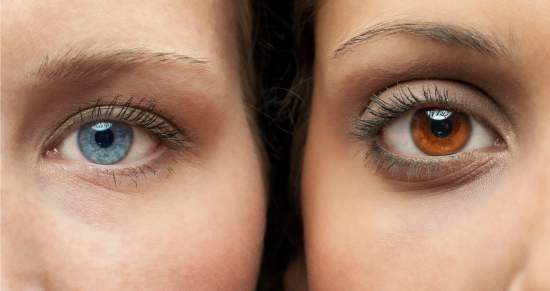
Soon You’ll Be Able to Turn Your Brown Eyes Blue for $5,000

A new treatment has successfully changed the color of people’s eyes in Latin America, but the procedure isn’t approved in the U.S. yet.

For years, a California-based company called Stroma Medical has been publicizing a laser procedure that turns brown eyes blue. Theoretically, this would give brown-eyed individuals the choice to change the tint of their irises, not unlike the way many decide to use surgery to alter the noses or chests they were born with.

Now Stroma Medical claims that it has conducted 37 successful treatments on patients in Mexico and Costa Rica. It also says that it would likely charge about $5,000 for anyone wanting the procedure. That is, of course, only if and when American medical safety regulators give the surgery the green light in the United States.

Company chairman Gregg Homer says the procedure works by disturbing the thin layer of pigment that exists on the surfaces of all brown irises.

“The fundamental principle is that under every brown eye is a blue eye,” Homer told CNN. “If you take that pigment away, then the light can enter the stroma—the little fibers that look like bicycle spokes in a light eye—and when the light scatters it only reflects back the shortest wavelengths and that’s the blue end of the spectrum.”

Although the treatment lasts only 20 seconds, the patient’s eye color isn’t changed right away. Instead, it takes a few weeks for the human body to remove the pigmented tissue, resulting in blue eyes.

Given that light eyes are increasingly rare, with less than a fifth of Americans boasting blue peepers, it’s easy to see how there might be demand for this procedure. A preference for blue eyes in Western societies has been documented in many unscientific ways, though controlled studies suggest that the blue-eyes-are-more-attractive stereotype is more a product of culture than unconscious preference.

Whether or not you feel this procedure is a net good—or bad—thing for society, a bigger concern might be safety.

Though Stroma claims the surgery is safe, at least one ophthalmologist cautioned that the shedding of pigment could clog up drainage channels in the eye, increasing pressure and the risk for glaucoma.

http://time.com/money/3733372/surgery-turn-brown-eyes-blue/

Middle school students in Pennsylvania given ‘Fifty Shades of Grey’ puzzles

When James Carter got a look at the word puzzle his son said he received in his eighth-grade class Monday, he was shocked.

Words like “bondage,” ”leather cuffs,” “spanking” and “submissive” jumped out — and those were the tamer ones. Others were so racy they had to be covered over for a newscast.

The word puzzle was based on the erotic novel and upcoming movie “Fifty Shades of Grey.”

Then Carter’s son gave him more disturbing news.

“I asked my son who passed it out, and he said the teacher passed it out,” he told WTAE-TV in Pittsburgh. “I don’t think this is what they should be doing in the eighth-grade level.”

At least five students in the Monessen Middle School classroom reportedly got copies of the word puzzle. It was apparently downloaded from a website, copied and given students. A note at the bottom of the worksheet says it’s “suitable for individuals or educators that want something with a difficulty level of Very Difficult.” After brief instructions, it ends with, “But most of all HAVE FUN!!!”

Carter said he went to the school Tuesday afternoon but was denied information because he insisted on recording the conversation with school officials. Then he went to the school board meeting Tuesday evening.

“I wanted to record the conversation because a lot of parents had questions about it, and I was denied that,” Carter told the board. “So I guess I come here today to find out the timeline and how it happened.”

http://www.theblaze.com/stories/2015/02/11/fifty-shades-of-grey-word-puzzle-passed-out-in-middle-school-classroom-report/

Selfies Linked to Narcissism, Psychopathy

Men who post selfies on social media such as Instagram and Facebook have higher than average traits of narcissism and psychopathy, according to a new study from academics at Ohio State University.

Furthermore, people who use filters to edit shots score even higher for anti-social behaviour such as narcissism, an obsession with one’s own appearance.

Psychologists from the University of Ohio sampled 800 men aged 18 to 40 about their photo-posting habits on social media.

As well as questionnaires to test their levels of vanity, they were also asked if they edited their photos by cropping them or adding a filter.

Assistant Professor Jesse Fox, lead author of the study at The Ohio State University, said: ‘It’s not surprising that men who post a lot of selfies and spend more time editing them are more narcissistic, but this is the first time it has actually been confirmed in a study.

‘The more interesting finding is that they also score higher on this other anti-social personality trait, psychopathy, and are more prone to self-objectification” she said.

http://www.timeslive.co.za/lifestyle/2015/01/08/men-who-post-selfies-have-narcissistic-and-psychopathic-tendencies-study

Lincoln Museum Looking for Help Writing History

The Abraham Lincoln Presidential Library and Museum wants all armchair historians to volunteer for a special project they can do from home.

The library needs help transcribing 30,000 pages of historical documents.

Volunteers would get a look at the document, then type out what they see. Officials say the papers give unique insight into the day-to-day experience of living in Illinois during the Civil War.

Documents like these would ordinarily not be transcribed, leaving researchers to dig through them as they try to find something related to their topic. But in crowdsourcing the project, the library hopes to create a searchable database available to researchers around the world.

If you’re up for the challenge, visit ChroniclingIllinois.org and click on “Transcriptions.” That takes visitors to a page with links at the top and bottom to create an account. After you sign up, a confirmation will be sent to your email. Click on it and then go back to the Transcriptions page to select a document and begin.

http://www.wsiltv.com/news/three-states/Lincoln-Museum-Looking-for-Help-Writing-History-285572071.html

Thanks to Beth Pieper for bringing this to the attention of the It’s Interesting community.

New superthin material can cool buildings without requiring electricity, by beaming heat directly into outer space.

A new superthin material can cool buildings without requiring electricity, by beaming heat directly into outer space, researchers say.

In addition to cooling areas that don’t have access to electrical power, the material could help reduce demand for electricity, since air conditioning accounts for nearly 15 percent of the electricity consumed by buildings in the United States.

The heart of the new cooler is a multilayered material measuring just 1.8 microns thick, which is thinner than the thinnest sheet of aluminum foil. In comparison, the average human hair is about 100 microns wide.

This material is made of seven layers of silicon dioxide and hafnium dioxide on top of a thin layer of silver. The way each layer varies in thickness makes the material bend visible and invisible forms of light in ways that grant it cooling properties.

Invisible light in the form of infrared radiation is one key way all objects shed heat. “If you use an infrared camera, you can see we all glow in infrared light,” said study co-author Shanhui Fan, an electrical engineer at Stanford University in California.

One way this material helps keep things cool is by serving as a highly effective mirror. By reflecting 97 percent of sunlight away, it helps keep anything it covers from heating up.

In addition, when this material does absorb heat, its composition and structure ensure that it only emits very specific wavelengths of infrared radiation, ones that air does not absorb, the researchers said. Instead, this infrared radiation is free to leave the atmosphere and head out into space.

“The coldness of the universe is a vast resource that we can benefit from,” Fan told Live Science.

The scientists tested a prototype of their cooler on a clear winter day in Stanford, California, and found it could cool to nearly 9 degrees Fahrenheit (5 degrees Celsius) cooler than the surrounding air, even in the sunlight.

“This is very novel and an extraordinarily simple idea,” Eli Yablonovitch, a photonics crystal expert at the University of California, Berkeley, who did not take part in this research, said in a statement.

The researchers suggested that their material’s cost and performance compare favorably to those of other rooftop air-conditioning systems, such as those driven by electricity derived from solar cells. The new device could also work alongside these other technologies, the researchers said.

However, the scientists cautioned that their prototype measures only about 8 inches (20 centimeters) across, or about the size of a personal pizza. “We are now scaling production up to make larger samples,” Fan said. “To cool buildings, you really need to cover large areas.”

The scientists detailed their findings in the Nov. 26 journal Nature.

http://www.livescience.com/48942-cooling-buildings-without-electricity.html

Human intelligence is withering as computers do more, but there’s a solution.


Computers are taking over the kinds of knowledge work long considered the preserve of well-educated, well-trained professionals.

By Nicholas Carr

Artificial intelligence has arrived. Today’s computers are discerning and sharp. They can sense the environment, untangle knotty problems, make subtle judgments and learn from experience. They don’t think the way we think—they’re still as mindless as toothpicks—but they can replicate many of our most prized intellectual talents. Dazzled by our brilliant new machines, we’ve been rushing to hand them all sorts of sophisticated jobs that we used to do ourselves.

But our growing reliance on computer automation may be exacting a high price. Worrisome evidence suggests that our own intelligence is withering as we become more dependent on the artificial variety. Rather than lifting us up, smart software seems to be dumbing us down.

It has been a slow process. The first wave of automation rolled through U.S. industry after World War II, when manufacturers began installing electronically controlled equipment in their plants. The new machines made factories more efficient and companies more profitable. They were also heralded as emancipators. By relieving factory hands of routine chores, they would do more than boost productivity. They would elevate laborers, giving them more invigorating jobs and more valuable talents. The new technology would be ennobling.

Then, in the 1950s, a Harvard Business School professor named James Bright went into the field to study automation’s actual effects on a variety of industries, from heavy manufacturing to oil refining to bread baking. Factory conditions, he discovered, were anything but uplifting. More often than not, the new machines were leaving workers with drabber, less demanding jobs. An automated milling machine, for example, didn’t transform the metalworker into a more creative artisan; it turned him into a pusher of buttons.

Bright concluded that the overriding effect of automation was (in the jargon of labor economists) to “de-skill” workers rather than to “up-skill” them. “The lesson should be increasingly clear,” he wrote in 1966. “Highly complex equipment” did not require “skilled operators. The ‘skill’ can be built into the machine.”

We are learning that lesson again today on a much broader scale. As software has become capable of analysis and decision-making, automation has leapt out of the factory and into the white-collar world. Computers are taking over the kinds of knowledge work long considered the preserve of well-educated, well-trained professionals: Pilots rely on computers to fly planes; doctors consult them in diagnosing ailments; architects use them to design buildings. Automation’s new wave is hitting just about everyone.

Computers aren’t taking away all the jobs done by talented people. But computers are changing the way the work gets done. And the evidence is mounting that the same de-skilling effect that ate into the talents of factory workers last century is starting to gnaw away at professional skills, even highly specialized ones. Yesterday’s machine operators are today’s computer operators.

Just look skyward. Since their invention a century ago, autopilots have helped to make air travel safer and more efficient. That happy trend continued with the introduction of computerized “fly-by-wire” jets in the 1970s. But now, aviation experts worry that we’ve gone too far. We have shifted so many cockpit tasks from humans to computers that pilots are losing their edge—and beginning to exhibit what the British aviation researcher Matthew Ebbatson calls “skill fade.”

In 2007, while working on his doctoral thesis at Cranfield University’s School of Engineering, Mr. Ebbatson conducted an experiment with a group of airline pilots. He had them perform a difficult maneuver in a flight simulator—bringing a Boeing jet with a crippled engine in for a landing in rough weather—and measured subtle indicators of their skill, such as the precision with which they maintained the plane’s airspeed.

When he compared the simulator readings with the aviators’ actual flight records, he found a close connection between a pilot’s adroitness at the controls and the amount of time the pilot had recently spent flying planes manually. “Flying skills decay quite rapidly towards the fringes of ‘tolerable’ performance without relatively frequent practice,” Mr. Ebbatson concluded. But computers now handle most flight operations between takeoff and touchdown—so “frequent practice” is exactly what pilots are not getting.

Even a slight decay in manual flying ability can risk tragedy. A rusty pilot is more likely to make a mistake in an emergency. Automation-related pilot errors have been implicated in several recent air disasters, including the 2009 crashes of Continental Flight 3407 in Buffalo and Air France Flight 447 in the Atlantic Ocean, and the botched landing of Asiana Flight 214 in San Francisco in 2013.

Late last year, a report from a Federal Aviation Administration task force on cockpit technology documented a growing link between crashes and an overreliance on automation. Pilots have become “accustomed to watching things happen, and reacting, instead of being proactive,” the panel warned. The FAA is now urging airlines to get pilots to spend more time flying by hand.

As software improves, the people using it become less likely to sharpen their own know-how. Applications that offer lots of prompts and tips are often to blame; simpler, less solicitous programs push people harder to think, act and learn.

Ten years ago, information scientists at Utrecht University in the Netherlands had a group of people carry out complicated analytical and planning tasks using either rudimentary software that provided no assistance or sophisticated software that offered a great deal of aid. The researchers found that the people using the simple software developed better strategies, made fewer mistakes and developed a deeper aptitude for the work. The people using the more advanced software, meanwhile, would often “aimlessly click around” when confronted with a tricky problem. The supposedly helpful software actually short-circuited their thinking and learning.

The philosopher Hubert Dreyfus of the University of California, Berkeley, wrote in 2002 that human expertise develops through “experience in a variety of situations, all seen from the same perspective but requiring different tactical decisions.” In other words, our skills get sharper only through practice, when we use them regularly to overcome different sorts of difficult challenges.

The goal of modern software, by contrast, is to ease our way through such challenges. Arduous, painstaking work is exactly what programmers are most eager to automate—after all, that is where the immediate efficiency gains tend to lie. In other words, a fundamental tension ripples between the interests of the people doing the automation and the interests of the people doing the work.

Nevertheless, automation’s scope continues to widen. With the rise of electronic health records, physicians increasingly rely on software templates to guide them through patient exams. The programs incorporate valuable checklists and alerts, but they also make medicine more routinized and formulaic—and distance doctors from their patients.

In a study conducted in 2007-08 in upstate New York, SUNY Albany professor Timothy Hoff interviewed more than 75 primary-care physicians who had adopted computerized systems. The doctors felt that the software was impoverishing their understanding of patients, diminishing their “ability to make informed decisions around diagnosis and treatment.”

Harvard Medical School professor Beth Lown, in a 2012 journal article written with her student Dayron Rodriquez, warned that when doctors become “screen-driven,” following a computer’s prompts rather than “the patient’s narrative thread,” their thinking can become constricted. In the worst cases, they may miss important diagnostic signals.

The risk isn’t just theoretical. In a recent paper published in the journal Diagnosis, three medical researchers—including Hardeep Singh, director of the health policy, quality and informatics program at the Veterans Administration Medical Center in Houston—examined the misdiagnosis of Thomas Eric Duncan, the first person to die of Ebola in the U.S., at Texas Health Presbyterian Hospital Dallas. They argue that the digital templates used by the hospital’s clinicians to record patient information probably helped to induce a kind of tunnel vision. “These highly constrained tools,” the researchers write, “are optimized for data capture but at the expense of sacrificing their utility for appropriate triage and diagnosis, leading users to miss the forest for the trees.” Medical software, they write, is no “replacement for basic history-taking, examination skills, and critical thinking.”

Even creative trades are increasingly suffering from automation’s de-skilling effects. Computer-aided design has helped architects to construct buildings with unusual shapes and materials, but when computers are brought into the design process too early, they can deaden the aesthetic sensitivity and conceptual insight that come from sketching and model-building.

Working by hand, psychological studies have found, is better for unlocking designers’ originality, expands their working memory and strengthens their tactile sense. A sketchpad is an “intelligence amplifier,” says Nigel Cross, a design professor at the Open University in the U.K.

When software takes over, manual skills wane. In his book “The Thinking Hand,” the Finnish architect Juhani Pallasmaa argues that overreliance on computers makes it harder for designers to appreciate the subtlest, most human qualities of their buildings. “The false precision and apparent finiteness of the computer image” narrow a designer’s perspective, he writes, which can mean technically stunning but emotionally sterile work. As University of Miami architecture professor Jacob Brillhart wrote in a 2011 paper, modern computer systems can translate sets of dimensions into precise 3-D renderings with incredible speed, but they also breed “more banal, lazy, and uneventful designs that are void of intellect, imagination and emotion.”

We do not have to resign ourselves to this situation, however. Automation needn’t remove challenges from our work and diminish our skills. Those losses stem from what ergonomists and other scholars call “technology-centered automation,” a design philosophy that has come to dominate the thinking of programmers and engineers.

When system designers begin a project, they first consider the capabilities of computers, with an eye toward delegating as much of the work as possible to the software. The human operator is assigned whatever is left over, which usually consists of relatively passive chores such as entering data, following templates and monitoring displays.

This philosophy traps people in a vicious cycle of de-skilling. By isolating them from hard work, it dulls their skills and increases the odds that they will make mistakes. When those mistakes happen, designers respond by seeking to further restrict people’s responsibilities—spurring a new round of de-skilling.

Because the prevailing technique “emphasizes the needs of technology over those of humans,” it forces people “into a supporting role, one for which we are most unsuited,” writes the cognitive scientist and design researcher Donald Norman of the University of California, San Diego.

There is an alternative.

In “human-centered automation,” the talents of people take precedence. Systems are designed to keep the human operator in what engineers call “the decision loop”—the continuing process of action, feedback and judgment-making. That keeps workers attentive and engaged and promotes the kind of challenging practice that strengthens skills.

In this model, software plays an essential but secondary role. It takes over routine functions that a human operator has already mastered, issues alerts when unexpected situations arise, provides fresh information that expands the operator’s perspective and counters the biases that often distort human thinking. The technology becomes the expert’s partner, not the expert’s replacement.

Pushing automation in a more humane direction doesn’t require any technical breakthroughs. It requires a shift in priorities and a renewed focus on human strengths and weaknesses.

Airlines, for example, could program cockpit computers to shift control back and forth between computer and pilot during a flight. By keeping the aviator alert and active, that small change could make flying even safer.

In accounting, medicine and other professions, software could be far less intrusive, giving people room to exercise their own judgment before serving up algorithmically derived suggestions.

When it comes to the computerization of knowledge work, writes John Lee of the University of Iowa, “a less-automated approach, which places the automation in the role of critiquing the operator, has met with much more success” than the typical practice of supplanting human judgment with machine calculations. The best decision-support systems provide professionals with “alternative interpretations, hypotheses, or choices.”

Human-centered automation doesn’t constrain progress. Rather, it guides progress onto a more humanistic path, providing an antidote to the all-too-common, misanthropic view that venerates computers and denigrates people.

One of the most exciting examples of the human-focused approach is known as adaptive automation. It employs cutting-edge sensors and interpretive algorithms to monitor people’s physical and mental states, then uses that information to shift tasks and responsibilities between human and computer. When the system senses that an operator is struggling with a difficult procedure, it allocates more tasks to the computer to free the operator of distractions. But when it senses that the operator’s interest is waning, it ratchets up the person’s workload to capture their attention and build their skills.

We are amazed by our computers, and we should be. But we shouldn’t let our enthusiasm lead us to underestimate our own talents. Even the smartest software lacks the common sense, ingenuity and verve of the skilled professional. In cockpits, offices or examination rooms, human experts remain indispensable. Their insight, ingenuity and intuition, honed through hard work and seasoned real-world judgment, can’t be replicated by algorithms or robots.

If we let our own skills fade by relying too much on automation, we are going to render ourselves less capable, less resilient and more subservient to our machines. We will create a world more fit for robots than for us.

Mr. Carr is the author of “The Shallows: What the Internet Is Doing to Our Brains” and most recently, of “The Glass Cage: Automation and Us.”

Thanks to R. Williams for bringing this to the attention of the It’s Interesting community.

http://online.wsj.com/articles/automation-makes-us-dumb-1416589342