
Researchers Are Examining a 9,000-Year-Old Bison Mummy

The well-mummified specimen of a steppe bison, a now-extinct species that lived in the Ice Age, has intact organs.

By Marissa Fessenden
smithsonian.com

In the reaches of East Siberia, in the north of the Ust-Yana district, a section of lake shore slumped in 2011, revealing the frozen 9,000-year old body of a bison. The locals found the remains and delivered them to the Academy of Sciences in Yakutia, who realized this mummified bison was remarkably well preserved, reports The Siberian Times. Now, the first results from the necropsy are in, the researchers announced at the Annual Meeting of the Society of Vertebrate Paleontology.

The bison is a steppe bison, a species that lived during the early Holocene epoch, or 9,000 to 12,000 years ago. The mummy is in such good condition that the brain appears to be complete, though shrunken. Other organs, including the heart, blood vessels and stomach look to be close to their normal size, writes the Daily Mail. The find is a rare opportunity, explains Olga Potopova of the Mammoth Site of Hot Springs in South Dakota:

It is one out of three relatively complete steppe bison mummies that exist in the world, and it is the most complete out of those three.

The body is in excellent condition. Normally, we find the mummies that are significantly damaged by predators in the past, or by modern arctic foxes and others, as soon as mummies are thawed out from the permafrost.

Such processes happen very quickly, and a mummy that thaws out during summer may be gone in a few months forever.

Very few complete steppe bison have ever surfaced. This Siberian bison joins a much older steppe bison skeleton, nicknamed Bison Bob, that was discovered in 2013 and the remarkably well-mummified Alaska steppe bison (a different but related species) named Blue Babe. However, records of animals from the Siberian specimen’s era, known as the Pleistocene-Holocene boundary, are rare, Potopova says.

“The exclusively good preservation of the Yukagir bison mummy allows direct anatomical comparisons with modern species of Bison and cattle, as well as with extinct species of bison that were gone at the Pleistocene-Holocene boundary,” Evgeny Maschenko, a scientist from the Paleontological Institute in Moscow working on the project, says in a press release.

Further study of the bison’s parasites and stomach contents could give the researchers a more complete picture of life in the Holocene. They’ve noted so far that this animal had very little fat and may have died of starvation. He was about 4 years old. But more clues could led them to possible causes for the whole species’ extinction.

Read more here: http://www.smithsonianmag.com/smart-news/researchers-are-examining-9000-year-old-extinct-bison-mummy-180953284/

Human thoughts used to switch on genes

Could a futuristic society of humans with the power to control their own biological functions ever become reality?

It’s not as out there as it sounds, now the technical foundations have been laid. Researchers have created a link between thoughts and cells, allowing people to switch on genes in mice using just their thoughts.

“We wanted to be able to use brainwaves to control genes. It’s the first time anyone has linked synthetic biology and the mind,” says Martin Fussenegger, a bioengineer at ETH Zurich in Basel, Switzerland, who led the team behind the work.

They hope to use the technology to help people who are “locked-in” – that is, fully conscious but unable to move or speak – to do things like self-administer pain medication. It might also be able to help people with epilepsy control their seizures.

In theory, the technology could be used for non-medical purposes, too. For example, we could give ourselves a hormone burst on demand, much like in the Culture – Iain M. Banks’s utopian society, where people are able to secrete hormones and other chemicals to change their mood.

Mouse meet man

Fussenegger’s team started by inserting a light-responsive gene into human kidney cells in a dish. The gene is activated, or expressed, when exposed to infrared light. The cells were engineered so that when the gene activated, it caused a cascade of chemical reactions leading to the expression of another gene – the one the team wanted to switch on.

Next, they put the cells into an implant about the size of a 10-pence piece or a US quarter, alongside an infrared LED that could be controlled wirelessly. The implant was inserted under the skin of a mouse. A semi-permeable membrane allowed vital nutrients from the animal’s blood supply to reach the cells inside.

With the mouse part of the experiment prepared, the team turned to the human volunteers. Eight people, wearing EEG devices that monitored their brainwaves, were taught how to conjure up different mental states that the device could recognise by their distinctive brain waves.

The volunteers were shown meditation techniques to produce a “relaxed” pattern of brainwaves, and played a computer game to produce patterns that reflected deep concentration. They also used a technique known as biofeedback, in which they learned by trial and error to control their thoughts to switch on a set of lights on a computer.

By linking the volunteer’s EEG device to the wireless LED implant in the mouse, they were able to switch on the LED using any of the three mental states. This activated the light-responsive gene in the kidney cells, which, in turn, led to the activation of the target gene. A human protein was produced that passed through the implant’s membrane and into the rodent’s bloodstream, where it could be detected. “We picked a protein that made an enzyme that was easy to identify in the mouse as a proof of concept, but essentially we think we could switch on any target gene we liked,” says Fussenegger.

Behaviour controlled

The possibilities this could open up extend as far as your imagination. For example, the implant cells could produce hormones, so how about giving yourself a burst of oxytocin before a stressful social event – just by concentrating on a computer game?

That’s possible in principle, Fussenegger says, but for now his team is focused on creating a device to help people who are locked-in, or those with chronic pain, medicate themselves. For people with epilepsy, a similar device could potentially pick up the specific electrical patterns that appear in the brain just before a seizure. It might be possible to engineer cells to react to this pattern and release drugs to lessen the seizure.

While the applications are futuristic, the work itself is very interesting, says Florian Wurm, head of cellular biotechnology at EPFL in Lausanne, Switzerland. He says it shows for the first time that you can link together two really important ideas – synthetic biology and mind control.

“But we have to consider the ethical and legal challenges associated with this kind of technology,” Wurm says. “The moment you can control genes by thought you might be able to interfere with human behaviour, perhaps against someone’s wishes.” He doesn’t want to paint a negative picture, though. “We shouldn’t close our eyes to these inventions. It’s not going to be made into a medical device any time soon but it’s interesting to consider who it could help.”

Fussenegger says he would like to start a clinical trial within 10 years.

Journal reference: Nature Communications, DOI: 10.1038/ncomms6392

http://www.newscientist.com/article/dn26538-human-thoughts-used-to-switch-on-genes.html

The man who can hear Wi-Fi wherever he walks

Frank Swain has been going deaf since his 20s. Now he has hacked his hearing so he can listen in to the data that surrounds us.

I am walking through my north London neighbourhood on an unseasonably warm day in late autumn. I can hear birds tweeting in the trees, traffic prowling the back roads, children playing in gardens and Wi-Fi leaching from their homes. Against the familiar sounds of suburban life, it is somehow incongruous and appropriate at the same time.

As I approach Turnpike Lane tube station and descend to the underground platform, I catch the now familiar gurgle of the public Wi-Fi hub, as well as the staff network beside it. On board the train, these sounds fade into silence as we burrow into the tunnels leading to central London.

I have been able to hear these fields since last week. This wasn’t the result of a sudden mutation or years of transcendental meditation, but an upgrade to my hearing aids. With a grant from Nesta, the UK innovation charity, sound artist Daniel Jones and I built Phantom Terrains, an experimental tool for making Wi-Fi fields audible.

Our modern world is suffused with data. Since radio towers began climbing over towns and cities in the early 20th century, the air has grown thick with wireless communication, the platform on which radio, television, cellphones, satellite broadcasts, Wi-Fi, GPS, remote controls and hundreds of other technologies rely. And yet, despite wireless communication becoming a ubiquitous presence in modern life, the underlying infrastructure has remained largely invisible.

Every day, we use it to read the news, chat to friends, navigate through cities, post photos to our social networks and call for help. These systems make up a huge and integral part of our lives, but the signals that support them remain intangible. If you have ever wandered in circles to find a signal for your cellphone, you will know what I mean.

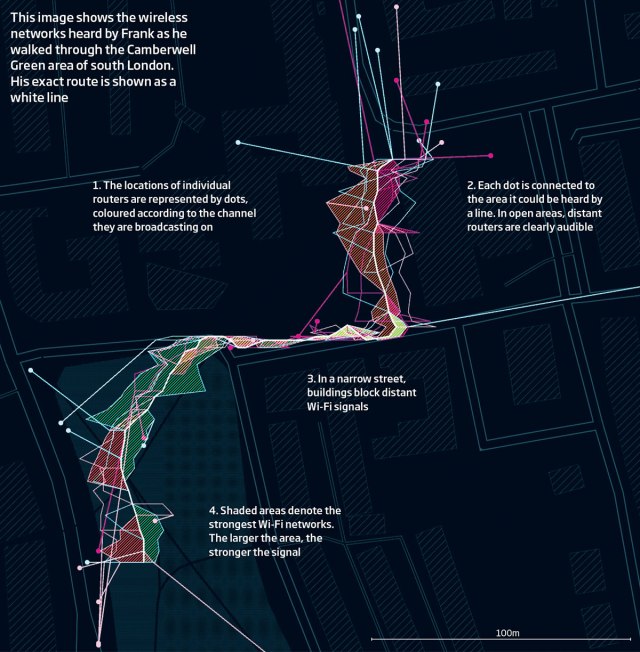
Phantom Terrains opens the door to this world to a small degree by tuning into these fields. Running on a hacked iPhone, the software exploits the inbuilt Wi-Fi sensor to pick up details about nearby fields: router name, signal strength, encryption and distance. This wasn’t easy. Reams of cryptic variables and numerical values had to be decoded by changing the settings of our test router and observing the effects.

“On a busy street, we may see over a hundred independent wireless access points within signal range,” says Jones. The strength of the signal, direction, name and security level on these are translated into an audio stream made up of a foreground and background layer: distant signals click and pop like hits on a Geiger counter, while the strongest bleat their network ID in a looped melody. This audio is streamed constantly to a pair of hearing aids donated by US developer Starkey. The extra sound layer is blended with the normal output of the hearing aids; it simply becomes part of my soundscape. So long as I carry my phone with me, I will always be able to hear Wi-Fi.

Silent soundscape

From the roar of Oxford Circus, I make my way into the close silence of an anechoic booth on Harley Street. I have been spending a lot of time in these since 2012, when I was first diagnosed with hearing loss. I have been going deaf since my 20s, and two years ago I was fitted with hearing aids which instantly brought a world of missing sound back to my ears, although it took a little longer for my brain to make sense of it.

Recreating hearing is an incredibly difficult task. Unlike glasses, which simply bring the world into focus, digital hearing aids strive to recreate the soundscape, amplifying useful sound and suppressing noise. As this changes by the second, sorting one from the other requires a lot of programming.

In essence, I am listening to a computer’s interpretation of the soundscape, heavily tailored to what it thinks I need to hear. I am intrigued to see how far this editorialisation of my hearing can be pushed. If I have to spend my life listening to an interpretative version of the world, what elements could I add? The data that surrounds me seems a good place to start.

Mapping digital fields isn’t a new idea. Timo Arnall’s Light Painting Wi-Fi saw the artist and his collaborators build a rod of LEDs that lit up when exposed to digital signals, and carried it through the city at night. Captured in long exposure photographs, the topographies of wireless networks appear as a ghostly blue ribbon that waxes and wanes to the strength of nearby signals, revealing the digital landscape.

“Just as the architecture of nearby buildings gives insight to their origin and purpose, we can begin to understand the social world by examining the network landscape,” says Jones. For example, by tracing the hardware address transmitted with the Wi-Fi signal, the Phantom Terrains software can trace a router’s origin. We found that residential areas were full of low-security routers whereas commercial districts had highly encrypted routers and a higher bandwidth.

Despite the information gathered, most people would balk at the idea of being forced to listen to the hum and crackle of invisible fields all day. How long I will tolerate the additional noise in my soundscape remains to be seen. But there is more to the project than a critique of digital transparency.

With the advent of the internet of things, our material world is becoming ever more draped in sensors, and it is important to think about how we might make sense of all this information. Hearing is a fantastic platform for interpreting dynamic, continuous, broad spectrum data.

Its use in this way is being aided by a revolution in hearing technology. The latest models, such as the Halo brand used in our project and ReSound’s Linx, boast a specialised low-energy Bluetooth function that can link to compatible gadgets. This has a host of immediate advantages, such as allowing people to fine-tune their hearing aids using a smartphone as an interface. More crucially, the continuous connectivity elevates hearing aids to something similar to Google Glass – an always-on, networked tool that can seamlessly stream data and audio into your world.

Already, we are talking to our computers more, using voice-activated virtual assistants such as Apple’s Siri, Microsoft’s Cortana and OK Google. Always-on headphones that talk back, whispering into our ear like discreet advisers, might well catch on ahead of Google Glass.

“The biggest challenge is human,” says Jones. “How can we create an auditory representation that is sufficiently sophisticated to express the richness and complexity of an ever-changing network infrastructure, yet unobtrusive enough to be overlaid on our normal sensory experience without being a distraction?”

Only time will tell if we have succeeded in this respect. If we have, it will be a further step towards breaking computers out of the glass-fronted box they have been trapped inside for the last 50 years.

Auditory interfaces also prompt a rethink about how we investigate data and communicate those findings, setting aside the precise and discrete nature of visual presentation in favour of complex, overlapping forms. Instead of boiling the stock market down to the movement of one index or another, for example, we could one day listen to the churning mass of numbers in real time, our ears attuned for discordant melodies.

In Harley Street, the audiologist shows me the graphical results of my tests. What should be a wide blue swathe – good hearing across all volume levels and sound frequencies – narrows sharply, permanently, at one end.

There is currently no treatment that can widen this channel, but assistive hearing technology can tweak the volume and pitch of my soundscape to pack more sound into the space available. It’s not much to work with, but I’m hoping I can inject even more into this narrow strait, to hear things in this world that nobody else can.

http://www.newscientist.com/article/mg22429952.300-the-man-who-can-hear-wifi-wherever-he-walks.html?full=true


Belarusian President Alyaksandr Lukashenka proclaims there is no toilet paper in Belarusian sausage

It’s a point of pride for Belarusian President Alyaksandr Lukashenka: No toilet paper in our sausage.

Lukashenka says that’s one thing that makes Belarusian products better than Russian ones.

He told Russian reporters on October 17 that Russia had lowered its food-quality standards after the 1991 collapse of the Soviet Union “while we, thanks to Lukashenka, retained state standards.”

“Belarusian [food] is of substantially higher in quality. There is no toilet paper in the salami and never was,” he said.

He added that “such facts have been discovered at Russian enterprises — toilet paper, soy, all kinds of additives.”

Both toilet paper and sausage were in short supply in the final years of the Soviet Union.

http://www.rferl.org/content/belarus-russia-food/26642326.html

Ebola treatment in Nebraska

Freelance journalist Ashoka Mukpo, who contracted Ebola in Liberia, arrived at the University of Nebraska Medical Center today, becoming the second patient with the deadly disease to be treated there.

Why is he being sent to Nebraska instead of some other facility? Because the hospital is home to the largest of four high-level biocontainment patient care units in the U.S.

The Nebraska Medical Center says the unit was commissioned in 2005 as a joint project with Nebraska Health and Human Services and the University of Nebraska Medical Center.

“It was designed to provide the first line of treatment for people affected by bio terrorism or extremely infectious naturally occurring diseases,” the center’s website says.

“The Ebola virus is very difficult to contract,” says Dr. Phil Smith, medical director of the unit, on its website. “The risk it would pose to people outside the unit would be zero, and this is something that can be very safely treated without infecting health care workers.”

The three other high-level biocontainment facilities in the U.S. are at Rocky Mountain Laboratories (RML) in Hamilton, Mont., the National Institutes of Health in Maryland and Emory University Hospital in Atlanta, where two infected patients were treated this summer.
Dr. Rick Sacra, 51, was treated last month at Nebraska Medical Center. He has since recovered.

In an interview with NPR in August, Bruce Ribner, director of Emory’s Serious Communicable Disease Unit, says caregivers use “personal protective equipment designed to prevent … staff from coming into contact with blood, body fluids and large respiratory droplets.”

Ribner said that the doors at the facility don’t need to be sealed “because all airflow goes into the patient room since the rooms are under negative pressure.”

Gizmodo writes:
“[The] isolation unit in Nebraska is isolated from the rest of the general hospital. It runs on its own air circulation system, and the air is passed through a high-efficiency particulate air (HEPA) filter before it is vented outside of the building. That’s the same kind of precautions that you would see in a biosafety level 4 lab (the highest) that works with deadly or highly contagious diseases.

“In addition, the biocontainment unit has negative air pressure, which means that air pressure inside the isolation rooms is slightly lower than that outside. Essentially, air is gently sucked into the room, so particles from inside the room can’t float out when you open a door. As another line of protection, ultraviolet lights zap any viruses or bacteria in the air or on surfaces.”

Wired says: “[Hospital] staff volunteers at Nebraska Medical Center run twice yearly drills with decontamination at their hospital’s 10-bed biocontainment unit. It’s the country’s largest, opened in 2005 with $1 million in federal and state funding. ‘It’s built like a concrete box,’ says Angela Hewlett, the unit’s associate medical director. ‘We want to keep our germs inside.’ But like Missoula, Nebraska hasn’t seen a single infectious disease patient. Sometimes they use it as overflow for the emergency room.”

http://www.npr.org/blogs/thetwo-way/2014/10/06/354083214/why-ebola-patients-are-getting-treatment-in-nebraska?utm_source=facebook.com&utm_medium=social&utm_campaign=npr&utm_term=nprnews&utm_content=202406

Device on the International Space Station may enable detection of Dark Matter in the Universe

Take a look around you, and in your mind’s eye, randomly wipe out all but a small fraction of what you can see. Pretend the vast rest of reality is there but invisible.

You’d probably like a device that helps you see much more of it.

Scientists working at CERN, the European Organization for Nuclear Research, have made some progress in that direction with the Alpha Magnetic Spectrometer (AMS), which has been riding aboard the International Space Station since 2011.

Physicists believe that mental exercise in blindness reflects the reality of our universe, only about 4% of which manifests as the kind of matter and energy we can perceive.

More than 70% consists of so-called dark energy, physicists say, and more than 20% is dark matter, neither of which humans can directly detect so far.

But scientists feel certain it must exist, partly because of the gravity it exerts on the visible universe.

This week, CERN scientists published an analysis of data from the AMS, which detects subatomic particles constantly bombarding Earth. They include exceedingly rare antimatter particles that can result from the breakdown of dark matter.
They are called positrons, also known as anti-electrons. They have the same mass as electrons, but electrons have a negative charge, and positrons have a positive charge.

Scientists believe dark matter collides, splitting into pairs of electrons and positrons, so the ability to examine positrons in detail could help in proving the existence of dark matter.

Positrons are produced in minute quantities in our corner of the universe, and mostly come flying our way from its far reaches, bundled up with gangs of other subatomic particles, mainly protons and electrons.

The flying particles bear the name “cosmic rays,” a misnomer given to them at a time when they were not as well understood.

The AMS project has analyzed 41 billion cosmic ray particles, and determined 10 million of them to be made of electrons and positrons.
There have been fluctuations in the number of positrons in the mix, and thanks to the orbiting spectrometer, for the first time in a half-century of cosmic ray research scientists have been able to measure an important peak in positrons.

“AMS now unveiled data that no other experiment could ever record,” said CERN spokesman Arnaud Marsollier.

The data hint at the existence of dark matter. But CERN scientists are not completely sure yet that dark matter is the true source of the positrons.

“It may come from high-energy phenomena somewhere in our universe: But what?” Marsollier asks. “Pulsars? Supernovas?”

Pulsars are stars similar to black holes that spray particles and light through the universe. Supernovas are exploded former stars.

Because it detects particles as opposed to light, the way a telescope would, AMS may also be able to see other cosmic phenomena a telescope cannot.

The data released this week need more study, but at first glance, CERN says, what they have seen so far looks “tantalizingly consistent with dark matter particles.”

If that’s the case, the AMS may have begun to remove humanity’s greatest blindfold.

http://www.cnn.com/2014/09/20/tech/innovation/dark-matter-experiment-data/index.html?hpt=hp_t2

When Scientists Give Up

scientist

Ian Glomski thought he was going to make a difference in the fight to protect people from deadly anthrax germs. He had done everything right — attended one top university, landed an assistant professorship at another.

But Glomski ran head-on into an unpleasant reality: These days, the scramble for money to conduct research has become stultifying.

So, he’s giving up on science.

And he’s not alone. Federal funding for biomedical research has declined by more than 20 percent in the past decade. There are far more scientists competing for grants than there is money to support them.

That crunch is forcing some people out of science altogether, either because they can’t get research funding at all or, in Glomski’s case, because the rat race has simply become too unpleasant.

“My lab was well-funded until, basically, the moment I decided I wasn’t going to work there anymore,” he says during an interview on the porch swing of his home in Charlottesville, Va. “And I probably could have scraped through there for the rest of my career, as I had been doing, but I would have had regrets.”

Glomski’s problem was that he could only get funding to do very predictable, unexciting research. When money gets tight, often only the most risk-averse ideas get funded, he and others say.

“You’re focusing basically on one idea you already have and making it as presentable as possible,” he says. “You’re not spending time making new ideas. And it’s making new ideas, for me personally, that I found rewarding. That’s what my passion was about.”

At his lab at the University of Virginia, Glomski had a new idea about how to study an anthrax infection as it spread through an animal — and doing this with scans, rather than having to cut the animal open.

But it was not a surefire idea. Like a lot of science, it might not have worked at all. Glomski never found out. His repeated grant applications to the National Institutes of Health never made the cut. Funding is so competitive that reviewers shy away from ideas that might not pan out.

“You actually have to be much more conservative these days than you used to,” Glomski says, “and being that conservative I think ultimately hurts the scientific enterprise.” Society, he says, is “losing out on the cutting-edge research that really is what pushes science forward.”

Historically, payoffs in science come from out of the blue — oddball ideas or unexpected byways. Glomski says that’s what research was like for him as he was getting his Ph.D. at the University of California, Berkeley. His lab leader there got funding to probe the frontiers. But Glomski sees that farsighted approach disappearing today.

“That ultimately squashed my passion for what I was doing,” he says. So two years ago, at the age of 41, he quit.

Instead of helping society improve its defenses against deadly anthrax, he’s starting a liquor distillery, Vitae Spirits. He’s actually excited about that. It’s a big challenge, and it allows him to pursue an idea with passion, rather than with resignation.

Meanwhile, Randen Patterson is not passionate about his post-science career as a grocery store proprietor. He recently bought the Corner Store in the tiny town of Guinda, Calif.

Patterson, 43, once worked for Dr. Solomon Snyder at Johns Hopkins University in one of the top neuroscience laboratories in the world. His research is published in some of the most prestigious journals.

And Patterson got there against the odds. He was raised in a trailer park in Pennsylvania by a single parent, he says, and stumbled into science quite by accident. Mentors realized his potential and encouraged him to make a career of it.

He landed a tenure-track assistant professorship at Penn State University, and then moved on to a similar job at University of California, Davis (a 45-minute drive from his new “hometown” of Guinda).

But Patterson struggled his entire career to get grants to fund his research, which uses computer simulations to probe the complex chemistry that goes on inside living cells. And he chose an arcane corner of this field to focus his intellectual energy.

“When I was a very young scientist, I told myself I would only work on the hardest questions because those were the ones that were worth working on,” he says. “And it has been to my advantage and my detriment.”

Over the years, he has written a blizzard of grant proposals, but he couldn’t convince his peers that his edgy ideas were worth taking a risk on. So, as the last of his funding dried up, he quit his academic job.

“I shouldn’t be a grocer right now,” he says with a note of anger in his voice. “I should be training students. I should be doing deeper research. And I can’t. I don’t have an outlet for it.”

When the writing was on the wall a few years ago, Patterson says he bought his own souped-up computer so he could continue dabbling in research on the side. But those ideas aren’t adding to the world’s body of knowledge about biology.

“The country has invested, in me alone, $5 million or $6 million, easily,” Patterson says, thinking back on the funding he received for his education and his research. And he’s just one of many feeling the brunt of the funding crunch.

There are no national statistics about how many people are giving up on academic science, but an NPR analysis of NIH data found that 3,400 scientists lost their sustaining grants between 2012 and 2013. Some will eventually get new funding, others will retire; but others, like Glomski and Patterson, will just give up.

“We’re taking all this money as a country we’ve invested … and we’re saying we don’t care about it,” Patterson says.

He watches with some trepidation as his daughter, a fresh college graduate, hopes to launch her own career in science.

The funding squeeze could persist for his daughter’s generation as well. So Patterson is hoping she will settle on a field other than biomedical research — one where money isn’t quite so tight.

http://www.npr.org/blogs/health/2014/09/09/345289127/when-scientists-give-up?&refresh=true

How a solar storm two years ago nearly caused a catastrophe on Earth

By Jason Samenow

On July 23, 2012, the sun unleashed two massive clouds of plasma that barely missed a catastrophic encounter with the Earth’s atmosphere. These plasma clouds, known as coronal mass ejections (CMEs), comprised a solar storm thought to be the most powerful in at least 150 years.

“If it had hit, we would still be picking up the pieces,” physicist Daniel Baker of the University of Colorado tells NASA.

Fortunately, the blast site of the CMEs was not directed at Earth. Had this event occurred a week earlier when the point of eruption was Earth-facing, a potentially disastrous outcome would have unfolded.

“I have come away from our recent studies more convinced than ever that Earth and its inhabitants were incredibly fortunate that the 2012 eruption happened when it did,” Baker tells NASA. “If the eruption had occurred only one week earlier, Earth would have been in the line of fire.”

A CME double whammy of this potency striking Earth would likely cripple satellite communications and could severely damage the power grid. NASA offers this sobering assessment:

Analysts believe that a direct hit … could cause widespread power blackouts, disabling everything that plugs into a wall socket. Most people wouldn’t even be able to flush their toilet because urban water supplies largely rely on electric pumps.

According to a study by the National Academy of Sciences, the total economic impact could exceed $2 trillion or 20 times greater than the costs of a Hurricane Katrina. Multi-ton transformers damaged by such a storm might take years to repair.

CWG’s Steve Tracton put it this way in his frightening overview of the risks of a severe solar storm: “The consequences could be devastating for commerce, transportation, agriculture and food stocks, fuel and water supplies, human health and medical facilities, national security, and daily life in general.”

Solar physicists compare the 2012 storm to the so-called Carrington solar storm of September 1859, named after English astronomer Richard Carrington who documented the event.

“In my view the July 2012 storm was in all respects at least as strong as the 1859 Carrington event,” Baker tells NASA. “The only difference is, it missed.”

During the Carrington event, the northern lights were seen as far south as Cuba and Hawaii according to historical accounts. The solar eruption “caused global telegraph lines to spark, setting fire to some telegraph offices,” NASA notes.

NASA says the July 2012 storm was particularly intense because a CME had traveled along the same path just days before the July 23 double whammy – clearing the way for maximum effect, like a snowplow.

“This double-CME traveled through a region of space that had been cleared out by yet another CME four days earlier,” NASA says. ” As a result, the storm clouds were not decelerated as much as usual by their transit through the interplanetary medium.”

NASA’s online article about the science of this solar storm is well-worth the read. Perhaps the scariest finding reported in the article is this: There is a 12 percent chance of a Carrington-type event on Earth in the next 10 years according to Pete Riley of Predictive Science Inc.

“Initially, I was quite surprised that the odds were so high, but the statistics appear to be correct,” Riley tells NASA. “It is a sobering figure.”

http://www.washingtonpost.com/blogs/capital-weather-gang/wp/2014/07/23/how-a-solar-storm-nearly-destroyed-life-as-we-know-it-two-years-ago/

Sleeping banker accidentally transfers millions

dynamic_resize

A German banker fell asleep and accidentally transferred more than $300 million from his employer.

The man fell asleep on his keyboard and turned a small transfer into an enormous one, AFP reports.

He was supposed to transfer 62.40 euros to a retiree’s bank account. Instead, he “fell asleep for an instant, while pushing onto the number two key on the keyboard” and sent 222,222,222.22 euros, or more than $300 million.

The bank quickly noticed the error and fixed it.

But the man’s co-worker was sacked for letting the error slip through when he verified the order.

A German court ruled Monday the man should get his job back.

http://cnews.canoe.ca/CNEWS/WeirdNews/2013/06/11/20891731.html

Hacking plant ‘blood vessels’ could avert food crisis

ngtpvbfh-1368974463

Today’s wars are not about food, but not too far in the future they could be. The number of people dying of starvation has been falling for decades, but the decline in the numbers of hungry people is slowing down. More than 800 million still remain undernourished. With nine billion mouths to feed by 2050, the task of feeding us all is only going to get harder.

There is a solution, though, according to a recent paper in the journal Nature written by some of the world’s leading plant biologists. They show that, by hacking how plants transport key nutrients into plant cells, we could solve the impending food crisis.

Each plant is made of billions of cells. All these cells are surrounded by membranes. The pores in these membranes are lined with special chemicals called membrane transporters. They do the job of ferrying nutrients that plants capture from soils with the help of roots.

What scientists have learnt is that if such membrane transporters are tweaked, they can enhance plant productivity. When these tweaks are applied to crops, they can produce plants that are high in calories, rich in certain nutrients or fight pests better. All these methods increase food production while using fewer resources.

Currently, world agriculture faces the problem of shrinking arable land, which is the area that is fit for food production. This is why the world’s leading plant biologists argue in the Nature paper that we must embrace genetically modified (GM) plants, many of which have better membrane transporters making them more productive without increasing land use.

Good modification
Over two billion people suffer from iron or zinc deficiency in their diets. Biofortification involves increasing concentration of such essential minerals. Simple genetic modification increases the amount of membrane transporters that ferry these minerals. Such plants when ready for harvest can have as much as four times the concentration of iron, compared to that of common crop variety.

A little known fact is that making fertilisers consumes about 2% of world’s energy. This makes the process a significant contributor to emission of greenhouse gases. Modifying membrane transporters can help cut those emissions, because it can make a plant more effective at using plant fertilisers.

For instance, only 20-30% of phosphorus added to soil as fertilisers is used by crop plants. Tweaking transporters such as PHT1 can increase the uptake of phosphorus. Similar results can be obtained when NRT genes are modified, which increase uptake of nitrogen from fertilisers.

Better resistance
About a third of the Earth’s ice-free land is acidic. The problem is that in highly acidic conditions aluminium in soil exists in a form that is toxic to plants. Such land cannot be used to grow food, but if crops were able to counteract the effects of acidity on growth that land would become available.

Scientists have found some varieties of wheat that have a trick to enable them to grow in acidic conditions. One of its membrane transporter called ALMT1 pumps out malate anion from its roots into the soil which traps the toxic form of aluminium.

Varieties of wheat without this natural transporter can be improved by breeding with varieties that do. But, crops such as barley, which have no comparable system of transporter in its membrane, need to be genetically modified to express the ALMT1 transporter protein. This allows for greatly increased yields even in acidic soils.

When salt is bad
Much of the world’s arable lands are becoming salty as a result of current irrigation practices. This happens when, on evaporation, salts in irrigation water are left behind inthe soil. Salts are toxic to plants and are severely limiting yields in over 30% of irrigated crops.

But there are membrane transporters which can stem the flow of salts into plants. These transporters, from the HKT family, rid the water of sodium before it is taken up by the plants. One example is that of durham wheat, which was modified to possess the HKT5 gene. The modification helped increase its yield in salty soils by 25%.

Fighting from the inside
Disease-causing micro-organisms, pathogens, manipulate a plant’s functioning and consume the fruit of its labour. Most crops have membrane transporters called SWEETs that move sucrose made by leaves from photosynthesis to other regions where it may be stored. Plant pathogens have evolved to manipulate SWEET genes so that sugars are moved to cells where they can feed on the goods.

Now scientists have found a way of disrupting this pathogen-induced manipulation by a method called RNA-silencing. These reduce, or sometimes eliminate, the pathogens’ ability to feed on the plants’ hard work, and in turn they help increase plant productivity.

Not all bad
Researchers have been quietly chugging away in labs working on making such radical improvements to crops. Breeding of plants, a form of untailored genetic modification that bestowed most of the benefits to agriculture a generation ago, is not able to keep up with the pace of change required for an ever-increasing demand for food. That is why it is important that we understand the science behind the process of tinkering with specific genes, before jumping on the “GM is bad” wagon.

Scientists are aware of the moral, ethical and environmental discussions surrounding production of GM food, and have been working carefully to address those issues. It is important that they continue to do so, while exploring the full potential of GM research to tackle the issue of hunger that looms large over the future of our species.

https://theconversation.com/hacking-plant-blood-vessels-could-avert-food-crisis-14182