Princeton University professor posts CV of his failures

BY DIANA BRUK

When we compare ourselves to successful people, it’s easy to assume that they’ve got some sort of success gene that the rest of us don’t have. But the truth is that people who are “successful,” have failed at just as many things as the rest of us–they just know how to get up, brush themselves off, and try again…and again…annnnd again.

To prove this point in a powerful way, Johannes Haushofer, an assistant professor of psychology and public affairs at Princeton University, shared a resume that lists his failures rather than his achievements.

To be clear, Professor Haushofer has a lot of achievements, including getting a B.A. from Oxford and a PhD from Harvard, winning a wide variety of coveted fellowships, getting papers published, and acquiring teaching positions at MIT, Harvard, and Princeton. But he’s also experienced a whole lot of failure and rejection, as this CV shows.

“Most of what I try fails, but these failures are often invisible, while the successes are visible,” he wrote. “I have noticed that this sometimes gives others the impression that most things work out for me. As a result, they are more likely to attribute their own failures to themselves, rather than the fact that the world is stochastic, applications are crapshoots, and selection committees and referees have bad days.”

As Haushofer points out, he’s not the first person to do this, nor is it his original idea. He was inspired by a 2010 article written by Melanie Stefan, a lecturer at the University of Edinburgh. Now that his CV has gone viral, however, it’s inspired other people all over the world to share their own resumes of failure, to remind people that rejection is all just a normal part of the process.

JOHANNES HAUSHOFER
CV OF FAILURES

Most of what I try fails, but these failures are often invisible, while the successes are visible. I have noticed that this sometimes gives others the impression that most things work out for me. As a result, they are more likely to attribute their own failures to themselves, rather than the fact that the world is stochastic, applications are crapshoots, and selection committees and referees have bad days. This CV of Failures is an attempt to balance the record and provide some perspective.

This idea is not mine, but due to a wonderful article in Nature by Melanie I. Stefan, who is a Lecturer in the School of Biomedical Sciences at the University of Edinburgh. You can find her original article here, her website here, her publications here, and follow her on Twitter under @MelanieIStefan.
I am also not the first academic to post their CV of failures. Earlier examples are here, here, here, and here.

This CV is unlikely to be complete – it was written from memory and probably omits a lot of stuff. So
if it’s shorter than yours, it’s likely because you have better memory, or because you’re better at trying things than me.

Degree programs I did not get into
2008 PhD Program in Economics, Stockholm School of Economics
2003 Graduate Course in Medicine, Cambridge University
Graduate Course in Medicine, UCL
PhD Program in Psychology, Harvard University
PhD Program in Neuroscience and Psychology, Stanford University
1999 BA in International Relations, London School of Economics
Academic positions and fellowships I did not get
2014 Harvard Kennedy School Assistant Professorship
UC Berkeley Agricultural and Resource Economics Assistant Professorship
MIT Brain & Cognitive Sciences Assistant Professorship

This list is restricted to institutions where I had campus visits; the list of places where I had
first-round interviews but wasn’t invited for a campus visit, and where I wasn’t invited to
interview in the first place, is much longer and I will write it up when I get a chance. The list
also shrouds the fact that I didn’t apply to most of the top economics departments (Harvard,
MIT, Yale, Stanford, Princeton, Chicago, Berkeley, LSE) because one of my advisors felt they
could not write a strong letter for them.

Awards and scholarships I did not get
2011 Swiss Network for International Studies PhD Award
2010 Society of Fellows, Harvard University
Society in Science Scholarship
University of Zurich Research Scholarship
2009 Human Frontiers Fellowship
2007 Mind-Brain-Behavior Award (Harvard University)
2006 Mind-Brain-Behavior Award (Harvard University)
2003 Fulbright Scholarship
Haniel Scholarship (German National Merit Foundation)

Paper rejections from academic journals
2016 QJE, Experimental Economics
2015 AER x 2
2013 PNAS, Experimental Economics, Science, Neuron
2009 AER
2008 Science, Neuron, Nature Neuroscience, Journal of Neuroscience, Journal of Vision

Research funding I did not get
2016 MQ Mental Health Research Grant
2015 Russell Sage Research Grant (two separate ones)
2013 National Science Foundation Research Grant
2010 University of Zurich Research Grant
Swiss National Science Foundation Research Grant
2009 Financial Innovation Grant
International Labor Organization Research Grant
3ie Research Grant

Meta-Failures
2016 This darn CV of Failures has received way more attention than my entire body of academic
work.

http://www.seventeen.com/life/news/a40055/princeton-professor-resume-of-failures/

Coral reef larger than Delaware discovered in muddy Amazon waters

by Bryan Nelson

Coral reefs are sometimes called the rain forests of the sea due to their immense biodiversity. Like rain forests, they’re typically found in the tropics, and because they usually thrive in clear, turquoise waters, they make for accessible attractions for divers, snorkelers, and researchers alike.

Reefs don’t usually like to form in muddy waters, such as at mouths of rivers — or so we used to think. But a remarkable new discovery in the Amazon could rewrite the book on coral reef biology. There, in the murky waters at the mouth of the Amazon River, scientists have found a massive, thriving coral reef that stretches from the French Guiana border to Brazil’s Maranhão State, an area covering about 3,600 square miles, reports The Smithsonian. That’s larger than the state of Delaware.

How did such a natural spectacle remain hidden from science until now? Well, as noted, scientists don’t usually think to look for coral reefs in muddy waters. Also, the Amazon has the largest discharge of any river in the world, so the waters at its mouth are more than murky — they’re downright thick and soupy.

Still, it’s incredible to discover such a massive new ecosystem like this in modern times. Scientists are giddy at the thought of the number of new creatures — animals that have evolved to thrive uniquely in this unexpected environment — that might soon be discovered here.

“This is something totally new and different from what is present in any other part of the globe,” said oceanographer Fabiano Thompson. “But until now, it’s been almost completely overlooked.”

“You wouldn’t expect to have gigantic reefs there, because the water is full of sediment and there’s nearly no light or oxygen,” added Thompson.

Researchers have already found at least 29 specimens of sponges that likely constitute new species. Strange microbes that seem to base their metabolism not on light but on minerals and chemicals such as ammonia, nitrogen and sulfur are also plentiful in early samples. This unconventional form of life could help explain how the creatures that live among this reef manage to survive.

So far, only a small fraction of the new habitat has been mapped, and it may have been discovered in the nick of time, seeing as oil and gas companies are rapidly expanding into the region for potential drilling. Discovering this unique reef system here will hopefully lead to protections that will help preserve it before it can be irreparably damaged.

http://www.mnn.com/earth-matters/wilderness-resources/stories/coral-reef-larger-delaware-discovered-muddy-amazon-waters

Ping-Pong is good for the brain

by RUSSELL MCLENDON

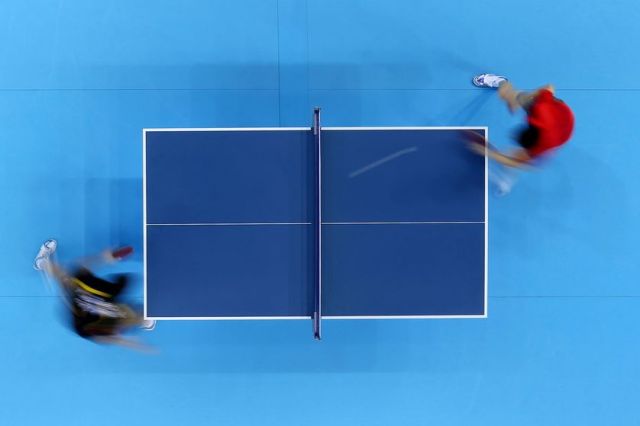
Ping-Pong, or table tennis, is played by some 300 million people worldwide, according to the International Table Tennis Federation (ITTF), making it one of Earth’s most popular sports. It has been an Olympic sport since 1988, and its U.S. cachet has spiked in recent years amid the rise of hip Ping-Pong hangouts like New York’s SPiN and Portland’s Pips & Bounce.

It’s not hard to see why. Ping-Pong is accessible for beginners, has relatively low injury risk, and works as a boozy bar game or intense test of wills. And despite long being relegated to garages and basements, Ping-Pong is also increasingly billed as a “brain sport,” featuring a mix of aerobics, strategy, quickness and coordination.

“There is a lot going on in table tennis,” says Wendy Suzuki, a tenured professor of neuroscience at New York University and author of “Healthy Brain, Happy Life,” a new book exploring how physical exercise can affect the human brain. “Attention is increasing, memory is increasing, you have a better mood. And you’re building motor circuits in your brain. A bigger part of your brain is being activated.”

Of course, Ping-Pong is only one path to the mental perks of exercise, Suzuki adds, and since not enough research has focused on its effects, we can’t be sure how it stacks up with other options. Many people prefer simpler activities like walking and running, for example, or more aerobic, larger-scale sports like lawn tennis.

Still, Ping-Pong has a certain mojo that’s hard to replicate. Its small playing area tends to accelerate the action, encouraging players to think and move at a dizzying pace. It’s a game of strategy, too, like high-speed chess without chairs. And not only can it complement a broader fitness regimen, but it’s also a gateway sport, masquerading as mindless fun until it gets our brains — and bodies — hooked on speed.


The sport of pings

Table tennis, like its outdoor ancestor, was born in England. The sport dates back to the late 19th century, according to the International Olympic Committee (IOC), and was pushing players to use their heads from the very beginning:

“It is thought that upper-class Victorians in England invented table tennis in the 1880s as a genteel, after-dinner alternative to lawn tennis, using whatever they could find as equipment. A line of books would often be the net, the rounded top of a champagne cork would be the ball and occasionally a cigar box lid would be a racket.”

This inspired several commercial spinoffs by the 1890s, although they didn’t sell well because the balls were either rubber (too wild) or cork (too mild), explains the ITTF. When celluloid balls debuted in 1900, table tennis finally got the bounce it needed.

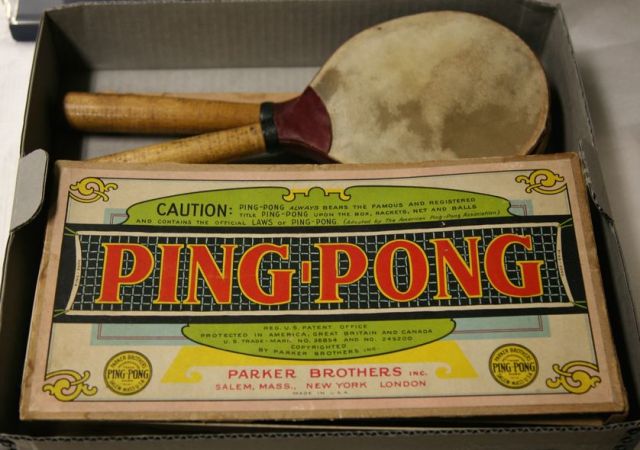
Beyond changing the game itself, celluloid balls also gave it a new name: “Ping-Pong.” That phrase reportedly came from an 1884 song by English songwriter Harry Dacre, repurposed to describe the sound of a celluloid ball bouncing off a paddle.

Early versions of the game also went by a variety of other names, including: Whiff-Waff, Pim-Pam, Flim-Flam, Gossima, Netto and Parlor Tennis.

“Ping-Pong” proved most popular, but since it was trademarked, many similar games were marketed simply as table tennis. That remains the sport’s official name, yet while Ping-Pong is still a U.S. trademark — now owned by Indiana-based Escalade Sports — it also lives on as a widespread nickname for the sport.

The first standard rules, and world championships, came in 1926 with the founding of the ITTF. Japan’s Hiroji Satoh later upended the table-tennis world in 1952, and not just as the first non-European player to win a world title: He became the first person in history to win using a paddle coated in foam rubber. Its spin was a literal game-changer, and table tennis soon embraced foam as its future.

That began a shift in Ping-Pong power from Europe to Asia, as Japan, China and Korea went on to dominate international play for decades. The sport also served as a cultural and political bridge, most famously in the April 1971 Ping-Pong diplomacy, which helped restore relations between the U.S. and China.

Seventeen years later, table tennis debuted at the 1988 Olympics in Seoul, giving the former parlor game a new level of athletic legitimacy. Players have backed it up, too, smashing a 2.7-gram (0.1-ounce) ball at up to 150 kilometers per hour (93 miles per hour), often with seemingly impossible spin. But even at less than Olympic speeds, Ping-Pong can bring a lot more to the table than its casual origins might suggest.

Live pong and prosper

“I play table tennis for the same reason people do crosswords,” says Will Shortz, New York Times crossword puzzle editor and owner of Westchester Table Tennis Center (WTTC) in Pleasantville, New York. “It refreshes me and relaxes me. I get wrapped up in a game, and afterward I feel great and ready to go back to life.”

Shortz is famed for his puzzle-building skills, with a list of accolades too long to list here, but he’s also a table-tennis celebrity. He opened the WTTC in 2011, and even recently helped 18-year-old Chinese player Kai Zhang move to New York, where he’s already ranked No. 1 in the U.S. and hopes to represent his new country in the Olympics. But perhaps Shortz’s main claim to Ping-Pong fame is The Streak:

The Streak was only meant to last a year, but as the video above notes, Shortz kept going past 365 days because “his brain was too happy.” In fact, he still plays daily, and has done so for more than three-and-a-half years. When we spoke recently, he was still going strong at nearly 1,300 consecutive days of Ping-Pong.

“It built up over time. I had other streaks before I started this one,” he says. “I had one streak that went for 80 days before I had a trip to Europe and broke it. The next one went for 280 days before I missed a day.” That was in Croatia, where he’d made plans to play at a local table-tennis club but couldn’t get there in time.

“That was the last day I missed,” he adds. “Oct. 3, 2012, was the last day I didn’t play.”

Shortz says he isn’t aware of, or interested in, any official record for such a streak. He really just plays Ping-Pong every day because it rejuvenates him.

“Any exercise is good if it gets blood going through the entire body,” he says. “I think table tennis is especially good because it’s a brain sport, training your body to perform instantly in different situations.” By forcing us to anticipate our opponents’ moves, then react with both speed and precision, Ping-Pong “is a way of getting the brain and the body prepared for everything else you do in life.”

Staying on the ball

So what actually happens inside your head during Ping-Pong? We don’t have the brain scans to know for sure, but other exercise research does provide some hints. Based on her professional expertise in neuroscience, plus her personal experience with exercise, Suzuki offers a few basic examples of your brain on Ping-Pong:

Mood: “The one thing we know that can happen immediately, that certainly happens to me when I exercise, is the mood boost,” Suzuki says. “This is not specific to table tennis; anything that is aerobic will give you a mood boost, because it increases the neurotransmitters that are decreased in depression.”

Neurotransmitters are vital chemicals that regulate various brain functions, and aerobic exercise affects major ones like dopamine (movement, emotional responses, feelings of pleasure), serotonin (mood, appetite, sleep, memory) and norepinephrine (stress response). On top of boosting moods in the short-term, regular exercise is associated with reduced depression and anxiety over time.

Motor control: There are other long-term perks, too. “We know there are a lot of changes in the motor cortex, the part of the brain’s outer covering that lights up when you do any voluntary movement, and in the cerebellum, which is critical for fine motor control,” Suzuki says. “This is a wonderful example of brain plasticity, the ability of the brain to change based on an experience or environmental factors.”

Memory: Aerobic activity can also raise levels of brain-derived neurotrophic factor (BDNF), a protein that promotes neuron growth and survival, thus helping fend off diseases like Alzheimer’s and Parkinson’s. In fact, exercise is a great way to get new brain cells, says Suzuki, who specializes in brain regions linked to memory.

“The hippocampus is special not only because it’s important for memory, but also because it’s one of the only brain structures that keeps making brand-new brain cells into adulthood,” she says. “In most of the brain, whatever cells you’re born with are all you get. But in the hippocampus, there’s a steady birth of new brain cells throughout our adult life. And the cool thing is we know that physical aerobic exercise will stimulate the growth of more brain cells and will help them survive longer. In studies of animals, that’s correlated with increases in various kinds of memory.”

Attention: “And the final one, the one we know the most about in humans, is that increased aerobic exercise will improve your ability to shift and focus attention,” she says. “Certainly that’s what you’re getting in table tennis. You’re getting improved attention, and you’re practicing your attention capacities — keeping your eye on the ball, anticipating what will happen next.”

All pings to all people

Playing Ping-Pong can do wonders for our brains, but Suzuki adds an important footnote: “One caveat is that if you play really slowly, those benefits may drop off. So these comments are more about the aerobic play of Ping-Pong.”

The idea of Ping-Pong as aerobic exercise might have seemed silly in the early 20th century, and some people still see it more as a casual game than a serious sport. But therein lies its beauty: Thanks to a simple premise and variable pace, Ping-Pong can be both. It’s accessible to beginners who need to play slowly, but regular practice also trains veteran players to move (and think) at incredible speeds.

One of those veterans is Sean O’Neill, a former Olympic player and coach who was inducted into the USA Table Tennis (USATT) Hall of Fame in 2008. Video of Olympic table tennis on TV and YouTube “has shown the dynamic ability of the players on a more regular basis,” he says, and inspired a surge of popularity. “More and more recreational players are buying professional quality equipment to copy the pros.”

As an Olympian, O’Neill says he loves to see the sport’s increasingly global appeal. “No matter where you go, table tennis is viewed as a great sport which anyone can play. I think most people are attracted due to the non-discriminatory nature of the sport,” he says, noting that it can be fun for people of all ages, sizes, physical conditions or skill levels. And that makes it especially valuable as an entry point for people who might not otherwise see themselves as athletes.

“We see a trend of both creative people and those from science really fall in love with the sport,” O’Neill says. “There is something about fast-action problem solving with spin, speed and placement that seems to excite these crowds. It is non-impact and a great cardio workout with low joint and bone stress. Many players have a tough time stopping once they pick up the paddle.”

Head of the table

Shortz clearly fits that profile. “I’m an obsessive person,” he admits, but “in a good way, I think.” And while his level of commitment may be uncommon, he agrees with O’Neill that this everyman’s sport has unusual appeal for eggheads, too.

“My experience is that table tennis attracts smart people,” Shortz says. “You don’t have to be a genius to play, but it helps to have something on the ball.”

Ping-Pong’s popularity has waxed and waned over time, he adds, and it still has a long way to go before most Americans see it as a serious sport. “But I think things are on the upswing,” he says. “It has become semi-cool. Social Ping-Pong clubs are open all around now, and I think being in the Olympics has conferred legitimacy.”

Its reputation as a brain sport may be helping, too, although Suzuki notes we can’t easily quantify a sport’s braininess. Almost any aerobic activity could be considered a brain sport, and there isn’t enough research to indicate more cognitive benefits from table tennis than from basketball or badminton. Instead of waiting for that research to come out, however, she has a better idea: Do the research yourself.

“I like to encourage people to do their own experiments on themselves,” she says. “See if you notice the mood shift from exercise. People get sucked back into, ‘Oh, I’m so busy, I’m so stressed, I don’t have time for that,’ without noticing how much even a single bout of exercise can improve your mood and give you more energy.

“Just do it once,” she adds, “and see if it motivates you to continue.”

If it’s still a habit 1,300 days later, your brain must be pretty happy.

http://www.mnn.com/health/fitness-well-being/blogs/ping-pong-good-for-brain

This Robot Led People to Their Doom — And Sheeple Still Followed It

Researchers from Georgia Institute of Technology, backed by money from the Air Force, ran a test to see if people trying to escape from a high-rise building would trust a robot to lead them. Overwhelmingly, the sheeple followed the little droid to their simulated deaths.

The robot tried really hard to make itself look untrustworthy. It pretended to malfunction. It led people into rooms with no exits and then walked them around in circles. It pointed participants toward a dark room blocked by furniture. Still, participants deferred to the supposed authority of the little metal homunculus.

Researchers even manufactured a moment with the participants before the experiment began: The robot was meant to lead them to a conference room but behaved erratically along the way. These people were fooled into believing the robot was broken, and still, despite this, they stuck by the robot throughout the simulated fire until the researchers had to go in, retrieve them and tell them the test was over.

“We expected that if the robot had proven itself untrustworthy in guiding them to the conference room, that people wouldn’t follow it during the simulated emergency,” research engineer Paul Robinette said in a press release on the Georgia Tech website. “Instead, all of the volunteers followed the robot’s instructions, no matter how well it had performed previously. We absolutely didn’t expect this.”

http://mic.com/articles/136649/this-robot-led-people-to-their-doom-and-sheeple-still-followed-it#.kBwYK8Sa3

Plugging in this date will permanently crash your iPhone

iphone

by David Goldman

Your iPhone really hates the date January 1, 1970. It hates it so much that it will permanently crash if you change your iPhone’s time settings to that date.

It’s not totally clear why the crash is happening. It’s not at all obvious why anyone even bothered trying to set an iPhone’s clock back 46 years.

But we can make a pretty educated guess.

January 1, 1970 is the earliest date you can set your iPhone to. If you turn your date and time settings to manual (please don’t do this), and scroll the calendar back as far as you can go (seriously, don’t do this), you can only go as far back as January 1, 1970.

That’s because Unix time began at midnight GMT on January 1, 1970. Unix time has been counting every second since then. Many gadgets, including the iPhone, use Unix time as the basis for their clocks.

Now, why would scrolling all the way back to January 1, 1970 (00:00:00 in Unix time) turn your iPhone into a brick? If your time zone isn’t GMT, your iPhone might think you’re in a time before January 1, 1970 — or before zero. Though Unix time can be negative, it’s possible that something about that makes your iPhone go haywire.

http://money.cnn.com/2016/02/12/technology/iphone-date-bug/index.html

Donald Trump’s Art of the Fail

By MICHAEL KRUSE

In a boardroom on the 26th floor of Trump Tower, in a meeting in the late 1980s in the offices of the Trump Organization, one of Donald Trump’s deputies had had it. Blanche Sprague earlier in the day had learned of the death of a friend in a car wreck, and Trump was berating one of the people seated at the conference table, and so Sprague angrily stood up. “It just became too much,” she said the other day on the phone from New York, “and I said, ‘I can’t take it anymore,’ and I just walked out.”

She regretted it immediately, thinking surely Trump would fire her. Then her phone rang. It was him. She told him she wanted to write letters of apology to the 20 or so people at the meeting.

Don’t, Trump said.

“He said, ‘No, that would hurt you, possibly change you—I don’t want you to do it,’” Sprague said. “He didn’t want to put me in a position of having to be weakened by my mistake.”

Over these last 40 lime-lighted years, Trump has won a lot, but he has lost a lot, too—four corporate bankruptcies, two failed marriages and a vast array of money-squandering business ventures. He lost his signature Trump Shuttle airline to his lenders. His self-branded casinos in Atlantic City struggled consistently to turn profits. In each case, though, he has heeded a form of the advice he gave that day to Sprague: Never acknowledge failure. Never admit defeat.

“He’s probably the greatest self-promoter and self-spinmeister that’s ever lived,” said Harry Hurt III, the author of Lost Tycoon: The Many Lives of Donald J. Trump. “By claiming victory over and over again, it starts to become a self-fulfilling prophecy.”

“He’s been able to create his own reality,” said Wayne Barrett, the author of Trump: The Deals and the Downfall.

“It’s admirable in a way, how he defines himself as succeeding where others see failure,” said Michael D’Antonio, the author of Never Enough: Donald Trump and the Pursuit of Success. “It’s a remarkable performance, and one he’s been giving all his life.”

“Man is the most vicious of all animals,” Trump told People in 1981, “and life is a series of battles ending in victory or defeat.”

Two years after he said that, he bought the New Jersey Generals of the second-rate United States Football League. It got him in Sports Illustrated and on the back page of the New York City tabloids, adding considerably to his fledgling celebrity. Eager to challenge the National Football League, he wanted the USFL to shift its schedule from the spring to the fall. Most of his fellow owners didn’t want that. TV networks weren’t interested in putting the USFL up against the better quality NFL. Trump sued the NFL and its commissioner, saying the NFL was a monopoly, seeking more than $1 billion in damages. Jurors ruled that the NFL essentially was a monopoly but that the USFL was the cause of its own problems. The NFL was ordered to write a check to the USFL … for $3.76. USFL owners had lost more than $150 million. Trump had lost $22 million. The USFL folded in 1986. Many people blamed Trump.

Trump?

“The sports business is a lousy business,” he told Playboy.

Years later, in an interview with the Buffalo News, he drastically underplayed his role in the decisions that led to the USFL’s demise. “That wasn’t a Trump thing,” he said.

In the late ‘80s, he went on a shopping jag, overpaying for properties with hundreds of millions of dollars borrowed from banks.

He bought for $29-million a 282-foot yacht, which could sleep 52 staff and came with gold doorknobs and a sundeck protected by bulletproof glass. He used it primarily as a trophy. “I’m not even interested in boats,” he told the Chicago Tribune.

He took out a $425 million loan, personally guaranteeing $125 million of it, to buy the Plaza hotel in Manhattan for $407.5 million—the most money ever paid for a hotel—without even doing a careful inspection, according to Gwenda Blair in her book The Trumps. He bought the space for a full-page open letter in the New York Times. “For the first time in my life, I have knowingly made a deal that was not economic—for I can never justify the price I paid, no matter how successful the Plaza becomes.” He said he had purchased “a masterpiece—the Mona Lisa.”

He took out a $400 million loan, personally guaranteeing $100 million of that, to buy the Eastern Air Shuttle for $365 million—even though the company itself had just valued the shuttle at $300 million. Talking to reporters, he compared this, too, to the Mona Lisa. He wanted to decorate the insides of the planes with marble before being told that would make them too heavy to fly.

In 1990, he opened his third casino in Atlantic City, New Jersey—the Trump Taj Mahal joined the Trump Plaza and the Trump Castle—and the launch was chaotic, with underprepared, overburdened staff and malfunctioning slot machines. Trump went on CNN and told Larry King his casino was doing so poorly because his casino was doing so well. The machines, he suggested, simply couldn’t keep up with the demand.

“It would be, like, too much use?” King asked.

“They were virtually on fire,” Trump answered.

But soon it was clear: Trump was more than $3 billion in debt, $900 million of which he had personally guaranteed, and his casinos were struggling, in a city that was struggling, in an economy that was struggling. Trump blamed it on the recession. He blamed it on the invasion of Kuwait by Saddam Hussein, “that madman.” He blamed his employees. In the New York Times, he denigrated the president of one of his casinos, calling him “a Type C personality,” and he said he also was “upset with the people running the Trump Shuttle.” He said the press was “dishonest.” He said people were “jealous.”

Trump’s marriage was crumbling, too, due in part to his infidelity—this was the first of his divorces—but he saw it at least as a publicity victory because the high-profile unraveling made him and his name fixtures on the fronts of well-read tabloids.

“This is great for business,” Trump told John O’Donnell, a president of one of his casinos—not the one with the “Type C personality”—according to a book he wrote later called Trumped! “The way this works is, this’ll bring all the men in,” O’Donnell said Trump told him. “They’re going to want to be with Trump.”

O’Donnell wrote the book after he quit working for Trump. In it, he portrayed Trump as an intemperate, incompetent, self-centered racist. O’Donnell, Trump said, was “a fucking loser.”

In late 1990, in Palm Beach, Florida, banks forced him to hold an auction to get rid of empty, unsold condos in a building of his. Embarrassing? “You know what I think?” he said. “I think there’s something very sophisticated and intelligent about auctions.”

He slipped off the Forbes list of the 400 richest people in the country. After years of angling for higher positions in the rankings—he “constantly calls,” an editor of the magazine told Tim O’Brien for his book, TrumpNation—Trump trashed the publication, calling it “sloppy” and “arbitrary.”

Ultimately, though, the banks gave Trump a break, because they were as tethered to him as he was to them. Trump lost control of the Plaza and the Shuttle—he sold the yacht to a Saudi royal—but the banks loaned him $65 million. They deferred all his payments for three to five years. They put him on an allowance—of $450,000 a month. “It’s a good deal,” Trump told Fortune. In a book he co-wrote that came out that year, titled Surviving at the Top, he said it was “a great victory.”

He also in the book recounted a recent trip to West Point, where he had been “strolling the grounds while talking with some military men,” at which point he came upon a statue of General Douglas MacArthur. He read the inscription of something MacArthur had said: “Your mission remains fixed, determined, inviolable. It is to win wars.”

This made Trump think of himself.

“Just win wars,” he wrote in the book. “The general was talking to soldiers, of course, but I felt that what he said applied to me as well. My main purpose in life is to keep winning.”

The Trump Taj Mahal went bankrupt in 1991.

The Trump Castle and the Trump Plaza went bankrupt in 1992.

Thanks, though, to the gilded, too-big-to-fail reprieve Trump had gotten from the banks, and then loans from his siblings from their inheritances from their father, who had made hundreds of millions of dollars building apartments and homes for middle-class families in Brooklyn and Queens, Trump managed to avoid personal bankruptcy.

He then took his casinos public in the mid-1990s, transferring their debt, hundreds of millions of dollars, to shareholders. He declared it to be “a very good deal.”

In 2000, a Gallup poll ranked Trump as the nation’s most famous businessman, pegging his name recognition just a tick shy of total—98 percent. He toyed with the idea of running for president. He wrote another book. It was called The America We Deserve.

Trump Hotels and Casino Resorts kept not making a profit—it hadn’t in 1995, or 1996, or 1997, or 1998, or 1999, and it didn’t in 2000, and 2001, and 2002, and 2003—and in 2004, corporate bankruptcy loomed again.

In March, he told the New York Times he had a limited role, and that he was but “a major shareholder.”
“This has nothing to do with me,” he said.

In July, after another alarming quarterly report, Trump tried to drown out that news by announcing his intention to erect “the tallest building in Las Vegas.” (Trump Hotel Las Vegas, not the tallest building in Las Vegas, actually was built—four years later.) In August, when the company decided to file for bankruptcy, Trump issued a press release touting a new line of Trump-branded suits.
The banks negotiated with Trump and his representatives to restructure debt and reorganize the company, and here there were echoes of the early 1990s: Trump emerged relatively unscathed, retaining the title of chairman, plus an annual salary of $2 million, with a three-year contract assuring that “Mr. Trump shall not be required to devote any fixed amount of time to the performance of his duties,” according to the Atlantic City Press.

“I don’t think it’s a failure,” Trump told an Associated Press reporter. “It’s a success.”
“Somehow the B-word never caught on very well in this country,” he said to O’Brien, referring to bankruptcy. “But the smartest people in the country call me and say, ‘How the fuck did you pull that off?’”

Out came another book. This one? How to Get Rich.

“If I ever had a weak company that I wanted to make look strong, I’d hire Donald,” Alan Marcus, a business consultant who ran Trump’s public relations from 1994 to 2000, told O’Brien for TrumpNation. “Everything that fails he spins into victory.”

Trump sued O’Brien, calling him “a terrible writer,” for $5 billion—for damaging his brand because O’Brien’s reporting showed Trump to be a millionaire, not a billionaire. In a deposition, Trump admitted that he exaggerated. “I think everybody does,” he said. The judge dismissed the suit.
In 2009, Trump Entertainment Resorts—formerly Trump Hotels and Casino Resorts—filed for bankruptcy, again.

And in 2011, engaged in what had become one of his cyclical, headline-generating flirtations with the presidency, Trump publicly pestered President Barack Obama so much about whether or not he was born in the United States that the White House released his long-form birth certificate. It showed, of course, that Obama had been born in Hawaii, not Kenya. Egg on his face? Trump crowed that he had been the first person to get Obama to give up the document.

“I am very proud of myself,” he told reporters.

By this time, he was seven years into his run as the star of The Apprentice, the reality TV ratings hit, a show that let him play a better, more edited, less complicated version of himself, and without which he could not have mounted a presidential bid that can only be described at this juncture as a startling success.

Even though his record is riddled with defeat.

Last August, in the first Republican debate, way back when everybody thought they knew how this would go, Chris Wallace of Fox News asked Trump a question.

“Mr. Trump,” Wallace said. “You talk a lot about how you are the person on this stage to grow the economy. I want to ask you about your business records. … Trump corporations, casinos and hotels, have declared bankruptcy four times over the last quarter-century. … Question, sir: With that record, why should we trust you to run the nation’s business?”

Trump was ready. He had been asked this before. In 2011, for instance, it came up on ABC’s This Week.

“I never went bankrupt,” he had said then. He never went bankrupt—his companies, though, filed for Chapter 11, the chapter of the bankruptcy code that lets debtors reorganize and restructure in an effort to save a company instead of shutter it. That’s what Trump has done four times. He has used Twitter, too, to stress the distinction. “I never went bankrupt,” he has tweeted over and over.

“Dopey,” he once tweeted at a person with 42 followers, “I never filed for bankruptcy.” So on Fox News, from the debate stage in Cleveland, he unleashed.

“Because,” Trump told Wallace, “I have used the laws of this country, just like the greatest people that you read about every day in business have used the laws of this country, the chapter laws, to do a great job for my company, for myself, for my employees, for my family, et cetera.

“I have never gone bankrupt, by the way,” he said. “I have never.”

Wallace pressed.

Trump talked over him, using his characteristic verbal stop sign. “Excuse me, excuse me …”
“That’s your line,” Wallace said, “but your companies have gone bankrupt.”

“Excuse me …”

Wallace kept trying. “Sir,” he said, “let’s just talk about the latest example, which is Trump Entertainment Resorts, which went bankrupt in 2009. In that case alone, lenders to your company lost over $1 billion, and 1,100 people were laid off.”

“Well, I—,” Trump said.

“Is that the way you’d run our country?” Wallace asked.

“Let me just tell you about the lenders,” Trump said. “First of all, these lenders aren’t babies. These are total killers. These are not the nice, sweet little people that you think, okay? You know, I mean, you’re living in a world of the make believe, Chris, you want to know the truth. And I had the good sense to leave Atlantic City—which, by the way, Caesars just went bankrupt.” He motioned toward Chris Christie, his fellow candidate for president, the governor of New Jersey. “Every company—Chris can tell you—every company virtually in Atlantic City went bankrupt. Every company. And let me just tell you. I had the good sense, and I’ve gotten a lot of credit in the financial pages—several years ago I left Atlantic City before it totally cratered, and I made a lot of money in Atlantic City. And I’m very proud of it. I want to tell you that. Very, very proud of it.”

The crowd in Cleveland laughed and clapped and cheered.

Read more: http://www.politico.com/magazine/story/2016/01/donald-trumps-art-of-the-fail-213578#ixzz3z2HwO1Iq

Black German woman discovers her grandfather was Nazi Amon Goeth, featured in Schindler’s List

By Moni Basu

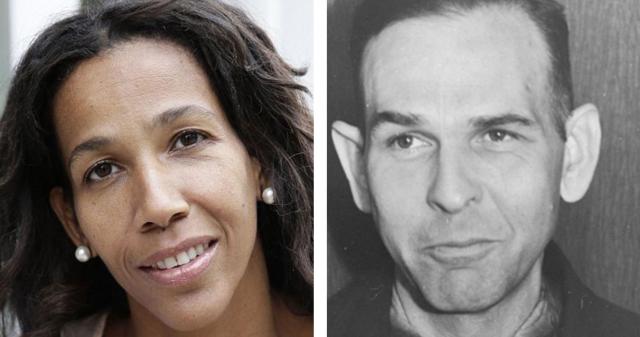
Jennifer Teege thought she knew the hard truths of her life: that her German mother left her in the care of nuns when she was 4 weeks old, and that her biological father was Nigerian, making her the only black child in her Munich neighborhood.

But the hardest truth came to her years later on a warm August day in Hamburg when she walked into the central library and picked up a red book with a black-and-white picture of a woman on the cover. It was titled “I Have to Love My Father, Don’t I?”

As Teege, then 38, flipped through the pages, she felt she’d been caught in a furious storm that had suddenly come from nowhere.

She had unearthed the ghastly family secret.

She looked at the names of people and places in the book and realized that the woman on the cover was her biological mother.

And the father in the title was none other than Amon Goeth, the sadistic Nazi who was commandant of the Plaszow concentration camp in Poland. Many came to know about Amon Goeth through Ralph Fiennes’ portrayal of him in the 1993 movie “Schindler’s List.”

Teege doesn’t know why she was drawn to the book. But on that day, Teege learned that she — a black German woman who’d gone to college in Israel and befriended the descendants of Holocaust survivors, who now had a successful career and a loving family — was the granddaughter of a monster.

It was a moment that cut her life in two. There was the “before,” when she knew nothing of her family’s sinister past, and “after,” when she was forced to live with that truth.

In the library, Teege grew cold knowing she was connected by blood to a man responsible for the deaths of 8,000 Jews. She checked out her mother’s book, lay down on a bench outside and called her husband to come fetch her.

Teege had battled depression all her life and had wondered what was behind her sadness. In fact, she’d gone to the library that day for psychological research.

“I always had this inner feeling that something was wrong,” she says, likening it to being inside a house with many locked doors. “I didn’t know what was behind them.”

She looked in the mirror at herself, saw Amon Goeth’s chin, the same lines between the nose and mouth, and thought: “Do I carry something of him in me?”

After the initial jolt eased, she embarked on a quest to know everything. Eventually, she wrote a book of her own: “My Grandfather Would Have Shot Me: A Black Woman Discovers her Family’s Nazi Past.”

She feels fairly certain that her grandfather would not have hesitated to kill her. She is, after all, far from the Aryan ideal espoused by Amon Goeth, who, according to Teege’s book, went to the gallows saying, “Heil Hitler.”

“It’s a story you can’t take to your grave. It’s exceptional,” Teege says on a recent January day at Atlanta’s Emory University, where she spoke about her identity and her journey to reconcile with it.

She has left her job in advertising and made her personal history her life’s work now. She speaks about how she progressed from her initial fear and guilt to acceptance of her history and knowledge that she is a very different person than her grandfather.

“Today, I am not afraid of him,” she says. “We are two very different people.”

And she talks about how, for a long time before her discovery, she didn’t believe in fate, only in chance. But now she thinks differently. She thinks about the choices she made that took her to Israel and led her to her mother’s book. She believes she made them for a reason.

Some things in life, she says, are predetermined.

Teege’s case was exceptional, thought Peter Bruendl, a Munich psychoanalyst who has treated her and other grandchildren of Nazis.

Teege first had to deal with being a mixed-race child given up for adoption and the feelings that can bring, of being unwanted and worthless, Bruendl says in Teege’s book. And then, when she thought she was settled in life, she suffered again with the discovery of her family history.

“Frau Teege’s experience is heartbreaking,” he says. “Even her conception was a provocation.”

Teege’s mother became pregnant after a brief affair with a Nigerian student. She was working six days a week and battling depression and took the baby to Salberg House, a Catholic home for infants in suburban Munich.

For the first few years of Teege’s life, her mother occasionally came to see her at Salberg House and sometimes took the child to visit her grandmother. A foster family took Teege in when she was 3 and adopted her four years later, insisting that her mother refrain from further contact.

Teege wouldn’t see her mother again until she was 21, after a younger half sister called and re-established contact. Born Monika Goeth, Teege’s mother had since taken her husband’s last name and is now known as Monika Hertwig.

Hertwig had never told her young daughter about their Nazi blood. Nor did she mention it at that meeting.

“She decided not to say anything,” Teege says. “She thought that if I didn’t know, it would be easier for me. I believe her.”

Teege found the book at the library 17 years later.

‘One minute like an entire day’: Remembering Auschwitz 02:56
Just hours after she took the book home on that day in 2008, German television aired a PBS documentary called “Inheritance” in which the filmmaker had taken Teege’s mother and Helen Jonas-Rosenzweig, a Jewish maid subjected to Amon Goeth’s cruelty, back to Plaszow.

Teege, however, did not see the film until later; even then, she could not finish it in one sitting. Beyond the shocking history, it was too much to bear to see intimate details about the mother who’d been absent in her life.

In retrospect, Teege thinks her mother should not have agreed to be filmed in such a vulnerable state. She looked so lost and lonely.

“My mother was fragile then. She wasn’t ready to be on screen,” Teege says.

The film documents awkward moments in which Hertwig is still repeating phrases she heard growing up, that Amon Goeth only shot Jews because they spread infectious diseases.

“Monika, please, stop. Stop right now,” Jonas-Rosenzweig tells her as the two are standing in Goeth’s villa at Plaszow.

At the time, Hertwig was still piecing together the story of her father’s horrors.

No one in post-war Germany spoke of what they knew of the Holocaust. Nobody wanted to talk about what happened to the Jews, Hertwig once said. “They were extinct like the dinosaurs.”

Hertwig’s mother — Ruth Irene Kalder, Goeth’s mistress at his villa in Plaszow — beat her when she asked too many questions. The older woman had always spoken of Goeth as a “war hero,” and Hertwig grew up surrounded by lies, thinking of her father as another victim of the Third Reich.

Hertwig finally learned from her grandmother that Goeth was far from a hero, that he tortured and killed people.

Ruth, who later in life took Goeth’s surname, never showed any remorse except once, according to Hertwig. Shortly before Ruth committed suicide in 1983, she said she should have done more to help people.

After finding Hertwig’s book, Teege knew she had to seek her mother out — not so much for a reckoning, she says, but because she had too many questions swirling in her head. She wanted details that only her birth mother could know.

By then, many months had passed and Teege had already gone to Poland, already seen the places where her mother had also returned to learn the truth. She found Hertwig’s address and went to see her, not knowing whether there would be acceptance or rejection. She had learned so much about her mother through her book, the documentary and online research. Yet she didn’t know her.

They visited Ruth’s grave together, and Hertwig talked about Amon Goeth as though he were at Plaszow only yesterday. Hertwig has said in interviews that speaking ill of her father feels like a betrayal of her mother.

She was living with the dead, Hertwig told her daughter.

Teege says she saw in her mother what she has seen in relatives of other Nazi perpetrators, especially their children. Many cannot bear to live with the sins of their fathers. Others have sterilized themselves, as though a Nazi gene could be passed on through birth.

Teege is thankful she is different than her mother, who Teege says still lives every day with the notion that she has to atone for Goeth’s deeds. Teege has seen this kind of suffering in the children of Holocaust victims as well.

“The second generation had a lot of trouble dealing with the Holocaust,” Teege says. “My generation, we are different. We know the difference between responsibility and guilt.”

Teege doesn’t believe in inherited guilt. Everyone, she says, has the right to his or her own life story.

Teege’s life story is punctuated with ironies and coincidences so great that they prompted her to rethink the concept of fate.

As a young woman, long before her discovery, she attended the Sorbonne in Paris for a year and, in a life drawing class, she met Noa, an Israeli woman. Teege later vacationed in Israel, and on one trip, after sleeping through her 4:30 a.m. alarm and missing her flight back to Germany, she ended up staying. She attended Tel Aviv University, earned a degree in Middle Eastern and African studies and learned to speak Hebrew.

“That I chose Israel … that I missed the flight and stayed — this makes my story more striking,” Teege says. “Destiny.”

Today, I am not afraid of him. We are two very different people.

She was in Israel when “Schindler’s List” opened, and everyone was talking about Steven Spielberg’s Holocaust movie. Teege watched it later on TV in her Tel Aviv flat. It was just a movie to her then, one that she thought had too much of a Hollywood ending.

The subtitle of her mother’s book was, “The Life Story of Monika Goeth, Daughter of the Concentration Camp Commandant in ‘Schindler’s List.’ ” That day in the Hamburg library, Teege’s mind churned to recall the movie. Suddenly, it became deeply personal.

Teege says she does not want to keep secrets from her friends and family. Two years went by before she could reveal her Nazi roots to her friends in Israel, descendants of Holocaust victims and survivors. She didn’t know if any of them were directly connected to Plaszow, and she was afraid how they might react.

But in her book, Teege describes her Jewish friends as being empathetic. “They cried with me.”

She also has spoken with her young sons.

“It was important to me not to keep it a secret,” she says. She doesn’t want them to go through the shock of discovery, which became almost as traumatic for Teege as the truth itself.

“But I have not let them watch ‘Schindler’s List,’ ” she says. “They should be older.”

People assume she has watched the movie many times. They are wrong. She doesn’t feel the need to watch it over and over. She knows her grandfather’s story.

A woman with two lives
It has been more than seven years since Teege learned she was the granddaughter of Amon Goeth. She thinks of her stranger-than-fiction life as a puzzle with many pieces but missing a frame. Her discovery at the Hamburg library helped her put it all together.

“My life is much better than what it used to be,” she says.

She is thankful she had an identity in her “before” years. That’s what she held onto in the “after” years.

Teege’s mother has not called her daughter again since their last meeting. In Teege’s book, Hertwig says she didn’t understand her daughter’s need for reconciliation and felt it was too late to start a relationship.

But Teege’s quest to know her true identity opened other doors. Growing up, she’d never felt a need to find her biological father. But once she had come to terms with her mother’s family, she sought out her father, too. They finally met, and the two remain in contact.

“It’s a nice addition — to know my black heritage,” she says. “And crucial. It’s part of my identity.”

At 45, Teege says she is now a woman with two lives. She is a mother and a teacher. That’s the part she calls normal. The other life is led as the granddaughter of Amon Goeth. She knows she has to keep the two separate.

Most of all, she has learned not to live constantly in the past.

http://www.cnn.com/2016/01/29/world/my-grandfather-would-have-shot-me/index.html

The tiny hole in every airplane window

by Robbie Gonzalez

Here’s a question you’ve probably asked at some point in your life. Most likely you’ve asked it in passing, while parked in seat 22A on a flight to… wherever: What’s with that little hole in the airplane window?

The purpose of this tiny hole is the topic of countless online message boards. Most of these forums read like this 2006 discussion on airliners.net, where user Gh123 inquires about the hole and its function. “Is it for pressurization purposes?” they ask. Another user named Pygmalion responds: “The hole is there to equalize pressure between the inside of the cabin and the actual window which is the outer pane. The inner pane is just to keep you crazy pax from scratching the outer one which could make it crack.” Other users elaborate on Pygmalion’s explanation. They, too, reference pressure, outer panes, and pax (an abbreviation for “passengers”), along with other terms like “primary panes,” “failsafe,” and “crazing.” Many of the answers are correct, or partially correct, but for anyone unfamiliar with aircraft design or terminology, the explanations can be a little opaque.

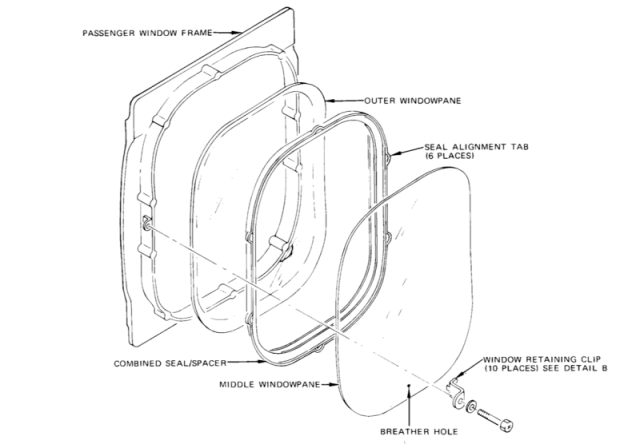
To clear things up, I spoke with Marlowe Moncur, Director of Technology for GKN Aerospace, the world leader in passenger cabin window design development and manufacturing. I also tracked down a copy of a maintenance manual for the Boeing 737 (the most widely produced jet airliner in aviation history), which includes some illustrations that are helpful in understanding the purpose of the “breather hole”—for this is the little window-hole’s official name—in the context of the cabin window as a whole.

The passenger cabin windows on most commercial aircraft consist of outer, middle, and inner panes. As you might expect, these designations reference where the panes are positioned relative to the external and internal portions of the aircraft. All three of these panes are made of acrylic, a synthetic resin prized for its transparency and resiliency, but only two of them—the outer and middle panes—are said to be structural. These structural panes are installed in a rubber perimeter seal and housed in the plane’s fuselage. The internal pane, which Moncur calls a “scratch pane,” lives on the passenger-side of the window assembly, and is mounted in the sidewall lining of the cabin.

The combined seal/spacer, which is labeled as such in the above diagram, puts a little distance between the outer pane and the middle pane. It is a key component in what Marlowe calls the “two-pane air-gap design,” in which “the outer pane is the primary structural window, and carries the cabin pressure during flight.”

Primary structural window—what does that mean? At cruising altitudes of around 35,000 feet, atmospheric pressure (i.e. the pressure outside the aircraft) is about 3.4 pounds per square inch. That’s way too low for bodily functions important at such altitudes, e.g. consciousness; so, inside the cabin, pressure is artificially maintained at roughly 11 pounds per square inch—about what you’d experience at an elevation of 7,000 feet. The bigger the pressure differential between air outside the plane and air inside the plane, the bigger the strain placed on the plane’s various cabin structures, including its windows.

“The outer pane is the primary structural window” simply means that, under normal conditions, the outer pane bears all of the stress of cabin pressurization. The inner pane is redundant, says Moncur, a failsafe “designed to hold the cabin pressure in the event that the outer [pane] is fractured,” which he says is “an extremely rare event.” (According to the 737 maintenance manual, the middle pane is designed to maintain 1.5 times the normal operating pressure at 70 degrees Fahrenheit. Moncur adds that the “effectiveness of the two pane design is rigorously tested during window qualification.”)

Equipped with this understanding, the purpose of the breather hole, which is located near the bottom of the middle pane, becomes clear: it serves as a bleed valve, allowing pressure between the air in the passenger cabin and the air between the outer and middle panes to equilibrate. This tiny little hole ensures that cabin pressure during flight is applied only to the outer pane, says Moncur, thus preserving the middle pane for emergency situations.

Carolina Reaper Chili forces home evacuation in Manchester

Terri Moran, 19, had been enjoying drinks with pals at her home ahead of a night of Halloween festivities on October 29 in Fallowfield, Manchester, when two of them were taken ill.

The Criminology and Sociology student said: “We thought it’s got to be a gas leak, nothing else came to mind. We ran out of the house.

“We then saw the house behind us and another on our left that were doing the same thing.

She added: “Everyone was quite scared because chili never came to our mind and the only thought was a gas leak.

“I rang 111 and they said to ring 999.

“I said: ‘We don’t know what’s going on, we think there’s been a gas leak or maybe a burst pipe.’

“They told me to get everyone out of the house.

“We were all quite panicky and the fire-fighters helped to calm us down.

“They came out of the house coughing and had to put gas masks on before going back in.

“They got a big industrial fan to ventilate all the houses one-by-one and opened all the door and windows.”

She added fire-fighters told her the case was the “weirdest they had dealt with in 20 years”.

http://www.dailystar.co.uk/news/latest-news/474392/World-s-hottest-CHILLI-fumes-evacuate-students-from-their-homes