To create a robot with common sense, mimic a toddler

robot

Artificial intelligence researcher Ben Goertzel wants to create robots far more intelligent than humans


Why will your robot, Adam Z1, be a toddler?

We are not trying to make a robot exactly like a 3-year-old. There is no toilet training involved! Our main goal is for him to engage in creative play like a young child. For example, if you ask him to “build me something I haven’t seen before” using foam blocks, he would remember what he’d seen you see and then build something different. A smart 3-year-old can do this but no robot today can.

Where will that lead?
What I want to do is make thinking machines that are far smarter than humans. Step one is to make an AI program that understands the world, and itself, in a basic common-sense manner. I think the best way to get there is to build a robot toddler.

How will you get from toddler-level smarts to super-intelligence?
We have specialised algorithms that can predict the stock market and genetic causes of disease. Once we get an AI with basic common sense, you can hybridise with existing narrow software. By putting the two together, you are going to get a whole new kind of artificial general intelligence expert – good at solving specialised problems, but in a way that uses contextual understanding.

Many have tried to create human-like AI and failed. What will be different about yours?
Our open source AI project OpenCog has an architecture for general intelligence that incorporates all the different aspects of what the mind does. No one else seems to have that. Most computer scientists focus on one algorithm – for search or for pattern-recognition, perhaps. The human mind is more heterogeneous; it integrates a bunch of different algorithms. We have tried to encompass that complexity in a family of learning and memory algorithms that all work together.

Will you teach the robot or program it?
It will be a mix. The robot will watch people in the lab and experiment and fiddle with things, and we will also have a programming team improving the algorithms all the time. But there won’t be “build stairs” or “build a wall” programs that we write. It will have to learn these things from higher-level goals – like pleasing people, or getting gold stars.

Adam Z1’s body will be a highly lifelike Hanson robot – why is that important?
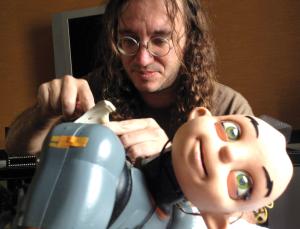
The main thing with the Hanson robot is that the face is highly expressive. In terms of social interactions, it is valuable to have a robot that can convey emotions and desires. He needs to learn from people: the more engaged they are, the better data they will give to power his learning.

You are crowdfunding Adam Z1. So far you have only $5000 of the $300,000 target…
Raising research money via crowdfunding is a very speculative thing. We viewed it as a kind of experiment, not only to gain money but also to learn how people react; what they say, what pushback they give. If we succeed, that would be awesome and will accelerate our progress. Fortunately we already have some funding, so the project is going forward one way or another.

http://www.newscientist.com/article/mg21929260.300-to-create-a-robot-with-common-sense-mimic-a-toddler.html#.Uez9QNK-pH8

Advanced ‘artificial skin’ senses touch, humidity, and temperature

e-skin-layers

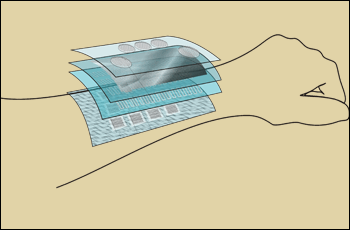
Technion-Israel Institute of Technology scientists have discovered how to make a new kind of flexible sensor that one day could be integrated into “electronic skin” (e-skin) — a covering for prosthetic limbs that would allow patients to feel touch, humidity, and temperature.

Current kinds of e-skin detect only touch, but the Technion team’s invention “can simultaneously sense touch (pressure), humidity, and temperature, as real skin can do,” says research team leader Professor Hossam Haick.

Additionally, the new system “is at least 10 times more sensitive in touch than the currently existing touch-based e-skin systems.”

Researchers have long been interested in flexible sensors, but have had trouble adapting them for real-world use Haick says. A flexible sensor would have to run on low voltage (so it would be compatible with the batteries in today’s portable devices), measure a wide range of pressures, and make more than one measurement at a time, including humidity, temperature, pressure, and the presence of chemicals. These sensors would also have to be able to be manufactured quickly, easily, and cheaply.

The Technion team’s sensor has all of these qualities, Haick says. The secret: monolayer-capped gold nanoparticles that are only 5–8 nanometers in diameter, surrounded by connector molecules called ligands.

“Monolayer-capped nanoparticles can be thought of as flowers, where the center of the flower is the gold or metal nanoparticle and the petals are the monolayer of organic ligands that generally protect it,” says Haick.

The team discovered that when these nanoparticles are laid on top of a substrate — in this case, made of PET (flexible polyethylene terephthalate), the same plastic found in soda bottles — the resulting compound conducted electricity differently depending on how the substrate was bent.

The bending motion brings some particles closer to others, increasing how quickly electrons can pass between them. This electrical property means that the sensor can detect a large range of pressures, from tens of milligrams to tens of grams.

And by varying how thick the substrate is, as well as what it is made of, scientists can modify how sensitive the sensor is. Because these sensors can be customized, they could in the future perform a variety of other tasks, including monitoring strain on bridges and detecting cracks in engines.

“The sensor is very stable and can be attached to any surface shape while keeping the function stable,” says Dr. Nir Peled, Head of the Thoracic Cancer Research and Detection Center at Israel’s Sheba Medical Center, who was not involved in the research.

Meital Segev-Bar et al., Tunable Touch Sensor and Combined Sensing Platform: Toward Nanoparticle-based Electronic Skin, ACS Applied Materials & Interfaces, 2013, DOI: 10.1021/am400757q

http://www.kurzweilai.net/advanced-artificial-skin-senses-touch-humidity-and-temperature

Thanks to SRW for bringing this to the attention of the It’s Interesting community.

Clip-Air reimagines travel with modular mass transit aircraft

Clipair

Unless you happen to live right next to an airport, chances are hopping on an airplane isn’t the first step in your travel day. First there’s getting to the airport, which either means leaving your car in an expensive parking lot or hopping on a train.

And that’s what got the minds at Switzerland’s École Polytechnique Fédérale de Lausanne (EPFL) thinking. They surmised that most mass transit options are really just modules into which people are crammed. Train cars look a lot like the fuselage of an aircraft, for instance.

And so the Clip-Air concept was born. In theory, high-capacity Clip-Air train cars, each a self-contained fuselage, can be plucked from the tracks and snapped onto a set of wings. Customers would only have to board and pass through security once — at their local train depot. Once the plane lands, the whole process happens in reverse, dropping off passengers along a train route close to their final destination.

What’s more, Clip-Air is designed to fit up to three standard fuselages under a single set of wings, reducing the number of planes in the air. If only two of the three fuselages are booked by passengers, Clip-Air planes can snap on a cargo plane to keep efficiency up.

Clip-Air has been under development since 2009 and is described by its designers as “quite a long-term project.” However, EPFL has completed some encouraging studies which prove that their designs would indeed fly. And they’ll be showcasing a model of their modular design at the Paris Air Show later this month. So, while there are still plenty of hurdles to clear before we see the ease of travel Clip-Air promises, this mega-project is already inching closer to being part of tomorrow’s reality.

Thanks to Jody Troupe for bringing this to the attention of the It’s Interesting community.

http://www.dvice.com/2013-6-12/clip-air-reimagines-travel-modular-mass-transit-aircraft

How technology may change the human face over the next 100,000 years

Faces-of-the-Future-4

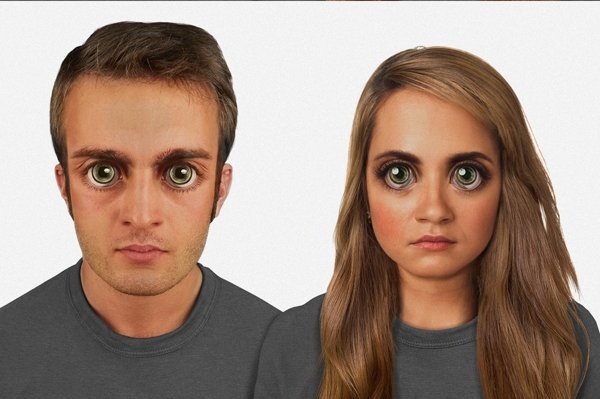
Designer Lamm’s depiction of how the human face might look in 100,000 years

We’ve come along way looks-wise from our homo sapien ancestors. Between 800,000 and 200,000 years ago, for instance, rapid changes in Earth climate coincided with a tripling in the size of the human brain and skull, leading to a flattening of the face. But how might the physiological features of human beings change in the future, especially as new, wearable technology like Google Glass change the way we use our bodies and faces? Artist and researcher Nickolay Lamm has partnered with a computational geneticist to research and illustrate what we might look like 20,000 years in the future, as well as 60,000 years and 100,000 years out. His full, eye-popping illustrations are at the bottom of this post.

Lamm says this is “one possible timeline,” where, thanks to zygotic genome engineering technology, our future selves would have the ability to control human biology and human evolution in much the same way we control electrons today.

Lamm speaks of “wresting control” of the human form from natural evolution and bending human biology to suit our needs. The illustrations were inspired by conversations with Dr. Alan Kwan, who holds a PhD in computational genomics from Washington University.

Kwan based his predictions on what living environments might look like in the future, climate and technological advancements. One of the big changes will be a larger forehead, Kwan predicts – a feature that has already expanding since the 14th and 16th centuries. Scientists writing in the British Dental Journal have suggested that skull-measurement comparisons from that time show modern-day people have less prominent facial features but higher foreheads, and Kwan expects the human head to trend larger to accommodate a larger brain.

Kwan says that 60,000 years from now, our ability to control the human genome will also make the effect of evolution on our facial features moot. As genetic engineering becomes the norm, “the fate of the human face will be increasingly determined by human tastes,” he says in a research document. Eyes will meanwhile get larger, as attempts to colonize Earth’s solar system and beyond see people living in the dimmer environments of colonies further away from the Sun than Earth. Similarly, skin will become more pigmented to lesson the damage from harmful UV radiation outside of the Earth’s protective ozone. Kwan expects people to have thicker eyelids and a more pronounced superciliary arch (the smooth, frontal bone of the skull under the brow), to deal with the effects of low gravity.

The remaining 40,000 years, or 100,000 years from now, Kwan believes the human face will reflect “total mastery over human morphological genetics. This human face will be heavily biased towards features that humans find fundamentally appealing: strong, regal lines, straight nose, intense eyes, and placement of facial features that adhere to the golden ratio and left/right perfect symmetry,” he says.

Eyes will seem “unnervingly large” — as least from our viewpoint today — and will feature eye-shine and even a sideways blink from the re-introduced plica semilunaris to further protect from cosmic ray effects.

There will be other functional necessities: larger nostrils for easier breathing in off-planet environments, denser hair to contain heat loss from a larger head — features which people may have to weigh up against their tastes for what’s genetically trendy at the time. Instead of just debating what to name a child as new parents do today, they might also have to decide if they want their children to carry the most natural expression of a couple’s DNA, such as their eye-color, teeth and other features they can genetically alter.

Excessive Borg-like technological implants would start to become untrendy, though, as people start to increasingly value that which makes us look naturally human. That “will be ever more important to us in an age where we have the ability to determine any feature,” Kwan says.

Wearable technology will still be around, but in far more subtle forms. Instead of Google Glass and iWatch, people will seek discrete implants that preserve the natural human look – think communication lenses (a technologically souped up version of today’s contacts) and miniature bone-conduction devices implanted above the ear. These might have imbedded nano-chips that communicate to another separate device to chat with others or for entertainment.

The bird’s eye view of human beings in 100,000 years will be people who want to be wirelessly plugged in, Kwan says, but with minimal disruption to what may then be perceived as the “perfect” human face.

His Predictions:

In 20,000 years: Humans have a larger head with a forehead that is subtly too large. A future “communications lens” will be manifested as a the yellow ring around their eyes. These lenses will be the ‘Google Glass’ of the future.

In 60,000 years: Human beings have even larger heads, larger eyes and pigmented skin. A pronounced superciliary arch makes for a darker area below eyebrows. Miniature bone-conduction devices may be implanted above the ear now to work with communications lenses.

In 100,000 years: The human face is proportioned to the ‘golden ratio,’ though it features unnervingly large eyes. There is green “eye shine” from the tapetum lucidum, and a more pronounced superciliary arch. A sideways blink of the reintroduced plica semilunaris seen in the light gray areas of the eyes, while miniature bone-conduction devices implanted above the ear work with the communications lenses on the eyes.

Thanks to Ray Gaudette for bringing this to the attention of the It’s Interesting community.

http://news.yahoo.com/human-face-might-look-100-171207969.html

Disney’s Electronic Wristband Illustrates Why Big Companies Push Contactless Wallets

disney

Disney just announced an electronic wristband for visitors to its theme parks that neatly illustrates why companies like Google and cellphone networks are pushing the idea of using contactless technology in phones for payments, tickets, boarding passes and more. The short answer? They want data.

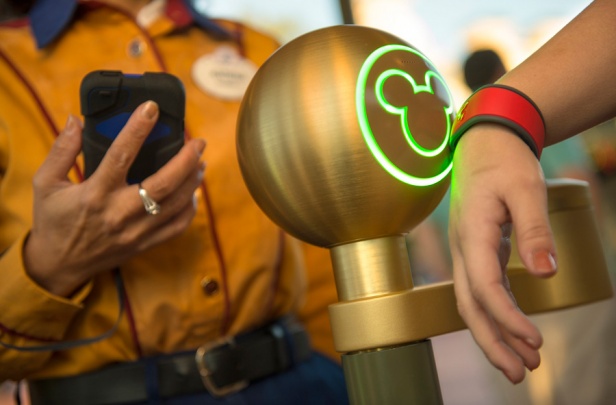
Disney’s MagicBand, an ID tag that uses Bluetooth and contactless NFC technology, is being introduced at Walt Disney World in Florida. It replaces a person’s ticket and can be used to tag into rides and other attractions at the park. It can also be used to open a guest’s hotel door, and to pay in stores at the resort. In the future, the Bluetooth link will make it possible for you to wander up to an attraction or Disney character and be greeted using your first name.

To sum up, a person opting to use a MagicBand could find their stay much more convenient, and perhaps even leave their wallet back at their hotel. It’s a very similar pitch to that made by companies including Google, and the consortium of major cellphone networks, Isis, for contactless “wallets” based on near field communication chips (NFC) built into phones.

However, Disney’s MagicBand program has significant benefits to the company, too. The MagicBand collects valuable data each time it is tagged or used to buy something, providing a new perspective on what Disney’s customers are doing at the resort. It becomes possible to do things like look for relationships between the attractions and rides a person visits, or the characters they meet, and what they spend money on in the gift shop. Disney could look for signs of the social dynamics of groups of people that arrive at the park together.

Disney has plans to install devices that use Bluetooth to log any MagicBand that passes by, said Thomas Staggs, chairman of Walt Disney Theme Parks and Resorts, Wednesday. People will be able to opt out of that part of the data collection he said, but whether data logged when a person actively tags a band would be treated in the same way wasn’t mentioned.

Using a contactless wallet app on your phone could provide similar data harvesting opportunities. A person using one might get to leave their wallet at home, and could pay for stuff or provide tickets and boarding passes with a tap of their phone. The provider of the wallet app would get a detailed feed on where its users went, what they were doing and what they spent money on.

Some people will be wary of such data collection, many more probably won’t care. Putting that issue aside, though, Disney’s MagicBand sounds like it is genuinely useful and thanks to the company’s ability to ensure everything inside its resorts works with the technology, could make your stay at Disney’s resort go more smoothly. The stuttering progress of NFC wallets and the like outside the magic kingdom – despite the hype – is to a large degree because the real world is a much messier place. Neither Google nor the cellphone carriers or other companies pushing their own MagicBand-style wallets can yet offer something that works in every store, with every bank and in every place. For now, the benefits of contactless wallets are much clearer to the providers of them than to consumers.

Thanks to Kebmodee for bringing this to the attention of the It’s Interesting community.

Sea Level Could Rise 5 Feet in New York City by 2100

sea level nyc

The U.S.’s largest metropolis and the entire east coast could face frequent destruction unless the region takes previously unthinkable actions

By Mark Fischetti

By 2100 devastating flooding of the sort that Superstorm Sandy unleashed on New York City could happen every two years all along the valuable and densely populated U.S. east coast—anywhere from Boston to Miami.

And unless extreme protection measures are implemented, people could again die.

Hyperbole? Hardly. Even though Sandy’s storm surge was exceptionally high, if sea level rises as much as scientists agree is likely, even routine storms could cause similar destruction. Old, conservative estimates put the increase at two feet (0.6 meter) higher than the 2000 level by 2100. That number did not include any increase in ice melting from Greenland or Antarctica—yet in December new data showed that temperatures in Antarctica are rising three times faster than the rate used in the conservative models. Accelerated melting has also been reported in Greenland. Under what scientists call the rapid ice-melt scenario, global sea level would rise four feet (1.2 meters by the 2080s, according to Klaus Jacob, a research scientist at Columbia University’s Lamont–Doherty Earth Observatory. In New York City by 2100 “it will be five feet, plus or minus one foot,” Jacob says.

Skeptics doubt that number, but the science is solid. The projection comes in part from the realization that the ocean does not rise equally around the planet. The coast from Cape Cod near Boston to Cape Hatteras in North Carolina is a hot spot—figuratively and literally. In 2012 Asbury Sallenger, a coastal hazards expert at the U.S. Geological Survey (USGS), reported that for the prior 60 years sea level along that section of the Atlantic coast had increased three to four times faster than the global average. Looking ahead to 2100, Sallenger indicated that the region would experience 12 to 24 centimeters—4.7 to 9.4 inches—of sea level rise above and beyond the average global increase.

Sallenger (who died in February) was careful to point out that the surplus was related only to ocean changes—such as expansion of water due to higher temperature as well as adjustments to the Gulf Stream running up along the coast brought about by melting Arctic ice—not changes to the land.

Unfortunately, that land is also subsiding. Since North American glaciers began retreating 20,000 years ago, the crust from New York City to North Carolina has been sinking, as the larger continent continues to adjust to the unloading. The land will continue to subside by one to 1.5 millimeters (0.04 to 0.06 inch) a year, according to S. Jeffress Williams, a coastal marine geologist with the USGS and the University of Hawaii at Mānoa. The boundary zone where rising crust to the north changes to falling crust to the south runs roughly west to east from central New York State through Massachusetts.

Certain municipalities such as Atlantic City, N.J., are sinking even faster because they are rapidly extracting groundwater. Cities around Chesapeake Bay, such as Norfolk, Va., and Virginia Beach, are subsiding faster still because sediment underneath them continues to slump into the impact crater that formed the bay 35 million years ago.

When all these factors are taken into account, experts say, sea level rise of five feet (1.5 meters) by 2100 is reasonable along the entire east coast. That’s not really a surprise: the ocean was 20 to 26 feet (six to eight meters) higher during the most recent interglacial period.

Now for the flooding: Sandy’s storm surge topped out at about 11 feet (3.4 meters) above the most recent average sea level at the lower tip of Manhattan. But flood maps just updated by the Federal Emergency Management Agency in January indicate that even an eight-foot (2.5-meter) surge would cause widespread, destructive flooding. So if sea level rises by five feet (1.5 meters_, a surge of only three feet is needed to inflict considerable damage.

How frequently could that occur? Municipalities rarely plan for anything greater than the so-called one-in-100-year storm—which means that the chances of such a storm hitting during any given year is one in 100. Sandy was a one-in-500-year storm. If sea level rises by five feet, the chance in any year of a storm bringing a three-foot surge to New York City will increase to as high as one in three or even one in two, according to various projections. The 100-year-height for a storm in the year 2000 would be reached by a two-year storm in 2100.

With hundreds of people still homeless in Sandy’s wake, coastal cities worldwide are watching to see how New York City will fend off rising seas. Scientists and engineers have proposed solutions to pieces of the complex puzzle, and a notable subset of them on the New York City Panel on Climate Change are rushing to present options to Mayor Michael Bloomberg by the end of May. But extensive interviews with those experts leads to several controversial and expensive conclusions: Long-term, the only way to protect east coast cities against storm surges is to build massive flood barriers (pdf). The choices for protecting the long stretches of sandy coastlines between them—New Jersey, Maryland, the Carolinas, Florida—are even more limited.

As for sea level rise, retreat from low-lying shores may be the best option. Despite the gut reaction of “No, we won’t go,” climate forces already in motion may leave few options.

http://www.scientificamerican.com/article.cfm?id=fischetti-sea-level-could-rise-five-feet-new-york-city-nyc-2100

Trouble With Math? Maybe You Should Get Your Brain Zapped

sn-math

by Emily Underwood
ScienceNOW

If you are one of the 20% of healthy adults who struggle with basic arithmetic, simple tasks like splitting the dinner bill can be excruciating. Now, a new study suggests that a gentle, painless electrical current applied to the brain can boost math performance for up to 6 months. Researchers don’t fully understand how it works, however, and there could be side effects.

The idea of using electrical current to alter brain activity is nothing new—electroshock therapy, which induces seizures for therapeutic effect, is probably the best known and most dramatic example. In recent years, however, a slew of studies has shown that much milder electrical stimulation applied to targeted regions of the brain can dramatically accelerate learning in a wide range of tasks, from marksmanship to speech rehabilitation after stroke.

In 2010, cognitive neuroscientist Roi Cohen Kadosh of the University of Oxford in the United Kingdom showed that, when combined with training, electrical brain stimulation can make people better at very basic numerical tasks, such as judging which of two quantities is larger. However, it wasn’t clear how those basic numerical skills would translate to real-world math ability.

To answer that question, Cohen Kadosh recruited 25 volunteers to practice math while receiving either real or “sham” brain stimulation. Two sponge-covered electrodes, fixed to either side of the forehead with a stretchy athletic band, targeted an area of the prefrontal cortex considered key to arithmetic processing, says Jacqueline Thompson, a Ph.D. student in Cohen Kadosh’s lab and a co-author on the study. The electrical current slowly ramped up to about 1 milliamp—a tiny fraction of the voltage of an AA battery—then randomly fluctuated between high and low values. For the sham group, the researchers simulated the initial sensation of the increase by releasing a small amount of current, then turned it off.

For roughly 20 minutes per day over 5 days, the participants memorized arbitrary mathematical “facts,” such as 4#10 = 23, then performed a more sophisticated task requiring multiple steps of arithmetic, also based on memorized symbols. A squiggle, for example, might mean “add 2,” or “subtract 1.” This is the first time that brain stimulation has been applied to improving such complex math skills, says neuroethicist Peter Reiner of the University of British Columbia, Vancouver, in Canada, who wasn’t involved in the research.

The researchers also used a brain imaging technique called near-infrared spectroscopy to measure how efficiently the participants’ brains were working as they performed the tasks.

Although the two groups performed at the same level on the first day, over the next 4 days people receiving brain stimulation along with training learned to do the tasks two to five times faster than people receiving a sham treatment, the authors reported in Current Biology. Six months later, the researchers called the participants back and found that people who had received brain stimulation were still roughly 30% faster at the same types of mathematical challenges. The targeted brain region also showed more efficient activity, Thompson says.

The fact that only participants who received electrical stimulation and practiced math showed lasting physiological changes in their brains suggests that experience is required to seal in the effects of stimulation, says Michael Weisend, a neuroscientist at the Mind Research Network in Albuquerque, New Mexico, who wasn’t involved with the study. That’s valuable information for people who hope to get benefits from stimulation alone, he says. “It’s not going to be a magic bullet.”

Although it’s not clear how the technique works, Thompson says, one hypothesis is that the current helps synchronize neuron firing, enabling the brain to work more efficiently. Scientists also don’t know if negative or unintended effects might result. Although no side effects of brain stimulation have yet been reported, “it’s impossible to say with any certainty” that there aren’t any, Thompson says.

“Math is only one of dozens of skills in which this could be used,” Reiner says, adding that it’s “not unreasonable” to imagine that this and similar stimulation techniques could replace the use of pills for cognitive enhancement.

In the future, the researchers hope to include groups that often struggle with math, such as people with neurodegenerative disorders and a condition called developmental dyscalculia. As long as further testing shows that the technique is safe and effective, children in schools could also receive brain stimulation along with their lessons, Thompson says. But there’s “a long way to go,” before the method is ready for schools, she says. In the meantime, she adds, “We strongly caution you not to try this at home, no matter how tempted you may be to slap a battery on your kid’s head.”

http://news.sciencemag.org/sciencenow/2013/05/trouble-with-math-maybe-you-shou.html?ref=hp

As the Earth warms, 400 year old frozen plants are being revived

plants

Plants that were frozen during the “Little Ice Age” centuries ago have been observed sprouting new growth, scientists say. Samples of 400-year-old plants known as bryophytes have flourished under laboratory conditions. Researchers say this back-from-the-dead trick has implications for how ecosystems recover from the planet’s cyclic long periods of ice coverage. The findings appear in Proceedings of the National Academy of Sciences.

They come from a group from the University of Alberta, who were exploring an area around the Teardrop Glacier, high in the Canadian Arctic. The glaciers in the region have been receding at rates that have sharply accelerated since 2004, at about 3-4m per year. That is exposing land that has not seen light of day since the so-called Little Ice Age, a widespread climatic cooling that ran roughly from AD 1550 to AD 1850.

“We ended up walking along the edge of the glacier margin and we saw these huge populations coming out from underneath the glacier that seemed to have a greenish tint,” said Catherine La Farge, lead author of the study.

Bryophytes are different from the land plants that we know best, in that they do not have vascular tissue that helps pump fluids around different parts of the organism. They can survive being completely desiccated in long Arctic winters, returning to growth in warmer times, but Dr La Farge was surprised by an emergence of bryophytes that had been buried under ice for so long.

“When we looked at them in detail and brought them to the lab, I could see some of the stems actually had new growth of green lateral branches, and that said to me that these guys are regenerating in the field, and that blew my mind,” she told BBC News. “If you think of ice sheets covering the landscape, we’ve always thought that plants have to come in from refugia around the margins of an ice system, never considering land plants as coming out from underneath a glacier.”

But the retreating ice at Sverdrup Pass, where the Teardrop Glacier is located, is uncovering an array of life, including cyanobacteria and green terrestrial algae. Many of the species spotted there are entirely new to science.

“It’s a whole world of what’s coming out from underneath the glaciers that really needs to be studied,” Dr La Farge said.

“The glaciers are disappearing pretty fast – they’re going to expose all this terrestrial vegetation, and that’s going to have a big impact.”

http://www.bbc.co.uk/news/science-environment-22656239

The Virtual Therapist

_67807883_face_research

_67807877_virtualshrink

Ellie is a creation of ICT, and could serve as an important diagnostic and therapeutic tool for veterans with Post-Traumatic Stress Disorder.

By Alastair Leithead
BBC News, Los Angeles

The University of Southern California’s Institute for Creative Technologies is leading the way in creating virtual humans. The result may produce real help for those in need.

The virtual therapist sits in a big armchair, shuffling slightly and blinking naturally, apparently waiting for me to get comfortable in front of the screen.

“Hi, I’m Ellie,” she says. “Thanks for coming in today.”

She laughs when I say I find her a little bit creepy, and then goes straight into questions about where I’m from and where I studied.

“I’m not a therapist, but I’m here to learn about people and would love to learn about you,” she asks. “Is that OK?”

Ellie’s voice is soft and calming, and as her questions grow more and more personal I quickly slip into answering as if there were a real person in the room rather than a computer-generated image.

“How are you at controlling your temper?” she probes. “When did you last get into an argument?”

With every answer I’m being watched and studied in minute detail by a simple gaming sensor and a webcam.

How I smile, which direction I look, the tone of my voice, and my body language are all being precisely recorded and analysed by the computer system, which then tells Ellie how best to interact with me.

“Wizard of Oz mode” is how researcher Louis-Philippe Morency describes this experiment at the University of Southern California’s Institute for Creative Technologies (ICT).

In the next room his team of two are controlling what Ellie says, changing her voice and body language to get the most out of me.

Real people come in to answer Ellie’s questions every day as part of the research, and the computer is gradually learning how to react in every situation.

It is being taught how to be human, and to respond as a doctor would to the patients’ cues.

Soon Ellie will be able to go it alone. That opens up a huge opportunity for remote therapy sessions online using the knowledge of some of the world’s top psychologists.

But Dr Morency doesn’t like the expression “virtual shrink”, and doesn’t think this method will replace flesh-and-blood practitioners.

“We see it more as being an assistant for the clinician in the same way you take a blood sample which is analysed in a lab and the results sent back to the doctor,” he said.

The system is designed to assess signs of depression or post-traumatic stress, particularly useful among soldiers and veterans.

“We’re looking for an emotional response, or perhaps even any lack of emotional response,” he says.

“Now we have an objective way to measure people’s behaviour, so hopefully this can be used for a more precise diagnosis.”

The software allows a doctor to follow a patient’s progress over time. It objectively and scientifically compares sessions.

“The problem we have, particularly with the current crisis in mental health in the military, is that we don’t have enough well trained providers to handle the problem,” says Skip Rizzo, the associate director for medical virtual reality at the ICT.

“This is not a replacement for a live provider, but it might be a stop-gap that helps to direct a person towards the kind of care they might need.”

The centre does a lot of work with the US military, which after long wars in Iraq and Afghanistan has to deal with hundreds of thousands of troops and veterans suffering from various levels of post-traumatic stress disorder.

“We have an issue in the military with stigma and a lot of times people feel hesitant talking about their problems,” he says. A virtual counselling tool can alleviate some of this reluctance.

“We see this as a way for service members or veterans to talk openly and explore their issues.”

The whole lab is running experiments with virtual humans. To do so, it blends a range of technologies and disciplines such as movement sensing and facial recognition.

Dr Morency has won awards for his work into the relationship between psychology and minute physical movements in the face.

“People who are anxious fidget with their hands more, and people who are distressed often have a shorter smile with less intensity. People who are depressed are looking away a lot more,” he says.

Making computer-generated images appear human isn’t easy, but if believable they can be powerful tools for teaching and learning. To that end, the lab is involved in several different projects to test the limits and potential of virtual interactions.

In the lab’s demonstration space a virtual soldier sits behind a desk and responds to a disciplinary scenario as part of officer training.

The team have even built a Wild West style saloon, complete with swinging doors and bar.

Full-size characters appear on three projection screens and interact with a real person walking in, automatically responding to questions and asking their own to play out a fictional scenario.

Downstairs, experiments are creating 3D holograms of a human face.

Throughout the building, the work done is starting to blur the lines between the real world and the virtual world.

And the result just may be real help for humans who need it.

http://www.bbc.co.uk/news/magazine-22630812

Many thanks to Jody, for bringing this to the attention of the It’s Interesting community.

Are we on the cusp of a solar energy boom?

Solar_graphsolar

Solar power is getting much easier to store — and at a much cheaper price

The total solar energy hitting the Earth each year is equivalent to 12.2 trillion watt-hours. That’s over 20,000 times more than the total energy all of humanity consumes each year.

And yet photovoltaic solar panels, the instruments that convert solar radiation into electricity, produce only 0.7 percent of the energy the world uses.

So what gives?

For one, cost: The U.S. Department of Energy estimates an average cost of $156.90 per megawatt-hour for solar, while conventional coal costs an average of $99.60 per MW/h, nuclear costs an average of $112.70 per MW/h, and various forms of natural gas cost between $65.50 and $132 per MW/h. So from an economic standpoint, solar is still uncompetitive.

And from a technical standpoint, solar is still tough to store. “A major conundrum with solar panels has always been how to keep the lights on when the sun isn’t shining,” says Christoph Steitz and Stephen Jewkes at Reuters.

But thanks to huge advancements, solar’s cost and technology problems are increasingly closer to being solved.

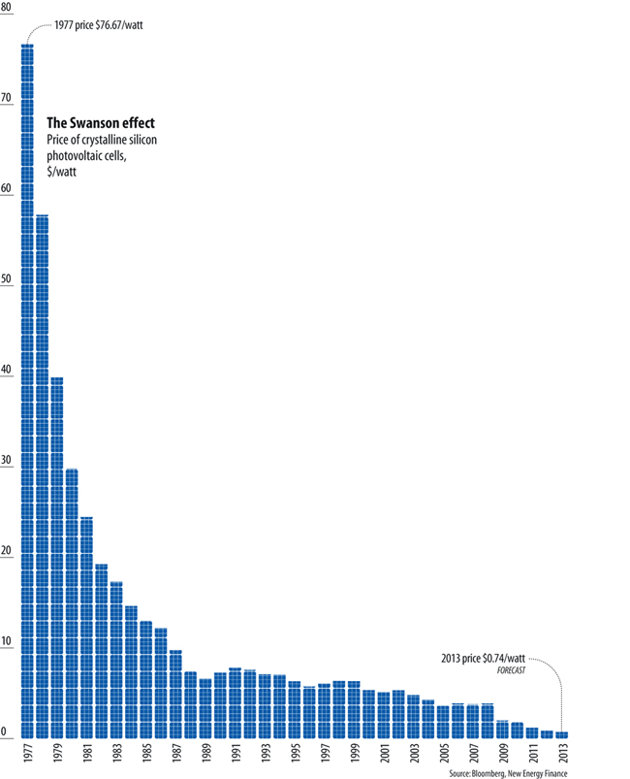
The percentage of light turned into electricity by a photovoltaic cell has increased from 8 percent in the first Cadmium-Telluride cells in the mid-1970s to up to 44 percent in the most efficient cells today, with some new designs theoretically having up to 51 percent efficiency. That means you get a lot more bang for your buck. And manufacturing costs have plunged as more companies have entered the market, particularly in China. Prices have fallen from around $4 per watt in 2008 to just $0.75 per watt last year to just $0.58 per watt today.

If the trend stays on track for another 8-10 years, solar generated electricity in the U.S. would descend to a level of $120 per MW/h — competitive with coal and nuclear — by 2020, or even 2015 for the sunniest parts of America. If prices continue to fall over the next 20 years, solar costs would be half that of coal (and have the added benefits of zero carbon emissions, zero mining costs, and zero scarcity).

Scientists have made huge advances in thermal storage as well, finding vastly more efficient ways to store solar energy. (In one example, solar energy is captured and then stored in beds of packed rocks.)

Lower costs and better storage capacity would mean cheap, decentralized, plentiful, sustainable energy production — and massive relief to global markets that have been squeezed in recent years by the rising cost of fossil fuel extraction, a burden passed on to the consumer. All else being equal, falling energy prices mean more disposable income to save and invest, or to spend.

The prospect of widespread falling energy costs could be a basis for a period of strong economic growth. It could help us replace our dependence on foreign oil with a robust, decentralized electric grid, where energy is generated closer to the point of use. This would mean a sustainable energy supercycle — and new growth in other industries that benefit from falling energy costs.

Indeed, a solar boom could prove wrong those who claim that humanity has over-extended itself and that the era of growth is over.

Thanks to Ray Gaudette for bringing this to the attention of the It’s Interesting community.

http://news.yahoo.com/cusp-solar-energy-boom-075000286.html