July 19: A Chance to See Saturn, For the First Time in 7 Years

Saturn

In July, you will have the photo opp of a lifetime.

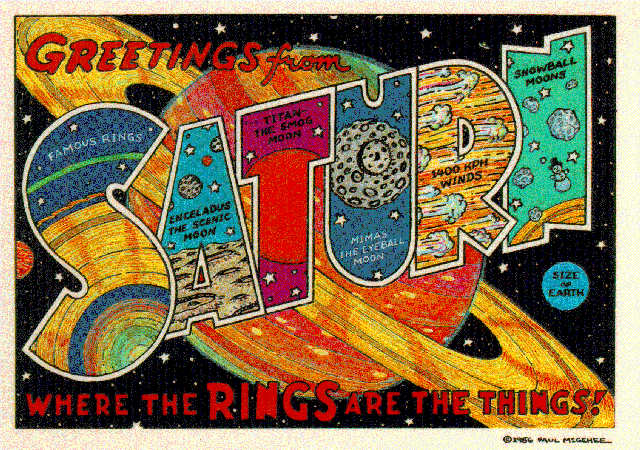
According to the Cassini Solstice Mission website, the sun will backlight Saturn on July 19, allowing you to clearly see the planet’s rings, photograph them and observe the changes over the past seven years, since Saturn was last photographed.

The positioning of the planets against the sun will also allow for a clear photo of Earth from 898 million miles away. This shot of the Earth will be only the third of its kind in the history of U.S. space travel. The first was taken from the Voyager in 1990, from 4 billion miles away; the second from Cassini in 2006, from 926 million miles away.

NASA posted directions on its website for waving at Saturn on July 19. Since the picture of Earth will be tiny, NASA is encouraging people to capture their own photos of Saturn and send them in, which they will then compile into a collage and post on its website.

NASA is promoting Wave at Saturn with a Flickr group, Facebook event page and a #waveatsaturn Twitter hashtag.

The Cassini portrait session of Earth is expected to last around 15 minutes, beginning at 5:27 p.m. ET on July 19.

Thanks to Kebmodee for bringing this to the attention of the It’s Interesting community.

http://mashable.com/2013/06/25/saturn-photo/

Ancient Egyptian jewellery carved from a meteorite

Gerzeh-bead

Think iron jewellery is down-to-earth? Not for the ancient Egyptians, it wasn’t. A 5300-year-old necklace bead found in an Egyptian tomb was made with iron from a meteorite.

Evidence for iron smelting in Egypt dates back to the 6th century BC, but archaeologists have found much older iron artefacts in the region, including in Tutankhamun’s tomb. Such artefacts are “pretty much exclusive to high-status tombs”, says Diane Johnson of the Open University in Milton Keynes, UK. Previous analyses of the oldest of these – nine iron beads from a cemetery near the Nile – proved inconclusive on their origins.

Now Johnson and colleagues have taken another look at one of the beads (pictured) and concluded that it is indeed from a meteorite. The surface of the bead had low levels of nickel, but the levels inside were as high as they would be in a meteorite.

But the clincher was evidence of a distinctive crystal structure – known as the Widmanstätten pattern – that only forms when iron and nickel cools very slowly, as it does in meteoroids (Meteoritics & Planetary Science, doi.org/mmb).

It is “very convincing” that the beads come from a meteorite, says Meenakshi Wadhwa of the Center for Meteorite Studies at Arizona State University in Tempe.

http://www.newscientist.com/article/mg21829195.500-ancient-egyptian-jewellery-carved-from-a-meteorite.html?cmpid=RSS|NSNS|2012-GLOBAL|online-news

NASA funds development of 3D printer to make food in space, starting with a pizza

meal_worms_3d
Delicious Uncle Sam’s Meal Cubes are laser-sintered from granulated mealworms; part of this healthy breakfast.
mendel_small_si

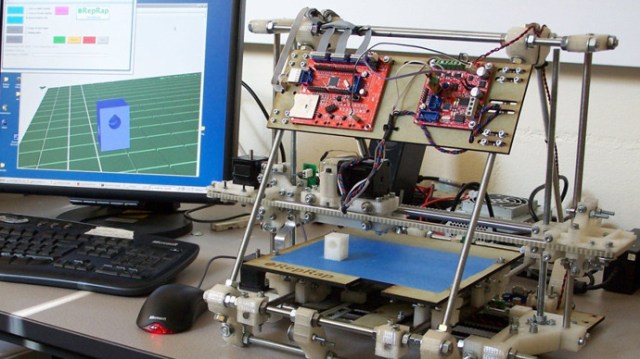
NASA is funding research into 3D printed food which would provide astronauts with meals during long space flights. The futuristic food printers would use cartridges of powder and oils which would have a shelf life of 30 years.

While the idea may seem like something out of a Sci-Fi movie, the process of printing food has already been proven possible. The brains behind the innovation, Anjan Contractor, previously printed chocolate in a bid to prove his concept.

Contractor and his company, Systems & Materials Research Corporation, will now use NASA’s $125,000 grant to attempt to print a pizza. The grant was applied for on March 28, 2013. The pizza printer is still in the conceptual stage, and will begin to be built in two weeks.

The printer will first print a layer of dough, which will be cooked while being printed. Tomato powder will then be mixed with water and oil to print a tomato sauce. The topping for the pizza will be a “protein layer” which could come from any source – animals, milk, or plants.

The concept is to use basic “building blocks” of food in replaceable powder cartridges. Each block will be combined to create a range of foods which can be created by the printer. The cartridges will have a shelf life of 30 years – more than long enough to enable long-distance space travel.

Contractor and his team hope the 3D printer will be used not only by NASA, but also by regular Earthlings. His vision would mean the end of food waste, due to the powder’s long shelf life.

“I think, and many economists think, that current food systems can’t supply 12 billion people sufficiently, ” he said, as quoted by Quartz.

“So we eventually have to change our perception of what we see as food.” There are some conveniences which would come along with the printer. For example, recipes could be traded with others through software. Each recipe would have a set of instructions which tells the printer which cartridge of powder to mix with which liquids, and at what rate and how it should be sprayed.

Another perk includes personalized nutrition.

“If you’re male, female, someone is sick—they all have different dietary needs. If you can program your needs into a 3D printer, it can print exactly the nutrients that person requires,” Contractor said.

Contractor plans on keeping the software portion of his 3D printer entirely open-source, so that anyone can look at its code. He believes this will allow people to find creative uses for the hardware.

http://rt.com/usa/nasa-3d-pizza-printer-590/

Dennis Hope is selling property on the Moon and other planets.

dennissaguaroMoon_seip

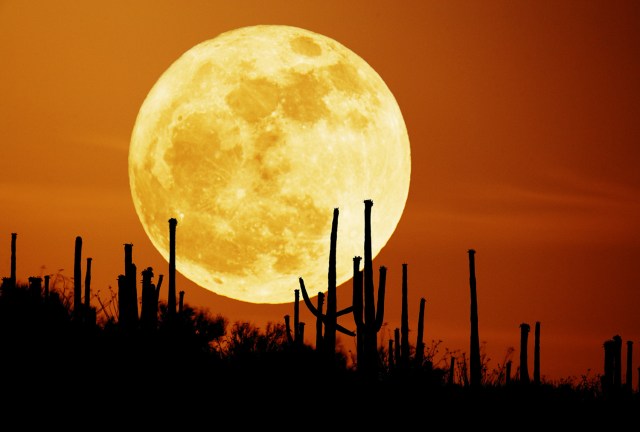
Calling it the biggest loophole in the world doesn’t quite capture its reach: Dennis Hope claims that he owns the moon—and our solar system’s planets—due to what the Outer Space Treaty doesn’t say. The treaty has been the guiding document on space law since 1967, and while it bars any country on Earth from laying claim to a heavenly body, it makes no mention of private companies or individuals doing just that. So Hope formed Lunar Embassy Corp, snatched up the property rights to the moon and more, and has been selling off one-acre lots since.

Purchases can be made here: http://www.lunarembassy.com/

Though Yahoo shines a light on Hope’s offerings (your own piece of the moon will cost just $19.99 an acre; Mars will run you slightly more at $22.49), it’s far from the first time he’s been in the news. He was featured in the documentary Lunarcy!, out last month on Epix, notes the Hollywood Reporter, and he’s talked to media before. As National Geographic previously reported, Hope thinks he has solid ground to stand on: He registered his moon claim with the UN in 1980, and got no answer, which he thinks means it’s a go. And while there’s still plenty of real estate to be had, Hope has sold more than a nominal amount of each: 600 million moon acres (about 7.5% of it) and 325 million Mars acres. He says two former US presidents are landowners as well as 250 “very well known celebrities,” as are two US hotel chains. But Hope does draw the line somewhere: The Apollo landing sites are off-limits.

http://www.newser.com/story/167265/this-man-claims-he-owns-the-moon.html

Life quite possibly existed before Earth, claim scientists

origins+of+life

Life existed long before Earth came into being, and may have originated outside our solar system, scientists claim.

Researchers say life first appeared about 10 billion years ago – long before Earth, which is believed to be 4.5 billion years old. Geneticists have applied Moore’s Law – observation that computers increase exponentially in complexity, at a rate of about double the transistors per integrated circuit every two years – to the rate at which life on Earth grows in complexity.

Alexei Sharov of the National Institute on Ageing in Baltimore, and Richard Gordon of the Gulf Specimen Marine Laboratory in Florida, replaced the transistors with nucleotides – the building blocks of DNA and RNA – and the circuits with genetic material. Their findings suggest life first appeared about 10 billion years ago, far older than the Earth’s projected age of 4.5 billion years. Like in the 2012 sci-fi movie Prometheus, as our solar system was forming, pre-existing bacteria-like organisms, or even simple nucleotides from an older part of the galaxy, could have reached Earth by hitching an interstellar ride on comets, asteroids or other inorganic space debris.

However, the calculations are not a scientific proof that life predates Earth – there’s no way of knowing for sure that organic complexity increased at a steady rate at any point in the universe’s history.

“There are lots of hypothetical elements to (our argument) … But to make a wider view, you need some hypothetical elements,” Sharov said.

Sharov said that if he had to bet on it, he’d say “it’s 99 per cent true that life started before Earth – but we should leave one per cent for some wild chance that we haven’t accounted for.”

The theory of “life before Earth,” if found true, challenges the long-held science-fiction trope of the scientifically advanced alien species. If genetic complexity progresses at a steady rate, then the social and scientific development of any other alien life form in the Milky Way galaxy would be roughly equivalent to those of humans, the report said.

“Contamination with bacterial spores from space appears the most plausible hypothesis that explains the early appearance of life on Earth,” researchers said.

http://www.phenomenica.com/2013/04/life-did-exist-before-earth-claim-scientists.html

The Sun has 5 billion years left

here-comes-the-sun

The universe will continue expanding and the objects which it is composed of will move apart faster, causing stars, such as the Sun, to become fainter, although in the case of the Sun this will not happen for “more than 5 billion years”, Nobel laureate in physics Brian Schmidt said.

The US-born astrophysicist, who lives in Australia, won the Nobel Prize in Physics in 2011 along with Adam Riess and Saul Perlmutter for discovering that the universe is accelerating.

The greatest challenge for scientists today is figuring out the “dark energy” of which nearly 70 percent of the universe is made, Schmidt said.

http://www.phenomenica.com/2013/04/sun-has-5-billion-years-left.html

Shark behaviour affected by full moon

grey-reef-shark-moon

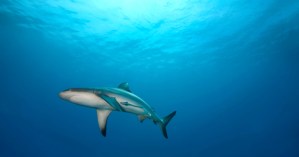
Grey reef sharks behave differently depending on the point in the lunar cycle, new research suggests.

THE DIVING BEHAVIOUR OF sharks appears to be influenced by the moon, water temperature and time of day, researchers have revealed.

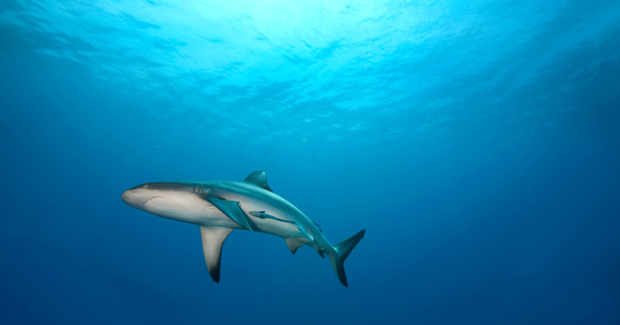
A study of about 40 grey reef sharks, commonly found on coral reefs in northern Australia and the Indo-Pacific, found they stayed in deep water during a full moon and moved to shallow water with the new moon.

“To our knowledge, this is the first time such patterns have been observed in detail for reef sharks,” says lead researcher Gabriel Vianna, from the University of Western Australia (UWA) in Perth.

The sharks were tagged near Palau, east of the Philippines, and followed for two years. During this time, scientists from UWA and the Australian Institute of Marine Science recorded their movement and diving patterns.

The findings, published this week in the journal PLOS ONE, reveal that sharks descended to greater depths, and used a wider range of depths, around the time of the full moon.

Diving was also affected by seasonal changes, as the group, which mostly consisted of adult females, was recorded diving to an average depth of 35m in winter and 60m in spring.

In winter, the sharks remained closer to the surface, where the water was warmer. During summer, however, the sharks moved to a range of depths.

The researchers suggest that because sharks are cold blooded, they may prefer warmer water to conserve their energy. Warm water may also provide optimal conditions for foraging for food, the study says.

The findings also suggest that the time of day could affect how deeply sharks dive.

“We were surprised to see sharks going progressively deeper during the morning and the exact inverse pattern in the afternoon, gradually rising towards the surface,” says Gabriel, adding that the behaviour may relate to how much light is reflected on the reef at different times during the day.

Better knowledge of shark behaviour could help reduce the risk of sharks coming into contact with locals and tourists fishing, particularly if their diving behaviour can be predicted at certain times of the day.

“In places such as Palau, which relies heavily on marine tourism and where sharks are a major tourist attraction, the fishing of a few dozen sharks from popular dive sites could have a very negative impact on the national economy,” Gabriel says.

http://www.australiangeographic.com.au/journal/sharks-affected-by-full-moon.htm

NASA Mars Rover draws enormous penis in the dirt – almost crashes NASA’s website

mars_rover_oo_err

Nasa’s $800m Mars Exploration Rovers have accidentally drawn a penis.

The twin exploration vehicles Spirit and Opportunity were launched nine years ago, in an effort to search the surface of Mars for signs of water erosion and possibly even life.

According to Nasa, since then the rovers have driven over more than 10km of Martian land, directed by teams back on Earth combined with autonomous cameras designed to avoid potential problems with the terrain.

It appears that part of the robots’ programming involves spinning in tight circles to test nearby terrain and find new routes.

Humorously, depending on your age perhaps, that has the unfortunate consequence of drawing a certain shape on the surface, which when discovered by Reddit essentially crashed Nasa’s website.

The image was posted on Nasa’s site and appears to be a genuine picture from the Martian surface – albeit one taken at an unfortunate angle.

It’s not clear which of the rovers drew the shape, or even when it was made.

Nasa lost communication with the Spirit rover in 2009 after it became stuck in some sand. Meanwhile the Opportunity is still traversing the surface on its way to the Endeavour crater.

http://www.huffingtonpost.co.uk/2013/04/24/mars-rover-penis-nasa_n_3144656.html

Wet washcloth in space

Two high school students in Nova Scotia, Kendra Lemke and Meredith Faulkner, asked Canadian astronaut Chris Hadfield (who is orbiting the planet right now) what would it be like to dip a wash cloth in water, (they suggested he clump it into a bottle, then pull it out) and squeeze it.

On Earth, a really wet wash cloth, squeezed tight, will drip, right?

Up on the International Space Station, wet wash cloths don’t drip. What they do is shown here.

Supernova left its mark in ancient bacteria

1_12797_Cass-A-NASA
Radioactive iron may be first fossil imprint of a nearby cosmic explosion.

by Alexandra Witze

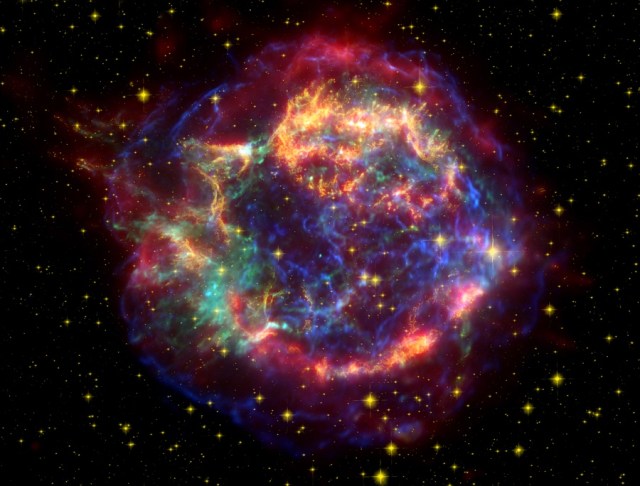
Sediment in a deep-sea core may hold radioactive iron spewed by a distant supernova 2.2 million years ago and preserved in the fossilized remains of iron-loving bacteria. If confirmed, the iron traces would be the first biological signature of a specific exploding star.

Shawn Bishop, a physicist at the Technical University of Munich in Germany, reported preliminary findings on 14 April at a meeting of the American Physical Society in Denver, Colorado.

In 2004, scientists reported finding the isotope iron-60, which does not form on Earth, in a piece of sea floor from the Pacific Ocean. They calculated how long ago this radioactive isotope had arrived by using the rate at which it decays over time. The culprit, they concluded, was a supernova in the cosmic neighbourhood.

Bishop wondered if he could find signs of that explosion in the fossil record on Earth. Some natural candidates are certain species of bacteria that gather iron from their environment to create 100-nanometre-wide magnetic crystals, which the microbes use to orient themselves within Earth’s magnetic field so that they can navigate to their preferred conditions. These ‘magnetotactic’ bacteria live in sea-floor sediments.

So Bishop and his colleagues acquired parts of a sediment core from the eastern equatorial Pacific Ocean, dating to between about 1.7 million and 3.3 million years ago. They took sediment samples from strata corresponding to periods roughly 100,000 years apart, and treated them with a chemical technique that extracts iron-60 but not iron from nonbiological sources, such as soil washing off the continents. The scientists then ran the samples through a mass spectrometer to see if any iron-60 was present.

And it was. “It looks like there’s something there,” Bishop told reporters at the Denver meeting. The levels of iron-60 are minuscule, but the only place they seem to appear is in layers dated to around 2.2 million years ago. This apparent signal of iron-60, Bishop said, could be the remains of magnetite (Fe3O4) chains formed by bacteria on the sea floor as radioactive supernova debris showered on them from the atmosphere, after crossing inter-stellar space at nearly the speed of light.

No one is sure what particular star might have exploded at this time, although one paper points to suspects in the Scorpius–Centaurus stellar association, at a distance of about 130 parsecs (424 light years) from the Sun3.

“I’m really excited about this,” says Brian Thomas, an astrophysicist at Washburn University in Topeka, Kansas, who was not involved in the work. “The nice thing is that it’s directly tied to a specific event.”

“For me, philosophically, the charm is that this is sitting in the fossil record of our planet,” Bishop says. He and his team are now working on a second core, also from the Pacific, to see if it too holds the iron-60 signal.

http://www.nature.com/news/supernova-left-its-mark-in-ancient-bacteria-1.12797