New Frog Species Found in New York City

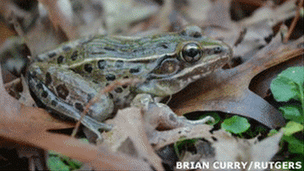
Scientists say they have found a new type of frog living in New York City.

While new species are usually discovered in remote regions, this so-far unnamed type of leopard frog was first heard croaking on Staten Island.

Jeremy Feinberg of Rutgers University in New Jersey noticed the frogs there had a call he had never heard before.

They look identical to other species, but genetic analysis showed they are a new species of leopard frog that probably once lived in Manhattan.

While studying leopard frogs Mr Feinberg noticed that instead of the long “snore” he was expecting, he heard a short, repetitive croak.

“When I first heard these frogs calling, it was so different, I knew something was very off,” Feinberg said.

The frogs are currently found in Staten Island, mainland New York, and New Jersey, sometimes in sight of the Statue of Liberty.

The research by scientists at the University of California, Rutgers, UC Davis and the University of Alabama has been published online in the journal Molecular Phylogenetics and Evolution.

“For a new species to go unrecognised for all this time in this area is amazing,” said Professor Brad Shaffer, one of the authors from the University of California Los Angeles.

“Many amphibians are secretive and can be very hard to find, but these frogs are pretty obvious, out-there animals,” he said.

“This shows that even in the largest city in the US there are still new and important species waiting to be discovered that could be lost without conservation.”

There are more than a dozen species of leopard frog found from Canada to central America.

http://www.bbc.co.uk/news/world-us-canada-17367664


Qantas Plane passenger finds live MAGGOTS crawling inside packet of nuts (which she’d already started eating)


An Australian woman told Monday how she was horrified to discover live maggots in a snack she was eating while on a Qantas flight from Los Angeles to Melbourne.

Victoria Cleven began tucking into her snack of nuts and dried fruit as she made her way home on Thursday. At the time, she did not turn on her overhead light as the cabin was darkened.

“It tasted strange, and I turned the light on and looked at the rest of the packet, and just started seeing maggots coming out of it everywhere,” Cleven, 42, told Melbourne’s Herald-Sun newspaper.

“I couldn’t talk. I was nearly throwing up. I was beside myself.”

Her 15-year-old son then checked two other packets of the snack and found they also were seething with maggots.

Qantas said it had apologised to the woman and would investigate how the situation arose.

“We’ve apologised to her for her experience,” a Qantas spokesman told AFP. “We’re speaking to the supplier of the trail mix to try to establish how it could have happened.

“We’re taking it very seriously,” the spokesman added.

http://www.relax.com.sg/relax/news/1040064/Woman_finds_maggots_in_Qantas_snack.html

Here is the video she and her son posted.


Face Of Jesus Appears On Stingray

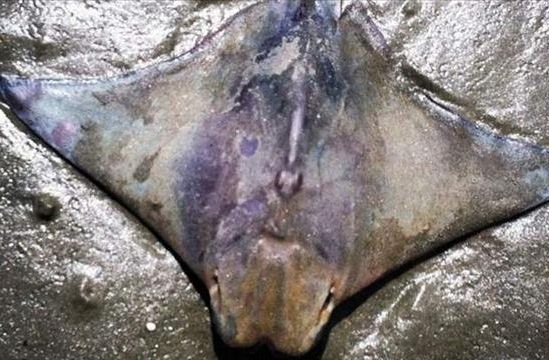
New religious/internet icon Sad Stingray Jesus spotted in South Carolina. Via Charleston’s Post and Courier:

It’s not as famous as Grilled Cheesus or Nun Bun, but the image a James Island woman found Friday on the back of a dead cownose ray may be one day.

“I just kind of thought it looked like a bearded homeless man,” said Erica Scheldt, 24. “But when I posted pictures on Instagram, one of my friends was like, ‘That’s Jesus.’ And I was like, ‘Oh my God! You’re right!’”

Scheldt also pointed out that she is from Nashville, home of the famous  Nun Bun, a cinnamon roll that bears a strong resemblance to Mother  Teresa.


http://www.disinfo.com/2012/04/face-of-jesus-appears-on-stingray/


Colonoscopy Reveals Living Cockroach in Patient’s Colon

“A 52-year-old woman with a history of depression was referred by her  primary physician for colorectal cancer screening. She had no family  history of colorectal cancer and a review of systems was positive for  abdominal bloating. Bowel preparation was done using 4 L of polyethylene  glycol the evening prior to screening colonoscopy. The procedure was  uncomplicated with no gross mucosal pathology, however, an insect was  found in the transverse colon (Fig. 1, to the left), was found in the transverse colon on a routine screening colonoscopy.). The insect was aspirated and sent to the lab for further identification. The insect had three body segments (head, thorax, and abdomen) with ventrodorsal flattening of the body and a segmented abdomen, three pairs of legs extending from the thorax (with spikes and claw-like terminal appendages), elongated hind legs, and a pair of elongated antennae extending from the head to beyond the hind legs.These morphologic findings were most consistent with the nymph form of Blattella germanica (German cockroach) of the Blattellidae family, a common household pest. The patient had a cockroach infestation at home and hence it was hypothesized that she may have inadvertently ingested a cockroach with food.”

http://blogs.discovermagazine.com/discoblog/2011/01/03/ncbi-rofl-an-unusual-finding-during-screening-colonoscopy-a-cockroach/

Ulcers from H. Pylori Increase the Risk of Diabetes


The same bacterium responsible for most stomach ulcers may play a role in the development of Type 2 diabetes among overweight and obese adults, New York University researchers recently reported.

And in the same way that antibiotics eradicate the bacterium and heal ulcers, antibiotics might eventually prove useful in diabetes prevention, they suggest in an article appearing in the Journal of Infectious Diseases.

Non-diabetic adults infected with Helicobacter pylori (whether or not they had ulcer symptoms), tended to have higher blood sugar than adults without H. pylori, according to the study co-authored by Yu Chen, an associate professor of environmental medicine at NYU, and Dr. Martin J. Blaser, chairman of NYU’s department of medicine.

Chen and Blaser assessed blood sugar levels using measurements of glycosylated hemoglobin (HbA1c or A1c), a marker of excess glucose in the bloodstream that in recent years has become a key tool for diagnosing and monitoring diabetes.

Helicobacteri pylori is a complicated bacterium. Persistent H. pylori infections beginning in childhood have been linked decades later to ulcers of the stomach and small intestine, and a heightened risk of stomach cancer. Although H. pylori can inflame the stomach, many infected people have no symptoms.

Blaser called H. pylori a complicated and interesting organism that affects children and adults in entirely different ways. In previous work he and Chen found that H. pylori protects children against asthma and allergy.

“This study provides further evidence of late-in-life cost to having H. pylori,” Blaser said in an interview. The findings also give new support to “the concept of eradicating H. pylori in older people.”

Theoretically, antibiotics that wipe out H. pylori might protect older, overweight men and women from developing diabetes, Blaser and Chen said. However, scientists still need to determine how eliminating H. pylori might affect Type 2 diabetes, and how H. pylori affects sugar breakdown among people of different weights.

Chen and Blaser proposed a mechanism for how H. pylori might set the stage for diabetes. They said the bacterium might alter levels of two important digestive hormones, ghrelin and leptin. Ghrelin, sometimes called the hunger hormone, decreases calorie-burning and promotes weight gain. Leptin reduces appetite and boosts calorie-burning. Previous research has linked H. pylori with decreased ghrelin and increased leptin.

In the past, scientists working with small samples came up with conflicting findings about an association between H. pylori and Type 2 diabetes, a chronic disease strongly associated with excess body weight, as well as heredity. Formerly called adult onset or late onset diabetes, Type 2 diabetes has become epidemic among overweight and obese youngsters. It kills an estimated 3.8 million adults worldwide each year.

One of the strengths of the NYU study is that Blaser and Chen worked with a bigger study population, analyzing data from 7,417 adults in the National Health and Nutrition Examination Survey (NHANES) III and 6,072 adults and children 3 and older in NHANES 1999-2000.

“H. pylori was consistently positively related to HbA1c level in adults, a valid and reliable biomarker for long-term blood glucose levels,” they wrote.

In an editorial appearing in the same issue of the journal, lead author Dani Cohen, an epidemiologist at Tel Aviv University in Israel, suggested that the new findings could have important implications for diabetes prevention and control.

Cohen, a specialist in H. pylori’s health effects, said the next step should be conducting rigorous studies to examine the impact of H. pylori treatment on A1c levels and on the development of diabetes among older adults carrying excess pounds.

http://www.12newsnow.com/story/17156233/diabetes-linked-to-ulcer-causing-bacteria

Japan tsunami ‘Ghost Ship’ haunts Canada coast

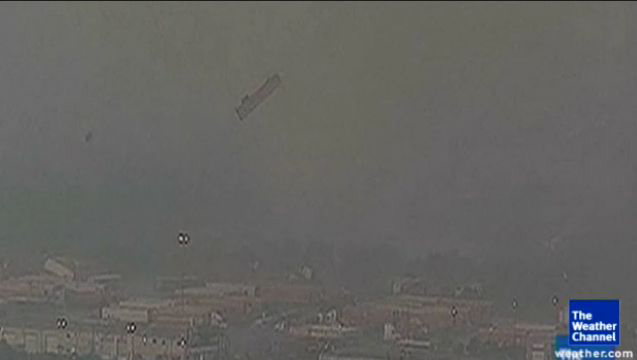
Vancouver Sun reports: VANCOUVER — After being flushed out to sea by last year’s massive tsunami and earthquake, a Japanese squid-fishing boat has drifted across the Pacific Ocean and was about 120 nautical miles off British Columbia’s north coast Friday evening. The 150-foot ship was found drifting right-side-up about 140 nautical miles (260 km) from Cape Saint James, on the southern tip of Haida Gwaii.

“It’s been drifting across the Pacific for a year, so it’s pretty beat up,” said marine search coordinator Jeff Olsson of Victoria’s Joint Rescue Coordination Centre.

http://photoblog.msnbc.msn.com/_news/2012/03/26/10877479-japan-tsunami-ghost-ship-haunts-canada-coast


U.S. Security Will Be Put at Risk With Future Water Shortages


Water shortages, polluted water and floods will increase the risk of instability in nations important to U.S. national security interests, according to a new U.S. intelligence community assessment released Thursday.

“During the next 10 years, many countries important to the United States will almost certainly experience water problems – shortages, poor water quality, or floods – that will contribute to the risk of instability and state failure and increase regional tensions,” the report from the office of the director of national intelligence states.


The assessment focused on seven key river basins located in the Middle East, Asia and Africa that are considered strategically important to the United States: the Indus, Jordan, Mekong, Nile, Tigris-Euphrates, Amu Darya and Brahmaputra basins.

The intelligence report indicates conflict between nations over water problems is unlikely in the next 10 years, but after that, water in shared basins will increasingly be used by some nations as leverage over their neighbors, the report says.

A senior U.S. intelligence official who briefed reporters on the report said, “It’s very difficult to be specific about where because it depends upon what individual states do and what actions are taken on water issues between states.”

The study also warns of the potential for water to be used as a weapon, “with more powerful upstream nations impeding or cutting off downstream flow.”

Water could also become a terrorist tool, according to the report. The U.S. official said that, “because terrorists are seeking more high visibility items to attack, in some cases we identified fragile water infrastructure that could potentially be a target for terrorism activity.” A likely target would be dams.

The official also said terrorist groups could take advantage of large movements of people displaced by water issues in vulnerable nations.

The report indicates water supplies will not keep up with the increasing demand posed by a growing world population.

Climate change will further aggravate the water problems in many areas, as will continued economic development, the report says.

“The lack of adequate water,” it says, “will be destabilizing factor in some countries because they do not have the financial resources or the technical ability to solve their internal water problems.”

Food markets are threatened by depletion of ground water in some agriculture areas of the world. Unless corrective steps are taken, food production will decline, increasing the stress on global markets, the report predicts.

The intelligence community assessed that by 2040, water shortages and pollution will harm the economic performance of important trading partners.

The study does not name specific countries, because it is based on a classified national intelligence estimate.

But the report indicates that increasing populations, industrial development and climate change in South Asia, the Middle East and North Africa will make it difficult for those regions to deal with water problems.

The report does say that improved water management and investment in water-related sectors, such as agriculture, hydroelectric power and water treatment, could compensate for increased demand over next 30 years.

Since agriculture uses nearly 70% of all ground water, the report states it has the most potential to provide relief if technological changes are implemented such as large-scale drip irrigation systems.

The intelligence study suggests developing countries are likely to turn to the United States to lead the effort to resolve water problems, because of its technological capabilities.

Secretary of State Hillary Clinton, who was concerned about how global water problems could affect U.S. security interests over the next 30 years, requested the study on global water security. The National Intelligence Council prepared the assessment with contributions from 10 intelligence organizations.  

At a World Water Day event at the State Department on Thursday,  Clinton labeled the report “sobering,” and called on everyone to read it to “see how imperative clean water and access to water is to future peace, security, and prosperity, globally.” 

The Secretary also used the occasion to announce a new effort called the U.S. Water Partnership which bring together experts in the private sector and government to find system wide solutions to water problems.

http://security.blogs.cnn.com/2012/03/22/u-s-security-at-risk-over-water/?hpt=hp_t3