Water in faults vaporizes during an earthquake, depositing gold

gold-ed
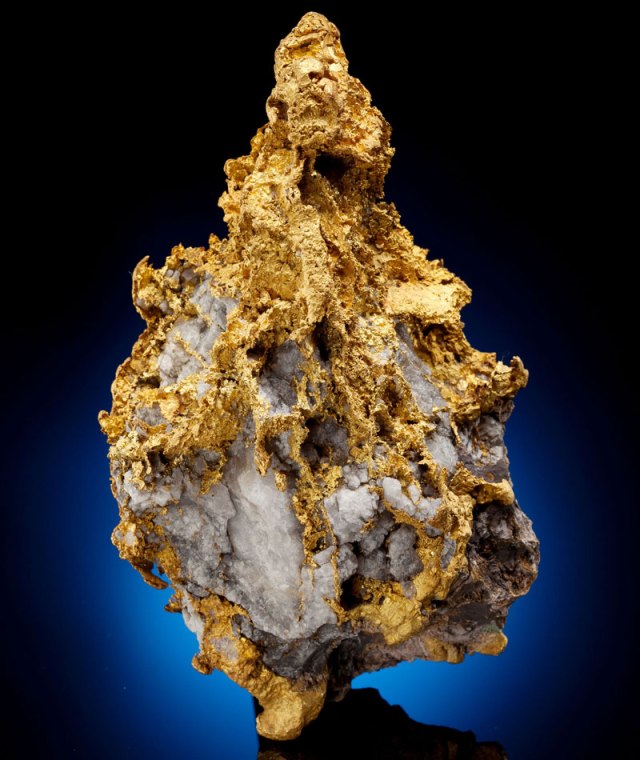
The tyrannosaur of the minerals, this gold nugget in quartz weighs more than 70 ounces (2 kilograms).

Earthquakes have the Midas touch, a new study claims.

Water in faults vaporizes during an earthquake, depositing gold, according to a model published in the March 17 issue of the journal Nature Geoscience. The model provides a quantitative mechanism for the link between gold and quartz seen in many of the world’s gold deposits, said Dion Weatherley, a geophysicist at the University of Queensland in Australia and lead author of the study.

When an earthquake strikes, it moves along a rupture in the ground — a fracture called a fault. Big faults can have many small fractures along their length, connected by jogs that appear as rectangular voids. Water often lubricates faults, filling in fractures and jogs.

About 6 miles (10 kilometers) below the surface, under incredible temperatures and pressures, the water carries high concentrations of carbon dioxide, silica and economically attractive elements like gold.

During an earthquake, the fault jog suddenly opens wider. It’s like pulling the lid off a pressure cooker: The water inside the void instantly vaporizes, flashing to steam and forcing silica, which forms the mineral quartz, and gold out of the fluids and onto nearby surfaces, suggest Weatherley and co-author Richard Henley, of the Australian National University in Canberra.

While scientists have long suspected that sudden pressure drops could account for the link between giant gold deposits and ancient faults, the study takes this idea to the extreme, said Jamie Wilkinson, a geochemist at Imperial College London in the United Kingdom, who was not involved in the study.

“To me, it seems pretty plausible. It’s something that people would probably want to model either experimentally or numerically in a bit more detail to see if it would actually work,” Wilkinson told OurAmazingPlanet.

Previously, scientists suspected fluids would effervesce, bubbling like an opened soda bottle, during earthquakes or other pressure changes. This would line underground pockets with gold. Others suggested minerals would simply accumulate slowly over time.

Weatherley said the amount of gold left behind after an earthquake is tiny, because underground fluids carry at most only one part per million of the precious element. But an earthquake zone like New Zealand’s Alpine Fault, one of the world’s fastest, could build a mineable deposit in 100,000 years, he said.

Surprisingly, the quartz doesn’t even have time to crystallize, the study indicates. Instead, the mineral comes out of the fluid in the form of nanoparticles, perhaps even making a gel-like substance on the fracture walls. The quartz nanoparticles then crystallize over time.

Even earthquakes smaller than magnitude 4.0, which may rattle nerves but rarely cause damage, can trigger flash vaporization, the study finds.

“Given that small-magnitude earthquakes are exceptionally frequent in fault systems, this process may be the primary driver for the formation of economic gold deposits,” Weatherley told OurAmazingPlanet.

Quartz-linked gold has sourced some famous deposits, such as the placer gold that sparked the 19th-century California and Klondike gold rushes. Both deposits had eroded from quartz veins upstream. Placer gold consists of particles, flakes and nuggets mixed in with sand and gravel in stream and river beds. Prospectors traced the gravels back to their sources, where hard-rock mining continues today.

But earthquakes aren’t the only cataclysmic source of gold. Volcanoes and their underground plumbing are just as prolific, if not more so, at producing the precious metal. While Weatherley and Henley suggest that a similar process could take place under volcanoes, Wilkinson, who studies volcano-linked gold, said that’s not the case.

“Beneath volcanoes, most of the gold is not precipitated in faults that are active during earthquakes,” Wilkinson said. “It’s a very different mechanism.”

Understanding how gold forms helps companies prospect for new mines. “This new knowledge on gold-deposit formation mechanisms may assist future gold exploration efforts,” Weatherley said.

In their quest for gold, humans have pulled more than 188,000 tons (171,000 metric tons) of the metal from the ground, exhausting easily accessed sources, according to the World Gold Council, an industry group.

http://www.livescience.com/27953-earthquakes-make-gold.html

Putting the Clock in ‘Cock-A-Doodle-Doo’

130318132625-large
Of course, roosters crow with the dawn. But are they simply reacting to the environment, or do they really know what time of day it is? Researchers reporting on March 18 in Current Biology, a Cell Press publication, have evidence that puts the clock in “cock-a-doodle-doo”

“‘Cock-a-doodle-doo’ symbolizes the break of dawn in many countries,” says Takashi Yoshimura of Nagoya University. “But it wasn’t clear whether crowing is under the control of a biological clock or is simply a response to external stimuli.”

That’s because other things — a car’s headlights, for instance — will set a rooster off, too, at any time of day. To find out whether the roosters’ crowing is driven by an internal biological clock, Yoshimura and his colleague Tsuyoshi Shimmura placed birds under constant light conditions and turned on recorders to listen and watch.

Under round-the-clock dim lighting, the roosters kept right on crowing each morning just before dawn, proof that the behavior is entrained to a circadian rhythm. The roosters’ reactions to external events also varied over the course of the day.

In other words, predawn crowing and the crowing that roosters do in response to other cues both depend on a circadian clock.

The findings are just the start of the team’s efforts to unravel the roosters’ innate vocalizations, which aren’t learned like songbird songs or human speech, the researchers say.

“We still do not know why a dog says ‘bow-wow’ and a cat says ‘meow,’ Yoshimura says. “We are interested in the mechanism of this genetically controlled behavior and believe that chickens provide an excellent model.”

Tsuyoshi Shimmura, Takashi Yoshimura. Circadian clock determines the timing of rooster crowing. Current Biology, 2013; 23 (6): R231 DOI: 10.1016/j.cub.2013.02.015

http://www.sciencedaily.com/releases/2013/03/130318132625.htm

Ancient urine provides clues to Africa’s past

sn-hyrax

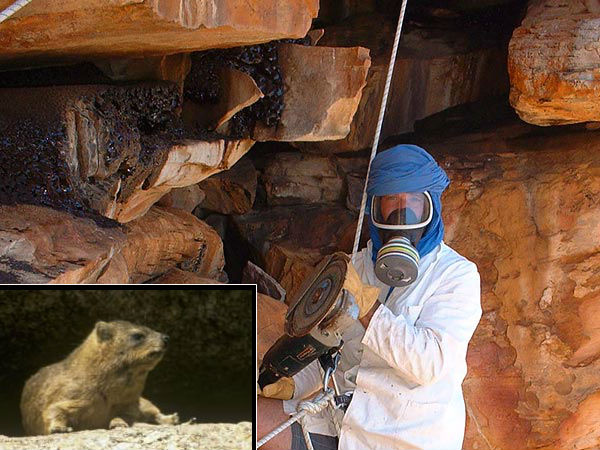
When it comes to peering into Africa’s climate past, the ancient homes of hyraxes are number one. Paleoclimatologists typically dig up muddy core samples and analyze their pollen content for clues to long-ago weather, but parts of southern and central Africa are too dry to preserve such evidence. Enter the rock hyrax (Procavia capensis) (inset), a furry mammal that looks like a large groundhog but is actually a distant cousin of the elephant. Brian Chase, a geographical scientist at the University of Montpellier in France, turned to urine accretions left by the animals thousands of years ago; hyrax colonies use the same rock shelters for generation after generation, depositing pollen, calcium remnants, charcoal particles, stable isotopes, and other detritus in their urine (black splotches on rock in main image). Most climate models predict arid conditions in southern Africa 12,000 years ago, but the pollen content of hyrax urine from that period indicates that they ate grasses, which flourish in wetter conditions Chase, who reported his findings here today at the annual meeting of the American Association for the Advancement of Science (which publishes ScienceNOW), believes his method can be used to give researchers a wealth of data to improve their models of Africa’s paleohistory. “You can turn a 2-meter pile of pee into a very nice section which you can bring back to the lab,” he told the audience. “These are very high-resolution records.”

http://news.sciencemag.org/sciencenow/2013/02/scienceshot-ancient-pee-provides.html?ref=hp

Thanks to Dr. Rajadhyaksha for bringing this to the attention of the It’s Intereting community.

Ancient fish had circular-saw jaw

sn-heliocoprion

An ancient fish that sported a saw blade-like whorl of serrated teeth—and was long presumed to be a member of the shark family—actually belonged to a different but closely related group, a new study suggests. Members of the genus Helicoprion were first described in 1899, but fossils have been notoriously incomplete, with most including only spiral groupings of teeth. Although some fossils have also preserved hints of cartilaginous tissue, none have included the braincase or postcranial parts of these fish. Accordingly, scientists never came up with a convincing idea of what these creatures looked like, with some teams suggesting the whorls sprouted from the nose like an elephant’s trunk, and others placing toothy appendages on the creature’s tail, dorsal fins, or drooping from the lower jaw. Now, an x-ray CT scan of a particularly well-preserved fossil unearthed in Idaho in 1950—one that includes 117 teeth, the cartilage on which they were attached, and part of the upper jaw—reveals that the whorl resided within the animal’s lower jaw (artist’s concept above), researchers reported in Biology Letters. The size and shape of the upper jaw fragment suggests that the creature was about 4 meters long, with some other species in the Helicoprion genus measuring almost twice that length. The arrangement of tissues in the animal’s lower jaw, including those previously hidden by the rock that entombs them, definitively shows that Helicoprion is not a shark, the researchers say. Instead, the genus is nestled firmly within a group of cartilaginous fish known as chimaera, a lineage that includes species commonly known as ghost sharks and ratfish.

http://news.sciencemag.org/sciencenow/2013/02/scienceshot-ancient-fish-sported.html?ref=em

Thanks to Dr. Rajadhyaksha for bringing this to the attention of the It’s Interesting community.

Doubts about Johns Hopkins research have gone unanswered, scientist says

JN2_2846a1360362374

Daniel Yuan, pictured at his home in Laurel, raised doubts for years about the work of his colleagues in a Johns Hopkins medical research lab. “The denial that I am hearing from almost everyone in the group as a consensus is troubling to me,” he wrote in one e-mail. In December 2011, after 10 years at the lab, he was fired.

By Peter Whoriskey
The Washington Post Published: March 11
The numbers didn’t add up.

Over and over, Daniel Yuan, a medical doctor and statistician, couldn’t understand the results coming out of the lab, a prestigious facility at Johns Hopkins Medical School funded by millions from the National Institutes of Health.

He raised questions with the lab’s director. He reran the calculations on his own. He looked askance at the articles arising from the research, which were published in distinguished journals. He told his colleagues: This doesn’t make sense.

“At first, it was like, ‘Okay — but I don’t really see it,’ ” Yuan recalled. “Then it started to smell bad.”

His suspicions arose as reports of scientific misconduct have become more frequent and critics have questioned the willingness of universities, academic journals and the federal government, which pays for much of the work, to confront the problem.

Eventually, the Hopkins research, which focused on detecting interactions between genes, would win wide acclaim and, in a coup for the researchers, space in the pages of Nature, arguably the field’s most prestigious journal. The medical school even issued a news release when the article appeared last year: “Studies Linked To Better Understanding of Cancer Drugs.”

What very few readers of the Nature paper could know, however, was that behind the scenes, Yuan’s doubts seemed to be having profound effects.

In August, Yu-yi Lin, the lead author of the paper, was found dead in his new lab in Taiwan, a puncture mark in his left arm and empty vials of sedatives and muscle relaxants around him, according to local news accounts — an apparent suicide.

And within hours of this discovery, a note was sent from Lin’s e-mail account to Yuan. The e-mail, which Yuan saved, essentially blamed him for driving Lin to suicide. Yuan had written to Nature’s editors, saying that the paper’s results were overstated and that he found no evidence that the analyses described had actually been conducted. On the day of his death, Lin, 38, the father of three young daughters, was supposed to have finished writing a response to Yuan’s criticisms.

The subject line of the e-mail to Yuan, sent by an unknown person, said “your happy ending.”

“Yu-yi passed away this morning. Now you must be very satisfied with your success,” the e-mail said.

Yuan said he was shocked by the note, so much so that he began to shake.

But in the seven months since, he has wondered why no one — not the other investigators on the project, not the esteemed journal, not the federal government — has responded publicly to the problems he raised about the research.

The passions of scientific debate are probably not much different from those that drive achievement in other fields, so a tragic, even deadly dispute might not be surprising.

But science, creeping ahead experiment by experiment, paper by paper, depends also on institutions investigating errors and correcting them if need be, especially if they are made in its most respected journals.

If the apparent suicide and Yuan’s detailed complaints provoked second thoughts about the Nature paper, though, there were scant signs of it.

The journal initially showed interest in publishing Yuan’s criticism and told him that a correction was “probably” going to be written, according to e-mail rec­ords. That was almost six months ago. The paper has not been corrected.

The university had already fired Yuan in December 2011, after 10 years at the lab. He had been raising questions about the research for years. He was escorted from his desk by two security guards.

More recently, a few weeks after a Washington Post reporter began asking questions, a university spokeswoman said that a correction had been submitted to Nature and that it was under review.

“Your questions will be addressed with that publication,” a spokeswoman for the Hopkins medical school, Kim Hoppe, wrote in an e-mail.

Neither the journal nor the university would disclose the nature of the correction.

Hoppe declined an opportunity to have university personnel sit for interviews.

In the meantime, the paper has been cited 11 times by other published papers building on the findings.

It may be impossible for anyone from outside to know the extent of the problems in the Nature paper. But the incident comes amid a phenomenon that some call a “retraction epidemic.”

Last year, research published in the Proceedings of the National Academy of Sciences found that the percentage of scientific articles retracted because of fraud had increased tenfold since 1975.

The same analysis reviewed more than 2,000 retracted biomedical papers and found that 67 percent of the retractions were attributable to misconduct, mainly fraud or suspected fraud.

“You have a lot of people who want to do the right thing, but they get in a position where their job is on the line or their funding will get cut, and they need to get a paper published,” said Ferric C. Fang, one of the authors of the analysis and a medical professor at the University of Washington. “Then they have this tempting thought: If only the data points would line up . . . ”

Fang said retractions may be rising because it is simply easier to cheat in an era of digital images, which can be easily manipulated. But he said the increase is caused at least in part by the growing competition for publication and for NIH grant money.

He noted that in the 1960s, about two out of three NIH grant requests were funded; today, the success rate for applicants for research funding is about one in five. At the same time, getting work published in the most esteemed journals, such as Nature, has become a “fetish” for some scientists, Fang said.

In one sense, the rise in retractions may mean that the scientific enterprise is working — bad work is being discovered and tossed out. But many observers note that universities and journals, while sometimes agreeable to admitting small mistakes, are at times loath to reveal that the essence of published work was simply wrong.

“The reader of scientific information is at the mercy of the scientific institution to investigate or not,” said Adam Marcus, who with Ivan Oransky founded the blog Retraction Watch in 2010. In this case, Marcus said, “if Hopkins doesn’t want to move, we may not find out what is happening for two or three years.”

The trouble is that a delayed response — or none at all — leaves other scientists to build upon shaky work. Fang said he has talked to researchers who have lost months by relying on results that proved impossible to reproduce.

Moreover, as Marcus and Oransky have noted, much of the research is funded by taxpayers. Yet when retractions are done, they are done quietly and “live in obscurity,” meaning taxpayers are unlikely to find out that their money may have been wasted.

Johns Hopkins University typically receives more than $600 million a year from NIH, according to NIH figures.

For someone who has taken on a battle with Johns Hopkins and Nature, Yuan is strikingly soft-spoken.

He grew up in Gainesville, Fla., and attended MIT and then medical school at Johns Hopkins. He worked briefly as a pediatrician and an assistant professor of pediatrics before deciding that he preferred pure research. He has a wife and two kids and is an accomplished violinist.

In 2001, he joined the lab of Jef Boeke, a Hopkins professor of molecular biology and genetics. Boeke’s work on the yeast genome is, as academics put it, “highly cited” — that is, other papers have used some of his articles numerous times for support. Last year, he was named a member of the prestigious American Academy of Arts and Sci­ences.

The lab’s research focused on developing a methodology for finding evidence of genes interacting, primarily in the yeast genome and then in the human genome. Genetic interactions are prized because they yield insights into the traits of the genes involved.

During Yuan’s time there, the lab received millions in NIH funding, and according to internal e-mails, the people in the lab were under pressure to show results. Yuan felt the pressure, too, he says, but as the point person for analyzing the statistical data emerging from the experiments, he felt compelled to raise his concerns.

As far back as 2007, as the group was developing the methodology that would eventually form the basis of the Nature paper, Yuan wrote an anguished e-mail to another senior member of the lab, Pamela Meluh.

“I continue to be in a state of chronic alarm,” he wrote in August 2007. “The denial that I am hearing from almost everyone in the group as a consensus is troubling to me.”

Meluh quickly wrote back: “I have the same level of concern as you in terms of data quality, but I have less basis to think it can be better. . . . I’m always torn between addressing your and my own concerns and being ‘productive.’ ”

Then Boeke weighed in, telling Yuan that if he could improve the data analysis, he should, but that “the clock is ticking.”

“NIH has already given us way more time than we thought we needed and at some point we’ve got to suck it up and run with what we have,” Boeke wrote to Meluh and Yuan.

A few years later, another deadline was looming, and Elise Feingold, an NIH administrator, wanted to know what the lab had accomplished.

“I do need some kind of progress report on what you have been doing the past two years . . . and what you think you can accomplish with these funds,” she wrote to Boeke.

Citing Feingold’s message, ­Meluh wrote to Yuan, asking for help in explaining what the lab had produced. Its members had worked diligently, Yuan says, but hadn’t arrived at the kind of significant findings that generally produce scientific papers.

“I want to make it look like we’ve been busy despite lack of publications,” Meluh wrote.

Meluh did not respond to a request for an interview. Boeke referred questions to the university’s public relations team, which declined to comment further. An NIH official declined to comment.

While Yuan was growing increasingly skeptical of the lab’s methodology, Yu-yi Lin, who was also working at the lab, was trying to extend it. In the past, it had been applied to the yeast genome; Lin would extend it to the human genome — and this would become the basis of the Nature paper.

Lin, who was from Taiwan, was an up-and-comer. As a graduate student at Johns Hopkins just a few years before, he’d won an award for his work in cell metabolism and aging. He was also arranging for a prestigious spot at National Taiwan University.

At one point, when he was still at the Boeke lab at Hopkins, Lin asked Yuan to help analyze the data that would become the basis for the Nature paper, Yuan says. Yuan said he declined to get involved because he thought the methodology still had deep flaws.

Interactions between Lin and Yuan at the lab were few, Yuan said, and at any rate, Yuan had other things to worry about. He was slowly being forced out. He was demoted in 2011 from research associate to an entry-level position. A disagreement over whether Yuan should have asked Boeke if he wanted a byline on a paper erupted into further trouble, e-mail and other records show.

The Johns Hopkins spokeswoman, Hoppe, declined to discuss Yuan’s job termination.

On Dec. 15, 2011, Yuan was forced to leave the lab. He wasn’t allowed to make copies of his cell collection. He spent the next month trying to keep his mind busy. He read books about JavaScript and Photoshop, which he thought would enrich his research abilities. As he looked for other research jobs, he sensed that he had been blackballed.

Then, in February 2012, the Nature paper was published.

The research was a “profound achievement” that would “definitely be a great help to solve and to treat many severe diseases,” according to a news release from National Taiwan University, where Lin was now working.

Upon reading it, Yuan said, he was astonished that Lin had used what he considered a flawed method for finding genetic interactions. It had proved troublesome in the yeast genome, he thought. Could it have possibly been more reliable as it was extended to the human genome?

Lin, Boeke and their co-authors reported discovering 878 genetic interactions, or “hits.”

But Yuan, who was familiar with the data and the statistics, reanalyzed the data in the paper and concluded that there was essentially no evidence for any more than a handful of the 878 genetic interactions.

One of the key problems, Yuan wrote to the Nature editors, was that the numerical threshold the investigators used for determining when a hit had arisen was too low. This meant they would report far more hits than there actually were.

Yuan also calculated that, given the wide variability in the data and the relative precision required to find a true hit, it would have been impossible to arrive at any conclusions at all. By analogy, it would be like a pollster declaring a winner in an election when the margin of error was larger than the difference in the polling results.

“The overwhelming noise in the . . . data and the overstated strength of the genetic interactions together make it difficult to reconstruct any scientific process by which the authors could have inferred valid results from these data,” Yuan wrote to the editors of Nature in July.

His analysis attacks only the first portion of the paper; even if he is correct, the second part of the paper could be true.

Nevertheless, Yuan wanted Nature to publish his criticism, and following instructions from the journal, he forwarded his letter to Boeke and Lin, giving them two weeks to respond.

Just as the two weeks were to elapse, Boeke wrote to Nature asking for an extension of time — “a couple weeks or more” — to address Yuan’s criticism. Boeke explained that end-of-summer schedules and the multiple co-authors made it difficult to respond on time.

A day later, Lin was discovered dead in his office at National Taiwan University.

“Renowned scientist found dead, next to drug bottles,” the headline in the Taipei Times said.

Even in his death, the Nature paper was a kind of shorthand for Lin’s scientific success.

“A research team [Lin] led was featured in the scientific journal Nature in February for their discovery of the key mechanism for maintaining cell energy balance — believed to be linked to cellular aging and cancer,” the newspaper said.

If there was a suicide note, it has not been made public, and it is difficult to know what went through Lin’s mind at the end of his life. The apparent suicide and the e-mail to Yuan suggest only that Lin may have been distraught over the dispute; they do not prove that he acted improperly.

Shortly after the Nature paper appeared, Yuan hired lawyer Lynne Bernabei to challenge the way he was terminated at Hopkins.

In late August, Yuan asked the Nature editors again whether they would publish his criticism. Lin was dead, but Boeke and the others had had a month to respond, and Yuan hadn’t heard a thing.

On Sept. 28, a Nature editor informed Yuan by e-mail that the journal was still waiting on a fuller response from Boeke and that “experiments are being done and probably a Correction written.”

Such a correction has not appeared.

So as a last attempt, he figured he’d try the federal government, which paid for much of the research. But the government suggested that the threat to the federal research, if there was any, ended with Lin’s death.

“It is our understanding that these allegations are being investigated by Johns Hopkins University,” said the letter from the Office of Research Integrity.

Besides, it noted, the person responsible for the paper was Lin.

“Deceased respondents no longer pose a risk,” the letter said.

http://www.washingtonpost.com/business/economy/doubts-about-johns-hopkins-research-have-gone-unanswered-scientist-says/2013/03/11/52822cba-7c84-11e2-82e8-61a46c2cde3d_story_4.html

Thanks to Kebmodee for bringing this to the attention of the It’s Interesting community.

Strange new creature pushes fossil record back 200 million years

fossil

Christopher Cameron of the University of Montreal’s Department of Biological Sciences and his colleagues have unearthed a major scientific discovery — a strange phallus-shaped creature they found in Canada’s Burgess Shale fossil beds, located in Yoho National Park. The fossils were found in an area of shale beds that are 505 million years old.

Their study, published online in the journal Nature on March 13, 2013, confirms Spartobranchus tenuis is a member of the acorn worms group which are seldom-seen animals that thrive today in the fine sands and mud of shallow and deeper waters. Acorn worms are themselves part of the hemichordates, a group of marine animals closely related to today’s sea stars and sea urchins. “Unlike animals with hard parts including teeth, scales and bones, these worms were soft-bodied, so their fossil record is extremely rare,” said author Dr. Chris Cameron of the University of Montreal. “Our description of Spartobranchus tenuis, a creature previously unknown to science, pushes the fossil record of the enteropneusts back 200 million years to the Cambrian period, fundamentally changing our understanding of biodiversity from this period.”

Since their discovery in the 19th-century, some of the biggest questions in hemichordate evolution have focused on the group’s origins and the relationship between its two main branches: the enteropneusts and the pterobranchs, including graptolites. “One of the big punchlines from my graduate work, was molecular evidence that enteropneusts and pterobranchs are closely related” said Cameron, a specialist on the taxonomy, evolution and biogeography of hemichordates.

“It’s astonishing how similar Spartobranchus tenuis fossils are to modern day acorn worms, except that they also formed fibrous tubes.” The tubes provide a key missing link that connects the two main hemichordate groups. “The explosive radiation of graptolites in the Paleozoic planktonic ecosystems is known only from the diversity of their tubes. Our findings suggest that the tubes were lost in the lineage leading to modern day enteropneusts, but elaborated on in graptolites and retained to the present day in pterobranchs” added Cameron.

Hemichordates also share many of the same characteristics as chordates — a group of animals that includes humans — with the name hemichordate roughly translating to ‘half a chordate.’

“Work from my lab has shown that enteropneusts filter feed using a pharynx perforated with gill slits, just like the invertebrate chordates” added Cameron. Spartobranchus tenuisprobably fed on small particles of matter filtered from the seawater. “There are thousands of specimens at the Walcott Quarry in Yoho National Park, so it’s possible Spartobranchus tenuis may have played an important role in moving carbon from the water column to the sediment in the early Burgess Shale environment” said Cameron.

Detailed analysis suggests Spartobranchus tenuis had a flexible body consisting of a short proboscis, collar and narrow elongate trunk terminating in a bulbous structure, which may have served as an anchor. The largest complete specimens examined were 10 centimetres long with the proboscis accounting for about half a centimetre. A large proportion of these worms was preserved in tubes, of which some were branched, suggesting the tubes were used as a dwelling structure.

Other members of the Spartobranchus tenuis research team are lead author Jean-Bernard Caron of the Royal Ontario Museum and Simon Conway Morris of the University of Cambridge.

http://www.sciencedaily.com/releases/2013/03/130313141450.htm

Guide dog for blind dog

blind_dog

A caring terrier has taken on the role as guide-dog for his blind labrador brother. Little crossbreed terrier Milo, six, acts as seven-year-old Eddie’s eyes to play and bring him back to proud owner Angie Baker-Stedham when they’re out and about. He can even be seen pulling Eddie along by a lead. Angie, 45, says the heartwarming pair from Cardiff are joined at the hip. She said: “Before Eddie went blind they both used to chase after dog toys, but now Eddie relies on Milo to help him play and they love going into the woods.

“Milo has always got his eye on Eddie and even sits on Eddie’s back when he lies down. I first noticed that Eddie was going blind last year when he started to walk into wheelie bins and walls. It happened so quickly which is sad because before they used to play together so easily. Now Milo helps me to fetch Eddy when I call for him. He leads Eddie all the way back to me.”

Milo took on the role of his assistance dog with no training. Angie said: “Milo really cares for Eddie, he always licks his face, they sleep in the same room and spend all their time together. Without Milo, Eddie would be lost. It’s a wonderful relationship and improves Eddie’s quality of life, as his blindness is incurable.”

http://www.mirror.co.uk/news/uk-news/guide-dog-blind-dog-caring-1748005

Astrobiologists Find Ancient Fossils in Fireball Fragments

Polonnaruwa%20meteorite

On 29 December 2012, a fireball lit up the early evening skies over the Sri Lankan province of Polonnaruwa. Hot, sparkling fragments of the fireball rained down across the countryside and witnesses reported the strong odour of tar or asphalt.

Over the next few days, the local police gathered numerous examples of these stones and sent them to the Sri Lankan Medical Research Institute of the Ministry of Health in Colombo. After noticing curious features inside these stones, officials forwarded the samples to a team of astrobiologists at Cardiff University in the UK for further analysis.

The results of these tests, which the Cardiff team reveal today, are extraordinary. They say the stones contain fossilised biological structures fused into the rock matrix and that their tests clearly rule out the possibility of terrestrial contamination.

In total, Jamie Wallis at Cardiff University and a few buddies received 628 stone fragments collected from rice fields in the region. However, they were able to clearly identify only three as possible meteorites.

The general properties of these three stones immediately mark them out as unusual. One stone, for example, had a density of less than 1 gram per cubic centimetre, less than all known carbonaceous meteorites. It had a partially fused crust, good evidence of atmospheric heating, a carbon content of up to 4 per cent and contained an abundance of organic compounds with a high molecular weight, which is not unknown in meteorites. On this evidence, Wallis and co think the fireball was probably a small comet.

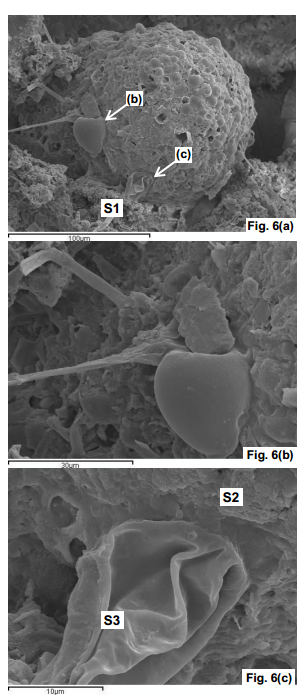
The most startling claims, however, are based on electron microscope images of structures within the stones (see above). Wallis and co say that one image shows a complex, thick-walled, carbon-rich microfossil about 100 micrometres across that bares similarities with a group of largely extinct marine dinoflagellate algae.

They say another image shows well-preserved flagella that are 2 micrometres in diameter and 100 micrometres long. By terrestrial standards, that’s extremely long and thin, which Wallis and co interpret as evidence of formation in a low-gravity, low-pressure environment.

Wallis and co also measured the abundance of various elements in the samples to determine their origin. They say that low levels of nitrogen in particular rule out the possibility of contamination by modern organisms which would have a much higher nitrogen content. The fact that these samples are also buried within the rock matrix is further evidence, they say.

Wallis and co are convinced that the lines of evidence they have gathered are powerful and persuasive. “This provides clear and convincing evidence that these obviously ancient remains of extinct marine algae found embedded in the Polonnaruwa meteorite are indigenous to the stones and not the result of post-arrival microbial contaminants,” they conclude.

There’s no question that a claim of this kind is likely to generate controversy. Critics have already pointed out that the stones could have been formed by lightning strikes on Earth although Wallis and co counter by saying there was no evidence of lightning at the time of the fireball and that in any case, the stones do not bear the usual characteristics of this kind of strike. What’s more, the temperatures generated by lightning would have destroyed any biological content.

Nevertheless, extraordinary claims require extraordinary evidence and Wallis and co will need to make their samples and evidence available to the scientific community for further study before the claims will be taken seriously.

If the paper is taken at face value, one obvious question that arises is where these samples came from. Wallis and co have their own ideas: “The presence of fossilized biological structures provides compelling evidence in support of the theory of cometary panspermia first proposed over thirty years ago,” they say.

This is an idea put forward by Fred Hoyle and Chandra Wickramasinghe, the latter being a member of the team who has carried out this analysis.

There are other explanations, of course. One is that the fireball was of terrestrial origin, a remnant of one of the many asteroid impacts in Earth’s history that that have ejected billions of tonnes of rock and water into space, presumably with biological material inside. Another is that the structures are not biological and have a different explanation.

Either way, considerably more work will have to be done before the claims from this team can be broadly accepted. Exciting times ahead!

http://www.technologyreview.com/view/512381/astrobiologists-find-ancient-fossils-in-fireball-fragments/

Thanks to Kebmodee for bringing this to the attention of the It’s Interesting community.
Supermassive black hole spins at nearly the speed of light

blackhole
This artist’s concept illustrates a supermassive black hole with millions to billions times the mass of our sun. It’s surrounded by matter flowing onto the black hole in what is termed an accretion disk. Also shown is an outflowing jet of energetic particles, believed to be powered by the black hole’s spin. High energy X-radiation lights up the disk, which reflects it, making the disk a source of X-rays. The reflected light enables astronomers to see how fast matter is swirling in the inner region of the disk, and ultimately to measure the black hole’s spin rate.

Nothing can escape a black hole, even light, because to wrench away from its titanic gravitational pull, you’d have to move faster than light is capable of traveling. And nothing can do that, as far as anyone knows. As matter falls into a black hole’s gaping maw, it superheats to millions of degrees, screaming a final cry of X-rays as it is torn apart. At a specific point called an event horizon, the matter disappears and is never heard from again.

A pair of X-ray telescopes recently watched some of these X-ray death gasps and were able to figure out how fast a black hole is spinning. This is “hugely important” for black hole science, according to researchers working with NASA’s Nuclear Spectroscopic Telescope Array, or NuSTAR space telescope. One particularly cool finding: The black hole is spinning almost as fast as Einstein’s theory of gravity says it possibly could. It’s spinning at almost the speed of light.

The galaxy in question is called NGC 1365, which is about twice the size of the Milky Way and located about 60 million light years away. The black hole is about 2 million times more massive than the sun. Scientists using NuSTAR and the European Space Agency’s XMM-Newton satellite wanted to measure how fast it is spinning. This is a key feature of black holes that is related to their size and the way they gobble up stars, gas and even other black holes.

The problem is that black holes are hard to study, because, you know, not even light can escape them. To measure them, you have to measure their effect on their surroundings–like the X-rays emitted by dying matter. This is hard to do because objects between us and them can get in the way, however, making the X-rays look distorted. There have been two competing models explaining why the X-rays look warped: Either gravitational distortion caused by black hole gravity, or distortion caused by intervening clouds of gas and dust.

In this new study, NuSTAR and XMM-Newton set out to determine which one is right. The telescopes carefully traced the X-rays emitted at the very, very edge of the black hole, right near the event horizon, or the point of no return. By combining their distinct viewing abilities, the two telescopes were able to see a wide range of X-ray energies, and figure out that the X-rays are not actually distorted by intervening gas clouds. They look distorted because the black hole is spinning, and its immense gravity warps spacetime as it swirls around. This information was used to tell just how fast the black hole is spinning: Just below the universal speed limit.

Along with new information about this particular black hole, this study suggests that black hole observations can remove a little bit of ambiguity. This will help astronomers continue to unravel the mysteries of these galactic monsters. A paper describing the findings is published last week in Nature.

http://www.popsci.com/science/article/2013-02/new-telescope-discovery-distant-gargantuan-black-hole-spins-near-light-speed