
Thanks to Shauna for bringing this to the attention of the It’s Interesting community.
Category: Nature
Physicists discover ‘clearest evidence yet’ that the Universe is a hologram


At a black hole, Albert Einstein’s theory of gravity apparently clashes with quantum physics, but that conflict could be solved if the Universe were a holographic projection.
A team of physicists have provided what has been described by the journal Nature as the “clearest evidence yet” that our universe is a hologram.
The new research could help reconcile one of modern physics’ most enduring problems : the apparent inconsistencies between the different models of the universe as explained by quantum physics and Einstein’s theory of gravity.
The two new scientific papers are the culmination of years’ work led by Yoshifumi Hyakutake of Ibaraki University in Japan, and deal with hypothetical calculations of the energies of black holes in different universes.
The idea of the universe existing as a ‘hologram’ doesn’t refer to a Matrix-like illusion, but the theory that the three dimensions we perceive are actually just “painted” onto the cosmological horizon – the boundary of the known universe.
If this sounds paradoxical, try to imagine a holographic picture that changes as you move it. Although the picture is two dimensional, observing it from different locations creates the illusion that it is 3D.
This model of the universe helps explain some inconsistencies between general relativity (Einstein’s theory) and quantum physics. Although Einstein’s work underpins much of modern physics, at certain extremes (such as in the middle of a black hole) the principles he outlined break down and the laws of quantum physics take over.
The traditional method of reconciling these two models has come from the 1997 work of theoretical physicist Juan Maldacena, whose ideas built upon string theory. This is one of the most well respected ‘theories of everything’ (Stephen Hawking is a fan) and it posits that one-dimensional vibrating objects known as ‘strings’ are the elementary particles of the universe.
Maldacena has welcomed the new research by Hyakutake and his team, telling the journal Nature that the findings are “an interesting way to test many ideas in quantum gravity and string theory.”
Leonard Susskind, a theoretical physicist regarded as one of the fathers of string theory, added that the work by the Japanese team “numerically confirmed, perhaps for the first time, something we were fairly sure had to be true, but was still a conjecture.”
Here is the original press release from Nature:
A team of physicists has provided some of the clearest evidence yet that our Universe could be just one big projection.
In 1997, theoretical physicist Juan Maldacena proposed1 that an audacious model of the Universe in which gravity arises from infinitesimally thin, vibrating strings could be reinterpreted in terms of well-established physics. The mathematically intricate world of strings, which exist in nine dimensions of space plus one of time, would be merely a hologram: the real action would play out in a simpler, flatter cosmos where there is no gravity.
Maldacena’s idea thrilled physicists because it offered a way to put the popular but still unproven theory of strings on solid footing — and because it solved apparent inconsistencies between quantum physics and Einstein’s theory of gravity. It provided physicists with a mathematical Rosetta stone, a ‘duality’, that allowed them to translate back and forth between the two languages, and solve problems in one model that seemed intractable in the other and vice versa. But although the validity of Maldacena’s ideas has pretty much been taken for granted ever since, a rigorous proof has been elusive.
In two papers posted on the arXiv repository, Yoshifumi Hyakutake of Ibaraki University in Japan and his colleagues now provide, if not an actual proof, at least compelling evidence that Maldacena’s conjecture is true.
In one paper2, Hyakutake computes the internal energy of a black hole, the position of its event horizon (the boundary between the black hole and the rest of the Universe), its entropy and other properties based on the predictions of string theory as well as the effects of so-called virtual particles that continuously pop into and out of existence. In the other3, he and his collaborators calculate the internal energy of the corresponding lower-dimensional cosmos with no gravity. The two computer calculations match.
“It seems to be a correct computation,” says Maldacena, who is now at the Institute for Advanced Study in Princeton, New Jersey and who did not contribute to the team’s work.
The findings “are an interesting way to test many ideas in quantum gravity and string theory”, Maldacena adds. The two papers, he notes, are the culmination of a series of articles contributed by the Japanese team over the past few years. “The whole sequence of papers is very nice because it tests the dual [nature of the universes] in regimes where there are no analytic tests.”
“They have numerically confirmed, perhaps for the first time, something we were fairly sure had to be true, but was still a conjecture — namely that the thermodynamics of certain black holes can be reproduced from a lower-dimensional universe,” says Leonard Susskind, a theoretical physicist at Stanford University in California who was among the first theoreticians to explore the idea of holographic universes.
Neither of the model universes explored by the Japanese team resembles our own, Maldacena notes. The cosmos with a black hole has ten dimensions, with eight of them forming an eight-dimensional sphere. The lower-dimensional, gravity-free one has but a single dimension, and its menagerie of quantum particles resembles a group of idealized springs, or harmonic oscillators, attached to one another.
Nevertheless, says Maldacena, the numerical proof that these two seemingly disparate worlds are actually identical gives hope that the gravitational properties of our Universe can one day be explained by a simpler cosmos purely in terms of quantum theory.
http://www.nature.com/news/simulations-back-up-theory-that-universe-is-a-hologram-1.14328#/b1
Whales trapped in Everglades waters
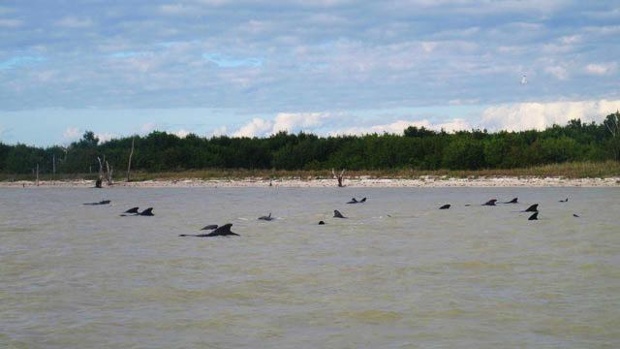
Wildlife workers in boats struggled Wednesday to coax nearly four dozen pilot whales out of dangerous shallow waters in Florida’s Everglades National Park, hoping to spare them the fate of 10 others that already have died.
Four of the whales had to be euthanized Wednesday, and six others already had died, said Blair Mase, the marine mammal stranding network coordinator for the National Oceanic and Atmospheric Administration. At least three could be seen on the beach, out of the water.
Park spokeswoman Linda Friar said rescuers were trying to surround the whales with boats about 75 feet from shore and nudge them out of the roughly 3-foot-deep salt water back to sea.
“They are trying to herd the animals out to sea,” Friar said. “They are not cooperating.”
Workers tried to nudge the whales out to sea a day earlier with no success. The whales are stranded in a remote area that takes more than an hour to reach by boat from the nearest boat ramp.
“This scenario is very challenging because of where they are,” Mase said. Officials typically have access to heavy equipment to rescue stranded whales, but that isn’t an option where the whales are now.
Furthermore, the area is so shallow that it’s difficult to get the mammals enough water to propel them back to sea. A team of biologists was still assessing the whales Wednesday.
Officials don’t know how long the whales been stranded or how they got there. The whales usually swim together in large groups and tend to follow a dominant male leader, so it’s not uncommon for multiple whales to get stranded at once.
At least one other group of whales has stranded in the park in the past 10 years.
“It’s not uncommon,” Friar said. “But it’s not something that happens a lot.”
Mase said the whales are known to inhabit deep water, “so they are very out of their home range.”
http://www.theguardian.com/environment/2013/dec/04/whales-trapped-everglades-florida-park
Thanks to Dr. D for bringing this to the attention of the It’s Interesting community.
Sexual frustration shortens the life of the fruit fly

Sexually frustrated fruit flies die earlier, new research suggests.
Scientists made the discovery by genetically modifying male flies to release female sex pheromones. Other males were left nearby and therefore instantly aroused by the pheromones. Some were allowed to mate, but others weren’t.
The findings, published in the journal Science, show that the sexually frustrated flies’ lives were 40 per cent shorter, while those who did mate suffered less stress.
Dr Scott Pletcher, Assistant Professor of Molecular & Integrative Physiology at the University of Michigan, co-authored the research. He told the BBC: “We immediately observed that (the non-mating flies) looked quite sick very soon in the presence of these effeminised males.”
A brain chemical, neuropeptide F (NPF), appeared to play a big role. NPF levels went up once flies were aroused. It would normally go down again upon mating.
But when it stayed high, it caused the stress and apparently the premature deaths.
Dr Pletcher went on: “Evolutionarily we hypothesise the animals are making a bet to determine that mating will happen soon.
“Those that correctly predict may be in a better position, they either produce more sperm or devote more energy to reproduction in expectation, and this may have some consequences [if they do not mate].”
Thanks to Dr. D for bringing this to the attention of the It’s Interesting community.
Bonobos facing extinction
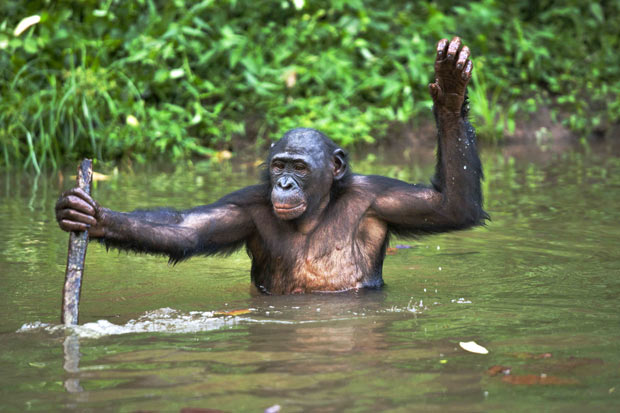
The rare Bonobo ape – formerly known as the pygmy chimpanzee – faces a serious menace to its continued survival due to the activities of humans, scientists say.
The bonobo is perhaps most widely known for being one of the few species apart from some humans (and as it turns out, fruitbats) to routinely perform fellatio as part of sexual activity. A new scientific study reveals, however, that the fun-loving apes’ very survival is seriously threatened by predatory humans.
“Bonobos that live in closer proximity to human activity and to points of human access are more vulnerable,” says Dr Janet Nackoney, a professor at Maryland uni. “Our results point to the need for more places where bonobos can be safe … which is an enormous challenge in the [war-torn Congo, which is the only place the bonobos are found].”
A press release issued to highlight Nackoney and her colleagues’ study says:
The bonobo is smaller in size and more slender in build than the common chimpanzee. The great ape’s social structure is complex and matriarchal. Unlike the common chimpanzee, bonobos establish social bonds and diffuse tension or aggression with sexual behaviors.
It seems that human aggression is a major problem for the bonobo, which perhaps understandably “avoids areas of high human activity …
“As little as 28 percent of the bonobo’s range remains suitable,” the press announcement adds.
“For bonobos to survive over the next 100 years or longer, it is extremely important that we understand the extent of their range, their distribution, and drivers of that distribution,” says Ashley Vosper of the Wildlife Conservation Society. “Bonobos are probably the least understood great ape in Africa, so this paper is pivotal in increasing our knowledge and understanding of this beautiful and charismatic animal.”
Despite the bonobos’ somewhat louche reputation, it seems that there’s nothing salacious about local humans’ interest in them: but the people of the area do hunt apes and monkeys for food, and destruction or partial destruction of forest by farmers is also a major turn-off for the cheery apes. Scientists hope that more terrain suitable for bonobos to live in can be classified as national park – or perhaps discovered within existing parks or otherwise-protected areas.
“The future of the bonobo will depend on the close collaboration of many partners working towards the conservation of this iconic ape,” says Dr Liz Williamson of the International Union for Conservation and Nature Primate Specialist Group.
The new study is published in the journal Biodiversity and Conservation
Thanks to Dr. Lutter for bringing this to the attention of the It’s Interesting community.
How the Whale Became the Whale

About 54 million years ago, a semiaquatic deerlike creature headed into the water for good, giving rise to whales and their relatives. The newly sequenced genome of the minke whale, a baleen whale found worldwide, tells the story of how stressful this move to live underwater was. An international team has decoded the genomes of four minke whales, a fin whale, a bottlenose dolphin, and a finless porpoise, comparing these cetaceans’ genes to the equivalent genes in other mammals. It found whale-specific mutations in genes important for the regulation of salt and of blood pressure and for antioxidants that get rid of charged oxygen molecules that can harm cells. These molecules increase in number as the whale uses up its oxygen supply during dives. Whales also had larger numbers of related genes, called gene families, for dealing with sustained dives, the team reports online today in Nature Genetics. Overall, 1156 gene families had expanded, and several increased the number of enzymes that help the whale cope with low-to-no oxygen conditions. A few of those expanded families are also expanded in naked mole rats, which live underground where oxygen is scarce. But the numbers of genes for body hair and for taste and smell had decreased. And of course, there were genes and gene families that help explain why whales look the way they do.
http://news.sciencemag.org/biology/2013/11/scienceshot-how-whale-became-whale
Thanks to Dr. Rajadhyaksha for bringing this to the attention of the It’s Interesting community.
Desert Farming Experiment Yields First Results

A project to “green” desert areas with an innovative mix of technologies—producing food, biofuel, clean water, energy, and salt—reached a milestone this week in the Gulf state of Qatar. A pilot plant built by the Sahara Forest Project (SFP) produced 75 kilograms of vegetables per square meter in three crops annually, comparable to commercial farms in Europe, while consuming only sunlight and seawater. The heart of the SFP concept is a specially designed greenhouse. At one end, salt water is trickled over a gridlike curtain so that the prevailing wind blows the resulting cool, moist air over the plants inside. This cooling effect allowed the Qatar facility to grow three crops per year, even in the scorching summer. At the other end of the greenhouse is a network of pipes with cold seawater running through them. Some of the moisture in the air condenses on the pipes and is collected, providing a source of fresh water.
One of the surprising side effects of such a seawater greenhouse, seen during early experiments, is that cool moist air leaking out of it encourages other plants to grow spontaneously outside. The Qatar plant took advantage of that effect to grow crops around the greenhouse, including barley and salad rocket (arugula), as well as useful desert plants. The pilot plant accentuated this exterior cooling with more “evaporative hedges” that reduced air temperatures by up to 10°C. “It was surprising how little encouragement the external crops needed,” says SFP chief Joakim Hauge.
The third key element of the SFP facility is a concentrated solar power plant. This uses mirrors in the shape of a parabolic trough to heat a fluid flowing through a pipe at its focus. The heated fluid then boils water, and the steam drives a turbine to generate power. Hence, the plant has electricity to run its control systems and pumps and can use any excess to desalinate water for irrigating the plants.
The Qatar plant has also experimented with other possibilities such as culturing heat-tolerant algae, growing salt-tolerant grasses for fodder or biofuel, and evaporating the concentrated saline the plant emits to produce salt.
The Qatar plant—which is supported by Qatari fertilizer companies Yara International and Qafco—is just 1 hectare in extent with 600 square meters of growing area in the greenhouse. The fact that this small greenhouse produced such good yields, Hauge says, suggests that a commercial plant—with possibly four crops a year—could do even better. SFP researchers estimate that a facility with 60 hectares of growing area under greenhouses could provide all the cucumbers, tomatoes, peppers, and egglants now imported into Qatar. The results “reveal the potential for enabling restorative growth and value creation in arid land,” Hauge says. “I personally think that it is very important that people promote and invest in these ideas. Protected agriculture (I call it “indoor food production”) is an important option for the desert areas, particularly in the Middle East,” says Richard Tutwiler, director of the Desert Development Center at the American University in Cairo. “The big question is economic feasibility. How much did it cost to produce 75 kg of cucumbers per square meter?”
SFP is now engaged in studies aimed at building a 20-hectare test facility near Aqaba in Jordan. “This will be a considerable scaling up from the 1 hectare in Qatar,” Hauge says, and big enough to demonstrate commercial operation.
http://news.sciencemag.org/asiapacific/2013/11/desert-farming-experiment-yields-first-results
Thanks to Kebmodee for bringing this to the attention of the It’s Interesting community.
Vets: Dogs overdose on drug-user poop

Vets in Berlin are warning about an increase in the number of pets falling ill and being unable to walk properly after eating the drug-users’ faeces in the city’s parks.
Parks in the Treptow and Kreuzburg areas of the capital see groups of drug users gathering – some of whom go to the toilet in the bushes. The results of which, the Tagesspiegel newspaper reported on Monday, are proving dangerous for dogs.
Vets told the newspaper that they had seen a rise in the number of dogs being brought in that had eaten human waste. Tests revealed that they had been poisoned by illegal drugs, like heroin, still present in the excrement.
Vet Reinhold Sassnau told the paper that symptoms include dehydration, shaking, an inability to walk properly and a rapid heartbeat. He sees a lot of these cases during his night shifts, he said.
If owners take their dog to a vet in time, the animal can be given an emetic which forces them to vomit up the faeces. If not, treatment can require staying in a clinic for some time to stabilize. Sassnau said fatal cases were rare.
One student, identified only as Malte, told the newspaper that he had to take his 10-year-old dog, Bob, to an emergency vet after walking him through Görlitzer Park, an area well-known for drug-dealing. “We thought he was going to die,” he said.
Jörn Bischof, the vet at the Charlottenburg clinic who treated Bob earlier in October, told the paper: “This is becoming more frequent.”
He added that although dogs are often tempted to eat waste they come across outdoors, owners should try to train them not to.
9 lousy places for a vacation
1. Buford, Wyoming
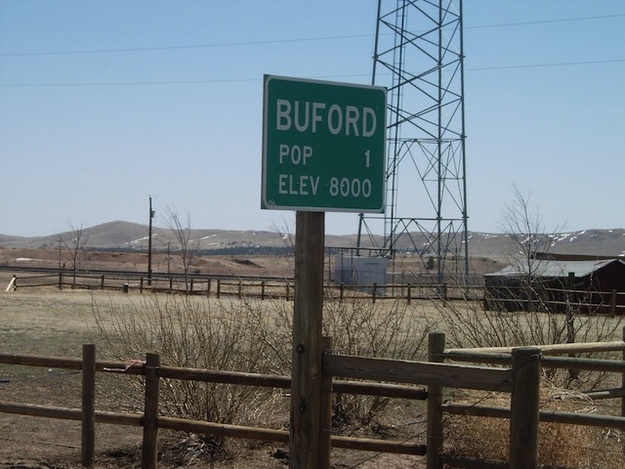
Formerly sporting a bustling population of two, Buford now only has a single resident.
2. The Great Pacific Garbage Patch
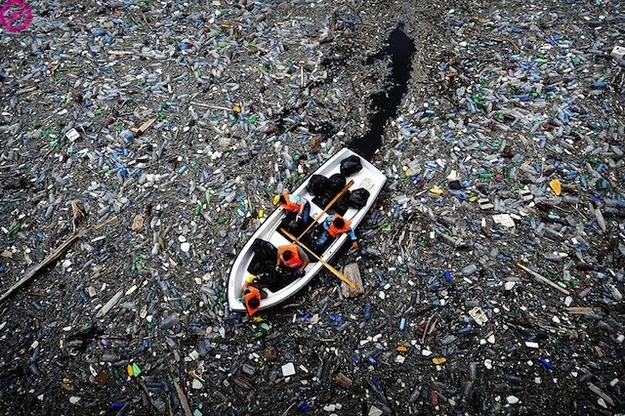
The Patch is a basically immobile, gigantic mass of trash out in the middle of the Pacific. Most estimates put its size—composed entirely of plastic bottles, chemical sludge, and basically any other kind of debris you can imagine—larger than the state of Texas. You’d probably rather go to Texas.
3. Alnwick Poison Garden, England
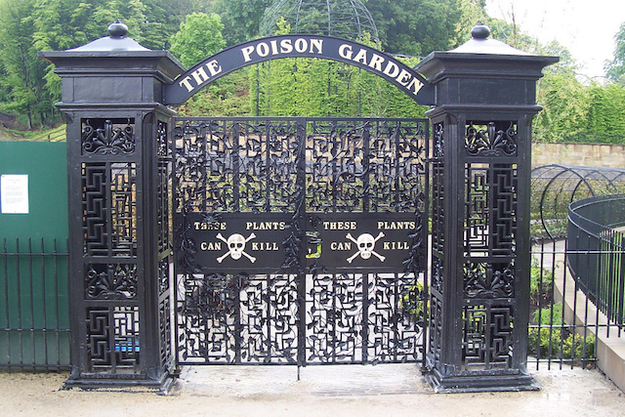
The Alnwick Poison Garden is pretty much what you’d think it is: a garden full of plants that can kill you (among many other things). Some of the plants are so dangerous that they have to be kept behind bars. It’s not exactly your typical stroll through a botanical garden.
4. Ramree Island, Burma

Ramree Island may be in the beautiful Burma, but nothing about this place is beautiful. It’s actually just a giant swamp full of thousands of saltwater crocodiles—which are the deadliest in the world—plus mosquitos loaded with malaria, oh, and venomous scorpions. Also, there was a six-week long battle here during WWII, in which only twenty Japanese soliders survived… out of 1000. And most were killed by the wildlife.
5. The Zone of Alienation, Ukraine

Although you probably wouldn’t want to vacation in Pripyat either, the Zone of Alienation is the 19-mile decommissioned perimeter surrounding the grounds of the Chernobyl incident. It’s administered by a branch of government specifically so that no-one is allowed into it, but there are a few hundred residents who refused to move. What’s wrong with those people? You probably don’t want to know
6. Ilha de Queimada Grande, Brazil
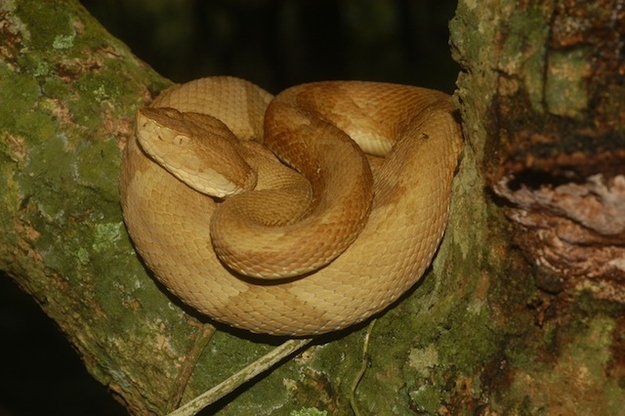
Sorry to tell you this, but Ilha de Queimada Grande isn’t a fantastical island getaway. It’s actually an island full of thousands of snakes. Its name literally means, “Snake Island.” It has the highest concentration of snakes in the world, with 1-5 golden lanceheads per square meter—oh, and they’re very poisonous: when designs were drawn up to build a plantation on the island, all the scouts were killed.
7. St. Helena
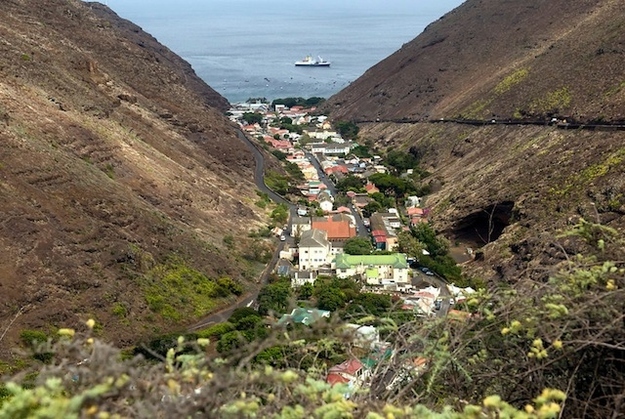
If you somehow end up in the same place where Napoleon was imprisoned and spent his final days, things are probably going wrong. Oh yeah, and there’s no functioning airport, either. The only way you can get on or off the island is via container ships from South Africa. Which only come every few months.
8. Izu Island, Japan
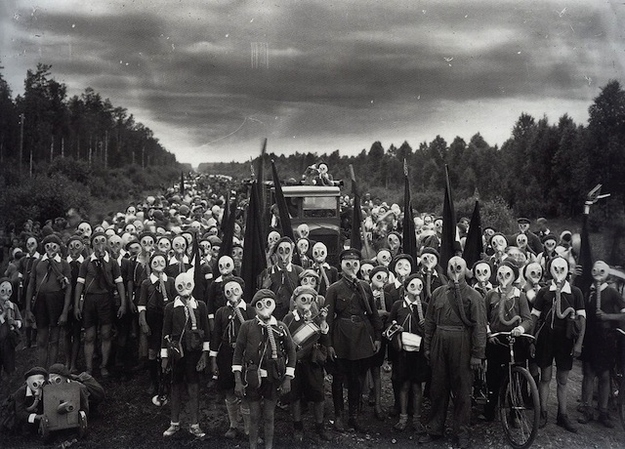
The Izus are a group of volcanic islands located off the southern coast of Japan’s Honshu island. They’re technically part of Tokyo, except because they’re extremely volcanic, the air constantly smells of sulfur and residents have been evacuated twice—in 1953 and 2000—because of “dangerously high levels of gas.” Although allowed back in 2005, inhabitants are now required to carry gas masks on their person at all times.
9. Mud Volcanoes of Azerbaijan
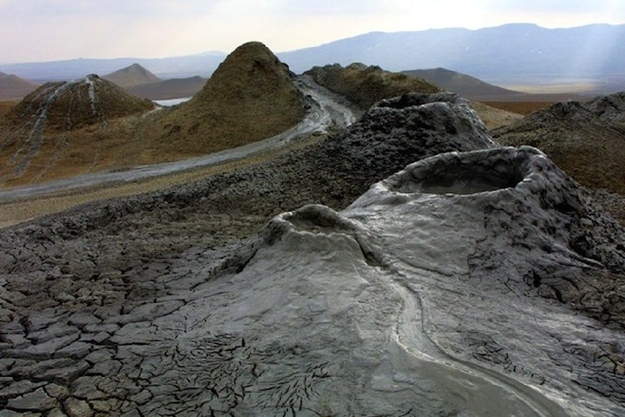
Sure, mud volcanoes aren’t nearly as dangerous as their cousins of the magmatic variety, but when they do actually erupt, it’s not exactly a pretty sight. In 2001, a new island grew out of the Caspian Sea, due to an increase in volcanic activity—right nearby where hundreds of these bad boys are. Generally, they go off every twenty years, and when they do, they shoot flames “hundreds of meters into the sky” and deposit tons of mud into the immediate area.
 It's Interesting