Woolly Mammoth DNA To Be Cloned, Then Joined With Elephant DNA To Create New Creature

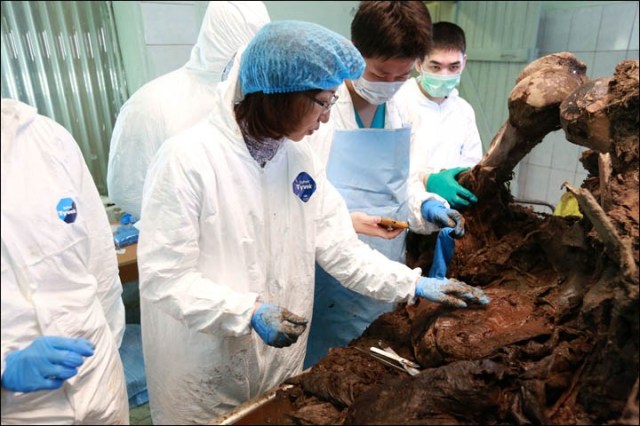
A team of international scientists are extracting high quality DNA from the remains of a woolly mammoth that lived 43,000 years ago, with the aim of joining it with the DNA of an elephant, they told The Siberian Times Thursday. Results from the necropsy of the woolly mammoth in Yakutsk, Sakha Republic — due to wind up Saturday after more than 10 months of analysis — has caused “palpable excitement” within the team of scientists, hailing from Russia, the UK, the United States, Denmark, South Korea, and Moldova.

“The data we are about to receive will give us a high chance to clone the mammoth,” Radik Khayrullin, vice president of the Russian Association of Medical Anthropologists, told The Siberian Times in Yakutsk. He urged responsibility in any attempts to clone the woolly mammoth. “It is one thing to clone it for scientific purpose, and another to clone for the sake of curiosity,” he said. Geneticists are reportedly searching for an Asian elephant whose egg could be injected with cloned material from the woolly mammoth. That same or another female elephant would be the surrogate mother of the resulting fertilzed egg. Any resulting wooly mammoth/elephant hybrid baby would have to be female, since there is no y-chromosome material from the wooly mammoth, who was a female. At any rate, such a procedure would take decades to perfect, experts said.

Semyon Grigoriev, head of the Museum of Mammoths of the Institute of Applied Ecology of the North at the North Eastern Federal University, told The Siberian Times that because the evolutionary paths of the mammoth and the elephant diverged so long ago, cloning will be challenging. However, the samples will allow geneticists to completely decode the DNA of the mammoth.

The Russian woolly mammoth was between 50 and 60 years old when she died. Though the upper part of her carcass has been devoured by animals, the lower part (the legs and a detached trunk) was “astonishingly, very well preserved,” Viktoria Egorova, chief of the research and clinical diagnostic laboratory of the medical clinic of North-Eastern Federal University told The Siberian Times. The mammoth, which may have met her demise by falling through a hole in the ice, lay in the permafrost of Maly Lyakhovskiy Island until it was found last May.
The mammoth as a species disappeared from Siberia at the end of the Pleistocene era about 10,000 years ago, with warming climate and hunting by humans thought to be contributing factors. An isolated population of woolly mammoths persisted on Wrangel Island in the Arctic Ocean, between the Chukchi and East Siberian Seas, until around 4,000 years ago.

‘We have dissected the soft tissues of the mammoth, and I must say that we didn’t expect such results,” Dr. Egorova told The Siberian Times. The necropsy revealed well-preserved muscle and adipose tissues (loose connective tissues which store fat), and “blood vessels with strong walls,” and within intact blood vessels themselves, for the first time ever in an ancient carcass of an extinct animal, erythrocytes, or red blood cells that contain the oxygen-carrying molecule hemoglobin, Egorova told The Siberian Times.

Biologists have been able to discern cells within the woolly mammoth’s blood that had been in the process of migration (involved in growth and healing) within the lymphoid tissue when the woolly mammoth died, a finding Egorova termed “another great discovery.” The intestines contained remains of the vegetation eaten by the mammoth; its multi-chambered stomach was preserved, as was a kidney, which contained fragments Egorova suspects are kidney stones.

One of the Canadian scientists looking foward to anayzing blood samples from the woolly mammoth is Kevin Campbell, a University of Manitoba professor of environmental and evolutionary physiology who has rearched and written on the subject of hemoglobin in woolly mammoths. In 2010, Campbell wrote a letter in the journal Nature Genetics describing how he had genetically resurrected and analyzed woolly mammoth hemoglobin “to reveal for the first time…the structural underpinnings of a key adaptive physiochemical trait in an extinct species.” He discovered that whereas the efficiency of hemoglobin in elephants to offload oxygen to respiring cells is hampered at low temperatures, mammoth hemoglobin has amino acid substitutions that “provide a unique solution to this problem and thereby minimize energetically costly heat loss.” Since then, Campbell has recreated the hemoglobin of woolly mammoths.

Campbell, who described himself as “bitterly disappointed” that he couldn’t make the necropsy of the woolly mammoth in Russia, said he would be doing the next best thing next week; joining one of his collaborators, Roy E. Weber at Aarhus University, Denmark who will be returning from Russia with some muscle and blood samples extracted from the woolly mammoth. If nothing else, the blood samples may allow Campbell to verify the presence of cold-tolerant hemoglobin in woolly mammoths. “It’s one thing to synthesize mammoth hemoglobin in bacteria: It’s quite another story to study the real thing from a 43,000 year-old specimen,” Campbell told the International Science Times. “No other specimen has ever been so well preserved that we could potentially obtain hemoglobin oxygen-binding data from it. This specimen offers the unique opportunity to collect precisely the same kind of physiologically relevant information from an extinct species as I could from those that are still alive.”

Climate change (as destructive a force as it is for the planet) has proven to be a boon for evolutionary physiologists interested in examining extinct animals. “One of the dirty little secrets of this field is that the increased melting of the North affords the finding of many, many more specimens,” Campbell said. “I don’t want to encourage further global warming, but it is a benefit from permafrost melting and so much being exposed, that they are finding woolly rhinos, bison, a crazy number of ancient horses and specimens in the Canadian and Russian Arctic.” Gold mining and industrial development has also unearthed more prehistoric animals than ever before in human history.

The researchers who peformed the autopsy on the woolly mammoth will hold a conference in Greece in May to announce the results.

http://www.isciencetimes.com/articles/6946/20140313/woolly-mammoth-dna-cloning-elephant-clone.htm
California school children get surprise viewing of rare ‘false killer whales’ on field trip

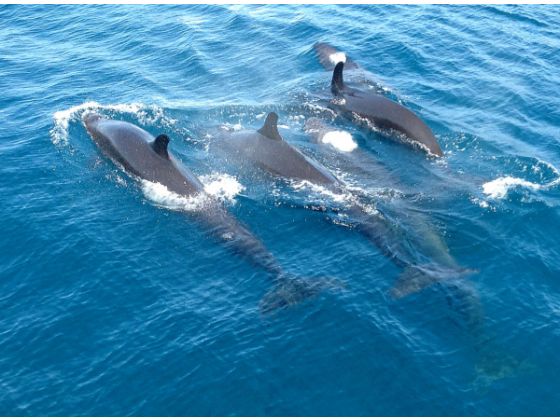
A pod of “false killer whales” made an unexpected visit to the Orange County coast Wednesday, delighting school children on whale-watching tours as the mammals romped through the waves and circled a boat.

The rarely seen whales, last reported off Orange County in 2005, were spotted by the crew of the Sea Explorer from the Ocean Institute in Dana Point late Wednesday morning off San Clemente. About 70 children from Brywood Elementary School in Irvine saw the whales in two separate trips on the vessel, 35 children each, and the whales put on a show.

“At one point when they stopped, they encircled the boat, some of them coming up against it and rubbing on the hull,” said the Sea Explorer’s captain, marine biologist Mike Bursk. “And of course the kids were going crazy.”

One of the whales also took a deep dive and returned with a large white sea bass clamped in its jaws, Bursk said.

The large, boisterous members of the dolphin family, usually found much farther out to sea, drew other vessels, including a boat from Capt. Dave’s Dolphin and Whale Watching Safari.

Capt. Dave himself – Dave Anderson – got close-ups of a curious false killer whale when he went out alone in an inflatable boat and thrust a GoPro camera into the water.

“All of a sudden, one just came right over, and he was right next to my hand,” Anderson said. “I was getting a little bit nervous, because these guys are carnivores.”

The creatures seemed to investigate everything about the boat, including the motor, he said.

“If you look at the video, you can see how long that animal stayed there, turning upside-down and checking out the camera,” he said.

A group of children from San Juan Elementary School aboard the Dana Pride from Dana Wharf Sportfishing and Whale Watching, also got a good view of the whales, passing up a gray whale in order to see them, said Todd Mansur, the boat’s captain.

http://www.ocregister.com/articles/whales-605430-boat-whale.html

Man survives by eating flies while lost for 2 weeks in Australian Outback

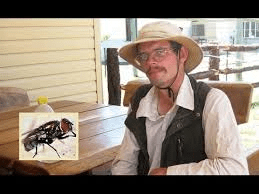
A German tourist who was missing for more than two weeks in the Australian Outback survived by eating flies after becoming lost and stranded by floodwaters, police said Friday.

Daniel Dudzisz was picked up by a motorist late Thursday near the township of Windorah in Queensland state, police Inspector Mark Henderson said.

The 26-year-old insulin-dependent diabetic had last been seen on Feb. 17 when he left Windorah to walk 77 kilometers (48 miles) north across rugged terrain to the settlement of Jundah, Henderson said.

Dudzisz became stranded by floodwaters for about 10 days and lived on insects for most of the time he was lost, Henderson said.

“He joked about never going hungry in the Australian Outback because of the amount of flies you can eat for their protein,” Henderson told Australian Broadcasting Corp. radio.

“He had some baked beans and cereal when he left Windorah and exhausted that pretty quickly, and said he’d been eating flies ever since,” Henderson added.

Dudzisz told police he had heard search helicopters but their crews could not see him through the canopy of trees, Henderson said.

Dudzisz, who had an adequate supply of insulin with him, refused medical treatment at Windorah.

“He certainly was hungry, but other than that he was in reasonable spirits,” Henderson said.

Henderson said Dudzisz remained determined to trek west to the sparsely populated Northern Territory.

“He has made an agreement now that he will stick to the main roads now rather than going cross country,” Henderson said.

http://www.startribune.com/world/248980281.html

New research shows that elephants know how dangerous people are from how they speak

When an elephant killed a Maasai woman collecting firewood near Kenya’s Amboseli National Park in 2007, a group of young Maasai men retaliated by spearing one of the animals.

“It wasn’t the one that had killed the woman, says Graeme Shannon, a behavioral ecologist at Colorado State University, in Fort Collins. “It was just the first elephant they encountered—a young bull on the edge of a swamp.”

The Maasai spiked him with spears and, their anger spent, returned home. Later, the animal died from his wounds.

Elephants experience those kinds of killings sporadically. Yet the attacks happen often enough that the tuskers have learned that the Maasai—and Maasai men in particular—are dangerous.

The elephants in the Amboseli region are so aware of this that they can even distinguish between Ma, the language of the Maasai, and other languages, says a team of researchers, who report their findings today in the Proceedings of the National Academy of Sciences.

The results add to “our growing knowledge of the discriminatory abilities of the elephant mind, and how elephants make decisions and see their world,” says Joyce Poole, an elephant expert with ElephantVoices in Masai Mara, Kenya.

Indeed, previous studies have shown that the Amboseli elephants can tell the cattle-herding, red-robed Maasai apart from their agricultural and more blandly dressed neighbors, the Kamba people, simply by scent and the color of their dress.

The elephants know too that walking through villages on weekends is dangerous, as is crop raiding during the full moon.

They’re equally aware of their other key predator, lions, and from their roars, know how many lions are in a pride and if a male lion (the bigger threat because he can bring down an elephant calf) is present.

And they know exactly how to respond to lions roaring nearby: run them off with a charge.

Intriguingly, when the Amboseli elephants encounter a red cloth, such as those worn by the Maasai, they also react aggressively. But they employ a different tactic when they catch the scent of a Maasai man: They run away. Smelling the scent of a Kamba man, however, troubles them far less.

“They have very clear behavioral responses in all of these situations,” says Karen McComb, a behavioral ecologist at the University of Sussex, in the United Kingdom. “We wondered if they would react differently to different human voices.”

To find out, she and her colleagues played recordings to elephant families of Maasai and Kamba men, as well as Maasai women and boys, speaking a simple phrase in their language: “Look, look over there, a group of elephants is coming.”

Over a two-year period, they carried out 142 such playbacks with 47 elephant families, each time playing a different human voice through a concealed speaker placed 50 meters (164 feet) from the animals. They video-recorded the elephants’ reactions to the various human voices, including a Maasai man’s voice they altered to sound like a woman’s.

As soon as an elephant family heard an adult Maasai man speak, the matriarch didn’t hesitate, the researchers say. “She instantly retreats,” Shannon says. “But it’s a silent retreat. They sometimes make a low rumble, and may smell for him, too, but they’re already leaving, and bunching up into a defensive formation. It’s a very different response to when they hear lions.”

In contrast, the voices of Kamba men didn’t cause nearly as strong a defensive reaction: The elephants didn’t consider the Kamba a serious threat.

“That subtle discrimination is easy for us to do, but then we speak human language,” says Richard Byrne, a cognitive biologist at the University of St. Andrews, in Scotland. “It’s interesting that elephants can also detect the characteristic differences between the languages.”

The Amboseli elephants were also sufficiently tuned in to the Maasai language that they could tell women’s and boys’ voices from men’s, seldom turning tail in response. “Maasai women and boys don’t kill elephants,” Shannon points out. Nor were the elephants tricked by the man’s altered voice; when they heard it, they left at once.

“The elephants’ decision-making is very precise,” McComb says, “and it illustrates how they’ve adapted where they can to coexist with us. They’d rather run away than tangle with a human predator.”

Why, one wonders, don’t elephants retreat when poachers descend on them?

“Unfortunately, there are going to be things they cannot adapt to, things such as humans’ ability to come after them with automatic weapons or mass poisonings,” McComb says. “And in those situations, we have to protect them—or we will lose them, ultimately.”

http://news.nationalgeographic.com/news/2014/03/140310-elephants-amboseli-national-park-kenya-maasai-kamba-lions-science/?google_editors_picks=true

Thanks to Da Brayn for bringing this to the It’s Interesting community.

Video of kangaroo eating penguin: herbivores are not all strict vegetarians

WHILE KANGAROOS ARE known to munch grass, with the addition of fruit, flowers, sap and bark for tree kangaroos, who knew they favour an occasional bite of meat?

Sam Murray, who captured this curious footage, happened upon this western grey kangaroo (Macropus fuliginosus) tucking into a penguin on the beach at Cape Le Grande national park, located east of Esperance, WA in March 2013.

“We were walking down to the beach in the late evening before sunset, and we noticed a group of five or six kangaroos gathered on the beach. We started towards them and all the others were quick to hop away, but not this smaller one,” Sam says.

“He was really quite focussed on what he was doing. Even when we got to within a metre and a half of him, he wouldn’t stop eating.”

Kangaroos sometime eat meat
Professor Graeme Coulson, a zoologist at the University of Melbourne, explains that “All living macropods appear to be gentle herbivores. They [generally] lack the equipment to capture and kill other animals, or the digestive system to handle a meaty diet.”

While penguins aren’t a typical kangaroo snack, Graeme says that “Australia once had carnivorous macropods. The largest of these was Propleopus oscillans, which stood up to 2 m tall and had teeth that were well adapted to eating meat. This ‘killer kangaroo’ went extinct tens of thousands of years ago.”

While this footage may strike many as peculiar, Professor Tim Flannery, an expert mammalogist, says “This is unusual, I admit, but most herbivores will eat some protein if it’s available. Tree kangaroos will eat birds and even cows will chew on a bone.”

Graeme also recognizes that known herbivores are not all strict vegetarians. “White-tailed deer in the USA have been reported stealing trout from a fishing camp and removing nestlings from nests hidden in prairie grassland. Captive macropods are known to eat a wide range of foods, including chicken and lamb chops. This western grey kangaroo was simply taking advantage of an easy meal,” Graeme says.

http://www.australiangeographic.com.au/topics/wildlife/2014/02/video-kangaroo-eats-a-penguin

Reality show snake-handling preacher dies — of snakebite

140216095220-jamie-coots-restricted-story-top

By Ashley Fantz, CNN

A Kentucky pastor who starred in a reality show about snake-handling in church has died — of a snakebite.

Jamie Coots died Saturday evening after refusing to be treated, Middleborough police said.

On “Snake Salvation,” the ardent Pentecostal believer said that he believed that a passage in the Bible suggests poisonous snakebites will not harm believers as long as they are anointed by God. The practice is illegal in most states, but still goes on, primarily in the rural South.

Coots was a third-generation “serpent handler” and aspired to one day pass the practice and his church, Full Gospel Tabernacle in Jesus Name, on to his adult son, Little Cody.

The National Geographic show featured Coots and cast handling all kinds of poisonous snakes — copperheads, rattlers, cottonmouths. The channel’s website shows a picture of Coots, goateed, wearing a fedora. “Even after losing half of his finger to a snake bite and seeing others die from bites during services,” Coots “still believes he must take up serpents and follow the Holiness faith,” the website says.

In February 2013, Coots was given one year of probation for having crossed into Tennessee with venomous snakes. He was previously arrested in 2008 for keeping 74 snakes in his home, according to National Geographic. Tennessee banned snake handling in 1947 after five people were bitten in churches over two years’ time, the channel says on the show site.

On one episode, Coots, who collected snakes, is shown trying to wrest a Western diamondback out of its nook under a rock deep in East Texas. He’s wearing a cowboy hat and a T-shirt that says “The answer to Y2K – JESUS.”

The pastor is helped by his son and a couple of church members.

“He’ll give up, just sooner or later,” one of the members says. “Just be careful. Ease him out.”

The group bags two snakes, which a disappointed Coots says hardly justifies the trip to Texas.

“Catching two snakes the first day, ‘course we’d hoped for more,” Coots says in the video. “We knew that the next day we was gonna have to try to hunt harder and hope for more snakes.”

http://www.cnn.com/2014/02/16/us/snake-salvation-pastor-bite/index.html?c=homepage-t

Thanks to Pete Cuomo for bringing this to the attention of the It’s Interesting community.

High resolution satellites revolutionize whale spotting from outer space and give hope for imperiled right whale

CNSPhoto-WHALES
New high resolution satellite image processing technology allows researchers to identify and count right whales at the ocean surface or to depths of up to 15 metres — described as a boon to tracking the health of whale populations.

The very trait that pushed southern right whales close to extinction — lolling near the surface of warm waters — is helping to revolutionize the way whales are counted.

New satellite technology has allowed the use of high-resolution photographs and image processing software to detect the crustaceans at the surface or to a depth of 15 metres in shallow waters off Argentina.

High-res satellites are a cost-effective improvement over the way whale populations are currently calculated — narrowly limited counts from shore, a ship or a plane.

Scientists used the most powerful commercial observation platforms available can see surface features as small as 50 centimetres in black and white.

A test of the satellite’s image-recognition capacity, reported in the journal Plos One, detected about 90% of southern right whales swimming in the Golfo Nuevo on the coast of Argentina compared to a manual search of the imagery.

The accuracy surpasses previous attempts at space-borne assessment and could revolutionize the way whale populations are estimated.

“Our study is a proof of principle,” Peter Fretwell of the British Antarctic Survey told the BBC.

“But as the resolution of the satellites increases and our image analysis improves, we should be able to monitor many more species and in other types of location.

“It should be possible to do total population counts and in the future track the trajectory of those populations.”

For this study, Fretwell and his colleagues purchased a single, massive image taken in September 2012 by the WorldView2 satellite. The image covers 113 square kilometres including Golfo Nuevo, a circular gulf off the Argentine coast and an area where southern right whales are known to breed and raise their young from July through November.

By looking at the same image in different wavelengths, including one able to penetrate 15 metres beneath the ocean, the researchers were able to spot 55 probable whales and 22 possible whales in the gulf as well as 13 whale-shapes underwater.

“Satellite imagery provides much more accurate and wider coverage,” Fretwell told the Los Angeles Times. “If this works, we can take it out to many other species as well.”

These animals were driven to near-extinction in the early 20th century. Recognized as slow, shallow swimmers, they were the “right” whales to hunt.

For this reason, their numbers dropped from a pre-whaling population of 55,000-70,000 to just 300 by the 1920s.

“The same reason they are the right whales to catch makes them the right whales to look for by satellite,” said Fretwell.

Their numbers have seen something of a recovery, but without the means to carry out an accurate census, it is hard to know their precise status.

Scientists already have used satellite imagery to count populations of penguins in Antarctica, and Fretwell said similar work was being done with seals. The key to using satellites to track animals is not the size of the animal but how much it stands out from its environment, he said.

http://news.nationalpost.com/2014/02/14/high-resolution-satellites-revolutionize-whale-spotting-and-give-hope-for-imperiled-right-whale/?utm_source=feedburner&utm_medium=feed&utm_campaign=Feed%3A+NPWorld+%28National+Post+-+World%29

Crazy ants from South America use a secret weapon against fire ant venom to aid their invasion of the southern U.S

CrazyAnts_m_0214

By Tanya Lewis, LiveScience

All over the southern United States, miniature foes are engaging in fierce battle. Invasive “crazy ants” have been displacing fire ants, and a curious defensive strategy may be behind the crazy ants’ bold takeover.

Fire ants pack potent venom that kills most ants that come into contact with it. But when crazy ants get stung, they secrete a substance and rub it all over themselves to neutralize the venom, new research finds.

This detoxifying behavior — the first example of an insect capable of detoxifying another’s venom — may be the reason crazy ants have been able to compete with the venomous fire ants, according to the study detailed online on Feb. 13 in the journal Science.

“As this plays out, unless something new and different happens, crazy ants are going to displace fire ants from much of the southeastern U.S. and become the new ecologically dominant invasive ant species,” study leader Ed LeBrun, a researcher at the University of Texas at Austin, said in a statement.

Fire ants (Solenopsis invicta) invaded the U.S. South in the 1930s, hailing from their native South America home. Another South American species, tawny (or raspberry) crazy ants (Nylanderia fulva) — named for their color and their quick, erratic movements — invaded Texas and Florida in the early 2000s, and have been steamrolling fire ant populations in the South ever since.

When fire ants attack, they dab their enemies with powerful venom that usually kills other insects. But LeBrun’s team noticed that after crazy ants were dabbed with the venom, they would stand on their hind and middle legs, curl their abdomens — which are covered in glands that secrete formic acid — and smear the acid all over their bodies.

To study how the detoxing substance worked, the researchers sealed off the crazy ants’ glands with nail polish and then placed the ants in a container with red fire ants. Only about half of these crazy ants survived after being dabbed with venom by the fire ants, compared with 98 percent of unpainted crazy ants.

The researchers aren’t sure exactly how the formic acid protects crazy ants from the fire ant venom. The acid may protect the crazy ant by destroying venom proteins and preventing them from penetrating the ant’s exoskeleton.
Crazy ants and fire ants are both native to northern Argentina, Paraguay and southern Brazil, where their territories overlap. The crazy ants likely evolved their detoxifying behavior alongside their venomous neighbors, the researchers said.

In contrast to fire ants, crazy ants don’t confine themselves to mounds in the garden. They crawl inside homes and even swarm inside electronic appliances — shorting out phones, air conditioners and other devices.

“When you talk to folks who live in the invaded areas, they tell you they want their fire ants back,” LeBrun told Live Science previously.

Crazy ants don’t have as painful a sting as fire ants, but they multiply more quickly and don’t eat the same ant poison bait, scientists say. Fortunately, the crazy ant invasion moves slowly, advancing only about 600 feet (180 meters) per year, except if transported in potted plants or vehicles. LeBrun recommends that people check plants for ant nests before buying them, and check their cars before traveling if they live in crazy ant-infested areas.

Other than human activities, geology and climate are the only factors standing in the way of these determined insects, which continue their relentless takeover of the South.

http://www.mnn.com/earth-matters/animals/stories/crazy-ants-use-a-secret-weapon-to-aid-their-invasion-of-the-southern

Rare image shows great white shark losing tooth during airborne attack on seal

Shark Loses a Tooth

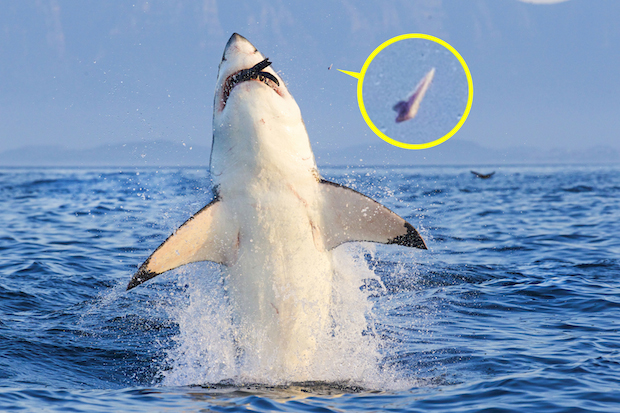
A photographer off South Africa recently captured the moment a large great white shark breached the surface during an ambush attack on an unsuspecting seal.

What he soon found out was that in one of his images was a large triangular-shaped tooth, flying through the air.

Not a big deal for the shark. Great whites possess the ability to replace lost teeth rather quickly, and may lose more than 35,000 teeth in a lifetime.

But it was a huge deal for the photographer, David Jenkins, because his rare image reveals more about the dynamics of a white shark’s ambush attack.

“It all happened incredibly quickly,” he told the Daily Mail. “I didn’t know the shark had lost its tooth until I zoomed in on the image in the back of my camera to check if the photo was sharp and in focus.

“I have never seen this happen or even seen a photo of this happening on a real seal hunt before. It’s definitely a unique shot.”

The waters near Cape Town boast a large population of great white sharks, which sometimes launch airborne during their attacks.

http://www.grindtv.com/outdoor/nature/post/rare-image-shows-great-white-shark-losing-tooth-during-airborne-attack-on-seal/

Thanks to Pete Cuomo to bringing this to the attention of the It’s Interesting community.

Science shows that camels weren’t domesticated as early as The Bible states

subCAME-master1050

By JOHN NOBLE WILFORD

There are too many camels in the Bible, out of time and out of place.

Camels probably had little or no role in the lives of such early Jewish patriarchs as Abraham, Jacob and Joseph, who lived in the first half of the second millennium B.C., and yet stories about them mention these domesticated pack animals more than 20 times. Genesis 24, for example, tells of Abraham’s servant going by camel on a mission to find a wife for Isaac.

These anachronisms are telling evidence that the Bible was written or edited long after the events it narrates and is not always reliable as verifiable history. These camel stories “do not encapsulate memories from the second millennium,” said Noam Mizrahi, an Israeli biblical scholar, “but should be viewed as back-projections from a much later period.”

Dr. Mizrahi likened the practice to a historical account of medieval events that veers off to a description of “how people in the Middle Ages used semitrailers in order to transport goods from one European kingdom to another.”

For two archaeologists at Tel Aviv University, the anachronisms were motivation to dig for camel bones at an ancient copper smelting camp in the Aravah Valley in Israel and in Wadi Finan in Jordan. They sought evidence of when domesticated camels were first introduced into the land of Israel and the surrounding region.

The archaeologists, Erez Ben-Yosef and Lidar Sapir-Hen, used radiocarbon dating to pinpoint the earliest known domesticated camels in Israel to the last third of the 10th century B.C. — centuries after the patriarchs lived and decades after the kingdom of David, according to the Bible. Some bones in deeper sediments, they said, probably belonged to wild camels that people hunted for their meat. Dr. Sapir-Hen could identify a domesticated animal by signs in leg bones that it had carried heavy loads.

The findings were published recently in the journal Tel Aviv and in a news release from Tel Aviv University. The archaeologists said that the origin of the domesticated camel was probably in the Arabian Peninsula, which borders the Aravah Valley. Egyptians exploited the copper resources there and probably had a hand in introducing the camels. Earlier, people in the region relied on mules and donkeys as their beasts of burden.

“The introduction of the camel to our region was a very important economic and social development,” Dr. Ben-Yosef said in a telephone interview. “The camel enabled long-distance trade for the first time, all the way to India, and perfume trade with Arabia. It’s unlikely that mules and donkeys could have traversed the distance from one desert oasis to the next.”

Dr. Mizrahi, a professor of Hebrew culture studies at Tel Aviv University who was not directly involved in the research, said that by the seventh century B.C. camels had become widely employed in trade and travel in Israel and through the Middle East, from Africa as far as India. The camel’s influence on biblical research was profound, if confusing, for that happened to be the time that the patriarchal stories were committed to writing and eventually canonized as part of the Hebrew Bible.

“One should be careful not to rush to the conclusion that the new archaeological findings automatically deny any historical value from the biblical stories,” Dr. Mizrahi said in an email. “Rather, they established that these traditions were indeed reformulated in relatively late periods after camels had been integrated into the Near Eastern economic system. But this does not mean that these very traditions cannot capture other details that have an older historical background.”