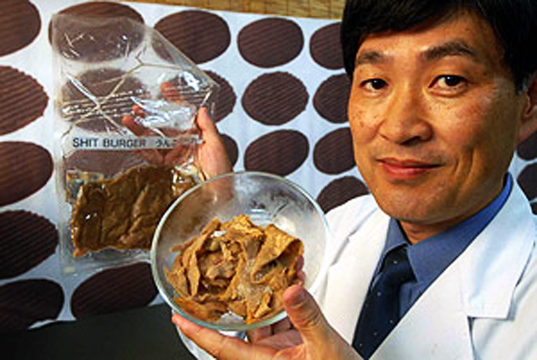
Japanese Scientist Invents Safe Edible Burger From Human Feces

Mitsuyuki Ikeda, a researcher from the Environmental Assessment Center in Okayama has developed a new artificial meat burger made of human feces.

Ikeda has gathered sewage mud (which contains human feces) and has developed the artificial meat by adding fecal extracts, soy protein and steak sauce essence. Artificial food coloring to added to it to give it the same look as red meat. It is composed of 63 percent protein, 25 percent carbohydrates, 3 percent lipids and 9 percent minerals.

Protein is extracted from the sewage mud first. After the protein is extracted, “reaction enhancer” is added to it and it is then put in a machine called the “exploder” which produces the artificial meat. During the entire process, the bacteria in the sewage mud is rendered harmless as it is killed by heating.

The scientist is hoping that the new type of meat will one day replace real meat, which is more expensive to produce. He claims that the new feces burger is actually healthier than real meat (fecal meat has less fat and hence less calories) and is more environment-friendly (cows supposedly contribute around 18 percent of our greenhouse gas emissions).

Currently, fecal meat costs 10-20 times more than normal meat because of the cost of research, but ultimately Ikeda plans to bring the price down so that people can switch to feacl meat one day.

Ikeda did not say whether his “poop meat” is as tasty as real meat and he has acknowledged that few people would be keen to eat it.

http://www.ibtimes.com/articles/164958/20110617/japanese-scientist-makes-poop-burger-mitsuyuki-ikeda.htm


Ulcers from H. Pylori Increase the Risk of Diabetes


The same bacterium responsible for most stomach ulcers may play a role in the development of Type 2 diabetes among overweight and obese adults, New York University researchers recently reported.

And in the same way that antibiotics eradicate the bacterium and heal ulcers, antibiotics might eventually prove useful in diabetes prevention, they suggest in an article appearing in the Journal of Infectious Diseases.

Non-diabetic adults infected with Helicobacter pylori (whether or not they had ulcer symptoms), tended to have higher blood sugar than adults without H. pylori, according to the study co-authored by Yu Chen, an associate professor of environmental medicine at NYU, and Dr. Martin J. Blaser, chairman of NYU’s department of medicine.

Chen and Blaser assessed blood sugar levels using measurements of glycosylated hemoglobin (HbA1c or A1c), a marker of excess glucose in the bloodstream that in recent years has become a key tool for diagnosing and monitoring diabetes.

Helicobacteri pylori is a complicated bacterium. Persistent H. pylori infections beginning in childhood have been linked decades later to ulcers of the stomach and small intestine, and a heightened risk of stomach cancer. Although H. pylori can inflame the stomach, many infected people have no symptoms.

Blaser called H. pylori a complicated and interesting organism that affects children and adults in entirely different ways. In previous work he and Chen found that H. pylori protects children against asthma and allergy.

“This study provides further evidence of late-in-life cost to having H. pylori,” Blaser said in an interview. The findings also give new support to “the concept of eradicating H. pylori in older people.”

Theoretically, antibiotics that wipe out H. pylori might protect older, overweight men and women from developing diabetes, Blaser and Chen said. However, scientists still need to determine how eliminating H. pylori might affect Type 2 diabetes, and how H. pylori affects sugar breakdown among people of different weights.

Chen and Blaser proposed a mechanism for how H. pylori might set the stage for diabetes. They said the bacterium might alter levels of two important digestive hormones, ghrelin and leptin. Ghrelin, sometimes called the hunger hormone, decreases calorie-burning and promotes weight gain. Leptin reduces appetite and boosts calorie-burning. Previous research has linked H. pylori with decreased ghrelin and increased leptin.

In the past, scientists working with small samples came up with conflicting findings about an association between H. pylori and Type 2 diabetes, a chronic disease strongly associated with excess body weight, as well as heredity. Formerly called adult onset or late onset diabetes, Type 2 diabetes has become epidemic among overweight and obese youngsters. It kills an estimated 3.8 million adults worldwide each year.

One of the strengths of the NYU study is that Blaser and Chen worked with a bigger study population, analyzing data from 7,417 adults in the National Health and Nutrition Examination Survey (NHANES) III and 6,072 adults and children 3 and older in NHANES 1999-2000.

“H. pylori was consistently positively related to HbA1c level in adults, a valid and reliable biomarker for long-term blood glucose levels,” they wrote.

In an editorial appearing in the same issue of the journal, lead author Dani Cohen, an epidemiologist at Tel Aviv University in Israel, suggested that the new findings could have important implications for diabetes prevention and control.

Cohen, a specialist in H. pylori’s health effects, said the next step should be conducting rigorous studies to examine the impact of H. pylori treatment on A1c levels and on the development of diabetes among older adults carrying excess pounds.

http://www.12newsnow.com/story/17156233/diabetes-linked-to-ulcer-causing-bacteria

Unemployed Austrian man cuts off foot to continue claiming jobless benefits – only to discover he is still eligible for work


A man who almost died after cutting his own foot off so he could stay on jobless benefits has been told he might still qualify for work despite his amputation.

Long term unemployed Hans Url, 56, had just been told his hand-outs would stop if he did not accept work found for him by job centre staff.

And when his claims that he was too sick and did not like the work were challenged with the offer of a medical, he took drastic measures.

Url, of Mitterlabill, southern Austria, rigged up a mitre saw and sliced off his foot – then put it in the oven for good measure to ensure no surgeon could reattach it.

But job centre staff have delivered a blow to hapless Url’s plan by saying his new disability does not rule him out for work.

Police spokesman Franz Fasching said: ‘The planning was meticulous.

‘He waited until his wife and his adult son had left the house and he was alone.

‘He then switched it on and sliced off his left foot above the ankle – throwing it in the fire so it would not be possible to reattach it before he called emergency services.

‘He then made his way to the garage where he called emergency services and waited for them to arrive.

The police added that the man had almost died from loss of blood before the emergency services arrived and that they had recovered the foot from the oven – but that it had been too badly burned to reattach.

He was airlifted to hospital in Graz where his condition was said to be stable after emergency surgery to seal the wound.

A hospital spokesman said: ‘The foot was too badly burned to reattach. All we could do was seal the wound. He had lost a lot of blood – he almost died on the way to hospital. He was put in an artificial coma.’

The police spokesman Fasching added that they were investigating the case as an attempted suicide.

But Feldbach AMS job centre spokesman Hermann Gössinger said: ‘This is a tragic case but it will not help the man.

‘His latest excuse had been a bad back which is why he had been sent for a medical.

‘But even now losing a foot does not automatically mean he will not be able to work. He will be assessed once he is out of hospital and we will see what work we can find for him.’

Read more: http://www.dailymail.co.uk/news/article-2121100/Man-saws-foot-avoid-work-continue-claiming-jobless-benefits.html#ixzz1qXMdOIKC

U.S. Security Will Be Put at Risk With Future Water Shortages


Water shortages, polluted water and floods will increase the risk of instability in nations important to U.S. national security interests, according to a new U.S. intelligence community assessment released Thursday.

“During the next 10 years, many countries important to the United States will almost certainly experience water problems – shortages, poor water quality, or floods – that will contribute to the risk of instability and state failure and increase regional tensions,” the report from the office of the director of national intelligence states.


The assessment focused on seven key river basins located in the Middle East, Asia and Africa that are considered strategically important to the United States: the Indus, Jordan, Mekong, Nile, Tigris-Euphrates, Amu Darya and Brahmaputra basins.

The intelligence report indicates conflict between nations over water problems is unlikely in the next 10 years, but after that, water in shared basins will increasingly be used by some nations as leverage over their neighbors, the report says.

A senior U.S. intelligence official who briefed reporters on the report said, “It’s very difficult to be specific about where because it depends upon what individual states do and what actions are taken on water issues between states.”

The study also warns of the potential for water to be used as a weapon, “with more powerful upstream nations impeding or cutting off downstream flow.”

Water could also become a terrorist tool, according to the report. The U.S. official said that, “because terrorists are seeking more high visibility items to attack, in some cases we identified fragile water infrastructure that could potentially be a target for terrorism activity.” A likely target would be dams.

The official also said terrorist groups could take advantage of large movements of people displaced by water issues in vulnerable nations.

The report indicates water supplies will not keep up with the increasing demand posed by a growing world population.

Climate change will further aggravate the water problems in many areas, as will continued economic development, the report says.

“The lack of adequate water,” it says, “will be destabilizing factor in some countries because they do not have the financial resources or the technical ability to solve their internal water problems.”

Food markets are threatened by depletion of ground water in some agriculture areas of the world. Unless corrective steps are taken, food production will decline, increasing the stress on global markets, the report predicts.

The intelligence community assessed that by 2040, water shortages and pollution will harm the economic performance of important trading partners.

The study does not name specific countries, because it is based on a classified national intelligence estimate.

But the report indicates that increasing populations, industrial development and climate change in South Asia, the Middle East and North Africa will make it difficult for those regions to deal with water problems.

The report does say that improved water management and investment in water-related sectors, such as agriculture, hydroelectric power and water treatment, could compensate for increased demand over next 30 years.

Since agriculture uses nearly 70% of all ground water, the report states it has the most potential to provide relief if technological changes are implemented such as large-scale drip irrigation systems.

The intelligence study suggests developing countries are likely to turn to the United States to lead the effort to resolve water problems, because of its technological capabilities.

Secretary of State Hillary Clinton, who was concerned about how global water problems could affect U.S. security interests over the next 30 years, requested the study on global water security. The National Intelligence Council prepared the assessment with contributions from 10 intelligence organizations.  

At a World Water Day event at the State Department on Thursday,  Clinton labeled the report “sobering,” and called on everyone to read it to “see how imperative clean water and access to water is to future peace, security, and prosperity, globally.” 

The Secretary also used the occasion to announce a new effort called the U.S. Water Partnership which bring together experts in the private sector and government to find system wide solutions to water problems.

http://security.blogs.cnn.com/2012/03/22/u-s-security-at-risk-over-water/?hpt=hp_t3

‘Kony 2012’ Director Suffers Psychotic Break


The director of a wildly popular video about brutal African warlord Joseph Kony has been diagnosed with brief psychosis and is expected to stay in the hospital for weeks, his wife said Wednesday.

Jason Russell, 33, was hospitalized last week in San Diego after witnesses saw him pacing naked on a sidewalk, screaming incoherently and banging his fists on the pavement. He was in his underwear when police arrived.

His outburst came after the video’s sudden success on the Internet brought heightened scrutiny to Invisible Children, the group he co-founded in 2005 to fight African war atrocities.

Russell’s family said that the filmmaker’s behavior was not due to drugs or alcohol. He was given a preliminary diagnosis of brief reactive psychosis, in which a person displays sudden psychotic behavior.

“Doctors say this is a common experience given the great mental, emotional and physical shock his body has gone through in these last two weeks. Even for us, it’s hard to understand the sudden transition from relative anonymity to worldwide attention — both raves and ridicules, in a matter of days,” Danica Russell said in a statement.

Researchers don’t know how many people suffer from the condition, mainly because symptoms are fleeting, but those with personality disorders are at greater risk for having an episode. Brief reactive psychosis is triggered by trauma or major stress such as an accident or death of a loved one. Other stressors can include sleep deprivation or dehydration.

Symptoms include hallucinations, delusions and strange speech and behavior. People typically recover within a few weeks without medication. Others have to take antipsychotic drugs to alleviate symptoms or undergo talk therapy to cope.

The condition causes “temporary debilitation, but in general people have good recoveries,” said Dr. Stephen Marder, professor of psychiatry at the University of California, Los Angeles.

In some cases, doctors say brief reactive psychosis can signal the beginning of a more serious mental illness such as schizophrenia.

Danica Russell said it may be months before her husband returns to San Diego-based Invisible Children.

“Jason will get better. He has a long way to go, but we are confident that he will make a full recovery,” she said.

Russell narrates the 30-minute video “Kony 2012,” which has been viewed more than 84 million times on YouTube since it was released this month. In the video, Russell talks to his young son, Gavin, about Kony and the Lord’s Resistance Army.

The Invisible Children group has been criticized for not spending enough directly on the people it intends to help and for oversimplifying the 26-year-old conflict involving the LRA and its leader, Kony, a bush fighter wanted by the International Criminal Court for crimes against humanity.

Invisible Children has acknowledged the video overlooked many nuances but said it was a “first entry point” that puts the conflict “in an easily understandable format.” It said money that directly benefits the cause accounted for more than 80 percent of its spending from 2007 to 2011.

Read more: http://www.sfgate.com/cgi-bin/article.cgi?f=/n/a/2012/03/21/national/a083749D70.DTL#ixzz1prY2sYn4


Astronauts Suffer Brain and Eye Damage After One Month in Space

Astronauts who have spent more than a month in space have shown evidence of damage to their eyeballs and brain tissue.

MRI scans on 27 Nasa astronauts revealed a pattern of deformities in their eyeballs, optic nerves and pituitary glands, it was revealed in the journal Radiology.

Seven of the astronauts had a flattening of one or both of the eyeballs, causing them to become long-sighted. Four had swelling around the optic nerve and three had deformed pituitary glands.

The study was led by Larry Kramer at the University of Texas Health Science Centre in Houston, who says the findings could be explained by a build-up of cerebrospinal fluid in the brains of the astronauts, caused by exposure to the micro-gravity of space.

He added: “Microgravity-induced intracranial hypertension represents a hypothetical risk factor and a potential limitation to long-duration space travel.

“Consider the possible impact on proposed manned missions to Mars or even the concept of space tourism. Can risks be eventually mitigated? Can abnormalities detected be completely reversed?

“The next step is confirming the findings, defining causation and working towards a solution based on solid evidence.”

The findings have not rendered any astronauts ineligible for future space travel.

Shuttle missions typically last a couple of weeks, AFP reports, while International Space Station journeys can last more than six months.

A Mars mission could potentially last a year-and-a-half.

Last month Nasa published a feature about vision changes experienced by astronauts on board the ISS. It referenced research from the October 2011 issue of Ophthalmology and referred to tests on seven astronaut test subjects who all reported blurred vision.

Astronaut Bob Thirsk, who spent six months as a member of the Expedition 20 and 21 crews in 2007, told a post-flight survey: “After a few weeks aboard I noticed that my visual acuity had changed.

“My distant vision was not too bad, but I found that it was more difficult to read procedures. I also had trouble manually focusing cameras, so I would ask a crewmate to verify my focus setting on critical experiments.”

Nasa provides space anticipation glasses (spectacles with a stronger prescription) for crew members over the age of 40

Crews also have access to SuperFocus glasses – adjustable focus glasses eliminating the need for bi- and tri-focal lens associated with multiple vision adjustments. These specialised glasses are in addition to an astronaut’s regular prescription glasses.

http://www.huffingtonpost.co.uk/2012/03/13/astronauts-in-space-for-more-than-one-month-suffer-brain-and-eye-damage_n_1341190.html?1331642133&ncid=edlinkusaolp00000008

Pudding to the Rescue


Pudding the cat is big. He is orange. He is laid-back. And he’s a lifesaver.

Just ask Amy Jung. The 36-year-old Wisconsin resident credits 21-pound Pudding with saving her from the grip of diabetic seizure mere hours after she adopted him from a local animal shelter.

“If something or someone hadn’t pulled me out of that, I wouldn’t be here,” Jung told the Green Bay Press-Gazette newspaper.

Here’s what happened: On Feb. 8, Jung visited the Door County Humane Society with her son, Ethan. She had no intention of adopting a pet; she and her son just wanted to play with the cats, who are allowed to roam free at the no-kill shelter.

But, as can happen with felines and humans, Pudding and Jung felt a strong and immediate connection.

“He just gravitated to her,” Door County Humane Society Executive Director Carrie Counihan told TODAY.com.

Jung made an on-the-spot decision to bring Pudding home. Always a calm and relaxed guy, Pudding took to his new digs right away, displaying not a hint of skittishness on his first day there.

That evening Jung, who has been living with diabetes since the age of 4, went to bed at about 9:30 p.m. About 90 minutes later, she started to have a diabetic seizure. That’s when, according to the Green Bay Press-Gazette, “Pudding planted his weight on her chest and, when he could not wake her, began swatting her face and biting her nose.”

Dog saves 11-year-old boy from cougar attack

Jung came to her senses enough to yell out to her son for assistance. At that point, Pudding jumped up onto Ethan’s bed and startled him into action. He immediately rushed to get his mom the help she needed.

“Her doctor said she could have gone into a coma and not come out of it if much more time had gone by,” Counihan said. “The fact that Pudding did what he did without knowing her that well is just amazing to me.”

Since the scary Feb. 8 incident, Jung has followed her doctor’s advice to have Pudding registered as a therapy animal.

“I think he’s already made his first trip to Walmart,” Counihan said.

Pudding had been living at the shelter for about a month before Jung took him home. He arrived there in early January with another cat named Wimsy after their owner died. Jung adopted Wimsy, too, because she didn’t want to separate them.

Cat protects couple from deadly gas leak

This wasn’t Pudding’s first stint at the Door County Humane Society. In 2008, a family surrendered him to the shelter because their son was allergic to cats. His name at that time was Starbuck. His last owner, the woman who just passed away, decided to change his name to Pudding.

“Pudding is 8 1/2-ish now — not too old,” Counihan said. “And Wimsy is 3 years old. Maybe he’ll pick up some of Pudding’s powers.”

Roast Beef the penguin charms nursing-home residents

http://today.msnbc.msn.com/id/46504285/ns/today-good_news/


Thanks to the future Dr. Goldman for bringing this to the attention of the It’s Interesting community.


95 Year Old Chinese Woman Climbs Out of Her Coffin 6 Days After Being Declared Dead


A 95-year-old Chinese woman thought to have passed away stunned her neighbours – after waking up six days after she had been placed in a coffin.

Li Xiufeng was found motionless and not breathing in bed by a neighbour two weeks after tripping and suffering a head injury at her home in Beiliu, Guangxi Province.

When the neighbour who found her could not wake the pensioner up, they feared the worst and thought the elderly woman had passed away.

She was placed in a coffin which was kept in her house unsealed under Chinese tradition for friends and relatives to pay respects.

But the day before the funeral, neighbours found an empty coffin, and later discovered the 95-year-old, who had since woken up, in her kitchen cooking.

Neighbour Chen Qingwang, 60, who originally found Mrs Xiufeng, said: ‘She didn’t get up, so I came up to wake her up.

‘No matter how hard I pushed her and called her name, she had no reactions.

‘I felt something was wrong, so I tried her breath, and she has gone, but her body is still not cold.’

As Mrs Xiufeng lived alone, Mr Qingwang and his son made preparations for her funeral, and the ‘dead’ woman was left in her coffin two days after she was discovered.

The day before she was due to be permanently laid to rest, however, Mr Qingwang arrived at his neighbour’s property and found her ‘corpse’ had disappeared.

Mr Qingwang added: ‘We were so terrified, and immediately asked the neighbours to come for help.’

Neighbours searched her property before finding the pensioner in her kitchen cooking.

She reportedly told villagers: ‘I slept for a long time. After waking up, I felt so hungry, and wanted to cook something to eat.

‘I pushed the lid for a long time to climb out.’

Medics said Mrs Xiufeng had suffered an ‘artificial death’, when a person has no breath, but their body remains warm.

A doctor at the hospital was quoted as saying: ‘Thanks to the local tradition of parking the coffin in the house for several days, she could be saved.

Despite cheating death, however, the same Chinese tradition left Mrs Xiufeng without any possessions, according to ritual, after a person dies, all their belongings must be burnt.


Read more: http://www.dailymail.co.uk/news/article-2109719/Chinese-woman-95-comes-life-climbing-coffin-days-died.html#ixzz1oK5RdTh8


PICA: Woman Eats 4,000 Sponges


A DENTAL nurse told yesterday how she has EATEN 4,000 washing-up sponges due to a rare disorder.

Kerry Trebilcock, 21, has also munched more than 100 bars of SOAP.

She suffers from pica, which causes victims to crave objects that are not food.

Kerry, of Mylor, Cornwall, said: “One day I will beat this and be able to have a shower or do the washing-up without feeling hungry.”

Sponge eater Kerry said she likes to spice up her bizarre snacks with hot sauce or mustard.

Sometimes, she dips them in tea or hot chocolate like biscuits.

She also chomps on chunks of soap — but only organic fruit-flavoured varieties, with lemon and lime her favourite.

Kerry said: “I have been very particular about the type of sponges and soaps I’d eat and how I’d prepare them.

“If I went out for the day I’d carry a small plastic bag of cut-up pieces of sponge with some tomato and BBQ sauce in Tupperware. I was never without a ‘snack’.”

Other pica sufferers eat metal, coal, sand, chalk — or even lightbulbs and furniture.

Petite Kerry, who weighs just 8st, has endured shocking stomach cramps, constipation and diarrhoea.

And although she has cut down on her sponge munching, she has been unable to totally shake the condition.

At one point Kerry was eating five a day topped with hot relish, BBQ sauce, ketchup, mustard, jam or honey.

She said: “The sauces and dipping the sponges in drinks softened them — and I’d chew them until the flavour was gone. Then I would swallow the sponge.”

Sponges are commonly made from cellulose wood fibres or foamed plastic polymers.

Organic soap contains olive or palm oil, glycerin and plant scents, plus oatmeal to lift off dead skin.

Kerry’s eating habits changed after a holiday to Morocco in 2008, during which she picked up an infection of hookworm, a parasite that lives in the small intestine.

At first, she began craving junk food. But then something strange happened.

She said: “After one dinner where I ate a double helping of lasagne and a tub of ice cream, I still felt hungry.

“To distract myself, I decided to wash the dishes. I took out a new sponge from a packet and had an overwhelming desire to eat it.

“I sat down with a glass of water and chewed the sponge until it was gone.

“It tasted of nothing but I found eating it enjoyable.

“Finally my hunger was gone and my stomach felt satisfied.”

Afterwards, though, she felt embarrassed and scared — and cried herself to sleep.

But the next morning, as she washed herself with lemon and lime soap, she had an urge to eat some and swallowed a chunk.

She said: “I knew something was very wrong with me but I didn’t want to tell anyone as I felt like a freak. But after a week I’d eaten nine sponges and over a pound of organic soap.”

Her hookworm infection was diagnosed by her GP but she kept quiet about her cravings in case he thought she was mad.

She said: “I would go to the supermarket and buy over 40 sponges and different types of organic soap.

“It made me hungry just smelling all the different soap products in the cleaning aisle. The cashiers joked that I must love cleaning!”

Kerry, who also eats normal food, finally confided to a friend in 2009.

And after seeing the doctor again, she was told she had pica and could seriously damage her digestive system.

A programme of counselling and vitamins has set her on the road to recovery. And she is determined to succeed. But it is a slow and arduous process.

Kerry said: “I still have a one-inch square of sponge and three teaspoons of organic soap with each meal.

“But I am making progress and speak to other sufferers of pica on internet forums, which helps.

“There are some out there far worse than me who eat car tyres, spoons and even sofas.”

Kerry is trying to curb her pangs with Floral Gum sweets.

She said: “They taste like soap so they help me get the flavour I desire without doing any damage. I know one day I will beat this.”

Kerry’s student sister Jody, 20, told how the family initially found her sponge munching hard to understand.

She said: “Watching her eat a sponge or soap was extremely weird. But Kerry has educated us all about pica.

“I’m so proud she has worked hard to fight this condition and is recovering through counselling.

“She is really brave to talk about it so openly.”

http://www.thesun.co.uk/sol/homepage/news/4161108/Girl-eats-4000-brwashing-up-sponges.html

Man Killed by Heat Generated by his Home Cannabis Farm


Luke Holmes, 28, grew huge quantities of marijuana in three-foiled lined tents, with each one containing rows of powerful halogen lights.

The heat they generated sent temperatures soaring to dangerous levels, with police nearly fainting from heat when they entered the house last June, according to a report in The Sun.

Holmes passed away in his sleep in his Halifax, West Yorks, property. He was found by friends three days later when they broke in, concerned that they hadn’t heard from him.

Holmes’ death was declared accidental by an inquest, which ruled that he died from hyperthermia, or excessive heat.

Read more: http://www.metro.co.uk/news/826522-heat-from-cannabis-farm-lamps-kills-drug-user#ixzz1npbGaQB7