Diving Pigs


Diving helps pigs improve their immunity against disease and improves the quality of the pork — at least according to a farmer in Central China’s Hunan province, said a report from News.163.com—the NetEase website.

Huang Demin has built a 3-meter-tall wooden diving platform close to his pigsty in Ningxiang county so his livestock can dive on a daily basis.

Huang has to push his pigs hard to jump from the platform, as most do not seem to enjoy the airborne experience, he said. But he added that he believes diving can help the pigs eat more food and grow faster.

Huang also has an economic motivation — he sells the pork from his diving pigs at three times the price of normal pigs at market. His handmade platform is also now a tourist attraction.

http://europe.chinadaily.com.cn/china/2012-11/14/content_15929283.htm


Scientists decode why Einstein was a genius


Physicist Albert Einstein’s brain had an “extraordinary” prefrontal cortex – unlike those of most people – which may have contributed to his remarkable genius, a new study has claimed.

According to the study led by Florida State University evolutionary anthropologist Dean Falk, portions of Einstein’s brain have been found to be unlike those of most people and could be related to his extraordinary cognitive abilities.

Falk and his colleagues describe for the first time the entire cerebral cortex of Einstein’s brain from an examination of 14 recently discovered photographs.

The researchers compared Einstein’s brain to 85 “normal” human brains and, in light of current functional imaging studies, interpreted its unusual features.

“Although the overall size and asymmetrical shape of Einstein’s brain were normal, the prefrontal, somatosensory, primary motor, parietal, temporal and occipital cortices were extraordinary.

“These may have provided the neurological underpinnings for some of his visuospatial and mathematical abilities, for instance,” said Falk.

The study was published in the journal Brain.

On Einstein’s death in 1955, his brain was removed and photographed from multiple angles with the permission of his family. Furthermore, it was sectioned into 240 blocks from which histological slides were prepared.

A great majority of the photographs, blocks and slides were lost from public sight for more than 55 years. The 14 photographs used by the researchers now are held by the National Museum of Health and Medicine.

The study also published the “roadmap” to Einstein’s brain prepared in 1955 by Dr Thomas Harvey to illustrate the locations within his previously whole brain of 240 dissected blocks of tissue, which provides a key to locating the origins within the brain of the newly emerged histological slides.

http://www.phenomenica.com/2012/11/scientists-decode-why-einstein-was-a-genius.html

Facts that really are Quite Interesting


For nearly a decade, Stephen Fry has been serving up weekly portions of astonishing information in the popular BBC television quiz show QI.

And despite its name – QI stands for Quite Interesting – it provokes laughter, amazement, and, occasionally, plain disbelief.

Here, in a fascinating new book from the QI team, are the answers to the questions you never even thought to ask.

The Queen is the legal owner of one-sixth of the Earth’s land surface.

The ozone layer smells faintly of geraniums.

The average person walks the equivalent of three times around the world in a lifetime.

Forty-six per cent of American adults can’t read well enough to understand the label on their prescription medicine.

In his first year at Harrow, Winston Churchill was bottom of the whole school.

When the Mona Lisa was stolen from the Louvre in 1911, one of the suspects was Picasso.

Under extreme high pressure, diamonds can be made from  peanut butter.

Liechtenstein, the world’s sixth smallest country, is the world’s largest exporter of false teeth.

In 1811, nearly a quarter of all  the women in Britain were named Mary.

People in Victorian Britain who couldn’t afford chimney sweeps dropped live geese down their chimneys instead.

On average, every square mile of sea on the planet contains 46,000 pieces of rubbish.

Harry Houdini could pick up pins with his eyelashes and thread a needle with his toes.

The Inca measurement of time was based on how long it took to boil a potato.

When customers visited the first supermarkets in Britain, they were afraid to pick up goods from the shelves in case they were told off.

On a clear, moonless night the human eye can detect a match being struck 50 miles away.

Richard Gere’s middle name is Tiffany

Bugs bunny is not a rabbit but a hare

After two weeks of wear, a pair  of jeans will have grown a  1,000-strong colony of bacteria  on the front, 1,500-2,500 on the  back and 10,000 on the crotch.

Each year, drug baron Pablo  Escobar had to write off ten per cent of his cash holdings because of rats nibbling away at his huge stash of bank notes.

In 2010, the Catholic Church had an income of $97 billion.

The French for ‘paperclip’  is trombone.

In 2010, Ghana banned the sale of second-hand underpants.

The Icelandic phone book is ordered by first name.

Jimmy Carter once sent a jacket to the dry-cleaner’s with the nuclear detonation codes still in the pocket.

The Vatican City has the highest crime rate in the world. Though the resident population is only just over 800, more than 600 crimes are committed there each year.

Two-and-a-half million Mills & Boon novels were pulped and added to the tarmac of the M6 toll motorway to make it more absorbent.

In 2005, the 54 billionaires in Britain paid only £14.7 million in income tax between them. Of this, £9 million came from James Dyson.

More than 90 per cent of all the blackcurrants grown in Britain go into Ribena.

It costs more to make the cardboard box that Shredded Wheat comes in than it does to make the cereal itself.

The American secret service tried to spike Hitler’s carrots with female hormones to change him into a woman.

Ants can survive in a microwave: they are small enough to dodge the rays.

In 17th Century Venice, women’s shoes could have heels more than 12in high.

The sun’s core is so hot that a piece of it the size of a pinhead would give off enough heat to kill a  person 160 kilometres (99 miles) away.

In 1987, American Airlines saved $40,000 by removing an olive from each salad in First Class.

One hundred thousand mobile phones are dropped down the lavatory in Britain every year, and 50,000 get run over.

The national anthem of Bangladesh includes the line: ‘The fragrance from your mango groves makes me wild with joy.’

People all over the world are  walking ten per cent faster than they did a decade ago.

A 2011 study by Nobel Economics laureate Daniel Kahneman of 25 top Wall Street traders found that they were no more consistently successful than a chimpanzee tossing a coin.

Until 1857, it was legal for British husbands to sell their wives. The going rate was £3,000 (£223,000 in today’s money).

King Herod’s first wife was called Doris.

Victorian guidebooks advised women to put pins in their mouths to avoid being kissed in the dark when trains went through tunnels.

The Brazilian state of Rio Grande do Sul has only five per cent of the country’s population but provides 70 per cent of its  fashion models.

Manchester United is the most hated brand in Britain and the seventh most hated in the world.

When Fidel Castro seized power in Cuba, he ordered all Monopoly sets to be destroyed.

The French mathematician Descartes had a theory that monkeys and apes were able to talk – but kept quiet in case they were asked to do any work.

Olivia Newton-John was president of the Isle of Man Basking Shark Society.

None of the best-known English swear words is of Anglo-Saxon origin.

Areodjarekput is an Inuit word meaning ‘to exchange wives for a few days only’.

The first commercial chewing gum appeared in 1871, after Thomas Adams had failed to make car tyres from the same ingredients.

Beyonce is an 8th cousin, four times removed, of Gustav Mahler.

There are enough diamonds in existence to give everyone on the planet a cupful.

If your stomach acid got on to your skin it would burn a hole in it.

The French for ‘window-shopping’ is faire du leche-vitrines or ‘window-licking’.

Despite playing the Fonz for ten years in the sitcom Happy Days, Henry Winkler never learned to ride a motorcycle.

At Ronnie Barker’s memorial service in Westminster Abbey in 2006, four candles were carried instead of the usual two.

Chess, ludo and snakes and ladders were all invented in ancient India. Snakes and ladders was called Moksha Patam – ‘the path to liberation’.

As soon as Lord Byron left England for the last time in 1816, his creditors entered his home and repossessed everything he owned, right down to his tame squirrel.

Powerful acids in snakes’ stomachs mean they will explode if given Alka-Seltzer

Twenty per cent of all road accidents in Sweden involve and elk

The dialling code for Russia is 007

Sudan has more pyramids than Egypt

If all the salt in the sea were spread evenly over the land, it would be 500ft thick.

Women buy 80 per cent of everything that is for sale.

Two-thirds of the world’s population has never seen snow.

The eruption of Krakatoa in 1883 was the loudest sound in recorded history. It was heard 3,000 miles away in Mauritius.

If you have a pizza with radius z and thickness a, its volume is pi*z*z*a.

Venus rotates so slowly on its  axis that its day is longer than  its year.
http://www.dailymail.co.uk/news/article-2227311/Now-really-Quite-Interesting-The-answers-questions-thought-youd-ask.html

Violinist Ben Lee declared quickest human on the planet

Judges and scientists working on the Quest channel’s show, Superhuman Showdown, unanimously voted the 32-year-old musician the fastest superhuman on earth, after he beat off stiff competition from a speed shooter and a base jumper.

Ben and his fellow competitors were tested in a controlled environment and researchers used magnetic electrical pulses to measure the contestants’ brain activity during their tasks.

Among those vying for the title were the world base race champion Frode Johannessen, who can ‘fly’ unassisted at 170pm and speed shooter Jerry Miculek who can fire eight rounds on four targets in 1.06 seconds.

Head spinner Aicho Ono, who can perform 135 head spins in one minute, and speed eater Pete Czerwinski, who is able to eat a 12 inch pizza in 34 seconds, also tried their best to win the coveted title.

Ben was thrilled to have been declared the winner: “It’s taken tens of thousands of hours of practice to reach this speed but it definitely helped that my parents were musical and encouraged me to play.”

He has played the violin since the age of five, and at 16 he was awarded Daily Telegraph Young Jazz Composer Of The Year. He has now insured his fingers for £3 million.

His record for playing Flight of the Bumblebee note perfect on the electric violin is 58.05 seconds.

http://www.telegraph.co.uk/news/newstopics/howaboutthat/9681666/Worlds-Fastest-Superhuman-title-awarded-to-speed-violinist-Ben-Lee.html

Mysterious gulf coast dolphin killings

Conservation experts and federal agents say they’re looking into the violent deaths of several bottlenose dolphins along the northern Gulf Coast this year, including one that was shot and another that was stabbed with a screwdriver.

“I can’t explain why anyone would shoot a dolphin,” Jeff Radonski, a Florida-based special agent for the National Oceanic and Atmospheric Administration, told CNN. Radonski said NOAA is investigating four of the six deaths reported since June.

Samia Ahmad, a spokeswoman for the Institute for Marine Mammal Studies in Gulfport, Mississippi, said at least six dolphins had died as a result of foul play since January. In one case, a dolphin had its jaw cut off, she said.

In September, a dolphin that washed up on Elmer’s Island, Louisiana, had been shot. The bullet that killed it was found in its lung, NOAA reported. In June, a bottlenose was found in Perdido Bay, on the Florida-Alabama state line, with a screwdriver stuck in its head, the agency said.

Dolphins are covered by the Marine Mammal Protection Act, a 1972 law that makes killing them punishable by fines of up to $20,000 and a year in prison. In at least two previous cases, fishing charter captains have been found guilty of shooting at dolphins that approached their boats or the fish their passengers had hooked, NOAA says.

NOAA spokeswoman Allison Garrett told CNN that the most recent prosecution involved a Panama City, Florida, man who was convicted of throwing pipe bombs at dolphins. He was sentenced to two years in prison in 2009 for violating the federal conservation law and for possessing an explosive device as a convicted felon.

http://www.cnn.com/2012/11/19/us/dolphin-deaths/index.html?hpt=hp_t2

Kate Moss’ Tattoo Inked By Lucian Freud Worth $1 Million Or More


For many people, their body art is priceless. But for Kate Moss, one tatoo could be worth more than $1 million because it was inked by revered German painter Lucian Freud. Freud and Moss met in 2002 and shortly after, he etched swallows at the base of her spine. 

“He told me about when he was in the Navy, when he was 19 or something, and he used to do all of the tattoos for the sailors. And I said, ‘Oh my God, that’s amazing,'” she told Vanity Fair. “And he went, ‘I can do you one. What would you like? Would you like creatures of the animal kingdom?’ 

“I said I liked birds and he replied, I’ve done birds. And he pointed down at a painting of a chicken upside down in a bucket to which I replied, “No, I’m not having that.” We decided to do a flock of birds,” she said.

Moss also admitted she knows the tattoo could be worth a fortune, which many publications, like the (U.K.) Telegraph, have estimated to be over $1 million.

“I mean, it’s an original Freud. I wonder how much a collector would pay for that? A few million? If it all goes horribly wrong I could get a skin graft and sell it! It’s probably the only one on skin that’s still around,” she said.

Moss met Freud in 2002 after admitting he was the person she’d most like to meet. The duo linked up after Moss agreed to pose for a nude painting while pregnant with Lila Grace.

“I went to his house and he started [the nude painting] that night. Couldn’t say no to Lucian. Very persuasive. I phoned Bella [his daughter] the next day and said, ‘How long is it going to take?’ She said: ‘How big is the canvas?’. I said, ‘it’s quite big.’ She said: ‘Oh dear, could take six months to a year.”

The painting ended up taking nine months to finish and went for £3.9 million during an auction in 2005.

Freud died in July 2011 at 88-years-old.

http://www.ibtimes.com/kate-moss-tattoo-inked-lucian-freud-worth-1-million-or-more-photos-889882

Artificial muscle is 200 times stronger than real muscle


They’re small but mighty. The tiny artificial muscles created by an international team of researchers are 200 times stronger than human muscle fibers of comparable size.

In the future, improved versions of the muscles could go into the next generation of motors for robots arms, flaps on airplane wings, medical devices — any inanimate thing that moves.

“There’s a lot of excitement,” said Richard Vaia, who studies high-tech materials at the Air Force Research Laboratory at Wright-Patterson Air Force Base in Ohio. Vaia was not involved in the making of the new muscle.

Researchers around the world have been trying to create artificial muscles that work more the way natural muscles do, to allow for more-delicate movements than current mechanisms can achieve.

Ray Baughman, a nanotechnology researcher at the University of Texas at Dallas, led the team that made the new muscle, which he sometimes calls a yarn because of the way it’s woven.  The muscles would work well in small medical devices, he said. His lab in Texas has thought of another creative use for them, too: “We’ve been playing with yarns to open and close blinds depending on the temperature of the room,” he told TechNewsDaily.

In the farther future, artificial muscles could give robots more natural-looking facial expressions, Baughman said.

The lab wants to try to manufacture longer ropes of the muscle, so it can weave a protective fabric for firefighters’ uniforms. The fabric would automatically seal its pores when faced with a sudden flash, Baughman said.

Baughman’s new muscles are made of ropes of carbon nanotubes, a super-tiny, high-tech material that researchers are adding to everything from water filters to experimental airplane parts. Baughman said he and his team twisted the nanotubes — “quite similarly to the way people insert twists into common wool or cotton fibers” — into thicker yarns. They then filled the hollow space in the nanotubes with different materials, including paraffin, the wax that goes in candles.

To get the muscles to contract, researchers heated them briefly. When heated, the paraffin wax expanded, pushing against the nanotube walls and making them fatter and shorter. As the wax cooled again, it shrank, and the nanotubes became narrower and longer. The muscles were able to shorten and then lengthen again every 25 milliseconds, or 25 thousandths of a second, Baughman said. Such fast contractions mean the muscles are able to perform a lot of work, he said.

The combination of carbon nanotubes and wax impresses Vaia. “The novel thing was how they utilized the properties of the two, came up with the correct processing to put them together,” he said.

Right now, Baughman’s lab knows how to make a muscle fiber that’s one kilometer (0.62 miles) long, but Baughman hopes one day to weave fabrics that require miles of fiber.

He also is looking to make the muscles react to chemicals instead of heat. Heat-driven motors are energy-inefficient, so chemical-driven muscles might be more practical.

Baughman and his colleagues wrote about their work Nov. 15 in the journal Science.

http://www.livescience.com/24811-strong-artificial-muscle.html

Orphan alien planet without a parent star discovered nearby

Astronomers have discovered a potential “rogue” alien planet wandering alone just 100 light-years from Earth, suggesting that such starless worlds may be extremely common across the galaxy.

The free-floating object, called CFBDSIR2149, is likely a gas giant planet four to seven times more massive than Jupiter, scientists say in a new study unveiled today (Nov. 14). The planet cruises unbound through space relatively close to Earth (in astronomical terms; the Milky Way galaxy is 100,000 light-years wide), perhaps after being booted from its own solar system.

“If this little object is a planet that has been ejected from its native system, it conjures up the striking image of orphaned worlds, drifting in the emptiness of space,” study leader Philippe Delorme, of the Institute of Planetology and Astrophysics of Grenoble in France, said in a statement.

Delorme and his team detected CFBDSIR2149’s infrared signature using the Canada-France-Hawaii Telescope, then examined the body’s properties with the European Southern Observatory’s Very Large Telescope in Chile. [Video: Rogue Planet Has No Parent Star]

The newfound object appears to be among a stream of young stars called the AB Doradus moving group, the closest such stream to our own solar system.

Scientists think the AB Doradus stars all formed together between 50 million and 120 million years ago. If CFBDSIR2149 is indeed associated with the group — and researchers cite a nearly 90 percent probability — then the object is similarly young.

And if the discovery team is right about CFBDSIR2149’s age, the body is likely a planet, with an average temperature of 806 degrees Fahrenheit (430 degrees Celsius), researchers said.

There’s still a slight chance that CFBDSIR2149 is a brown dwarf — a strange object that’s larger than a planet but too small to trigger the internal nuclear fusion reactions required to become a full-fledged star. Additional observations should help decide the matter.

“We need new observations to confirm that this object belongs to the AB Doradus moving group,” Delorme told SPACE.com via email. “With a good distance measurement and a more accurate proper motion, we will be able to increase (or decrease) the probability that it is indeed a planet.”

The new study was published today in the journal Astronomy & Astrophysics.

The discovery of a starless alien planet would not be shocking, at least not anymore. In the last year or so, astronomers have spotted a number of such orphan worlds — so many, in fact, that some scientists think parentless planets are the rule rather than the exception.

One 2011 study, for example, estimated that rogue worlds outnumber “normal” planets with obvious host stars by at least 50 percent throughout the Milky Way. If that’s the case, the galaxy that includes Earth probably also hosts billions of orphan planets.

And gas giants may be in the minority among these solitary wanderers, researchers say.

“We now know that such massive planets are rare and that Neptunes or Earth-mass planets are much more common,” Delorme said. “We also know that massive objects are more difficult to eject [from solar systems] than light ones. If you follow the rationale, you deduce that ejected exo-Neptunes and ejected exo-Earths should be much more common than objects like CFBDSIR2149.”

It’s exciting to have a starless planet so close to Earth, researchers say. Future telescopes should be able to learn a great deal about CFBDSIR2149, since they won’t have to contend with the overwhelming glare of a nearby host star.

“This object is a really easy-to-study prototype of the ‘normal’ giant planets we hope to discover and study with the upcoming generation of direct-imaging instruments,” Delorme said. “It will help to improve our forecast of these objects’ luminosity and hence help us discover them ―and, once discovered, it will help us understand the physics of their atmospheres.”

http://www.livescience.com/24772-rogue-alien-planet-discovery.html

A Peek Inside Rappers’ Brains Shows Roots Of Improvisation

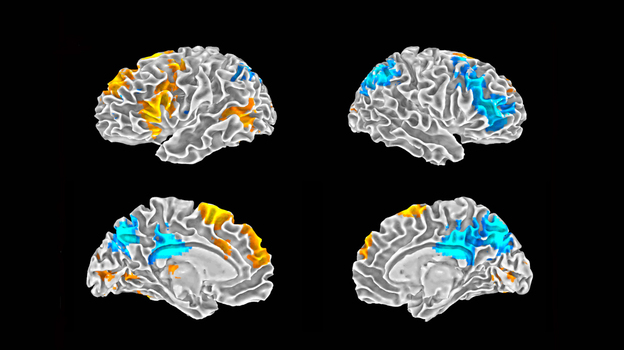
 The warmer orange colors show parts of the brain most active during improvisational rap. The blue regions are most active when rappers performed a memorized piece.

Some rappers have an impressive ability to make up lyrics on the fly, in a style known as freestyle rap.

These performers have a lot in common with jazz musicians, it turns out.

Scientists have found artists in both genres are using their brains in similar ways when they improvise.

A group of jazz pianists had their heads examined in a 2008 PLOS One study, which subjected the musicians to functional magnetic resonance imaging scans. These scans highlight areas of brain activity.

When riffing on a tune instead of playing a memorized composition, the musicians had lower activity in a part of the frontal brain that is thought to be responsible for planning and greater activity in another part of the frontal brain believed to motivate thought and action.

After hearing about the jazz study, Los Angeles rappers Michael Eagle and Daniel Rizik-Baer contacted one of the researchers, Allen Braun, chief of the voice, speech and language branch of the National Institute on Deafness and Other Communication Disorders. Eagle and Rizik-Baer proposed a similar study on freestyle rap.

Soon Braun’s colleague Siyuan Liu at NIDCD put together a team, which included the two rappers, to determine what was happening inside these performers’ brains.

In their study, published today in Scientific Reports, five professional rappers were given a set of lyrics to memorize. A week later each was put inside an MRI machine to put on his performance.

“It’s not a very natural environment, that’s for sure,” notes Braun, a co-author on the latest study. “It’s noisy and you have to lie on your back. And you need to stay still.”

The clinical setting may not have been the normal setting for the rappers, but they had little difficulty performing on cue. Each would perform the preset rap, and then they would switch to improvising to the same music track.

“By comparing the two, we could see the neural activity associated with freestyle rap,” Braun says.

When Liu and the other researchers examined the fMRI data, they found that, like the jazz musicians, the rappers’ brains were paying less conscious attention to what was going on but had strong action in the area that motivates action and thought.

“Unlike the jazz study, these changes were very strongly associated with the left hemisphere of the brain,” Braun says. That’s the half of the brain where, for most right-handed people, language is processed.

The team also found a network of connections in the performers’ brains during the freestyle raps, linking parts of the brain responsible for motivation, language, action and emotion.

And raps that were rated as more innovative correlated with more activity in the region of the brain that stores words. It’s not surprising, says Braun, “that the more creative the rap, the more they’re tapping the lexicon.”

The study is part of a larger body of research that is hoping to determine what is happening inside the brain during the creative process. Braun says that he’d like to know more about what happens in the next phase of creativity, revision. He has recruited a group of poets for that study.

http://www.npr.org/blogs/health/2012/11/14/165145967/a-peek-inside-rappers-brains-shows-roots-of-improvisation?sc=emaf

Thanks to Dr. Nakamura for bringing this to the attention of the It’s Interesting community.

Motorists waste £50m a year while defrosting their cars

Motorists who leave their car engine idle while defrosting their windscreen will waste nearly £50m in fuel this winter, according to Direct Line Car Insurance.

While the average person takes only three minutes to defrost their car, high fuel costs mean even using this small amount of petrol or diesel will see their money go up in exhaust fumes. The wasted fuel equates to over 300 million road miles, and would enable someone to drive an average sized car more than 13,000 times around the world.

However, fuel waste should not be the only worry for motorists. Of those regular drivers who took part in the study, 42pc admitted to having left their car unattended with the keys in the ignition. This makes them the perfect target for thieves, and they risk invalidating their insurance policy as well, should the vehicle get stolen.

Steve Price, head of Direct Line Car Insurance, said: “With fuel prices having risen more than 40 pence per litre since 2007, it makes more sense than ever to consider alternative methods of defrosting your car on icy days. It is really important that drivers never leave their cars unattended with the keys in the ignition under any circumstances, but particularly when defrosting their cars.

“Many of us are pressed for time in the mornings and so leaving your car to warm up whilst running back indoors to tie up some loose ends can seem like a clever use of our time. However, if a theft occurs under these circumstances, policyholders may not be covered.”

http://www.telegraph.co.uk/finance/personalfinance/insurance/motorinsurance/9674396/Motorists-waste-50m-a-year-while-defrosting-their-cars.html