Study of the Decade: Looking at Photos of Cute Animals Linked to Increased Work Performance

Stuck at work? Having trouble finishing out your Friday? Take a good, long look at this bunny. It’s adorable. And, according to newly published research, it could actually improve your performance at work*.

Researchers from Hiroshima University in Japan describe the results of their study in the latest issue of PLoS ONE. We’ve preserved the researchers’ description verbatim where possible, including explanations only when necessary, because there’s something unequivocally excellent about reading things like “cuteness-triggered positive emotion” in peer-reviewed scientific research:

In this study, three experiments were conducted to examine the effects of viewing cute images on subsequent task performance. In the first experiment, university students performed a fine motor dexterity task [participants played Bilibili Dr. Game, basically the Japanese version of Operation] before and after viewing images of baby [“cute images”] or adult [“less cute”] animals. Performance… increased after viewing cute images more than after viewing images that were less cute.

In the second experiment, this finding was replicated by using a non-motor visual search task. [This involved counting the number of times a specified number appeared in successive 40-digit groupings. For example, a subject presented with the numbers on the left would be asked to identify, as quickly as possible, how many times the number 8 appeared in the group. Test participants completed as many of these number groups as possible in a three minute period.] Performance improved more after viewing cute images than after viewing less cute images. Viewing images of pleasant foods was ineffective in improving performance. 

In the third experiment, participants performed a global–local letter task after viewing images of baby animals, adult animals, and neutral objects.

A quick explanation here: in a global-local letter task, participants are asked to indicate, as quickly as possible, whether a stimulus contains the letter “H” or letter “T” by pressing left or right on a response pad. Sounds easy, but the task actually requires a fair bit of concentration, as sometimes the letter the participant is looking for is actually composed of a series of other letters (an example is the big “H,” pictured at left, built out of smaller, closely spaced “F”s. This is an example of a global target stimulus); while other times, the letter they’re looking for is spelling out a larger letter (the big “L” on the left is built out of smaller, closely spaced “T”s. This is an example of a localtarget stimulus). Alright, back to the findings:

In general, global features were processed faster than local features. However, this global precedence effect was reduced after viewing cute images.

Results show that participants performed tasks requiring focused attention more carefully after viewing cute images. This is interpreted as the result of a narrowed attentional focus induced by the cuteness-triggered positive emotion… For future applications, cute objects may be used as an emotion elicitor to induce careful behavioral tendencies in specific situations, such as driving and office work.

http://io9.com/5947360/study-of-the-decade-looking-at-photos-of-cute-animals-linked-to-increased-work-performance

DARPA project suggests a mix of man and machine may be the most efficient way to spot danger: the Cognitive Technology Threat Warning System

smart_sentryx519


Sentry duty is a tough assignment. Most of the time there’s nothing to see, and when a threat does pop up, it can be hard to spot. In some military studies, humans are shown to detect only 47 percent of visible dangers.

A project run by the Defense Advanced Research Projects Agency (DARPA) suggests that combining the abilities of human sentries with those of machine-vision systems could be a better way to identify danger. It also uses electroencephalography to identify spikes in brain activity that can correspond to subconscious recognition of an object.

An experimental system developed by DARPA sandwiches a human observer between layers of computer vision and has been shown to outperform either machines or humans used in isolation.

The so-called Cognitive Technology Threat Warning System consists of a wide-angle camera and radar, which collects imagery for humans to review on a screen, and a wearable electroencephalogram device that measures the reviewer’s brain activity. This allows the system to detect unconscious recognition of changes in a scene—called a P300 event.

In experiments, a participant was asked to review test footage shot at military test sites in the desert and rain forest. The system caught 91 percent of incidents (such as humans on foot or approaching vehicles) in the simulation. It also widened the field of view that could effectively be monitored. False alarms were raised only 0.2 percent of the time, down from 35 percent when a computer vision system was used on its own. When combined with radar, which detects things invisible to the naked eye, the accuracy of the system was close to 100 percent, DARPA says.

“The DARPA project is different from other ‘human-in-the-loop’ projects because it takes advantage of the human visual system without having the humans do any ‘work,’ ” says computer scientist Devi Parikh of the Toyota Technological Institute at Chicago. Parikh researches vision systems that combine human and machine expertise.

While electroencephalogram-measuring caps are commercially available for a few hundred dollars, Parikh warns that the technology is still in its infancy. Furthermore, she notes, the P300 signals may vary enough to require training or personalized processing, which could make it harder to scale up such a system for widespread use.

Thanks to Kebmodee for bringing this to the attention of the It’s Interesting community.

http://www.technologyreview.com/news/507826/sentry-system-combines-a-human-brain-with-computer-vision/

2 tons of pigeon droppings found in Swedish church tower

The property manager of the Heliga Trefaldighets Kyrka in Gavle, Sweden, explained Thursday, November 22, 2012, how their church tower came to hold 2 tons of pigeon droppings. Yahoo! News had the very disgusting details:

“Lennart Helzenius said on Thursday that church staff had been shocked by the sheer number of bags of excrement cleaners were removing from the tower. He says the droppings filled 80 bags in the first round of cleaning, and then just as many in the second round.

Helzenius says the hatch had probably been left open since the 1980s.”

Histoplasmosis and cryptococcosis are both lung diseases that are contacted by breathing the fungus spores from pigeon excrement. You can read more about the dangers and guidelines regarding the cleanup of pigeon droppings in the work place or home here on Animal.Discovery.com.

http://www.examiner.com/article/a-swedish-church-finds-2-tons-of-pigeon-poop-the-tower

Water Ice and Possible Organic Materials Discovered at Mercury’s North Pole


It’s time to add Mercury to the list of worlds where you can go ice-skating. Confirming decades of suspicion, a NASA spacecraft has spotted vast deposits of water ice on the planet closest to the sun.

Temperatures on Mercury can reach 800 degrees Fahrenheit (427 degrees Celsius), but around the north pole, in areas permanently shielded from the sun’s heat, NASA’s Messenger spacecraft found a mix of frozen water and possible organic materials.

Evidence of big pockets of ice is visible from a latitude of 85 degrees north up to the pole, with smaller deposits scattered as far away as 65 degrees north.

The find is so enticing that NASA will direct Messenger’s observation toward that area in the coming months — when the angle of the sun allows — to get a better look, said Gregory Neumann, a Messenger instrument scientist at NASA’s Goddard Space Flight Center in Maryland. [Latest Mercury Photos from Messenger]

“There is an ongoing campaign, when the spacecraft permits, to look further northward,” said Neumann, the lead author of one of three Mercury studies published online in the Nov. 29 edition of the journal Science.

Researchers also believe the south pole has ice, but Messenger’s orbit has not allowed them to obtain extensive measurements of that region yet.

Messenger will spiral closer to the planet in 2014 and 2015 as it runs out of fuel and is perturbed by the sun’s and Mercury’s gravity. This will let researchers peer closer at the water ice as they figure out how much is there.

Speculation about water ice on Mercury dates back more than 20 years.

In 1991, Earth-bound astronomers fired radar signals to Mercury and received results showing there could be ice at both poles. This was reinforced by 1999 measurements using the more powerful Arecibo Observatory microwave beam in Puerto Rico. Radar pictures beamed back to New Mexico’s Very Large Array showed white areas that researchers suspected was water ice.

A closer view, however, required a spacecraft. Messenger settled into Mercury’s orbit in March 2011, after a few flybys.  Almost immediately, NASA used a laser altimeter to probe the poles. The laser is weak — about the strength of a flashlight — but just powerful enough to distinguish bright icy areas from the darker, surrounding Mercury regolith.

Neumann said the result was “curious”: There were few bright spots inside craters.

Team member John Cavanaugh was pretty sure of what they were finding, Neumann recalled. Cavanaugh had been a part of NASA’s Lunar Reconnaissance Orbiter team, and he had seen a similar strange pattern on Earth’s moon when LRO found ice at the lunar poles in 2009.

Flash heating on Mercury would mix nearly all of its ice with the surrounding regolith – as well as with possible organic material borne to the planet by comets and ice-rich asteroids.

“So what you’re seeing is the fact that water ice can’t survive indefinitely in these locations because the temperatures apparently spike up,” Neumann said.

The team expected to find water ice on Mercury. Indeed, Messenger already drew a link this year between permanently shadowed areas on the planet and the “radar bright” spots seen from Earth.

All researchers needed to do was point their instruments in the right spot, seek out bright areas and then measure the temperature and composition.

Messenger’s neutron spectrometer spotted hydrogen, which is a large component of water ice. But the temperature profile unexpectedly showed that dark, volatile materials – consistent with climes in which organics survive – are mixing in with the ice.

“This was very exciting. You are looking for bright stuff, and you see dark stuff – gee, it’s something new,” Neumann said.

Organic materials are life’s ingredients, though they do not necessarily lead to life itself. While some scientists think organics-bearing comets sparkedlife on Earth, the presence of organics is also suspected on airless, distant worlds such as Pluto. Scientists say comets carrying organic bits smashed into other planets frequently during the solar system’s history.

Researchers are now working to determine if they indeed saw organics on Mercury. So far, they suspect Mercury’s water ice is coated with a 4-inch (10 centimeters) blanket of “thermally insulating material,” according to Neumann’s paper.

It will take further study to figure out exactly what this material is, but Neumann said the early temperature curves could show organic materials such as amino acids.

http://www.livescience.com/25132-water-ice-mercury-messager-discovery.html

Monster Black Hole Is Biggest Ever Found

galaxy-ngc-1277-giant-black-hole


Astronomers have discovered what may be the most massive black hole ever known in a small galaxy about 250 million light-years from Earth, scientists say.

The supermassive black hole has a mass equivalent to 17 billion suns and is located inside the galaxy NGC 1277 in the constellation Perseus. It makes up about 14 percent of its host galaxy’s mass, compared with the 0.1 percent a normal black hole would represent, scientists said.

“This is a really oddball galaxy,” said study team member Karl Gebhardt of the University of Texas at Austin in a statement. “It’s almost all black hole. This could be the first object in a new class of galaxy-black hole systems.”

The giant black hole is about 11 times as wide as the orbit of Neptune around our sun, researchers said. The mass is so far above normal that the scientists took a year to double-check and submit their research paper for publication, according to the study’s lead author, Remco van den Bosch.

“The first time I calculated it, I thought I must have done something wrong. We tried it again with the same instrument, then a different instrument,” van den Bosch, an astronomer at Germany’s Max Planck Institute for Astronomy, told SPACE.com. “Then I thought, ‘Maybe something else is happening.'” [Strangest Black Holes in the Universe]

The finding may have implications for our understanding of how giant black holesevolve  in the center of galaxies.

Astronomers typically believe that the size of the central part of a galaxy, and the black hole inside of it, are linked. But the vastly different proportions seen in NGC 1277 are calling that into question.

NGC 1277’s black hole could be many times more massive than its largest known competitor, which is estimated but not confirmed to be between 6 billion and 37 billion solar masses in size.It makes up about 59 percent of its host galaxy’s central mass – the bulge of stars at the core. The object’s closest competitor is in the galaxy NGC 4486B, whose black hole takes up 11 percent of that galaxy’s central bulge mass.  

 However, van den Bosch’s team says it has also spotted five other galaxies near NGC 1277 that look about the same, and may also harbor gigantic black holes inside of them.

“You always expect to find one sort [of a phenomenon], but now we have six of them,” van den Bosch said. “We didn’t expect them, because we do expect the black holes and the galaxies to influence each other.”

The research is detailed in the Nov. 29 edition of the journal Nature.

http://www.livescience.com/25101-biggest-black-hole-discovery.html

$500,000 for future trips to Mars

SpaceX founder and billionaire Elon Musk is laying out his plans for a colony on Mars, and they are specific.

Musk has mapped out an approximate number of people he imagines living in the Mars colony (80,000), as well as how much a ticket to Mars might cost — $US500,000 ($A477,300).

But first, he said, SpaceX has to design what he calls a “rapid and reusable” rocket that can land vertically. “That is the pivotal step to achieving a colony on Mars,” he told an audience at the Royal Aeronautical Society in London last week.

If SpaceX or another company can’t come up with a rocket that can be reused and refuelled, like we reuse aeroplanes, then he said colonising Mars would be prohibitively expensive.

Musk described creating a rocket that could shuttle between Mars and the Earth as “possible, but quite difficult”.

But that hasn’t stopped him from mapping out a vision of how a colony on Mars might grow. The first step, of course, is getting a manned mission to Mars, which Musk said he thinks SpaceX can do in 10 to 15 years.

Next, he envisions sending 10 people to the Red Planet, along with supplies to build transparent domes, Space.com reports. If the domes are pressurised with the CO2 in Mars’ atmosphere, the colonists could grow Earth crops in the soil on Mars.

As the colony became more self-sufficient, space on the rocket could be filled with people rather than supplies.

And those numbers Musk tossed out are not random. He arrived at 80,000 colonists by estimating that by the time a Mars colony is a reality there will be 8 billion people on Earth. Musk said he thinks 1 in 100,000 people will be ready and willing to take the journey to Mars. As for the $US500,000 ticket — he said that while it’s a lot of money, it is a sum of money that someone who has worked hard and saved carefully might be able to afford.

And as to whether the American taxpayer should contribute to a colony on Mars, Musk says yes. A colony on another planet is life insurance for life collectively, he said during his talk. He added that it would be a fun adventure to watch, even if you aren’t planning on going yourself.

http://m.smh.com.au/technology/sci-tech/your-ticket-to-mars-half-a-million-dollars-20121127-2a4bc.html

Pokertox

Try to keep a straight face – a plastic surgeon is offering card players the chance to have a perfect poker face with his pioneering new botox technique.

New York doctor Dr Jack Berdy has launched the idea of using botox to allow people to gain an advantage in the game by hiding their emotions in a service he calls Pokertox.

‘Very few people can maintain a real poker face,’ Dr Berdy told the New York Post. ‘They have some “tells,” some expression that gives away that they have a good hand or a bad hand’ to an opponent.’

‘Some squint, or furrow their brows,’ Dr Berdy, from Manhattan’s East Side, told the New York Post.

‘We can inject botox appropriately so the other player doesn’t get the message that they’re angry, disappointed or happy.

‘What someone sees across the table is no movement,’ he said.
‘After a few days players will have a relaxed, rested appearance in a very natural way that without effort can be maintained however the cards decide to play.

‘It also works the other way too – at our SmoothMED walk-in we can put Botox in areas to make it look like the player has a ‘tell’ they really don’t have.’

Pokertox costs an average $600 to $800 and lasts three to four months, he says.

The idea came to Dr Berdy because he used to be a gambler and his specialty is botox — ‘and they go together.’

Read more: http://www.dailymail.co.uk/news/article-2236717/Doctor-offers-botox-shots-poker-fans-players-read-expressions.html#ixzz2DRXudtFH

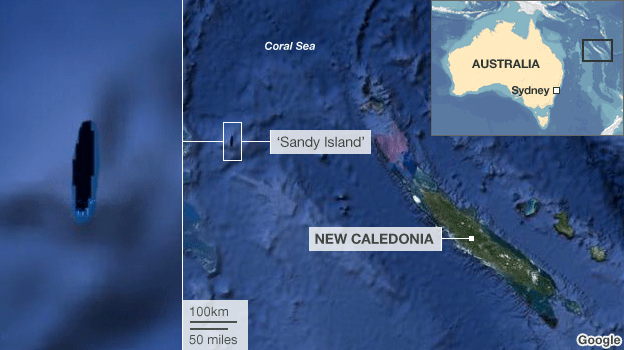
South Pacific Sandy Island proven not to exist


A South Pacific island, shown on marine charts and world maps as well as on Google Earth and Google Maps, does not exist, Australian scientists say.

The supposedly sizeable strip of land, named Sandy Island on Google maps, was positioned midway between Australia and French-governed New Caledonia.

But when scientists from the University of Sydney went to the area, they found only the blue ocean of the Coral Sea.

The phantom island has featured in publications for at least a decade.

Scientist Maria Seton, who was on the ship, said that the team was expecting land, not 1,400m (4,620ft) of deep ocean.

“We wanted to check it out because the navigation charts on board the ship showed a water depth of 1,400m in that area – very deep,” Dr Seton, from the University of Sydney, told the AFP news agency after the 25-day voyage.

“It’s on Google Earth and other maps so we went to check and there was no island. We’re really puzzled. It’s quite bizarre.

“How did it find its way onto the maps? We just don’t know, but we plan to follow up and find out.”

Australian newspapers have reported that the invisible island would sit within French territorial waters if it existed – but does not feature on French government maps.

Australia’s Hydrographic Service, which produces the country’s nautical charts, says its appearance on some scientific maps and Google Earth could just be the result of human error, repeated down the years.

A spokesman from the service told Australian newspapers that while some map makers intentionally include phantom streets to prevent copyright infringements, that was was not usually the case with nautical charts because it would reduce confidence in them.

A spokesman for Google said they consult a variety of authoritative sources when making their maps.

“The world is a constantly changing place, the Google spokesman told AFP, “and keeping on top of these changes is a never-ending endeavour’.’

The BBC’s Duncan Kennedy in Sydney says that while most explorers dream of discovering uncharted territory, the Australian team appears to have done the opposite – and cartographers everywhere are now rushing to undiscover Sandy Island for ever.

http://www.bbc.co.uk/news/world-asia-20442487

Chinese cross-dressing grandfather finds internet fame


A 72-year-old Chinese man has become an internet sensation after his granddaughter used him as a cross-dressing model to promote her clothing store.

Lu Qing, who lives in southern China’s Guangdong province, posted pictures of her grandfather dressed in an array of pink skirts, red tights and fur-lined women’s jackets to promote her online fashion outlet Yuekou.

The images of Liu Xianping have since gone viral and seen him branded the “world’s coolest” grandfather by internet users for his slender legs and modelling poise. They have also boosted his granddaughter’s bottom line.

“Since the pictures came out, we’ve had a huge number of website visitors, and are selling five times as many clothes as before,” Lu said.

“Previously, we sometimes sold less than 10 items a day, and were feeling depressed about the business.”

Lu said her grandfather was “surprised” by the reaction to the photos and at least three other stores had asked him to pose for them, but he was unlikely to accept.

“He doesn’t see modelling as a way of making money, its just about having fun with his relatives,” she said, adding she hopes to use his services again.

Liu “had a young heart”, she said, and enjoys visits to parks and zoos, as well as playing games on his mobile phone. “He thinks bringing people’s attention to the elderly is great, so he’s been very happy recently.”

The Offbeat China website, which tracks internet developments in the country, said Liu’s modelling illustrates the transformation it has undergone.

“It is stories like this when one can get a sense of what a diversified society China has changed into in the past 40 years, especially for someone like Liu who has lived through one of the most rigid times in China’s history,” said a post on the site.

Liu, who has worked as a teacher and a farmer, did not need prompting to take up modelling, Lu said.

“My grandfather saw some new stock one day and thought some of the colours were pretty… he wasn’t embarrassed to model because we’re all very close to him,” she said, adding that his favourite item was a red women’s coat.

Read more: http://www.theage.com.au/digital-life/digital-life-news/crossdressing-grandfather-finds-internet-fame-20121126-2a24l.html#ixzz2DXGgpoYN