Drive-in Sex Booths to Open in Zurich

zurichsex booth


Zurich city officials hope to have new sex booths, similar to those pictured above that are currently used in Germany, by August

There will be enough booths constructed on the outskirts of the city to accommodate around 30 prostitutes.

City officials hope the booths, which will come with inbuilt panic alarms, will be ready for launch in August.

An on-site counsellor will also be provided in the taxpayer funded scheme.

It is hoped the move will help make the sex industry much safer and more regulated, ABC News reported.

Prostitution will be banned in certain parts of the city and confined to the booths and two other zones after they open in August.

Michael Herzig, spokesperson for Zurich Social Welfare Department, said: ‘The big difference is that until now prostitution is in a public space.

‘Now we are going to change this, transfer it from the street, from a public to a private space to an old industrial area which belongs to the city that give us the possibility to define the rules of prostitution in this space.

‘The women will be better protected from attack, and it will also mean better business for them.

‘With the women right by the sex boxes there is no “travel time” so they can deal with more customers. It’s a better business model than standing on the street.’

Prostitutes will also have to apply for a £26 licence, register with a health insurer and buy a ticket each night for about £3 before they begin soliciting customers from January onwards.

Social Welfare Department officials said the plan is ‘progressing’ and is ready to enter into full-force in the New Year.
http://www.dailymail.co.uk/news/article-2240233/Drive-sex-booths-built-Zurich-help-make-prostitution-safer.html?ito=feeds-newsxml

Future technology from Apple

applecomputer062906vig1


All the way back in February of this year, Apple’s iPhone business alone surpassed the size of Microsoft’s entire business, reaching nearly $25 billion in annual revenue versus Microsoft’s ~$20 billion.

Since February, Apple’s iPhone business has only grown, widening this gap.

Here’s the outdated chart from February:

iPhone vs Microsoft

Remarkable isn’t it?

Here’s what’s more remarkable yet: At this very moment, Apple is working on technology that, if successfully developed, will cannibalize and ultimately destroy that iPhone business.

We have two pieces of evidence.

The first is that Apple has established a pattern.

Unlike most companies, Apple has a remarkable ability to predict the kinds of gadgets that will undercut the gadgets it sells, and then build these new gadgets better than anyone else could.

The best example of this is the iPad, which is actively disrupting Apple’s own Mac business.

During Business Insider’s Ignition Conference last week, top Apple analyst Gene Munster of Piper Jaffray talked about Apple’s tendency to cannibalize its own businesses and predicted that it would continue to do so.

He speculated that Apple is working on consumer robotics, wearable computers, 3D printing, consumable computers, and automated technology.

He showed everyone this chart, which visualizes Apple’s pattern:

Munster on Apple

Here’s the other reason it’s safe to assume Apple is quietly working on the destruction of its most massive business, the iPhone.

Just like Google and Microsoft, Apple is working on computerized glasses. 

Computerized glasses, are, at the moment, the technology that is most likely to bring the smartphone era to an end.

They fit into an obvious pattern, where computers have been getting smaller and closer to our faces since their very beginning. 

First they were in big rooms, then they sat on desktops, then they sat on our laps, and now they’re in our palms. Next they’ll be on our faces. 

We have the rough schematics of Apple’s project.

They’ve been  publicly available on the US Patent Office’s website since this summer, when they were noticed by several Apple-watching websites.

In the patent filing, Apple calls the gadget  a “head-mounted display” or “HMD.”  

The filing is authored by Tony Fadell, designer of the iPod, and John Tang. Fadell is no longer at Apple, but Tang is.

Some highlights from the description:

  • An HMD is “a display device that a person wears on the head in order to have video information directly displayed in front of the eyes.”
  • “The optics are typically embedded in a helmet, glasses, or a visor, which a user can wear.”
  • “HMDs can be used to view a see-through image imposed upon a real world view, thereby creating what is typically referred to as an augmented reality.”
Apple says HMDs can be used…
  • To “display relevant tactical information, such as maps or thermal imaging data.”
  • To “provide stereoscopic views of CAD schematics, simulations or remote sensing applications.”
  • For “gaming and entertainment applications.”
A gadget that features applications for maps, games, and a million other uses? Sounds familiar.

Here’s an illustration from the patent filing:

Apple Patent

Read more: http://www.businessinsider.com/apple-is-quietly-working-to-destroy-the-iphone-2012-12#ixzz2E7XVXabt

170-Foot-Long Trampoline Installed in Russian Forest

tramp1tramp2tramp4tramp3

A nearly 170-foot-long trampoline trail has been installed in a Russian forest as part of the 2012 Archstoryanie festival, an art and music exposition.

The trampoline, called “Fast Track,” was designed by design company Salto and installed in Nikola-Lenivets, Russia.

“‘Fast track’ is a integral part of park infrastructure, it is a road and an installation at the same time,” Salto explains on their website. “It challenges the concept of infrastructure that only focuses on technical and functional aspects and tends to be ignorant to its surroundings.”

“‘Fast track’ is an attempt to create intelligent infrastructure that is emotional and corresponds to the local context,” the designers explained. “It gives the user a different experience of moving and perceiving the environment.”

http://abcnews.go.com/blogs/headlines/2012/11/170-foot-long-trampoline-installed-in-russian-forest/

Bosses more likely to hire someone they find attractive, study finds

interview_2412938b

Employers are more likely to hire people they fancy, researchers claim, as they find “leisure pursuits, background and self-presentation” are more important than skills.

Women in the workplace have fought a long battle to prove their skills, experience and CV are the only keys to their success.

But their efforts may have been in vain, as a study find good looks, a winning smile and a little gentle flirtation may be the key to securing a job after all.

Bosses would rather hire someone they find attractive and enjoy spending time with than the perfectly-qualified candidate, it has been claimed.

They would rather employ someone “who will be their friend or maybe even their romantic partner”, with whom they feel a “spark”, researchers have suggested.

A study, conducted by American sociologists, has found interviewers at banking, law and management consultancy firms consistently prefer applicants they “feel good around”.

More than half of employers claim attractiveness, the right social background and how candidates spend their leisure time are the most important considerations when hiring, it is claimed.

Dr Lauren Rivera, from Northwestern University in the United States, found interviewers often put their personal feelings of comfort, acceptance and excitement first.

Half of those studied ranked “cultural fit” as the most important criterion at job interview stage, meaning they were more likely to hire someone with the same “leisure pursuits, background and self-presentation” as current staff.

“Of course employers are looking for people who have the baseline of skills to effectively do the job,” she said.

“But, beyond that, employers really want people who they will bond with, who they will feel good around, who will be their friend and maybe even their romantic partner.

“As a result, employers don’t necessarily hire the most skilled candidates.”

The study, based on 120 interviews and published in the American Sociological Review, is the first investigation of its kind into whether shared culture between employers and job candidates matters.

Dr Rivera said: “It is important to note this does not mean employers are hiring unqualified people.

“But my findings demonstrate that – in many respects – employers hire in a manner more closely resembling the choice of friends or romantic partners than how one might expect employers to select new workers.

“When you look at the decision to date or marry someone what you think about is commonalities. Do you have a similar level of education? Did you go to a similar calibre school? Do you enjoy similar activities? Are you excited to talk to each other? Do you feel the spark?

“These types of things are salient at least to the employers I’ve studied.”

In studying graduate and undergraduate employment programmes, she also noted significant differences in the way different social classes approached interviews.

“Evaluators are predominately white, Ivy League-educated, upper-middle or upper class men and women who tend to have more stereotypically masculine leisure pursuits and favour extracurricular activities associated with people of their background,” she said.

“Given less affluent students are more likely to believe achievement in the classroom rather than on the field or in the concert hall matters most for future success and focus their energies accordingly, the types of cultural similarities valued in elite firms’ hiring processes has the potential to create inequalities in access to elite jobs based on parental socioeconomic status.”

http://www.telegraph.co.uk/news/newstopics/howaboutthat/9710004/Bosses-more-likely-to-hire-someone-they-fancy-study-finds.html

Russian Drivers Stuck In 120-Mile Traffic Jam

Snowbound traffic queue, Moscow 29/11/12


Thousands of cars, lorries and motorists became stuck for up to three days in a huge traffic jam on a motorway northwest of Moscow after Russia was hit by heavy snowfall.

The length of the queue on the M-10 highway, which is one of the busiest in the country, was put at up to 120 miles (200km), according to media reports.

Some 4,000 trucks were thought to be involved.

Unusually severe conditions for early winter and heavy snow were blamed for the gridlock, which paralysed circulation over the weekend and into Monday.

Drivers waited for hours without moving in temperatures of -5 degrees Celsius, with one motorist reported as saying he had travelled just “one kilometre over 24 hours”.

Field kitchens were set up along stretches of the road, which is surrounded by a forest, in an attempt to ensure people had food and drink.

But many of those stranded came close to running out of fuel as they kept their engines and heating running in the sub-zero temperatures.

“Drivers help one another and that’s it, the problems are on the side of the authorities. There are no gasoline tankers, no water, nothing. We are just stuck here,” a truck driver called Sergei said.

Officials said that traffic had been moving normally again since the early hours of Monday but acknowledged more needed to be done to prevent a repeat of the problems.

Deputy Prime Minister Dmitry Rogozin said it was clear road services had not worked effectively.

“At the start of the snowfall, not even a half of the available technical hardware was used.

“Many drivers were stuck without provisions and fuel in the middle of a forest. This is not a European road but a Russian one, a forest road,” he said.

Emergency Situations Minister Vladimir Puchkov described the problems as “a good lesson for all the services”.

“They need to work on the roads and not in their warm offices,” he warned.

Russia map

<:figure><:figure>

The M-10 links Moscow with Russia’s second largest city St Petersburg.

Prime Minister Dmitry Medvedev said that the road services needed to work efficiently and prevent such incidents from happening.

But he also appeared to admit that such problems were inevitable given Russia’s harsh climatic conditions.

“Drivers need to be prepared for the fact that the weather in our country is very, very complicated and there is always going to be snow,” Mr Medvedev said on television.

Russian authorities have been accused of sluggish responses to weather-related problems, including deadly wildfires in 2010 and flooding in the south this summer.

The M-10 highway links Moscow with Russia’s second largest city St Petersburg, some 435 miles (700km) from the capital, and stretches on to the border with Finland.

Russia’s roads have been the butt of criticism since Tsarist times and its infrastructure has been plagued with problems since the Soviet era when defence spending was high at the expense of roads, housing, healthcare and other civilian needs.

http://news.sky.com/story/1019710/russia-drivers-stuck-in-120-mile-traffic-jam

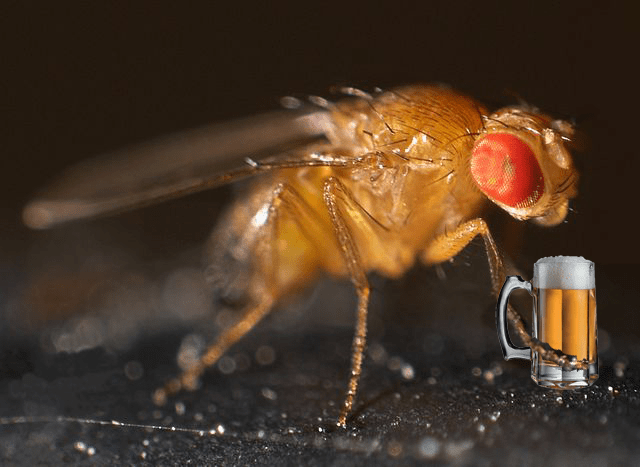
Sexually-deprived fruitflies drink more alcohol

drinking_drosophila

Rejection stinks. It literally hurts. But worse, it has an immediate and negative impact on our brains, producing withdrawal symptoms as if we’re quitting a serious addiction cold turkey. It’s no wonder, then, that we are tempted to turn to drugs to makeourselves feel better. But we’re not the only species that drowns our sorrows when we’re lonely – as a new study in Science reveals, rejected Drosophila do, too. Scientists have found not only will these sexually frustrated flies choose to consume more alcohol than their happily mated peers, sex and alcohol consumption activate the same neurological pathway in their brains.

Drosophila melanogaster males sure know how to woo a lady. When placed in the same container as a potential mate, a male fly will play her a delicate love song by vibrating one wing, caress her rear end, and gently nuzzle her most private of parts with his proboiscis to convince her that he is one heck of a lover. But even the most romantic fly can’t convince an already mated female Drosophila to give up the goods, so scientists were able to use the girls’ steely resolve to see how rejection affects fly drinking behavior.

“Alcohol is one of the most widely used and abused drugs in the world,” explains lead author Galit Shohat-Ophir. “The fruit fly Drosophila melanogaster is an ideal model organism to study how the social environment modulates behavior.” Previous studies have found that Drosophila melanogaster exhibit complex addiction-like behaviors. So in the controlled setting of Ulrike Heberlein’s lab at the University of California San Francisco, researchers paired male fruit flies with three types of females: 1) unmated females, which were willing and happy to mate; 2) mated females, which actively rejected the men; and 3) decapitated females, which didn’t actively reject the guys but, well, weren’t exactly willing partners either. After the flies were satisfied or frustrated, they were offered regular food and food spiked with ethanol, and the researchers measured which type they preferred to see if there was any connection between sex and drinking.

The flies that were rejected drank significantly more than their satisfied peers, but so did the ones paired with incapacitated girls, suggesting that it wasn’t the social aspect of rejection but sexual deprivation that drives male flies to increase their ethanol consumption (see the video at the end!). This alcoholic behavior was very directly related to the guy fly ever getting laid, for even after days of blue balls, if he was allowed to spend some time with a willing woman, he no longer preferred the spiked food.

What the scientists really wanted to understand, though, was why. What drives a frustrated fly to the flask? So to look at the underlying mechanism of this phenomenon, the scientists examined the flies’ brains. A body of scientific literature has connected one particular neurotransmitter, neuropeptide F (NPF), to ethanol-related behaviors in Drosophila, so it was a logical place to start. A very similar neurotransmitter in our brains, called neuropeptide Y (NPY), is linked to alcoholism.

Increased expression of NPF in mated male brains, as shown through immunochemistry.

The team found that sexual frustration caused an immediate decrease in the expression of NPF, while sex increased expression. Furthermore, when they used genetics to artificially knock down NPF levels in the satisfied flies, they drank as much as their not-so-satisfied friends. Similarly, when the researchers artificially increased NPF levels, flies stayed sober. This is the first time NPF levels have connected sexual activity to drinking. Clearly, NPF levels controlled the flies’ desire to drink, so the team further explored how NPF works in the fly’s brain.

Many animals, including ourselves, possess a neurological reward system which reinforces good behavior. Through this system, we ascribe pleasure or positive feelings to things we do that are necessary for species survival, including sex, eating, and social interaction. Drugs tap into this system, stimulating pleasure which can lead to addiction. Previous studies have shown that flies find intoxication rewarding, so the researchers hypothesized that NPF may play a role in the reward system.

Preference tests showed that artificially increasing NPF levels in the absence of sex or ethanol was rewarding to the flies, confirming the scientists’ hypothesis. This was further supported by the discovery that constantly activating NPF abolished the flies’ tendency to consider ethanol rewarding.

“NPF is a currency of reward” explains Shohat-Ophir. High NPF levels signal good behavior in Drosophila brains, thus reinforcing any activities which led to that state. This is a truly novel discovery, for while NPF and the mammal version, NPY, have been linked to alcohol consumption, no animal model has ever placed NPF/NPY in the reward system.

Understanding the role of NPF in reward-seeking behaviors may lead to better treatments for addicts. “In mammals, including humans, NPY may have a similar role [as NPF],” says Shohat-Ophir. “If so, one could argue that activating the NPY system in the proper brain regions might reverse the detrimental effects of traumatic and stressful experiences, which often lead to drug abuse.” Already, NPY and drugs that affect the function of its receptors are in clinical trials for anxiety, PTSD, mood disorders and obesity. This study suggests that perhaps they should be tested as treatment for alcoholism, too, as well as other reward-based addictions.

Research: Shohat-Ophir, G, KR Kaun & R Azanchi (2012). Sexual Deprivation Increases Ethanol Intake in Drosophila. Science 335: 1351-1355.

Click  http://blogs.scientificamerican.com/science-sushi/2012/03/15/flies-drink-upon-rejection/

to view a sequence of  three videos that show a male fly courting and successfully mating with a female fly, another male fly being rejected by a female, and a male choosing to consume an alcohol-infused solution over a non-alcohol solution. Video © Science/AAAS

New research shows that homicide spreads through a city like infectious disease

crime-scene-1


Homicide moves through a city in a process similar to infectious disease, according to a new study that may give police a new tool in tracking and ultimately preventing murders.

Using Newark, N.J., as a pilot case, a team of Michigan State University researchers led by April Zeoli successfully applied public health tracking methods to the city’s 2,366 homicides between 1982 and 2008. They found the killings were not randomly located but instead followed a pattern, evolving from the city’s center and moving southward and westward over time.

Like a flu bug that spreads to susceptible groups such as children and the elderly, homicide clusters in Newark — often fueled by gangs and guns — spread to areas consisting largely of poor and minority residents. Over time, the concentration of homicides effectively disappeared from one area and settled in another.

“By using the principles of infectious disease control, we may be able to predict the spread of homicide and reduce the incidence of this crime,” said Zeoli, public health researcher in MSU’s School of Criminal Justice.

The study is one of the first to use analytic software from the field of medical geography to track long-term homicide trends. Zeoli said the method can be done in real time which would allow police to identify emerging hotspots.

The researchers also identified areas of Newark that had no homicide clusters during the 26-year time frame of the study, despite being surrounded by deadly violence.

“If we could discover why some of those communities are resistant,” Zeoli said, “we could work on increasing the resistance of our communities that are more susceptible to homicide.”

Joining Zeoli on the study were criminal justice researchers Jesenia Pizarro and Christopher Melde and medical geographer Sue Grady.

The study is published in Justice Quarterly, a research journal.

http://www.sciencedaily.com/releases/2012/11/121129103541.htm

Zic Zazou

This is a pretty incredible musical performance: the members of French artistic troupe Zic Zazou play a piece from Bizet’s opera ‘Carmen’ using sandpaper, handmade instruments, tools, a few beer bottles, some pots and pans, and yes, a balloon.

A couple of questions come to mind: first of all, how many years did it take them to get this good at playing random objects like they’re instruments?

Quite a while, as it turns out. The troupe has been together since 1987. The guys in the video above are the same nine people who started out making music and performance art together all those years ago.

To find out more about them, you can check out the Zic Zazou website right here.

The Bizet performance was recorded for the French TV show ‘La Grande Battle,’ in which people competed to create the most innovative, clever cover of a classical composition.

Zic Zazou won the whole thing.

Other entrants include Joanda, who interpreted a piece by Verdi using only traditional Mediterranean instruments, Whiskybaba, who dressed up like weird circus performers and turned Mozart’s ‘A Little Night Music’ into a wonky polka, and crooner Tony Vitti, who adapted Beethoven’s ‘Ode To Joy’ into a jazz tune.

Musicians’ Brains Synchronize During Duets

brain-generic-101221-02

The brain waves of two musicians synchronize when they are performing duet, a new study found, suggesting that there’s a neural blueprint for coordinating actions with others.

A team of scientists at the Max Planck Institute for Human Development in Berlin used electrodes to record the brain waves of 16 pairs of guitarists while they played a sequence from “Sonata in G Major” by Christian Gottlieb Scheidler. In each pair, the two musicians played different voices of the piece. One guitarist was responsible for beginning the song and setting the tempo while the other was instructed to follow.

In 60 trials each, the pairs of musicians showed coordinated brain oscillations — or matching rhythms of neural activity — in regions of the brain associated with social cognition and music production, the researchers said.

“When people coordinate their own actions, small networks between brain regions are formed,” study researcher Johanna Sänger said in a statement. “But we also observed similar network properties between the brains of the individual players, especially when mutual coordination is very important; for example at the joint onset of a piece of music.”

Sänger added that the internal synchronization of the lead guitarists’ brain waves was present, and actually stronger, before the duet began.

“This could be a reflection of the leading player’s decision to begin playing at a certain moment in time,” she explained.

Another Max Planck researcher involved in the study, Ulman Lindenberger, led a similar set of experiments in 2009. But in that study, which was published in the journal BMC Neuroscience, the pairs of guitarists played a song in unison, rather than a duet. Lindenberger and his team at the time observed the same type of coordinated brain oscillations, but noted that the synchronization could have been the result of the similarities of the actions performed by the pairs of musicians.

As the new study involved guitarists who were performing different parts of a song, the researchers say their results provide stronger evidence that there is a neural basis for interpersonal coordination. The team believes people’s brain waves might also synchronize during other types of actions, such as during sports games.

The study was published online Nov. 29 in the journal Frontiers in Human Neuroscience.

http://www.livescience.com/25117-musicians-brains-sync-up-during-duet.html

British company claims biggest engine advance since the jet: the SABRE engine

A Skylon in flight with a cutaway of the SABRE engine


A small British company with a dream of building a re-usable space plane has won an important endorsement from the European Space Agency (ESA) after completing key tests on its novel engine technology.

Reaction Engines Ltd believes its Sabre engine, which would operate like a jet engine in the atmosphere and a rocket in space, could displace rockets for space access and transform air travel by bringing any destination on Earth to no more than four hours away.

That ambition was given a boost on Wednesday by ESA, which has acted as an independent auditor on the Sabre test programme.

“ESA are satisfied that the tests demonstrate the technology required for the Sabre engine development,” the agency’s head of propulsion engineering Mark Ford told a news conference.

“One of the major obstacles to a re-usable vehicle has been removed,” he said. “The gateway is now open to move beyond the jet age.”

The space plane, dubbed Skylon, only exists on paper. What the company has right now is a remarkable heat exchanger that is able to cool air sucked into the engine at high speed from 1,000 degrees Celsius to minus 150 degrees in one hundredth of a second.

This core piece of technology solves one of the constraints that limit jet engines to a top speed of about 2.5 times the speed of sound, which Reaction Engines believes it could double.

With the Sabre engine in jet mode, the air has to be compressed before being injected into the engine’s combustion chambers. Without pre-cooling, the heat generated by compression would make the air hot enough to melt the engine.

The challenge for the engineers was to find a way to cool the air quickly without frost forming on the heat exchanger, which would clog it up and stop it working.

Using a nest of fine pipes that resemble a large wire coil, the engineers have managed to get round this fatal problem that would normally follow from such rapid cooling of the moisture in atmospheric air.

They are tight-lipped on exactly how they managed to do it.

“We are not going to tell you how this works,” said the company’s chief designer Richard Varvill, who started his career at the military engine division of Rolls-Royce. “It is our most closely guarded secret.”

The company has deliberately avoided filing patents on its heat exchanger technology to avoid details of how it works – particularly the method for preventing the build-up of frost – becoming public.

The Sabre engine could take a plane to five times the speed of sound and an altitude of 25 km, about 20 percent of the speed and altitude needed to reach orbit. For space access, the engines would then switch to rocket mode to do the remaining 80 percent.

Reaction Engines believes Sabre is the only engine of its kind in development and the company now needs to raise about 250 million pounds ($400 million) to fund the next three-year development phase in which it plans to build a small-scale version of the complete engine.

Chief executive Tim Hayter believes the company could have an operational engine ready for sale within 10 years if it can raise the development funding.

The company reckons the engine technology could win a healthy chunk of four key markets together worth $112 billion (69 billion pounds) a year, including space access, hypersonic air travel, and modified jet engines that use the heat exchanger to save fuel.

The fourth market is unrelated to aerospace. Reaction Engines believes the technology could also be used to raise the efficiency of so-called multistage flash desalination plants by 15 percent. These plants, largely in the Middle East, use heat exchangers to distil water by flash heating sea water into steam in multiple stages.

The firm has so far received 90 percent of its funding from private sources, mainly rich individuals including chairman Nigel McNair Scott, the former mining industry executive who also chairs property developer Helical Bar.

Chief executive Tim Hayter told Reuters he would welcome government investment in the company, mainly because of the credibility that would add to the project.

But the focus will be on raising the majority of the 250 million pounds it needs now from a mix of institutional investors, high net worth individuals and possibly potential partners in the aerospace industry.

Sabre produces thrust by burning hydrogen and oxygen, but inside the atmosphere it would take that oxygen from the air, reducing the amount it would have to carry in fuel tanks for rocket mode, cutting weight and allowing Skylon to go into orbit in one stage.

Scramjets on test vehicles like the U.S. Air Force Waverider also use atmospheric air to create thrust but they have to be accelerated to their operating speed by normal jet engines or rockets before they kick in. The Sabre engine can operate from a standing start.

If the developers are successful, Sabre would be the first engine in history to send a vehicle into space without using disposable, multi-stage rockets.

Skylon is years away, but in the meantime the technology is attracting interest from the global aerospace industry and governments because it effectively doubles the technical limits of current jet engines and could cut the cost of space access.

The heat exchanger technology could also be incorporated into a new jet engine design that could cut 5 to 10 percent – or $10 (6.25 pounds)-20 billion – off airline fuel bills.

That would be significant in an industry where incremental efficiency gains of one percent or so, from improvements in wing design for instance, are big news.

Thanks to Kebmodee for bringing this to the attention of the It’s Interesting community.

http://uk.reuters.com/article/2012/11/28/uk-science-spaceplane-idUKBRE8AR0R520121128