Whale watchers look the wrong way as huge humpback leaps out of ocean

whale_2416552b

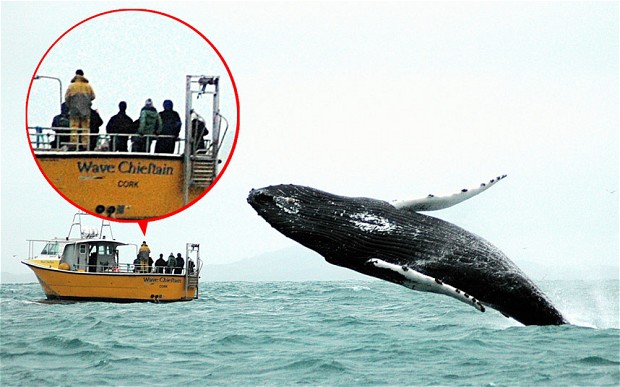
A 45-foot humpback whale leapt above the waves as group of nature lovers gazed the wrong way this past weekend off the Atlantic coast of Ireland.

A cameraman caught the “whale ahoy” moment off Baltimore in west Cork where marine enthusiasts have been cruising the waters hoping to sight a group of five humpbacks that have been feeding on local shoals of sprat and herring for the last two weeks.

The presence of the humpbacks, breaching the waves with their 30-tonne bodies in pursuit of fish, has triggered a mini-tourism boom as people flock to the village to charter local boats in search of the whales.

Simon Duggan, 44, a local photographer and RNLI Lifeboat crew member, took a series of photographs of the humpbacks “bubble feeding” – the hunting technique where whales dive under a shoal of fish, releasing air bubbles to confuse their prey and bunch them together.

After herding and confusing the fish, the whales use their powerful bodies to surge upwards through the shoal with their mouths wide open to scoop up as many sprat or herring as possible.

After taking the picture of the humpback fully breaching the water after hoovering up its prey, a rare and spectacular display of the cetacean’s hunting prowess, Mr Duggan noticed that another boat of whale watchers had missed their moment.

“It happened so fast – the adrenalin was going,” he said. “When I looked at the photo I realised everyone else was looking the wrong way.”

http://www.telegraph.co.uk/earth/wildlife/9719020/Whale-watchers-look-the-wrong-way-as-huge-humpback-leaps-out-of-ocean.html

Cape Town baboons get paintballed

baboon_2396823b


Baboons in Cape Town are being paintballed to drive them out of residential suburbs and stop them from pillaging homes and cars on brazen food raids.

The animals are shot by monitors who shadow the city’s several primate troops, which are notorious for causing havoc in areas bordering their natural mountain habitat.

“It does work, it’s actually fantastic,” said city veterinary scientist Elzette Jordan.

“They hate it so much, so when they just see you with it and you shake it and they hear the paintballs rattling inside, then they move off already, and you don’t actually have to shoot.”

The paintballs are being used alongside other aversion techniques while a baboon management road map is drawn up.

Paintballing is the most common technique and its success is attributed to the apes not liking projectiles being hurled at them.

However, some streetwise animals have learned to spot white paint and duck when it is fired, forcing monitors to use more colourful options.

Cape Town’s mountainous peninsula is home to several protected Chacma baboon troops and bold plunders are frequent. People have been injured in some instances.

“Our current strategy is to get them 100 per cent out of urban space,” Jordan told AFP.

“We want to push them back into the natural space and for us to do that, we have to teach them that they can never be quite sure and feel safe inside the urban space and that’s why we’re using aversion conditioning techniques.”

http://www.telegraph.co.uk/earth/wildlife/9674445/Cape-Town-baboons-get-paintballed.html

After 30 years, Supersymmetry Fails Test and is Forcing Physicists to Seek New Ideas

As a young theorist in Moscow in 1982, Mikhail Shifman became enthralled with an elegant new theory called supersymmetry that attempted to incorporate the known elementary particles into a more complete inventory of the universe.

“My papers from that time really radiate enthusiasm,” said Shifman, now a 63-year-old professor at the University of Minnesota. Over the decades, he and thousands of other physicists developed the supersymmetry hypothesis, confident that experiments would confirm it. “But nature apparently doesn’t want it,” he said. “At least not in its original simple form.”

With the world’s largest supercollider unable to find any of the particles the theory says must exist, Shifman is joining a growing chorus of researchers urging their peers to change course.

In an essay posted last month on the physics website arXiv.org, Shifman called on his colleagues to abandon the path of “developing contrived baroque-like aesthetically unappealing modifications” of supersymmetry to get around the fact that more straightforward versions of the theory have failed experimental tests. The time has come, he wrote, to “start thinking and developing new ideas.”

But there is little to build on. So far, no hints of “new physics” beyond the Standard Model — the accepted set of equations describing the known elementary particles — have shown up in experiments at the Large Hadron Collider, operated by the European research laboratory CERN outside Geneva, or anywhere else. (The recently discovered Higgs boson was predicted by the Standard Model.) The latest round of proton-smashing experiments, presented earlier this month at the Hadron Collider Physics conference in Kyoto, Japan, ruled out another broad class of supersymmetry models, as well as other theories of “new physics,” by finding nothing unexpected in the rates of several particle decays.

“Of course, it is disappointing,” Shifman said. “We’re not gods. We’re not prophets. In the absence of some guidance from experimental data, how do you guess something about nature?”

Younger particle physicists now face a tough choice: follow the decades-long trail their mentors blazed, adopting ever more contrived versions of supersymmetry, or strike out on their own, without guidance from any intriguing new data.

“It’s a difficult question that most of us are trying not to answer yet,” said Adam Falkowski, a theoretical particle physicist from the University of Paris-South in Orsay, France, who is currently working at CERN. In a blog post about the recent experimental results, Falkowski joked that it was time to start applying for jobs in neuroscience.

“There’s no way you can really call it encouraging,” said Stephen Martin, a high-energy particle physicist at Northern Illinois University who works on supersymmetry, or SUSY for short. “I’m certainly not someone who believes SUSY has to be right; I just can’t think of anything better.”

Supersymmetry has dominated the particle physics landscape for decades, to the exclusion of all but a few alternative theories of physics beyond the Standard Model.

“It’s hard to overstate just how much particle physicists of the past 20 to 30 years have invested in SUSY as a hypothesis, so the failure of the idea is going to have major implications for the field,” said Peter Woit, a particle theorist and mathematician at Columbia University.

The theory is alluring for three primary reasons: It predicts the existence of particles that could constitute “dark matter,” an invisible substance that permeates the outskirts of galaxies. It unifies three of the fundamental forces at high energies. And — by far the biggest motivation for studying supersymmetry — it solves a conundrum in physics known as the hierarchy problem.

The problem arises from the disparity between gravity and the weak nuclear force, which is about 100 million trillion trillion (10^32) times stronger and acts at much smaller scales to mediate interactions inside atomic nuclei. The particles that carry the weak force, called W and Z bosons, derive their masses from the Higgs field, a field of energy saturating all space. But it is unclear why the energy of the Higgs field, and therefore the masses of the W and Z bosons, isn’t far greater. Because other particles are intertwined with the Higgs field, their energies should spill into it during events known as quantum fluctuations. This should quickly drive up the energy of the Higgs field, making the W and Z bosons much more massive and rendering the weak nuclear force about as weak as gravity.

Supersymmetry solves the hierarchy problem by theorizing the existence of a “superpartner” twin for every elementary particle. According to the theory, fermions, which constitute matter, have superpartners that are bosons, which convey forces, and existing bosons have fermion superpartners. Because particles and their superpartners are of opposite types, their energy contributions to the Higgs field have opposite signs: One dials its energy up, the other dials it down. The pair’s contributions cancel out, resulting in no catastrophic effect on the Higgs field. As a bonus, one of the undiscovered superpartners could make up dark matter.

“Supersymmetry is such a beautiful structure, and in physics, we allow that kind of beauty and aesthetic quality to guide where we think the truth may be,” said Brian Greene, a theoretical physicist at Columbia University.

Over time, as the superpartners failed to materialize, supersymmetry has grown less beautiful. According to mainstream models, to evade detection, superpartner particles would have to be much heavier than their twins, replacing an exact symmetry with something like a carnival mirror. Physicists have put forward a vast range of ideas for how the symmetry might have broken, spawning myriad versions of supersymmetry.

But the breaking of supersymmetry can pose a new problem. “The heavier you have to make some of the superpartners compared to the existing particles, the more that cancellation of their effects doesn’t quite work,” Martin explained.

Most particle physicists in the 1980s thought they would detect superpartners that are only slightly heavier than the known particles. But the Tevatron, the now-retired particle accelerator at Fermilab in Batavia, Ill., found no such evidence. As the Large Hadron Collider probes increasingly higher energies without any sign of supersymmetry particles, some physicists are saying the theory is dead. “I think the LHC was a last gasp,” Woit said.

Today, most of the remaining viable versions of supersymmetry predict superpartners so heavy that they would overpower the effects of their much lighter twins if not for fine-tuned cancellations between the various superpartners. But introducing fine-tuning in order to scale back the damage and solve the hierarchy problem makes some physicists uncomfortable. “This, perhaps, shows that we should take a step back and start thinking anew on the problems for which SUSY-based phenomenology was introduced,” Shifman said.

But some theorists are forging ahead, arguing that, in contrast to the beauty of the original theory, nature could just be an ugly combination of superpartner particles with a soupçon of fine-tuning. “I think it is a mistake to focus on popular versions of supersymmetry,” said Matt Strassler, a particle physicist at Rutgers University. “Popularity contests are not reliable measures of truth.”

In some of the less popular supersymmetry models, the lightest superpartners are not the ones the Large Hadron Collider experiments have looked for. In others, the superpartners are not heavier than existing particles but merely less stable, making them more difficult to detect. These theories will continue to be tested at the Large Hadron Collider after it is upgraded to full operational power in about two years.

If nothing new turns up — an outcome casually referred to as the “nightmare scenario” — physicists will be left with the same holes that riddled their picture of the universe three decades ago, before supersymmetry neatly plugged them. And, without an even higher-energy collider to test alternative ideas, Falkowski says, the field will undergo a slow decay: “The number of jobs in particle physics will steadily decrease, and particle physicists will die out naturally.”

Greene offers a brighter outlook. “Science is this wonderfully self-correcting enterprise,” he said. “Ideas that are wrong get weeded out in time because they are not fruitful or because they are leading us to dead ends. That happens in a wonderfully internal way. People continue to work on what they find fascinating, and science meanders toward truth.”

From Simons Science News (find the original story here)

http://www.scientificamerican.com/article.cfm?id=supersymmetry-fails-test-forcing-physics-seek-new-idea

Peak Phosphorus and Food Production

phosphorus


Investor Jeremy Grantham of GMO recently published a startlingly depressing outlook for the future of humanity. 

Grantham thinks the number of people on Earth has finally and permanently outstripped the planet’s ability to support us.

Grantham believes that the planet can only sustainably support about 1.5 billion humans, versus the 7 billion on Earth right now (heading to 10-12 billion).

Basically, Grantham thinks most of us are going to starve to death.

Why?

In part because we’re churning through a finite supply of something that is critical to our ability to produce food: Phosphorus.

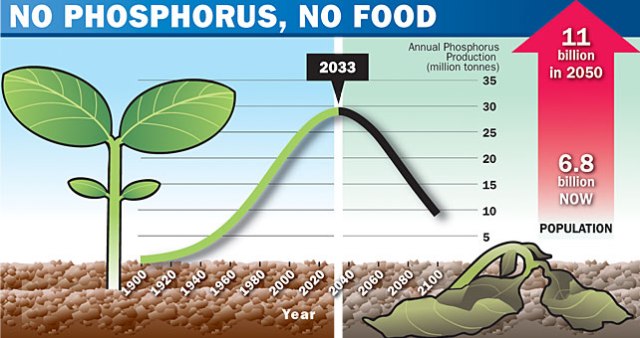
Phosphorus is a critical ingredient of fertilizer, and there is a finite supply of it. The consensus is that we will hit “peak phosphorus” production within a few decades, after which point our phosphorus supply will inexorably decline. As it declines, we will be unable to feed ourselves. And you know the rest.

Of course, ever since Malthus, a steady stream of doomsayers have predicted a ghastly end to the human population explosion–and, so far, they’ve all been wrong.

So why is a man of Grantham’s intelligence adding his voice to this chorus?

And how real is this threat? Are we all going to starve?

Humans have been around for a while. But for most of our existence, our population was small and stable. Then it exploded.

Most of this explosion has come in the past 200 years–just as Malthus predicted. What Malthus did not foresee was the discovery of oil, commercial fertilizer, and other resources, which have (temporarily) supported this population explosion.

Most of this explosion has come in the past 200 years--just as Malthus predicted. What Malthus did not foresee was the discovery of oil, commercial fertilizer, and other resources, which have (temporarily) supported this population explosion.

GMO

For the past 100 years, technology has made these resources cheaper to extract and produce, which has made them ever cheaper. Grantham thinks that trend has now permanently ended.

For the past 100 years, technology has made these resources cheaper to extract and produce, which has made them ever cheaper. Grantham thinks that trend has now permanently ended.

GMO

Take oil, for example. Oil traded at about $16 a barrel for a century. Then, as demand outstripped supply, the “normal” price increased to ~$35 a barrel. Now, Grantham thinks “normal” is about ~$75 a barrel

Take oil, for example. Oil traded at about $16 a barrel for a century. Then, as demand outstripped supply, the "normal" price increased to ~$35 a barrel. Now, Grantham thinks "normal" is about ~$75 a barrel

GMO

Why are oil prices rising? Because oil demand is now growing far faster than oil supply. The world’s oil production has barely increased since the 1970s, while oil usage has exploded.

Why are oil prices rising? Because oil demand is now growing far faster than oil supply. The world's oil production has barely increased since the 1970s, while oil usage has exploded.

GMO

Demand is exceeding supply for other commodities, too. Like metals. Here’s a hundred-year look at the prices of Iron ore.

Demand is exceeding supply for other commodities, too. Like metals. Here's a hundred-year look at the prices of Iron ore.

GMO

But the real problem is food.

Over the past century, the world has produced ever more food from the same (relatively) finite supply of arable land. For example, this chart shows global wheat production in the past 50 years. The blue line is farmland. The yellow line is total wheat production. The pink line is “yield per hectare.” Production is rising because yield is increasing.

Why are crop yields increasing? Fertilizer.

Why are crop yields increasing? Fertilizer.

chuckoutrearseats via Flickr

In the past half-century, we have used an ever-increasing amount of fertilizer. Not just in total, but per acre. This chart, for example, shows the number of tons of fertilizer used per square kilometer of farmland.

In the past half-century, we have used an ever-increasing amount of fertilizer. Not just in total, but per acre. This chart, for example, shows the number of tons of fertilizer used per square kilometer of farmland.

GMO

And this leads us to the first problem. 40 years ago, the average growth rate of crop yields per acre was an impressive 3.5% per year. This was comfortably ahead of the growth rate of global population. In recent years, however, the growth in crop yields per acre has dropped to about 1.5%. That’s dangerously close to the growth of population.

And this leads us to the first problem. 40 years ago, the average growth rate of crop yields per acre was an impressive 3.5% per year. This was comfortably ahead of the growth rate of global population. In recent years, however, the growth in crop yields per acre has dropped to about 1.5%. That's dangerously close to the growth of population.

GMO

That brings us to the second problem. We don’t have an infinite supply of fertilizer.

For most of human history, we used “natural fertilizer” (poop). But then we started making more powerful stuff.

Commercial fertilizer requires, among other ingredients, potassium and phosphorus. There are finite quantities of both. Phosphorus, especially, is in short supply.

Phosphorus (P) is essential for life. Plants absorb it from fertilized soil, and then animals absorb it when they eat plants (and each other). When the plants and animals excrete waste or die, the phosphorus returns to the environment. Eventually, given enough time, it gets compressed into rock at the bottom of the ocean.

Phosphate is a critical ingredient of fertilizer, and there is no substitute for it (because plants are partially made from it). This photo shows the difference between corn fertilized with phosphorus (background) and corn without.

Most of the phosphate we use in commercial fertilizer comes from phosphate rock, which was once sediment at the bottom of the ocean. This mine is located in Togo.

In the past ~120 years, we have become completely dependent on phosphate rock for phosphorus used in commercial fertilizer. Before that, our phosphate came from manure.

As the human population grows, and emerging markets get richer and need more food and animal feed, we’re consuming more and more phosphorus (red line).

The amount of phosphate rock we use, therefore, continues to climb.

The trouble is that there isn’t an infinite amount of phosphate rock. Estimates differ on the amount of reserves available in the world, but they’re not unlimited. Some scientists think we have enough to last hundreds of years. Others, however, are far less optimistic.

The consensus of many scientists is that we will hit “peak phosphorus” production in about 2030. After that, phosphorus production is expected to decline.

As phosphorus production drops, crop yields will drop. And then, the concern is, we won’t be able to grow enough food to feed ourselves.

As phosphorus production drops, crop yields will drop. And then, the concern is, we won't be able to grow enough food to feed ourselves.

So is that it? Are we screwed?

Not necessarily. It turns out that our urine and feces contain a lot of phosphorus–which is why they make good fertilizer. If we got serious about recycling our bio-waste, we could reduce our need for phosphate rock.

But although conservation and recycling will help, they won’t fix the problem. Because a huge amount of phosphorus will still be lost to runoff. Phosphate that isn’t consumed by plants leaches out of the soil into rivers and then to the ocean.

So, eventually, the finite supply of usable phosphorus could be a big problem.

Jeremy Grantham, by the way, thinks the finite supply of fertilizer and limits of crop yields are starting to affect food prices. Soybean prices, for example, have jumped in the last 10 years.

So have corn prices.

And wheat prices.

So, why is all this happening now, when the global population has been exploding for two centuries? The answer, in part, is the spectacular growth of China, India, and other massive countries. The resource-usage of these countries is mind-boggling. Here, for example, are Grantham’s estimates of the percentage of world consumption of various resources that are consumed by China alone.

So, why is all this happening now, when the global population has been exploding for two centuries? The answer, in part, is the spectacular growth of China, India, and other massive countries. The resource-usage of these countries is mind-boggling. Here, for example, are Grantham's estimates of the percentage of world consumption of various resources that are consumed by China alone.

GMO

Common sense will tell you that finite resources can’t support infinite growth. And another look at the “growth curve” of human population shows why it might be silly to dismiss Malthus, et al, as “obviously wrong.” (Maybe they were just early).

Common sense will tell you that finite resources can't support infinite growth. And another look at the "growth curve" of human population shows why it might be silly to dismiss Malthus, et al, as "obviously wrong." (Maybe they were just early).

Human population.

Wikipedia

But here’s hoping science and ingenuity help us find a way to fix the problem.

But here's hoping science and ingenuity help us find a way to fix the problem.

Read more: http://www.businessinsider.com/peak-phosphorus-and-food-production-2012-12?op=1#ixzz2E7yHKqnu

 
Thanks to SRW for bringing this to the attention of the It’s Interesting community.

Mother-Child Connection: Scientists Discover Children’s Cells Living in Mothers’ Brains, Including Male Cells Living in the Female Brain for Decades

scientists-discover-childrens-cells-living-in-mothers-brain_1


The link between a mother and child is profound, and new research suggests a physical connection even deeper than anyone thought. The profound psychological and physical bonds shared by the mother and her child begin during gestation when the mother is everything for the developing fetus, supplying warmth and sustenance, while her heartbeat provides a soothing constant rhythm.

The physical connection between mother and fetus is provided by the placenta, an organ, built of cells from both the mother and fetus, which serves as a conduit for the exchange of nutrients, gasses, and wastes. Cells may migrate through the placenta between the mother and the fetus, taking up residence in many organs of the body including the lung, thyroid muscle, liver, heart, kidney and skin. These may have a broad range of impacts, from tissue repair and cancer prevention to sparking immune disorders.

It is remarkable that it is so common for cells from one individual to integrate into the tissues of another distinct person. We are accustomed to thinking of ourselves as singular autonomous individuals, and these foreign cells seem to belie that notion, and suggest that most people carry remnants of other individuals. As remarkable as this may be, stunning results from a new study show that cells from other individuals are also found in the brain. In this study, male cells were found in the brains of women and had been living there, in some cases, for several decades. What impact they may have had is now only a guess, but this study revealed that these cells were less common in the brains of women who had Alzheimer’s disease, suggesting they may be related to the health of the brain.

We all consider our bodies to be our own unique being, so the notion that we may harbor cells from other people in our bodies seems strange. Even stranger is the thought that, although we certainly consider our actions and decisions as originating in the activity of our own individual brains, cells from other individuals are living and functioning in that complex structure. However, the mixing of cells from genetically distinct individuals is not at all uncommon. This condition is called chimerism after the fire-breathing Chimera from Greek mythology, a creature that was part serpent part lion and part goat. Naturally occurring chimeras are far less ominous though, and include such creatures as the slime mold and corals.

 Microchimerism is the persistent presence of a few genetically distinct cells in an organism. This was first noticed in humans many years ago when cells containing the male “Y” chromosome were found circulating in the blood of women after pregnancy. Since these cells are genetically male, they could not have been the women’s own, but most likely came from their babies during gestation.

In this new study, scientists observed that microchimeric cells are not only found circulating in the blood, they are also embedded in the brain. They examined the brains of deceased women for the presence of cells containing the male “Y” chromosome. They found such cells in more than 60 percent of the brains and in multiple brain regions. Since Alzheimer’s disease is more common in women who have had multiple pregnancies, they suspected that the number of fetal cells would be greater in women with AD compared to those who had no evidence for neurological disease. The results were precisely the opposite: there were fewer fetal-derived cells in women with Alzheimer’s. The reasons are unclear.

Microchimerism most commonly results from the exchange of cells across the placenta during pregnancy, however there is also evidence that cells may be transferred from mother to infant through nursing. In addition to exchange between mother and fetus, there may be exchange of cells between twins in utero, and there is also the possibility that cells from an older sibling residing in the mother may find their way back across the placenta to a younger sibling during the latter’s gestation. Women may have microchimeric cells both from their mother as well as from their own pregnancies, and there is even evidence for competition between cells from grandmother and infant within the mother.

What it is that fetal microchimeric cells do in the mother’s body is unclear, although there are some intriguing possibilities. For example, fetal microchimeric cells are similar to stem cells in that they are able to become a variety of different tissues and may aid in tissue repair. One research group investigating this possibility followed the activity of fetal microchimeric cells in a mother rat after the maternal heart was injured: they discovered that the fetal cells migrated to the maternal heart and differentiated into heart cells helping to repair the damage. In animal studies, microchimeric cells were found in maternal brains where they became nerve cells, suggesting they might be functionally integrated in the brain. It is possible that the same may true of such cells in the human brain.

These microchimeric cells may also influence the immune system. A fetal microchimeric cell from a pregnancy is recognized by the mother’s immune system partly as belonging to the mother, since the fetus is genetically half identical to the mother, but partly foreign, due to the father’s genetic contribution. This may “prime” the immune system to be alert for cells that are similar to the self, but with some genetic differences. Cancer cells which arise due to genetic mutations are just such cells, and there are studies which suggest that microchimeric cells may stimulate the immune system to stem the growth of tumors. Many more microchimeric cells are found in the blood of healthy women compared to those with breast cancer, for example, suggesting that microchimeric cells can somehow prevent tumor formation. In other circumstances, the immune system turns against the self, causing significant damage. Microchimerism is more common in patients suffering from Multiple Sclerosis than in their healthy siblings, suggesting chimeric cells may have a detrimental role in this disease, perhaps by setting off an autoimmune attack.

This is a burgeoning new field of inquiry with tremendous potential for novel findings as well as for practical applications. But it is also a reminder of our interconnectedness.

http://www.scientificamerican.com/article.cfm?id=scientists-discover-childrens-cells-living-in-mothers-brain

Landfill Harmonic

As the world tries to come up with interesting ways to spread the word about saving our environment, a man in Paraguay has found an innovative way to promote “green” ideas and social awareness – while also encouraging music.

Favio Chávez was working at a huge landfill south of the capital, Asunción, several years ago when he made friends with the families who worked as recyclers and lived among the trash. He eventually figured out how to use the scraps of dirty oil cans, jars, wood, forks and other junk in the Cateura Landfill to make instruments for his very own orchestra, with the local kids as its members.

“One day it occurred to me to teach music to the children of the recyclers and use my personal instruments,” explains 36 year-old Chávez, who worked as an ecological technician at the landfill. “But it got to the point that there were too many students and not enough supply. So that’s when I decided to experiment and try to actually create a few.”

A musician himself, Chávez had experience forming classical ensembles. But constructing a brass and string section from scratch wasn’t part of the plan.

At first, he just threw together a few for the children who didn’t have something to play with. But after hearing the good sound the objects produced, he consulted the help of a resident garbage picker nicknamed “Cola” to gradually perfect them over time. 

What astonished everyone was how the recycler used his basic carpentry skill to engineer such smooth sounding, built-to-scale cellos and violins in his workshop just from scraps.

“It was very difficult at first and it has been a learning process,” says Favio. “But after four years of testing them out, we discovered which materials were better for resonance effects and built the instruments that we use now.”   

His love of music is what made Chávez form the orchestra, now 30 member-strong. 

While it has been a big commitment for the children and families, it has paid off – they’ve received worldwide recognition and have performed throughout the world, from Argentina to Brazil to Germany.

Their unique story is so special that a U.S.-based filmmaker is currently making a documentary about them. “Landfill Harmonic” follows Favio’s ensemble as it takes what the world throws away and turns it into a piece of beauty.

The children orchestra has donated some instruments to the Musical Instrument Museum in Phoenix, Arizona and plans to play a show there soon.

“It’s awe inspiring that people could live in that degree of squalor and still have the spirit to make this orchestra,” said documentary director Graham Townsley. “It’s breathtaking.“ 

The ultimate goal of the music project is to educate the public about a world problem, they say, that shouldn’t be ignored. Plus, it’s giving the children an opportunity they otherwise would never have had.

“I made this orchestra to educate the world and raise awareness,“ says Chávez. “But it’s also a social message to let people know that even though these students are in extreme poverty, they can also contribute to society.  They deserve an opportunity.”
Read more: http://latino.foxnews.com/latino/lifestyle/2012/11/21/landfill-worker-in-paraguay-turns-trash-into-orchestra/#ixzz2E7NjZBTB

Besse Cooper, World’s Oldest Person, Dies at 116. 114 year old Iowan Dina Manfredini is new record holder.

Besse Cooper, Paul Cooper


The 116-year-old woman believed to be the oldest person in the world passed away yesterday afternoon.

The Associated Press reported that Besse Cooper, a retired Georgia school teacher with a passion for politics, died quietly in her bed at a Monroe, Ga. nursing home about an hour’s drive from Atlanta. Cooper had recently battled stomach flu, but she had reportedly recovered by Monday. On Tuesday, Cooper had her hair set and watched a Christmas movie, but then she experienced breathing problems. She expired at about 2 p.m. after receiving oxygen.

“With her hair fixed it looked like she was ready to go,” Sidney Cooper, Besse Cooper’s 77-year-old son, told the AP.

(MORE: World’s Oldest Dad, 96, Fathers Another Child)

The younger Cooper said his mother was a determined, strong and intelligent individual. CNN reported that just five years after her birth in 1896, Besse Cooper started walking from her family’s Sullivan County, Tenn. log cabin to school in order to make sure one of her brothers got to class. Her time in the classroom developed into a love for school, and she eventually studied education at Johnson City’s East Tennessee Normal School (now East Tennessee State University).

After graduation, she started teaching in Tennessee for $35 an hour, but she moved to Monroe during World War I after her friend informed her she could make more money in the Peach State, according to CNN.

In addition to her appreciation for education, Besse Cooper also developed a fondness for politics. CNN reported she joined the suffrage movement when she was 24, speaking about the importance of having a voice in politics and registering women to vote. After the 19th Amendment granted women the right to vote, she never missed a chance to cast her ballot — except twice (In 2012 and in 1948, when she and her husband — who died in 1963 — believed Thomas Dewey would easily win).

Sidney Cooper told CNN that his mother cherished her 80s most out of the nearly 12 decades she lived. He said she loved to garden, watch the news on TV and read — despite her declining eyesight. But Besse Cooper still had it going on, even during the last years of her life. As an 111-year-old, she impressed Robert Young, Guinness senior consultant for gerontology, with her abilities.

“It’s a sad day for me,” Young told AP of Besse Cooper’s death. “At that age she was doing really well, she was able to read books.”

AP reported the supercentenarian was distinguished as the oldest person on the planet in January 2011. In May of the same year, however, Guinness World Records discovered another woman who was 48 days older, Brazilian Maria Gomes Valentin. After Valentin died the following month, Cooper reclaimed the honor no other Georgian has ever received. She told Guinness in 2012 that her secret to longevity was staying out of others’ business and abstaining from junk food.

Besse Cooper’s death makes 115-year-old Dina Manfredini, who lives in Johnston, Iowa, the new record holder. Only seven other people in history have bested Besse Cooper’s time on this Earth — 116 years and 100 days, according to Guinness. The oldest person ever documented — France’s Jeanne Calment, who passed away in 1997, lived to be 122.
Read more: http://newsfeed.time.com/2012/12/05/besse-cooper-worlds-oldest-person-dies-at-age-116/#ixzz2EDha9BwH

The Death of “Near Death” Experiences ?

near-death-experience-1


You careen headlong into a blinding light. Around you, phantasms of people and pets lost. Clouds billow and sway, giving way to a gilded and golden entrance. You feel the air, thrusted downward by delicate wings. Everything is soothing, comforting, familiar. Heaven.

It’s a paradise that some experience during an apparent demise. The surprising consistency of heavenly visions during a “near death experience” (or NDE) indicates for many that an afterlife awaits us. Religious believers interpret these similar yet varying accounts like blind men exploring an elephant—they each feel something different (the tail is a snake and the legs are tree trunks, for example); yet all touch the same underlying reality. Skeptics point to the curious tendency for Heaven to conform to human desires, or for Heaven’s fleeting visage to be so dependent on culture or time period.

Heaven, in a theological view, has some kind of entrance. When you die, this entrance is supposed to appear—a Platform 9 ¾ for those running towards the grave. Of course, the purported way to see Heaven without having to take the final run at the platform wall is the NDE. Thrust back into popular consciousness by a surgeon claiming that “Heaven is Real,” the NDE has come under both theological and scientific scrutiny for its supposed ability to preview the great gig in the sky.

But getting to see Heaven is hell—you have to die. Or do you?

This past October, neurosurgeon Dr. Eben Alexander claimed that “Heaven is Real”, making the cover of the now defunct Newsweek magazine. His account of Heaven was based on a series of visions he had while in a coma, suffering the ravages of a particularly vicious case of bacterial meningitis. Alexander claimed that because his neocortex was “inactivated” by this malady, his near death visions indicated an intellect apart from the grey matter, and therefore a part of us survives brain-death.

Alexander’s resplendent descriptions of the afterlife were intriguing and beautiful, but were also promoted as scientific proof. Because Alexander was a brain “scientist” (more accurately, a brain surgeon), his account carried apparent weight.

Scientifically, Alexander’s claims have been roundly criticized. Academic clinical neurologist Steve Novella removes the foundation of Alexander’s whole claim by noting that his assumption of cortex “inactivation” is flawed:

Alexander claims there is no scientific explanation for his experiences, but I just gave one. They occurred while his brain function was either on the way down or on the way back up, or both, not while there was little to no brain activity.

In another takedown of the popular article, neuroscientist Sam Harris (with characteristic sharpness) also points out this faulty premise, and notes that Alexander’s evidence for such inactivation is lacking:

The problem, however, is that “CT scans and neurological examinations” can’t determine neuronal inactivity—in the cortex or anywhere else. And Alexander makes no reference to functional data that might have been acquired by fMRI, PET, or EEG—nor does he seem to realize that only this sort of evidence could support his case.

Without a scientific foundation for Alexander’s claims, skeptics suggest he had a NDE later fleshed out by confirmation bias and colored by culture. Harris concludes in a follow-up post on his blog, “I am quite sure that I’ve never seen a scientist speak in a manner more suggestive of wishful thinking. If self-deception were an Olympic sport, this is how our most gifted athletes would appear when they were in peak condition.”

And these takedowns have company. Paul Raeburn in the Huffington Post, speaking of Alexander’s deathbed vision being promoted as a scientific account, wrote, “We are all demeaned, and our national conversation is demeaned, by people who promote this kind of thing as science. This is religious belief; nothing else.” We might expect this tone from skeptics, but even the faithful chime in. Greg Stier writes in the Christian post that while he fully believes in the existence of Heaven, we should not take NDE accounts like Alexander’s as proof of it.

These criticisms of Alexander point out that what he saw was a classic NDE—the white light, the tunnel, the feelings of connectedness, etc. This is effective in dismantling his account of an “immaterial intellect” because, so far, most symptoms of a NDE are in fact scientifically explainable. [ another article on this site provides a thorough description of the evidence, as does this study.]

One might argue that the scientific description of NDE symptoms is merely the physical account of what happens as you cross over. A brain without oxygen may experience “tunnel vision,” but a brain without oxygen is also near death and approaching the afterlife, for example. This argument rests on the fact that you are indeed dying. But without the theological gymnastics, I think there is an overlooked yet critical aspect to the near death phenomenon, one that can render Platform 9 ¾ wholly solid. Studies have shown that you don’t have to be near death to have a near death experience.

“Dying”

In 1990, a study was published in the Lancet that looked at the medical records of people who experienced NDE-like symptoms as a result of some injury or illness. It showed that out of 58 patients who reported “unusual” experiences associated with NDEs (tunnels, light, being outside one’s own body, etc.), 30 of them were not actually in any danger of dying, although they believed they were [1]. The authors of the study concluded that this finding offered support to the physical basis of NDEs, as well as the “transcendental” basis.

Why would the brain react to death (or even imagined death) in such a way? Well, death is a scary thing. Scientific accounts of the NDE characterize it as the body’s psychological and physiological response mechanism to such fear, producing chemicals in the brain that calm the individual while inducing euphoric sensations to reduce trauma.

Imagine an alpine climber whose pick fails to catch the next icy outcropping as he or she plummets towards a craggy mountainside. If one truly believes the next experience he or she will have is an intimate acquainting with a boulder, similar NDE-like sensations may arise (i.e., “My life flashed before my eyes…”). We know this because these men and women have come back to us, emerging from a cushion of snow after their fall rather than becoming a mountain’s Jackson Pollock installation.

You do not have to be, in reality, dying to have a near-death experience. Even if you are dying (but survive), you probably won’t have one. What does this make of Heaven? It follows that if you aren’t even on your way to the afterlife, the scientifically explicable NDE symptoms point to neurology, not paradise.

This Must Be the Place

Explaining the near death experience in a purely physical way is not to say that people cannot have a transformative vision or intense mental journey. The experience is real and tells us quite a bit about the brain (while raising even more fascinating questions about consciousness). But emotional and experiential gravitas says nothing of Heaven, or the afterlife in general. A healthy imbibing of ketamine can induce the same feelings, but rarely do we consider this euphoric haze a glance of God’s paradise.

In this case, as in science, a theory can be shot through with experimentation. As Richard Feynman said, “It doesn’t matter how beautiful your theory is, it doesn’t matter how smart you are. If it doesn’t agree with experiment, it’s wrong.

The experiment is exploring an NDE under different conditions. Can the same sensations be produced when you are in fact not dying? If so, your rapping on the Pearly Gates is an illusion, even if Heaven were real. St. Peter surely can tell the difference between a dying man and a hallucinating one.

The near death experience as a foreshadowing of Heaven is a beautiful theory perhaps, but wrong.

Barring a capricious conception of “God’s plan,” one can experience a beautiful white light at the end of a tunnel while still having a firm grasp of their mortal coil. This is the death of near death. Combine explainable symptoms with a plausible, physical theory as to why we have them and you get a description of what it is like to die, not what it is like to glimpse God.

Sitting atop clouds fluffy and white, Heaven may be waiting. We can’t prove that it is not. But rather than helping to clarify, the near death experience, not dependent on death, may only point to an ever interesting and complex human brain, nothing more.

http://blogs.scientificamerican.com/guest-blog/2012/12/03/the-death-of-near-death-even-if-heaven-is-real-you-arent-seeing-it/

Bugarach – the only place that will survive the 12-21-12 Mayan apocalypse

b2The village of Bugarach attracts many  who believe that it will survive the  end of the World 21 December 2012article-2242176-161D29A6000005DC-874_634x424

article-2242176-161E81D7000005DC-4_306x263article-2242176-16473AC8000005DC-803_634x422

  • Bugarach – population: 176 – has been earmarked by doomsday cults as the only place in the world which is going to survive Armageddon
  • It is based on an interpretation of the Mayan calendar which claims a planet is on a crash course with Earth and will impact on December 21 2012
  • According to prophecy aliens will emerge from their ‘spaceship garage’ in the town’s Pic de Bugarach mountain and pluck believers to safety
  • ‘Authentic Bugarach stones’ are on sale for €1.50 a gram while a bottle of water from the local spring will cost an eye-watering €15
  • One landowner is offering up his four-bedroom home for £1,200 a night and can offer a camping space in his field for £324
  • ‘Apocalypse pizza’ and ‘End of the World vintage’ wine also available

Nestled in the rolling foothills of the French Pyrenees, market day in the tiny farming community of Bugarach has never been busier.

But shoppers aren’t there to sample the fresh meat, wine and dairy for which the town is locally famed, they are there to pick up their own piece of end-of-the-world memorabilia.

It is because Bugarach – population 176 – has been earmarked by doomsday cults as the only place in the world which is going to survive Armageddon, scheduled for December 21 this year by an ancient Mayan prophecy.

Modern interpretations of the forecast, heavily stoked by internet rumour, predict that aliens will emerge from their ‘spaceship garage’ hidden deep within the town’s imposing Pic de Bugarach mountain and pluck anyone in the vicinity to safety.

Now, Armageddon tourists and UFO spotters hoping for salvation are swarming to the two-street hamlet to collect a slice of Last Day history.

And it is an opportunity the village’s shrewd inhabitants are eager not to pass up.

Souvenirs include ‘authentic Bugarach stones’ from Pic de Bugarach’s rock-face itself, on sale for €1.50 (£1.20) a gram, and ‘natural pyramids of pyrite iron’ from underground.

Meanwhile, a bottle of water from the local spring, which can apparently cure a range of ailments, costs an eye-watering €15 (£12).

One landowner is even offering up his four-bedroom home with close up views of the mysterious peak for £1,200 a night.

But for those on a budget, he can offer camping space in his field (tent not included) for 400 euros a night.

‘I possess a rare asset, the land of immortality,’ he told La Depeche du Midi, the area’s local daily.

On the evening in question, tourists can pop to the local Italian restaurant for an ‘Apocalypse pizza’, washed down with a local vintner’s ‘End Of The World’ vintage.

If the predictions turn out to be wrong, they can celebrate with the same wine-seller’s ‘Survival Vintage’, on sale a day later.

But Bugarach’s mayor, Jean Pierre Delord, is worried about the numbers of New Agers arriving in the town.

Police and troops have been drafted in to deal with the sudden influx and stop believers from scaling the mountain. Although many believe this is merely a cover for the investigation of dozens of recent UFO sightings.

David, who quit his telecoms job in Tours to move to Bugarach, told The Sun: ‘There are serious things going on here – I want to know what these objects are.

‘Things exist and people have a right to know.’

While David, who would not reveal his surname, said he wasn’t sure the world would actually end in three weeks, added: ‘I do think the capitalist system is going to collapse then.’

But others have expressed anger at the town, blaming it for taking advantage of ‘gullible’ New Agers.

Eric Freysselinard, the prefect of the Aude county which includes Bugarach, said this week: ‘I find it really outrageous to abuse the naivety of people and rush into commerce that defies common sense.’

The prophesy is based on an interpretation of the ancient Mayan calendar which claims an intergalactic planet is on a crash course with Earth and will impact on December 21 2012.

The French government has even warned of the risk of mass suicides in the country by people who believe the world will self-destruct next year.

Recent disasters – including the earthquake in Japan – as well as anxiety over pandemics and economic concerns – are creating a global climate of fear, which for some are omens of impending doom.

A report published yesterday by watchdog Miviludes said the picturesque village near Carcassonne should be monitored in the lead-up to the end of 2012.

Miviludes president Georges Fenech said: ‘I think we need to be careful. We shouldn’t get paranoid, but when you see what happened at Waco in the United States, we know this kind of thinking can influence vulnerable people.’

The internet is awash with myths about the hamlet.

These include beliefs that the mountain is surrounded by a magnetic force, that it is the site of a concealed alien base, or even that it contains an underground access to another world.

Patrice Etienne, who runs an organic cafe in the village, said there have been an increased number of reports by walkers in the area of cameras jamming when they tried to take pictures and strange noises rumbling underground.

‘We have seen military aircraft, police and soldiers,’ he added. ‘It’s like a Spielberg movie. They are looking for something. There is something in this mountain, definitely.’

Meanwhile, panic is spreading throughout Russia at such a rate over the Earth’s pending doom, that Moscow’s minister of emergency situations has told its citizens that the world will not end on December 21.

Ancient Mayans claimed that is the day a 5,125-year cycle known as the Long Count in the Mayan calendar supposedly comes to a close. Many in Russia, where mystical thinking is popular, have taken notice.

Some are hoarding everyday items such as sugar, matches and candles, while inmates in a jail are said to have experienced a ‘collective mass psychosis’.

The ministry said it had access to ‘methods of monitoring what is occurring on Earth’, and could say with confidence all will be well.

However Russians were warned they still face the threats of ‘blizzards, ice storms, breakdowns in heat, electricity and water supply’.

An official from the Russian State Church has also spoken out to reassure frightened people.

http://www.dailymail.co.uk/news/article-2242176/Bugarach-Town-set-survive-Mayan-Apocalypse-cracks-open-End-World-wine.html?ICO=most_read_module

Gardening On The Moon


Gardening in space! Chinese astronauts may grow fresh vegetables in extraterrestrial bases on Moon or Mars in the future to provide food and oxygen supplies to astronauts, an official said after a successful lab experiment.

Deng Yibing, deputy director of the Beijing-based Chinese Astronaut Research and Training Center, said that the recent experiment focused on a dynamic balanced mechanism of oxygen, carbon dioxide, and water between people and plants in a closed system.

According to Deng, a cabin of 300 cubic metres was established to provide sustainable supplies of air, water and food for two participants during the experiment, the official Xinhua news agency reported.

Four kinds of vegetables were grown, taking in carbon dioxide and providing oxygen for the two people living in the cabin. They could also harvest fresh vegetables for meals, Deng said.

The experiment, the first of its kind in China, is extremely important for the long-term development of the country’s manned space programme, Deng added.

The cabin, a controlled ecological life support system (CELSS) built in 2011, is a model of China’s third generation of astronauts’ life support systems, which is expected to be used in extraterrestrial bases on the Moon or Mars.

The introduction of a CELSS seeks to provide sustainable supplies of air, water and food for astronauts with the help of plants and algae, instead of relying on stocks of such basics deposited on board at the outset of the mission.

Advance forms of CELSS also involve the breeding of animals for meat and using microbes to recycle wastes.

Scientists from Germany also participated in the experiments.

http://www.phenomenica.com/2012/12/chinese-astronauts-plan-to-grow-vegetables-on-moon.html