How big would the coin made of $1 trillion worth of platinum be?

Platinum-nugget

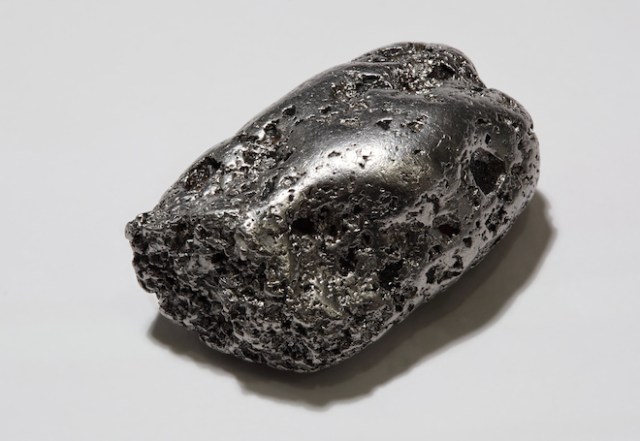
What if the U.S. Treasury minted a coin from $1 trillion worth of platinum?

Such a coin would weigh 42,778,918 pounds — the equivalent of nearly seven Saturn V rockets — and occupy 31,947 cubic feet.

What would this coin look like?

If it had the same proportions as the U.S. dollar coin, it would be roughly 80 feet wide and 6 feet thick. Though not a very practical coin, it would have the benefit of being really difficult to steal. And you could see it from space.

But commodity money disappeared a long time ago, so let’s say the government decides to mint an actual trillion-dollar coin, and makes it out of pure platinum at the same size as the U.S. silver dollar; though the coin would be worth $1 trillion, the platinum itself would only be worth a bit more than $1,200.

[Calculations assumed $1,593 per troy ounce of platinum.]

http://www.wired.com/wiredscience/2013/01/1-trillion-platinum-coin/

Pet turtle escapes after 70 years

enhanced-buzz-26435-1357568305-5-1

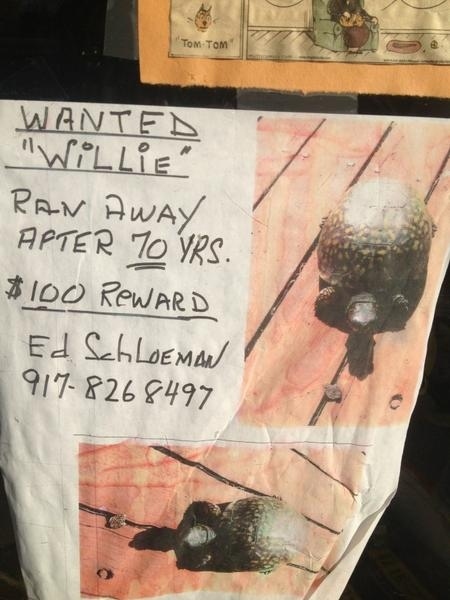
Ed Schloeman’s parents purchased four eastern box turtles in the early 1940s, right around the time Schloeman was born.

When his parents died 15 years ago, the surviving turtle, Willie, went to Schloeman, who still lives in the Windsor Terrace neighborhood he grew up in, and who is now 70 years old.

“When my parents passed away I received that wonderful gift,” he told BuzzFeed.

Schloeman kept Willie, who’s about seven inches long with the species’ distinctive brown and yellow shell, in a “caged environment” in his back yard on East 2nd Street, a sloping street a block from Green-Wood Cemetery. But late last year, Willie vanished.

“He just got out somehow,” said Schloeman, who plastered the neighborhood with “Wanted” flyers, one of which BuzzFeed noticed on the door of the nearby Sean Casey Animal Rescue.

“He’s probably hibernating someplace somehow,” Schloeman, who sells fire suppression systems from his Brooklyn home.

Schloeman, a Vietnam veteran, is also active in a charity that brings Transcendental Meditation to soldiers suffering from post-traumatic stress.

“Hopefully if he unhibernates in April, a neighbor will find him,” he said.

Schloeman said Willie has no particular personality, and didn’t appear personally anguished over his disappearance.

“You can’t get close to a turtle,” he said.

http://www.buzzfeed.com/bensmith/turtle-escapes-after-70-years?utm_campaign=socialflow&utm_source=twitter&utm_medium=buzzfeed

Huge new flying frog discovered in Vietnam

new-flying-frog-discovered

A NEW SPECIES OF flying frog has been discovered close to Vietnam’s largest city, surprising researchers.

Dr Jodi Rowely, a biologist from the Australian Museum who led the discovery, was stunned to find the 10cm frog less than 100km from Ho Chi Minh City, one of South East Asia’s largest urban centres with a population of over 9 million people.

“To discover a previously unknown species of frog, I typically have to climb rugged mountains, scale waterfalls and push my way through dense and prickly rainforest vegetation,” says Jodi.

“I certainly didn’t expect to find a new species of frog sitting on a fallen tree in lowland forest criss-crossed by a network of paths made by people and water buffalo, and completely surrounded by a sea of rice paddies,” says Jodi.

New amphibian found near Ho Chi Minh City
The frog is bright green with a white belly and has been named Helen’s tree frog (Rhacophorus helenae) after Jodi’s mother. The discovery was published last month in The Journal of Herpetology.

Jodi said the large frog has likely evaded biologists until now by spending most of its time out of sight, in the canopy of large trees. The frog has webbed hands and feet like parachutes, allowing it to glide from tree to tree.

To date, the species had only been found in two patches of lowland forest close to Ho Chi Minh City. Lowland forests are among the most threatened habitats in the world. In 2011 the Javan Rhino which relied on lowland forests was confirmed extinct in Vietnam.

“The new species is at great risk due to ongoing habitat loss and degradation – the greatest threat to amphibians throughout Southeast Asia – but hopefully it has been discovered just in time to help protect it,” says Jodi.

http://www.australiangeographic.com.au/journal/huge-new-flying-frog-discovered-in-vietnam.htm?_tmc=s1fuf2HtTMTwOjr3WxI17LME68lov6cs-fubIOVdTCg

West High Bros – Iowa City teen Jeremiah Anthony starts trending of complimenting classmates on Twitter

Screen-Shot-2013-01-05-at-7_21_38-AM

When rogue Twitter accounts started criticizing students and calling them names in Eastern Iowa last year, some Iowa City teenagers decided to take Internet anonymity in a different direction.

Since it started last October, West High Bros — a Web presence operated by West High students — has earned almost 700 Twitter followers and even more Facebook friends.

The idea came after a bullying Twitter account at Linn-Mar High School spurred copycats in Iowa City.

“That’s the opposite of what we’re doing,” said junior Jon Ealy, one of the students who runs the social media account. “A few started up, but this is the only one that’s lasted.”

The strategy is simple: Identify a student, find them on Twitter or Facebook, and say something nice.

“You’re the next great Trojan legend,” “You can make anyone crack up with your corny jokes,” and “You’re a great role model for West High,” are just a few of the compliments the Twitter account has dealt this week.

And it’s not just students who get the love. West High Bros also has sent positive thoughts to Superintendent Steve Murley, City High Principal John Bacon, and even the Press-Citizen: “Nobody covers West sports and activities better than you guys.”

A similar Twitter account has sprung up at City High. City High Average Guys did not respond to an interview request last week.

West High Bros tries to target students who look like they’re having bad days and athletes heading to big competitions.

(Page 2 of 2)

“We make a point of always saying something to state finalists, which we’ve had a lot of,” West High junior Jeremiah Anthony said.

The students have kept varying degrees of anonymity. Ealy outed himself when buzz started to grow about who was running the account. Anthony said he doesn’t talk openly about his involvement but doesn’t deny it either. And some of the other handful of users keep themselves totally unattached.

“I feel like it’s more effective if they don’t know it’s coming from one of their friends,” said one user, who even keeps her involvement a secret from her mom.

Most of the students involved are juniors, so they’ll be able to keep the project up for at least two more years, but there’s a goal the students would like to meet before giving up the project.

“I just want it to be so there doesn’t need to be an anonymous account to be supportive,” Anthony said. “When people start saying something nice for no reason, that’s when we should stop.”

Students started the West account and others like it at several Eastern Iowa schools, including City High, last year to counteract those who were using anonymous Twitter handles to criticize and name call.

West High Bros had nearly 1,600 Twitter followers as of Monday — more than twice as many as it had in September, when the group was featured in the Press-Citizen.

“It’s been gaining some legs here, and now it’s very pervasive throughout the school,” Arganbright said Monday.

“We make a point of always saying something to state finalists, which we’ve had a lot of,” West High junior Jeremiah Anthony said.

The students have kept varying degrees of anonymity. Ealy outed himself when buzz started to grow about who was running the account. Anthony said he doesn’t talk openly about his involvement but doesn’t deny it either. And some of the other handful of users keep themselves totally unattached.

“I feel like it’s more effective if they don’t know it’s coming from one of their friends,” said one user, who even keeps her involvement a secret from her mom.

Most of the students involved are juniors, so they’ll be able to keep the project up for at least two more years, but there’s a goal the students would like to meet before giving up the project.

“I just want it to be so there doesn’t need to be an anonymous account to be supportive,” Anthony said. “When people start saying something nice for no reason, that’s when we should stop.”

Students started the West account and others like it at several Eastern Iowa schools, including City High, last year to counteract those who were using anonymous Twitter handles to criticize and name call.

West High Bros had nearly 1,600 Twitter followers as of Monday — more than twice as many as it had in September, when the group was featured in the Press-Citizen.

“It’s been gaining some legs here, and now it’s very pervasive throughout the school,” Arganbright said Monday.

Human Immortality in 33 Years Claims Dmitry Itskov’s 2045 Initiative

IMAGE634795077231612631

Although James Cameron’s “Avatar” took place more than 140 years into the future, a Russian billionaire has teamed with dozens of scientists to lay out a plan that would use avatars to transfer human consciousness into an artificial form. The goal: human immortality by 2045.

The 2045 Initiative, a life-extension project founded by 31-year-old Russian billionaire Dmitry Itskov in February 2011, offers a timeline for immortality over the next 33 years. Beginning with remotely controlled robotic avatars and re-creating the human brain through computer models, the end result would be human immortality in the form of holographic avatars.

The 2045 Initiative, which has had a major social media blitz, brought together 30 top Russian scientists to develop the “imortal” technology, laying out the plan for human immortality on its website.

“The first phase is to create a humanoid robot dubbed ‘avatar,’ and a state-of-the-art brain-computer interface system. The next phase consists of creating a life-support system for the human brain and connect it to the ‘avatar.’ The final phase … is to create an artificial brain in which to transfer the original individual consciousness into,” reads the plan.

Here’s the 2045 Initiative’s timeline:

2015 – 2020: A robotic copy of a human body remotely controlled by a brain-computer interface

2020 – 2025: An avatar is created in which a human brain can be transplanted at the end of life

2030 – 2035: An avatar that can now contain an artificial brain in which a human personality can be transferred at the end of life

2040 – 2045: A holographic avatar emerges

In addition to taking the Internet by storm, the 2045 Initiative has also launched its own political party, called Evolution 2045, pushing a new strategy for human development. The Russia-based party takes a global approach, encouraging other countries to follow in its footsteps “not in the arms race, but in the race for building a bright future for mankind.”

Last month Itskov appealed to members of the Forbes World’s Billionaires List, urging them to take heed of the “vital importance of funding scientific development in the field of cybernetic immortality and the artificial body.

“Contributing to cutting-edge innovations in the fields of neuroscience, nanotechnology and android robotics is more than building a brighter future for human civilization. [It’s also] a wise and profitable business strategy that will create a new and vibrant industry of immortality — limitless in its importance and scale. This kind of investment will change every aspect of business as we know it,” read Itskov’s open letter.

Itskov plans to host a Global Future Congress meeting next year in New York. A previous event was held last February in Moscow.

This massive hypothetical technology would give the “new” mankind amazing survival abilities, according to the Initiative.

“The new human being will receive a huge range of abilities and will be capable of withstanding extreme external conditions easily: high temperatures, pressure, radiation, lack of oxygen,” claims the Initiative on its website.

And according to a slick video produced by the 2045 Initiative, once the hologram-like avatar reinvents mankind’s scientific and social structure, war and violence will go by the wayside as “spiritual self-improvement” becomes mankind’s primary goal.

But what about the average Joe who just wants to live forever?

The cost of these avatars should be on par with that of an automobile, the Initiative’s website assures, as soon as mass production begins.

http://abcnews.go.com/blogs/technology/2012/08/human-immortality-in-33-years-claims-dmitry-itskovs-2045-initiative/#.UOcJvQYxrPo.email

Thanks to H.M. for bringing this to the attention of the It’s Interesting community.

Meteorite has highest water concentration of any yet discovered from Mars

130103062853-mars-meteorite-story-top

A team of scientists has established a whole new class of meteorites that seems to have come from Mars’ crust, based on a rare sample from 2.1 billion years ago.

The newly analyzed meteorite has more water than any other Martian meteorite that we know of, by a magnitude of more than 10, said Carl Agee, lead study author and director of the Institute of Meteoritics at the University of New Mexico. Agee and colleagues published their analysis of the meteorite in the journal Science Express.

“There are thousands and thousands of meteorites, and so far this is the only one like it,” Agee said.

This is a volcanic rock that was probably part of an eruption, and interacted with water to the extent that some water got incorporated into the structure of the minerals, Agee said. “That’s why we’re able to see it after a couple of billion years,” he said.

The precise source of the water in the meteorite is unknown. It could have come from a lake or stream, or ground water that a volcano intruded into, Agee said. Alternatively, the water could have come from frozen Martian tundra that melted when hot volcanic material moved through it.

“We do know that there was a significant amount [of water] available,” he said.

Agee and colleagues were able to extract water from the meteorite by putting it into a vacuum-sealed tube and heating it up. Using a mass spectrometer, they were able to determine that the gas released from the heated meteorite was water vapor.

“That vapor is true Martian water that is, sort of like, being awakened” after many years, he said. “We’re pulling it out of the rock.”

Agee’s meteorite is similar to the type of rocks that NASA spacecraft have found on the surface of Mars in terms of its chemical composition. This is the first meteorite that’s a good match to those rocks on Mars today.

The meteorite’s age also makes it unique, Agee said. It from 2.1 billion years ago, making it the second-oldest sample that we have. The oldest is the Alan Hills meteorite, discovered in Antarctica in 1984, which is 4.5 billion years old. All other samples have been much younger.

Right now, Mars is cold and dry, inhospitable for life, Agee said. But many scientists believe the environment used to be warm and wet and that somewhere in its history the planet lost its atmosphere and surface water. When and how that happened are big mysteries.

“This meteorite is a sample from that transitional period, perhaps,” Agee said. “Because of the water that’s present in it, it may be giving us a glimpse of what the surface conditions were like, as well.”

The rare Mars rocks came from Morocco. There are nomads in that country who make a living by scouring the Sahara Desert for the dark, black rocks that have fallen from space, Agee explains. They bring these meteorites into towns and sell them to a dealer. Then the dealer sells them internationally to collectors, museums and scientists.

When Agee realized how rare and important his first sample was, he wanted to know if there were more. The meteorite hunters have since recovered a few more pieces.

The biggest piece of this Martian meteorite fits into the palm of your hand and weighs 320 grams (about 11 ounces), Agee said. There are two samples in his lab and two more in Paris.

“It’s going to be real interesting to see if there are more that are recovered,” he said. “But I think that this particular type is going to be extraordinarily rare.”

Meteorite has highest water content of any from Mars, scientists say

Researchers unlock formula that brilliant mathematician Srinivasa Ramanujan wrote on his deathbed 100 years ago

srinivasa_ramanujan_-_opc_-_1

theta-function

While on his death bed, the brilliant Indian mathematician Srinivasa Ramanujan cryptically wrote down functions he said came to him in dreams, with a hunch about how they behaved. Now 100 years later, researchers say they’ve proved he was right.

“We’ve solved the problems from his last mysterious letters. For people who work in this area of math, the problem has been open for 90 years,” Emory University mathematician Ken Ono said.

Ramanujan, a self-taught mathematician born in a rural village in South India, spent so much time thinking about math that he flunked out of college in India twice, Ono said.

But he sent mathematicians letters describing his work, and one of the most preeminent ones, English mathematician G. H. Hardy, recognized the Indian boy’s genius and invited him to Cambridge University in England to study. While there, Ramanujan published more than 30 papers and was inducted into the Royal Society. [Creative Genius: The World’s Greatest Minds]

“For a brief window of time, five years, he lit the world of math on fire,” Ono told LiveScience.

But the cold weather eventually weakened Ramanujan’s health, and when he was dying, he went home to India.

It was on his deathbed in 1920 that he described mysterious functions that mimicked theta functions, or modular forms, in a letter to Hardy. Like trigonometric functions such as sine and cosine, theta functions have a repeating pattern, but the pattern is much more complex and subtle than a simple sine curve. Theta functions are also “super-symmetric,” meaning that if a specific type of mathematical function called a Moebius transformation is applied to the functions, they turn into themselves. Because they are so symmetric these theta functions are useful in many types of mathematics and physics, including string theory.

Ramanujan believed that 17 new functions he discovered were “mock modular forms” that looked like theta functions when written out as an infinte sum (their coefficients get large in the same way), but weren’t super-symmetric. Ramanujan, a devout Hindu, thought these patterns were revealed to him by the goddess Namagiri.

Ramanujan died before he could prove his hunch. But more than 90 years later, Ono and his team proved that these functions indeed mimicked modular forms, but don’t share their defining characteristics, such as super-symmetry.

The expansion of mock modular forms helps physicists compute the entropy, or level of disorder, of black holes.

In developing mock modular forms, Ramanujan was decades ahead of his time, Ono said; mathematicians only figured out which branch of math these equations belonged to in 2002.

“Ramanujan’s legacy, it turns out, is much more important than anything anyone would have guessed when Ramanujan died,” Ono said.

The findings were presented last month at the Ramanujan 125 conference at the University of Florida, ahead of the 125th anniversary of the mathematician’s birth on Dec. 22.

Read more: http://www.businessinsider.com/researchers-unlock-formula-mathematician-srinivasa-ramanujan-2012-12#ixzz2GTAEauqP

Thanks to Kebmodee for bringing this to the attention of the It’s Interesting community.

Oompa Loompa Attack in Norfolk, England

Wonka Inventing Room Collection Launch At Sweet! Hollywood Grand Opening

A man in Norfolk, England, was reportedly attacked last week by a pair of Oompa Loompas.

According to WTVR.com, the 28-year-old man was assaulted in a city center by four individuals — two of whom had been dressed up as the orange-skinned characters made famous in Roald Dahl’s children’s book “Charlie and the Chocolate Factory.”

The man reportedly “suffered cuts to his face, nose and lip, as well as two black eyes” after being confronted by the group last Thursday.

The Guardian reports that the two Oompa Loompas, believed to be men, were accompanied by a woman and a man “not wearing fancy dress.”

Police say that the costumed men had “painted orange faces and dyed green hair.” They were said to have also been wearing “hooped tops.”

“One of the males in the group…pushed the victim to the floor before he got up,” a spokesman for Norfolk police said, according to Sky News. “He was then hit on the head, fell to the floor and hit again.”

Police are currently searching for the perpetrators.

http://www.huffingtonpost.com/2013/01/01/oompa-loompa-attack-man-assaulted-by-willy-wonka-characters_n_2392997.html?utm_hp_ref=weird-news

Samurai Isao Machii slices speeding pellet (200 mph) in half

samurai1

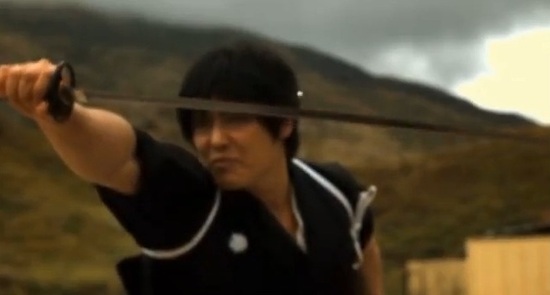
This truly needs to seen to be believed: A man who calls himself a modern-day samurai warrior has been videotaped slicing a speeding pellet in half with a sword.

Isao Machii accomplished the seemingly superhuman feat in a video filmed at a firing range outside Los Angeles last year. The clip was recently recirculated by Oddity Central. The filmmakers used a special camera to slow down the film by 250 times. Viewers can see Machii’s blade slicing into the pellet, which was moving at 200 mph.

Witness Dr. Ramani Durvasula, an associate Professor of Psychology from California State University, said she heard the blade connect with the bullet, but could not see it.

“This is about processing it at an entirely different sensory level because he is not visually processing it,” Durvasula says in the video. “This is a different level of anticipatory processing. Something so procedural, something so fluid for him.”

Machii’s skills with a blade are well-documented.

The Daily Mail notes that the swordsman began studying the ancient art at age 5 and is now the leader of his own samurai school.

Machii also holds multiple Guinness World Records, including one for most sword cuts to straw mats in three minutes. Machii’s record of 252 cuts was achieved on the set of Lo Show Dei Record, in Milan, Italy, in April 2011.

Perhaps unsurprisingly, YouTube is filled with videos of the talented samurai’s various feats. Machii has been filmed cutting an egg in half, slicing the delicate top of a mushroom and cutting clean through an iron pipe.

http://www.huffingtonpost.com/2012/12/28/isao-machii-modern-day-samurai-cuts-pellet-half_n_2377386.html

Wisdom from psychopaths?

wisdom-from-psychopaths_1_jpg_pagespeed_ce_Oc_jJVtPyw

Adapted from The Wisdom of Psychopaths: What Saints, Spies, and Serial Killers Can Teach Us about Success, by Kevin Dutton, by arrangement with Scientific American/Farrar, Straus and Giroux, LLC (US), Doubleday Canada (Canada), Heinemann (UK), Record (Brazil), DTV (Germany), De Bezige Bij (Netherlands), NHK (Japan), Miraebook (Korea) and Lua de Papel (Portugal). Copyright © 2012 Kevin Dutton

“Got anything sharp?” the woman at reception barks, as I deposit the entire contents of my briefcase—laptop, phone, pens—into a clear, shatter-resistant locker in the entrance hall. “Now place the index finger of your right hand here and look up at the camera.”

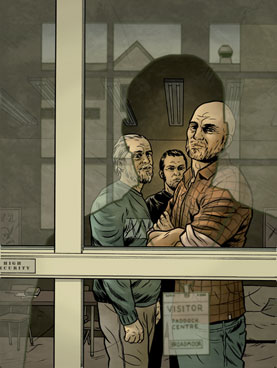
Once you pass through border control at Broadmoor, the best-known high-security psychiatric hospital in England, you are immediately ushered into a tiny air lock, a glass-walled temporary holding cell between reception and the hospital building proper, while the person you are visiting—in my case, a psychologist assigned to escort me to my destination—gets buzzed by reception and makes his way over to meet you.

It’s a nervy, claustrophobic wait. As I sit flicking through magazines, I remind myself why I’m here—an e-mail I had received a couple of weeks after launching the Great British Psychopath Survey, in which I tested people in different professions for psychopathic traits. One of the survey’s respondents, a barrister by trade, had written to me. He had posted a score that certainly got my attention.

“I realized from quite early on in my childhood that I saw things differently than other people,” he wrote. “But more often than not, it’s helped me in my life. Psychopathy (if that’s what you want to call it) is like a medicine for modern times. If you take it in moderation, it can prove extremely beneficial. It can alleviate a lot of existential ailments that we would otherwise fall victim to because our fragile psychological immune systems just aren’t up to the job of protecting us. But if you take too much of it, if you overdose on it, then there can, as is the case with all medicines, be some rather unpleasant side effects.”

The e-mail had got me thinking. Might this eminent criminal defense lawyer have a point? Was psychopathy a “medicine for modern times”? The typical traits of a psychopath are ruthlessness, charm, focus, mental toughness, fearlessness, mindfulness and action. Who wouldn’t at certain points in their lives benefit from kicking one or two of these up a notch?

I decided to put the theory to the test. As well as meeting the doctors in Broadmoor, I would talk with some of the patients. I would present them with problems from normal, everyday life, the usual stuff we moan about at happy hour, and see what their take on it was. Up until now it had seemed like a good idea.

“Professor Dutton?” I look up to see a blond guy in his mid-30s peering around the door at me. “Hi, I’m one of the clinical leads at the Paddock Center. Welcome to Broadmoor! Shall I take you over?”

The Paddock Center is an enclosed, highly specialized personality disorder directorate comprising six 12-bedded wards. Around 20 percent of the patients housed there at any one time are what you might call “pure” psychopaths. These are confined to the two Dangerous and Severe Personality Disorder (DSPD) wards. The rest present with so-called cluster disorders: clinically significant psychopathic traits, accompanied by traits typically associated with other personality disorders—borderline, paranoid and narcissistic, for example. Or they may have symptoms such as delusions and hallucinations indicative of psychosis.

Suddenly, reality dawns. This is no drop-in center for the mocha-sipping worried well. This is the conscienceless inner sanctum of the Chianti-swilling unworried unwell—the preserve of some of the most sinister neurochemistry in the business. The Yorkshire Ripper is in here. So is the Stockwell Strangler. It’s one of the most dangerous buildings on earth.

We emerge from the mazy, medicinal bowels of the hospital to the right of a large, open-air enclosure, topped off with some distinctly uncooperative razor wire. “Er … I am going to be all right, aren’t I?” I squeak.

My guide grins. “You’ll be fine,” he says. “Actually trouble on the DSPD wards is relatively rare. Psychopathic violence is predominantly instrumental, a direct means to a specific end. Which means, in an environment like this, that it’s largely preventable. And in the event that something does kick off, easily contained.

“Besides,” he adds, “it’s a bit late to turn back now, isn’t it?”

Getting to Know the Locals

We enter one of Broadmoor’s ultrasequestered DSPD wards. My first impression is of an extremely well appointed student residence hall. All blond, clean-shaven wood. Voluminous, freshly squeezed light. There’s even a pool table, I notice. A man named Danny shoots me a glance from behind his Nintendo Wii. Chelsea are 2–0 up against Manchester United. “We are the evil elite,” Danny says. “Don’t glamorize us. But at the same time, don’t go the other way and start dehumanizing us, either.”

Larry, a gray, bewhiskered, roly-poly kind of guy, takes a shine to me. Dressed in a Fair Isle sweater and beige, elasticized slacks, he looks like everyone’s favorite uncle. “You know,” he says, as he shakes my hand, “they say I’m one of the most dangerous men in Broadmoor. Can you believe that? But I promise you, I won’t kill you. Here, let me show you around.”
Larry escorts me to the far end of the ward, where we stop to take a peek inside his room. It looks like a typical single-occupancy hospital room, though with a few more creature comforts such as a computer, desk space, and a raft of books and papers on the bed. Next is the garden: a sunken, gray-bricked patio affair, about the size of a tennis court, interspersed with benches and conifers. We then drop in on Jamie.

“This guy’s from Cambridge University,” announces Larry, “and he’s in the middle of writing a book on us.”

Jamie stands up and heads us off at the door. A monster of a man at around 6′2″, with char-grilled stubble and a piercing cobalt stare, he has the brooding, subsatanic presence of the lone, ultraviolent killer. The lumberjack shirt and shaven, wrecking-ball head don’t exactly help matters.

“So what’s this book about, then?” he growls, in a gangsterish Cockney whisper, arms folded in front of him, left fist jammed under his chin. “Same old bollocks, I suppose? Lock ’em up and throw away the key? You know, you’ve got no idea how vindictive that can sound at times. And, might I add, downright hurtful. Has he, Larry?”

Larry guffaws theatrically and clasps his hands to his heart in a Shakespearean display of angst. Jamie, meanwhile, dabs at imaginary tears.

“I happen to think that you guys have got something to teach us,” I say. “A certain personality style that the rest of us can learn from. In moderation, of course. That’s important. Like the way, just now, you shrugged off what people might think of you. In everyday life, there’s a level on which that’s actually quite healthy.”

Jamie seems quite amused by the idea that I might be soliciting his advice. “Are you saying that me and Larry here have just got too much of a good thing?”

Back at other end of the ward, Danny has just been named Man of the Match. “I see he hasn’t killed you, then,” he says casually. “You going soft in your old age, Larry?”

I laugh. More than a little nervously, I realize. But Larry is deadly serious.

“Hey,” he says insistently. “You don’t get it, do you, boy?” He looks at me. “I said I wouldn’t kill you. And I didn’t, right?”

And it hits me that Larry may not have been bluffing. The curtain comes down on the football game. Danny zaps it off. He leans back in his chair.

“So a book, eh?” he says.

“Yes,” I say. “I’m interested in the way you guys solve problems.”

Danny eyes me quizzically. “What kind of problems?” he asks.

“Everyday problems,” I say, and I tell him about some friends of mine who were trying to sell their house.

Ruthless People

How to get rid of an unwanted tenant? That was the question for Don and his wife, Fran, whose elderly mother, Flo, had just moved in with them. Flo had lived in her previous house for 47 years, and now that she no longer needed it, Don and Fran had put it on the market. Being in an up-and-coming area of London, the house had drawn quite a bit of interest. But there was also a problem. The tenant. Who wasn’t exactly ecstatic at the prospect of hitting the road.

Don and Fran had already lost out on one potential sale because he couldn’t, or wouldn’t, pack his bags. But how to get him out?

“I’m presuming we’re not talking violence here,” inquires Danny. “Right?”

“Right,” I say. “We wouldn’t want to end up inside now, would we?”

Danny gives me the finger. But the very fact that he asks such a question at all debunks the myth that violence, for psychopaths, is the only club in the bag.

“How about this, then?” rumbles Jamie. “With the old girl up at her in-laws, chances are the geezer’s going to be alone in the house, yeah? So you pose as some bloke from the council, turn up at the door and ask to speak to the owner. He answers and tells you the old dear ain’t in. Okay, you say. Not a problem. But have you got a forwarding contact number for her, cuz you need to speak to her urgently?

“By this stage he’s getting kind of curious. What’s up? he asks, a bit wary, like. Actually, you say, quite a lot. You’ve just been out front and taken a routine asbestos reading. And guess what? The level’s so high it makes Chernobyl look like a health spa. The owner of the property needs to be contacted immediately. A structural survey has to be carried out. And anyone currently living at the address needs to vacate the premises until the council can give the all clear.

“That should do the trick. With a bit of luck, before you can say ‘slow, tortuous death from lung cancer,’ the wanker will be straight out the door.”

Jamie’s elegant, if rather unorthodox, solution to Don and Fran’s stay-at-home tenant conundrum certainly had me beat. The idea of getting the guy out so sharpish as to render him homeless and on the streets just simply hadn’t occurred to me. And yet, as Jamie quite rightly pointed out, there are times in life when it’s a case of the “least worst option.” Interestingly, he argues that it’s actually the right thing to do.

“Why not turf the bastard out?” he asks. “I mean, think about it. You talk about ‘doing the right thing.’ But what’s worse, from a moral perspective? Beating someone up who deserves it? Or beating yourself up who doesn’t? If you’re a boxer, you do everything in your power to put the other guy away as soon as possible, right? So why are people prepared to tolerate ruthlessness in sport but not in everyday life? What’s the difference?”
Winning Smiles

Jamie’s solution to Don and Fran’s tenant problem carries undertones of ruthlessness. Yet as Danny’s initial qualification of the dilemma quite clearly demonstrates—“I’m presuming we’re not talking violence here, right?”—such ruthlessness need not be conspicuous. The dagger of hard-nosed self-interest may be concealed, rather deftly, under a benevolent cloak of opaque, obfuscatory charm.

Psychopaths’ capacity for charm is, needless to say, well documented. As is their ability to focus and “get the job done.” It’s a powerful, and smart, combination.

Leslie, another inmate, has joined us and has a rather nice take on charm: “The ability to roll out a red carpet for those you cannot stand in order to fast-track them, as smoothly and efficiently as possible, in the direction you want them to go.”
With his coiffured blond locks and his impeccable cut-glass accent, he looks, and sounds, like a dab hand. He also has a good take on focus, especially when it comes to getting what you want. Leslie realized from a rather young age that what went on in his head obeyed a different set of operating principles than most.

“When I was a kid at school, I tended to avoid fisticuffs,” he tells me. “You see, I figured out pretty early on that, actually, the reason why people don’t get their own way is because they often don’t know themselves where that way leads. They get too caught up in the heat of the moment and temporarily go off track.

“Jamie was talking about boxing there a minute ago. Well, I once heard a great quote from one of the top trainers. He said that if you climb into the ring hell-bent on knocking the other chap into the middle of next week, chances are you’re going to come unstuck. But if, on the other hand, you concentrate on winning the fight, simply focus on doing your job, well, you might just knock him into the middle of next week anyway.”

The triumvirate of charm, focus and ruthlessness can predispose someone for long-term life success. Take Steve Jobs. Jobs, commented journalist John Arlidge shortly after the Apple chief’s death in 2011, achieved his cult leader status “not just by being single-minded, driven, focused … perfectionistic, uncompromising, and a total ball-breaker.” In addition, Arlidge noted, he had charisma. He would, as technology writer Walt Mossberg revealed, drape a cloth over a product—some pristine creation on a shiny boardroom table—and uncover it with a flourish.

Apple isn’t the world’s greatest techno innovator. Far from it. It wasn’t the first outfit to introduce a personal computer (IBM), nor the first to introduce a smartphone (Nokia). What Jobs brought to the table was style. Sophistication. And timeless, technological charm.

Apple’s setbacks along the road to world domination serve as a cogent reminder of the pitfalls and stumbling blocks that await all of us in life. Everyone, at some point or other, leaves someone on the floor, so to speak, and there’s a pretty good chance that that someone, today, tomorrow or at some other auspicious juncture down the line, is going to turn out to be you.

Neural Steel

Psychopaths, lest Jamie and the boys have yet to disabuse you, have no problem whatsoever facilitating others’ relationships with the floor. But they’re also pretty handy when they find themselves on the receiving end. And such inner neural steel, such inestimable indifference in the face of life’s misfortunes, is something that all of us, perhaps, could do with a little bit more of.

Studies of psychopaths have even revealed a brain signature for this relative indifference to setbacks. Anthropologist James Rilling of Emory University and his co-workers scanned the brains of those scoring high in psychopathy after these individuals experienced having their own attempts to cooperate unreciprocated. The scientists discovered that, compared with “nicer,” more equitable participants, the psychopaths exhibited significantly reduced activity in the brain’s emotion hub, the amygdala. This diminished activity, suggestive of a muted emotional reaction, could be considered a neural trademark of “turning the other cheek,” a response that can sometimes manifest itself in rather unusual ways.

“When we were kids,” Jamie chimes in, “we’d have a competition. See who could get the most elbows (rejections) on a night out. You know, from girls, like. The bloke who’d got the most by the time the lights came on would get the next night out for free.

“Course, it was in your interest to rack up as many as possible, right? A night on the piss with everything taken care of by your mates? Sorted! But the funny thing was, soon as you started to get a few under your belt, it actually got f— harder. Soon as you realize that it actually means jack, you start getting cocky. You start mouthing off. And some of the birds start to buy it!”

The Feel-Good Emergency

Mental toughness and fearlessness often go hand in hand. Of course, to many of us lesser mortals, fearlessness may seem quite foreign. But Leslie explains the rationale behind this state—and how he maintains it. “The thing about fear, or the way I understand fear, I suppose—because, to be honest, I don’t think I’ve ever really felt it—is that most of the time it’s completely unwarranted anyway. What is it they say? Ninety-nine percent of the things people worry about never happen. So what’s the point?

“I think the problem is that people spend so much time worrying about what might happen, what might go wrong, that they completely lose sight of the present. They completely overlook the fact that, actually, right now, everything’s perfectly fine.

“So the trick, whenever possible, I propose, is to stop your brain from running on ahead of you.”

Leslie’s pragmatic endorsement of the principles and practices of what might otherwise be described as mindfulness is typical of the psychopath. A psychopath’s rapacious proclivity to live in the moment, to “give tomorrow the slip and take today on a joyride” (as Larry, rather whimsically, puts it), is well documented—and at times can be stupendously beneficial. In fact, anchoring your thoughts unswervingly in the present is a discipline that psychopathy and spiritual enlightenment have in common. Clinical psychologist Mark Williams of the University of Oxford, for example, incorporates this principle of centering in his mindfulness-based cognitive-behavior therapy program for sufferers of anxiety and depression.
“Feeling good is an emergency for me,” Danny had commented as he’d slammed in his fourth goal for Chelsea on the Wii. Living in the moment, for him and many psychopaths, takes on a kind of urgency. “I like to ride the roller coaster of life, spin the roulette wheel of fortune, to terminal possibility.”

A desire to feel good in the here and now, shrugging off the future, can be taken to an extreme, of course. But it’s a goal we could all perhaps do with taking onboard just a little bit more in our lives.

“Settle in okay?” my guide inquires as we jangle back to clinical psychology suburbia. I smile.

ABOUT THE AUTHOR(S)

KEVIN DUTTON is a research psychologist at the Calleva Research Center for Evolution and Human Sciences at Magdalen College, University of Oxford. He is author of Split-Second Persuasion: The Ancient Art and New Science of Changing Minds (Houghton Mifflin Harcourt, 2011).

(Further Reading)

The Mask of Sanity: An Attempt to Reinterpret the So-Called Psychopathic Personality. Hervey M. Cleckley. C. V. Mosby, 1941.

Without Conscience: The Disturbing World of the Psychopaths among Us. Robert D. Hare. Guilford Press, 1999.

Snakes in Suits: When Psychopaths Go to Work. Paul Babiak and Robert D. Hare. Regan Books, 2006.

Psychopathic Personality: Bridging the Gap between Scientific Evidence and Public Policy. Jennifer L. Skeem, Devon L. L. Polaschek, Christopher Patrick and Scott O. Lilienfeld in Psychological Science in the Public Interest, Vol. 12, No. 3, pages 95–162; December 2011.

Take part in the Great American Psychopath Survey and learn much more about psychopaths at Dutton’s Web site: http://www.wisdomofpsychopaths.com

http://www.scientificamerican.com/article.cfm?id=wisdom-from-psychopaths