New Jersey school makes no cursing rule for girls only

No-Cursing-at-School

Female students at a Catholic high school in northern New Jersey have taken a “no-cursing” pledge at the request of school administrators, though some question why no such demand was made of male students.

Lori Flynn, a teacher who organized the campaign at Queen of Peace High School in North Arlington, told The Record of Woodland Park there is no double-standard. She says that while males weren’t asked to take the vow, they have been asked not to swear when girls are near.

Flynn says school officials want “ladies to act like ladies.” And Brother Larry Lavallee, the school’s principal, says girls have the foulest language.

Many girls said they would try to follow the pledge they took Friday morning, even though they believe it should apply to all students.

Sixteen-year-old Kaitlin McEnery said the pledge is a “good idea,” but believes that “putting it into action is the problem.” And classmate Dana Cotter, 16, thought that male students should join the pledge because “boys should be more like gentlemen.”

Teachers said they hoped that if the girls focused on cleaning up their speech on campus for a month, their improved manners would take hold and rub off on the boys. They timed the initiative to Catholic Schools Week and the old-fashioned romance of Valentine’s Day, promising lollipops as rewards and handing out pins showing a red slash through a pair of pink lips.

“It’s unattractive when girls have potty mouths,” said Nicholas Recarte, 16.

A pitcher on the school’s baseball team, Recarte said he can’t help shouting obscenities from the mound after mishaps, and he didn’t expect that to change.

http://www.nbcphiladelphia.com/news/national-international/NJ-School-No-Cursing-Rule-For-Girls-189649171.html

Abnormal gut bacteria linked to severe malnutrition

starve

There’s more to malnutrition than poor diet. Two complementary studies suggest that microbes have an important role to play in both the onset and treatment of a poorly understood form of malnutrition called kwashiorkor.

Malnutrition, the leading cause of death among children worldwide, remains something of a puzzle. It is unclear, for instance, why some children are especially prone to becoming malnourished when siblings they live with appear to fare better.

Now Jeffrey Gordon at Washington University in St Louis, Missouri, and his colleagues have found that a child’s risk of malnutrition may come down to the microbes in his or her guts.

Working in southern Malawi, the team identified sets of identical and non-identical twins in which one child had kwashiorkor – thought to be caused by a lack of protein – and the other did not, despite the shared genetics and diet. Gordon’s team took faecal samples from three sets of twins and transplanted the samples into the guts of mice, which were then fed a typical nutrient-poor Malawian diet.

Mouse weight lossAll of the mice lost some weight. However, some lost significantly more weight, and more quickly, than others. Further investigation showed that these mice had all received a faecal sample from children with kwashiorkor.

The finding strongly hinted that the mice had picked up a kwashiorkor-like condition from the microbes within the faecal implant, so the researchers studied the rodents’ gut flora. They found higher than normal levels of bacteria associated with illnesses such as inflammatory bowel disease.

The results suggest pathogenic microbes may heighten the problems of malnutrition in some children, says Jeremy Nicholson at Imperial College London, a member of the study team. “There’s a lot of work revolving around obesogenesis – how given a standard diet one set of bugs might make more calories available than another set,” he says. “But the other side of that coin is that maybe particular bugs can restrict calorie availability and exacerbate a poor diet.”

Indi Trehan at Washington University, another member of the research team, agrees. “I think it is correct that there are more factors than simple food insecurity at play in terms of malnutrition,” he says.

Antibiotic aidTrehan is lead author on a second new study, which examines how children with kwashiorkor respond when given nutrient-rich therapeutic diets. Trehan’s team found that the children were significantly less likely to become malnourished once the dietary treatment had ended if they were given a course of antibiotics along with the diet.

Together, the studies help us understand the role that infections might play in malnutrition, says Trehan. This might point towards a future in which microbial concoctions can be tailored to guard against such infections and treat specific conditions, suggests Nicholson.

Alexander Khoruts at the University of Minnesota in Minneapolis has been using faecal transplants to treat resistant Clostridium difficile disease in humans. “It is likely that microbiota are involved in pathogenesis of many other diseases, and it is possible that faecal transplants may be an approach to treat those as well,” he says. But because gut bacteria are so complex, he thinks more research will be needed to develop appropriate microbe-based therapies.

http://www.newscientist.com/article/dn23127-abnormal-gut-bacteria-linked-to-severe-malnutrition.html

Mind-meld brain power is best for steering spaceships

piggy

Two people have successfully steered a virtual spacecraft by combining the power of their thoughts – and their efforts were far more accurate than one person acting alone. One day groups of people hooked up to brain-computer interfaces (BCIs) might work together to control complex robotic and telepresence systems, maybe even in space.

A BCI system records the brain’s electrical activity using EEG signals, which are detected with electrodes attached to the scalp. Machine-learning software learns to recognise the patterns generated by each user as they think of a certain concept, such as “left” or “right”. BCIs have helped people with disabilities to steer a wheelchair, for example.

Researchers are discovering, however, that they get better results in some tasks by combining the signals from multiple BCI users. Until now, this “collaborative BCI” technique has been used in simple pattern-recognition tasks, but a team at the University of Essex in the UK wanted to test it more rigorously.

So they developed a simulator in which pairs of BCI users had to steer a craft towards the dead centre of a planet by thinking about one of eight directions that they could fly in, like using compass points. Brain signals representing the users’ chosen direction, as interpreted by the machine-learning system, were merged in real time and the spacecraft followed that path.

The results, to be presented at an Intelligent User Interfaces conference in California in March, strongly favoured two-brain navigation. Simulation flights were 67 per cent accurate for a single user, but 90 per cent on target for two users. And when coping with sudden changes in the simulated planet’s position, reaction times were halved, too. Combining signals eradicates the random noise that dogs EEG signals. “When you average signals from two people’s brains, the noise cancels out a bit,” says team member Riccardo Poli.

The technique can also compensate for a lapse in attention. “It is difficult to stay focused on the task at all times. So when a single user has momentary attention lapses, it matters. But when there are two users, a lapse by one will not have much effect, so you stay on target,” Poli says.

NASA’s Jet Propulsion Lab in Pasadena, California, has been observing the work while itself investigating BCI’s potential for controlling planetary rovers, for example. But don’t hold your breath, says JPL senior research scientist Adrian Stoica. “While potential uses for space applications exist, in terms of uses for planetary rover remote control, this is still a speculative idea,” he says.

http://www.newscientist.com/article/mg21729025.600-mindmeld-brain-power-is-best-for-steering-spaceships.html

Alleged Sexual Abuse of Patients in Parkland Memorial Hospital Psychiatric Emergency Room

douglas

Caregivers in Parkland Memorial Hospital’s psychiatric emergency room suspected that their new patient had been drugged and raped. She cried, talked nonsensically and asked for a genital exam.

Levie Smith Jr. saw a fellow aide — a man not qualified to do such an exam — take the patient to a bathroom and close the door behind them. Smith alerted a nurse, who walked across the unit and opened the door.

“What the — !” the nurse cried out, his face turning “red as a beet,” Smith said. A few minutes later, the nurse told Smith what he had seen: The patient was bent over, with her pants down around her ankles. The aide, Jermaine Douglas, had his face “a few inches away from her bottom.”

Parkland police investigated the October 2010 incident one year later, their records show. Officially, they concluded that the only person who behaved inappropriately was the patient. The Texas Department of State Health Services also investigated a year later, based on a Dallas Morning News inquiry. “The state cited Parkland for failing to report the alleged sexual abuse,” hospital officials said, although DSHS did not verify patient harm.

Douglas, who remains on duty in the psych ER, denied wrongdoing to police and health care regulators. He declined to be interviewed for this story. His personnel records, which Parkland released in response to a public information request, show no sign that he has ever been disciplined for misconduct with patients.

Contradictions abound in official records on the case, raising questions about what really happened and whether Parkland responded properly. Here’s how events unfolded, according to regulators’ records, police reports and eyewitness accounts:

The nurse who interrupted the bathroom incident promptly called the psych ER manager, Vernell Brown, who was away from the unit at the time. Brown instructed the nurse not to file an electronic patient safety report. Employees are supposed to submit such a report as soon as possible after witnessing potential harm.

Instead, on Brown’s orders, the nurse made a handwritten account of what he had seen: Douglas escorted the patient to the bathroom and disappeared for “several minutes.” When the nurse opened the bathroom door, Douglas ran toward him, “was startled and stuttered, ‘I I was a checking her bruises.’”

A patient safety report was later made in Brown’s name. Dated the day after the incident, it said the patient “exposed herself to male staff. Staff stated while obtaining a urine sample from pt [patient] she pulled down her underwear wanting to show staff a bruise on her buttock.”

The report made no mention of what Smith and the nurse, Robert Meskunas, said they saw. A legally required internal safety investigation did not occur.

Smith, who quit Parkland in late 2011 and filed a federal discrimination complaint, told The News that Douglas had a habit of standing near slightly open bathroom doors while female patients provided urine samples. He said he had warned unit manager Brown about this. But Brown and Douglas were friends, Smith said, and no change in behavior resulted.

Brown now works at a desk job outside the psych ER. He did not respond to interview requests from The News. He told regulators that “Parkland police talked to the patient,” who “denied the incident.”

But none of the officers named in records obtained by The News reported interviewing the patient.

Three Parkland police officers spoke separately over time to Meskunas, the nurse who walked in on the aide and the patient. Only one, Detective Jon David Schoen, created an investigative record.

Another detective, Darlene Griffin, said Meskunas “adamantly denied” seeing anything inappropriate in the bathroom. But Griffin could not remember when their conversation occurred, did not document it at the time and took “no further actions.”

The third officer, Cornelius Torrence, said Meskunas complained about Douglas inappropriately “being inside the restroom” with a patient. “There was more than just one incident he was upset about,” the officer said, according to records. But he viewed this as an “administrative” matter and didn’t investigate further. Like Griffin, he did not remember when the conversation occurred nor document it at the time. None of the officers agreed to be interviewed.

In a recent statement to The News, Parkland claimed its police investigated the case twice, although it released only one investigative record. The statement also repeated the claim that Meskunas had recanted and told police “nothing inappropriate had occurred.”

Smith, after being shown a copy of the Parkland statement, said: “They’re trying to cover it up.” Hospital officials denied any “effort to suppress or overlook” any sex abuse allegations.

Meskunas resigned last month and declined to comment. But he told Schoen that the recantation claim was incorrect, according to an audio recording of their conversation obtained by The News.

During the November 2011 recorded conversation, Meskunas asked the detective why he had not tried to speak with the patient. “Because right now she’s not a victim,” Schoen said. “You don’t want to create a problem where there’s not one.”

Schoen also told Meskunas that he’d learned Douglas had a history of similar misconduct and had “actually been suspended for it before.”

“The police department would love to do something about it,” Schoen said. But “because it was handled administratively the first time, there’s no criminal offense.” The detective did not explain what he meant by that.

When Meskunas said it was “so wrong” for Douglas to avoid charges and keep his job, the detective replied: “I don’t disagree with you a bit.”

Schoen said he and his supervisor “tried to come up with a criminal offense that we could prove, and there’s not one” without an allegation of physical contact. They also lacked proof, he said, that Douglas’ intention was sexual gratification.

“Sexual gratification?” Meskunas fired back. “He had her bent over like a stripper with his face all in her business.”

Parkland’s website says sexual abuse “can be verbal, visual or anything that forces a person into unwanted sexual contact or attention.” According to a brochure distributed by the hospital, it includes failure to respect people’s privacy in bathrooms.

Schoen told the nurse he was “sorry that we couldn’t do something that kind of satisfied you more. I hope you understand the predicament that we’re in as a police department.”

Then the detective offered some parting advice.

“If it happens again,” he said, “you don’t have a duty to go through your chain of command to report a criminal offense. You can go straight to the police department, especially if you can articulate why you believe that it would be covered up if you went through your chain of command.”

Smith told The News that Parkland has “some great officers” who sincerely try to carry out their duties. But “they are puppets.”

“The police are there to protect the hospital,” Smith said. “It’s not about the patients.”

After interrupting the bathroom incident, Meskunas asked fellow nurse Annie Molinaro to interview the patient. Government health regulators questioned Molinaro about this during their October 2011 investigation

She recalled that the patient, when asked “if everything was OK,” said that Douglas had been in the bathroom with her and “I tried to show him.” As they spoke, Molinaro told regulators, the patient began to pull down her pants again in the dayroom — a large space in the middle of the unit where most patients spend time.

Molinaro’s account, as described in the government’s investigative report, gives no more details of what the patient said. When Schoen, the Parkland detective, questioned Molinaro two weeks later, he reported her saying “that the patient denied any inappropriate conduct by the suspect.”

In the tape-recorded conversation with Schoen, Meskunas said Molinaro told him on the day of the incident that the patient spoke of “doing what she was told.” He added that “she was very confused,” and “she was embarrassed.”

Meskunas alleged that Molinaro was trying to protect the reputation of Brown, the psych unit manager, because she was having sex with him.

“You’re not the only person that has said that,” Schoen responded. “You and I both know the relationship between Vernell and Annie, but I can’t prove that that affected her judgment or her statement.”

Molinaro is the only person interviewed by regulators or police who said that the patient tried to pull her pants down in the dayroom. She did not respond to interview requests.

Smith said he did not see this and doubted whether it occurred. If it did happen, he said, then Molinaro violated the patient’s privacy by questioning her in the presence of other patients.

According to the government’s report, Douglas said he told the patient to wait outside the bathroom while he picked up trash inside. She followed him in, began asking questions and insisted on showing him her bruises. The door was partially open. “All of a sudden the patient dropped her pants,” he is quoted as saying.

Douglas told regulators that he did not touch the woman. When they asked if he sexually abused her, he said he was turning away from her when Meskunas walked in. He “did not look at the bruises.”

Two weeks later, when Schoen interviewed Douglas, the story seemed to change. “He stated that at no time was he inside the bathroom with the patient,” according to the Parkland detective’s report.

Smith told The News that account was “a lie.”

“I saw it,” he added. “He went in after her.”

Schoen’s official report on the bathroom incident concluded: “While it does appear that the patient behaved inappropriately, there does not appear to be any evidence that a criminal offense was committed.”

The patient seemed to have been adequately protected, the report said. Yet it added: “A recommendation was made to review the policies and procedures for staff dealing with patients and make appropriate changes to safeguard the patients and prevent unintentional inappropriate activities between staff and patients.”

In its Jan. 22 statement to The News, Parkland said, “education was conducted in the psychiatric ER regarding incident reporting and appropriate procedures in dealing with patients of the opposite sex.”

The Department of State Health Services, which licenses Texas hospitals, produced the regulatory report for the U.S. Centers for Medicare & Medicaid Services. “There was no indication” of sexual abuse found when interviewing Parkland employees and reviewing hospital records, the report concluded.

But it noted that “some of the information received by the surveyor conflicted.” Interviews and records summarized in the report repeatedly point to possible misconduct.

DSHS spokeswoman Carrie Williams declined to comment, saying that investigative details are confidential. Texas law prohibits public release of such reports. The News obtained its copy from federal health officials, who blacked out the names of most Parkland employees and the patient.

Williams did say that Parkland’s failure to contact DSHS, and the resulting delay in investigating, “made it very difficult” for regulators to determine what happened.

Parkland learned new information during the regulatory investigation that led to Douglas’ suspension, the DSHS report says.

The new information isn’t described in the government report or in personnel records that Parkland released to The News. But Smith said he overheard a government investigator, after interviewing him, make a telephone call urging Douglas’ immediate removal from duty.

Parkland records show that Douglas was suspended that day, pending an internal investigation of “allegations of inappropriate behavior with a patient.” The records don’t show why he was put back on duty.

The Parkland detective, during the recorded conversation, said the hospital’s top psychiatric official was “frankly disappointed that she had to put him [Douglas] back on the schedule.”

That executive, Larae Huycke, was new to her management job at the time. Smith said Huycke initially told subordinates she planned to fire Douglas even if he wasn’t criminally charged. But she didn’t.

“Larae told me, ‘Levie, if this situation blows up, it could cause the psych ER to close,’” Smith told The News. He understood Huycke to mean that the unit couldn’t survive a confirmation of sexual misconduct, given what had already happened.

In late 2011, members of Parkland’s governing board revealed that they had considered closing the unit. The News had reported throughout 2011 on widespread problems in Parkland’s psychiatric ER, including the finding by regulators that psych aides had illegally restrained a patient shortly before he died. (Parkland police did not investigate that case.) The regulators went on to identify hospital-wide problems and install safety monitors.

Huycke herself was later accused of using an illegal chokehold on another psych ER patient. Parkland police quickly cleared her. But after a few weeks, the hospital said she would step down and return to full-time nursing work. Huycke hung up when a reporter recently called.

After the bathroom incident, Smith said, he was pressured to distance himself from Meskunas, the nurse who reported it. Fed up, Smith eventually quit and filed a complaint with the U.S. Equal Employment Opportunity Commission. In it, Smith said his boss, Brown, had referred to Meskunas as a “white boy” and called another nurse who reported patient safety issues a “white bitch.”

The federal agency dismissed Smith’s complaint without certifying Parkland had complied with the law. The hospital successfully contested Smith’s unemployment compensation claim.

Smith recalled that he had once reminded Brown about Douglas’ habit of lingering near female patients as they urinated. He said Brown responded: “Let him hang himself. If he’s done it once, he’ll do it again.”

PARKLAND STAFF INVOLVED IN PSYCH ER CASE
In October 2010, a nurse reported witnessing the sexual abuse of a psychiatric patient in a Parkland Memorial Hospital bathroom. Regulators and Parkland police who investigated a year later did not substantiate the allegation. Here is a snapshot of events. All job titles are those employees held at the time.

THE PATIENT
Her identity has not been released, and she was never interviewed by police or health care regulators. Hospital workers suspected she had been drugged and raped before arriving at the psychiatric ER.

JERMAINE DOUGLAS
Psych ER aide
He escorted the patient to a bathroom, where she pulled her pants down to her ankles. He denies any wrongdoing.

LEVIE SMITH JR.
Psych ER aide
He alerted a nurse that Douglas had gone into the bathroom with the patient.

ROBERT MESKUNAS
Psych ER nurse
He opened the bathroom door and reported finding the patient, pants down and bent over, with Douglas’ face near her crotch.

VERNELL BROWN
Psych ER unit manager
He received a phone call from Meskunas about the incident and told him not to file a patient-safety report.

ANNIE MOLINARO
Psych ER nurse
At Meskunas’ request, she interviewed the patient shortly after the incident. He said Molinaro told him the patient spoke of “doing what she was told.” But Parkland police said she later claimed the patient “denied any inappropriate conduct” by Douglas. There’s no record that Molinaro made such a claim to government regulators.

DARLENE GRIFFIN
Parkland police detective
She said Meskunas “adamantly denied” seeing anything inappropriate in the bathroom. She didn’t document the conversation at the time.

CORNELIUS TORRENCE
Parkland police corporal
He spoke separately with Meskunas and said the nurse complained about Douglas being inappropriately “inside the restroom” with the patient. He didn’t document the conversation at the time.

JOHN DAVID SCHOEN
Parkland police detective
He conducted the only documented criminal investigation of the incident. He did not speak to the patient but concluded officially that she “behaved inappropriately” and no crime was committed.

LARAE HUYCKE
Psychiatric executive
Smith said she vowed to fire Douglas even if police filed no charges. Schoen said privately that she was “disappointed that she had to put him back on the schedule.”

SOURCES: U.S. Centers for Medicare & Medicaid Services; Parkland; Dallas Morning News research

http://res.dallasnews.com/graphics/2013_02/parkland/#day3main

Retreating rebels burn Timbuktu’s science manuscripts

t1

t2

It is what conservators, archivists and researchers have feared. As Malian troops, supported by the French military, advanced on the fabled city of Timbuktu in northern Mali, retreating Islamist rebels have set fire to the Ahmed Baba Institute and a warehouse containing valuable scientific manuscripts dating back to medieval times.

The Ahmed Baba Institute housed an estimated 30,000 manuscripts. The texts include documents on astronomy, medicine, botany, mathematics and biology, evidence that science was under way in Africa before European settlers arrived. They were not only from scholars working in Timbuktu, once a centre for learning, but also from all over Mali and as far as the borders of Mauritania, Burkina Faso, Senegal, Guinea, Niger, Algeria and the Ivory Coast.

It is unclear at this stage how many of the texts have been destroyed.

The rebel group Ansar al Dine wrestled control of Timbuktu from Tuareg separatists in April last year, and since have been using the Institute as their base. The rebels had earlier looted the building of its vehicles, computers and other equipment.

Rich academic history“There is no way these people can claim to be Africans when they destroy the very foundation of our contribution to world knowledge and academia,” says George Abungu, vice president of the executive council of the International Council of Museums. The texts “are the very evidence that Africa had a rich academic history before the coming of the Europeans, as opposed to the earlier notion that we had none”, he says. He describes the burning as “an incredible loss to Africa’s heritage, a backward move to the dark ages”.

Following the rebels’ destruction of Timbuktu’s shrines and tombs in recent weeks, there had been talk of a behind-the-scenes plan to remove for safekeeping some of the estimated 700,000 manuscripts housed in public and private libraries throughout the city.

But even if the plan had been carried out in time, not all the ancient texts would have been rescued given their number and their scattered locations. In any case, some manuscripts are too fragile to be moved.

http://www.newscientist.com/article/dn23113-retreating-rebels-burn-timbuktus-science-manuscripts.html?cmpid=RSS|NSNS|2012-GLOBAL|online-news

Parkland Memorial Hospital nurse accused of sexually assaulting patient

menchaca-s

Of all the sex-abuse suspects whose names Parkland Memorial Hospital has disclosed, only one is known to have lost his caregiver’s license because of the allegations. And he got it back after two months.

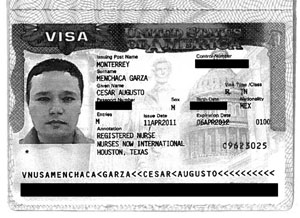
The Texas Board of Nursing revoked Cesar Menchaca’s license in September after finding that he fondled a hospitalized jail inmate — a man who was shackled to a bed and was not his patient. The Texas agency that licenses hospitals came to a similar conclusion and cited it as one reason for fining Parkland a record $1 million last summer.

“His actions were not acceptable practice for our clinicians,” the hospital said in a Jan. 22 statement to The Dallas Morning News. “Chief Nursing Officer Mary Eagen demanded his association with Parkland be terminated.”

But Parkland police called the abuse allegation unfounded. A detective reached this conclusion after interviewing Eagen’s subordinates and the patient, according to police records.

“He said the investigation was terminated because I used the word ‘groin’ instead of ‘penis’” when first describing the incident, inmate Rubin Crain told The News. (The newspaper generally doesn’t name alleged sexual abuse victims, but Crain volunteered to be identified.) Police records do show that the detective considered this a key reason for closing the case.

Menchaca did not respond to interview requests. The Parkland contractor that employed him said he was falsely accused.

The 35-year-old man went to work at Parkland in late 2011, as federally installed safety monitors began documenting the public hospital’s many dangers. One was that Parkland had simply failed to hire enough caregivers. The shortage soon worsened, as the monitors’ scrutiny of patient care led to firings and resignations.

Menchaca was part of the crisis-control plan. He worked for a company called Nurses Now International, which brought nurses from Mexico to Dallas for additional training at El Centro College and then placed them in temporary jobs at Texas hospitals.

The nurse came with a resume listing several prior employers in Saltillo, a city about three hours’ drive from the Texas border. He had one glowing letter of reference, although it was eight years old. On his first attempt to get a Texas nursing license, he flunked the exam, doing particularly poorly in areas where authorities have repeatedly faulted Parkland: safety and infection control.

But Menchaca passed on the second try. Parkland put him to work as part of its “float pool,” which dispatches nurses to areas that need extra help.

One of those areas was the seventh floor, where patients with a variety of ailments are treated. One of those patients, beginning last April, was Crain. He had a severe infection stemming from a finger injury.

Like other Dallas County inmates who become Parkland patients, Crain was not only chained to his bed but also under guard by a sheriff’s officer. His long history of criminal convictions includes everything from marijuana possession to robbery.

That history, Crain knows, makes people inclined to doubt him, and he did not seek out news coverage. But numerous government employees — both investigators and witnesses, including a guard — have lent credence to his complaints about Menchaca.

The state nursing board, for example, declared that Menchaca twice “fondled the penis and testicles” of Crain, which “exposed the patient unnecessarily to the risk of mental and physical harm.” It reached this conclusion after the nurse failed to respond to written allegations.

oth molestations occurred in the middle of the night, Crain said, under the pretense that the nurse was checking his lymph nodes and pulses. He recalled that the first time, in late April, he tried to alert his guard — who was sleeping and “told me to go back to sleep.” Crain did nothing further at the time, fearing “no one would believe me.”

A report by two investigators from the Department of State Health Services, the hospital licensing agency, describes what happened during the second incident:

Crain’s regular nurse began a 30-minute break about 2 a.m. on May 3. She asked Menchaca to respond if any of her patients called for help. Menchaca — without being summoned — quickly went to see Crain in Room 716. A different guard was on duty, and she was awake.

Menchaca immediately violated protocol in two ways, guard Delesia Lacy told the DSHS investigators: He did not put on a “contact isolation gown,” which is designed to prevent the spread of infection, and he closed the privacy curtains around the patient’s bed, preventing her from maintaining required visual contact with the inmate.

The nurse “spoke to the patient in medical terms for a minute, and then it became very quiet,” according to Lacy. He “was behind the curtain for 10 to 15 minutes.”

Lacy had “worked at the hospital for several years and never seen a nurse come in at 2 a.m. and do an assessment on an inmate,” the DSHS report added. She “stated she believed something happened. It was just too strange.”

Crain told her after Menchaca left that he’d been molested, and she urged him to speak with his regular nurse. That nurse and a supervisor told DSHS that Menchaca had no business conducting a full physical assessment and that he had not documented anything about it in the medical record.

When state investigators interviewed Menchaca, he “changed the subject frequently and required redirection.” When asked why he didn’t document his exam, he “did not answer the question.”

Menchaca wrote a statement for Parkland police saying that Crain had been suffering from swollen lymph nodes and groin pain. Also, “I verified the status of his handcuffs that might compromise his circulation.”

He told the hospital detective that the medical record lacked documentation “because he usually gives the patient’s nurse a verbal report,” according to a police report. Menchaca claimed he went to Crain’s room without being called “because he does not want to be accused of not taking care of” patients. And he said he pulled the privacy curtain “because the [sheriff’s] officer was female.” There’s no indication in the police report that the suspect explained his failure to use the isolation gown.

Before federal safety monitors were installed at Parkland, the hospital repeatedly broke the law by not reporting abuse allegations to DSHS. Reporting has improved since then, the state agency says, although the hospital took nine days longer than allowed to disclose the Menchaca matter. DSHS, which hasn’t always interviewed alleged victims, then spoke with Crain.

State investigators substantiated the abuse allegation, saying Parkland failed to protect his “physical and emotional health.” But the criminal case was another dead end.

Menchaca was suspended on the day of the incident and fired the next. At the time of termination, Parkland police were “considering a referral to the district attorney,” says a hospital record cited in the DSHS report.

But the Parkland detective soon declared “there was no basis” for a charge of assault — which Texas law defines as including offensive physical contact. Generally speaking, assault is a misdemeanor. It’s a felony if sexual penetration or serious injury occurs, or if the contact causes mental injury to a disabled person.

In justifying his conclusion, the detective cited both Crain’s initial description of the unwanted touching and statements by two nurses. They thought Menchaca shouldn’t have been in Crain’s room, he wrote, “but they said if he was checking” what he claimed he was, then his actions “would be one way to check.”

Menchaca’s employer takes a position similar to that of the police.

“It’s a total fabrication,” Nurses Now vice chairman David Roth said of the abuse complaint. In a September interview with The News, he laughingly mocked as “incredible” the idea that abuse could occur with a jailer nearby.

Menchaca didn’t initially respond to nursing board allegations because they were mailed to his apartment near Parkland after he’d moved out, Roth said. “He’s never had his day in court on that,” said the executive, whose company has offices in Kentucky and Mexico.

Company lawyers have since persuaded the nursing board to reconsider the matter and, at least for now, to restore Menchaca’s license. It isn’t clear when the board will decide his fate.

Menchaca recently admitted to the board that he failed to report his new address. It was in Houston, where Nurses Now sent him to work at Harris Health — another public hospital system.

Nurses Now did not disclose why he was fired in Dallas, Harris Health spokeswoman Melinda Muse said. Harris Health fired him in September, shortly after he lost his nursing license, and has refused to take him back.

Where is Menchaca now? Nurses Now representatives won’t say.

http://res.dallasnews.com/graphics/2013_02/parkland/#day1main

Choking allegations against doctor began at Parkland Memorial Hospital

zafarmand-s

By BROOKS EGERTON
Staff Writer
begerton@dallasnews.com

You look like the movie star Julia Roberts, the doctor told the hospital patient. She told police that he urged her to act — to pretend she “was sedated and begging him not to leave.”

Then the doctor grabbed one of her breasts and squeezed her neck “to the point that she had trouble breathing,” according to a police report. He asked “if she liked being choked.”

When Dr. Alireza Atef-Zafarmand came back to her room later that day in 2006, the woman called a nurse for help. The nurse called Parkland Memorial Hospital’s police force. Paul Nix was one of the officers who responded.

“She seemed very credible” and “very rattled,” said Nix, who recalled details of the matter as soon as The Dallas Morning News made a brief, general inquiry. “I believed her that something went wrong.”

But the police case — like many other sexual abuse allegations at Parkland reviewed by The News — went nowhere. “Eyewitnesses made statements that the accusations of choking and groping were untrue,” hospital leaders said in a written statement last month.

Police reports released by Parkland, however, do not support that claim. They refer to a single witness who was simply unable to confirm anything besides verbal contact. And Nix, who left Parkland in 2007, questioned whether there was a witness.

Parkland’s statement denied mishandling the police case, saying there was no effort “to suppress or overlook incidents of alleged assault.” However, it said Atef-Zafarmand committed verbal misconduct and that the hospital failed to discipline him for that.

“The evidence suggests he should have been promptly removed from Parkland,” the statement said. “We are confident that should a similar incident arise today, the offending physician would quickly be removed.”

Atef-Zafarmand told The News that he never touched the patient but did tell her she looked like the movie star.

“I asked her, ‘Do you have the same talent?’” the 47-year-old kidney specialist said. “A lot of people, they take it as a compliment.”

Atef-Zafarmand said he first spoke to the woman in a hallway and followed her to her ninth-floor room. She wasn’t his patient, he said, and he didn’t know her name or reason for hospitalization.

In the ensuing months, his medical superiors disciplined him for several incidents of misconduct that occurred outside the public hospital. Yet Parkland and its academic affiliate, UT Southwestern Medical Center, still let Atef-Zafarmand graduate from his training program in 2007.

The UTSW faculty member who oversaw the training program said Atef-Zafarmand was going to be expelled a few months before graduation, according to university records. But the faculty member was overruled by Dr. Greg Fitz, who has since become dean of UTSW’s medical school.

After Atef-Zafarmand graduated, some UTSW officials endorsed him to Dallas-area private hospitals. For example, the man who issued the expulsion warning, Dr. Biff Palmer, ranked him “excellent” in all categories, including ethical conduct.

Fitz and Palmer declined interview requests. In a written statement, UTSW said it never received reports from Parkland or elsewhere that Atef-Zafarmand “acted in a sexually inappropriate manner with any patient.” It added: “Based on the facts available at the time, UTSW acted appropriately.”

Since Atef-Zafarmand began working in private practice, two other women have told Dallas police that he choked and sexually assaulted them. He did not respond to questions about these allegations.

None of the cases has led to criminal charges or discipline by the Texas Medical Board, the state agency that licenses doctors.

After attending medical school in his native Iran, Atef-Zafarmand came to Dallas in 2004 for a three-year fellowship in kidney disease. He spent much of his time at Parkland, along with about 1,000 other doctors in postgraduate training. They reported to UTSW faculty members and worked under a Parkland contract that says harassment, abuse and disrespectful or unprofessional conduct “would be cause for immediate termination.”

But the consequences for Atef-Zafarmand fell far short of that mark. UTSW records show he was counseled three times in the first five months of his fellowship for “poor work ethic,” showing disrespect to a supervisor and “unprofessional conduct directed toward a patient.”

Trouble surfaced again in January 2006. Late one night, Parkland police got a call for help from the ninth floor. A patrol officer interviewed the female patient and soon notified Nix, the sergeant on duty. Nix re-interviewed the woman and said he heard none of the shifting, dreamlike tales that heavily medicated people sometimes tell. Nor did he hear any vague allegations or threats of lawsuit.

“She was very detailed, very specific,” said Nix, who is now chief deputy to the sheriff of Hardeman County, northwest of Dallas. “She never wavered from the story.”

Police records show that Nix consulted one of the patient’s physicians, who also found her to be credible. She “was not on any medications that would normally cause one to hallucinate,” the physician was quoted as saying.

Nix recalled alerting a lieutenant at home around midnight. A higher-level supervisor also was notified, “and I want to say they called Dr. [Ron] Anderson,” Parkland’s chief executive at the time. “It was a big brouhaha.”

Smith Lawrence, then Parkland’s police chief, said he didn’t remember the case but did recall investigating other sexual abuse allegations around the same time. “You’d catch hell for that,” he said, referring to investigations of doctors.

Lawrence retired in 2008, when he was in his early 70s, and declined to be interviewed in detail. “When I left Parkland, I made it my last mission to leave all that stuff behind,” he said.

He suggested that The News contact CaSandra Williams, who was his top aide and now heads the police department at Texas Health Presbyterian Hospital Dallas. She did not respond to interview requests. Parkland has retained responsibility for her officer’s license, state records show. It would not say why.

Atef-Zafarmand said police questioned him the day after the patient complained. “That’s impossible,” he recalled telling them. “There must be a mistake.”

An officer took him to the patient’s room, and she identified him as her attacker. He said she told him, “When you talked to me, I felt that something is getting to my brain, and I knew that you were doing it.”

The woman seemed “scared to death,” Atef-Zafarmand said. “It was a very disturbing situation.”

He said police never asked him to take a lie-detector test.

“That would have been an option,” Nix said, because Parkland frequently dealt with a contracted polygraph operator, primarily when evaluating job candidates. He said he was not involved in the case after the first night and knew no details of the investigation.

Not seeking a polygraph sounds odd, said Fred Price, who was a Parkland police detective until the year before the incident and is now a Dallas County courtroom bailiff. “They used the snot out of that polygraph when I worked there,” he said.

Atef-Zafarmand said Parkland officials told him that the patient had previously been hospitalized for psychiatric problems. Legal experts say that releasing such information could violate her privacy rights under HIPAA, the Health Information Portability and Accountability Act.

A senior hospital executive, Atef-Zafarmand said, apologized for the necessity of the police investigation and told him officials believed he was innocent. The executive also warned him not to make unnecessary remarks.

“That is one of my personal problems,” Atef-Zafarmand said. “I do a lot of unnecessary things.”

Atef-Zafarmand insisted that witnesses would have seen him if he had touched the patient. There was a second patient in the room, he said, and she had a relative visiting.

Statements from Parkland officials and hospital records contradict each other on this point. For more than a year, the hospital had refused to release police records on the case. After it finally did so on Jan. 18, officials said they were sharing copies of all police reports.

Those reports made no mention of eyewitnesses. But a Parkland statement to The News, four days later, said police had dropped the case after eyewitnesses said the assault allegation was “untrue.”

After The News asked Parkland whether it had released all records, the hospital produced a one-page document that it said had been accidentally withheld. It was labeled the “final page” of the police file and referred to a single, unnamed witness. Nothing else in the file references a witness.

This witness, described as the patient’s roommate, heard Atef-Zafarmand’s “Julia Roberts” remark and role-playing request, according to the one-page document. But “roommate could not provide any additional information to confirm the complainant’s allegation of physical contact.” There is no reference to anyone calling the allegation “untrue.”

There are other discrepancies. The “reporting officer” box on the form was left blank, meaning no one took responsibility for writing the final page. Nix said he could not remember ever seeing such an omission on a Parkland police report.

“That’s very stinky,” said Nix, who reviewed the police file released to The News.

Equally strange, he said, is the final page’s reference to a roommate. He said the patient didn’t have one when Atef-Zafarmand first visited her. She got one later that day. “[She] now has a roommate and that also makes her feel better,” says Nix’s contemporaneous police report.

That corresponds to the other records Parkland initially released. The group of reports begins with an overview, written by the first responder that makes no mention of anyone having information except the patient and the nurse she’d asked for help.

The final page said it “appears the conduct was not appropriate, but not illegal in any manner.” The criminal case was closed on Jan. 29, 2006, one day after Nix’s report.

Police records don’t show that an investigator was ever assigned to the case, although they do name one officer who began interviewing Atef-Zafarmand. That officer was Kenneth Cheatle, then a lieutenant and now Parkland’s police chief. There are no reports in the file from him.

Parkland would not give The News written statements from the patient, roommate or suspect, even though the newspaper agreed to have all patient-identifying information blacked out.

“The whole investigation,” Nix said, “is completely missing.”

A few months after the choking report, Atef-Zafarmand faced trouble again. These accusations came from another hospital where UTSW doctors work, the Dallas VA Medical Center. He was moonlighting in its urgent care center, earning extra money while doing kidney research.

This time Atef-Zafarmand was accused of harassing female co-workers — other doctors in residency training and at least one hospital employee. VA officials terminated him and notified UTSW, according to medical center records that the Texas attorney general ordered released to The News. (UTSW tried to withhold the records, saying they belonged to a medical committee that needed secrecy to promote frank evaluation of trainees.)

“Dr. Atef made sexually suggestive remarks,” said a June 2006 letter from the VA to the physician’s lawyer, “and, in every instance, attempted to or did in fact make inappropriate physical contact with the residents under the guise of a ‘study’ that he was doing.”

When top UTSW lawyer Leah Hurley released the VA correspondence, she said she had produced all public records related to sexual misconduct allegations against Atef-Zafarmand. The News twice responded that records appeared to be missing, leading Hurley each time to disclose more documents.

These documents included material showing that UTSW had placed the doctor on probation because of the VA matter. In doing so, his fellowship supervisor warned that “any other allegations of this nature or similar in nature would not be tolerated and would be grounds for dismissal.”

Atef-Zafarmand said UTSW helped replace the VA income by giving him moonlighting work at Parkland and the university’s own St. Paul hospital.

In late 2006, he submitted a required annual report to the Texas Medical Board. On it, according to records released by Parkland, he said he had not been disciplined by any health-care entity. He signed his name next to a warning that it’s a crime “to submit a false or misleading statement to a governmental agency.”

Atef-Zafarmand did not respond to recent News questions about the submission. But earlier, he did tell the newspaper he understood that adverse actions must be reported to the medical board.

More trouble surfaced in early 2007. Records say Atef-Zafarmand approached a young radiology technician in the gift shop of UTSW’s other hospital, Zale Lipshy. He asked if she was interested in psychiatry and invited her to participate in a study. She agreed and went with him to his nearby office.
“You asked her a series of questions such as ‘Can you act like someone else?’” says a reprimand letter that UTSW gave Atef-Zafarmand. “You asked her to take deep breaths and to picture herself in a place that made her feel completely relaxed. You moved her arms and legs to make sure that she was completely relaxed.

“She reports that she ultimately fell to the floor.”

According to the letter, Atef-Zafarmand never obtained UTSW’s permission to conduct such research or the young woman’s written consent to participate. Federal law generally requires researchers to meet both conditions.

The letter notes similarities between the incident and the VA findings. It also mentions a prior complaint at Parkland, without details.

And it raises the possibility of other incidents: “Although we have not been able to verify this information, we have received reports from at least one woman unaffiliated with UT Southwestern that you approached her at a local bar and made similar statements” to those made to the radiology technician.

Atef-Zafarmand’s conduct at Parkland, the VA and in his office was “unprofessional and will not be tolerated,” the letter says. He was warned not to contact the technician, not to invite anyone to his office for research participation, and “not to engage in the activity of hypnotizing anyone while on the UT Southwestern campus.”

The letter says Atef-Zafarmand denied asking the woman to take part in a study. “You indicated that you had a personal interest” in her and “had been very straightforward with her regarding your intentions.”

That’s absurd, the woman told The News. Roxann Neal said the doctor approached her again, in her work area, to ask that she leave with him. He said he wanted to “buy a gift for me to tell me thank you for helping” with the study.

Neal recalled realizing early in their first encounter “that something was wrong,” leading her “to play along and get out of there.” She said the state medical board should strip Atef-Zafarmand of his license. “I don’t think he has the morals that a physician needs to have.”

Texas law generally prevents the medical board from revealing whether it has received complaints about a doctor.

Atef-Zafarmand did not appeal the reprimand at the time but later sought to minimize it and, in 2010, tried unsuccessfully to have it rescinded, other UTSW records say. An email from Atef-Zafarmand said the woman “had no concern about issues such as sexual harassment” and mistakenly suspected he was conducting research not related to kidneys.

The email attributed these statements to Vernon Mullen, who headed UTSW’s office of equal opportunity and minority affairs. He “told me that the issue was a misunderstanding and there was nothing to worry about,” Atef-Zafarmand wrote.

Mullen retired in 2011, UTSW said. He did not respond to an interview request.

Atef-Zafarmand told The News he never harassed or engaged in sexual misconduct with anyone and never touched fellow trainees. He said he did invite some of them to try breathing exercises that promote relaxation but did not bother those who declined.

He also said he had tried for several months, without success, to obtain all of UTSW’s records about him.

“I am talking to you right now as a victim, not as the person who did the offense,” Atef-Zafarmand said in an interview late last year. “I think that the way they have it structured over there, when you get on the spot on something, they ruin your brain.”

That, he said, is why he decided to speak with the newspaper. “That’s why when you called me about abuse, I said, ‘Yeah, there is abuse, but not what you think.’ I was the abused one.”

He said his experiences at Parkland and UTSW “changed my personality,” leading him to fear being open with hospital co-workers and unwilling to date them.

Atef-Zafarmand finished his training in June 2007, receiving a Parkland certificate saying he “discharged the duties with honor.” The document was signed by Palmer, his UTSW training program director; Anderson, the hospital’s CEO; and Dr. Lauren McDonald, then chair of Parkland’s governing board.

Later that year, Atef-Zafarmand went to work for McDonald’s employer — Dallas Nephrology Associates, a prominent group of kidney specialists. McDonald said she played no role in hiring him and was unaware of any misconduct allegations. The group’s chief executive issued a statement saying he, too, knew nothing about them.

Dallas Nephrology helped Atef-Zafarmand get permission to treat patients at several Dallas-area hospitals, he told UTSW. But in applying for these privileges, he failed to disclose the reprimand to at least some of them. The reprimand letter had cautioned that it would be part of his permanent UTSW file and “subject to disclosure to requesters such as medical boards, potential employers etc.”

Atef-Zafarmand acknowledged this failure in a 2008 email that asked Palmer for help. “In two places, Baylor and Presby Dallas, I did not get a chance to fix the applications ahead of time before they brought it up to me,” he wrote. He attached an email he previously sent to Presbyterian that said he didn’t know he was ever on probation and added: “I did not try to hide any fact from you.”

Palmer responded that he couldn’t help with the disclosure failure, but “I can attest that you have successfully completed the program.”

Later, when another faculty member took over as training program director, she asked Palmer how he responded when hospitals and prospective employers asked about Atef-Zafarmand’s history. “I have generally put he is qualified in all categories,” Palmer responded. “When asked whether he was ever in trouble during fellowship such as probation, I report he received a letter of reprimand.”

“Letter of reprimand for unprofessional behavior, correct?” the new director asked.

“I never specify, but yes,” Palmer wrote back.

Baylor Health Care System ultimately awarded Atef-Zafarmand privileges at its Garland hospital. When The News asked why, the system gave a written answer: “All of this physician’s professional references recommended him.”

There is no indication in medical board records that he was ever allowed to treat patients at Presbyterian. Its officials declined to comment.

The two most recent abuse allegations against Atef-Zafarmand arose from encounters outside hospitals. Both were reported to Dallas police within 24 hours.

In July 2010, a 21-year-old woman said he attacked her after they had lunch at his condo near downtown. He “started rubbing her shoulders,” according to a police report, “and then started choking her from behind.”

The woman said he forced her to the floor, pulled her pants off and raped her. He “pressed both his thumbs on the veins in her neck,” she told police, causing her “to come in and out of consciousness about three times.”

In July 2011, an 18-year-old woman said he reached into her shorts at a Dallas nightclub and penetrated her with a finger. She had agreed to spend the evening with him for $400 but had not been paid and had not consented to sexual contact, a police report says.

“She told the susp[ect] to stop,” according to the report, then vomited and was ejected from the club. Atef-Zafarmand walked her to his car, where he allegedly put out a cigarette on her chest and choked her. “She does not remember what took place after that and woke up” at his condo, the report says. A detective later photographed injuries to her neck, arms and one breast.

Records released by Dallas police show no sign that the doctor was questioned in either case. Both accusers ultimately decided not to pursue prosecution, the records say.

In 2011, Atef-Zafarmand left Dallas Nephrology. He has since worked a series of temporary jobs, both in the Dallas area and in North Dakota.

http://res.dallasnews.com/graphics/2013_02/parkland/#day1main

Quite likely one of the worst jobs of all time

London-sewer-C19th

London-sewer-C19th2

To live in any large city during the 19th century, at a time when the state provided little in the way of a safety net, was to witness poverty and want on a scale unimaginable in most Western countries today. In London, for example, the combination of low wages, appalling housing, a fast-rising population and miserable health care resulted in the sharp division of one city into two. An affluent minority of aristocrats and professionals lived comfortably in the good parts of town, cossetted by servants and conveyed about in carriages, while the great majority struggled desperately for existence in stinking slums where no gentleman or lady ever trod, and which most of the privileged had no idea even existed. It was a situation accurately and memorably skewered by Dickens, who in Oliver Twist introduced his horrified readers to Bill Sikes’s lair in the very real and noisome Jacob’s Island, and who has Mr. Podsnap, in Our Mutual Friend, insist: “I don’t want to know about it; I don’t choose to discuss it; I don’t admit it!”

Out of sight and all too often out of mind, the working people of the British capital nonetheless managed to conjure livings for themselves in extraordinary ways. Our guide to the enduring oddity of many mid-Victorian occupations is Henry Mayhew, whose monumental four-volume study of London Labour and the London Poor remains one of the classics of working-class history. Mayhew–whom we last met a year ago, describing the lives of London peddlers of this period–was a pioneering journalist-cum-sociologist who interviewed representatives of hundreds of eye-openingly odd trades, jotting down every detail of their lives in their own words to compile a vivid, panoramic overview of everyday life in the mid-Victorian city.

Among Mayhew’s more memorable meetings were encounters with the “bone grubber,” the “Hindoo tract seller,” an eight-year-old girl watercress-seller and the “pure finder,” whose surprisingly sought-after job was picking up dog mess and selling it to tanners, who then used it to cure leather. None of his subjects, though, aroused more fascination–or greater disgust–among his readers than the men who made it their living by forcing entry into London’s sewers at low tide and wandering through them, sometimes for miles, searching out and collecting the miscellaneous scraps washed down from the streets above: bones, fragments of rope, miscellaneous bits of metal, silver cutlery and–if they were lucky–coins dropped in the streets above and swept into the gutters.

Mayhew called them “sewer hunters” or “toshers,” and the latter term has come to define the breed, though it actually had a rather wider application in Victorian times–the toshers sometimes worked the shoreline of the Thames rather than the sewers, and also waited at rubbish dumps when the contents of damaged houses were being burned and then sifted through the ashes for any items of value. They were mostly celebrated, nonetheless, for the living that the sewers gave them, which was enough to support a tribe of around 200 men–each of them known only by his nickname: Lanky Bill, Long Tom, One-eyed George, Short-armed Jack. The toshers earned a decent living; according to Mayhew’s informants, an average of six shillings a day–an amount equivalent to about $50 today. It was sufficient to rank them among the aristocracy of the working class–and, as the astonished writer noted, “at this rate, the property recovered from the sewers of London would have amounted to no less than £20,000 [today $3.3 million] per annum.”

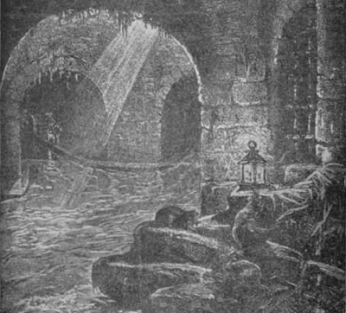
The toshers’ work was dangerous, however, and–after 1840, when it was made illegal to enter the sewer network without express permission, and a £5 reward was offered to anyone who informed on them–it was also secretive, done mostly at night by lantern light. “They won’t let us in to work the shores,” one sewer-hunter complained, “as there’s a little danger. They fears as how we’ll get suffocated, but they don’t care if we get starved!”

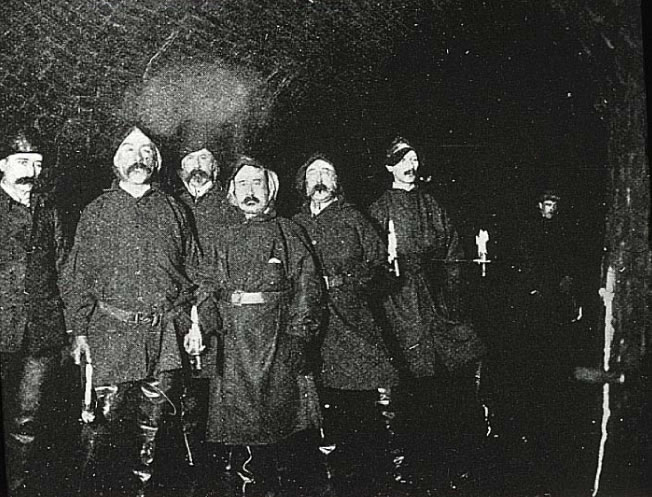
Quite how the members of the profession kept their work a secret is something of a puzzle, for Mayhew makes it clear that their dress was highly distinctive. “These toshers,” he wrote,

“may be seen, especially on the Surrey side of the Thames, habited in long greasy velveteen coats, furnished with pockets of vast capacity, and their nether limbs encased in dirty canvas trousers, and any old slops of shoes… [They] provide themselves, in addition, with a canvas apron, which they tie round them, and a dark lantern similar to a policeman’s; this they strap before them on the right breast, in such a manner that on removing the shade, the bull’s eye throws the light straight forward when they are in an erect position… but when they stoop, it throws the light directly under them so that they can distinctly see any object at their feet. They carry a bag on their back, and in their left hand a pole about seven or eight feet long, one one end of which there is a large iron hoe.”

This hoe was the vital tool of the sewer hunters’ trade. On the river, it sometimes saved their lives, for “should they, as often happens, even to the most experienced, sink in some quagmire, they immediately throw out the long pole armed with the hoe, and with it seizing hold of any object within reach, are thereby enabled to draw themselves out.” In the sewers, the hoe was invaluable for digging into the accumulated muck in search of the buried scraps that could be cleaned and sold.

Knowing where to find the most valuable pieces of detritus was vital, and most toshers worked in gangs of three or four, led by a veteran who was frequently somewhere between 60 and 80 years old. These men knew the secret locations of the cracks that lay submerged beneath the surface of the sewer-waters, and it was there that cash frequently lodged. “Sometimes,” Mayhew wrote, “they dive their arm down to the elbow in the mud and filth and bring up shillings, sixpences, half-crowns, and occasionally half-sovereigns and sovereigns. They always find these the coins standing edge uppermost between the bricks in the bottom, where the mortar has been worn away.”

Life beneath London’s streets might have been surprisingly lucrative for the experienced sewer-hunter, but the city authorities had a point: It was also tough, and survival required detailed knowledge of its many hazards. There were, for example, sluices that were raised at low tide, releasing a tidal wave of effluent-filled water into the lower sewers, enough to drown or dash to pieces the unwary. Conversely, toshers who wandered too far into the endless maze of passages risked being trapped by a rising tide, which poured in through outlets along the shoreline and filled the main sewers to the roof twice daily.

Yet the work was not was unhealthy, or so the sewer-hunters themselves believed. The men that Mayhew met were strong, robust and even florid in complexion, often surprisingly long-lived–thanks, perhaps, to immune systems that grew used to working flat out–and adamantly convinced that the stench that they encountered in the tunnels “contributes in a variety of ways to their general health.” They were more likely, the writer thought, to catch some disease in the slums they lived in, the largest and most overcrowded of which was off Rosemary Lane, on the poorer south side of the river.

“Access is gained to this court through a dark narrow entrance, scarcely wider than a doorway, running beneath the first floor of one of the houses in the adjoining street. The court itself is about 50 yards long, and not more than three yards wide, surrounded by lofty wooden houses, with jutting abutments in many upper storeys that almost exclude the light, and give them the appearance of being about to tumble down upon the heads of the intruder. The court is densely inhabited…. My informant, when the noise had ceased, explained the matter as follows: “You see, sir, there’s more than thirty houses in this here court, and there’s no less than eight rooms in every house; now there’s nine or ten people in some of the rooms, I knows, but just say four in every room and calculate what that there comes to.” I did, and found it, to my surprise, to be 960. “Well,” continued my informant, chuckling and rubbing his hands in evident delight at the result, “you may as well just tack a couple of hundred on to the tail o’ them for makeweight, as we’re not werry pertikler about a hundred or two one way or the other in these here places.”

No trace has yet been found of the sewer-hunters prior to Mayhew’s encounter with them, but there is no reason to suppose that the profession was not an ancient one. London had possessed a sewage system since Roman times, and some chaotic medieval construction work was regulated by Henry VIII’s Bill of Sewers, issued in 1531. The Bill established eight different groups of commissioners and charged them with keeping the tunnels in their district in good repair, though since each remained responsible for only one part of the city, the arrangement guaranteed that the proliferating sewer network would be built to no uniform standard and recorded on no single map.

Thus it was never possible to state with any certainty exactly how extensive the labrynth under London was. Contemporary estimates ran as high as 13,000 miles; most of these tunnels, of course, were far too small for the toshers to entert, but there were at least 360 major sewers, bricked in the 17th century. Mayhew noted that these tunnels averaged a height of 3 feet 9 inches, and since 540 miles of the network was formally surveyed in the 1870s it does not seem too much to suggest that perhaps a thousand miles of tunnel was actually navigable to a determined man. The network was certainly sufficient to ensure that hundreds of miles of uncharted tunnel remained unknown to even the most experienced among the toshers.

It is hardly surprising, in these circumstances, that legends proliferated among the men who made a living in the tunnels. Mayhew recorded one of the most remarkable bits of folklore common among the toshers: that a “race of wild hogs” inhabited the sewers under Hampstead, in the far north of the city. This story­–a precursor of the tales of “alligators in the sewers” heard in New York a century later–suggested that a pregnant sow by some accident got down the sewer through an opening, and, wandering away from the spot, littered and reared her offspring in the drain; feeding on the offal and garbage washed into it continually. Here, it is alleged, the breed multiplied exceedingly, and have become almost as ferocious as they are numerous.

Thankfully, the same legend explained, the black swine that proliferated under Hampstead were incapable of traversing the tunnels to emerge by the Thames; the construction of the sewer network obliged them to cross Fleet Ditch–a bricked-over river–“and as it is the obstinate nature of a pig to swim against the stream, the wild hogs of the sewers invariably work their way back to their original quarters, and are thus never to be seen.”

A second myth, far more eagerly believed, told of the existence (Jacqueline Simpson and Jennifer Westwood record) “of a mysterious, luck-bringing Queen Rat”:

This was a supernatural creature whose true appearance was that of a rat; she would follow the toshers about, invisibly, as they worked, and when she saw one that she fancied she would turn into a sexy-looking woman and accost him. If he gave her a night to remember, she would give him luck in his work; he would be sure to find plenty of money and valuables. He would not necessarily guess who she was, for though the Queen Rat did have certain peculiarities in her human form (her eyes reflected light like an animal’s, and she had claws on her toes), he probably would not notice them while making love in some dark corner. But if he did suspect, and talked about her, his luck would change at once; he might well drown, or meet with some horrible accident.

One such tradition was handed down in the family of a tosher named Jerry Sweetly, who died in 1890, and finally published more than a century later. According to this family legend, Sweetly had encountered the Queen Rat in a pub. They drank until midnight, went to a dance, “and then the girl led him to a rag warehouse to make love.” Bitten deeply on the neck (the Queen Rat often did this to her lovers, marking them so no other rat would harm them), Sweetly lashed out, causing the girl to vanish and reappear as a gigantic rat up in the rafters. From this vantage point, she told the boy: “You’ll get your luck, tosher, but you haven’t done paying me for it yet!”

Offending the Queen Rat had serious consequences for Sweetly, the same tradition ran. His first wife died in childbirth, his second on the river, crushed between a barge and the wharf. But, as promised by legend, the tosher’s children were all lucky, and once in every generation in the Sweetly family a female child was born with mismatched eyes–one blue, the other grey, the color of the river.

Queen Rats and mythical sewer-pigs were not the only dangers confronting the toshers, of course. Many of the tunnels they worked in were crumbling and dilapidated–“the bricks of the Mayfair sewer,” Peter Ackroyd says, “were said to be as rotten as gingerbread; you could have scooped them out with a spoon”–and they sometimes collapsed, entombing the unwary sewer hunters who disturbed them. Pockets of suffocating and explosive gases such as “sulphurated hydrogen” were also common, and no tosher could avoid frequent contact with all manner of human waste. The endlessly inquisitive Mayhew recorded that the “deposit” found in the sewers

“has been found to comprise all the ingredients from the gas works, and several chemical and mineral manufactories; dead dogs, cats, kittens, and rats; offal from the slaughter houses, sometimes even including the entrails of the animals; street pavement dirt of every variety; vegetable refuse, stable-dung; the refuse of pig-styes; night-soil; ashes; rotten mortar and rubbish of different kinds.”

That the sewers of mid-19th-century London were foul is beyond question; it was widely agreed, Michelle Allen says, that the tunnels were “volcanoes of filth; gorged veins of putridity; ready to explode at any moment in a whirlwind of foul gas, and poison all those whom they failed to smother.” Yet this, the toshers themselves insisted, did not mean that working conditions under London were entirely intolerable. The sewers, in fact, had worked fairly efficiently for many years–not least because, until 1815, they were required to do little more than carry off the rains that fell in the streets. Before that date, the city’s latrines discharged into cesspits, not the sewer network, and even when the laws were changed, it took some years for the excrement to build up.

By the late 1840s, though, London’s sewers were deteriorating sharply, and the Thames itself, which received their untreated discharges, was effectively dead. By then it was the dumping-ground for 150 million tons of waste each year, and in hot weather the stench became intolerable; the city owes its present sewage network to the “Great Stink of London,” the infamous product of a lengthy summer spell of hot, still weather in 1858 that produced a miasma so oppressive that Parliament had to be evacuated. The need for a solution became so obvious that the engineer Joseph Bazalgette–soon to be Sir Joseph, a grateful nation’s thanks for his ingenious solution to the problem–was employed to modernize the sewers. Bazalgette’s idea was to build a whole new system of super-sewers that ran along the edge of the river, intercepted the existing network before it could discharge its contents, and carried them out past the eastern edge of the city to be processed in new treatment plants.

Even after the tunnels deteriorated and they became increasingly dangerous, though, what a tosher feared more than anything else was not death by suffocation or explosion, but attacks by rats. The bite of a sewer rat was a serious business, as another of Mayhew’s informants, Jack Black–the “Rat and Mole Destroyer to Her Majesty”–explained.”When the bite is a bad one,” Black said, “it festers and forms a hard core in the ulcer, which throbs very much indeed. This core is as big as a boiled fish’s eye, and as hard as stone. I generally cuts the bite out clean with a lancet and squeezes…. I’ve been bitten nearly everywhere, even where I can’t name to you, sir.”

There were many stories, Henry Mayhew concluded, of toshers’ encounters with such rats, and of them “slaying thousands… in their struggle for life,” but most ended badly. Unless he was in company, so that the rats dared not attack, the sewer-hunter was doomed. He would fight on, using his hoe, “till at last the swarms of the savage things overpowered him.” Then he would go down fighting, his body torn to pieces and the tattered remains submerged in untreated sewage, until, a few days later, it became just another example of the detritus of the tunnels, drifting toward the Thames and its inevitable discovery by another gang of toshers–who would find the remains of their late colleague “picked to the very bones.”

Read more: http://blogs.smithsonianmag.com/history/2012/06/quite-likely-the-worst-job-ever/#ixzz2JgTnkQ9U
Follow us: @SmithsonianMag on Twitter

Miami 4th grader wins science fair with drug sniffing dogs and ounce of cocaine

dog

When fourth-grader Emma Bartelt wanted to wow the judges at her elementary school’s science fair, she knew she had to do something unexpected.

All she needed was a box, a jar, three dogs … and an ounce of cocaine.

These days, vinegar and baking soda is so passé.

In what Miami-Dade school district officials are calling a first, Emma tapped her connections with Miami-Dade police to show how a dog’s sense of smell helps it find narcotics.

“The student’s science project involved a very unusual set of circumstances, including having a parent who is a well-respected police detective with experience in training dogs that sniff for illegal substances,” school district spokesman John Schuster said in statement.

Earlier this month, Miami-Dade police Det. Douglas Bartelt and his colleagues let Emma sit in while they put three drug sniffing canines through a search exercise at their narcotics training facility. There was Roger, a springer spaniel; Levi, a golden retriever; and Franky, a retired chocolate Labrador.

The dogs were individually timed as they searched for 28 grams of cocaine — worth an estimated $1,300 on the street — locked in a metal canister, hidden in a box somewhere in a single room. The exercise was then repeated in a second room.

In the end, Franky came out first, sniffing out the cocaine in 43 seconds. At no time did Emma handle the drugs or the dogs, a Police Department spokeswoman said.

Cocaine is not specifically banned from use in district science fair rules, the Miami Herald reported.

The project earned Emma first prize at her school, Coral Gables Preparatory Academy, and a chance to participate in the county science fair at Miami Dade College on Jan. 26. She received an honorable mention there, district officials said.

Emma explained “the purpose of this scientific investigation was to find which dog would find the cocaine fastest using its sense of smell,” according to the Herald.

http://www.latimes.com/health/boostershots/la-sci-sn-student-cocaine-science-fair-20130131,0,1052960.story